Early premarket gappers
- Gapping up:
- FREY +11.1%, AVID +9%, GAMB +6.5%, HEI +3.5%, NMMC +2%, DOLE +2%, BIDU +1.8%, FSLR +1.6%, SNY +1.5%, MMM +1.5%, FFIE +1.4%, HAE +1.3%, PLAB +1.1%, WNC +1%
- Gapping down:
- SGMO -3.8%, BIG -2.2%, AX -2%, HLX -0.7%
Iran Sends First Shipment of Combat Drones to Russia
Moscow is expected to use the weapons on the Ukrainian battlefield, U.S. officials say
Iran has shipped its first plane loads of combat drones to Russia, part of a deepening plan between the two countries for Moscow to use the weapons against Ukrainian forces, U.S. officials said Tuesday.
Biden administration officials said Russian cargo planes have flown at least two kinds of Iranian drones to Russia that the U.S. expects Moscow to use in Ukraine to carry out missile strikes, surveillance and electronic warfare.
The U.S. expects Tehran to deliver hundreds of drones to Russia as Moscow tries to counter the flow of military support that the U.S. and its allies are giving to Kyiv. Ukrainian forces have launched a major counteroffensive in an effort to reclaim territory in southern Ukraine that Russian seized early in the war.
The delivery underscores how Iran has emerged as one of the world’s most prolific purveyors of drone technology, which has helped its allies in Yemen, Iraq, Syria and Lebanon, U.S. and Israeli officials have said.
>>> Up
>>> Down
* BW LPG Cut to Hold at Pareto Securities; PT 73 kroner
* Carrefour Cut to Neutral at JPMorgan; PT 20.50 euros
* H&M Cut to Hold at Handelsbanken
* Kingspan Cut to Hold at Jefferies; PT 63.60 euros
* Molecular Partners Cut to Sector Perform at RBC
* Petrobras ADRs Cut to Market Perform at Itau BBA; PT $14.50
* S Immo Cut to Hold at SRC Research; PT 23 euros
>>> Initiation
* Dufry Rated New Buy at HSBC; PT 47.50 Swiss francs
>>> Call
* H&M Downgraded at Handelsbanken With Tough Quarters Seen Ahead
* Kingspan Cut to Hold at Jefferies on Continued Near-Term Risks
* Zantac Settlement Likely to Be Below $10 Billion, Barclays Says
Lina Khan’s Merger Metaverse
The FTC Chair is using a discredited theory to block a Meta acquisition.
Give Federal Trade Commission Chair Lina Khan props for legal invention. Her agency’s lawsuit to block Facebook-parent Meta from acquiring Within Unlimited, the virtual-reality app developer, creates an antitrust metaverse worthy of Doctor Strange.
CEO Mark Zuckerberg has sought to expand in the burgeoning virtual reality (VR) market as Facebook’s user growth has slowed. The company now boasts the best-selling VR headset and some of the most popular apps, many of which it has acquired. While most VR users are video-gamers, Meta wants to broaden the market with fitness workouts.
Last year Meta announced plans to acquire Within, the studio behind the popular VR fitness app Supernatural that offers guided workouts in exotic locations. “Fitness is the killer use case for VR,” says Within CEO Chris Milk.
Enter the FTC’s three Democratic commissioners, who overruled career staff and voted to bring a lawsuit to block the acquisition under the Clayton Act. The FTC wants to constrain Meta’s VR ambitions while setting a regulatory precedent that will create new antitrust uncertainty and discourage acquisitions across the U.S. economy. Meta’s acquisition “poses a reasonable likelihood of substantially lessening competition in the market for VR dedicated fitness apps,” the lawsuit says.
But how can the acquisition reduce competition when Meta doesn’t own any fitness apps, and Supernatural has plenty of competitors even by the FTC’s admission? According to the suit, Meta’s music and rhythm app Beat Saber competes with Supernatural because they both involve people moving around in space and burning calories. Seriously?
Perhaps even Ms. Khan realizes this theory of competition stretches law and logic, so the lawsuit offers another argument. Lo, Meta could use its current profits to develop its own fitness app or add fitness features to its existing apps, which would “have the effect of substantially deconcentrating and increasing competition in the market.”
This argument is based on a discredited antitrust theory known as “potential competition,” which concedes that merging parties don’t actually compete against each other but could do so. This theory was used to attack conglomerate mergers a half century ago before its illogic and bad economics were taken apart by Phil Areeda and other antitrust scholars. Their work influenced judges who have looked on the theory with disfavor.
But Ms. Khan is undaunted and relies on an even more extreme version known as “actual potential competition.” This holds that a merger is illegal not because the buyer is already competing in the market but because the buyer should have entered the market on its own to provide more competition.
Under current antitrust precedent, the FTC would have to prove that the VR fitness market is highly concentrated; that Meta probably would have entered the market and its entry would have pro-competitive effects; and there are few other firms capable of doing so.
Failing to demonstrate any of these things, the FTC shifts the burden to Meta to prove that it wouldn’t seek to develop its own fitness app if it doesn’t acquire Within. It’s impossible to prove this negative, as Ms. Khan knows. Meta doesn’t have to prove this under existing antitrust doctrine, so Ms. Khan is trying to rewrite antitrust law via litigation.
Though the lawsuit doesn’t say so explicitly, it’s clear the FTC is trying to prevent Meta from using acquisitions to expand its leading position in VR. Never mind that Apple and Alphabet are moving fast into VR with even deeper pockets. Acquisitions can also represent an economically efficient allocation of capital. But Ms. Khan thinks Meta should have been barred from buying Instagram and WhatsApp, and she doesn’t want it getting bigger. She’d prefer to break up Meta instead.
Venture capitalists often fund startups on the hope that they will be bought by larger companies. Ms. Khan is setting down the marker that the FTC can block acquisitions merely to prevent big companies from getting bigger, even if they don’t reduce competition or harm consumers. This will chill investment and innovation, and it deserves a burial in court.
New York Yankees and LA fund join investors in AC Milan
Announcement comes as US group RedBird prepares to close acquisition of Italian football club
The New York Yankees baseball franchise and a Los Angeles investment fund are investing in AC Milan alongside US private equity group RedBird, which is closing in on the €1.2bn acquisition of Italy’s football champions, two people with direct knowledge of the matter said.
The baseball team, owned by the Steinbrenner family, and Main Street Advisors, the LA-based fund that counts among its investors basketball star LeBron James, famed music producer Jimmy Iovine and rapper Drake, will become shareholders in the Serie A team, those people said.
RedBird is set to announce the entry of its new partners as early as Wednesday when it is expected to officially take control of the club from its current owner, US hedge fund Elliott Management, those people said.
The deal, orchestrated by RedBird’s founder Gerry Cardinale, highlights the continued appetite among US investors to buy into the world’s favourite sport and particularly teams in Italy’s top-flight league.
The Yankees are among the biggest brands in sport, with a Major League Baseball-record 27 World Series championships. The team has been owned by the Steinbrenner family since 1973 when late patriarch George paid $8.8mn for the franchise, which is now valued at $6bn by Forbes.
The Yankees are co-owners, with Manchester’s City Football Group, of the New York City FC franchise of US-based Major League Soccer.
Cardinale has worked with the New York Yankees for decades, including during his years at Goldman Sachs, which advised and was an early investor in the formation of the team’s regional sports channel, the YES Network.
The Yankees will work closely with AC Milan as Cardinale tries to increase the Italian club’s revenues and on-field successes, people familiar with the matter said. Part of the collaboration could include AC Milan programming on the YES Network, a regional sports network owned by a consortium of the Yankees club, Amazon, RedBird and Sinclair Broadcast Group.
Cardinale’s existing business network of high-profile athletes and celebrities helped facilitate the deal with Main Street, said people briefed on the matter. James, Iovine and Drake are passive investors in Milan through the fund and have not taken direct stakes, two people said.
James, a four-time National Basketball Association champion, and business partner Maverick Carter have an existing relationship with Cardinale. RedBird is a shareholder in the pair’s media group, SpringHill, and each already own minority stakes in Fenway Sports Group, which controls Liverpool Football Club and the Boston Red Sox.
Cardinale, who agreed to take over Milan in May, sees the northern Italian team as a “sleeping giant” and wants to build on an Elliott turnround project that restored the club to the lucrative Uefa Champions League tournament and captured its first league since 2011 title last season.
Elliott agreed to lend RedBird €600mn to help fund the takeover. With interest charged at 7 per cent, Cardinale had spent the summer talking to potential co-investors aiming to slash the size of the loan. It is unclear how much of the club the Yankees and Main Street will own.
RedBird’s sports investments also include French football club Toulouse FC and a 15 per cent stake in the Rajasthan Royals, one of 10 cricket franchises in the Indian Premier League, which has become an economic powerhouse in the sport.
After Hours Summary: Quiet session after hours; HEI trades flat on earnings; AVID +9.8% pops as it will join S&P SmallCap 600; LCID -1.1% lower on mixed shelfAfter Hours Gainers:
Companies trading higher in after hours in reaction to earnings/guidance: GAMB +10.3%
Companies trading higher in after hours in reaction to news: AVID +9.8% (to join S&P SmallCap 600), DDI +4.1% (IGT and DDI settle lawsuit), NMMC +2.1% (terminates previously announced merger with Corcentric), HAE +1.3% (announces deal with Epic to offer its SafeTrace Tx blood bank info to Epic's network of hospitals), HLX +0.7% (acquires JV controlled by Murphy Exploration), LMT +0.2% (awarded a $503 mln US Navy order), IGT +0.1% (IGT and DDI settle lawsuit)
After Hours Losers:
Companies trading lower in after hours in reaction to earnings/guidance: HEI -0.04%
Companies trading lower in after hours in reaction to news: LCID -1.1% (files for $8 bln mixed securities shelf offering; also stock offering related to warrants), ZEN -0.1% (confirms it received unsolicited proposal from Light Street Capital)
Europe Plans "Emergency Intervention" In Power Market As All Hell Breaks Loose
With even Zoltan Pozsar warning that Europe faces an apocalypse of sorts now that the Eurussia divorce is complete and energy prices in Europe are hitting fresh daily record highs every single day - just today, German 1Year forward baseload electricity rose above €1000, or 10x where they were a year ago, before easing after European nat gas prices plunged the most since March after Germany said its gas stores are filling up faster than planned ahead of winter...
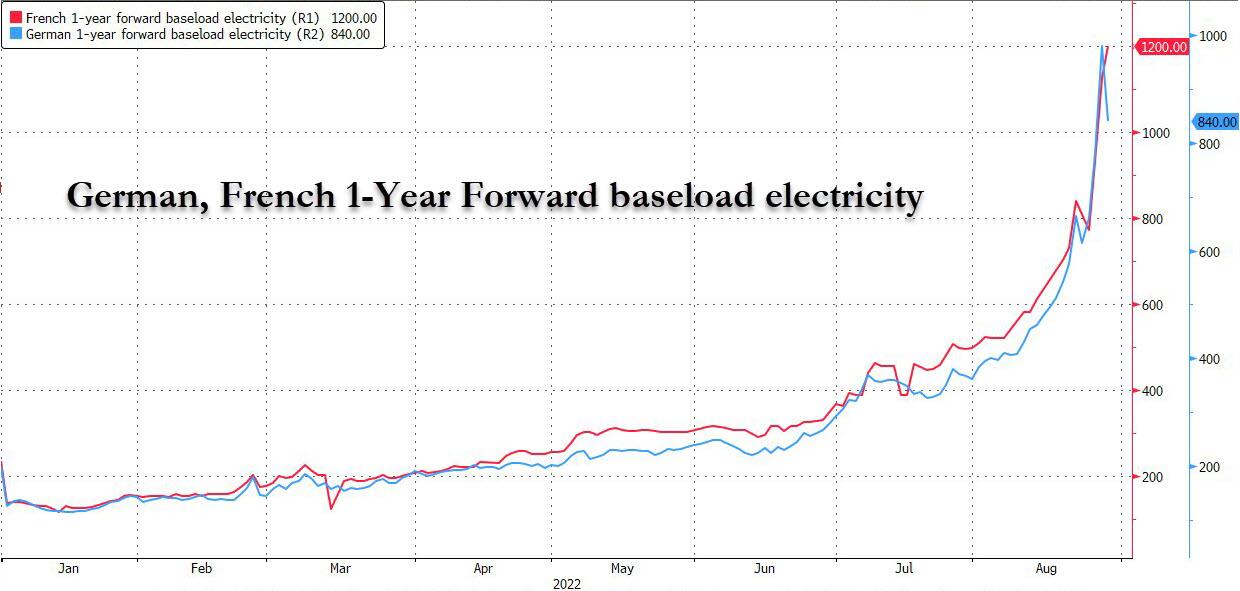
... moments ago the European Union appears to have finally realized that it faces an armed revolt this winter, or worse, when millions face freezing cold without power and heat (see "This Is Beyond Imagination": Polish Homeowners Line Up For Days To Buy Coal Ahead Of Winter"), and announced that it was planning "urgent steps" to push down soaring power prices, Commission President Ursula von der Leyen said on Monday.
"The skyrocketing electricity prices are now exposing, for different reasons, the limitations of our current electricity market design,” von der Leyen said in a speech at the Bled Strategic Summit in Slovenia, pointing out what has been obvious for years to those who warned repeatedly that Europe should probably not take make its energy policy based on the idiotic ravings of a self-absorbed, petulant, Scandinavian teenager. “It was developed under completely different circumstances and completely different purposes.”
Ah yes, it's the "circumstances and purposes" that are at fault, not Europe's catastrophic "green" push over the past decade that left the continent at the mercy of Putin, very much as one Donald J Trump warned would happen... and speaking of Putin, maybe Europe can impose a few more self-destructive sanctions on Russian energy exports. But we digress...
Ursula then added “that’s why we are now working on an emergency intervention and a structural reform of the electricity market", one which would look roughly like this.

The unprecedented spike in power prices, which have soared almost 10-fold in the past year, has fueled inflation, increased the economic burden on businesses and households recovering from the pandemic, and forced the ECB to aggressively hike rate in hopes of crushing demand into what is now a definite recession if not a depression. One could say that Putin couldn't have planned his revenge on Europe better.
According to Bloomberg, more and more member states are calling for a price cap and the Czech Republic, which holds the rotating presidency of the EU, plans to convene an extraordinary meeting of energy ministers on Sept. 9.
In other words, while the ECB plans to crush demand with tighter monetary conditions, European governments will ease demand and inject fiscal stimulus to avoid an angry mob descending on various local parliaments.
Of course, being a harebrained European "plan" which doesn't make any sense - just like anything else out of Europe - the exact details of an EU intervention plan are still being developed, and EU diplomats said the EU’s executive arm could offer a detailed plan as soon as this week. Don't hold your breath: after all, absent a massive ECB-funded stimulus - the proceeds of which will immediately go to Putin - unless Europe has somehow found brand new deposits of nat gas which are immediately accessible and don't require tens of billions and years of development to be extracted, what Europe is doing is just the latest jawboning.
With Russia squeezing gas deliveries, power-plant outages further sapping supply, while droughts and lack of wind make a mockery of "green" energy sources, the pressure is growing on EU leaders to act quickly or risk social unrest and political upheaval. Czech Prime Minister Petr Fiala is seeking backing for his price-cap plan and plans to discuss possible limits with German Chancellor Olaf Scholz.
“High energy prices are a Europe-wide problem that we need to tackle at European level,” Fiala said on his Twitter account. “Ahead of the EU Energy Council we want to find a way to help people and businesses that we can agree on with other European leaders.”
Czech officials are proposing to cap prices of natural gas used for power generation, Industry and Trade Minister Jozef Sikela said on Monday.
“We may open the question of emission allowances, as some other member states have done in past, that also present a major part of the total price,” Sikela said. “We may open the question of the overall market regulation, total decoupling of the prices,” adding that the bloc cannot meddle too much with the market or fuel speculation.
Amusingly, EU member states have already earmarked about 280 billion euros (or roughly the same in USD now that we are at parity) in measures such as tax cuts and subsidies to ease the pain of surging energy prices for businesses and consumers, but the aid risks being dwarfed by the scale of the crisis. In other words, the ECB will be hiking rates even as it has to inject even more liquidity into the market to enable the latest helicopter money stimulus. Governments have also started to limit energy use, banning outside lighting for buildings in Germany and lowering indoor heating temperatures, to meet the EU voluntary target of cutting gas demand by 15%.
On Saturday, Belgian Prime Minister Alexander De Croo warned that the EU can’t continue resolving the problem of sky-rocketing energy costs by cutting taxes and called for a price cap instead. Should the bloc fail to reach an agreement, Belgium will consider national measures, he told VTM television.
France last week reacted skeptically to the idea of setting limits on power prices, saying its situation is different from other European countries thanks to government measures offering protection against inflation.
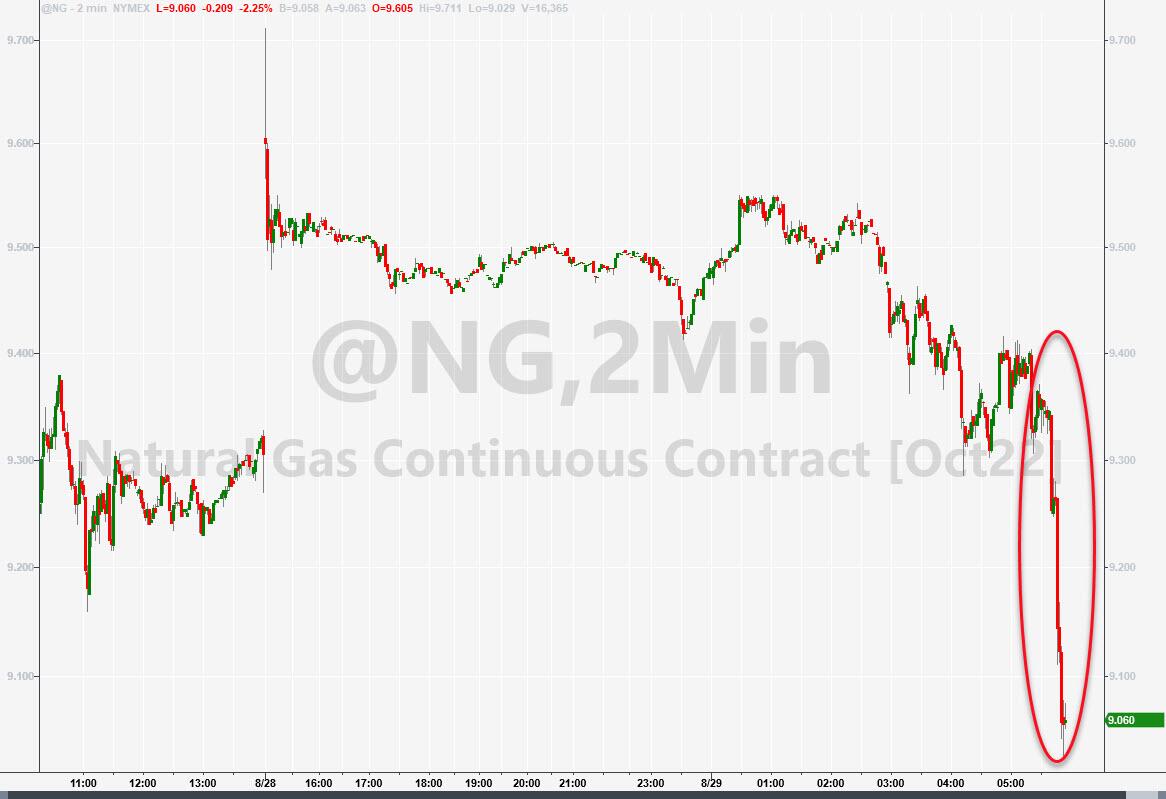
In kneejerk response, some European commodity prices dipped from all time highs, while US nat gas dipped to session lows amid expectations Europe's "energy emergency" could mean fewer Us LNG exports. We doubt that, and in fact expect that Europe will double down begging for every last drop of US, Canadian, Qatari LNG it can find.