Research Calls
- Upgrades:
- Apple Hospitality REIT (APLE) upgraded to Equal Weight from Underweight at Wells Fargo; tgt raised to $17
- AstraZeneca (AZN) upgraded to Buy from Hold at Argus; tgt $75
- Envista (NVST) upgraded to Overweight from Neutral at Piper Sandler; tgt raised to $46
- Host Hotels (HST) upgraded to Overweight from Equal Weight at Wells Fargo; tgt raised to $21
- Park Hotels & Resorts (PK) upgraded to Overweight from Equal Weight at Wells Fargo; tgt lowered to $17
- Downgrades:
- Aerie Pharma (AERI) downgraded to Neutral from Buy at Citigroup; tgt raised to $15.25
- Avalara (AVLR) downgraded to Mkt Perform from Mkt Outperform at JMP Securities
- Choice Hotels (CHH) downgraded to Underweight from Equal Weight at Wells Fargo; tgt lowered to $123
- Cooper (COO) downgraded to Sector Weight from Overweight at KeyBanc Capital Markets
- Diamondrock Hospitality (DRH) downgraded to Equal Weight from Overweight at Wells Fargo; tgt lowered to $10
- Dow (DOW) downgraded to Underweight from Sector Weight at KeyBanc Capital Markets; tgt $45
- Hain Celestial (HAIN) downgraded to Equal Weight from Overweight at Consumer Edge Research; tgt $23
- Hersha Hospitality Trust (HT) downgraded to Equal Weight from Overweight at Wells Fargo; tgt lowered to $11.50
- Life Storage (LSI) downgraded to In-line from Outperform at Evercore ISI; tgt lowered to $138
- LyondellBasell (LYB) downgraded to Underweight from Sector Weight at KeyBanc Capital Markets; tgt $73
- Molecular Partners AG (MOLN) downgraded to Mkt Perform from Outperform at SVB Leerink; tgt lowered to $8
- Pebblebrook Hotel Trust (PEB) downgraded to Equal Weight from Overweight at Wells Fargo; tgt lowered to $20
- Sonova (SONVY) downgraded to Hold from Buy at Deutsche Bank
- Westlake Corporation (WLK) downgraded to Underweight from Sector Weight at KeyBanc Capital Markets; tgt $90
- Others:
- Battalion Oil Corp. (BATL) initiated with a Buy at ROTH Capital; tgt $28
- Deciphera Pharmaceuticals (DCPH) initiated with an Outperform at Cowen; tgt $25
- Denny's (DENN) initiated with a Buy at CL King; tgt $14
- Frontier Group Holdings (ULCC) resumed with a Buy at Citigroup; tgt $20
- IGM Biosciences (IGMS) initiated with a Buy at BofA Securities; tgt $34
- Millicom International Cellular (TIGO) initiated with a Neutral at UBS; tgt $16.50
- Mondee Holdings (MOND) initiated with an Overweight at Cantor Fitzgerald; tgt $15
- Vigil Neuroscience (VIGL) initiated with a Buy at H.C. Wainwright; tgt $24
- Vivid Seats (SEAT) initiated with a Sector Perform at RBC Capital Mkts; tgt $10.50
- Xenon Pharmaceuticals (XENE) initiated with a Buy at BofA Securities; tgt $45
Gapping down
In reaction to earnings/guidance:
- CTLT -9.7%, SLQT -8.3%
Select index ETFs showing early weakness:
- QQQ -1.3%, IWM -1.2%, SPY -1%, DIA -0.9%
Other news:
- GTES -3.8% (files mixed securities shelf offering; also files for 178,587,591 share common stock offering by selling shareholders)
- FLEX -2.7% (receives shareholder approval to purchase up to 20% of its shares, board has authorized management to continue its share repurchase plan in an amount not to exceed $1 bln)
- DWAC -2.2% (experiencing financial problems, according to Washington Post)
- NVDA -1.9% (Cautious Barrons article)
- ALB -1.6% (concludes strategic review of Catalysts business; will retain under a separate, to-be-named entity and wholly owned subsidiary of Albemarle)
- KNSL -1.1% (files mixed securities shelf offering)
Analyst comments:
- DOW -2.5% (downgraded to Underweight from Sector Weight at KeyBanc Capital Markets)
- DRH -1.8% (downgraded to Equal Weight from Overweight at Wells Fargo)
- CHH -1.4% (downgraded to Underweight from Equal Weight at Wells Fargo)
- PEB -0.9% (downgraded to Equal Weight from Overweight at Wells Fargo)
Gapping up
In reaction to earnings/guidance:
- PDD +15%
Other news:
- HIL +20% (Hill International and GISI announce enhancements to their strategic merger agreement)
- NOTE +11.3% (files for 87,504,863 share common stock offering, relates to warrants)
- CTKB +2.9% (files mixed securities shelf offering)
- LYRA +1.7% (to Present Additional LANTERN Phase 2 Study Results for LYR-210 in Two Oral Presentations at ARS Annual Meeting)
- VXX +1.5% (trading higher with US futures under pressure)
- AMPY +0.7% (settles with U.S. Attorney's Office to resolve matters associated with Southern California pipeline incident)
Analyst comments:
- DCPH +1% (initiated with an Outperform at Cowen)
Early premarket gappers
- Gapping up:
- HIL +17.5%, AMPY +4.3%, NOTE +3.7%, VXX +3.5%, CTKB +1.8%
- Gapping down:
- GTES -3.8%, DWAC -3%, FLEX -2.7%, NVDA -1.3%, KNSL -1.1%, QQQ -1.1%, IWM -1.1%, SPY -0.9%, DIA -0.8%
Texas Crypto Miners Ask To Use As Much Power As All Of New York State
Texas officials have been urging crypto currency-miners to move their operations to the Lone Star State. The campaign is working so well that applications for power hook-ups are piling up to a level far above what state power authorities estimated just four months ago.
According to a new report from Bloomberg, miners have asked the Electric Reliability Council of Texas (ERCOT) to use up to 33 gigawatts of electricity over the next decade, a draw that's a third larger than what ERCOT's CEO estimated in April. To put that in perspective, 33 gigawatts would be enough to power all of New York state.
After suffering through disastrous power outages that factored into a 246-person death toll during a bitterly cold storm in Feb 2021, Texans couldn't be blamed for wringing their hands a little over the prospect of miners seeking so much energy.
An ERCOT spokeswoman assured Bloomberg that the organization expects to have sufficient output to meet surging demand. The stakes are high: Unlike other states that can lean on neighbors in times of stress, Texas operates its own, independent electric grid that makes most of the state an electricity island unto itself.

The Texas campaign to woo crypto miners has centered on the state's friendlier regulatory climate, cheap electricity and substantial renewable-energy sources. Per kilowatt-hour, commercial customers pay about a third less than the national average.
"It also has more wind power than any other state, which is appealing to miners pushing to appear more environmentally friendly," write's Bloomberg's Naureen S Malik.
Miners claim they're ideal power customers, ready to devour excess wind and solar energy when it's abundant, but also flexible enough to shut down when the grid is under strain.
That flexibility can pay off big: In July, Riot Blockchain collected a stunning $9.5 million in credits for shutting down its Texas mining rigs as the state faced a historic heat wave and energy was at a premium.
"By reducing power consumption by 21% last month, Riot got ERCOT to pay 100% of its electricity bill. So even though the company created fewer bitcoins in July, the company made about $7 million more than it would have if it had not curtailed its operations," reported the Houston Chronicle.
Is The Food Crisis Over Or Just Getting Started?
Are you hungry? Good, according to the central planners.

The folks over at the UN stopped destroying the world for a brief few minutes to publish a piece (snapshot below) justifying their behavior and explaining the “benefits” of the famine they’ve engineered.
Not making this up.
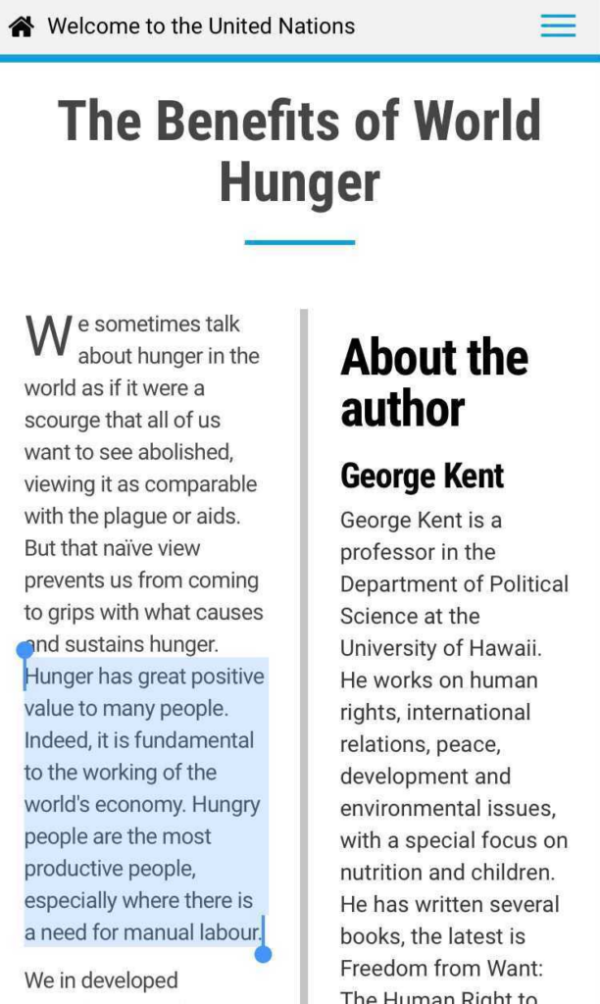
The article remained on the UN website for a day or so before being deleted after it went viral on social media, with people horrified at the truly unbelievable evil. The good thing about this is that as they continue with their predictive programming and NLP (seriously, look into both and it promises to blow your mind), more and more people wake from their trance. Once woken, they realize the incredible danger they are all in. And that is a good thing because you can’t fight an enemy until you understand one exists.
The “great reset” requires a populace beholden to the government and nobody else. As the central planners pursue their agenda of getting there, this is bound to be fraught with an awakening and a lot of angst.
The Great Awakening of the Average Joe
While Joe Sixpack doesn’t understand most of these, he doesn’t actually need to.
What Joe does care about is when he can’t afford groceries and when his electricity bill now suddenly wipes out his entire annual disposable income.
And that is enough to provide both pushback and an increasing ability to awaken to the horrors of what comes for him if this communist agenda masquerading as a plan to “save us from climate change” is NOT stopped in its tracks.
And with this realization will come politicians — many who themselves are parasites but doing what comes naturally to them: sensing a shift in the winds and rushing to get in front of it, champion it, and gain support.
Here, take a look. According to France24, Giuseppe Conte, the head of Five Star, said:
I have a strong fear that September will be a time when many families will face the terrible choice of paying their electricity bills or buying food. We are absolutely willing to dialogue, to make our constructive contribution to the government, to Draghi, (but) we are not willing to write a blank cheque.
He’s not wrong, of course, but this is a thug who was a massive contributor to the problems our proverbial “Joe” now faces.
Take a look at this.
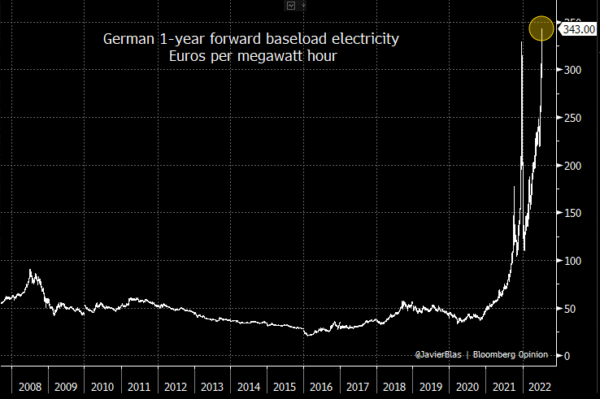
And as we’ve been continuously saying: energy underpins EVERYTHING. Which is why Eurozone CPI looks like it just mainlined viagra.
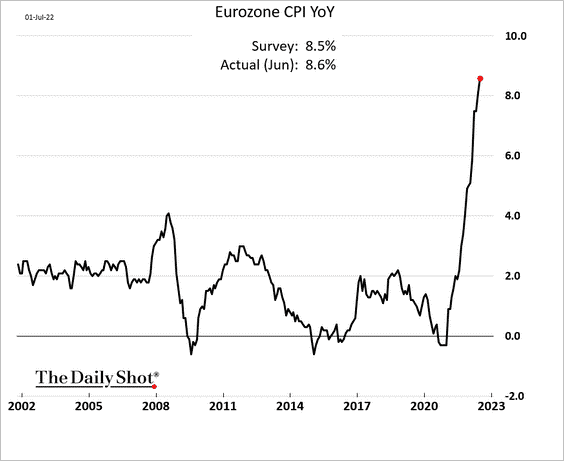
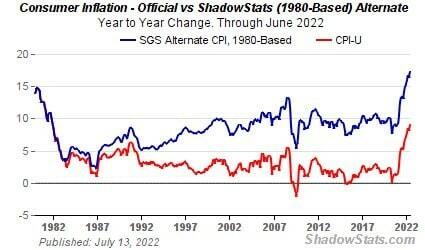
And this is saying something because as you know the way they measure CPI is, of course, complete hogwash and roughly half the real rate. Check out John Williams’ Shadowstats, where inflation in the US is calculated based on the methodology used back in the 80’s (pre-fraud). It just hit 17.3%. That’s a tad more than the 9.1% print they just tried to trick you with.
The other thing “Joe” cares about is when the government — under the guise of “saving the planet” — begins the process of stealing up to 50% of the farms in the Netherlands.
Reducing Nitrogen Emissions
Under a ridiculous narrative of “reducing nitrogen omissions” the Dutch government are proceeding with a blatant land grab of 30% of the Farmland. It is worth pointing out that air is 78% nitrogen. These morons have literally decided that air is dangerous.
Anyway, the farmers are having none of it and have blockaded roads, airports, and distribution centers. The fishermen have joined in and blocked the ports.
Domestically the Dutch farmers have massive support. Gratefully, people seem to intuitively understand that without them there will be no food. The propaganda is no longer having the desired effect on the populace. What a shame!
Every day a few more people wake to reality, and once you wake, you can’t unsee what you’ve seen. The existing political parties’ credibility is severely damaged. I’ve thought for some years now that if there is to be a shift, it will likely come from third parties. This is true across the Western world, and not uniquely a Dutch thing.
The Farmer–Citizen Movement in the Netherlands is now gaining momentum and size faster than any other.
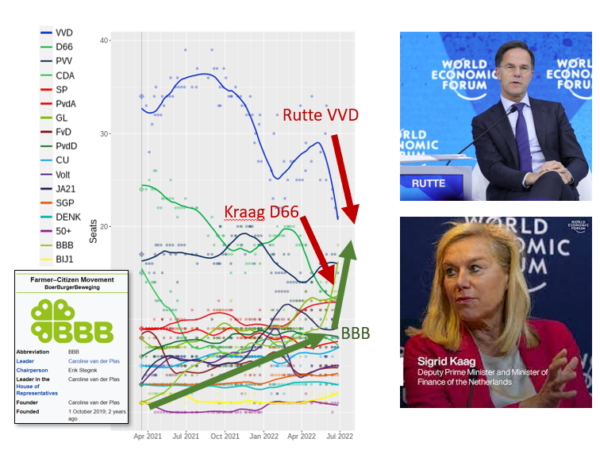
Over in France, the Marxist agenda gathers momentum.
France plans full nationalization of power utility EDF
France will fully nationalise EDF (EDF.PA), Prime Minister Elisabeth Borne said on Wednesday, in a move that would give the government more control over a restructuring of the debt-laden group while contending with a European energy crisis.

It is at this point that we should review a little history.
The last head of a European government to be killed and eaten by a mob was Dutch Johan de Witt in 1672, who was mutilated, hung, and had his liver roasted and digested by Orangists in the Hague.

Davos man deserves at least as much.
In the meantime, Europeans are going to be cold and hungry. Winter is just a few short months away now which brings us to investment implications. The stampede will begin in earnest for food and all those banned products like fertilizer.
* * *
Disturbing economic, political, and social trends are already in motion and now accelerating at breathtaking speed. Most troubling of all, they cannot be stopped. The risks that lie ahead are too big and dangerous to ignore. That’s why contrarian money manager Chris Macintosh just released the most critical report on these trends, What Happens Next. This free special report explains precisely what’s coming down the pike and what it means for your wealth and well-being. Click here to access it now.
China’s Property Slowdown Sends Bank Shares Tumbling
Fears of a weakening economy hit a pair of once high-flying bank stocks
HONG KONG—Shares in China’s privately run banks have fallen sharply this year, as the country’s property slowdown starts to bite.
The Shanghai-listed shares of China Merchants Bank and Ping An Bank Co. —two of China’s biggest, most prominent privately run lenders—have fallen by 32% and 25%, respectively, since the start of 2022, wiping $68 billion off their combined stock market value.
The selloff is just the latest indication of the problems a slowdown in the property sector is having on the wider economy. A two-year deleveraging campaign has damaged Chinese property companies, bringing on a liquidity crunch that has led to defaults among developers, the suspension of ongoing building projects and a big drop in new home sales. It has also fueled a boycott among some home buyers who are refusing to repay their mortgages.
That is bad news for Chinese banks, but the impact for China Merchants Bank and Ping An Bank will be worse than for the biggest state-owned lenders, said Kenny Ng, a securities strategist at Everbright Securities International. Declines in real-estate asset values will slow their mortgage business and hurt the wealth management products that the two banks have sold to their clients, some of which have included exposure to property developers’ debt, he said.
The shares of China Merchants Bank and Ping An Bank have easily outperformed the country’s big state-owned banks over the last five years, in part because the duo was flexible enough to tap new sources of wealth in a fast-growing economy, including making big bets on digital banking to boost their retail businesses. But analysts warn the privately run commercial banks will have more difficulty finding new sources of business in China’s slowing economy.
“The biggest problem the Chinese economy is facing is not liquidity,” Mr. Ng said. “Banks have enough liquidity, but consumers or investors don’t want to borrow from banks to spend or invest. This shows a lack of confidence.”
China’s “big four” state-owned banks— Agricultural Bank of China, Bank of China, China Construction Bank Corp. and Industrial & Commercial Bank of China Ltd. —have done much better in the stock market this year, bucking a long-term trend. They have fallen by an average of 4.9% since the start of the year, versus a 17% decline for the CSI 300 index of the largest stocks listed in Shanghai or Shenzhen.
This is partly because the giant state-run lenders have lower exposure to the property sector. Real-estate companies represent just 4% to 5% of their total loans, while China Merchants Bank and Ping An Bank have 7.2% and 9.4%, respectively, of their lending tied up in property, according to Macquarie.
But another key reason is that as China’s economy struggles, state-owned banks can find more alternatives to offering loans to developers. They can shift their lending from mortgages to big infrastructure loans, which private commercial banks will find hard to follow, said Vincent Chan, a China strategist at Aletheia Capital.
Privately-run banks are already trading more like state-owned ones according to their price-to-book ratios, a measure of how expensive shares are relative to a firm’s net worth. Since bank earnings can be volatile, investors and analysts often use the price-to-book ratio as a way to compare bank stocks.
At the end of 2021, China Merchants Bank and Ping An Bank were trading at forward price-to-book ratios of 1.49 and 0.88, respectively. Those numbers had fallen to around 0.92 and 0.61 by Aug. 26, according to FactSet. That is still a substantial premium to the big four, which are all trading at below 0.50.
“How much longer will the gap continue to close before stabilizing?” said Mr. Chan. “I believe if the Chinese economy stays where it is now, the joint-stock banks will struggle to perform for a long period of time.”
Joint-stock banks in China are run with a more widespread shareholding structure than the state-owned banks. The term includes privately-run lenders such as China Merchants Bank and Ping An Bank but also includes other institutions where the government holds a controlling interest.
Not everyone is so down on these firms. Elizabeth Kwik, an investment director of Asian equities at abrdn, said the commercial banks still have advantages over the state-owned goliaths that deserve to be reflected in their stock prices.
“Commercial banks tend to be better run with more of a focus on returns and profitability [and] they tend to have more say on their strategic direction,” she said. “So in our view that still makes them higher quality banks on the whole and over the longer term.”
She added, however, that China’s strict zero-Covid policy would provide some near-term pain for the privately run banks, since they are more exposed to retail activity than the state-owned lenders.
Ping An Bank said the impact of the property downturn on its retail business was small and manageable. The bank said it still saw big growth in the wealth management business, although it added that it had made efforts to decrease its offerings of some products. Ping An said it remained bullish on China’s economy, which still had “huge market potential and will see a resurgence in economic growth after the epidemic eases.”
China Merchants Bank didn’t respond to a request for comment.
Deal for Office Space Near Big U.S. Cities Bets on Suburban Lifestyle, Remote Work
GIC, Workspace Property Trust buying majority stake in 53 suburban office buildings
One of the world’s biggest sovereign-wealth funds and its U.S. partner are buying a majority stake in 53 suburban office buildings in a deal valuing the properties at $1.1 billion, a major bet that remote work will boost demand for workplaces close to residential areas.
Singapore’s GIC Pte. Ltd. is investing in the buildings alongside Workspace Property Trust, a privately held commercial real-estate firm based in Boca Raton, Fla., according to a person familiar with the matter. The deal will nearly double Workspace’s holdings to around 18 million square feet. Many of the newly acquired buildings are clustered around Atlanta, Dallas and the San Francisco Bay Area.
The suburban office sector has been hit hard by the pandemic. Vacancy rates rose in 2020 and 2021, and some properties have lost so much value that developers are tearing them down to build warehouses or apartments.
Workspace and GIC are betting that demand will rise for higher-end, modern suburban offices in good locations as more companies seek out areas closer to where their employees live. More Americans are working from home at least part of the week, and some firms are looking to add spaces that would allow their workers to return to the office without having to commute far.
“We believe the pandemic really accelerated the shift to suburban offices,” said Workspace’s co-founder and chief executive, Thomas Rizk.
Suburban office properties recently have suffered less than some central business districts, where vacancies are at record levels. In the second quarter, the U.S. downtown office vacancy rate surpassed the suburban vacancy rate for the first time in decades, according to CBRE Group Inc. Vacancies fell slightly to 16.8% in the suburbs and rose to 17% in city centers, the brokerage firm said.
While many suburban office buildings are obsolete, big financial firms are still willing to invest in fully occupied, higher-end properties, said Jordan Roeschlaub, co-head of Newmark Group’s debt, equity and structured finance group, which brokered the mortgage funding the purchase.
Mr. Rizk said suburban office vacancies are kept high by older buildings in poor locations. Modern properties that are close to residential areas, shops and restaurants are seeing rising rents, he said.
When Workspace launched in 2015, it was difficult to raise money for suburban office purchases, Mr. Rizk said. At the time, many corporations were ditching their sprawling, leafy office parks and moving into cities, and investors were more interested in buying office towers in places such as Manhattan or downtown San Francisco.
But since the start of the pandemic, the sector has attracted some new money. Last year, Workspace landed a $326.5 million investment from Oak Hill Advisors’ real-estate unit.
JPMorgan Chase & Co. and Bank of Montreal are financing the deal, which closed on Friday. The seller, Griffin Realty Trust Inc., is keeping a minority stake in the buildings.