FT : Pearson now a ‘growth stock’ as it bids to be digital-first education group

Pearson now a ‘growth stock’ as it bids to be digital-first education group
Publisher seeks to expand in life-long learning sector after years of disappointing returns

Pearson’s chief executive has said it is becoming a “growth stock” as the publisher seeks to turn itself into a digital-first company that is a “one-stop shop” for life-long education. 

Two years after he took the helm at Pearson, former Disney executive Andy Bird said the company was positioned to defy economic headwinds by offering investors the “real sales and real profits and real cash flows” of its longstanding business, combined with innovations in the fast-growing life-long learning sector. 

The comments restate Bird’s ambitious vision for Pearson, which he said has the potential to “rewrite how everything is done” in education by offering consumers and employers more accessible, technology-enabled methods of training. After years of disappointing returns, however, the company must cope with a flagging higher education market and stiff competition in the workforce training sector, where it has only a tentative foothold.

“I think you’ve seen Pearson move from being a value stock to being perceived as and seen as a growth stock,” Bird said in an interview with the Financial Times. “We’re attracting different investor classes. The message is starting to resonate that we are more than an educational textbook publisher.”

Pearson is among best performing FTSE 100 stocks this year, at 904p a share after rising 50 per cent. However the increase is from a low base, with Pearson issuing seven profit warnings in as many years before Bird took over.

In the past year the company has launched an online subscription service, Pearson+, where students can access all its textbooks as well as videos, social platforms and partner services for $14.99 a month.

It also hopes to move further into the workforce training market. This year it acquired Credly, a service that stores and verifies work accreditation, and Faethm, a company that assesses companies’ skills needs. 

Bird said Pearson would capitalise on the “expansion of the definition of higher education” as more employers looked to upskill their workforces and learners sought alternatives to university. 

He quoted from a recent conversation that he said captured a shift to more jobs-focused learning offering opportunities beyond the traditional university: “There used to be higher education. There’s now hire education.”

Some commentators remain sceptical about the company’s ability to turn itself round, noting Pearson’s workforce-skills division remains small and faces stiff competition from more established companies such as 2U and Coursera. “In workforce solutions they are so far behind — they don’t really have anything,” said one analyst who declined to be named.

While sales in the workplace-training division increased 6 per cent, the business accounted for just 7 per cent of total sales, according to interim results this year. Higher education, in comparison, was 21 per cent and assessments and qualifications 39 per cent. The relatively modest workforce skills division may struggle to make up for losses in the higher education unit, where sales fell 4 per cent.

As inflation rises and borrowing costs increase, Bird said the company would need to grapple with a period of “free money” coming to an end. “There’s going to be a more discerning use of capital,” he said. But he insisted that Pearson remained attractive, including to Silicon Valley investors.

A spokesperson said one-fifth of the company stock was now held by US shareholders, up from 10 per cent two years ago.

Miss Tweed : AP Series-1: Tensions among the watchmaker’s shareholders


From: Laurent Chekroun (MAKOR CAPITAL MARKET) At: 10/09/22 16:24:10 UTC+2:00
Subject: Miss Tweed : AP Series-1: Tensions among the watchmaker’s shareholders
AP Series-1: Tensions among the watchmaker’s shareholders
By Astrid Wendlandt
09/10/22
Audemars Piguet
Audemars Piguet (AP) is one of the biggest success stories in luxury watches of the last decade. Founded in 1875, AP is the last historical watchmaker of its size still in the hands of its founding families. However, this may not last forever as some of its minority shareholders are exploring a possible sale of their holdings, Miss Tweed has learned. In a few years, LVMH could end up being the ultimate owner, sources with first-hand knowledge of the matter said.

AP has never been stronger in terms of cachet, sales and profitability. It commands the highest premiums on the second-hand market, together with Rolex, Patek Philippe and Richard Mille. Now is the best time to cash in, some shareholders believe, as the brand is at a crossroads. Its longstanding CEO, François-Henry Bennahmias, is due to leave next year and a replacement has not yet been found, industry sources said.

Jasmine Audemars resigned in August after nearly 30 years as chairman of the board. The 82-year-old guardian of the temple was replaced by ex-Tiffany boss Alessandro Bogliolo, a choice that surprised many including Bennahmias himself, sources close to the company said. Bogliolo’s specialty is not watches. He has experience managing luxury brands and selling them at the highest price possible. The Italian businessman did a good job securing the sale of Tiffany to LVMH in 2020, pocketing more than $40 million in the process.

Bogliolo, who is due to start on Nov. 11, was not hired by AP not to steer the watchmaker -- he is not planning to move to Switzerland anytime soon -- but to help some of its minority shareholders monetize their stake, sources with first-hand knowledge of the matter said. Bogliolo is AP’s first chairman since the 1940s who is not a member of either founding family, Audemars or Piguet. This fact was confirmed by the company itself.

One person upset with the nomination of Bogliolo is Olivier Audemars, vice president of the board, several sources close to him and the company said. Knowing the Italian’s reputation for selling luxury businesses, he feels the company has let the wolf into the sheep pen. Olivier Audemars is not at all interested in letting go of his stake.

Olivier Audemars, 62, has two daughters under 21 who are not yet ready to pick up the mantle but they may wish to someday. Olivier Audemars is in fact a Piguet, his mother having married an Audemars who had nothing to do with the watchmaker. Olivier Audemars did not reply to Miss Tweed’s request for comment.

Jasmine Audemars and her sister Yveline, who partly lives in Canada, are AP’s biggest shareholders, with a stake of more than 30 percent, sources close to the company said. As neither have heirs, their stakes will go to the Audemars Piguet Foundation, which supports environmental projects. What will happen to Jasmine Audemars’ voting rights after she resigns as chairman of the board next month remains to be seen. The answer to that question will be critical to AP’s future. The company has declined to comment for this report.

CROSSROADS
Since AP is at its peak, the question is: Where does it go from here? Famous for its bestselling Royal Oak timepieces, AP is now roughly the size of Patek Philippe, according to Swiss broker Vontobel. The two luxury watchmakers are behind Rolex, which is king, and then Omega and Cartier in terms of turnover. AP is expected to make some 1.8 billion Swiss francs in sales this year versus 1.6 billion in 2021. Unlike Patek, which mainly sells through distributors, AP sells principally through its own boutiques. The difference in their business models makes it difficult to compare the two.

AP has the brand power to overtake Patek Philippe and propel itself into an even bigger league. But do its shareholders want that? Jasmine Audemars and Olivier Audemars favor letting the company grow naturally, without any external boost, sources close to the company say. They never expected it to become as big as it has done, and with their conservative, patrimonial views, they have always said they want AP to remain independent and family-owned.

“I never imagined that we would pass the billion mark when I took over as chairman of the board of directors,” Jasmine Audemars told Le Temps newspaper when she announced her departure in August. Back then, in 1994, the company made sales of 90 million Swiss francs, she said. “We are a family business, totally independent. We don't want to be dependent on analysts making crazy projections, which then influence stock values. We want to live our lives as we see fit and we are ready to face tougher times. That's how it was with our predecessors and it will be the same with our successors.”

But some of the company’s other shareholders think differently; they believe AP has the potential for much more growth.

This year, the brand will produce some 50,000 watches, up from 45,000 in 2021, having abandoned an earlier self-imposed limit of 40,000. AP is spending hundreds of millions of euros on a new production site, which is due to bring under one roof many of its different suppliers – just as former sister brand Jaeger-LeCoultre did a few years ago. Once the new production site is up and running in 2024, production at full capacity could reach 70,000 timepieces by 2025.

In the next five to ten years, AP could decide to raise that number to 100,000 or even 200,000. That would require significant investment, which not every AP shareholder is keen to make. So now is a good time to sell and let in a new investor. This view is shared by Oliviero Bottinelli, a member of AP’s board who runs the brand’s business in Asia, several sources close to the company say.

Oliviero Bottinelli’s influence over AP’s affairs and power within the board has grown, they said. His father, Pierangelo, a former investment banker, inherited a stake in the company after helping Audemars Piguet survive financial difficulties a few decades ago. “It would indeed appear that the Bottinellis’ voice has become louder,” one of the sources said. It was the Bottinellis who pushed the choice of Bogliolo on Jasmine and Olivier Audemars, the sources added.

Another key AP family shareholder is Singapore’s Sunil Amarasuriya, whose daughter Shanya, 31, replaced him on the board this year. Shanya, known for having strong opinions about AP’s future and sharing them with the board, now sits on AP’s audit and investment committees.

The Amarasuriya family owns the B.P. de Silva group of companies, with interests in watch distribution, jewelry, tea and other areas. In the 1970s, it was AP’s main distributor in Singapore. The family later gave up its distribution partnership in exchange for a stake in AP. Together with the Bottinellis, the Amarasuriyas are mulling a sale of their stake, several sources said. But it seems financial advisers have not yet been appointed.

Another small stakeholder is Steven Petruzzello, son of Irène LeCoultre of the watchmakers of the same name. His position is unclear. Unlike the Bottinellis and the Amarasuryias, he’s got watchmaking in his blood, which may incline him to hold onto his stake. Last century, Jaeger-LeCoultre and Audemars Piguet shared suppliers and even developed some movements together. AP used to own 40 percent of Jaeger-LeCoultre. But in 2000, it lost a bidding war to Richemont and the Geneva-based group now owns the brand.

FIRST RIGHT OF REFUSAL
All of AP’s five shareholders have first right of refusal if one or several wish to sell all or part of their stakes. Industry sources estimate that the Amarasuriyas and Bottinellis together own over 20 percent of Audemars Piguet. Using the company’s projected revenue estimate for next year of close to 2 billion Swiss francs, industry analysts estimate AP is worth at least 6-7 billion Swiss francs. For argument’s sake, 20 percent of that amount would be some 1.2 billion Swiss francs, which at today’s exchange rate is €1.24 billion.

That is a sizeable sum for Jasmine Audemars, Olivier Audemars and Steven Petruzzello to find if they want to buy out the other two shareholders. But they have several options.

One would be for the company itself, i.e. Audemars Piguet, to take on debt and buy their stake to keep any external investor out. The three shareholders wanting to preserve the company’s independence would probably favor this. But in light of the major investments AP needs to make in the future, this plan might not be easy to realize. As the global economy worsens, the credit market is expected to tighten further. Interest rates will go up, raising the cost of borrowing.

Another option would be to invite Rolex to chip in. The industry leader is one of the most profitable companies in Switzerland and it belongs to a foundation, making it impregnable. But that might not be simple either. Rolex is happy to remain a stand-alone company, industry sources say. It has enough on its plate producing an estimated one million watches a year while maintaining quality.

LVMH
The likeliest external investor is LVMH. The French group has made no secret of its wish to acquire a major watchmaker to complete its stable of “hard luxury” brands. Since ownership has been transferred to the younger generation at independent brands Patek Philippe and Richard Mille, Audemars Piguet is the last big target available.

Selling to LVMH may be the last thing Steven Petruzzello, Oliver and Jasmine Audemars want but it could happen at some point, industry insiders predict. “I think LVMH will do anything it can to buy Audemars Piguet,” one senior executive at the group said on condition of anonymity. The group owns TAG Heuer, Zenith and Hublot but these brands are much smaller than AP.

Taking on AP would put LVMH in the big league. Already strong in jewelry with Tiffany, Bulgari and Chaumet, it could grow even larger than the current watch and jewelry industry leader Richemont, owner of jewelers Cartier and Van Cleef & Arpels and watch brands Vacheron Constantin, IWC and Panerai.

Richemont is unlikely to make a move on Audemars Piguet but you never know. LVMH appears more motivated. The French group’s watches and jewelry division made nearly €9 billion in sales in 2021 while Richemont generated more than €11 billion from jewelry and €3.4 billion from watches in the fiscal year to March 31, 2022. That’s €14.4 billion in revenue in total from “hard luxury” brands.

When it comes to hunting, don’t forget that patience is one of the prime qualities of Bernard Arnault, CEO and controlling shareholder of LVMH. Arnault may be satisfied with a minority stake to begin with but after a while, he starts surreptitiously creating discord and turning the shareholders against each other. Eventually, they grow desperate and throw in the towel. That’s how Arnault buys them out.

Every family has weaknesses and baggage and the 73-year-old tycoon is a past master at exploiting them. He played that game at Hermès, pitting different clans of the family against each other, although after some time family shareholders united against him. Arnault takes a very long-term view. This is partly why LVMH is so successful and highly valued.

Arnault has big ambitions for the group’s watch and jewelry division. It is no coincidence that the three sons from his second marriage work there now. Alexandre, 30, the eldest, is No. 2 at Tiffany, in charge of products and communication. Fréderic, 27, runs TAG Heuer while the youngest Jean, 24, works for Louis Vuitton watches and is involved in many areas from strategy to marketing.

Earlier this year, to mark the 20th anniversary of the Tambour model, Jean Arnault helped Louis Vuitton hire its first ambassador for watches, the American actor Bradley Cooper. Jean Arnault is also working on resuscitating Daniel Roth, a forgotten watch brand LVMH inherited when it acquired Bulgari in 2011, Business Montres and Handelszeitung reported.

Watchmaking is very much on the minds of the Arnault family, and Audemars Piguet in particular is in their sights.

FT : The deal that showed Musk how hard it would be to exit Twitter bid

The deal that showed Musk how hard it would be to exit Twitter bid
US court ruling over generic drugmaker Akorn set high bar for any bidder seeking to withdraw from a takeover offer

It turns out that once-disgraced generic drugmaker Akorn will, most likely, remain a unicorn in Delaware law.

The company was the hapless star of a court battle that set an important legal benchmark for US mergers and acquisitions after German healthcare group Fresenius Kabi signed a $4bn deal to buy it in 2016.

Two years after that agreement, a Delaware state court allowed Fresenius to walk away from the deal. It is the first and last time in the state’s history that a buyer was allowed to terminate a merger agreement over a so-called “material adverse effect”, a degradation of a target company so grave that a buyer would not get the company they bargained for.

The decision has been pored over in recent months by many a lawyer to see if would provide an escape hatch for Elon Musk to dissolve his $44bn deal to buy Twitter.

Before suddenly indicating last week that he wanted to complete the buyout on the original terms, Musk had apparently been wavering on the deal, with the Tesla boss questioning Twitter over allegedly fake accounts, violations of government orders and false securities filings.

But the Akorn case shows how hard it would be for Musk, or any corporate acquirer in similar circumstances, to walk away. A key lesson of the Delaware decision is to not just examine the deterioration of a selling company but also how a buyer acts in the process of first trying to close and then terminating a deal.

Such conduct is crucial as a buyer seeking termination cannot first be in breach of their own obligations. The judge in the Akorn case ruled that Fresenius, by in large, carefully did its part to close the initial transaction and not breach its own obligations to do so, something Musk may not be able to match.

Musk’s erratic actions since signing the Twitter deal in April include trashing the company’s management in his tweets as well as seemingly trying to slow-walk the closing, according to disclosed texts and tweets. These alone would do him no favours in any trial.

Even last week, Twitter said in a filing that a deposition witness testified on Thursday that Musk still had not fully commenced the process of drawing on the committed debt financing even as he insisted days before that he now wanted to close.

There are other substantive differences between the Twitter and Akorn battles. After Fresenius and Akorn announced their deal, a German company received anonymous correspondence. A whistleblower was alleging huge data integrity problems at Akorn’s manufacturing facilities. Fresenius was separately getting nervous about its deal as Akorn had badly missed its forecast for revenue and profits.

On the manufacturing problems, a subsequent lengthy investigation by Fresenius uncovered enough red flags — including submitting false data to the Food and Drug Administration — to motivate it to terminate the deal. According to the ruling, a consultant testified at the trial that “Akorn’s data integrity failures were so fundamental that he would not even expect to see them ‘at a company that made styrofoam cups’”.

The cost to remedy the problems— $900mn or a fifth of the deal value — was substantial enough that the judge let Fresenius escape even as Akorn argued that the German company had accepted the risk of operational problems.

As at Akorn, a whistleblower emerged at Twitter after Musk had signed his deal. The former head of security at the company, Peiter Zatko, alleged that Twitter had not been complying with government decrees on data security. Musk’s lawyers seized on the parallels to the Akorn case, writing in his filings, “[a]s in Akorn, Defendants [Musk] are entitled to investigate those allegations and others in Zatko’s complaint to verify the accuracy of representations”.

Twitter’s stock price has steadily moved up since Musk’s termination attempt in July, a decent indicator of the quality of his grievances. But his antics are also likely a part of the calculus that Musk will either lose in court or settle first.

Fresenius had hired lawyers to investigate their ability to exit Akorn. But the trial record showed that Fresenius had been careful to listen to its lawyers’ advice and make sure its own house was in order.

The Delaware court has said Musk has until October 28 to complete the deal or otherwise face a legal process that he suddenly decided he wanted to avoid. It is his best chance to show that he can live up to what he signed for.

FT : EU accelerates talks on lower gas prices from alternative suppliers

EU accelerates talks on lower gas prices from alternative suppliers
Energy commissioner Kadri Simson travels to Algeria today

If there was one area on which EU leaders concurred during last week’s informal summit in Prague, it was a fresh push for the bloc to hold talks with alternative gas suppliers to buy more quantities at lower prices.

One country in the spotlight this week is Algeria, with energy commissioner Kadri Simson heading there today and more talks scheduled for tomorrow. We will examine the stakes and pitfalls in strengthening ties with the north African authoritarian regime.

In Prague, energy ministers will gather again tomorrow and Wednesday for an informal council, with recriminations possibly flaring up again over the distortive impact of national support measures. We will bring you the latest on the commission’s thinking in changes to the bloc’s state aid rule book when it comes to energy-crisis related subsidies.

Separately, France’s electricity grid operator has reassured the UK that it will still be able to provide Britain with power at critical moments despite problems with French nuclear reactors that have forced a reliance on imports.

And in election news, Austria’s president Alexander Van der Bellen is on course to return to office for a second term, according to preliminary results last night. In Germany, elections in the state of Lower Saxony kept the ruling Social Democrats in pole position, a rare boost to the party of chancellor Olaf Scholz.

Courting Algeria
Europe’s urgent search for gas from anywhere other than Vladimir Putin’s regime is pushing it to strengthen ties with a different kind of partner — opaque, authoritarian Algeria, write Barney Jopson in Madrid and Sam Fleming in Brussels.

Kadri Simson, the EU’s energy commissioner, meets her Algerian counterpart in the north African country today as part of a charm offensive whose goal is to cement it as a “long-term strategic partner”, according to one EU official. This will be followed on Tuesday in Algiers by an Algeria-EU energy business forum attended by Simson, Algeria’s energy minister, and a host of company representatives.

Algeria’s status as a natural gas supplier to Europe is nothing new. Its gasfields are already connected to the continent by two pipelines that run to Spain and one going to Italy, as well as by liquefied natural gas tankers that criss-cross the Mediterranean.

Although Spain’s ties with Algeria have been under strain this year, the need to eliminate Russia’s energy leverage has lifted the country’s importance to another level, alongside other gas suppliers such as the US, Norway, Nigeria and Qatar.

The EU is Algeria’s biggest market for gas and Algeria accounts for 10-12 per cent of gas supplies to the EU. But the union sees potential for Algeria to do more to fill the vacuum being left by Russia, even though the bloc’s long-term goal is to diminish its gas consumption.

This year Eni, the Italian energy group, has announced two big new hydrocarbon discoveries in the country. In April, it struck a deal with Sonatrach, Algeria’s state-owned gas company, to increase gas supplies from the country. (The north African state has, meanwhile, become Italy’s number one gas supplier).

“The co-operation is going well on the energy side,” the EU official said.

Just last week, Spain’s gas importer Naturgy announced that it had reached agreement with Sonatrach on a periodic price review for contracts it signed more than 20 years ago. Reflecting record gas prices on the global market, the deal gives Sonatrach a higher price, applicable retroactively, for gas sold in 2022.

“Prices are going to go up,” said Francisco Reynés, Naturgy chief executive, but not by an “exorbitant ” amount.

For Algeria, whose hydrocarbon industry has suffered from a lack of investment, high prices and the growing overseas appetite for gas are welcome. Algeria has been a difficult place for international oil and gas companies to work in and many have stayed away. The companies already there such as Eni and Total are the exception.

This year has also given Spain a sobering reminder that Algeria can be an unpredictable partner for whom price is not the only consideration.

Madrid angered Algiers in March by announcing that it supported a Moroccan plan for the Western Sahara that would give the territory limited autonomy under Moroccan sovereignty. Algeria, Morocco’s neighbour and longtime rival, backs full independence for the region.

In the weeks after Spain’s move, Algeria suspended a 20-year-old friendship treaty with its European neighbour and banned trade in products and services with the country. It did nothing to disrupt gas flows through the Medgaz pipeline that connects Algeria to Almería in Spain, but already in autumn 2021, because of its worsening ties with Rabat, Algeria had stopped sending gas to Spain via the Maghreb-Europe pipeline that runs through Morocco.

As a result, the proportion of Spain’s gas imports from Algeria has declined from a high of more than 50 per cent last year to 20-25 per cent per month since April 2022, according to Enagás, Spain’s gas grid operator.

The EU plays down the damage, given that there is spare capacity in Medgaz and the Transmed pipeline via Tunisia and Sicily to mainland Italy, as well as the potential to send more LNG by sea. “We have not suffered in any way. Algeria is very reliable partner,” the official said.

Chart du jour: Russian counter-strikes

At least 20 people were killed and dozens were injured in the city of Zaporizhzhia which fell under renewed missile attacks from Russia in retaliation to the damage incurred by the 12-mile Crimea bridge on Friday. Here is the FT’s explainer on what might have caused the explosions.

Level playing field?
The European Commission expects energy prices to stay high for at least another year, judging by a draft of its amended state aid framework, writes Andy Bounds in Brussels.

The “temporary crisis framework” allows governments to help companies affected by the Russian invasion of Ukraine in February and is about to be tweaked for a second time since its introduction in March. (The first changes came in July.)

The biggest change this time is to allow governments to subsidise high energy costs for another year, until December 31 2023. That at least doubles the amount of support available.

Lifetime limits become annual limits and some maximum ceilings are increased, according to the proposal, which could still be amended before approval.

The €62,000 and €75,000 caps in the agriculture, and fisheries and aquaculture sectors, respectively, would become €93,000 and €112,500 annual caps.

Companies in other sectors could get up to €2mn annually and the most energy intensive industries receive €50mn a year.

Sectors such as fertiliser, aluminium and paper making have warned that rising fuel bills would put them out of business — and some factories have already stopped production temporarily.

Competition commissioner Margrethe Vestager has heeded some of their concerns. As well as the subsidies for rising power costs, they can now get support for the costs of heating and cooling directly produced from gas and electricity, such as powering furnaces, which accounts for the bulk of their consumption.

Furthermore, a ban on profitable companies claiming would be lifted. The beneficiary could have positive earnings but they would have to have fallen by either 50 or 60 per cent — the number is still being haggled over by officials. “That change is vital,” said one industry figure. “A company would do anything to avoid making losses. They would be bankrupt. So the state aid would come too late.”

State aid could come in many forms, including state guarantees to prevent companies having to sell to meet margin calls demanded by banks. Subsidised loans to help them service commercial debts are another tool.

The timeframe for allowing support to companies to switch to renewable forms of energy is extended by a year as well, from June 2023 to June 2024.

Vestager is aiming to publish the amended framework this month, with pressure growing after Germany announced a much-criticised €200bn plan to help consumers and businesses there.

Poland’s prime minister Mateusz Morawiecki last week accused Berlin of “destroying the single market” as its deeper pockets could help its companies survive while those in poorer countries go to the wall.

“The integrity of the internal market is important to withstand external pressure and to avoid subsidy races, where member states with deeper pockets can outspend neighbours to the detriment of cohesion within the union,” the commission document says.

However, the move to lift the total amount of aid eligible again favours richer countries and will increase the push by some capitals for a single pot of money. “We need a European solution,” said one diplomat.

Expect the debate to continue in the informal — and possibly impolite — meeting of energy ministers in Prague starting tomorrow.

(ZH) How The EU Is Forcing Twitter To Censor (And Musk Can't Stop It)

How The EU Is Forcing Twitter To Censor (And Musk Can't Stop It)

Twitter is obviously at the center of what is commonly known as “Big Tech censorship.” It has been busily using the censorship tools at its disposal – from removing or quarantining tweets to surreptitiously “deboosting” them (shadow-banning) to outright account suspension – for at least two years now. And those who have managed to remain on the platform will have noticed a sharp upturn in its censorship activities starting last summer.
For most of this time, the main focus of Twitter censorship has, of course, been supposed “Covid-19 disinformation.” By now, almost all the most influential advocates of early treatment or critics of Covid-19 vaccines on Twitter have had their accounts suspended, and most have not made it back.
The list of the permanently suspended includes such prominent voices as Robert Malone, Steve Kirsch, Daniel Horowitz, Nick Hudson, Anthony Hinton, Jessica Rose, Naomi Wolf, and, most recently, Peter McCullough.
And myriad smaller accounts have met the same fate for committing such thought crimes as suggesting that the myocarditis risk of both mRNA vaccines (Moderna and BioNTech/Pfizer) outstrips any benefit or pointing to mRNA instability and its unknown consequences for safety and efficacy.
But why in the world would Twitter censor such content? The expression “Big Tech censorship” implies that Twitter et al. are censoring of their own accord, which invariably elicits the retort that, well, they are private companies, so they can do what they want. But why would they want to?
The notion that it is because the denizens of Silicon Valley are “leftists” or “liberals” is clearly not very helpful. They may well be. But whether mRNA vaccines are safe and effective, as advertised, is a factual matter, not an ideological one. And, in any case, the purpose of private for-profit corporations is, needless to say, to make a profit. The motto of the shareholder is not “Workers of the World Unite!” but “Pecunia non olet:” money doesn’t stink. Shareholders expect management to create value, not destroy it.
But what Twitter is doing by censoring is precisely subverting its own business model, thus undermining profitability and putting downward pressure on share price. Free speech is obviously the lifeblood of every social media. Censored speech – like the tweets of a Robert Malone or a Peter McCullough or, for that matter, a Donald Trump – translates into lost traffic for the platform. And traffic is, of course, the key to monetizing unrestricted online content.
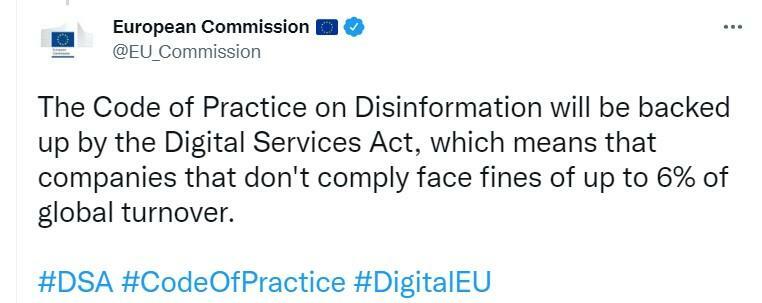
We could call this the “Twitter conundrum.” On the one hand, there is no way that Twitter could possibly “want” to censor Covid dissident voices, or indeed any voices, and thus restrict its own traffic. But, on the other hand, if it fails to do so, it risks incurring massive fines of up to 6% of turnover, which would likely represent a deathblow to a company that already has not turned a profit since 2019. Twitter, in effect, has a financial gun to its head: censor or else.
Wait, what? There has been much talk recently of the Biden administration exerting informal pressure on Twitter and other social media to censor unwelcome content and voices, and lawsuits have even been launched against the government for infringing the alleged victims’ 1st Amendment rights. But all that such pressure appears thus far to have consisted of are some chummy nudges in emails.
There has surely not been any threat of fines. How could there be without a law authorizing the executive branch to impose them? And such a law would be blatantly unconstitutional, since precisely what the 1st Amendment states concerning freedom of speech is that “Congress shall make no law…abridging” it.
But there’s the rub. Congress, needless to say, has not made any such law. But what if a foreign power made such a law and it de facto abridged the freedom of speech also of Americans?
Unbeknownst to most Americans, this has in fact occurred and their 1st Amendment rights are being vitiated, namely, by the European Union. There is a financial gun pointed at Twitter. But it is not the Biden administration, but rather the European Commission, under the leadership of Commission president Ursula von der Leyen, that has its finger on the trigger.
The law in question is the EU’s Digital Services Act (DSA), which was passed by the European Parliament last July 5 amidst almost total indifference – in Europe as much as in the United States – despite its momentous and disastrous implications for freedom of speech worldwide.
The DSA gives the European Commission the power to impose fines of up to 6% of global turnover on “very large online platforms or very large online search engines” that it finds to be non-compliant with its censorship requirements. “Very large” is defined as any platform or search engine that has over 45 million users in the EU. Note that while the size criterion is limited to users in the EU, the sanction is based precisely on the company’s global turnover.
The DSA has been designed to function in combination with the EU’s so-called Code of Practice on Disinformation: an ostensibly voluntary code for “combatting disinformation” – aka censoring – that was originally launched in 2018 and of which Twitter, Facebook/Meta and Google/YouTube are all signatories.
But with the passage of the DSA, the Code of Practice is evidently not so “voluntary” anymore. There is no need for complex legal analyses to show that the sanction provisions in the DSA are intended as the enforcement mechanism for the Code of Practice. The European Commission has said so itself – and in a tweet no less!
In fact, the Code has never really been all that voluntary. The Commission had already made its desire to “tame” the US tech giants known previously, and it had already flexed its muscles, imposing massive fines on Google and Facebook for other alleged offenses.
Moreover, it has been brandishing the threat of the DSA fines since December 2020, when it first put forward the DSA legislation. (In the European Union, the Commission, the EU’s executive branch, has sole authority to initiate legislation. Quaint American notions like the separation of powers are not a thing in the EU.) The eventual passage of the legislation by the parliament has always been treated as a mere formality. Indeed, the above-cited tweet was posted on June 16 of this year, three weeks before the parliament voted on the law!
Curiously, the publication of the draft legislation coincided with the authorization and subsequent rollout of the first Covid-19 vaccines in the EU: the legislation was unveiled on December 15 and the first Covid-19 vaccine, that of BioNTech and Pfizer, was authorized by the Commission just six days later. Vaccine skeptics or critics would quickly become the principal target of EU-driven online censorship thereafter.
Six months earlier, in June 2020, the Commission had already placed the focus of the Code firmly on alleged “Covid-19 disinformation” by launching a so-called Fighting COVID-19 Disinformation Monitoring Programme, in which all Code signatories were expected to participate. Some attempts had already been made at monitoring compliance with the Code, and signatories were expected to submit annual reports. But, as part of the Covid-19 monitoring program, signatories were now required – “voluntarily,” of course – to submit monthly reports to the Commission specifically dedicated to their Covid-19-related censorship efforts. The rhythm of submission was subsequently scaled back to bimonthly.
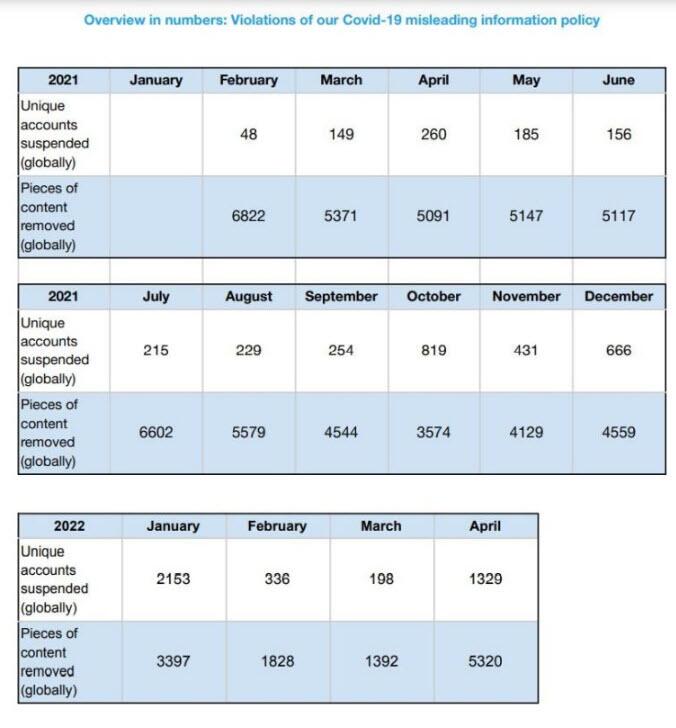
Twitter’s reports, for example, contain detailed statistics on Covid-related content removal and account suspensions. The below chart, showing the evolution of these numbers from February 2021 (shortly after vaccine rollout) through April 2022, is taken from Twitter’s latest available report from June of this year.
Note that the data concerns content removed and accounts suspended globally: i.e. Twitter’s efforts to satisfy the Commission’s censorship expectations do not only affect the accounts of users based in the EU, but of users all around the world.
The fact that many, if not most, of the accounts that have been suspended in this connection were written in English raises particularly troubling issues. In the aftermath of Brexit, after all, only around 1.5% of the EU’s population are native English speakers! Even supposing that policing speech was a good thing, what business does the EU have policing speech, or requiring social media platforms to police speech, in English, any more, say, than in Urdu or Arabic?
The Twitter report and those of other Code signatories can be downloaded here. If the numbers were to be continued, they would undoubtedly show a sharp upturn in censorship activities starting in late June/early July. Twitter users interested in the subject could not help but have noticed the massive purge of Covid dissident accounts that occurred over the summer.
And this upturn was in fact entirely to be expected, since on June 16 – the day the European Commission posted its warning to online platforms reproduced above and three weeks before the passage of the DSA – the Commission announced the adoption of a new, “strengthened” Code of Practice on Disinformation.
The timing was surely not coincidental. Rather, the adoption of the “strengthened” Code of Practice and the passage of the DSA served as a kind of one-two punch, putting “very large online platforms and search engines” – Twitter, Meta/Facebook and Google/YouTube, in particular – on notice about what would be in store for them if they failed to fulfill the EU’s censorship requirements.
Not only does the new Code contain no less than 44 “commitments” that signatories are expected to meet, but it also contains a deadline for meeting them: namely, six months after signature of the Code (cf. paragraph 1(o)). For original signatories of the new Code like Twitter, Meta and Google, this would bring us, namely to December. Hence, the sudden rush of Twitter et al. to prove their censorship bona fides.
The “strengthened” Code was supposedly written by the signatories themselves, but under extensive “guidance” from the European Commission that was first made available in May 2021. Chillingly, the Commission “guidance” refers to the kind of censorship data presented above as “key performance indicators” (pp. 21f). (Different euphemisms are used in the Code itself.)
As part of the new Code, moreover, signatories will participate in a “permanent task-force” chaired by the European Commission and that will also include “representatives of the European External Action Service,” i.e. the EU’s foreign service (Commitment 37).
Think about this for a moment. For the last several months, American commentators have been up in arms about occasional, informal contacts between social media companies and the Biden administration, whereas those same companies have been systematically reporting back to the European Commission on their censorship efforts for the last two years now and they will henceforth be part of a permanent task force on “combatting disinformation” – aka censoring — chaired by the European Commission.
While the former may or may not constitute collusion, the latter is obviously something much more than mere collusion. It is a matter of explicit EU policy and law that directly subordinates online platforms to the Commission’s censorship agenda and requires them to implement it on pain of ruinous fines.
Note that the DSA gives the Commission “exclusive” – in effect, dictatorial – powers to determine compliance and to apply sanction. For the online platforms, the Commission is judge, jury and executioner.
Again, there is no need to enter into the tortuous details of the legislative text to show this. All official EU pronouncements on the DSA highlight the fact. See here, for instance, from the parliament’s Internal Market Committee, which notes that the Commission will also be able to “inspect a platform’s premises and get access to its databases and algorithms.”
Does anyone really imagine that the Biden administration has anything remotely like this sort of capacity to direct the actions of online platforms? Make no mistake about it. Twitter censorship is government censorship. But the government in question is not the US government, but rather the European Union, and the EU is, in effect, imposing its censorship on the entire world.
Those hoping that Elon Musk’s buying Twitter, if it does indeed come to pass, will put an end to Twitter censorship are going to be in for a rude awakening. Elon Musk will be facing the same conundrum as Twitter’s present management and will be just as much hostage to the EU’s censorship requirements.
Lest there be any doubt about this, consider the below video, which, despite the forced smiles, has indeed something of the feel of a hostage video. In early May – just a couple of weeks after Twitter accepted Musk’s original purchase offer and, yet again, before the European parliament had even had the opportunity to vote on the DSA – the EU’s Internal Market Commissioner Thierry Breton traveled to Austin, Texas, to explain the “new regulation” to Musk.
Breton then memorialized Musk’s cringeworthy submission to the EU’s demands in the video posted on his Twitter feed.

Miss Tweed : AP Series-1: Tensions among the watchmaker’s shareholders

AP Series-1: Tensions among the watchmaker’s shareholders
By Astrid Wendlandt
09/10/22
Audemars Piguet
Audemars Piguet (AP) is one of the biggest success stories in luxury watches of the last decade. Founded in 1875, AP is the last historical watchmaker of its size still in the hands of its founding families. However, this may not last forever as some of its minority shareholders are exploring a possible sale of their holdings, Miss Tweed has learned. In a few years, LVMH could end up being the ultimate owner, sources with first-hand knowledge of the matter said.

AP has never been stronger in terms of cachet, sales and profitability. It commands the highest premiums on the second-hand market, together with Rolex, Patek Philippe and Richard Mille. Now is the best time to cash in, some shareholders believe, as the brand is at a crossroads. Its longstanding CEO, François-Henry Bennahmias, is due to leave next year and a replacement has not yet been found, industry sources said.

Jasmine Audemars resigned in August after nearly 30 years as chairman of the board. The 82-year-old guardian of the temple was replaced by ex-Tiffany boss Alessandro Bogliolo, a choice that surprised many including Bennahmias himself, sources close to the company said. Bogliolo’s specialty is not watches. He has experience managing luxury brands and selling them at the highest price possible. The Italian businessman did a good job securing the sale of Tiffany to LVMH in 2020, pocketing more than $40 million in the process.

Bogliolo, who is due to start on Nov. 11, was not hired by AP not to steer the watchmaker -- he is not planning to move to Switzerland anytime soon -- but to help some of its minority shareholders monetize their stake, sources with first-hand knowledge of the matter said. Bogliolo is AP’s first chairman since the 1940s who is not a member of either founding family, Audemars or Piguet. This fact was confirmed by the company itself.

One person upset with the nomination of Bogliolo is Olivier Audemars, vice president of the board, several sources close to him and the company said. Knowing the Italian’s reputation for selling luxury businesses, he feels the company has let the wolf into the sheep pen. Olivier Audemars is not at all interested in letting go of his stake.

Olivier Audemars, 62, has two daughters under 21 who are not yet ready to pick up the mantle but they may wish to someday. Olivier Audemars is in fact a Piguet, his mother having married an Audemars who had nothing to do with the watchmaker. Olivier Audemars did not reply to Miss Tweed’s request for comment.

Jasmine Audemars and her sister Yveline, who partly lives in Canada, are AP’s biggest shareholders, with a stake of more than 30 percent, sources close to the company said. As neither have heirs, their stakes will go to the Audemars Piguet Foundation, which supports environmental projects. What will happen to Jasmine Audemars’ voting rights after she resigns as chairman of the board next month remains to be seen. The answer to that question will be critical to AP’s future. The company has declined to comment for this report.

CROSSROADS
Since AP is at its peak, the question is: Where does it go from here? Famous for its bestselling Royal Oak timepieces, AP is now roughly the size of Patek Philippe, according to Swiss broker Vontobel. The two luxury watchmakers are behind Rolex, which is king, and then Omega and Cartier in terms of turnover. AP is expected to make some 1.8 billion Swiss francs in sales this year versus 1.6 billion in 2021. Unlike Patek, which mainly sells through distributors, AP sells principally through its own boutiques. The difference in their business models makes it difficult to compare the two.

AP has the brand power to overtake Patek Philippe and propel itself into an even bigger league. But do its shareholders want that? Jasmine Audemars and Olivier Audemars favor letting the company grow naturally, without any external boost, sources close to the company say. They never expected it to become as big as it has done, and with their conservative, patrimonial views, they have always said they want AP to remain independent and family-owned.

“I never imagined that we would pass the billion mark when I took over as chairman of the board of directors,” Jasmine Audemars told Le Temps newspaper when she announced her departure in August. Back then, in 1994, the company made sales of 90 million Swiss francs, she said. “We are a family business, totally independent. We don't want to be dependent on analysts making crazy projections, which then influence stock values. We want to live our lives as we see fit and we are ready to face tougher times. That's how it was with our predecessors and it will be the same with our successors.”

But some of the company’s other shareholders think differently; they believe AP has the potential for much more growth.

This year, the brand will produce some 50,000 watches, up from 45,000 in 2021, having abandoned an earlier self-imposed limit of 40,000. AP is spending hundreds of millions of euros on a new production site, which is due to bring under one roof many of its different suppliers – just as former sister brand Jaeger-LeCoultre did a few years ago. Once the new production site is up and running in 2024, production at full capacity could reach 70,000 timepieces by 2025.

In the next five to ten years, AP could decide to raise that number to 100,000 or even 200,000. That would require significant investment, which not every AP shareholder is keen to make. So now is a good time to sell and let in a new investor. This view is shared by Oliviero Bottinelli, a member of AP’s board who runs the brand’s business in Asia, several sources close to the company say.

Oliviero Bottinelli’s influence over AP’s affairs and power within the board has grown, they said. His father, Pierangelo, a former investment banker, inherited a stake in the company after helping Audemars Piguet survive financial difficulties a few decades ago. “It would indeed appear that the Bottinellis’ voice has become louder,” one of the sources said. It was the Bottinellis who pushed the choice of Bogliolo on Jasmine and Olivier Audemars, the sources added.

Another key AP family shareholder is Singapore’s Sunil Amarasuriya, whose daughter Shanya, 31, replaced him on the board this year. Shanya, known for having strong opinions about AP’s future and sharing them with the board, now sits on AP’s audit and investment committees.

The Amarasuriya family owns the B.P. de Silva group of companies, with interests in watch distribution, jewelry, tea and other areas. In the 1970s, it was AP’s main distributor in Singapore. The family later gave up its distribution partnership in exchange for a stake in AP. Together with the Bottinellis, the Amarasuriyas are mulling a sale of their stake, several sources said. But it seems financial advisers have not yet been appointed.

Another small stakeholder is Steven Petruzzello, son of Irène LeCoultre of the watchmakers of the same name. His position is unclear. Unlike the Bottinellis and the Amarasuryias, he’s got watchmaking in his blood, which may incline him to hold onto his stake. Last century, Jaeger-LeCoultre and Audemars Piguet shared suppliers and even developed some movements together. AP used to own 40 percent of Jaeger-LeCoultre. But in 2000, it lost a bidding war to Richemont and the Geneva-based group now owns the brand.

FIRST RIGHT OF REFUSAL
All of AP’s five shareholders have first right of refusal if one or several wish to sell all or part of their stakes. Industry sources estimate that the Amarasuriyas and Bottinellis together own over 20 percent of Audemars Piguet. Using the company’s projected revenue estimate for next year of close to 2 billion Swiss francs, industry analysts estimate AP is worth at least 6-7 billion Swiss francs. For argument’s sake, 20 percent of that amount would be some 1.2 billion Swiss francs, which at today’s exchange rate is €1.24 billion.

That is a sizeable sum for Jasmine Audemars, Olivier Audemars and Steven Petruzzello to find if they want to buy out the other two shareholders. But they have several options.

One would be for the company itself, i.e. Audemars Piguet, to take on debt and buy their stake to keep any external investor out. The three shareholders wanting to preserve the company’s independence would probably favor this. But in light of the major investments AP needs to make in the future, this plan might not be easy to realize. As the global economy worsens, the credit market is expected to tighten further. Interest rates will go up, raising the cost of borrowing.

Another option would be to invite Rolex to chip in. The industry leader is one of the most profitable companies in Switzerland and it belongs to a foundation, making it impregnable. But that might not be simple either. Rolex is happy to remain a stand-alone company, industry sources say. It has enough on its plate producing an estimated one million watches a year while maintaining quality.

LVMH
The likeliest external investor is LVMH. The French group has made no secret of its wish to acquire a major watchmaker to complete its stable of “hard luxury” brands. Since ownership has been transferred to the younger generation at independent brands Patek Philippe and Richard Mille, Audemars Piguet is the last big target available.

Selling to LVMH may be the last thing Steven Petruzzello, Oliver and Jasmine Audemars want but it could happen at some point, industry insiders predict. “I think LVMH will do anything it can to buy Audemars Piguet,” one senior executive at the group said on condition of anonymity. The group owns TAG Heuer, Zenith and Hublot but these brands are much smaller than AP.

Taking on AP would put LVMH in the big league. Already strong in jewelry with Tiffany, Bulgari and Chaumet, it could grow even larger than the current watch and jewelry industry leader Richemont, owner of jewelers Cartier and Van Cleef & Arpels and watch brands Vacheron Constantin, IWC and Panerai.

Richemont is unlikely to make a move on Audemars Piguet but you never know. LVMH appears more motivated. The French group’s watches and jewelry division made nearly €9 billion in sales in 2021 while Richemont generated more than €11 billion from jewelry and €3.4 billion from watches in the fiscal year to March 31, 2022. That’s €14.4 billion in revenue in total from “hard luxury” brands.

When it comes to hunting, don’t forget that patience is one of the prime qualities of Bernard Arnault, CEO and controlling shareholder of LVMH. Arnault may be satisfied with a minority stake to begin with but after a while, he starts surreptitiously creating discord and turning the shareholders against each other. Eventually, they grow desperate and throw in the towel. That’s how Arnault buys them out.

Every family has weaknesses and baggage and the 73-year-old tycoon is a past master at exploiting them. He played that game at Hermès, pitting different clans of the family against each other, although after some time family shareholders united against him. Arnault takes a very long-term view. This is partly why LVMH is so successful and highly valued.

Arnault has big ambitions for the group’s watch and jewelry division. It is no coincidence that the three sons from his second marriage work there now. Alexandre, 30, the eldest, is No. 2 at Tiffany, in charge of products and communication. Fréderic, 27, runs TAG Heuer while the youngest Jean, 24, works for Louis Vuitton watches and is involved in many areas from strategy to marketing.

Earlier this year, to mark the 20th anniversary of the Tambour model, Jean Arnault helped Louis Vuitton hire its first ambassador for watches, the American actor Bradley Cooper. Jean Arnault is also working on resuscitating Daniel Roth, a forgotten watch brand LVMH inherited when it acquired Bulgari in 2011, Business Montres and Handelszeitung reported.

Watchmaking is very much on the minds of the Arnault family, and Audemars Piguet in particular is in their sights.

FT : UK looks to cap renewable electricity generator revenues

UK looks to cap renewable electricity generator revenues
Wind and solar power companies fear the government’s plans amount to a windfall tax

The UK government is pressing ahead with plans to cap revenues that renewable electricity generators are making from sky-high wholesale power prices following Russia’s invasion of Ukraine.

Companies generating power from wind and solar fear the plans, similar to proposals already announced by the European Union, will effectively amount to a windfall tax on renewable energy.

The businesses involved in renewable power generation that could be affected include EDF Energy, RWE, ScottishPower and SSE.

The government had been hoping to persuade electricity generators to agree voluntarily to 15-year fixed-price contracts well below current wholesale rates for their output.

But talks with the companies have collapsed and government legislation, which could be unveiled as early as next week, will be used to underpin a revenue cap on the generators, said people familiar with the plans.

With UK households contending with soaring energy bills, the government indicated to generators at a private meeting last week that it would pursue a cap, said people briefed on the discussions.

People briefed on last week’s meeting said prices of about £50 to £60 per megawatt hour were mentioned as a starting point for the cap, well below current prices of about £490/MWh, although no final decisions have been taken.

Ministers have been alarmed at profits being made by some electricity generators that are still benefiting from a government subsidy scheme that dates back to 2002, when the renewable industry was in its infancy.

The government has been examining potential levels for the revenue cap using evidence such as wholesale prices prior to the energy crisis.

A “high percentage” or all of the revenues above the cap set by the government would be paid to the Treasury, added one of these people.

The EU has announced a similar cap as part of plans to raise €140bn in windfall taxes.

Electricity generators fear the UK government’s plans will be more damaging to the sector than a 25 per cent windfall tax imposed on oil and gas companies in May by the then chancellor Rishi Sunak.

His 25 per cent “energy profits levy” was accompanied by a new investment allowance that energy companies can use to offset their tax bills if they press ahead with projects to boost UK production of fossil fuels.

“The major issue is not that the government is doing a windfall tax in some shape or form,” said one industry person who attended last week’s meeting between the government and electricity generators.

This person objected to how oil and gas companies affected by the recent windfall tax benefited from an investment allowance, and accused the government of effectively endorsing fossil fuel investment over renewable technologies.

The government is committed to the UK reaching net zero carbon emissions by 2050.

Another industry person briefed on the talks between ministers and the electricity generators said: “You’re disincentivising technologies you can build quickly to lower [energy] bills.”

The Department for Business, Energy and Industrial Strategy declined to comment on the plans.

The government’s efforts to persuade electricity generators to agree voluntarily to 15-year fixed-price contracts were complicated by how ministers wanted deals that can have an impact this winter, and most companies had already agreed to sell their expected production far in advance.

The government last month announced that UK households’ energy bills would be capped at an average of £2,500 per annum for the next two years.