Early premarket gappers
- Gapping up:
- PYR +5.9%, VXX +2.2%, LMT +1%, GSK +0.5%
- Gapping down:
- RIVN -5.9%, EDU -5.4%, HRTX -3.3%, TLRY -2.5%, AZUL -1.9%, TEVA -1.9%, RBOT -1.8%, BKNG -1.1%, KALV -1%, CCCS -0.9%, QCOM -0.8%, NGG -0.8%
Research Calls
- Upgrades
- AENA (ANNSF) upgraded to Buy from Neutral at Goldman
- Fortinet (FTNT) upgraded to Overweight from Equal-Weight at Morgan Stanley; tgt raised to $69
- Kraft Heinz (KHC) upgraded to Buy from Neutral at Goldman; tgt $43
- Kroger (KR) upgraded to Outperform from Neutral at Exane BNP Paribas; tgt $51
- Merck (MRK) upgraded to Buy from Neutral at Guggenheim
- Satsuma Pharmaceuticals (STSA) upgraded to Outperform from Mkt Perform at SVB Leerink; tgt $15
- Toast (TOST) upgraded to Buy from Neutral at Mizuho; tgt raised to $24
- TELUS International (TIXT) upgraded to Neutral from Underperform at BofA Securities; tgt raised to $28
- Downgrades:
- Affimed Therapeutics (AFMD) downgraded to Hold from Buy at Stifel; tgt lowered to $2
- Axonics Modulation (AXNX) downgraded to Hold from Buy at Needham
- Argo Blockchain Plc (ARBK) downgraded to Equal Weight from Overweight at Barclays; tgt lowered to $3
- Bristol-Myers (BMY) downgraded to Neutral from Buy at Guggenheim
- Ford Motor (F) downgraded to Sell from Neutral at UBS; tgt lowered to $10
- General Motors (GM) downgraded to Neutral from Buy at UBS; tgt lowered to $38
- Global Medical REIT (GMRE) downgraded to Neutral from Outperform at Robert W. Baird; tgt $9
- H&M (HNNMY) downgraded to Sector Perform from Outperform at RBC Capital Mkts
- Highwoods Prop (HIW) downgraded to Neutral from Outperform at Robert W. Baird; tgt $31
- Kilroy Realty (KRC) downgraded to Neutral from Outperform at Robert W. Baird; tgt $49
- Lincoln National (LNC) downgraded to Hold from Buy at Jefferies; tgt lowered to $51
- Lowe's (LOW) downgraded to Hold from Buy at R5 Capital; tgt $223
- Novozymes (NVZMY) downgraded to Underperform from Neutral at Exane BNP Paribas
- Omega Health (OHI) downgraded to Neutral from Outperform at Robert W. Baird; tgt $30
- Procter & Gamble (PG) downgraded to Neutral from Buy at Goldman; tgt $143
- Qiagen (QGEN) downgraded to Neutral from Outperform at Oddo BHF; tgt $47
- Sabra Health Care REIT (SBRA) downgraded to Neutral from Outperform at Robert W. Baird; tgt $13
- TTEC Holdings (TTEC) downgraded to Neutral from Buy at BofA Securities; tgt lowered to $48ata Motors (TTM) downgraded to Neutral from Overweight at JP Morgan
- Tenable (TENB) downgraded to Neutral from Buy at BTIG Research
- Turning Point Brands (TPB) downgraded to Equal Weight from Overweight at Barclays; tgt lowered to $22
- Ventas (VTR) downgraded to Neutral from Outperform at Robert W. Baird; tgt $38
- Volkswagen AG (VWAGY) downgraded to Neutral from Buy at UBS
- Welltower (WELL) downgraded to Neutral from Outperform at Robert W. Baird; tgt $66
- Others:
- American Intl (AIG) resumed with a Buy at BofA Securities; tgt $58
- American Intl (AIG) resumed with a Buy at Goldman; tgt $83
- Ascendis Pharma (ASND) placed on 90-day upside Catalyst Watch at Citigroup
- Cipher Mining (CIFR) initiated with a Neutral at H.C. Wainwright; tgt $1.50
- Corebridge Financial (CRBG) initiated with an Equal-Weight at Morgan Stanley; tgt $25
- Corebridge Financial (CRBG) initiated with a Buy at BofA Securities; tgt $24
- Corebridge Financial (CRBG) initiated with a Neutral at Goldman; tgt $23
- Corebridge Financial (CRBG) initiated with an Outperform at RBC Capital Mkts; tgt $25
- Corebridge Financial (CRBG) initiated with an Overweight at Piper Sandler
- Corebridge Financial (CRBG) initiated with an Overweight at Wells Fargo; tgt $23
- Etsy (ETSY) initiated with a Buy at Goldman; tgt $130
- Grab (GRAB) initiated with an Equal Weight at Barclays; tgt $3
- Howmet Aerospace (HWM) initiated with a Buy at BofA Securities; tgt $40
- Third Harmonic Bio (THRD) initiated with an Outperform at Cowen
- Third Harmonic Bio (THRD) initiated with an Overweight at Morgan Stanley; tgt $34
- Wayfair (W) initiated with a Neutral at Goldman; tgt $36
Gapping down
In reaction to earnings/guidance:
- NGG -1% (guidance update)
Other news:
- RIVN -8.2% (aiming to recall nearly all of its vehicles due to a steering issue)
- EDU -5.4% (Provides Update on Status under Holding Foreign Companies Accountable Act)
- HRTX -3.3% (files for 24,677,419 share common stock offering by selling shareholders)
- TLRY -1.9% (files mixed securities shelf offering)
- AZUL -1.9% (announces preliminary traffic results for September)
- RBOT -1.8% (files for $400 mln mixed securities shelf offering)
- CCCS -0.9% (files for 17.8 mln common share offering; also files for 483,499,227 share common stock offering by selling shareholders)
- KALV -0.8% (Presents New Patient-Centric Data at 2022 HAEi Global Leadership Workshop)
- QCOM -0.8% (Cautious Barron's article)
Analyst comments:
- F -3.9% (downgraded to Sell from Neutral at UBS)
- GM -3.2% (downgraded to Neutral from Buy at UBS)
- AXNX -2.8% (downgraded to Hold from Buy at Needham)
- TTEC -1.4% (downgraded to Neutral from Buy at BofA Securities)
- GMRE -1.1% (downgraded to Neutral from Outperform at Robert Baird)
Gapping up
News:
- PYR +5.9% (announces that the negotiation for the land-based system to destroy PFAS contract has been suspended and discontinued)
- IMTX +3.1% (announces a clinical data update for the IMA203)
- VXX +1.6% (rising with softness in futures)
- NVRO +1.4% (comments on UnitedHealthcare (UNH) medical coverage policy update)
Analyst comments:
- FTNT +3.3% (upgraded to Overweight from Equal-Weight at Morgan Stanley)
- TIXT +1.2% (upgraded to Neutral from Underperform at BofA Securities)
Credit Card Rates Just Hit A Record As The Average Car Loan Rises To Fresh All Time High
With the 30 Year mortgage now (un)comfortably into 7% territory, the US housing market is already suffering the "sharpest turn since the 2008 crash", according to Redfin...
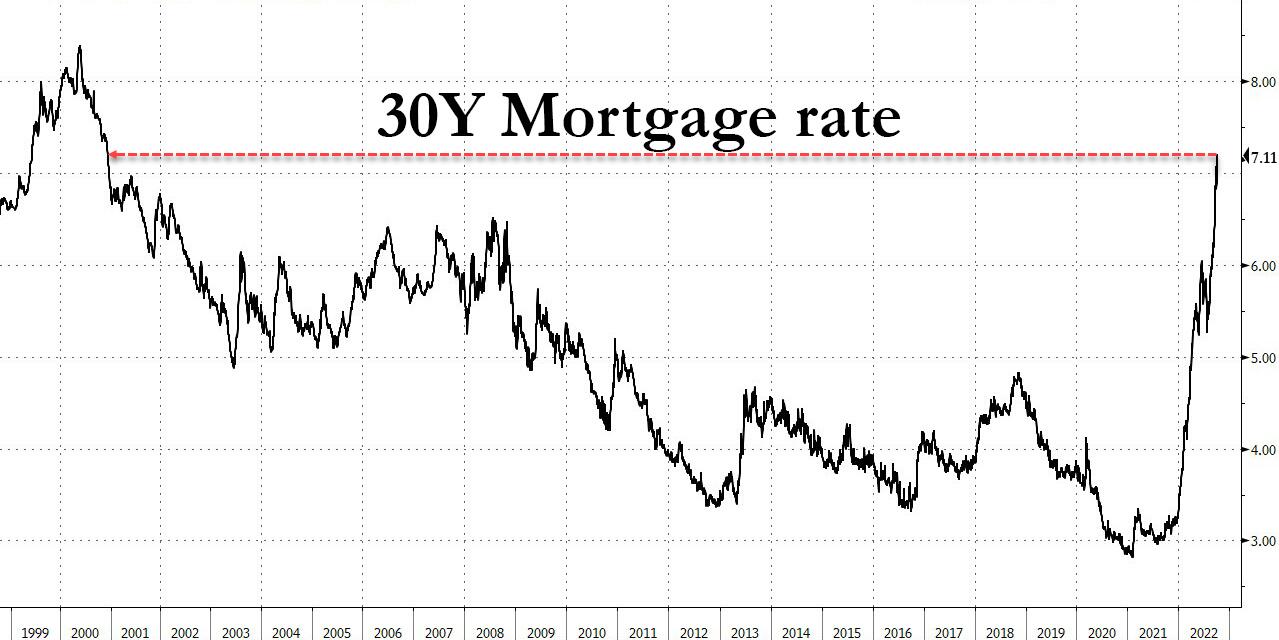
... pushing the average mortgage payment almost 50% to $2,500 from around $1,700 at the start of the year.
But we won't focus on mortgage in this post (we have done so excessively on various previous occasions), especially since in a world where most Americans have been forced to rent (with the average house increasingly unaffordable), having a mortgage became a luxury for the middle class long ago. Instead, we will bring readers' attention to what is no longer a luxury, but with the US savings rate at record lows...
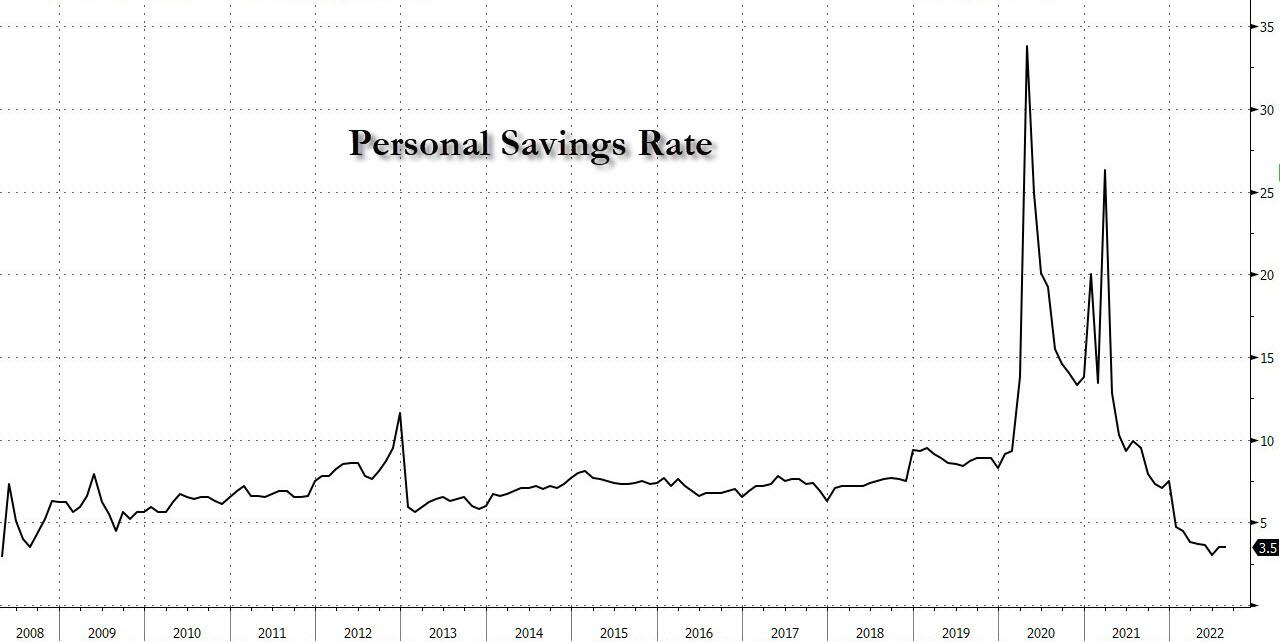
... and with credit card debt soaring every month by record amounts...

... to record highs...

... it is that tiny piece of plastic that has become absolutely indispensable in funding the American way of life, and unfortunately as the latest US consumer credit report showed, the interest rate on all credit card accounts (that were assessed any interest as of Q2), just jumped to the highest since Fed record-keeping started in Q4 1994.
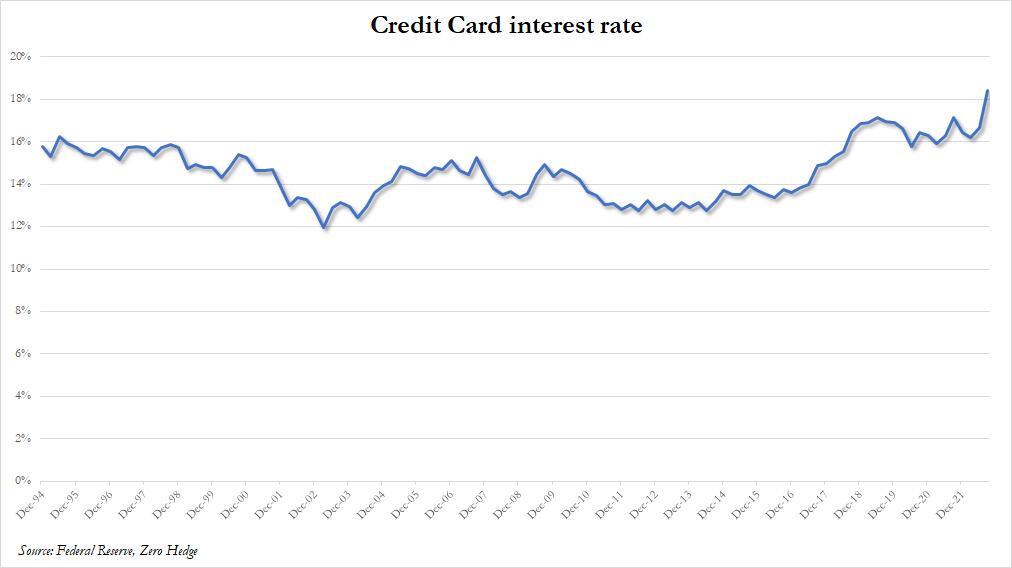
Yes, between soaring prices, exploding rents (after all, with 7% mortgage which nobody can afford, what's left of America's middle class is being pushed into renting), the rate on credit cards - that last lifeline to keeping with exploding inflation - just hit the highest on record. We will leave it to readers to decide what this means for the US economy, but first we just wanted to point out something else.
As we noted last week, used car prices are finally sliding, and not just sequentially...
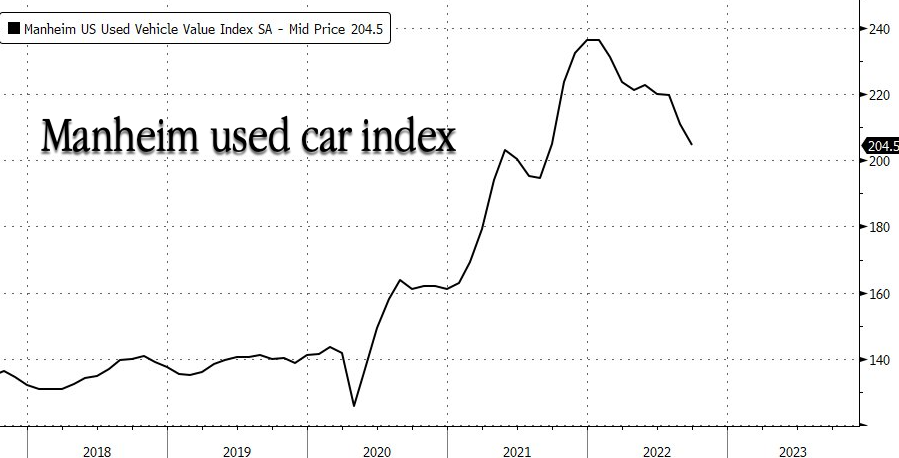
... but also annually.

That's a problem if the surge in car prices was the result of soaring auto loans. Which as the final chart in this post shows, was precisely the case as the average new car loan just surpassed $38,000 for the first time.
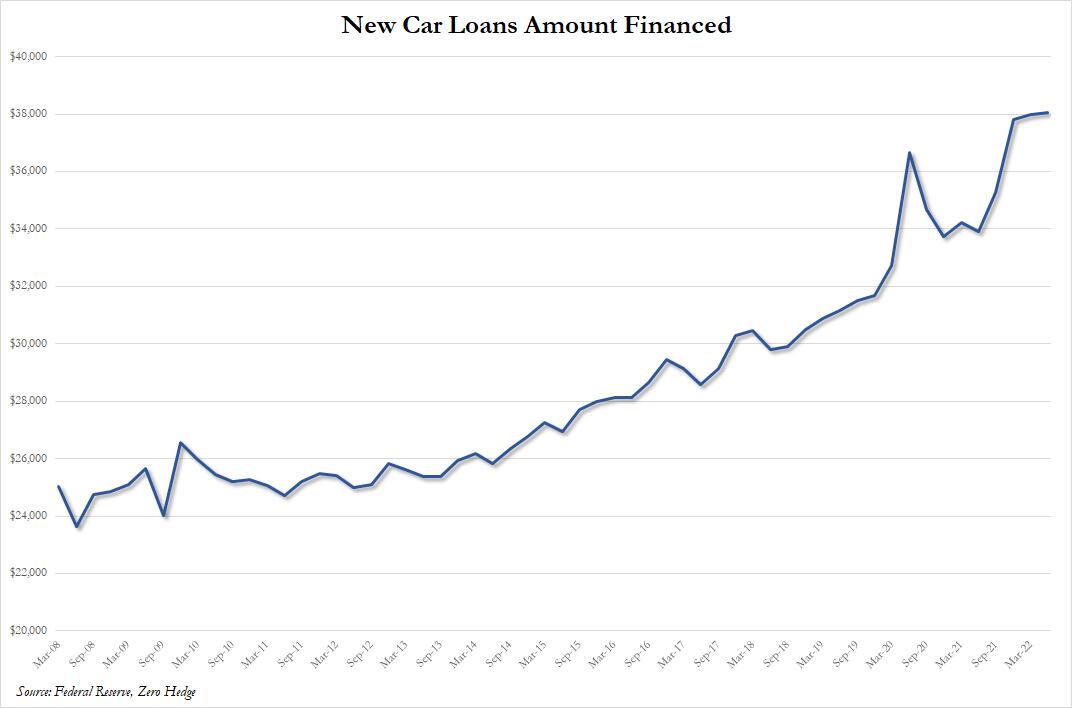
Translation: the implosion of the US consumer is coming and it will be spectacular.
Emma and Jens Grede: The Power Couple Behind the Kardashian Industrial Complex
The architects of multiple retail triumphs, including Skims and Good American, share a personal and professional chemistry that fuels their success.
LOS ANGELES — Emma and Jens Grede are best known as the couple running some of the most successful American fashion brands to launch in the past decade — many of which are co-piloted by members of the Kardashian-Jenner family. But when it comes down to it, they’re just two branding nerds who love talking shop.
“When people do something so obvious, [like] when Rihanna did Fenty [beauty] — " Jens starts in his Swedish-flecked accent, clad in a black Brunello Cucinelli dad sweatshirt and leaning towards his wife of a decade, who is sitting in a chair across from a low coffee table in her office.
“Everyone one was like…,” — Emma adds with a still-detectable East London inflection, sitting back, her black-and-white Nike Dunk high tops and gold Cartier Panthère watch both gleaming.
“That’s so obvious…but no one did it,” Jens says, finishing their thought.
While Jens has the air of an enthusiastic startup exec with a gentle intensity, Emma is bright-eyed, with an electrifying, people-magnet presence. And yet, the sense you get from both of the Gredes is that they are absolutely, 100 percent on it — no matter what the “it” is. At the moment, they’re using Rihanna’s billion-plus dollar, game-changing beauty venture as an example of the kinds of companies they themselves want to put money into. But they could very well be referring to one of their own businesses, which have an incredible hold on the American fashion market right now.
The Gredes, who have been working together for 16 years, romantically involved for 14 and married for 10, call their holding company Popular Culture, reflecting the centre of their life’s work. Even with the monoculture dissolving into a million little TikTok reels, they have managed to build brands that connect across generations and tastes. Victoria’s Secret-challenger Skims, one of their many Kardashian-linked ventures, is expected to generate $400 million in sales in 2022, while inclusive denim line Good American is slated to bring in $200 million. Both are profitable.
Those are just the two ventures at the top of their sizable CVs. Along with co-founding Good American with Khloé Kardashian in 2016 — introducing well-fitting, smartly designed denim in a broader range of sizes than was typically available — Emma is also the chairwoman of the Fifteen Percent Pledge, Aurora James’ nonprofit that advocates for retailers to sell more Black-owned brands, and an investor in several startups.
Jens devotes a significant percentage of his time to Skims, which he co-founded with Kim Kardashian in 2019. However, he’s also a co-founder of Tom Brady’s Brady, the American football star’s sportswear play, and Frame, the hit denim line that he started with longtime business partner Erik Torstensson.
:quality(70)/cloudfront-eu-central-1.images.arcpublishing.com/businessoffashion/FMYUYOUNGRBLLCP7R23KGXSC2A.jpg)
Frame Denim - Presentation - Mercedes-Benz Fashion Week Spring 2014 Jens Grede and Erik Torstensson attend the Frame Denim presentation in September 2013 in New York City. (Getty Images/Getty Images)
There’s more. They are also both co-founders of Safely, the cleaning products line that Emma fronts alongside Kris Jenner, while Emma is also a “founding partner, board member and chief product officer” of Skims. Oh, and Jens is an investor in Good American.
While some of these projects have been more successful than others, the Gredes have a clear formula. They look at what’s happening in culture, figure out where the market is not yet meeting the moment and capitalise on that gap, using the influence of their famous business partners to raise money and sell products. But identifying an opportunity — and finding a household name to help get it off the ground — is only one component of why they are winning.
“You can’t just do a celebrity brand — I find that completely uninteresting,” Emma says. “For me it’s about, first and foremost, trying to solve a problem.”
From Brand Whisperers to Brand Builders
In fashion, the Gredes came up fast. Jens started at Winkreative, Monocle-founder Tyler Brûlé's marketing agency, but soon decamped to build his own shop with Torstensson, which they called the Saturday Group. There, they worked on campaigns for the likes of Calvin Klein and Moncler while pursuing more unconventional projects, including Industrie, a biannual magazine (and savvy marketing and networking tool) that gave fashion’s behind-the-scenes players a glossy editorial treatment usually reserved for celebrities. It’s how Jens first met Andrew Rosen, founder of Theory and a prolific investor, who now backs several of the Gredes’ businesses alongside John Howard, founder of the private equity firm Irving Place Capital. When Rosen puts money into something, he is generous with his time and advice, and is extremely close with the Gredes — Jens says he is like a “second father.”
“Halfway through the [Industrie] interview, I said, ‘Who are you? You can’t be a reporter.’ Just because of the questions he was asking,” Rosen recalls. “Jens is an impressive guy. I just believed in him.”
Around the same time Jens and Torstensson were developing the Saturday Group, Emma was launching ITB — backed by Saturday — where, starting in 2008, she helped pair brands with influencers and more traditional celebrities for marketing campaigns. It’s how she first met Kris Jenner and her daughters and developed a relationship with them that would change the trajectory of their lives.
“I was very, very early on in understanding the mechanics of influencer marketing — and of course, celebrities are influencers, just on a slightly different level,” she says. “That put me in a pretty unique position of understanding that when a brand and a talent come together around something that is real and truthful, real magic can happen.”
Over the next several years, the Gredes spent time building brands for other people, until they got the overwhelming urge to do it themselves. Agency people often try to go brand-side, with mixed results, but with the launch of designer denim line Frame in 2012, and the backing of industry insiders like Rosen — who taught Grede and Torstensson the ropes of manufacturing and merchandising — something clicked.
:quality(70)/cloudfront-eu-central-1.images.arcpublishing.com/businessoffashion/QIAOVESIKFEIDN74TC235N74PE.jpg)
Emma and Jens Grede at their home in Los Angeles. (Michael Tyrone Delaney)
Four years later, Emma co-founded Good American, where she first exercised her merchandising prowess, succeeding in designing proper-fitting garments across a broad range of sizes at a time when bigger players weren’t even attempting to do so.
“Emma has got that understanding of her customer — of how to connect all the dots from a product point of view with authenticity and integrity,” says Rosen, who made his own fortune through his talent as a merchant. “She’s just got it — it’s sort of an intangible.”
Of course, there have been missteps along the way. For Jens, the failure of Grace, a little-black-dress line he launched with Torstensson in 2014 on the back of the success of Frame, may have taught him the biggest lesson: the importance of offering the right product for the right moment.
“It turns out, the product just wasn’t good enough,” he admits. “It was around the same time that Self-Portrait was coming out, and [designer Han Chong] didn’t have any of the same marketing skills that we did — he didn’t have Katie Grand, or Rosie Huntington-Whiteley walking the show or anything else — but he had a sensational product for the price.”
Emma, who sold ITB in 2018 to PR agency Rogers & Cowan for an undisclosed sum, says that early on in the agency’s run she underinvested in talent, thinking that she could do more of the work herself than was actually possible.
“I thought that I could easily spread myself across the world and easily do what I do, which is go in and win business and deliver it all,” she says. “I didn’t understand how to build a team and build culture, and get the right people that would support your vision. When I set up Good American, I decided I was going to surround myself with people who are way better than I am, who actually complement me and all the things that I’m not so good at.”
As the person who has most closely witnessed the Gredes’ ups and downs, Torstensson says, “Their attitude has always been, ‘just try and do’…It’s not being naive, but it’s more like, ‘Why not? Why can’t we? We should just try.’”
“They’re very complementary. Emma tends to flesh out the consumer-facing ideas, like how it would feel, why a customer would want it. Jens tends to flesh out the business engineering,” adds venture capitalist and entrepreneur Natalie Massenet, who invested in Good American through Imaginary Ventures alongside business partner Nick Brown. “But they’ve been in the business long enough that they’re ambidextrous. It would be unfair to pigeonhole either of them that way.”
:quality(70)/cloudfront-eu-central-1.images.arcpublishing.com/businessoffashion/UFYHYNGIAFGFVFCPQ5RZ5LZWRA.jpg)
The Fifteen Percent Pledge Benefit Gala Aurora James, Natalie Massenet and Emma Grede attend The Fifteen Percent Pledge Benefit Gala at New York Public Library in April 2022 in New York City. (Getty Images/Getty Images)
Work and Life As One
But how exactly have they done it?
For someone visiting their shared offices — located in one of those ultra-modern car parks in an industrial area of Los Angeles, where the black buildings look like modern barns instead of the boring, grey, cement boxes of the deep suburbs — it’s hard to tell where Good American ends and Skims begins. Which is essentially how the Gredes operate on every level.
“I’ve never tried to separate work and life,” says Jens, mentioning that, growing up in Sweden, his father, a film director, and mother, an artist, both primarily worked from home, and it “all flowed together….I ultimately think that…any marriage has a lot of elements that are work.”
For the first year they worked together, however, the couple’s relationship was strictly professional: she was his employee. They shared their feelings during a working lunch — no alcohol involved — at Claridge’s.
Jens: “I think we had both come to the understanding that we loved each other without having any form of relationship. And one day we just told each other. We just admitted it. And we basically decided then and there, that was that.”
Emma: “It really was kind of crazy, now that I think about it.”
Jens: “Yeah, it was cinematic, in hindsight, it feels like a Richard Curtis script. Very meet-cute, ‘Love Actually.’”
Emma: “[Laughs.] We haven’t been back.”
The memory now reads like a scene from “When Harry Met Sally,” but at the time Emma recognised that getting together could be a risk, likely more for her career than his.
“You have to remember, I was an employee of the agency, and I had never in my life been given that kind of opportunity,” she says. “Jens was very much like, ‘You’re really great at what you do and your context is useful right now.’ And so, [looks at Jens] you kind of set me up in the business. Jens and Erik had a huge amount of belief in me and that was, of course, extremely validating, and I didn’t want to mess it up. I was also extremely ambitious — and still am — so I’d be lying if I said I wasn’t very, very mindful of that. But I had trust in the fact that we were, and still are, great business partners. We’re really good together in more ways than just our personal relationship.”
That dynamic extends to their circle of close friends, many of whom are also business associates. Once, Torstensson and Massenet — who are romantic partners — and the Gredes decided to take the famed Myers-Briggs personality test for fun, discovering that Emma’s and Torstensson’s results matched up perfectly, as did Jens’ and Massenet’s.
“As in all relationships, it works very well if you’re very aligned about your dreams and your life. Their dreams are aligned,” Torstensson says. “Jens and I had that, too — we’ve always been aligned.”
The LA Effect
That extended family of work associates has become even more important five years after relocating to Los Angeles from London, where Emma was born and raised and where both had spent their early professional years. Along with two elementary school-aged kids, they welcomed twins, born via surrogate, into their lives a little under a year ago, the news of which Emma shared via Instagram. The couple is, on occasion, publicly open about private moments, like when Jens hired 1990s-era group Boyz II Men to serenade Emma for their 10-year wedding anniversary.
Moving to California has been formative, and not only because it allowed them to work more closely with the Kardashian-Jenners across several different brands without constantly travelling. It has also exposed their children to a different sort of life than either of them was accustomed to. They ended up buying a leaf-lined mansion in Bel Air, formerly owned by Max Azria — a retail mogul for another era — and have installed their clan and their impressive art collection, with works by the likes of Richard Prince, Rudolf Stingel and Barbara Kruger, within its walls.
They have amassed a new kind of privilege with the wealth they’ve acquired through sales of businesses and smart investments, but America was also a wake-up call. They landed just two years before the start of the pandemic, witnessing the civil-rights movement that swelled in the wake of the death of George Floyd, which had a profound effect on Emma. In the months that followed, she joined James in building the Fifteen Percent Pledge, now a major component of her work.
“For so many reasons. I talk about America being a positive thing for me, not just because of the business, but because I had a complete awakening personally,” she says. “It’s been interesting reevaluating what matters, what I care about, and really seeing that being put into action in a way that I don’t think would have been possible for me in Europe.”
Bulgari to Double Capacity of Valenza Jewelry Plant
With a new surface area of nearly 189,000 square feet, the project is expected to be completed by the end of 2025, with about 650 new employees set to be hired by 2028.
MILAN — Five years after unveiling a state-of-the-art jewelry manufacturing plant that was billed as the largest in Europe, Bulgari is already doubling the production capacity of the site, which is based in Valenza, Italy.
With a new surface area of nearly 189,000 square feet, the extension works will begin this month and the project is expected to be completed by the end of 2025. About 650 new employees are set to be hired by 2028.
“I never thought we would have to expand the plant so soon; the idea was that it would be adequate to carry on for 10 or 12 years. But demand has surged more than expected and we absolutely have to increase our in-house capabilities,” said chief executive officer Jean-Christophe Babin.
At the same time, Babin underscored Bulgari’s need to train new goldsmiths and integrate the artisanal talents.
The executive did not disclose the amount of the investment, but said it was “the highest investment” for the company and “almost twice as much” as the original funds channeled into the plant, called Manifattura.
“All Bulgari jewels are crafted exclusively in Italy because we believe in authentic and traditional craftsmanship and in the added value of operating where there is true know-how,” said Babin, speaking of the goldsmith tradition in Valenza, which dates back to the Renaissance. Valenza is located between Milan, Turin and Genoa.
“In a complex moment on a global level; we want to send a positive message for the future continuing to invest in our country. This will create many new direct jobs in the next five years, as well as many hundreds indirect with our suppliers,” he continued.
Further reflecting the company’s commitment to the territory and craftsmanship, the Rome-based company will open the Scuola Bulgari, bridging the new buildings with the existing one, which will also be renovated, Babin said.
“We make beauty and sell beauty and being surrounded by beauty reflects what we do, in an aesthetic and architectural balance,” he mused.
This education center is the first Bulgari training school for external students and was developed in collaboration with a design school.
The training course will last about a year and the best students will have the opportunity to be employed by Bulgari.
The Bulgari Academy, which helps avoid depleting the web of local artisans in the surrounding area, will instead continue to train new recruits who will have the opportunity to learn Bulgari’s specific crafting techniques directly from the house’s master craftsmen.
With four courses a year, each lasting four months with full-time attendance of 40 hours a week, the Bulgari Academy has now trained hundreds of jewelers.
The Valenza plant has been producing Bulgari staples such as the B.Zero1, Serpenti, Diva and Parentesi. Designs retail at up to 50,000 euros.
The extension will be built using innovative technologies and materials with low environmental impact, with the aim to achieve the LEED certification, which the existing construction earned in 2017.
Developed by the Italian architectural firm Politecnica, the project has been entirely designed with a sustainable approach and following the principles of energy efficiency, not only to drastically reduce the site’s environmental footprint but also to preserve the neighboring territory and its biodiversity.
The enlargement will consist of two new buildings and an external suspended bridge that will link all three structures to one another. The central part, totaling 49,518 square feet, in addition to presenting a reception area will house the Scuola Bulgari and a restaurant, while the largest building, covering 138,780 square feet, will be dedicated to production.
Babin explained that Bulgari is implementing concrete actions such as reducing the impact on the surrounding environment, incentivizing sustainable mobility, decreasing water consumption, optimizing energy performances also through renewable or alternative energy sources, using materials from nearby areas and with a high recycling value in the components.
Technology has evolved since the opening of the first Manifattura and the the expansion project will include new solutions. He cited an energy hub that will contain technologically advanced systems for the generation of hot and cold fluids with minimum energy consumption, a geothermal field installed under the parking lots for the production of about 1 megawatt of thermal energy and a new photovoltaic system, among others.
The Manifattura Bulgari began its production in January 2017 with 380 employees, with the number increasing to 750 currently.
The major recruitment program, which intends to employ about 650 new staff members between 2024 and 2028, includes a strategic plan for employer branding and talent scouting on a national and international scale, with a series of initiatives involving the most important jewelry schools in Italy and Europe.
Furthermore, Bulgari signed the Urban Planning Agreement with the municipalities of Valenza and nearby Pecetto, outlining the house’s commitment to finance two important interventions for environmental redevelopment and requalification in these territories.
The expansion project also includes further interventions aimed at drastically reducing its environmental impact and preserving the surrounding territory — in particular the biodiversity of the Pecetto hills, right behind the production site.
Bank of England unveils measures to ease strains in UK pension funds
Treasury also moves forward new fiscal plan and OBR forecasts to October 31 from November 23
The Bank of England has unveiled measures to stave off rushed asset sales by pension funds as it seeks to steady UK financial markets, while the UK Treasury also sought to assuage markets by bringing forward a much-awaited fiscal plan to October 31.
In the wake of fears of a “cliff edge” when its emergency bond-buying programme ends on Friday, the central bank both loosened the rules for the £65bn scheme and announced longer-lasting measures in a statement before markets opened on Monday.
Soon afterwards, chancellor Kwasi Kwarteng confirmed he would bring forward his medium-term fiscal plan from its previously scheduled date of November 23 and would ask the independent Office for Budget Responsibility to provide fiscal and economic forecasts on the same date.
In a statement before markets opened on Monday, the BoE said it would increase the limit on its purchases of UK government debt this week and would launch a new short-term funding facility to address the liquidity crisis in the UK pensions industry.
The latest intervention comes during a turbulent period in UK financial markets following Kwarteng’s “mini” Budget on September 23, in which the chancellor announced £45bn in unfunded tax cuts.
The fiscal plans ignited a historic sell-off in UK government bonds, which in turn caused a crisis in the pension industry and prompted the BoE to set up its bond-buying scheme. Pension plans have been dumping a broad range of assets, including corporate bonds as a result of the gilt sell-off, putting intense strains on the market.
The BoE’s intervention succeeded in stabilising markets, but created tension within the central bank over whether it was now targeting lower gilt yields, bringing with it lower government borrowing costs. BoE officials insisted it was not a monetary policy action, even though it used the Bank’s monetary policy tool — quantitative easing — and deputy governor Dave Ramsden described it last week as “an operation designed to buy time”.
The new funding facility is designed to more clearly show that these measures are financial tools, rather than a form of monetary policy.
Kwarteng has also faced pressure to explain the financing of the tax cuts, a principal reason why bringing the date forward for his fiscal plan and the OBR forecasts may assuage markets.
The BoE said on Monday that it was prepared to increase the size of its daily purchases of UK government bonds in order to “ensure there is sufficient capacity for gilt purchases” before the programme ends on Friday. While the central bank can buy a maximum of £5bn in gilts a day during its intervention, over the first eight days it purchased a cumulative total of less than £4bn — meaning that it retains significant headroom for additional purchases if needed this week.
Steve Webb, a partner with LCP, the actuarial consultants, and a former pensions minister, said the increase in the gilt purchase limit “should help to reduce any risk of a ‘cliff edge’ at the end of the week when the current special measures are switched off”.
Despite Monday’s measures, long-term UK government borrowing costs continued to rise. The 30-year gilt yield climbed 0.14 percentage points to 4.5 per cent, its highest level since the immediate aftermath of the BoE’s initial intervention on September 28.
“I don’t really see the point in saying you’ll buy ten billion a day when you’ve only been buying a few hundred million up until now,” said Peter Schaffrik, macro strategist at RBC. “The real question the markets have is ‘How much are you actually willing to spend?’”
The Bank also announced a new short-term lending facility designed to ease strains on pension funds that use liability-driven investing strategies, which are at the centre of the market turmoil.
The sell-off in UK government bonds meant pension funds needed to rapidly sell assets such as corporate debt and property funds to make collateral payments to keep their LDI strategies in place, creating a vicious circle that created strains in the sterling-denominated debt market.
In its announcement on Monday, the BoE said it would allow a broad range of collateral, including investment grade corporate bonds, to be used in the new repo facility to “enable banks to help to ease liquidity pressures facing their client LDI funds through liquidity insurance operations”.
The repo market acts as a vital lubricant in movements of billions of dollars and euros. Banks and investors use the market to find cash for the short term, offering high-quality collateral such as government bonds in return.
Peter Chatwell, head of macro trading strategies at Mizuho, said the new facility would “reduce the need for LDI accounts to force sell to find liquidity, when they can borrow cash versus a wider range of existing collateral from the BoE”. He added that the “liquidity crisis [among funds using LDI] may be better addressed via this facility”.
Hydrogen fund Hy24 raises €2bn as investors seek to tap clean energy shift
Round attracts global groups from Airbus and Total to SocGen and BBVA
A fund backed by global companies and financial institutions including TotalEnergies, Baker Hughes and Axa has raised €2bn to invest in green hydrogen projects, as it seeks to tap into growing adoption of the zero-carbon fuel.
The amount raised exceeds the €1.5bn target that Paris-based Hy24 had set when it launched in October. Hy24 is a joint fund between French private equity group Ardian and Zurich-based FiveT Hydrogen, an investment manager specialising in hydrogen investments.
The fundraising reflects increasing investor interest in hydrogen, and comes weeks after fund manager Copenhagen Infrastructure Partners announced a €3bn close on its own clean hydrogen fund.
Hy24’s fundraising drew investors including Airbus, Snam, Air Liquide, Japanese trading house Itochu and South Korean group Lotte Chemical. Financial institutions such as Société Générale, BBVA and the Japan Bank for International Cooperation also participated.
Green hydrogen uses renewable energy to power electrolysers that separate water into its atomic constituents of oxygen and hydrogen.
In Europe the fuel is increasingly viewed as a viable replacement for some Russian gas. Under the EU’s new energy blueprint REpowerEU, Brussels plans to use 20mn tonnes of hydrogen by 2030, half of which would be produced within the bloc.
The European Commission in July approved €5.4bn in funding for hydrogen projects of “common European interest”.
Hy24 has until “the end of the decade” to deploy the capital raised, chief executive Pierre-Etienne Franc told the Financial Times. The fund will look to co-invest globally in 15 to 20 projects, with Franc claiming it will help mobilise €20bn in investment into hydrogen projects.
The fund would look to invest “through the whole value chain”, Franc said, from production, storage and distribution to transportation and industrial usage.
In countries such as Japan and South Korea that lack natural resources, “the only way to import massive, gigawatt scale of renewable power is to transform it by electrolysis into energy in a storable form, which is hydrogen, and ship it or pipe it”, Franc said.
He added that hydrogen could serve as a seasonal store of energy in a way batteries were not yet able to do, and that decarbonisation of energy-intensive heavy industries would also require hydrogen.
Interest in green hydrogen has been rising across the globe, with a growing wave of investments planned in countries with an abundance of solar and wind.
Consultancy Rystad Energy said in a recent report that Egypt, the host of this year’s COP27 climate summit, was “well on its way to being a hydrogen powerhouse as a swath of project announcements have pushed estimated investments in the North African country’s sector past $100bn”.
The country’s annual hydrogen production capacity on an announced basis has reached 3.6mn tonnes, second only to Australia which has a capacity of 9.23mn tonnes, it said, with Mauritania, the US and Canada occupying the other top-five slots.