Challenges : Patrick Drahi, le patron de SFR, dans le viseur du fisc suisse

Patrick Drahi, le patron de SFR, dans le viseur du fisc suisse

Patrick Drahi est connu pour ses capacités à toujours optimiser la situation fiscale de son groupe. Des recettes qu’il appliquerait aussi à sa vie personnelle mais qui sont aujourd’hui en train de lui jouer un drôle de tour. Car l’administration fiscale du canton suisse de Genève lui a récemment envoyé une notification de redressement. Elle soupçonne le propriétaire du groupe de téléphonie SFR, de la chaîne de télévision BFMTV et de la maison d’enchères Sotheby’s (entre autres...) de vivre la quasi-totalité de son temps en Suisse dans une maison de Cologny, commune huppée du canton de Genève, comme l'indique RTS.

Officiellement, c’est sa femme qui réside dans cette énorme propriété. Car le milliardaire, classé 11ème fortune de France avec un patrimoine de 11 milliards d'euros selon le classement de Challenges, avait, lui, déclaré avoir sa résidence fiscale à Zermatt, dans le Valais, un canton nettement moins gourmand en impôts.

La bisbille date déjà d’il y a quelques années : mi-2019, l’administration cantonale avait déjà lancé une enquête, lui réclamant de l'argent. Elle avait été mise sur la piste après la révélation des déplacements du milliardaire à la suite d’une fuite de milliers de pages de documents informatiques. Le Français avait aussitôt mobilisé ses avocats pour contester la mesure. Il a d'ailleurs déposé un recours courant décembre de l'année dernière devant le Tribunal administratif.

Dans un courrier adressé en 2020 à l’administration, l'étude d'avocats Oberson Abels, qui défend l’homme d’affaires français, a aussi exposé "une synthèse générale du nombre de jours passés chaque année par Patrick Drahi et son épouse dans chaque lieu". D’où il ressort qu’entre 2016 et 2019, Patrick Drahi aurait passé 127 jours à Zermatt contre 46 à Genève, en moyenne, par an.

Optimisation fiscale ?
Le milliardaire avait, il faut le dire, déployé beaucoup d’énergie pour devenir résident à Zermatt, dans le Valais, dans les années 2000. D’abord installé à Genève, il s’y était fait refuser le statut de Résident à forfait fiscal. Un statut très intéressant. En Suisse, soit les étrangers résidents sont imposés sur leurs revenus, comme les autres citoyens, et leurs impôts peuvent alors être très élevés. Soit ils obtiennent le droit d’être imposés sur leur train de vie. On appelle cela le "forfait fiscal". C’est un impôt finalement assez faible, réservé à ceux qui n’ont pratiquement pas d’activité en Suisse.

Les 4.500 "millionnaires" et "milliardaires" étrangers imposés au forfait en Suisse ont ainsi payé 820 millions de francs d'impôt en tout (soit environ 830 millions d'euros) et pour tout en 2018. Soit environ 18.000 francs (à peu près la même chose en euros) par contribuable. Une trentaine de (très) grandes fortunes françaises, présents dans notre classement 2022, en bénéficient, notamment Pierre Castel, lui aussi en brouille avec le fisc suisse.

Une passion soudaine pour le Valais
Contrarié par le refus genevois, le Français s’était alors tourné, en 2005, vers le canton de Valais. Celui-ci avait été apparemment plus conciliant, estimant que "conformément à ce qu'admet la jurisprudence en la matière, il est manifeste que le volume d'activité exercée en Suisse par Patrick Drahi n'est pas suffisant pour lui refuser une imposition d'après la dépense". Autrement dit : ok pour un forfait fiscal dans le Canton de Valais puisque l'activité professionnelle de Patrick Drahi "a essentiellement eu lieu hors Suisse".

Mais quatre mois après avoir obtenu ce forfait fiscal, les époux Drahi se séparaient... pour ensuite se marier religieusement, en 2014. Retour d’affection ou manœuvre fiscale ? Le fisc suisse a sa petite idée puisqu’en 2019, il ouvre cette enquête sur la période fiscale 2009-2016.

Petites économies
Selon nos confrères de RTS (Radio-Télévision Suisse), le fisc valaisan estime que "la dépense annuelle des époux Drahi peut être fixée au minimum à 2 millions de francs", ce qui représentait autour de 800.000 francs suisses d'impôts par an à l’époque, avec un taux d’imposition cantonal fixé à 36% pour ce canton de Valais. Alors que dans le Canton de Genève (ou le taux est à 45%), il aurait payé plus d’un million.

Interrogé par Challenges, l'entourage de Patrick Drahi assure que celui-ci ne souhaite pas commenter et souligne que nos informations sont connues "à la suite de l’attaque informatique contre un des serveurs du groupe et de la tentative d’extorsion dont sont actuellement victimes les sociétés Altice Group Lux, Altice France et VMS." Le groupe affirme avoir déposé plainte et constater que Challenges utilise des éléments issus de cette attaque dont la reproduction pourrait faire l’objet de poursuites. Ce dont Challenges prend acte.

Mais, surtout, au final, cette affaire laisse perplexe. Patrick Drahi se serait donc donné tout ce mal pour économiser 200.000 francs suisses d’impôts par an (quasiment l'équivalent en euros) ? Mais comme on dit : il n’y a pas de petites économies…
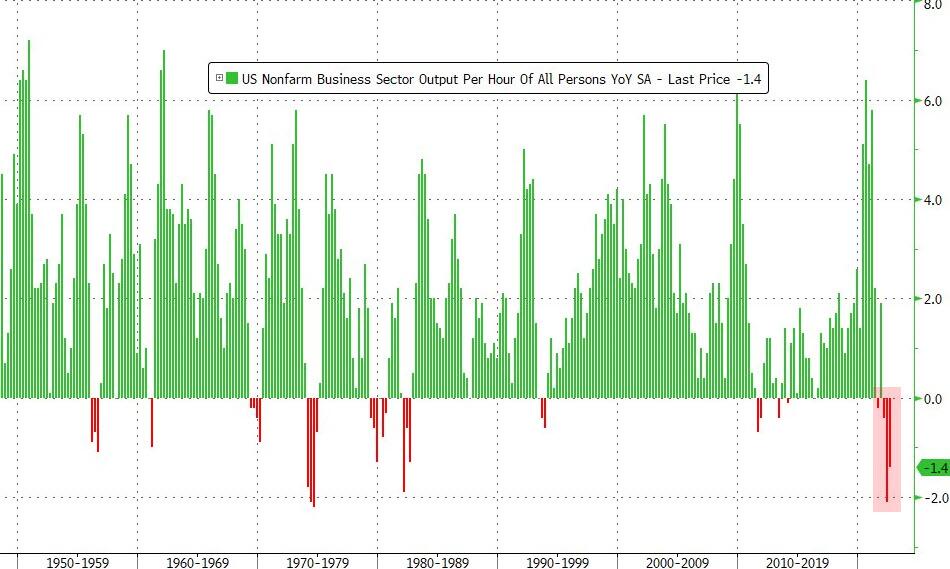
(ZH) US Unit Labor Costs Soar By Most In 40 Years Amid Dismal Productivity

US Unit Labor Costs Soar By Most In 40 Years Amid Dismal Productivity

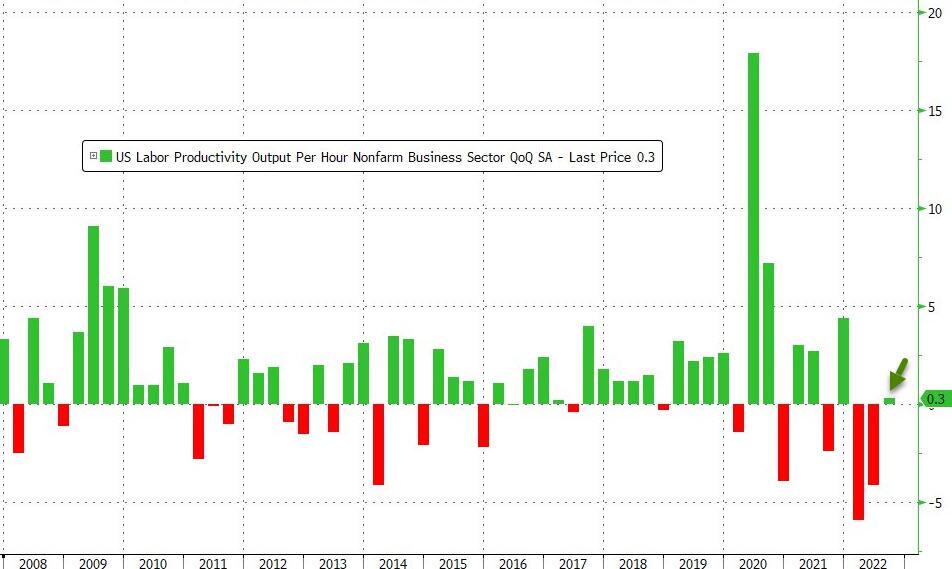
US Productivity growth barely rebounded in Q3 (+0.3% QoQ vs -4.1% QoQ in Q2), but this was slower than the 0.5% QoQ expected, after two quarters of huge weakness...
Source: Bloomberg
On a YoY basis, US Productivity is down for the 3rd straight quarter (and 4th quarter of the last 5)...
Source: Bloomberg
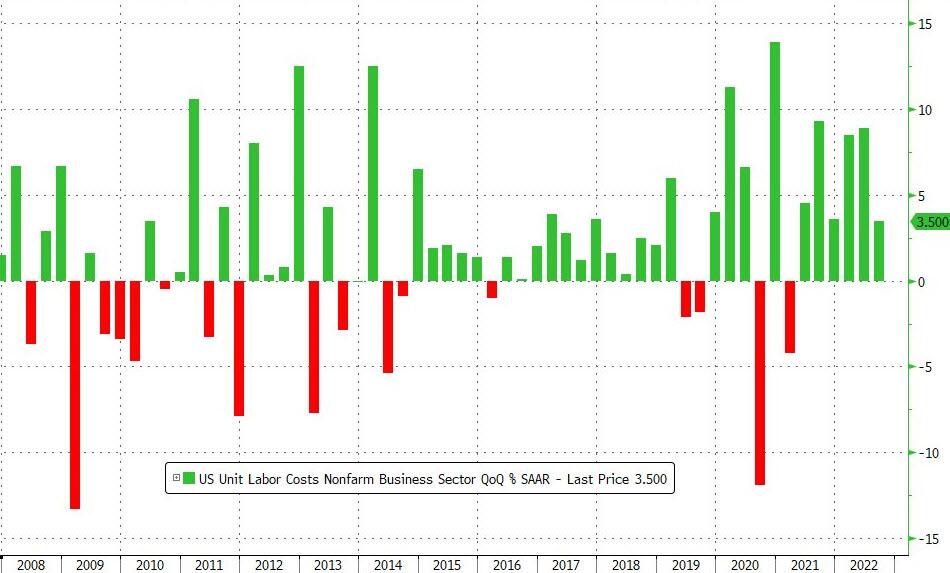
On the mirror image of productivity, unit labor costs rose 3.5% QoQ (a notable slowing from the 8.9% QoQ growth in Q2). This was the 6th quarter in a row of rising unit labor costs (but was less than the +4.0% QoQ expected)...
However, on a YoY basis, that is the fastest growth since Q3 1982...
Source: Bloomberg
Simply put, we can't have job growth and solid productivity when you make up numbers all the time.

(ZH) US Services Surveys "Paint A Concerning Picture" Into Year-End, Export Orde

US Services Surveys "Paint A Concerning Picture" Into Year-End, Export Orders Collapse

Following the disappointing drops in US Manufacturing surveys, this morning's US Services surveys were also expected to show declines.
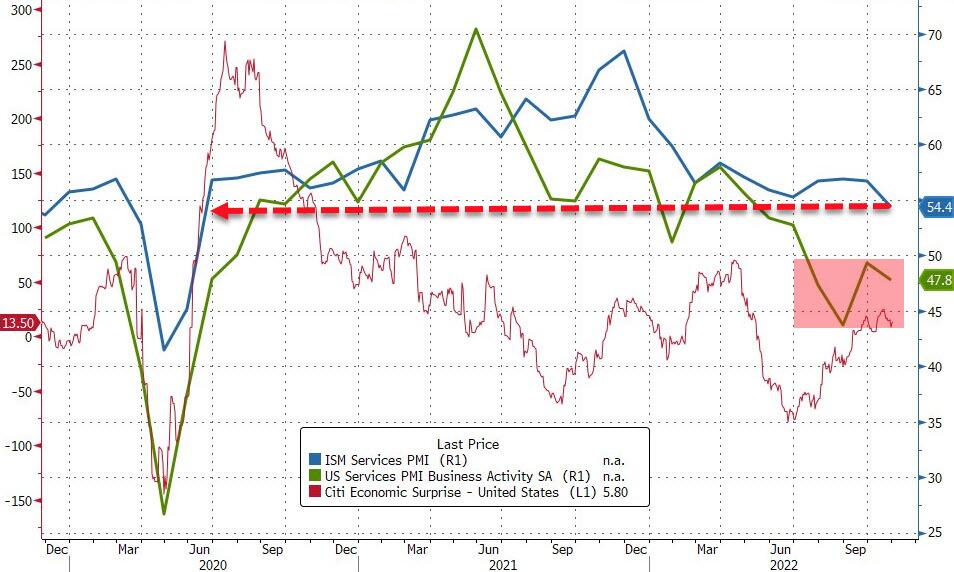
S&P Global's Services PMI final print for October was 47.8 (better than the flash print of 46.6 but lower than September's 49.3). This is the 4th straight month of contraction according to this signal.
ISM Services fell from 56.7 to 54.4 in October (worse then the 55.3 expected). This is the weakest print since May 2020.
Source: Bloomberg
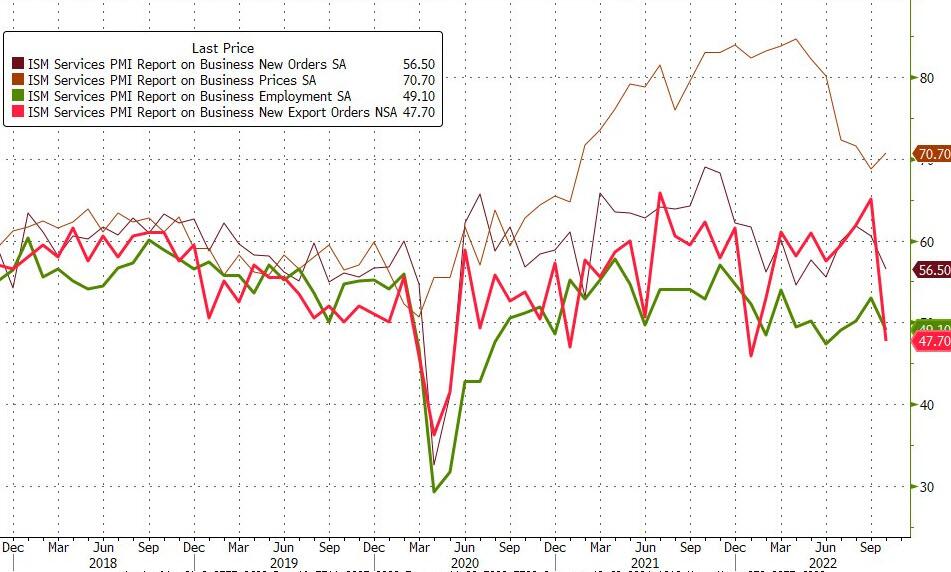
Under the hood of the Services PMI print, new export orders collapsed and employment contracted...
Source: Bloomberg
Anthony Nieves, ISM Chair warned:
"Growth continues at a slower rate for the services sector, which has expanded for all but two of the last 153 months. The sector had a pullback in growth for the second consecutive month in October due to decreases in business activity, new orders and employment."
ISM Respondents are not exactly exuberant:
  • “Despite the negative inflation news, higher gas prices and concerns of a recession, our restaurant sales have been resilient during what is typically a seasonal slump. We are positive to 2019 (pre-coronavirus pandemic), and traffic is down only about 4 percent, so it’s recovering. Staffing and supply chain challenges are improving, (and we are) seeing some decline in key commodities.” [Accommodation & Food Services]
  • Business remains tepid. We have a general concern that sales volumes are trending down as buyers communicate that they’re planning to buy only what they need for immediate sales.” [Agriculture, Forestry, Fishing & Hunting]
  • Customers are starting to delay projects and/or entering smaller-scale scopes of work. We believe this is a continuation of an uncertain economic environment.” [Construction]
  • “There are supply chain challenges for some paper- and tech-related products.” [Educational Services]
  • “Shortages and delays stabilizing. Labor availability and patient volume continue to be a challenge.” [Health Care & Social Assistance]
  • Electronic components lead times are becoming longer, pushing out almost a year. Not seeing much change in pricing based on inflation pressures at this point, but we expect to see changes after the first of the year. Business volume remains strong.” [Other Services]
  • As we prepare for a recession, our stakeholders, clients and vendors are all tightening their belts and reducing new spend. We are focusing on strategic renewals and expanding only where necessary with our closest vendor partners for our most critical tech projects.” [Professional, Scientific & Technical Services]
  • “Prices seem to continue increasing for commodities, including plumbing, flooring materials, floor adhesives, door locks, and bedroom and bathroom doors. Delays in delivery have increased after leveling off in the middle of the year.” [Real Estate, Rental & Leasing]
  • “We are in the final preparations for a successful holiday, despite lower sales. Labor is more available this year, and supply chain delays seem caught up for now.” [Retail Trade]
  • “It has become more challenging to maintain our level of service, due to increased demand, extended supplier lead times and the hyper-competitive employment market.” [Transportation & Warehousing]
  • We are experiencing a bullwhip of oversupply on some goods … while still desperately short on other goods. The market is recovering very inconsistently.” [Wholesale Trade]
Four out of seven US sectors monitored by S&P Global PMI data recorded lower business activity during October with Financials the worst-performing sector for the fifth month in a row...
"Service sector firms faced a challenging start to the final quarter of 2022, as a renewed contraction in new business dragged output down further. Demand conditions were hampered by tighter financial conditions and elevated rates of inflation, leading to reports of postponements and the delayed placement of orders as customers assess their spending.
"Subdued demand and weaker confidence in the outlook for output led to a near-stagnation in employment. Reports of the non-replacement of voluntary leavers brought signs that firms were evaluating costs and future demand more closely before advertising vacancies and expanding staffing levels.
"Nonetheless, momentum in previously soaring inflation slowed again. Hikes in costs softened, as service providers and manufacturers saw slower upticks in supplier and input prices. Meanwhile, private sector firms sought to boost demand through a slower increase in selling prices. Although softening, further elevated rises in prices paid by consumers present obstacles to firms in an already challenging demand environment and paint a concerning picture as we head towards the end of the year."
Finally, The S&P Global US Composite PMI Output Index posted 48.2 in October, down from 49.5 in September.
Not a pretty picture for US economic growth in Q4.

>>> US Gapping down


Gapping down
In reaction to earnings/guidance
:

  • ATUS -25.7%, LNC -25.5%, TNDM -22.1%, LUMN -20.1% (also enters into exclusive arrangement for the proposed sale of Lumen's EMEA business to Colt for $1.8 bln), ROKU -19.3% (also CFO to step down), RPD -16.4%, PTON -16%, MRVI -14.7%, FTNT -12.7%, CTSH -12% (also authorizes $2 bln increase to its share repurchase program), RELY -11.4%, RSI -10.7%, ZTS -10.7%, MRNA -10.3%, STAA -9.4%, VSTO -8.9%, FSR -8.8%, NTR -8.1%, QCOM -7.9% (also AAPL will keep QCOM chips next year, according to Bloomberg), SBSW -7.7%, WLK -7.4%, MAC -7.2%, CARS -6.8%, QLYS -6.6%, CF -6.5% (also authorizes new $3 bln share repurchase program), SITM -6.2%, YELL -5.4%, QRVO -5.4% (also authorizes new $2 bln share repurchase program), EQX -5.4%, TTMI -5.3%, BHC -5.1%, ASND -5%, NUS -5% (also pursuing a more aggressive approach to previously indicated restructuring plans), CXW -4.9%, BCOV -4.8%, ECPG -4.6%, CMI -4.6%, ALGT -4.5%, VRRM -4.2%, TEVA -4.2%, ALB -4.1%, UDMY -4.1%, NVMI -4.1%, MKSI -3.8%, DCPH -3.8%, GPRE -3.8%, TPX -3.7%, RGNX -3.5%, RGNX -3.5%, ZG -3.4%, EVH -3.3%, STLA -3.1%, MGM -3%, OGE -3%, DEN -3%, WMS -3%, RGR -2.9%, PLMR -2.8%, LNTH -2.8%, POWI -2.7% (also authorizes new $100 mln share repurchase program), WTS -2.5%, PK -2.3%, EVTC -2.2%, FIS -2.2%, WOW -2.2%, RGLD -2.1%, SRPT -2.1%, GFI -2%, WES -1.9%, DNB -1.9%, KYMR -1.8%, ICE -1.8%, KRTX -1.7%, W -1.7%, GOGO -1.7%, CIM -1.7%, HLMN -1.7%, EQH -1.6%, HII -1.5%, MET -1.4%, TNK -1.4%, MAR -1.4%, LANC -1.4%, HBM -1.3%, EVA -1.3%, NVEI -1.3%, LSPD -1.3%, XPRO -1.2%, RVLV -1.1% (also to partner with Griffin Gaming to create fashion-centered Web3 mobile gaming experience), APA -1.1%, BKE -1.1%, BBIO -1.1%, RCII -1%, AFG -1%, DSEY -1%

Other news:

  • PBPB -4.3% (extends contract for CEO thru 2025)
  • RGNX -3.5% (reports additional "positive" interim data from the ongoing Phase II ALTITUDE trial of RGX-314 for the treatment of diabetic retinopathy)
  • WES -1.9% (ENB and PAA purchase WES's 15% interest in Cactus II Pipeline for $265 mln)
  • AAPL -1.6% (will keep QCOM chips next year according to Bloomberg)
  • HII -1.5% (increases dividend)
  • KURA -1.3% (announces a $25 mln equity investment from Bristol Myers Squibb (BMY) and a term loan facility with access to up to $125 mln from Hercules Capital (HTGC))
  • MARA -1.2% (publishes Oct 2022 bitcoin production data)

Analyst comments:

  • FSR -9.4% (downgraded to Sector Perform from Outperform at RBC Capital Mkts)
  • AVDX -4.7% (downgraded to Underperform from Neutral at BofA Securities)
  • SBGI -4% (downgraded to Underweight from Overweight at Wells Fargo)
  • PATH -3.3% (downgraded to Perform from Outperform at Oppenheimer)
  • BILI -2.8% (downgraded to Neutral from Buy at BofA Securities)

>>> US Gapping up

Gapping up
In reaction to earnings/guidance
:

  • NRDS +17.8%, VCYT +10.6%, VMEO +10.5%, HUBS +10.5%, ETSY +9.9%, ELF +9.2%, INFN +9%, DDOG +7.9%, CFLT +7.6%, ACAD +6.7%, ING +6.3%, RIG +6.1%, EBAY +6.1%, RUN +6%, ESMT +5.7%, UAA +5.4%, H +5.3%, CROX +5.2%, EQIX +5%, PYCR +5%, GOLF +5%, SWTX +5%, PDM +4.9%, ORCC +4.7% (also increases dividend, introduces supplemental div, also $150 mln stock repurchase auth), AMPL +4.3%, BKNG +4.1%, IR +4%, CYBR +4%, HTGC +3.6%, NE +3.4%, GIL +3.1%, FROG +3%, WWE +2.8% (also ends investigation into former CEO V. McMahon), MGPI +2.7%, EVOP +2.6%, DCP +2.6%, PTRA +2.4%, FSLY +2.4%, PENN +2.4%, EPR +2.2%, VIRT +2.1%, ESTE +1.9%, PCOR +1.8%, IRM +1.7%, SNN +1.5%, CI +1.4%, COP +1.4%, PAA +1.3%, CHRD +1.3%, SU +1.2%, SU +1.2%, QSR +1.2%, PDCE +1.1%, MRO +1.1% (also to acquire the Eagle Ford assets of Ensign Natural Resources for $3 bln), NARI +1.1%, DLX +1.1%, MTG +1%, APG +1%, ROCK +1%

Other news:

  • SOVO +4.5% (files for 61103119 share offering by selling shareholders)
  • LAC +2.4% (intends to advance a reorganization that will result in the separation of its North American and Argentine business units into two independent public companies)
  • GEVO +1.9% (announces 5-year $165 mln agreement with Iberia Airlines)
  • ADCT +1.9% (ADCT and IGMS enter into clinical trial collaboration and supply agreement)
  • PAA +1.3% (ENB and PAA purchase WES's 15% interest in Cactus II Pipeline for $265 mln)
  • SPCE +1.3% (Bell Textron and Qarbon Aerospace to manufacture key subassemblies for new Delta class spaceships)
  • TYRA +1.1% (CFO to step down)

Analyst comments:

  • LIND +1.4% (upgraded to Outperform from Mkt Perform at William Blair)

WSJ : Carl Icahn Has More Than 8% Stake in Beverage-Can Maker Crown Holdings

Carl Icahn Has More Than 8% Stake in Beverage-Can Maker Crown Holdings
Activist investor believes Crown should shed noncore units and buy back more stock

Carl Icahn has a sizable stake in Crown Holdings Inc. CCK -3.19% and believes the beverage-can maker should shed noncore units and buy back more stock, according to people familiar with the matter.

The billionaire activist investor has a stake worth about $700 million, making him the company’s second-largest holder, the people said.

Crown has a market value of roughly $8 billion after its shares have lost nearly 40% so far this year. The stock plummeted last week after Crown lowered its financial outlook, blaming macroeconomic factors including inflation, higher interest rates and currency swings.

Crown Chief Executive Timothy Donahue said on a call with analysts and investors that the company also didn’t foresee “such a sudden and sharp decline” in demand for beverage cans globally.

Crown and its larger rival, Ball Corp. BALL -3.26% , have experienced severe whiplash amid the Covid-19 pandemic. Demand for aluminum cans spiked initially in 2020, as restaurants and bars were forced to shutter and consumers stayed home to sip on their favorite alcoholic beverages, including canned cocktails, spiked seltzer and beer. Popular brands such as Liquid Death also helped fuel sales of canned water.

But more recently, companies including Crown have said consumer demand for these types of drinks has fallen steeply, leaving them with a glut of inventory. Crown said it has indefinitely postponed certain projects in the U.S., while Ball said in August it planned to shutter two of its facilities in the U.S. Ball shares are down nearly 50% for the year.

“You never like to say, we’re caught off guard, but I think we were really,” Mr. Donahue said on last week’s conference call.

The company said it expects profit margins will remain under pressure for at least the balance of 2022, as consumers curtail their spending and restaurants and retailers readjust orders.

Before the pandemic, in 2017, Crown announced a deal to acquire Signode, a specialist in transit packaging, for $3.9 billion. The deal was meant to broaden and diversify Crown’s customer base, and increase cash flow, management said at the time. But investors weren’t as convinced the acquisition was a good fit and Crown shares traded lower on that news.

Crown also runs an aerosol and food-packaging business that manufactures cans for household products and snacks.

Mr. Icahn believes the company should consider spinning off or selling these noncore assets, which also include a minority stake in a European food-can business, the people familiar with the matter said. That would allow the company to focus on the beverage-can business, which Mr. Icahn believes is undervalued and poised to grow.

The octogenarian also believes the company could buy back more stock, the people said. Crown has been buying back stock but indicated on its recent earnings call that it is watching interest rates closely to see what it will be capable of doing in the future.

FT : Canada orders Chinese companies to divest stake in lithium mines

Canada orders Chinese companies to divest stake in lithium mines
Ottawa says it will ‘act decisively when investments threaten our national security’

Ottawa has ordered three Chinese groups to divest their stakes in Canadian critical mineral companies after a defence and intelligence review concluded that the investments posed a threat to national security.

In a move that reflected a significant hardening of Canada’s stance towards China, the government ordered Sinomine (Hong Kong) Rare Metals Resources to exit its stake in Power Metals, a Canadian lithium miner.

Ottawa also instructed Chengze Lithium International to divest its stake in Lithium Chile and told Zangge Mining Investment (Chengdu) to unwind its investment in Ultra Lithium, another Canadian resource developer.

Industry minister François-Philippe Champagne said Canada welcomed foreign direct investment from companies that “share our interests and values” but would “act decisively when investments threaten our national security and our critical minerals supply chains”.

Roland Paris, a foreign policy expert at the University of Ottawa, said the decision followed an announcement that Canada would allow only state-owned entities to invest in its critical mineral companies on an “exceptional basis”, heralding a tougher approach on Chinese companies.

“Together, these two announcements represent a significant shift in Canadian policy and a recognition that we and our allies will need to secure sources of critical minerals now and in the future,” Paris said.

He noted that Chrystia Freeland, the deputy prime minister, recently spoke in Washington about the need to boost economic ties among democratic allies and stressed Canada’s importance as a supplier of critical minerals.

Nazak Nikakhtar, a former US commerce department official, said the move was significant because it marked “a shift in Canadian national security policy from traditional national security risks to critical supply chain risks”.

She added that Canada was also trying to cement its position as an “excepted foreign state” for the purposes of inbound investment reviews conducted by the Committee on Foreign Investment in the US, the inter-agency panel that vets deals for national security concerns.

Canada is preparing to unveil a critical minerals strategy. In a statement, Champagne said critical minerals were “essential to powering the green digital economy” and that demand for the resources presented Canada with a “generational economic opportunity”.

Neil Beveridge, a Hong Kong-based analyst with research group Bernstein, said the move would not immediately affect Chinese lithium supply since Canada was not a large supplier and the targets were not among China’s biggest lithium miners.

But Beveridge said China and its industry would be worried about the “direction of travel”, which comes as Washington pressures allies’ companies to cut their reliance on Chinese industry. “If this were to happen in Australia, it would be a very, very big story,” he added.

President Joe Biden is trying to cut US reliance on China for the refinement of critical minerals, which are vital to manufacturing everything from weapons such as missiles to green products including electric vehicles.

For years, Chinese companies have been among the most active buyers of access to minerals that underpin the clean tech transition. While only about 13 per cent of global lithium extraction occurs in China — behind Australia and Chile — its refiners process more than half the global supply.

But the race for resources is set to intensify. Global lithium demand will soar more than tenfold over the next two decades, according to the International Energy Association. The growth is driven by a tectonic shift away from fossil fuels to electric vehicles and energy storage.

Canada’s announcement also comes as Ottawa prepares to release its first Indo-Pacific strategy this year. The government is expected to harden its stance on China, particularly after the release of two detained Canadian citizens, known colloquially as “the two Michaels”.

Their detention was retaliation against Canada for arresting Meng Wanzhou, the chief financial officer of Huawei, at Washington’s request.

FT : Art Basel/UBS art market report predicts an all-time high in 2022

Art Basel/UBS art market report predicts an all-time high in 2022
Despite a slowdown in the global economy, art spending is headed for record levels

The global economy might be headed for a slowdown, but trade in art looks to reach record levels this year with spending on track to more than double in 2022, according to the latest Arts Economics survey of more than 2,700 collectors worldwide. The findings, compiled by Clare McAndrew for Art Basel and UBS, reveal collector concerns over their carbon footprint now that in-person events are back — though not to the extent that art-shoppers want to rein in their own travel plans.

McAndrew’s report finds that global imports of art and antiques, highly correlated with sales in the market, rose 41 per cent to $26.6bn in 2021 and are up a further 19 per cent in 2022, using aggregated data from countries reporting in the first six months of the year — the majority by value, McAndrew confirms.

The value of art exports increased too, by 47 per cent in the same six-month period, having already grown 38 per cent last year, and after a slump in the pandemic year of 2020, the report finds.

For the first half of this year, the survey finds that the median expenditure on fine art, decorative art and antiques was $180,000, higher than for all of 2021 ($164,000) and estimated to rise to $372,000 by the end of this year.

McAndrew cautions some over-optimism on the part of buyers, who were surveyed in August, but says the preliminary findings suggest that cross-border trade in art will still “likely reach an historical peak” in 2022.

The report shows how the impact of the Covid-19 pandemic didn’t touch those collectors spending more than $1mn on art each year. These bigger spenders have risen from 18 per cent of respondents in 2019 to 29 per cent in the first half of 2022 — with 34 per cent planning to spend at least $1mn by year end, including 14 per cent who estimate spending more than $10mn. 

Art fairs are back in force and favour, with 338 live events in the planning for this year, a fall of only 6 per cent (22 fairs) from the pre-pandemic year of 2019 and a considerable rise from the 130 live events held in 2020. New fairs on the scene include two from the major players, namely Frieze Seoul and Paris+ par Art Basel.

This might all be good news for the art market, but a sobering, recurring theme in McAndrew’s recent reports is that while collectors voice growing concerns about the environmental impact of their high-end hobby and show a willingness to pay a premium for sustainable options, the majority (77 per cent) seem unfussed by their own aviation emissions and plan overall to travel more to events next year. Only 12 per cent say they expect to reduce their trips, and the vast majority of these (83 per cent) say that this is primarily due to the risks of Covid-19.

“In some ways, the art market is more sustainable than other luxury sectors — art is not a disposable item — but travel is the elephant in the room,” McAndrew tells the Financial Times.

Meanwhile, there has been only a “slight shift” in behaviour towards a de-globalised, more locally focused scene, McAndrew finds, as trade consolidates further within a smaller number of market hubs, primarily New York, London and Hong Kong.

Collecting too has become more concentrated. Across all regions combined, the Boomer generation (defined as aged between 58 and 75) generally spent at the highest levels and tended towards artists who were familiar to them and from galleries they already knew. Collectors from Asia were found to be more open-minded with just over half those surveyed in mainland China reporting that they dealt only with new galleries this year, by far the highest percentage overall.

Paintings are still the most popular medium, accounting for 23 per cent of collections, with sculpture in the second slot at 12 per cent. In the next 12 months, 80 per cent of collectors planned to buy paintings, with sculpture again the next most popular medium with a 55 per cent interest.

There is still demand for Non-Fungible Tokens (NFTs) despite the crypto winter. The report records that the value of sales of digital art with an NFT fell from $2.4bn in the second half of 2021 to $610mn in the first six months of this year. But art collectors are still on board: their median spend here reached $46,000 in the first half of this year, up from $44,000 last year. They expect to spend a median $96,000 in this field in 2022.

Online buying options have grown increasingly attractive after the investment made by art businesses during the pandemic. But the report finds overall that “While the pandemic offered an example of how the market might function differently, the desire for [high net worth] collectors to see artworks in person, particularly higher-priced works, versus the sustainability of doing so, is still swinging very much in favour of the former.”