WSJ : Deutsche Bank Faces Threat of Fines Over Money-Laundering Controls

Deutsche Bank Faces Threat of Fines Over Money-Laundering Controls
Move by German regulator BaFin suggests it is unhappy with the bank despite years of pressure

Germany’s top financial watchdog threatened to fine Deutsche Bank AG if it doesn’t implement controls against money laundering by a set deadline, suggesting the regulator isn’t satisfied with the bank’s efforts to police dirty-money flows.

BaFin, as the regulator is known, said late Friday that on Sept. 28 it told Deutsche Bank to take specific measures to prevent money laundering and terrorism financing so it could fulfill requests BaFin had made in 2018 and 2019. The regulator said it would impose financial penalties if the bank doesn’t comply.

Last year, the regulator expanded the role of a monitor it appointed in 2018 to look over implementation, showing it was still unhappy with the progress.

Deutsche Bank needs to meet deadlines by mid-2023.

A spokesman for the bank said there were no new findings in the latest order. “We are fully aligned with the BaFin on the necessary measures and have already completed a large proportion of them,” he added.

BaFin’s latest warning adds pressure on Chief Executive Officer Christian Sewing, who since taking over the bank in 2018 has tried to steer it away from scandals and focus on its operations. Last week it reported a jump in third-quarter profit as rising interest rates improved its lending business. Costs, however, remain under strain, partly because of how much the bank is spending to boost internal controls.

Past trouble with regulators includes paying fines in the U.S. for failing to properly monitor dealings with late financier and convicted sex offender Jeffrey Epstein and for its role as a correspondent bank for the Estonian branch of Danske Bank A/S, where some $230 billion had flowed from Russia and other former Soviet states over years with little oversight.

Deutsche Bank also has monitors in place as part of a 2017 settlement with New York state authorities related to “mirror trades,” in which the bank moved $10 billion of Russian client money out of the country.
Following Russia’s invasion of Ukraine, Deutsche Bank said it would withdraw from the country.

FT : US-European unity in the Ukraine war will be tested in winter

US-European unity in the Ukraine war will be tested in winter
Signs of frustration are appearing in Washington over the size and speed of Europe’s aid effort for Kyiv

As winter approaches, the US and its European allies face a test. Can they maintain their united front against Russia’s aggression in Ukraine and provide Kyiv with all the military, economic and political support it needs to sustain its struggle for independence? I’m at tony.barber@ft.com.

First, the results of last week’s poll. In response to the question whether Germany needs to do more to distance itself from China, some 70 per cent of you said yes, 18 per cent said the present balance was right and 12 per cent were on the fence. Thanks for voting!

Speaking by phone on Tuesday with Ukrainian president Volodymyr Zelenskyy, President Emmanuel Macron of France agreed to hold an international conference in Paris on December 13 on assistance for Ukraine over the winter. The focus will be on electricity, water supplies and other critical infrastructure.


With some 30 to 40 per cent of Ukraine’s power-generating capacity destroyed by Russian air attacks since the start of October, this is in principle a valuable initiative. Almost 5mn Ukrainians were without power on Friday. But the Paris meeting will also be important as a political signal that the west’s resolve to support Ukraine is undiminished.

However, there could be trouble ahead. We are already seeing signs that, in the US and some European countries, the commitment to support Ukraine over the long term is coming under pressure.

The US midterm elections
The first test is next week’s US midterms. Opinion polls indicate the Republicans are set to win control of the House of Representatives. House minority leader Kevin McCarthy suggested that, if this happens, it won’t be easy to secure future House approval for aid to Ukraine.

Senate Republican leader Mitch McConnell quickly contradicted McCarthy, saying that in the upper chamber of Congress his party’s support for Ukraine would remain solid.

However, Ukraine’s concerns were further raised when liberal Democrats sent a letter to the White House, urging the Biden administration to explore “all possible avenues” to end the war, including “direct engagement with Russia”. They soon withdrew their letter, but a certain confusion lingers over the resilience of bipartisan support for Ukraine in Washington.

Among American voters, the willingness to help Ukraine appears to be holding up. According to a Reuters/Ipsos poll released on October 10, 66 per cent support continuing US military aid — down from 73 per cent in late April.

As Keith Naughton argues in this article for The Hill, public support for Ukraine may be weaker than the polling indicates. Inflation and the cloudy economic outlook are the main concerns for Americans. National security and foreign policy are way down their list of priorities.

Imbalance between US and European aid
This matters because there’s growing impatience in Washington with the imbalance between the vast US military and financial effort on Ukraine’s behalf and the slower, smaller European response. This chart, prepared by the Kiel Institute for the World Economy, highlights the gap:

An early critic of the Europeans was Senator Roger Marshall of Kansas, a Republican. As Jeremy Shapiro observes in this commentary for the European Council on Foreign Relations, Marshall complained that “our Nato allies’ contributions have dropped off significantly, turning this essentially into a proxy war between the US and Russia”.

The plain fact is that, without US political leadership, strategic guidance and military supplies, the Europeans would have been very poorly placed to confront Russia after its invasion of Ukraine in February. On this point, some expert comments in Judy Dempsey’s Strategic Europe piece for Carnegie Europe make for sobering reading.

For example, Mary Murphy at the University of Cork states:

The tepid nature of the EU’s foreign, security and defence capacity is simply not equipped to provide the kind of long-term multi-faceted support which the United States can deliver.

The Europeans’ relative military weakness is a longstanding problem, not easy to rectify quickly. From a Ukrainian perspective, it is harder to understand why the EU — one of the world’s richest, most advanced economic regions — is so slow in activating its financial resources. Ukraine estimates it will need $38bn next year in budgetary assistance, but the Europeans are still tinkering with their funding plans.

Cracks in European political support
By and large, European governments remain committed to helping Ukraine, and the most prominent critics tend to be on the far right and far left. But there are exceptions, and they need watching.

In Germany, for instance, Michael Kretschmer, the Christian Democratic premier of the state of Saxony, called this week for a diplomatic end to the war. He said Germany should then return to using Russian gas to meet its energy needs.

In late October, President Zoran Milanović of Croatia boycotted an international summit on Ukraine held in Zagreb, and said: “In the end, Americans and Russians will have to sit at the table because they are waging a proxy war over Ukraine.”

Hungarian premier Viktor Orbán regularly makes much the same point, though he came up with a typically outrageous formulation last month when he said “hope for peace goes by the name of Donald Trump”.

In Italy, pro-Russia and pro-peace sentiments are the hallmark of former premier Silvio Berlusconi and League leader Matteo Salvini — both of whose parties have just returned to government — and of Giuseppe Conte, another ex-premier. However, Giorgia Meloni, the new prime minister, is a firm supporter of aid to Ukraine.

As economic recession and the energy crunch start to grip Europe, the question is whether the continent’s leaders can summon the will to boost their economic and military support for Ukraine. Without such an effort, American frustration with Europe will surely grow.

FT : Interest rate rises boost Warren Buffett’s Berkshire Hathaway results

Interest rate rises boost Warren Buffett’s Berkshire Hathaway results
US Fed’s monetary policy hits Berkshire’s stock portfolio but nearly triples returns on its cash pile

Warren Buffett’s Berkshire Hathaway is quickly becoming one of the principal beneficiaries from the sharp increase in interest rates in the US, as its fortress-like balance sheet begins to generate hundreds of millions of dollars in income for the sprawling conglomerate.

The interest the company earns on its $109bn cash pile nearly tripled from a year before to $397mn in the third quarter, it disclosed on Saturday, noting the gain was “primarily due to increases in short-term interest rates”.

Berkshire holds the vast majority of its cash in short-term Treasury bills, deposits at banks and in money market accounts, where interest rates have been rapidly rising as the Federal Reserve has tightened monetary policy. Last week the US central bank lifted rates to between 3.75 and 4 per cent, up from near zero at the year’s start, and traders expect that rate to top 5 per cent next year.

While tighter policy has sent shockwaves through financial markets — even bludgeoning the value Berkshire’s mammoth stock portfolio — it is finally beginning to pay dividends for companies and consumers holding cash.

Data from the Investment Company Institute showed that cash parked in money market funds that cater to everyday retail investors has swelled to a record high.


Buffett and Berkshire vice chair Charlie Munger have over the past decade presided over a significant expansion in Berkshire’s cash holdings, which they believe is critical given the potential catastrophic payouts the company’s insurance businesses could one day need to make.

It was a point underlined by third-quarter results that showed Berkshire was hit by a $3.4bn pre-tax loss from Hurricane Ian, which killed more than 100 people as it tore through parts of Florida. US president Joe Biden has said it will take years, not months, for the region to recover.

Berkshire’s insurance unit suffered an operating loss of $962mn during the quarter, with Geico warning that higher used auto parts prices and an increase in accidents were weighing on its results.


Buffett and Munger have long been able to stomach large losses in its insurance division because of the sizeable “float” — insurance premiums it collects before it must ultimately pay claims on obligations. That float has helped fuel its investments in stocks and fund the company’s acquisitions of businesses.

The sell-off in financial markets hampered Berkshire’s equity portfolio, which includes large stakes in Apple, American Express, Chevron and Bank of America. The company said its portfolio slid in value to $306.2bn from $327.7bn at the end of June.

Those declines pushed it to a net loss of $2.7bn in the period, or $1,832 per class A share, from a profit of $10.3bn a year before, worth $6,882 a share. Buffett has long characterised the swings in its investment portfolio — which it must recognise in its profit and loss statements due to accounting rules — as “meaningless”.

The dozens of businesses it owns, which are widely-watched for signs of the health of the American industrial and business complex, laid bare the resilience of the US economy while also signalling the potential slowdown engineered by the Fed. Berkshire’s results also showed the effects of inflation and the fights over better wages as real living standards come under pressure from higher prices.

Revenues at its BNSF railroad surged 17 per cent to $6.5bn, but profits slid as the volumes of freight it shipped declined and it paid higher wages to its employees. The railroad became a flashpoint earlier this year as more than 30,000 unionised workers at BNSF threatened to strike, pushing back against conditions and demanding a boost to pay.

A tentative agreement in September delivered concessions to employees and BNSF said pay costs rose 27 per cent in the third quarter from a year earlier.

The energy businesses within Berkshire’s utility division reported a 17 per cent jump in revenues, boosted by higher power costs.

But the company’s real estate brokerage unit saw sales tumble by nearly a fifth, and operating profits at the unit plummeted 72 per cent from the year before as the housing market cooled and it sold fewer homes.

Berkshire said higher mortgage rates were also expected to pressure its handful of businesses in the housing sector. During the quarter, however, those businesses — including the brick maker Acme and flooring group Shaw — were able to raise prices and registered strong demand.

Overall, operating earnings rose to $7.8bn from $6.5bn a year earlier. The results were helped by larger profits in its manufacturing and services business lines.


Berkshire, which this year bought a 21 per cent stake in energy company Occidental’s common stock, disclosed that in the fourth quarter it would begin reporting earnings from the oil and gas giant as part of its results.

The company also said it had spent just over $1bn in the quarter buying back its own stock.

Berkshire’s class A shares, which are down 4.1 per cent this year, have far outperformed the broader market. The benchmark S&P 500 has declined 20.9 per cent while an investor in US Treasuries has lost 15.3 per cent, according to Ice Data Services.

WWD : Puma Names New CEO, as Adidas Interviews Its Current One

Puma Names New CEO, as Adidas Interviews Its Current One
The executive changing of the guard comes at a time when both athletic giants are trying to gain ground amid the shaky economy.

Adidas appears to be readying to name a successor to Kasper Rørsted by poaching a new chief executive officer from a competitor: Puma leader Bjørn Gulden.

Adidas AG confirmed Friday that it is interviewing Gulden as a potential successor to Rørsted as CEO. Rumblings of Gulden being in the running for Rørsted’s job surfaced earlier this week. Gulden’s post on Puma’s management board is set to run out at the end of this year. He has served as Puma’s CEO since July 2013.

In turn, Puma revealed Friday that Arne Freundt has been named CEO of the company and chairman of its management board. This is a promotion for the 42-year-old executive, who will take over the top job at the start of the new year. A 10-year veteran with Puma, Freundt was named chief commercial officer of the management board. In being named the athletic giant’s incoming leader, he has received a four-year contract, according to a Puma statement Friday. His responsibilities at Puma have included working in corporate strategy, global direct-to-consumer business and serving as general manager of the Europe, the Middle East and Africa region.

Executives at Puma declined further comment Friday.

Under Gulden’s leadership, Puma’s most recent annual sales increased 32 percent to 6.8 million euros and profits rose to 557 million euros, marking the brand’s all-time strongest results. In a farewell message to Gulden for his nine years of service, the chair of Puma’s supervisory board Héloïse Temple-Boyer thanked him “for his excellent contributions,” during his nine years of service “in which he brought the Puma Group back on track” and “made sure to leave it in outstanding shape.”

Gulden has a well-rounded résumé and knows the professional world of sports firsthand. Prior to joining Puma he served as CEO of the Danish jewelry brand Pandora. He also once held the managing director role at Europe’s largest footwear retailer Deichmann. The executive is no stranger to Adidas, having acted as senior vice president of apparel and accessories at the activewear brand at one point. Gulden’s 20-year tenure in the athletic industry also has included holding various management positions at outdoor apparel company Helly Hansen.

The Norwegian-born Gulden was a professional football player and played for 1. FC Nürnberg in the German Bundesliga and for Bryne and Strømsgodset in the Norwegian Premier League. Gulden’s departure from Puma and Freundt’s ascent are happening amidst a rocky economy, further intensifying the rivalry between the number-two Adidas and number-three Puma in the athletic sector. What appears to be a power play of poaching between Adidas and Puma is reminiscent of the highly competitive ’90s and 2000s, when the leading brands routinely wooed each other’s top-shelf talent. Such shuffling was intended to not just bolster one, but also weaken the other.

With Gulden on his way out the door at Puma and Freundt on his way up, Temple-Boyer said, “In Arne Freundt, we have a recognized leader within the company taking over as CEO. He is the ideal choice to continue Puma’s very successful path and to further accelerate the company’s momentum.” She said he “carries the Puma family in his heart, and will ensure that Puma continues to be the best partner for Puma’s retailers, suppliers and athletes.”

RBC Capital Markets’ analyst Piral Dadhania described Gulden’s departure as positive for Adidas and negative for Puma, given Gulden’s “material impact and contribution to the business during his tenure.”

In notes issued Friday, Dadhania noted that Adidas “desperately need a new strategy, with a renewed focus on execution, rebuilding product offering (particularly in lifestyle footwear) and to fix its China business once and for all.”

Expecting Gulden to be able to deliver on this, he cautioned “it is not likely to happen overnight. Further, there is real risk that [fiscal 2023] guidance will be materially below current consensus expectations [RBC’s earnings before interest and taxes are 25 percent below consensus], partly due to lost revenues/profits from Yeezy contract termination.”

Adidas faced a firestorm of criticism for not severing ties faster with Kanye West, the artist now known as Ye, after his antisemitic and racial remarks. Last month the company terminated the Adidas-Yeezy agreement. Yeezy generated an estimated $2 billion a year — nearly 10 percent of Adidas’ revenues, according to Morningstar analyst David Swartz. Dadhania estimates parting ways with Ye would amount to a 500 million euro loss of revenues in fiscal 2022, followed by 1.7 billion euros to 1.8 billion euros in lost revenues in fiscal 2023, which translates into a 250 million euro and 700 million euro to 750 million euro impact on net income, respectively.

In his analyst note, Dadhania wrote that Adidas’ share price was up 24 percent “which we believe largely reflects short covering given negative positioning in the stock.”

From his viewpoint, Adidas’ product momentum has not been strong enough compared to its competitors in recent years, despite the brand momentum remaining strong.

Adidas has flagged slowing consumer demand in western markets since early September, a significant inventory build-up and further deterioration of traffic trends in China. We expect inventory clearance to spill over into [fiscal 2023] and likely to add incremental margin pressure.

In terms of Puma, the RBC Capital Markets’ analyst said, “We do believe the Puma business momentum is strong, and see no reason why this would change in the near-mid-term, delivering largely on the strategic plan created by Gulden.”

In a statement issued by Puma Friday, Gulden said he opted not to renew his contract at the end of this year. “I have had nine great years with the Puma family, and I am very proud of what we have achieved together. Even during difficult times, we have had great momentum and have delivered record results in revenue and in earnings. This has been achieved by outstanding teams, our special culture and a great supervisory board.”

Gulden continued: “The board has been very supportive also in difficult times and always with a long-term view looking at what will be the best for the company and our people. I felt it was the right time for Puma, my successor and me to leave now. I still have a lot of energy and want to at least continue five to 10 more years in an operational role, which I think would have been too long for Puma. Arne has been working directly with me for nine years, has always been part of setting the strategy and making big decisions and has made a big contribution to Puma’s success. He knows my strengths and weaknesses and I am sure he will do an even better job than me.”

WWD : Nike Suspends Relationship With Kyrie Irving

Nike Suspends Relationship With Kyrie Irving
The sportswear giant will not launch the Kyrie 8 sneaker, after the basketball player posted about an antisemitic film.

Nike has suspended working with Kyrie Irving, the American basketball player, after he posted about an antisemitic film.

The U.S. sportswear giant said Friday night that it will put its relationship with the Brooklyn Nets guard on hold.

“At Nike, we believe there is no place for hate speech and we condemn any form of antisemitism. To that end, we’ve made the decision to suspend our relationship with Kyrie Irving effective immediately and will no longer launch the Kyrie 8. We are deeply saddened and disappointed by the situation and its impact on everyone,” the activewear giant said in a statement.

Nike is the latest brand in a short period to distance itself from celebrity partners due to hate speech.

Last month, Balenciaga severed ties with Ye, the rapper formerly known as Kanye West, and Adidas terminated its Yeezy business with Ye. He had made increasingly controversial public comments, including antisemitic threats.

Nike has been producing Irving’s signature shoe for the past eight years.

He reportedly last week posted a link on Twitter to an antisemitic film, “Hebrews to Negroes: Wake Up Black America,” and on Instagram a screenshot of the movie’s online rental page.

In a subsequent press conference, Irving did not outright say he held no antisemitic beliefs. The Brooklyn Nets then suspended him.

On Friday, Iriving posted a statement on Instagram saying: “While doing research on YHWH, I posted a documentary that contained some false anti-Semitic statements, narratives and language that were untrue and offensive to the Jewish Race/Religion, and I take full accountability and responsibility for my actions.”

He apologized to Jewish families and communities “hurt and affected from my post.”

On Nov. 3, the Anti-Defamation League, Kyrie Irving and Brooklyn Nets issued a joint statement. In it they wrote: “The events of the past week have sparked many emotions within the Nets organization, our Brooklyn community, and the nation. The public discourse that followed has brought greater awareness to the challenges we face as a society when it comes to combating hate and hate speech. We are ready to take on this challenge and we recognize that this is a unique moment to make a lasting impact.”

Barrons : Twitter Is Elon Musk’s Biggest Test—and Tesla’s Bigges

Twitter Is Elon Musk’s Biggest Test—and Tesla’s Biggest Challenge. How They’ll Make It Work.

Elon Musk officially owns Twitter—and now the hand-wringing about his ability to oversee the rest of his empire has begun again. Of all the concerns around Tesla TSLA –3.64% , however, Musk’s ability to manage his time is probably furthest down the list.

Musk likes to think of himself as a problem solver, and he has a big one to solve in Twitter. The social-media company is far from profitable, and Musk loaded it up with debt to make the acquisition. Finding a way to cut costs while generating new revenue from the largest tech leveraged buyout ever is a challenge that will test his problem-solving skills and pull his attention away from Tesla (ticker: TSLA), SpaceX, The Boring Co., and Neuralink, the four other companies he controls.

But the days of any one of these companies needing Musk’s full attention are slowly fading. Tesla is now a very profitable auto maker, with less demand for a visionary leader and more for managers who have an operator’s touch. SpaceX has become a dominant, if not the dominant, player in the new space race, while Neuralink and Boring are the rounding errors in Musk’s massive portfolio. What’s more, Musk is a better manager than he has been given credit for, and the culture he has built at his companies should be strong enough to stay the course, even if he’s distracted.

Musk’s empire is huge. There’s Tesla, of course, which is worth some $700 billion based on a stock price of about $220, three times more than the next most-valuable auto maker. SpaceX, which pioneered reusable rockets and space-based high-speed internet, is worth another $125 billion based on its August capital raise, making it one of the five most valuable aerospace companies on the planet. The Boring Co., which is worth $6 billion, aims to solve the problem of urban traffic congestion by digging tunnels faster and cheaper than in the past. Neuralink, meanwhile, is investigating machine-brain interfaces and is worth about $1 billion.

Add it all up and the companies were worth $832 billion before Musk decided to add Twitter to his domain.

The market value of Musk’s companies isn’t the only thing that’s large. Tesla employs some 110,000 people, while SpaceX has a payroll of about 12,000. Neuralink and The Boring Co. each have 200 workers on staff. Twitter, even after layoffs that could total half of its pre-Musk employees, would still have almost 4,000 on the payroll. That’s 125,000-plus who work for Musk, nearly as many as the roughly 157,000 General Motors (GM) employs or Boeing ’s (BA) 142,000 workers. Tesla’s employees work in places as far-flung as Fremont, Calif.; Nevada; Austin, Texas; Buffalo, N.Y.; Berlin; and Shanghai.

It’s nearly unprecedented for one person to manage such a large and valuable group of companies. Steve Jobs tackled Pixar and Apple at the same time, though Pixar was relatively small and was bought by Walt Disney (DIS) for $7 billion in 2006.

Liberty Media’s John Malone controls more than a few companies via tracking stocks, including Formula One FWONA –1.49% (FWONK), the Atlanta Braves Major League Baseball BATRA –1.09% team (BATRA), satellite-radio company SiriusXM LSXMA –1.11% (LSXMA), and home-shopping leader QVC , as well as Liberty’s other media companies. Together, though, they employ roughly 45,000 people and have a combined market capitalization of an estimated $27 billion.

Warren Buffett’s Berkshire Hathaway BRK.A +0.75% (BRK.A) might be a better comparison. Berkshire owns more than 60 companies, employs 370,000 people, and is worth $625 billion. But there is a key difference between Musk and Buffett. Buffett is an investor and a delegator. He buys companies with strong management teams and then lets the managers run the businesses. He also has long had Charlie Munger to help him, and a deep bench of talent to call on—deep enough that investors have spent years speculating about who will run Berkshire once Buffett steps down.

Musk, on the other hand, doesn’t delegate like Buffett or Malone. When Tesla was smaller, his desk was on the factory floor in Fremont, and he still wades into Tesla technical and engineering decisions. Outside of SpaceX, which is run day-to-day by Gwynne Shotwell, most observers would be hard-pressed to name the executives and managers that are essential to Tesla, Neuralink, and The Boring Co. That makes sense for the smaller, privately held Boring and Neuralink, but Tesla has only three executives listed in its proxy filing—Musk, Chief Financial Officer Zachary Kirkhorn, and engineering chief Drew Baglino.

The Twitter distraction comes at what looks to be a critical time for Tesla, which is ramping up production at two new assembly plants, in Berlin and Austin. Tesla wants to deliver 50% more vehicles a year on average, which would mean it has to ship some five million cars in 2025.

Hitting those numbers will probably require a new plant, more company-owned battery capacity, and, very likely, a new low-price model, as well. There’s also the risk that Tesla can deliver those volumes but that demand for its cars just isn’t there as EV alternatives from Ford Motor (F), GM, and just about every other auto maker become available.

Musk’s full attention, however, might not be as important as it once was. At SpaceX, Shotwell isn’t afraid of making hard decisions and has a reputation for persuasiveness—she sold SpaceX launch services to customers such as NASA before the company had successfully launched a rocket—and for optimism. The Boring Co. and Neuralink are overseen by Jared Birchall, who worked at Merrill Lynch, Morgan Stanley, and Goldman Sachs before taking over Musk’s investments in 2016. He’s someone Musk trusts with everything from managing his considerable pile of money to managing his life.

And at Tesla, Musk has built a bench—and a culture—that should be able to handle his absences. Musk likes to create cross-functional teams, populated with engineers, to solve problems. It’s a collaborative environment, but Musk also has very high expectations and little patience for excuses. Musk is also an intensely logical person, says an executive at a large industrial firm who once worked with him in an executive capacity at SpaceX. When Musk attacks problems, “there is no guessing; there is no subjectivity. [He] always tries to get to the objective root of [problems].”

Musk also requires people to work on problems outside their immediate expertise. Many of the engineers hired at SpaceX, for instance, came from outside the aerospace industry. That decision turned out to be a boon for SpaceX, which completely upended the then-current space industry by doing things in a way existing players couldn’t imagine. Likewise, Konstantinos Laskaris, Tesla’s principal motor designer, was the one tapped to explain actuator design for the joints on Tesla’s humanoid robot at the company’s second annual Artificial Intelligence Day.

In fact, Tesla’s bench may be deeper than it’s given credit for. Kirkhorn, the CFO, is “super competent” and “so smart” as a manager, says Gerber Kawasaki Wealth Management President Ross Gerber. Baglino, whose official title is senior vice president of powertrain and energy engineering, took over for co-founder and former Chief Technology Officer J.B. Straubel in 2019 and has played a prominent role in earnings calls and at Tesla’s 2020 Battery Technology Day, though he remains something of a mystery to investors. Investors and analysts mostly deal with investor-relations head Martin Viecha, who Gerber describes as “almost like a chief of staff.”

Others who could be tasked with doing more as Musk’s attention turns to Twitter include Franz von Holzhausen, Tesla’s design chief; Ashok Elluswamy, who oversees driver-assistance software; and Lars Moravy, vice president of vehicle engineering, who has been taking apart cars since he was a teenager. They should be able to handle it. “Tesla is now a very big company with a lot of capable talents, executing very autonomously,” says New Street Research analyst Pierre Ferragu. “This makes the Twitter distraction a limited risk to Tesla.”

Damage to Tesla’s brand from the Twitter acquisition, however, might be a problem. Tesla has become the world’s most valuable car company without spending on traditional advertising. That was possible thanks to Musk’s personal brand as a someone working to save the environment. Now, Musk’s reputation is at risk as he wades into social-media management—and occasionally tweets conspiracy theories. To counteract that, Tesla may need to start considering how to separate its brand from that of its CEO.

“The best thing Tesla can do right now is to focus on branding Tesla as Tesla,” says Gerber. “Tesla should not just be Elon.”

Doing so could be expensive if it relies on advertising. GM and Ford spent more than $6 billion on marketing in 2021 combined, while earning roughly $24 billion in operating profit from $253 billion in combined sales. At a similar ratio of sales and earnings, Tesla could spend $3 billion to $4 billion on ads annually, or about 15% of expected 2023 operating profit of $22 billion.

If investors become convinced that Tesla is just another car company, it could trade at valuations closer to Porsche (P911.Germany) shares, which go for almost 18 times estimated 2023 earnings, or Toyota Motor (TM), at about nine times, rather than the 37 times it currently fetches.

Of all the risks Tesla faces, maintaining brand strength may be the one to worry about the most.
>>> Barron’s Weekend Summary

Barron’s Weekend Summary: Elon Musk likes to think of himself as a problem solver, and he has a big one to solve in Twitter.

Cover Story:
-Elon Musk likes to think of himself as a problem solver, and he has a big one to solve in Twitter. The social-media company is far from profitable, and Musk loaded it up with debt to make the acquisition. Finding a way to cut costs while generating new revenue from the largest tech leveraged buyout ever is a challenge that will test his problem-solving skills and pull his attention away from Tesla, SpaceX, The Boring Co., and Neuralink, the four other companies he controls.

Interview:
-This week, Barron’s interviews Thasunda Brown Duckett, a retirement expert. Retirement security and financial literacy are personal issues for Duckett, who often talks about how her father, a warehouse worker, missed out on years of retirement benefits. As president and CEO of TIAA, the $1.2T asset manager, Duckett is striving to shore up the retirement security of educators, healthcare workers, and other TIAA clients, and head off a national retirement crisis.

Tech Trader:
-Earnings reports have disproved the idea that cloud-based software companies have a magical power that makes them immune to recession. The trouble started two weeks ago, when both Microsoft and Amazon.com posted results for their cloud businesses—Azure and Amazon Web Services—that showed signs of a spending slowdown. Both Microsoft and Amazon noted that their customers were looking for ways to tighten spending. To be clear, the future of cloud computing is bullish. But there is also the risk that one or more of the cloud giants could miss expectations in the near term and trigger a market freakout—and that’s exactly what happened. This past week, Twilio and Atlassian—two once red-hot providers of cloud-based software tools—both issued ugly forecasts for the coming months.

The Trader:
-Markets like certainty. But that’s not what’s likely to happen after Election Day. History and polling both suggest that the most likely outcome will be a Republican win in the House and possibly in the Senate, leaving a divided government. The general rule of thumb, as far as the market is concerned, is that gridlock is good. It means fewer policy changes and less risk to individual sectors such as healthcare or energy from one party’s political priorities. Major tax code changes are also unlikely.
-Peloton Interactive lost less money, improved its free cash flow, and delivered more than expected connected fitness subscribers in the latest quarter—and its stock was rewarded for it. The big winner, however, might be Planet Fitness. Peloton’s loss is Planet Fitness’s gain. Konik notes that Planet Fitness has a large and growing presence—at the end of June it had 2,324 owned and franchised locations globally and aims to have 4,000 in the US alone—while gym membership demand should continue to improve.

Features:
Elon Musk is the center of his business universe, one that includes the huge and hugely successful companies Tesla and SpaceX. But for all the attention that Musk gets, he doesn’t do it all alone. The best known of his lieutenants is SpaceX president Gwynne Shotwell, who speaks publicly more often than Tesla’s top executives. But there are many others who can step up as Twitter demands more of Musk’s time. If anything, Musk might not get the credit he deserves for attracting top talent and building high-functioning teams.
-Twitter is now filled with tweets from the company’s laid off staff. Twitter employees waited for an email saying whether Elon Musk was laying them off. Reports through the week said Twitter’s new owner planned to cut half the social platform’s staff. As Friday progressed, no statement on the layoffs was issued from the company. But this is Twitter, and dozens of postings quickly appeared from people who said they’d been laid off. There were sympathetic replies, but the postings also drew jeers saying the layoffs were payback for Twitter’s purported censorship.

European Trader:
-Britain’s companies haven’t been in nearly as much disarray as its politicians this year. Pearson and BAE Systems —the two best-performers in the blue-chip FTSE 100 index since Jan. 1—are up more than 40% in local currency terms. he companies have done well in a challenging environment. Not only have financial markets been rocky, but firms have also had to cope with the fastest inflation in 40 years, rapidly rising interest rates, a depreciating pound, and the threat of an energy crisis after Russia cut off gas supplies to Europe.

Emerging Markets:
-Investors rarely applaud leftist victories in emerging markets elections. They’ve made an exception for Luiz Inácio Lula da Silva’s comeback in Brazil. That may not last. Brazil’s economy has defied gravity in 2022, growing 3% even as the central bank yanked rates to nearly 14% to quell inflation. Thank rising commodity earnings and expensive government cash transfers. The trick may run out of rope next year, especially if Lula’s spending ambitions push the central bank to stay higher for longer. “The inflection point on rates should come toward the end of the first half of 2023,” says Eduardo Figueiredo, head of Brazilian equities at asset manager abrdn. “But a lot depends on clarity around the fiscal framework.”

Commodities:
-Even if Europe has avoided the worst of the crisis this winter, 2023 is shaping up to be precarious, too—and some factors that helped Europe escape calamity this year are likely to go away. The International Energy Agency, a multinational organization based in Paris, published a report on Thursday explaining why Europe could have an even harder time preparing for the winter of 2023-2024. On the supply side, Europe’s woes are likely to translate into higher profits for several energy firms. Natural gas has historically been a seasonal business, with demand spiking in the winter because it’s used for heating. But the need for more gas in storage means that demand is likely to stay high all year round. Exxon Mobil CEO Darren Woods said on the company’s third-quarter-earnings call that he expects natural-gas demand to stay strong year-round for at least the next few years. Exxon and Chevron, among others, have profited from soaring gas demand this year. Higher demand for gas exports will also help companies that process and ship LNG around the world, such as Cheniere Energy and Golar LNG.

Streetwise:
-In this week’s Streetwise podcast, jack Hough says that Elon Musk overpaid for Twitter. What Comes Next? Scott Galloway and an ARKK Invest Futurist weigh in on America’s new favorite wedge issue: Elon Musk.

WSJ : The Ghosts of the 1972 Election Haunt This Year’s Vote

The Ghosts of the 1972 Election Haunt This Year’s Vote
Richard Nixon’s landslide victory over George McGovern signaled a political realignment whose consequences are still being felt 50 years later

Presidential reputations have little to do with electoral performance. Abraham Lincoln, our most beloved president, did not even win 40% of the popular vote when he ran in 1860. Richard Nixon, arguably our least beloved, won an overwhelming victory on Nov. 7, 1972—50 years ago this week.

When the results were in, Nixon had defeated South Dakota Senator George McGovern by nearly 20 million votes and by an even wider margin in the electoral college (520-17). It seemed like a historic realignment, one that would position Republicans for decades of success.

Watergate interrupted those plans, of course. But the realignment was real, and Nixon’s strategies still affect Americans as they head to the polls, a half-century later. Halloween has come and gone, but in many ways, we still live with the ghosts of 1972.

Nixon hoped to carve out votes from Democrats who felt alienated by the radical currents coursing through their party.

Four years earlier, Nixon had prevailed in a three-man race, but with only 43% of the vote. To improve his chances of reelection, he hoped to carve out votes from Southerners, independents and centrist Democrats who felt alienated by the radical currents coursing through their party in the late 1960s and early 1970s.

Conveniently, the Democrats were doing little to stifle those currents. After the disaster of the 1968 convention in Chicago, when Mayor Daley’s police clubbed protesters on live TV, they created a commission to rewrite the rules of the nomination process. Old-school power brokers—mayors, union bosses and state chairmen—were weakened, in favor of a more open process that, in theory, would appeal more directly to the people, through primaries.

As the commission’s co-chair, George McGovern was in a strong position to benefit from the new rules. A former fighter pilot in World War II, he had become dovish on Vietnam and many other issues, including amnesty for draft evaders. Republicans attacked, saying that his campaign was about “acid, amnesty and abortion.” Blue-collar Democrats had already begun to migrate toward Nixon in 1968, and that trickle would turn into a flood in 1972, especially after George Wallace’s challenge ended with an assassination attempt that left him paralyzed.

The Democrats continued to implode over the summer. The party was striving to reinvent itself, and the candidacy of Shirley Chisholm, the first African-American woman to run for the presidency, was heroic in its way. But Democrats continued to flounder as they tried to please every constituency. The party platform articulated “the right to be different,” and the convention certainly was. On the night of McGovern’s nomination he had to wait for hours, listening to satirical speeches from the floor proposing, among other things, Mao Zedong and Archie Bunker as running mates. Finally, at 2:48 a.m., he gave his speech to the nation. Inside the White House, gleeful Nixon staffers joked that McGovern had finally reached a prime time audience—in Guam.

McGovern also ran into trouble with his search for a running mate. He was rejected by a long list of party grandees until he finally found a Missouri senator, Thomas Eagleton, who said yes. But when news broke that Eagleton had suffered from depression and undergone electroshock therapy, McGovern asked him to resign and gave the spot to Sargent Shriver, a former Peace Corps director. These unforced errors continued to dog the Democrats into the fall.

At the same time, many voters liked Nixon’s record. The Vietnam War was far from over, but U.S. casualties were declining, and the economy was humming. GDP grew 6.5% in 1972, and in November the Dow Jones Industrial Average crossed the 1000-point threshold for the first time. If not exactly an environmentalist (he vetoed the Clean Water Act), Nixon understood that public opinion had shifted and Americans wanted to live in a cleaner country. He launched the EPA, signed the Clean Air Act, celebrated Earth Day and even tried to rally Americans behind “Earth Week.” Amazing as it may seem today for a Republican, Nixon also supported the expansion of health insurance, Social Security and anti-hunger programs, as well as ratification of the Equal Rights Amendment. He even contemplated a ban on handguns.

McGovern had his moments. Is there a better campaign song than “We Need to Be Governed by McGovern”? He also had a catchy, MAGA-ish slogan, “Make America Happen Again.” But the Democratic campaign was mostly a shambles. Prominent Democrats either openly or privately pledged support to Nixon, including Lyndon Johnson, labor leader George Meany, a passel of senators and many law-enforcement officials. Publicly, Nixon ran a smart campaign, seeming to stay above the fray.

The overwhelming victory came as no surprise in November. But Nixon later wrote, “I am at a loss to explain the melancholy that settled over me that night,” as if he had a premonition of the days ahead. Already, the public knew of the break-in at the Democratic campaign headquarters in the Watergate on June 17, and despite frantic efforts to contain the crisis, Nixon would never get the genie back into the bottle.

The tragedy is that he felt a need to game the system when it was so clear that he would win. Nixon could be gracious, as he was in 1960, when he narrowly lost to Kennedy. But there was a darker side, as his White House tapes famously revealed, showing his contempt for the rules. An aide, Jeb Magruder, later recalled that Nixon had a “voracious appetite for getting the enemy.” He used the word over and over again: “Never forget, the press is the enemy. The establishment is the enemy. The professors are the enemy…write that on the blackboard 100 times and never forget it.”

In fact, 783 newspapers endorsed Nixon in 1972, compared to only 56 for McGovern. True, there were Nixon-haters in the media, and some turned it into a kind of entertainment. Hunter S. Thompson was positively Gothic: “He speaks for the Werewolf in us; the bully, the predatory shyster who turns into something unspeakable, full of claws and bleeding string-warts on nights when the moon comes too close.”

But Nixon’s hatred of the chattering classes warped his judgment. Watergate was far worse than an intelligence-gathering operation; it was an attack on the integrity of our elections. Nixon’s underlings disrupted Democratic rallies and threatened to maim or murder journalists they disliked. They falsified classified documents to suggest misdeeds by the Kennedy administration. As the scandal deepened, Nixon tried to deploy the Justice Department against his rivals. Long after it was over, the former president tried to claim that Abraham Lincoln would have done the same thing, because anything a president does is, by definition, legal. That is the precise opposite of what Lincoln believed.

If this sounds familiar, it is because Donald Trump borrowed so much from the Nixon playbook. In 1972, Mr. Trump was just beginning to work for his father’s real estate empire, but as biographer Maggie Haberman has observed, he retains a “huge fascination” with the 37th president. Perhaps the ultimate legacy of the 1972 election is that it revealed just how fragile this great democracy could be, once the guardrails came off.

Mr. Widmer is Distinguished Lecturer at the Macaulay Honors College of the City University of New York. His latest book is “Lincoln on the Verge: Thirteen Days to Washington.”

(ZH) Whitney: The One Chart That Explains Everything

Whitney: The One Chart That Explains Everything

Authored by Mike Whitney,
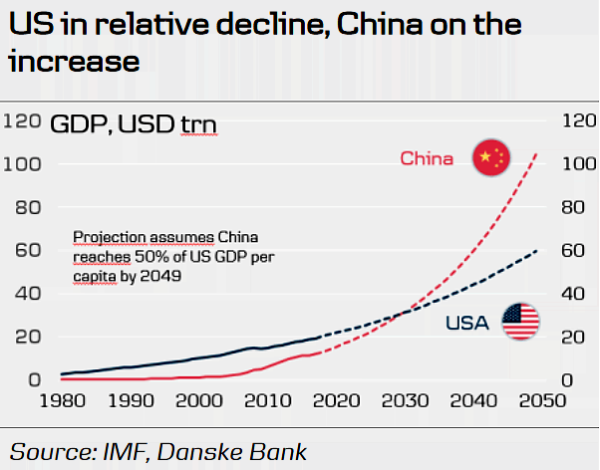
Look at the chart below. The chart explains everything.
It explains why Washington is so worried about China’s explosive growth. It explains why the US continues to hector China on the issues of Taiwan and the South China Sea. It explains why Washington sends congressional delegations to Taiwan in defiance of Beijing’s explicit requests. It explains why the Pentagon continues to send US warships through the Taiwan Strait and ship massive amounts of lethal weaponry to Taipei. It explains why Washington is creating anti-China coalitions in Asia that are aimed at encircling and provoking Beijing. It explains why the Biden administration is stepping up its trade war on China, imposing onerous economic sanctions on its businesses, and banning critical high-tech semi-conductors that are “are essential not just… for virtually every aspect of modern society, from electronic products and transport to the design and production of all manner of goods.” It explains why China has been singled-out in the US National Security Strategy (NSS) as “the only competitor with both the intent and, increasingly, the capability to reshape the international order.” It explains why Washington now regards China as its biggest and most formidable strategic adversary that must be isolated, demonized and defeated.
The chart above explains everything, not just the hostile diplomatic jabs that are designed to discredit and humiliate China, but also the openly belligerent policies that are aimed at Russia as well. People need to understand this. They need to see what is really going on so they can put events in their proper geopolitical context.
And what “context” is that?
The context of a Third World War; a war that was thoroughly-planned, instigated and (now) prosecuted by Washington and Washington’s proxies. That’s what’s really going on. The increasingly violent conflagrations we see cropping-up in Ukraine and Asia are not the result of “Russian aggression” or “evil Putin”. No. They are the actualization of a sinister geopolitical strategy to quash China’s meteoric rise and preserve America’s dominant role in the world order. Can there be any doubt about that?
No. None.
This is why we are experiencing the redivision of the world into warring blocs. This is why we are seeing the roll back of 30 years of Globalization and massive suppyline disruption. And this is why Europe has been thrust headlong into frigid darkness and forced deindustrialisation. All of these suicidal policies were concocted for one purpose and one purpose alone, to maintain America’s exalted spot in the global system. That is why all of humanity is presently embroiled in a Third World War; a war that is designed to prevent China from becoming the world’s biggest economy; a war that is designed to preserve US global primacy. Check out this excerpt from an article at the World Socialist Web Site:
An October 19 Financial Times article by Edward Luce, entitled “Containing China is Biden’s explicit goal,” sounded the following alarm: “Imagine that a superpower declared war on a great power and nobody noticed. Joe Biden this month launched a full-blown economic war on China—all but committing the US to stopping its rise—and for the most part, Americans did not react.
“To be sure, there is Russia’s war on Ukraine and inflation at home to preoccupy attention. But history is likely to record Biden’s move as the moment when US-China rivalry came out of the closet.”
Moreover, last week, a top Biden administration official indicated that the US was preparing new bans on China in key hi-tech areas. Speaking at the Center for a New American Security, Alan Estevez, the under-secretary of Commerce for Industry and Security, was asked if the US would ban China from accessing quantum information science, biotechnology, artificial intelligence software or advanced algorithms. Estevez admitted that this was already being actively discussed. “Will we end up doing something in those areas? If I was a betting person, I would put down money on that,” he said….
Luce concluded his Financial Times article cited above by declaring: “Will Biden’s gamble work? I’m not relishing the prospect of finding out. For better or worse, the world has just changed with a whimper not a bang. Let us hope it stays that way.”…(“Biden’s technology war against China”, World Socialist Web Site)
Once again, look at the chart. What does it tell you?
The first thing it tells you is that the hostilities we see in Ukraine (and eventually Taiwan), can be traced back to a fundamental shift in the global economy. China is growing stronger. It’s on a path to overtake the United States economy within the decade. And with growth, come certain benefits. As the world’s biggest economy, China will naturally become Asia’s regional hegemon. And, as Asia’s regional hegemon it will be able “to settle regional disputes in its own favor and to de-legitimize U.S. regional and global leadership.”
Can you see the problem here?
For nearly two decades, the US has oriented its foreign policy around a “rebalancing of forces” strategy called the “pivot to Asia”. In short, the US intends to be the dominant player in the world’s most populous and prosperous region, Asia. Can you see how China’s rise derails Washington’s plan for the future?
The United States is not going to let this happen without a fight. Washington is not going to let China muscle-it-out of the markets that it plans to dominate. That’s not going to happen. And if you think that’s going to happen, you’d better think again. The United States will go to war to avoid a scenario in which the US plays “second fiddle” to China. In fact, the foreign policy establishment has already decided that the US will engage China militarily for that very objective.
So, our thesis is simple; we think WW3 has already begun. That’s all we’re saying. The ructions we see in Ukraine are merely the first salvo in a Third World War that has already triggered an unprecedented energy crisis, massive worldwide food insecurity, a catastrophic break-down in global supply lines, widespread and out-of-control inflation, the steady reemergence of extreme nationalism, and the redivision of the world into warring blocs. What more proof do you need?
And it’s all economic. The origins of this conflict can all be traced back to the seismic changes in the global economy, the rise of China and the unavoidable decline of the United States. It is a case of one empire replacing the other. Naturally, a transition of this magnitude is going to generate tectonic changes in global distribution of power. And along with those changes will come more flashpoints, more devastation, and the looming prospect of nuclear war. And this is precisely how things are playing out.
So, how does the chart explain what is happening in Ukraine?
Washington’s proxy war in Ukraine is actually aimed at China not Russia. Russia is not a peer competitor and Russia does not have the economic wherewithal to displace the United States in the global order. NordStream, however, did pose a significant risk to the US by greatly strengthening Moscow’s economic relations with the EU and particularly with Europe’s industrial powerhouse, Germany. The Moscow-Berlin alliance—which was mutually beneficial and key to German prosperity—had to be sabotaged to prevent further economic integration that would have drawn the continents closer together into the world’s biggest free trade zone.Washington had to stop that in order to preserve its economic stranglehold on Europe and defend the dollar as the world’s reserve currency. Even so, no one expected the US to blow up the pipeline itself in—what appears to be—the greatest act of industrial terrorism in history. That was truly shocking.
In essence, Washington sees Russia as an obstacle to its “pivot” plan to encircle, isolate and weaken China. But Russia is not the greatest threat to US global primacy; not even close. That designation belongs to China.
The Third World War is being waged to contain China not Russia. What the war in Ukraine suggests is that—among foreign policy elites—there is general agreement that, The road to Beijing goes through Moscow. That appears to be the consensus view. In other words, US powerbrokers want to weaken Russia in order to spread US military bases across Asia. Ultimately, the military will be called upon to enforce Washington’s economic rule over its new Asian subjects. If that day ever comes.
We think it is extremely unlikely that Washington’s ambitious plan will succeed, but we have no doubt that it will be implemented all the same. Tens of millions of people are likely to die in a desperate attempt to turn-back the clock to the fleeting ‘unipolar moment’ and the equally short-lived American Century. It is a tragedy beyond comprehension.