FT : What the end of the US shale revolution would mean for the world

What the end of the US shale revolution would mean for the world
Fracking catapulted America to the top of the energy hierarchy, but low yields and a lack of reinvestment threaten that position

When the Decathlon, a 274-metre-long tanker, powered into the German port town of Wilhelmshaven last month it was tangible evidence of American geopolitical power.

Days earlier, an EU embargo on Russian seaborne crude had come into force, threatening yet more disruption in global energy markets. As the Decathlon unloaded its cargo, American oil was arriving in the nick of time.

Russia’s invasion of Ukraine has precipitated a global energy crisis — and the US has been among the biggest beneficiaries. As Moscow has cut natural gas shipments to Europe and western sanctions have targeted its oil, American exports of both have soared. About 500 tankers laden with American oil have sailed to Europe since February 2022, according to data firm Oilx, helping US crude exports hit a record high last year.

The milestone marked the apogee of the shale revolution — a 15-year energy and technology upheaval in which fracking made the world’s largest consumer of oil and gas also its biggest producer. Rapid shale growth delivered a huge stimulus to the global economy by keeping fuel prices low, and freed Washington’s hands to take on oil-rich rivals in Iran and Venezuela without fear of economic blowback for voters at home.

Soaring shale oil output helped soothe volatile crude markets — even as the Arab Spring brought turmoil to Middle Eastern producers and fresh conflict erupted in northern Iraq and the Arabian peninsula, including attacks on Saudi oil infrastructure. Today, the flotilla of American oil and gas exports traversing the Atlantic has helped to neutralise Vladimir Putin’s energy war.


The golden age of shale “vaulted the United States back to the top of the table in terms of geopolitical significance”, says David Goldwyn, a former senior energy adviser to Barack Obama and head of Goldwyn Global Strategies, a Washington consultancy. “The US is no longer in a position where it has to worry about the physical supply of oil or gas . . . and that gives it a great deal more freedom of action in international affairs.”

Additionally, the cumulative abundance of shale supply delivered over the past 15 years continues to shelter Americans from the sky-high natural gas and fuel prices that have rattled other developed economies, giving its industry a competitive advantage and its households more disposable income.

But that transformative age is drawing to a close, say analysts, with unpredictable consequences. High costs and labour shortages now bedevil the shale patch. Wall Street wants profits paid back to investors, not reinvested in new rigs. Even with crude prices at $80 a barrel, a price far above the long-term average, shale producers still fear to splurge capital. To top it off, new wells are yielding less oil.

“The aggressive growth era of US shale is over,” says Scott Sheffield, chief executive of Pioneer Natural Resources, the country’s biggest shale producer. “The shale model definitely is no longer a swing producer.”

There are scenarios where this might not matter: if China’s economy keeps sputtering and Russian oil exports remain robust, despite sanctions, then oil markets should be well supplied. And if an energy transition takes off quickly, the world may cope without fast-growing American oil supply. Indeed, some environmentalists will welcome slower fossil fuel growth from a major supplier.


But the evidence that the world’s consumers are losing their thirst for oil is thin, despite some governments’ efforts to decarbonise their economies and lower emissions. The International Energy Agency says the world will burn another 1.7mn barrels a day in 2023, reaching a record high of almost 102mn b/d. Goldman Sachs forecasts a demand leap this year of 2.7mn b/d, pushing oil prices back above $100 a barrel.

As the established global energy order rapidly unravels, the world may be entering a phase of yet more oil market volatility, analysts and executives warn.

This will be a problem for oil-importing countries, but an era of renewed power for some, especially Saudi Arabia, the United Arab Emirates and the other petrostates that form the Opec producer group.

Shale became the “readily available spare capacity that could compete with Opec, creating what we then called the ‘new oil order’,” says Jeff Currie, global head of commodities research at Goldman Sachs. “Today that flexibility is gone, pushing us back to the ‘old oil order’ of Opec dominance.”

Wil VanLoh, head of Quantum Energy Partners, one of the shale patch’s biggest private equity investors, puts it another way. “The world was really lulled into sleep by the success of the shale revolution,” he says. “The US took control of prices from Opec, because we became the sole source of growth for oil supply globally. Until suddenly, all of that changed.”

The shale boom
Nowhere encapsulates shale’s story better than North Dakota’s Bakken field. In the decade to 2020, the state’s oil production rocketed more than sevenfold to almost 1.5mn barrels a day, more than some Opec members produce.

A sleepy agrarian economy became an energy powerhouse. It made Harold Hamm, who bet the farm that he could blast oil from the Bakken’s brittle shales, America’s most famous oilman — and a billionaire.

An oil price crash in 2014 hurt the sector. But the pandemic crash of 2020 was near fatal, unleashing a wave of shale bankruptcies. It was the first sign of shale’s vulnerability, and it compelled then-President Donald Trump to beg Saudi Arabia and Russia to raise prices and spare America’s oil sector.

The Bakken’s output slumped to a little over 1mn b/d and has barely recovered. Just 39 rigs were operating across the field in the first week of January, down from more than 200 a decade ago. Continental Resources, Hamm’s company, has gone hunting for shale resources elsewhere. The Bakken’s heyday is over.

The Permian Basin in New Mexico and Texas has emerged as the new workhorse of the American oil industry. Output has hit a record high in recent months, enhancing its status as the world’s most prolific oilfield. Bumper wages have lured drivers, welders, and pipe fitters back to West Texas oil towns such as Midland and Odessa.

Even so, overall, US oilfield activity is not what it was; the pace of production is increasing at a fraction of the boom times.

As the Bakken and others were still emerging, between 2011 and 2014, US crude output rose each year on average by about 15 per cent. Production more than doubled in the 10 years to 2019, to a high of 13mn barrels a day just before the pandemic crash saw output go into reverse, as companies shut wells, mothballed equipment, and sacked tens of thousands of workers.

Output today remains well below the pre-Covid highs, and is now growing glacially by shale standards despite 18 months of strong oil prices. The Energy Information Administration, a government forecaster, expects supply over the next 12 months will rise by just 250,000 barrels a day, or 2 per cent — unable even to keep up with the forecast rise in the country’s oil demand. Output will only reach a new high again in late 2024.


Even this may overestimate the growth, some consultants believe, given recent falls in the number of operating rigs. Unless activity picks up again, consultancy Energy Aspects said shale’s decline rates would accelerate next year, “possibly even leading to outright year-on-year declines” in US output.

“What was once considered as the supply growth engine of the world may well be nearing its peak,” says Amrita Sen, the consultancy’s head of research.

Wall Street cashes out
Many headwinds now blow across the shale oil sector. Even in the Permian, which during the pandemic became the sole major area of production growth, operators say years of rampant drilling have shrunk the available acreage. The biggest producers there — Pioneer, Chevron, Devon Energy, ConocoPhillips, and a few others — still hold a healthy inventory of top-tier drilling locations, but smaller companies are running low.

Unlike conventional oil production, output from newly drilled shale wells plummets after a year or so of operation. To hold output steady each year, companies must keep drilling more wells. Tens of thousands have been drilled across the US in the past 15 years.

But “well performance and drilling inventory are emerging concerns”, in the shale patch, says Morgan Stanley. Last year, for the first time, the average volume of oil produced from each new well was down on the year before, estimates Rystad Energy, a consultancy.

Some Republicans and drillers blame the Biden administration for discouraging activity, but supply chain bottlenecks are a more tangible drag on the industry.

Goldman Sachs says labour shortages remain “severe”, with the jobs-to-workers gap running at about 20,000 people in recent months. The need to pay higher wages has contributed to rising costs; Enverus, an energy consultancy, says wells cost 30 per cent more to drill last year than in 2021 and expects the price to go up another 12 per cent in 2023.

The average shale well cost just $7.3mn to drill in 2019, but will cost $9mn this year, according to Rystad, while the price of drilling 100 feet has risen from $75,000 in 2020 to $100,000.

Some rigs and essential kit have lain without maintenance for months and now need refurbishing. Even if they had the will and capital to drill more wells, some operators say, they couldn’t do so quickly, given the poor state of some equipment and workforce constraints.

Perhaps the biggest obstacle to growth, however, is Wall Street. Shale’s boom years saw operators consistently outspend cash flows, chewing through tens of billions of dollars of outside capital to fund their drilling binges. Output soared, but the profligacy sparked an investor exodus.

With the help of an oil price recovery, shale operators pulled off a stunning business reversal: reining in capital spending and ploughing the windfall from a buoyant market into dividends and share buybacks. The transformation has made the sector the S&P’s best performer for the past two years — but only at the expense of growth.


“We produced too much oil and competed with Opec,” says Pioneer boss Sheffield. “We actually lowered the price by $20 to $30 per barrel over the past 10 years to the detriment of losing our entire investor base.”

The shift, says Sheffield, has been from an industry that spent 100 per cent of its cash flow on growing production to one that only reinvests 40 to 50 per cent, with the aim of growing between 0 and 5 per cent.

After a decade of deep shale losses, investors are enjoying the new model — and wary of making more risky bets on a sector with a bad record and an uncertain future in a decarbonising world.

“There’s almost no appetite from investors or companies to get back to reinvesting over 100 per cent of your cash flow,” says Arjun Murti, a veteran oil analyst who is now an adviser at Veriten, an energy consultancy. “We are looking at a slower pace of growth. It’s a meaningful development for oil markets.”

Return of the old world order
What is good for Wall Street will also, in this instance, be good for Riyadh.

Shale’s tepid growth is part of a wider period of chronic under-investment in global oil exploration elsewhere, argues Goldman’s Currie, and it will put oil market power — and geopolitical heft — back in the hands of Saudi Arabia and its Opec+ allies.

With decarbonisation on the horizon, investors are less willing to direct funds towards lengthy, expensive projects that often take years to pay off, such as those deep at sea, he argues. They have shifted instead to so-called “short-cycle” projects.

“And where are the world’s short cycle projects? Three places: US shale, Russia, and the Middle East,” says Currie. “You’ve taken out Russia for all the obvious reasons. Now you’re losing the second engine of growth of the three, with the US struggling. That really just leaves you with core Opec: the Middle East Gulf countries.”

This may not be a problem. Saudi Arabia, Opec’s linchpin, has often been a stabilising force in global oil markets. In 2020, it made deep output cuts to prop up prices, helping rescue shale and other producers from oblivion.

But this shift leaves the fate of the global crude market in the hands of countries with which the west has a volatile relationship. Should those producers choose not to ramp up, due to inability or unwillingness, then the only cure to high prices will be a rationing of oil demand, say analysts, probably through recession — akin to the price shock experienced by European natural gas consumers last year.

A hint of what may come was visible last year, when oil prices shot up to more than $130 a barrel after Russian tanks rolled into Ukraine. Shale operators held fast to their capital restraint, despite repeated pleas from the White House for more oil supply. It was an example of the kind of price discovery that will be a feature of a market lacking a supplier to rival Opec, argue some analysts.

“[The market] went up to test where some poor consumer can’t afford this anymore — and I think we found this at around $120 [a barrel],” says Raoul LeBlanc, vice-president for North American unconventionals at S&P Global Commodity Insights. “Because if the supply wasn’t going to happen, then it had to go to demand. And that’s where it went.”

But leaving the market to solve the problem does not make for good politics — especially in America — or comfortable geopolitics, especially during an era of unprecedented turmoil.

That is one reason why a Biden administration that entered office pledging to crack down on fracking has spent months fruitlessly imploring shale producers and their investors to ramp up drilling. It has also released millions of barrels of crude from strategic stockpiles, loosened sanctions on Venezuela’s oil sector and dispatched diplomats to Riyadh to ask for more supply.

Weaning the global economy off fossil fuels would help, while also cutting global greenhouse gas emissions — an ambition embedded in the Biden administration’s decarbonisation programme.

This approach, however, relies on bucking a century-old trend of ever-increasing oil consumption despite some forecasters’ models showing climate policy will break the world’s fossil fuel addiction.

“If . . . we end up being more thirsty for oil than the prevailing forecasts assume, then we’ve got big problems,” says Bob McNally, a former adviser to President George W Bush who now runs Rapidan Energy Group.

It would be an era of “economy-wrecking, geopolitically destabilising, boom and bust swings”, adds McNally. “That’s when you will wish for more shale.”
FT : US regulators crack down on private equity securitisation vehicles

US regulators crack down on private equity securitisation vehicles
Insurers would no longer be allowed to rely on rating agencies’ assessments of collateralised fund obligations

US regulators are cracking down on a type of investment vehicle used by private equity groups over fears that rating agencies are downplaying the dangers of the products and exposing insurers to under-appreciated risks.

The vehicles are known as “collateralised fund obligations” and echo the “collateralised debt obligations” that played a central role in the 2008 financial crisis. They parcel up stakes in hundreds of private equity-owned companies into products that are meant to diversify risk and win stellar credit ratings as a result.

But the National Association of Insurance Commissioners is moving to take over assessment of the products for US insurers, some of the main investors in the vehicles.

The planned move by the NAIC, which represents US insurance regulators, comes after a year-long investigation found that rating agencies can understate the risk of CFOs to insurers, according to people familiar with the matter. It is similar to steps the regulator took to rein in mortgage-backed securities in the wake of the financial crisis.

The changes “could have a profoundly adverse impact on the development and the issuance of CFOs”, said one adviser who has worked on several CFOs. The regulator’s involvement is “a huge deal”, they added.

The plans have taken the industry by surprise, said one executive working on plans to launch a CFO. “The NAIC has introduced a lot of uncertainty into the market and it has frozen a lot of activity.”

“It is not surprising that entities that have benefited financially by exploiting gaps in the NAIC’s regulatory guidance would be distressed when those deficiencies are being remediated by state regulators whose objective is the financial solvency of US insurers,” the NAIC told the Financial Times.

A CFO is, in effect, a box containing stakes in a range of different private equity funds, as well as private real estate, credit and infrastructure funds, in some cases. Typically, a CFO issues equity and senior and junior bonds, which offer fixed interest payments funded by cash that the funds pay out to their investors.

The NAIC has raised concerns about “the many . . . private layers” of CFOs. Its crackdown will also target similar structures.

The lack of disclosures of the assets underlying a CFO “den[ies] regulators, and possibly insurer investors, transparency into the true underlying risks, credit exposure and nature of the investment”, the NAIC said in a November report.

Some of the biggest names in the private equity industry, such as KKR and Blackstone, have issued CFOs, but the size of the mostly private market is almost impossible to measure.

The planned crackdown comes as several large financial institutions are considering setting up CFOs for the first time. Executives at JPMorgan Asset Management have held talks about potentially setting up a CFO, though no decision has been taken, according to a person with knowledge of the talks. JPMorgan declined to comment.

The private equity firms Eurazeo and Ardian have also discussed setting up CFOs, two people with knowledge of the matter said. Eurazeo and Ardian declined to comment.

One senior executive whose business stands to be hit by the reform said the move was “a huge land-grab” by the NAIC. “The regulator is being a market participant,” they said.

“The NAIC is not a ‘market participant’ but does respond when necessary to investment innovations . . . that are oftentimes used by market participants to circumvent regulatory guidance,” said the regulator, adding it is a non-profit organisation.

Under the current system, insurers can invest in CFOs at a low risk-based capital charge of less than 1 per cent. If the same insurer invested in the underlying private equity funds directly, it would face a much higher charge of as much as 30 per cent.

The NAIC report said it wanted to “eliminate this version of risk-based capital arbitrage”. Its new rules, which could be introduced this summer if US state-level insurance regulators agree them, would force insurers to share details of the product they were investing in with the NAIC, whose assessment would help determine the risk-based capital charge.

Fitch and KBRA rate CFOs, and S&P Global has rated ones set up by a unit of the Singapore state-owned investor Temasek. Typically, the ratings are paid for either by the organisations that issue the CFOs or by the investors in them.

Greg Fayvilevich, a senior director in Fitch’s funds and asset management business, said that while “some of the riskier structures may fall out” he thought “more diversified, traditional” deals were likely to continue.

KBRA said it was “aware of the NAIC’s efforts” and added: “We are always transparent and welcome the opportunity to discuss our rigorous analytical approach with the market.” S&P Global Ratings declined to comment.

Miss Tweed : What to expect for luxury this year

What to expect for luxury this year
By Astrid Wendlandt
15/01/23
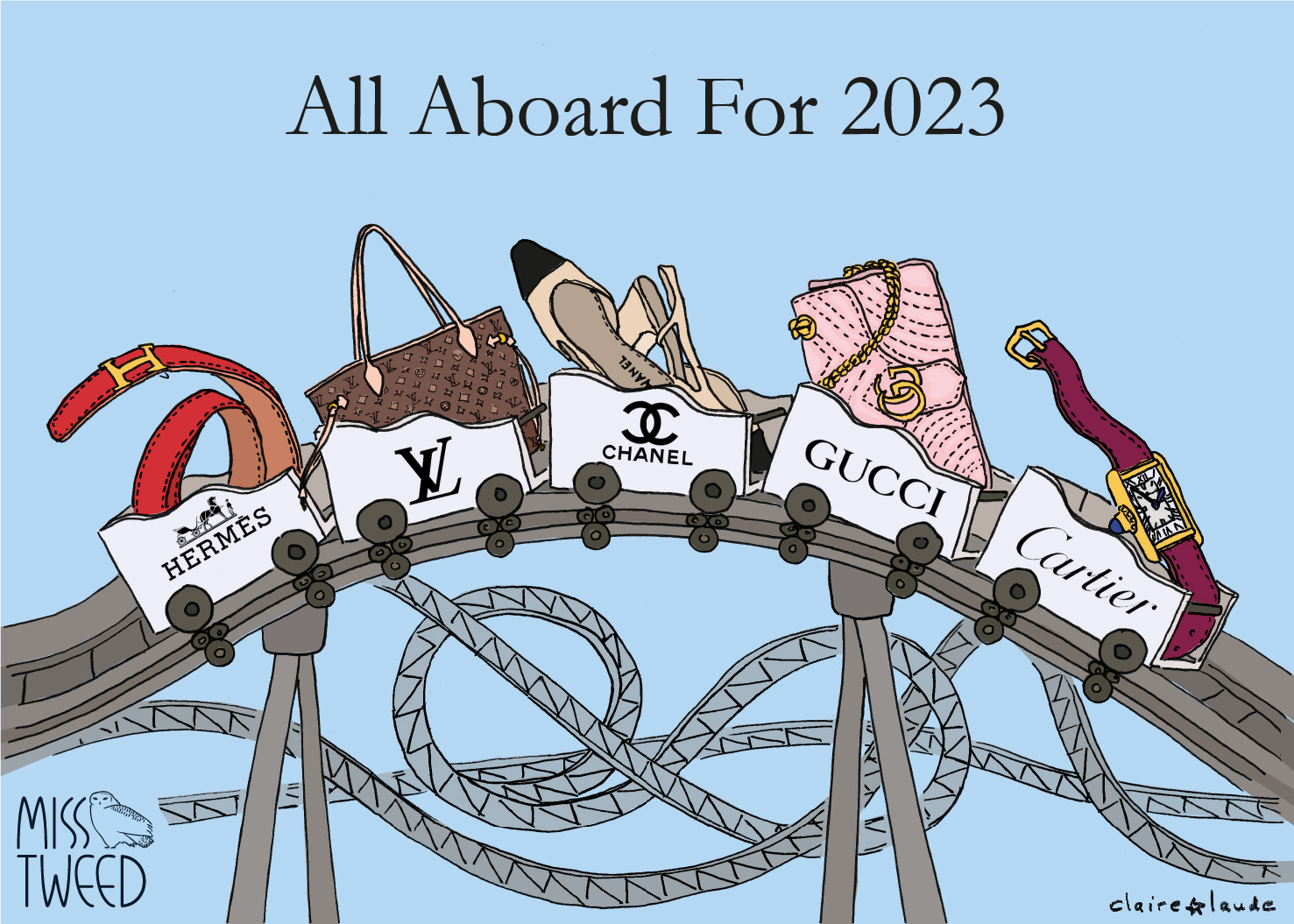
The luxury goods industry is set to defy concerns about a global economic recession and rampant inflation thanks to a faster-than-expected re-opening of the Chinese market and price hikes of bestsellers. However, analysts predict the sector will grow at a slower pace than in 2022 and some luxury groups will fare better than others.
Management and designer changes at Kering, Richemont and LVMH are also on the cards. Miss Tweed has the details.
Brokerage Bernstein expects a normalization of Western demand as “America and Europe sober up from the post-pandemic euphoria and cope with a deteriorating macro-economic environment”. It expects Chinese luxury demand to rebound by between 25% and 35% in 2023 and Western demand to continue to grow by between 5% and 10%. The combined effect should drive like-for-like luxury sales to the mid-teens level.
Rival UBS has published lower forecasts. It sees luxury organic sales up by only 9 percent in 2023 against 16 percent in 2022. The broker says: “Valuations still below recent peaks suggest the market is still not pricing in the potential upside from China re-opening… The higher valuations were put to the test in 2022 amid rising interest rates, which the sector weathered well thanks to the resilience of demand. We believe that now a return of the Chinese luxury consumer could drive a return to peak valuations.”
The Chinese consumer will represent around 17 percent of sales in 2022 versus 33 percent in 2019, and that proportion will grow in 2023, UBS predicts.
Chinese shoppers may be coming back with a vengeance but their return’s full impact will only start being felt in March or April, analysts and industry insiders forecast. They will first travel to Hong Kong, which re-opened its borders with mainland China on Jan. 8, and to other places like Macau, Korea and Japan, before venturing as far as Europe or the United States, they say.
Western brand managers expect Chinese tourists will return to their shops in the spring. And the Chinese lady pushing that chic entrance door will more likely be a member of the ultra-wealthy elite, ready to spend a sizeable amount, than an aspirational middle-class shopper looking to buy her first Louis Vuitton handbag. The return of the Chinese also means many brands will need to hire more staff and may have to drop their new-found habit of making people queue in front of the shop until an assistant is free to chaperone them, a trend Miss Tweed reported on last year. Indeed, customers have been irritated to be told they had to wait to spend their money on luxury goods.
“Ironically, European luxury stores seem to find it difficult to cater to locals plus American and Middle Eastern tourists at present,” said Erwan Rambourg, global head of consumer and retail research at HSBC. “So a return of Chinese tourists will put some pressure on managers to be creative when it comes to appropriately welcoming more consumers in European stores.” Rambourg expects luxury sales will receive an artificial boost from Chinese shoppers in the second quarter as the comparative basis will be favorable. Sales in China were down in high double digits for many brands last year.
Even though the prices of popular Dior and Chanel handbags have already risen by 20 percent or more in the past two years, many brands are forecast to further lift prices this year, particularly in Europe where the depressed euro has made luxury goods cheaper than in other regions. Some analysts expect prices to rise by more than 10 per cent in Europe and in single digits in the U.S. and China.

KERING
The year 2023 will mark a turning point for Kering. The French group needs to get Gucci to regain momentum by hiring a new designer and generally infuse new life into the brand. But it may take some time, as most high-profile designers already working for other brands will be tied to non-competition agreements in their contracts, preventing them from starting in the next 6-12 months. “We expect the brand to lag behind its peers again in 2023 due to the transition associated with its creative director change and the overall muted brand momentum, which could also limit its pricing power even in a higher inflationary environment,” UBS said.
Kering is also facing pressure to renew its top leadership, which has lost the confidence of some investors. They were less than pleased to discover that Kering had not planned the succession of outgoing designer Alessandro Michele, who left the brand abruptly at the end of November.
Kering CEO François-Henri Pinault needs to reassure investors that he is in charge, not his strongman, Gucci CEO Marco Bizzarri, who has influenced many of the group’s strategic decisions. The fact that Pinault told WWD Bizzarri would stay in place and lead the brand in the post-Michele period is hardly reassuring. It means he does not see the future of the group without him. Bizzarri is directly responsible for Gucci’s underperformance in the past three years.
“He has my full trust. He already had,” Pinault told the trade publications at Gucci's fall 2023 men's fashion show in Milan on Friday. “It’s so obvious that Marco is the CEO for this next chapter of Gucci for sure.”
Then there is the question of Balenciaga, sucked into a scandal after publishing a series of ads that sexualized children. How fast will the brand recover from the media storm that followed that? Will CEO Cedric Charbit take responsibility and leave in six months when a replacement can be found? And what kind of fashion will Demna Gvasalia, designer of the offending bondage teddy bears, produce if he needs to censor himself?
Saint Laurent is now Kering’s fastest-growing brand and one of the group’s most important sources of good news for investors. Here it is possible that CEO Francesca Bellettini will move on after 10 years at the helm. On the other hand, industry experts say it would be a shame to destroy the winning duo Bellettini forms with designer Anthony Vaccarello.
Bottega Veneta is expected to continue to grow nicely, although under designer Matthieu Blazy, who arrived in late 2021, it may not expand as fast as it did under Daniel Lee, who has gone to work for Burberry. With Blazy, Bottega Veneta has renewed its focus on its traditional intreccio leather weaving, for which it is famous. This low-risk approach may excite customers less than Lee’s hot designs, such as his pouch bag and bright green mules, but could pay off in the long run.
In terms of strategy, Kering should soon provide an update on its plans to build a beauty unit from scratch, industry sources say. “Diversifying into beauty is not clear-cut from an investment perspective, as it all depends on how much they can grow the business and how much it will cost to get the Gucci license back from Coty,” Rambourg said. As Miss Tweed has reported, U.S.-listed Coty holds the Gucci license for at least another four years. It is estimated to generate $450-$500 million in annual revenue, which is way below Kering’s expectations, considering the brand has grown significantly in the past seven years.

RICHEMONT/FARFETCH
High up on the priority list for Cartier owner Richemont is supporting Farfetch in its attempt to turn around Yoox-Net-A-Porter. There is also concern that Richemont’s hierarchic top-down corporate culture clashes with Farfetch’s well-meaning philosophy. This may create some disruption at the online luxury specialist. The London-based company should make some senior leadership changes in the next six months, analysts predict. CEO José Neves is under pressure from investors to strengthen the company’s leadership. However, he has been resisting attempts to get him to relinquish control and pass on the daily running of the company to somebody else. This adds another layer of unpredictability to Farfetch’s stock price which has melted to $5 from $28 in the past year.
As Miss Tweed reported in December, Richemont’s biggest fashion brand Chloé may have to recruit a new designer, as Gabriela Hearst is proving difficult for the CEO and staff to work with. The storied French brand, founded by Gaby Aghion in 1952 as an alternative to the formality of couture, has been the property of Richemont since the 1980s. It became profitable last year thanks to drastic cost-cutting.
Another question is what will happen to AZ Factory, the fashion start-up Richemont has been backing since its inception? Since its much-fêted founder, former Lanvin designer Alber Elbaz, died in April 2021, only three months after the brand’s launch, AZ Factory has been turning itself into a platform for young designers. But that business model is difficult to turn into a profit-making venture, industry insiders say.
Department stores are not willing to commit to purchasing products from designers customers hardly know. As Miss Tweed reported last December, the high turnover in creative directors does not give potential clients enough time to get to know their work and stories. It is not clear how long Richemont will continue to fund the company. It may choose to turn it into a foundation, which would make more sense than trying to squeeze cash out of it like blood from a stone.

LVMH
LVMH’s Dior has achieved the industry’s most impressive growth rates for a brand of its size. Analysts estimate Dior’s revenue to have risen fourfold in five years to reach more than €8 billion in 2022. In 2023, growth is likely to slow, not because Dior will be led by a new CEO but because the comparative basis will be high. The company will also need to adjust to its bigger size, hire more staff and organize its management structure in view of recent changes.
The big news, of course, is that Delphine Arnault, the 47-year-old daughter of LVMH CEO Bernard Arnault, is to become CEO of Dior as of Feb. 1st, as Miss Tweed was first to report this week. Charles Delapalme, who was in charge of retail, will be managing director.
From now on, Delapalme will handle everyday affairs at Dior while Delphine Arnault will mainly look after products. Their personalities could not be more different.
She may be competent from a design point of view but she is not known for being the warmest, most empathic luxury executive in the world. He has a reputation for being a stickler. “Charles Delapalme is a pretty disciplined person and into optimization,” one industry insider said.
But who knows? If he and Delphine alternate in the roles of “good cop” and “bad cop”, their dynamics might just work.

(ZH) Visualizing The Biggest Global Risks Of 2023

Visualizing The Biggest Global Risks Of 2023

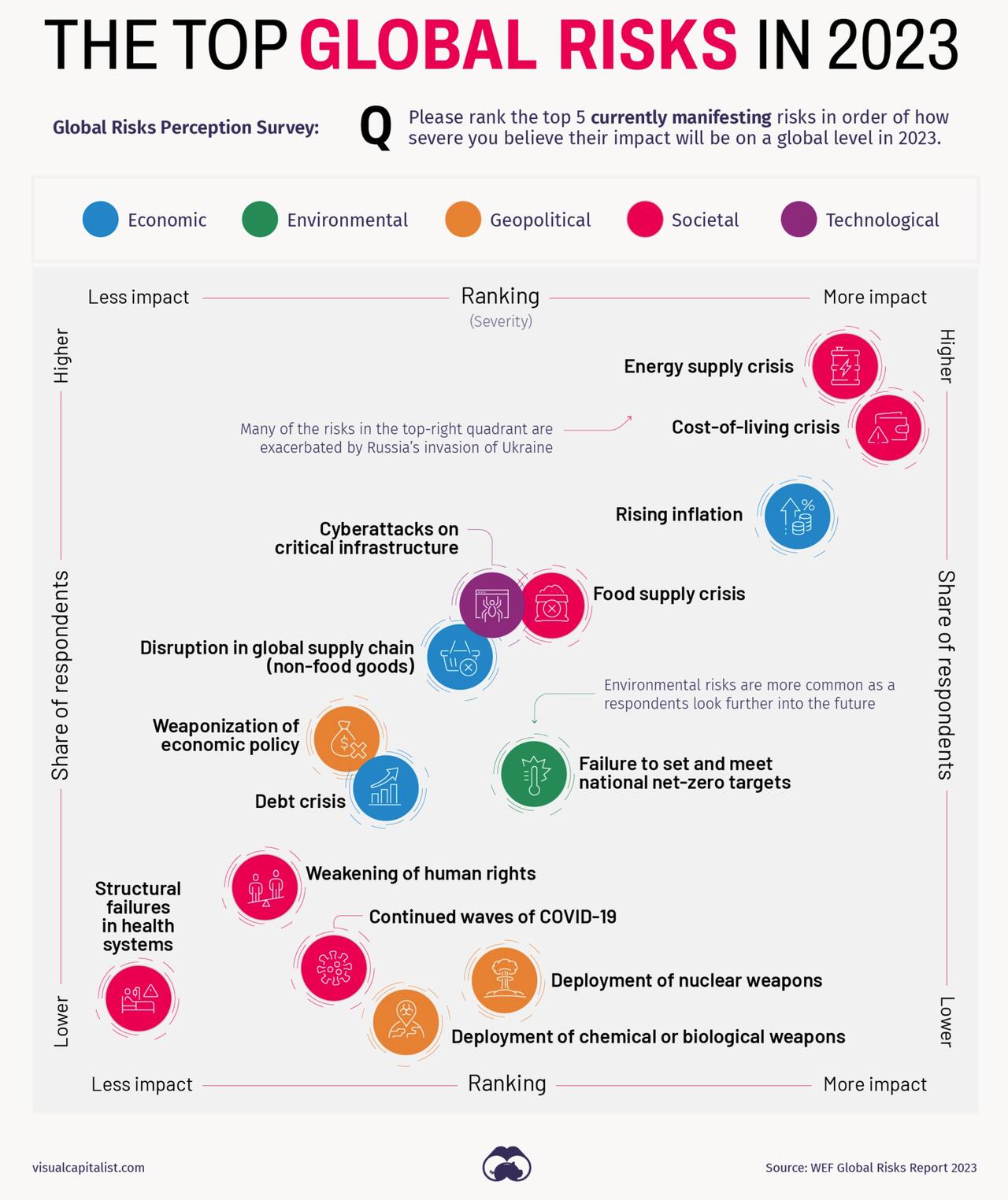
The profile of risks facing the world is evolving constantly. Events like last year’s invasion of Ukraine can send shockwaves through the system, radically shifting perceptions of what the biggest risks facing humanity are.
Visual Capitalist's Nick Routley created the graphic below to summarize findings from the Global Risks Report, an annual publication produced by the World Economic Forum (WEF).
It provides an overview of the most pressing global risks that the world is facing, as identified by experts and decision-makers.
These risks are grouped into five general categories: economic, environmental, geopolitical, societal, and technological.
Let’s dive into this year’s findings.

2023’s Risk Profile
In the lower–middle portion of the chart are the risks that could have serious impacts—such as attacks involving nuclear or biological weapons—but that were highlighted by fewer experts.
Over in the top-right quadrant of the chart are the risks that a number of experts mentioned, and that are causing a strain on society. Not surprisingly, the top risks are related to issues that impact a wide variety of people, such as the rising cost of living and inflation. When staples like food and energy become more expensive, this can fuel unrest and political instability—particularly in countries that already had simmering discontent. WEF points out that increases in fuel prices alone led to protests in an estimated 92 countries.
One risk worth watching is geoeconomic confrontation, which includes sanctions, trade wars, investment screening, and other actions that have the intent of weakening the countries on the receiving end. Efforts to mitigate this risk result in some of the key themes we see for the coming year. One example is the onshoring of industries, and “friend-shoring”, which is essentially moving operations to a foreign country that has more stable relations with one’s home country.

How Prepared Are We?
It’s one thing to be aware of risks, but it’s quite another to have the ability to head off negative events when they come to fruition.
The chart below is a look at how prepared we are globally to deal with specific types of risks that could arise in the next few years.
At the top of the chart are risks that experts feel society is better equipped to handle with current plans and resources. Moving towards the bottom of the chart are risks that experts feel are more of a threat since mechanisms for handling them are weak or non-existent.
Experts are generally more confident in solutions in the military or healthcare domains. Environmental and societal challenges leave policy and decision-makers less confident.
One telling observation from the data above is that none of the risks left a majority of experts feeling neither confident in our ability to prevent the risk from occurring, or prepared to mitigate its impact. As the 2020s are shaping up to be a turbulent decade, that could be a cause for concern.

Eugyppius : Energy Transition Farce Continues in Germany

Energy Transition Farce Continues in Germany: Regulators, fearing outages, announce plans to ration power for environmentally friendly, state-promoted electric vehicles and heat pumps
Once again: You can have intermittent windmill power, or you can put everyone in a battery-powered car, but you can't do both.

Klaus Müller, the president of the German Federal Network Agency [which regulates gas and electricity], has warned that the growing number of private electric car charging stations and electric-powered heat pumps could overload the power grid in Germany. “If very large numbers of new heat pumps and charging stations continue to be installed, then we’ll have to worry about overload problems and local power failures … if we do not act” …
According to the report, the … regulatory authority considers local low-voltage grids to be particularly susceptible to disruptions. The Agency has therefore published a strategy paper planning to ration the power consumption of heat pumps and electric car charging stations in times of high network utilisation. … Grid operators would then be forced to throttle the power supply to these systems … The plans for electricity rationing are slated to come into effect on 1 January 2024 …
Even in the event of power rationing, private charging stations would be able to draw enough power to charge an electric vehicle battery within three hours for a range of 50 kilometres, he said. Additionally … “nearly trouble-free continued operation” should still be possible for a large number of heat pumps.
It’s just great to hear that your driving might be limited to a 50-kilometre radius at any moment without notice, and also that your heaters will probably mostly work most of the time. This is what you get in Germany, for bending to generous state subsidies and messaging campaigns intended to accelerate the “energy transition,” a magical fantasy world of the future where everything will be powered by windmills and everyone will eat bio granola and wear Birkenstocks.
The Ukraine war is a catastrophe, but it has done us at least one crucial favor, by accelerating the German energy crisis. Because the truth is that we were always going to end up here, with too many electrical things and too little electricity to power them. It was just supposed to happen two or three decades from now, long after the reigning cast of Green luminaries had retired from public life.
Instead, all of these clowns are facing the mathematically certain and long-predicted consequences of their false promises right now. And it looks like their most committed supporters will be the first to suffer for their foolishness.

FT : Risky US corporate bonds rebound strongly as inflation threat recedes

Risky US corporate bonds rebound strongly as inflation threat recedes
Rally in junk-rated debt drives yields down since start of 2023

Risky corporate bonds trading in the US have kicked off 2023 on an upbeat note, with investors tolerating a smaller premium to hold low-grade debt as evidence of cooling inflation mounts.

Yields on speculative-grade US bonds have fallen by about 0.8 percentage points in the first two weeks of January to slightly more than 8 per cent, according to an ICE Data Services index, signalling a rise in the debt’s price.

Borrowing costs for groups with the lowest credit quality have dropped even more, according to an Ice gauge of distressed debt, sliding about 3 percentage points to 19.3 per cent — a level last seen five months ago.

Those improvements follow a heavy sell-off in low-grade bonds along with other riskier asset classes last year as the US central bank rapidly boosted interest rates.

This month’s move partly reflects a rally in US government debt, fuelled by expectations that the Federal Reserve will soften its stance on aggressive interest rate rises in the face of slowing price growth. The decline in benchmark Treasury yields has boosted the appeal of low-rated corporate bonds that typically offer higher returns.

The gulf in yields between junk bonds and Treasuries has also narrowed since the start of January, in a sign that investors are betting on a more benign economic backdrop and a decreasing risk of default.

The spread on US high-yield bonds has tightened by 0.5 percentage points since the end of December to 4.29 percentage points on January 12. The spread for the most distressed junk bonds has diminished by almost 3 percentage points to slightly less than 16 percentage points.


Matt Mish, head of credit strategy at UBS, said inflation had “on balance” been surprising investors “to the downside” recently.

Data on Thursday showed that the US consumer price index eased for a sixth consecutive month in December, to 6.5 per cent.

At the same time, “the growth data on net you could characterise as mixed” for the world’s largest economy, said Mish. “Which is why I think the inflation data, and expectations around how that flows through to Fed policy . . . is really what the market is focused on.”

The recent trimming of credit spreads has come even as the Treasury yield curve — the difference between two- and 10-year government bond yields — remains inverted, which is typically seen by investors as a harbinger of a prolonged economic contraction.

When a short but sharp recession hit during the depths of the coronavirus crisis in 2020, the US high-yield spread shot above 1,000 percentage points.

“I think it’s very hard to make the case that we’ll go through all 2023 without some significant widening in the spread,” said Marty Fridson, chief investment officer at Lehmann Livian Fridson Advisors.

“I don’t think Treasury rates are going to come down far enough to offset a [2, 3 or 4 percentage point] widening,” he added, pointing out that default rates were expected to rise.

“If spreads finish tighter at month-end it would be one positive data point for rest-of-year performance,” UBS’s Mish said.

Fridson noted that the high-yield market “does not have a great record” in providing a reliable alert well in advance of a recession.

“It’s typical that people seem to stay with it, maybe overstay their welcome, figuring, ‘well, I’ll get out before everybody else does’,” he said.

FT : US companies turn to convertible bonds as equity fundraising stalls

US companies turn to convertible bonds as equity fundraising stalls
Market for assets that mix debt and equity is ‘seeing activity’ as valuations steady and economic data offer hope

US companies are turning to convertible bonds as fundraising in Wall Street’s main equities market is at its lowest level for three decades.

December was the busiest month of last year for convertible issuance by deal count according to Refinitiv data, as activity picked up over the second half of 2022. The amount US-based companies raised more than doubled in the second half from the preceding six months, after a sharp earlier slowdown.

Michael Zeidel, head of Americas in law firm Skadden Arps’ capital markets division, said that “for more than 80 per cent of the year, the [convertibles] market was essentially dead” but it had “opened up” in the last two months of 2022 “and we are now seeing activity”.

Extreme volatility and rising interest rates made 2022 the worst year for traditional stock market listings in the US since 1990. Most experts think it will take at least another quarter for IPOs — the most lucrative and high-profile part of the equity capital markets business — to pick up.

But a recent steadying in valuations and encouraging inflation data have prompted a burst of activity in deals deemed to be less risky, especially sales of convertible bonds — debt that includes an equity component.

“Converts are always a market that tends to be interesting to a broader array of companies when other markets are experiencing difficulties,” said Craig McCracken, co-head of equity capital markets at Wells Fargo, “because of their greater certainty of execution”.


Convertibles start out like other corporate bonds, but they include an option enabling investors to swap their debt for equity if the company’s shares rise to a specific price. They can allow businesses to borrow at lower interest rates than a traditional bond, without immediately diluting existing shareholders’ stakes through the sale of new stock.

Like other forms of capital raising, convertible sales dropped in the spring of 2022 as inflation rose — stoked by Russia’s invasion of Ukraine — and monetary policy tightened. Issuance by US-domiciled companies fell almost two-thirds last year, according to Refinitiv data, to just under $27bn.

“This past year was difficult for converts . . . in line with other risk assets,” said Michael Youngworth, convertible bond strategist at Bank of America Global Research.

In an environment where interest rates are expected to remain elevated, as they are this year, “convertible financing becomes more attractive”, according to Youngworth, because it can help companies reduce borrowing costs relative to the ordinary bond market.

Concert giant Live Nation came to the market this week with a convertible bond sale that ultimately increased in size from $850mn to $900mn, implying stronger than expected demand. Some of the proceeds from the sale have been earmarked for buying back older instruments.

“I think we will see more traditional businesses . . . coming to the convertible market to continue to keep interest costs at a reasonable level,” said John McClain, portfolio manager at Brandywine Global Investment Management.

This year, “companies that are in the predicament of needing to finance their business [ . . . ] will have the ability to access a litany of different sources of capital that I think people aren’t giving them credit for”, McClain added.

Convertible deals can also be completed quickly, which is particularly beneficial when markets are volatile and windows of opportunity are short.

“It’s great for issuers because you can be [quickly] in and out of the market,” said Lizzie Reed, head of equity syndicate at Goldman Sachs. “I think it will be particularly active in the first and second quarters as the macro picture stabilises.”

But convertibles are not without risk, and have in recent years been associated with high-flying growth stocks whose valuations tumbled as the Federal Reserve jacked up borrowing costs.

Record numbers of convertibles are now trading at “busted” levels according to BofA, meaning their shares are unlikely ever to reach their conversion price. Globally, about two-thirds of convertibles are currently trading below their par value.

In 2021, “we saw a lot of very aggressive issuers coming to the convertible bonds space”, said Youngworth. “High-growth names that took advantage of their equity prices at all-time highs and the frenzy in equity markets to raise convertible bond capital opportunistically and very cheaply.”

The subsequent spike in interest rates “not only damaged the bond values of the convert”, Youngworth said, “but they also weakened the equity component as well, so converts got hit on both sides of their structure.”

This “resulted in a pretty meaningful sell-off in the asset class,” he said, “and it also helped to dampen the primary market.”

Youngworth’s team is “more optimistic” about 2023. They anticipate $70bn-80bn of issuance globally, with $45bn-48bn stemming from the US.

A brighter performance in the convertible market could also prompt more companies to contemplate IPOs, lawyers and bankers said.

“You’ll need to see . . . more converts that are being successfully priced and successfully traded,” said Wells Fargo’s McCracken. Then, “we’ll just continue going down the risk continuum,” he added, noting that IPOs are “at the riskier end of the overall equity markets”.

WSJ : Despite Easing Price Pressures, Economists in WSJ Survey Still See Recessi

Despite Easing Price Pressures, Economists in WSJ Survey Still See Recession This Year
Forecasters put 61% probability of recession in next 12 months

Despite signs that inflation has started to recede, economists still expect higher interest rates to push the U.S. economy into a recession in the coming year, according to The Wall Street Journal’s latest quarterly survey.

On average, business and academic economists polled by the Journal put the probability of a recession in the next 12 months at 61%, little changed from 63% in October’s survey. Both figures are historically high outside actual recessions.

The Federal Reserve had initially hoped it could bring down inflation with only a slowing in economic growth rather than an outright contraction, an outcome dubbed a “soft landing.” But three-quarters of respondents said the Fed wouldn’t achieve a soft landing this year.

That is despite a slightly more optimistic outlook for inflation. As measured by the year-over-year change in the consumer-price index, inflation has eased from 9.1% last June to 6.5% in December, and economists expect it to fall to 3.1% by the end of this year, a lower endpoint than the 3.3% they expected in the last survey, in October. They see it ending 2024 at 2.4%, little changed from the previous survey.

“While recent inflation prints have shown some progress, a few persistent categories like core services are associated with the historically tight labor market, suggesting that there is still ‘a long way to go’ for the Fed,” Deutsche Bank economists Brett Ryan and Matthew Luzzetti said in the survey. “The Fed would stay on its tightening trajectory to restore the rebalance of labor market and price stability, which in our view would engineer a sharp rise in unemployment and recession,” they added.

Greg Daco, chief economist at EY-Parthenon, said, “While services activity remains robust, the housing sector is tumbling under the weight of elevated mortgage rates and manufacturing activity is stalling—both signaling a broader economic downturn is likely coming.” He expects the combination of persistent inflation, tighter financial conditions and weaker global growth to tip the U.S. economy into a mild recession in the first half of 2023.

While economists don’t think a recession can be avoided, they expect it to be relatively shallow and short-lived, in line with other recent surveys.

On average, they expect gross domestic product to expand at a 0.1% annual rate in the first quarter of 2023 and contract 0.4% in the second. They see no growth for the third quarter and a 0.6% growth rate for the fourth.

Economists expect GDP to stagnate this year, posting growth of just 0.2% in the fourth quarter of 2023 compared with the fourth quarter of 2022. In the WSJ survey in October, economists forecast 0.4% GDP growth in 2023.

While most recessions have included at least two consecutive quarters of negative growth, that isn’t the criterion used by the panel at the National Bureau of Economic Research, a nonprofit academic group, which dates business cycles. A recession is “a significant decline in economic activity that is spread across the economy and that lasts more than a few months,” NBER says on its website. Still, even that definition is loose because NBER ultimately declared the 2020 downturn at the start of the Covid-19 pandemic a recession even though it lasted only two months.

Employers are expected to cut jobs starting in the second quarter through the end of the year, the survey found. For 2023 as a whole, economists expect that payrolls will decline by 7,000 a month on average. That is a sharp downgrade from October’s survey, when economists expected employers to add nearly 28,000 jobs a month over the subsequent four quarters.

Economists view high inflation, and the Fed’s efforts to tame it, as a top risk to the economy this year.

When asked which category of inflation will be the hardest to tame in 2023, a quarter of economists picked housing. A further 18% said healthcare and another 18% picked personal services.

Economists in the survey expect the Fed will need to raise the benchmark federal-funds rate target to 5% this year, in line with central-bank officials’ own projections. The Fed lifted the rate target by a half percentage point in December, to between 4.25% and 4.5%. Fed officials are trying to balance the risk of raising rates too much with the risk of not doing enough to slow down spending and investment, which could allow higher inflation to become entrenched.

Fed officials have signaled they don’t expect to cut rates this year. Economists disagree: 51% expect the Fed to start cutting this year, although that is down from 60% in the last survey. Markets also are pricing in interest-rate cuts this year.

The Fed will start cutting in the fourth quarter of this year, according to 31% of economists. Another 37% expect that in the first quarter of 2024, and 8% expect it in the second quarter of next year.

The Journal surveyed 71 economists, although not every economist answered every question. The survey was conducted Jan. 6-10.

WSJ : BlackRock vs. Goldman in the Fight Over 60/40

BlackRock vs. Goldman in the Fight Over 60/40
Is it time for a new approach to portfolios or was 2022 just a very bad year?

The best-known names in asset management and investment banking are taking opposite sides in the debate over the classic way of building a portfolio—60% stocks and 40% bonds—after a disastrous performance for the 60/40 model last year.

BlackRock BLK 0.00% says the losses—the worst in nominal terms for a 60/40 portfolio since the financial crisis of 2008-9 and the worst in real terms in a calendar year since the Great Depression—show that the structure is outdated. Goldman demurs, arguing that the odd big loss is inevitable in any strategy and that 60/40 remains a valid basic approach. Strategists and fund managers at other large money managers and banks have been piling in on both sides.

Investors should be paying close attention after decades of 60/40’s being accepted at a minimum as a reasonable base on which to construct a portfolio. Abandon it, and investments once considered exotic—BlackRock likes private debt and equity, commodities, infrastructure and inflation-linked bonds—join stocks and bonds as building blocks. Stick with it and they amount to small add-ons to the stock/bond core.

There are decent arguments for and against the 60/40 split as a sensible starting point for a portfolio.

Before getting into them, it is worth considering why 60/40 became the standard (some prefer 50/50 for a bit more caution, or 70/30 for a bit more aggressiveness). It gives an investor decent exposure to growth through the stock element, steady income from the bonds, and a cushion during recessions when stocks often fall hard and bond yields usually fall too, increasing bond prices. Plus, it is easy.

Last year, stocks were down big, and bonds lost money too. The Dow Jones U.S. Total Stock Market index lost 19.5% including dividends, while the ICE BofA U.S. Treasury index lost 12.9%. A 60/40 U.S. portfolio had one of its worst years ever, because the bonds didn’t do what they were supposed to do. The question, then, is whether 2022 was an exception and bonds will now resume normal service.

The best argument for sticking with 60/40, at least as a base, is that it is a decent neutral portfolio when we don’t have any idea about how the future will work out. Bonds have sometimes lost money at the same time as stocks for extended periods in the past, but not often.

“It’s happened [losses on both] in the past—it will happen in the future,” says Sharmin Mossavar-Rahmani, head of the investment strategy group in the Goldman Sachs investment division and chief investment officer of wealth management. “But it’s rare.”

Goldman calculates that U.S. stocks and bonds both lost money over a 12-month period just 2% of the time since 1926. You might reasonably be upset that your investments were caught up in such an unusual loss, but you should make radical portfolio changes only if you think this is the start of something new.

BlackRock argues exactly this. “This is a different regime. The great moderation is over,” says Vivek Paul, head of portfolio research at BlackRock Investment Institute.

After 10-year Treasury yields peaked at 15.8% in 1981, they fell for four decades to a low of 0.5% in 2020, offering surprise long-term capital gains to bondholders on top of the guaranteed income. Better still, from 2000 onward they offered fairly good day-to-day protection against losses on stocks, as the pattern of price moves flipped so bonds and stocks went in opposite directions. (Put another way, stocks tended to rise when bond yields went up, and fell when yields fell). The protection offered by bonds didn’t come at the cost of sacrificing returns.

For sure, 10-year yields can’t drop more than 15 percentage points in the next 40 years, because they currently yield only about 3.5%. The bond-equity link also seems to have returned to the pattern of higher bond yields being bad for stocks, and vice versa, as investors focus on inflationary pressure instead of economic growth. It is reasonable to think this might last given the long-term upward pressure on inflation from deglobalization, demographics and spending to combat climate change.

In a sense this is the active-passive argument played out again. If you, like me, think we’re probably heading for a more inflationary future, it makes sense to hold less in the way of ordinary bonds. But if you aren’t really sure—Ms. Mossavar-Rahmani says the outlook is clouded by “heavy fog,” and she’s not wrong—60/40 is a decent place to start.

A further argument for 60/40 is that many of the things put forward as an alternative portfolio cushion to bonds also had a terrible year last year. You might think Treasury inflation-protected securities would protect against inflation. But rising real yields meant that since the start of last year, TIPS lost almost exactly the same amount as ordinary Treasurys.

Private markets aren’t immune. Being private could mean the fund manager doesn’t tell you that you’ve lost money, but the value of a loan or a company has gone down as interest rates have risen, no matter whether the company is private or listed. And fees are far higher.

Commodities felt like a no-brainer last year, when everyone was obsessed with rising energy prices, metals shortages and inflation. Yet, the spot prices of crude oil, U.S. natural gas, gold and copper are very close to where they started 2022. It wasn’t a buy-and-hold market.

The fundamental problem is that last year the Everything Bubble deflated. Stocks and bonds started out very expensive, as did TIPS and private assets, because they were priced on the assumption of very low interest rates. Once the Federal Reserve recognized reality, the assumption went out the window and prices plunged. With valuations back in the range of reasonable for both stocks and bonds, a 60/40 equity/bond split is a decent starting point for building a portfolio—even if those who worry more about long-run inflation, as I do, might add a little more inflation protection than comes as standard.