What to expect for luxury this year
By Astrid Wendlandt
15/01/23
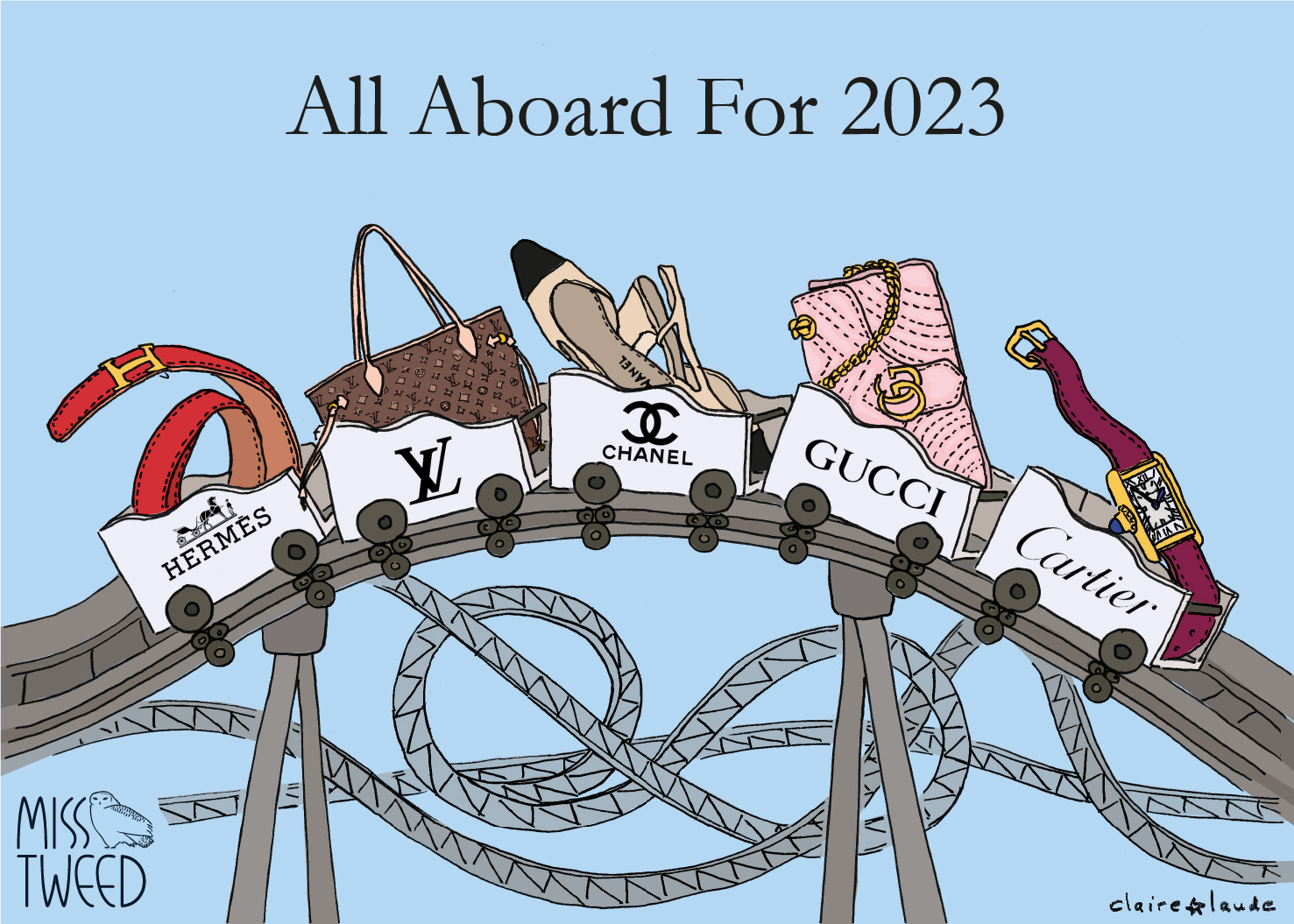
The luxury goods industry is set to defy concerns about a global economic recession and rampant inflation thanks to a faster-than-expected re-opening of the Chinese market and price hikes of bestsellers. However, analysts predict the sector will grow at a slower pace than in 2022 and some luxury groups will fare better than others.
Management and designer changes at Kering, Richemont and LVMH are also on the cards. Miss Tweed has the details.
Brokerage Bernstein expects a normalization of Western demand as “America and Europe sober up from the post-pandemic euphoria and cope with a deteriorating macro-economic environment”. It expects Chinese luxury demand to rebound by between 25% and 35% in 2023 and Western demand to continue to grow by between 5% and 10%. The combined effect should drive like-for-like luxury sales to the mid-teens level.
Rival UBS has published lower forecasts. It sees luxury organic sales up by only 9 percent in 2023 against 16 percent in 2022. The broker says: “Valuations still below recent peaks suggest the market is still not pricing in the potential upside from China re-opening… The higher valuations were put to the test in 2022 amid rising interest rates, which the sector weathered well thanks to the resilience of demand. We believe that now a return of the Chinese luxury consumer could drive a return to peak valuations.”
The Chinese consumer will represent around 17 percent of sales in 2022 versus 33 percent in 2019, and that proportion will grow in 2023, UBS predicts.
Chinese shoppers may be coming back with a vengeance but their return’s full impact will only start being felt in March or April, analysts and industry insiders forecast. They will first travel to Hong Kong, which re-opened its borders with mainland China on Jan. 8, and to other places like Macau, Korea and Japan, before venturing as far as Europe or the United States, they say.
Western brand managers expect Chinese tourists will return to their shops in the spring. And the Chinese lady pushing that chic entrance door will more likely be a member of the ultra-wealthy elite, ready to spend a sizeable amount, than an aspirational middle-class shopper looking to buy her first Louis Vuitton handbag. The return of the Chinese also means many brands will need to hire more staff and may have to drop their new-found habit of making people queue in front of the shop until an assistant is free to chaperone them, a trend Miss Tweed reported on last year. Indeed, customers have been irritated to be told they had to wait to spend their money on luxury goods.
“Ironically, European luxury stores seem to find it difficult to cater to locals plus American and Middle Eastern tourists at present,” said Erwan Rambourg, global head of consumer and retail research at HSBC. “So a return of Chinese tourists will put some pressure on managers to be creative when it comes to appropriately welcoming more consumers in European stores.” Rambourg expects luxury sales will receive an artificial boost from Chinese shoppers in the second quarter as the comparative basis will be favorable. Sales in China were down in high double digits for many brands last year.
Even though the prices of popular Dior and Chanel handbags have already risen by 20 percent or more in the past two years, many brands are forecast to further lift prices this year, particularly in Europe where the depressed euro has made luxury goods cheaper than in other regions. Some analysts expect prices to rise by more than 10 per cent in Europe and in single digits in the U.S. and China.
KERING
The year 2023 will mark a turning point for Kering. The French group needs to get Gucci to regain momentum by hiring a new designer and generally infuse new life into the brand. But it may take some time, as most high-profile designers already working for other brands will be tied to non-competition agreements in their contracts, preventing them from starting in the next 6-12 months. “We expect the brand to lag behind its peers again in 2023 due to the transition associated with its creative director change and the overall muted brand momentum, which could also limit its pricing power even in a higher inflationary environment,” UBS said.
Kering is also facing pressure to renew its top leadership, which has lost the confidence of some investors. They were less than pleased to discover that Kering had not planned the succession of outgoing designer Alessandro Michele, who left the brand abruptly at the end of November.
Kering CEO François-Henri Pinault needs to reassure investors that he is in charge, not his strongman, Gucci CEO Marco Bizzarri, who has influenced many of the group’s strategic decisions. The fact that Pinault told WWD Bizzarri would stay in place and lead the brand in the post-Michele period is hardly reassuring. It means he does not see the future of the group without him. Bizzarri is directly responsible for Gucci’s underperformance in the past three years.
“He has my full trust. He already had,” Pinault told the trade publications at Gucci's fall 2023 men's fashion show in Milan on Friday. “It’s so obvious that Marco is the CEO for this next chapter of Gucci for sure.”
Then there is the question of Balenciaga, sucked into a scandal after publishing a series of ads that sexualized children. How fast will the brand recover from the media storm that followed that? Will CEO Cedric Charbit take responsibility and leave in six months when a replacement can be found? And what kind of fashion will Demna Gvasalia, designer of the offending bondage teddy bears, produce if he needs to censor himself?
Saint Laurent is now Kering’s fastest-growing brand and one of the group’s most important sources of good news for investors. Here it is possible that CEO Francesca Bellettini will move on after 10 years at the helm. On the other hand, industry experts say it would be a shame to destroy the winning duo Bellettini forms with designer Anthony Vaccarello.
Bottega Veneta is expected to continue to grow nicely, although under designer Matthieu Blazy, who arrived in late 2021, it may not expand as fast as it did under Daniel Lee, who has gone to work for Burberry. With Blazy, Bottega Veneta has renewed its focus on its traditional intreccio leather weaving, for which it is famous. This low-risk approach may excite customers less than Lee’s hot designs, such as his pouch bag and bright green mules, but could pay off in the long run.
In terms of strategy, Kering should soon provide an update on its plans to build a beauty unit from scratch, industry sources say. “Diversifying into beauty is not clear-cut from an investment perspective, as it all depends on how much they can grow the business and how much it will cost to get the Gucci license back from Coty,” Rambourg said. As Miss Tweed has reported, U.S.-listed Coty holds the Gucci license for at least another four years. It is estimated to generate $450-$500 million in annual revenue, which is way below Kering’s expectations, considering the brand has grown significantly in the past seven years.
RICHEMONT/FARFETCH
High up on the priority list for Cartier owner Richemont is supporting Farfetch in its attempt to turn around Yoox-Net-A-Porter. There is also concern that Richemont’s hierarchic top-down corporate culture clashes with Farfetch’s well-meaning philosophy. This may create some disruption at the online luxury specialist. The London-based company should make some senior leadership changes in the next six months, analysts predict. CEO José Neves is under pressure from investors to strengthen the company’s leadership. However, he has been resisting attempts to get him to relinquish control and pass on the daily running of the company to somebody else. This adds another layer of unpredictability to Farfetch’s stock price which has melted to $5 from $28 in the past year.
As Miss Tweed reported in December, Richemont’s biggest fashion brand Chloé may have to recruit a new designer, as Gabriela Hearst is proving difficult for the CEO and staff to work with. The storied French brand, founded by Gaby Aghion in 1952 as an alternative to the formality of couture, has been the property of Richemont since the 1980s. It became profitable last year thanks to drastic cost-cutting.
Another question is what will happen to AZ Factory, the fashion start-up Richemont has been backing since its inception? Since its much-fêted founder, former Lanvin designer Alber Elbaz, died in April 2021, only three months after the brand’s launch, AZ Factory has been turning itself into a platform for young designers. But that business model is difficult to turn into a profit-making venture, industry insiders say.
Department stores are not willing to commit to purchasing products from designers customers hardly know. As Miss Tweed reported last December, the high turnover in creative directors does not give potential clients enough time to get to know their work and stories. It is not clear how long Richemont will continue to fund the company. It may choose to turn it into a foundation, which would make more sense than trying to squeeze cash out of it like blood from a stone.
LVMH
LVMH’s Dior has achieved the industry’s most impressive growth rates for a brand of its size. Analysts estimate Dior’s revenue to have risen fourfold in five years to reach more than €8 billion in 2022. In 2023, growth is likely to slow, not because Dior will be led by a new CEO but because the comparative basis will be high. The company will also need to adjust to its bigger size, hire more staff and organize its management structure in view of recent changes.
The big news, of course, is that Delphine Arnault, the 47-year-old daughter of LVMH CEO Bernard Arnault, is to become CEO of Dior as of Feb. 1st, as Miss Tweed was first to report this week. Charles Delapalme, who was in charge of retail, will be managing director.
From now on, Delapalme will handle everyday affairs at Dior while Delphine Arnault will mainly look after products. Their personalities could not be more different.
She may be competent from a design point of view but she is not known for being the warmest, most empathic luxury executive in the world. He has a reputation for being a stickler. “Charles Delapalme is a pretty disciplined person and into optimization,” one industry insider said.
But who knows? If he and Delphine alternate in the roles of “good cop” and “bad cop”, their dynamics might just work.