RIA Advice : Home Prices Will Likely Fall Further

Home Prices Will Likely Fall Further _ Link : http://bit.ly/3D8YLbp

Home prices have started to correct as interest rates rose sharply in 2022. However, the real problem for home prices is still coming in 2023 as the standoff between sellers and buyers comes to a head.
However, before we get there, let’s review how we got here.
Since the turn of the century, there have been two housing bubbles, with home prices reaching levels of unaffordability not previously seen in the United States. Such was, of course, due to lax lending policies and artificially low-interest rates luring financially unstable individuals into buying homes they could not afford. Such is easily seen in the chart below, which shows home equity versus mortgage debt. (Home equity is the difference between home prices and the underlying debt.)
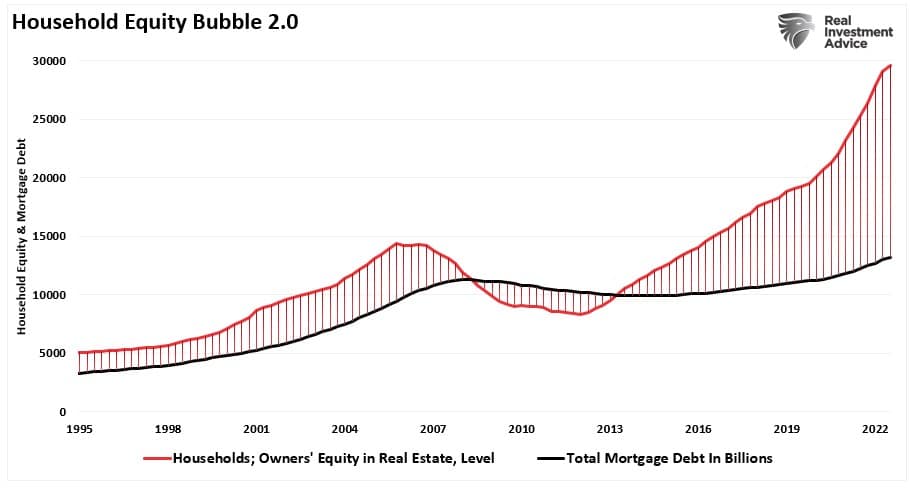
The current surge in home prices makes the previous bubble in 2008 look quaint by comparison.
At that previous peak in 2007, the equity in people’s homes was around $15 trillion, while mortgage debt stood at $9 trillion. When the bubble popped, home prices collapsed, flipping homeowner’s equity from positive to negative. Home equity is roughly $30 trillion, while mortgage debts have increased to roughly $12 trillion. That is an incredible spread, unlike anything seen previously.
However, this time, the surge in home prices wasn’t due to a surge in lax underwriting by mortgage companies but rather the infusion of capital directly to households following the COVID-19 pandemic-driven shutdown.
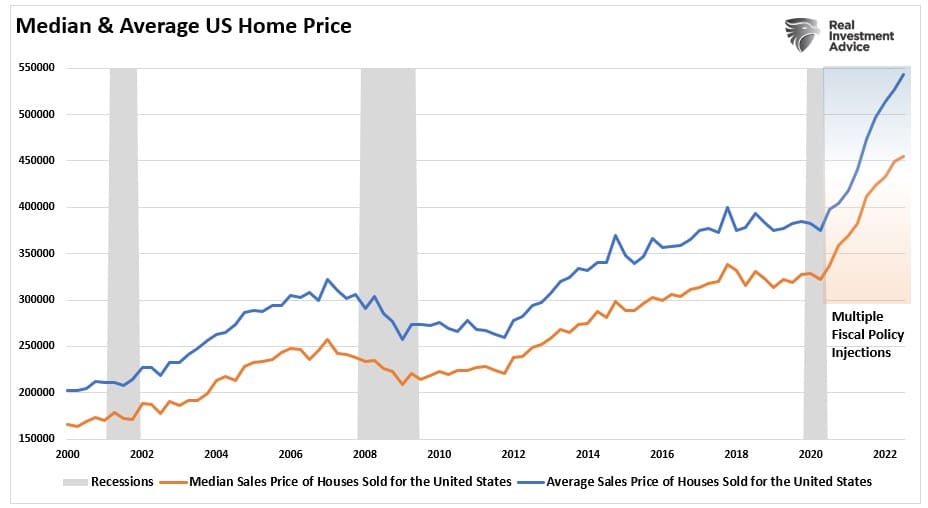
Of course, many young Millennials took that money and jumped into the home-buying frenzy. In many cases, buying sight unseen or willing to pay way over the asking price (thereby inflating home prices.) To wit:
“More and more millennials are sinking huge sums of money into homes they’ve never actually set foot in. While the sharp increase in sight-unseen buying in 2020 was certainly driven by pandemic restrictions, the phenomenon appears to be here to stay, due to the tech-forward nature of millennials and the competitive nature of the housing market.”Insider Business
Of course, the rush to buy a home, and overpaying for it, led to regret.
“The number-one reason for buyer’s remorse: 30% of respondents said they spent too much money. The second most common regret was rushing the home-buying process, with 30% saying their purchase decision was rushed and 26% indicating they bought too quickly.”CNBC
Unfortunately, there will be less demand as the massive flood of money into the housing market from Government stimulus reverses.

At The Margin
The problem with much of the mainstream analysis is that it is based on the transactional side of housing. Such only represents what is happening at the “margin.” Rather, the few people actively trying to buy or sell a home impact the data presented monthly.
To understand “housing,” we must analyze the “housing market” as a whole rather than what is happening at the fringes. For this analysis, we can use the data published by the U.S. Census Bureau.
To present some context for the following analysis, we must first have some basis from which to work. Our baseline for this analysis will be the number of total housing units, which, as of Q3-2021, was 143,613,000 units. The chart below shows the historical progression of the number of housing units in the United States compared to the total number of households and an estimate of the total potential households of buyers over the age of 25. For the estimate, we dividend the total active population over the age of 25 by 1.5 to account for single buyers and couples, who tend to make up the majority.
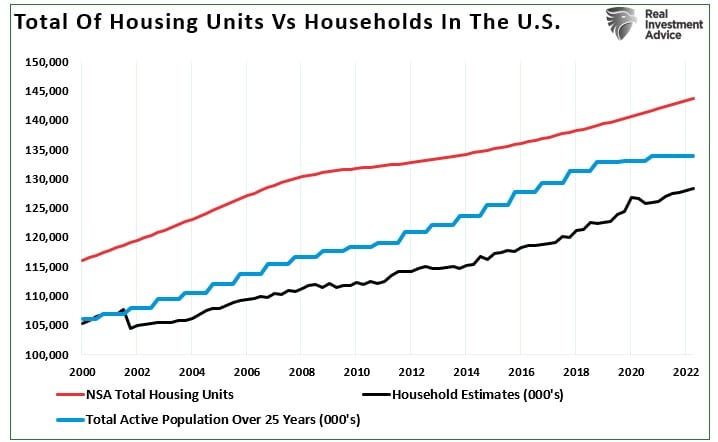
Not surprisingly, there are currently more houses than households to buy. Such is because several homes are vacant for different reasons, second homes, vacation homes, etc. Such is why, as we wrote previously, there isno such thing as a housing shortage.To wit:
“There are three primary issues that lead to changes in the supply of housing:“
  1. Prices rise to the point that sellers come into the market.
  2. Interest rates rise, pulling buyers out of the market.
  3. An economic recession removes buyers due to job loss.
“When those occur, transactions slow down, and inventory rises sharply.”
Not surprisingly, since that article was written in November 2020, just 2-years later, the supply of homes has risen sharply. Such is often a leading indicator of recessionary onsets as well.
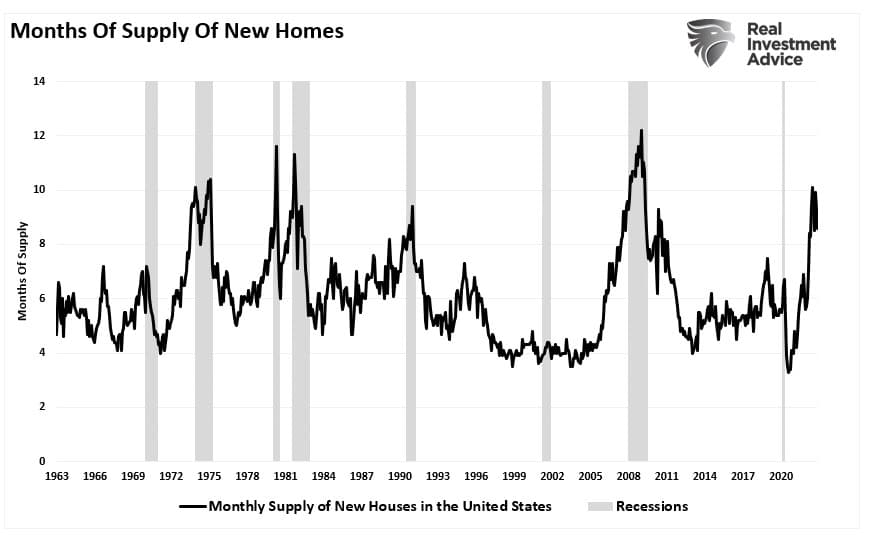
Also, sharply rising interest rates pull buyers out of the market.
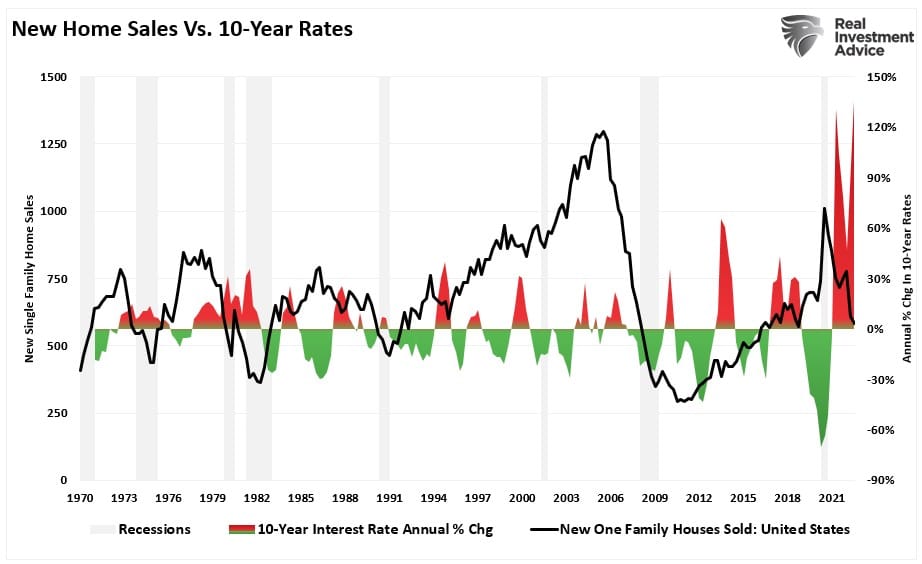
Another drag on prices in the new year will continue to be inventory coming to market as existing homeowners also try to sell their homes. More inventory and few buyers will equate to a further price drop in the coming year.
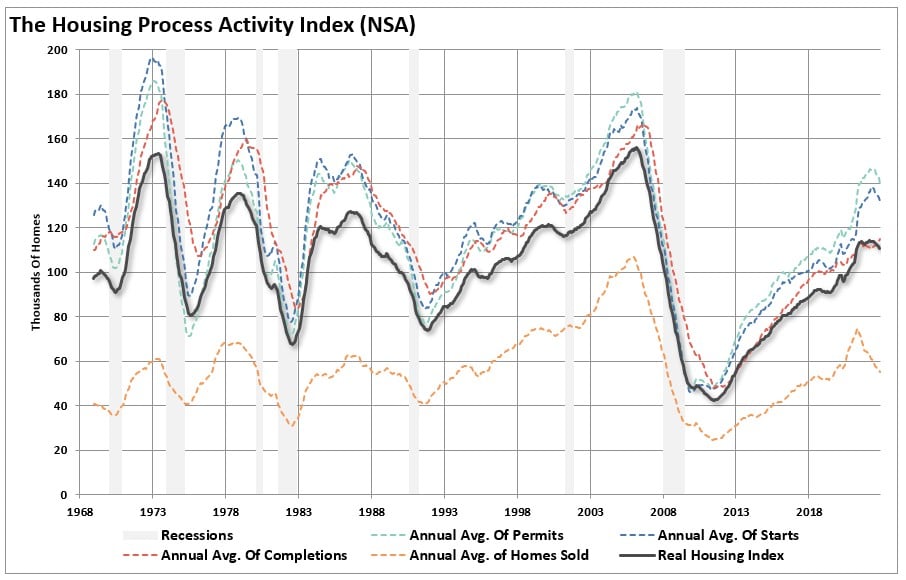
Home Prices To Fall Further
The chart below is the most telling of why home prices will fall further in the coming year. It is a composite index of everything involved in housing activity. It compiles new and existing home sales, permits, and housing starts. The index was rebased to 100 in 1999. The runup in the activity index into 2007 was a function, as noted above, of lax lending policies that led to the collapse in activity in 2008.
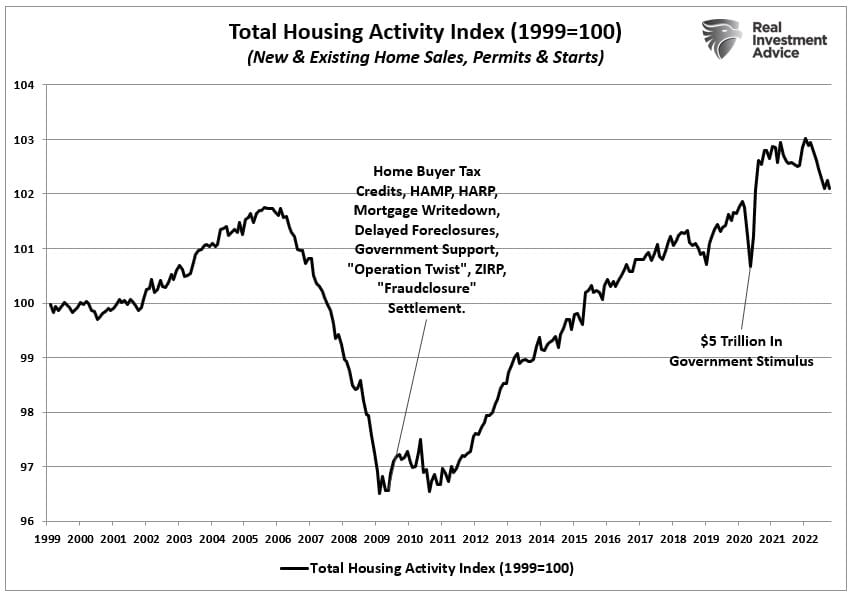
Following the collapse in 2008, the Fed dropped rates to zero and launched multiple QE programs as the Government bailed out everything that moved. The increase in housing activity over the next decade was unsurprising, and repeated monetary interventions boosted the wealth effect.
However, the sharp jump in housing activity in 2020 resulted from the direct monetary injections into households.
The reversion in home prices that has begun will likely continue as that excess liquidity continues to leave the economic system. That drain of liquidity, coupled with higher interest rates, and less monetary accommodation, will drag home prices lower. As that occurs, the “home equity” that many new buyers had in their homes will dissipate as homeownership costs continue to rise due to higher rates and inflation.
As home price depreciation gains traction, more homeowners will be dragged into selling to retain what value they had. For many Americans, most of their net worth is tied up in the homesteads. As the value fades, the decision to sell becomes more of a panic rather than a need.
While there isn’t a vast wasteland of bad mortgages sitting on the books, as seen in 2008, that doesn’t negate the risk of further home price declines in the coming year.
Not only are further home price declines possible, but it is also probable they could be deeper than many currently expect.

WWD : Thom Browne Wins Stripes Trademark Case Against Adidas

Thom Browne Wins Stripes Trademark Case Against Adidas
The jury found that the designer did not infringe on the sports giant's three-stripe mark.

Thom Browne has prevailed in his trademark infringement suit against Adidas.

On Thursday afternoon, less than three hours after closing arguments concluded, the eight-person jury came back with a verdict that found the luxury designer was not liable for damages or profits that it made selling product with four stripes or its trademark grosgrain ribbon.

“We are pleased that the jury found that at no time did Thom Browne Inc. infringe on any of Adidas’ trademarks. For over 20 years now, Thom Browne has been a pioneering force in luxury fashion, bringing a wholly unique and distinctive design aesthetic that combines classic tailoring with American sportswear sensibilities. We look forward to continuing to design and provide the creative products that have become the hallmark of the Thom Browne label,” a Thom Browne spokesperson said late Thursday.

Adidas America and Adidas AG had been seeking damages in the amount of $867,225 — the amount the companies agree it would have received in licensing fees from Thom Browne Inc., if the two had worked together — as well as the $7,011,961 million in profits it alleges the American designer made from selling apparel and footwear with stripes. The case was heard by Judge Jed Rakoff in Manhattan’s Southern District Court.

On Thursday, attorneys for Adidas and Thom Browne laid out their final arguments in closing statements in the trademark infringement suit between the two companies. And the jury, which heard testimony in the case from both sides over eight days, was charged with determining whether Thom Browne Inc. was liable for trademark infringement or dilution.

Thom Browne’s attorney, Robert T. Maldonado of Wolf, Greenfield & Sacks P.C., started his closing argument with a simple statement: “Adidas does not own stripes.”

He said Thom Browne, the designer and founder of the eponymous brand who was in the front row in his signature shorts suit and striped socks, cared enough about his company to be in court every day. On Thursday, the entire right side of the courtroom was filled with members of his team, all sporting head-to-toe looks from the collection. “He’s recognized as a game changer and an icon in the fashion industry,” Maldonado said of Browne. “The notion of Thom Browne wanting to trade on the reputation of Adidas offends him. He is not Adidas.”

Since the beginning, Browne has been using stripes, he said, to reference collegiate varsity sweaters and he “never considered Adidas” until he was approached by the company in 2007 after it saw some pieces he designed using three stripes as a design choice. Browne agreed to change his mark to four parallel bars so as not to get into litigation with the large sports company.

Maldonado said that Adidas’ trademarks show that it only owns three bars that it uses horizontally nearly all of the time. It also has a trademark for a quadrilateral bar logo.

He pointed to testimony from several witnesses over the course of the trial that, when asked to provide a specific definition for the three-stripe mark, said it could be anything from one to five or six bars, depending upon the usage. And the “smooshing” together of the bars on a collaboration with Gucci was also defined as three bars, another witness testified. On the New Classics collection launched last year, Adidas used stripes on the left sleeve, which a company executive said was “not where you usually see them,” Maldonado said, adding, “there is a complete lack of clarification.”

He proceeded to show documents from Adidas’ internal branding guidelines that designers can only tilt the stripes 20 degrees and use them vertically, never horizontally. And using white-on-white stripes, such as that used by Thom Browne on his sneakers, also violates the rules, Maldonado said. “How are we supposed to know that three stripes mean with all this inconsistent messaging from Adidas?”

Maldonado wrapped up his statement by saying that the luxury pricing of Thom Browne means that no one would be confused into thinking it was made by Adidas. And harm only occurs when someone buys something they think was made by someone else.

Because the two companies had coexisted for more than a decade since Thom Browne switched to four bars, and because Adidas did not show any evidence of harm, Maldonado asked the jury to award the company nothing in its suit. “To award damages, you have to prove harm, so we are asking for zero.”

In his closing argument, R. Charles Henn Jr. of Kilpatrick Townsend & Stockton LLP, who represents Adidas, reiterated the German sports company’s main points and reminded the jury that every trademark case has three interested parties — in this case, Adidas, Thom Browne and the public. The general public, he said, could be confused by the designer’s use of stripes on products that are in Adidas’ wheelhouse such as compression tights, T-shirts, jackets and other sports-themed apparel, as well as sneakers.

Because Adidas is well-known for the three-stripe mark it has been using in the U.S. since the 1950s, Henn said, consumers may see Thom Browne pieces in stores or on the street and be confused as to the maker. Adidas is not alleging that anyone spending $3,000 on a Thom Browne cashmere sweatpant and hoodie with stripes on the side would believe they were purchasing an Adidas product, he stressed, but if the product wasn’t clearly identified as Thom Browne on social media or when being worn in public, there could be confusion.

Henn said that Adidas’ “multiple” trademark registrations cover the use of three stripes on apparel and footwear in black-and-white or color as well as on the trifoil logo it began using in the 1970s and the “badge of sport” corporate logo it started using in the 1990s.

Over the years, Adidas has used the stripes horizontally, vertically and diagonally in a variety of colors. In addition, the company spends $300 million a year advertising the stripes and products sporting the mark in the U.S. account for $3.1 billion in annual sales, he said.

“It is one of the strongest trademarks in the United States when it comes to apparel and footwear,” Henn said.

Although Thom Browne, which had used three stripes on some pieces since its launch in 2003, switched to four parallel bars in 2008 after Adidas approached the company, Henn said many consumers still confuse the number of stripes when viewed from a distance. In addition, the “negative space” between the primary stripes can create the optical illusion that there are three bars.

He reminded the jury of the consumer survey conducted by Hal Poret that found 26.9 percent of the 2,400 participants believed Adidas was the manufacturer of some Thom Browne sports-related pieces with four parallel stripes.

Henn also pointed to Thom Browne’s move to increase its sportswear business by partnering with sports teams such as the FC Barcelona soccer club and its star athlete at the time, Lionel Messi, who had been an Adidas-sponsored ambassador for 15 years, as well as the Cleveland Cavaliers of the NBA where Adidas has had a long relationship, as evidence of bad faith among the Thom Browne team.

Following the verdict, Adidas out out a statement that said: “We are disappointed with the verdict and will continue to vigilantly enforce our intellectual property, including filing any appropriate appeals.”

Douglas Hand, an attorney with Hand Baldachin & Associates LLP, called the ruling “sound.

“This is a case of there being no confusion in the minds of consumers between the stripes in Thom Browne, the brand, and what Adidas uses. It’s a good thing for brands and the public at large. Stripes are a fundamental component of sportswear and there’s a function to stripes in fashion. It’s like using red or black in fashion. If something gets too associated with one brand, it’s problematic to other brands.”

He pointed to the Christian Louboutin case where he has sued over the use of red on shoes. The court has found that the trademark is for the red sole only, not the color red itself.

WWD : Marco Bizzarri Is Staying Put at Gucci

Marco Bizzarri Is Staying Put at Gucci
Kering head François-Henri Pinault told WWD the executive would lead the next chapter for the brand.

Squelching persistent speculation of a management change at Gucci, François-Henri Pinault told WWD that Gucci’s longtime chief executive officer Marco Bizzarri would stay in place and lead the brand in the post-Alessandro Michele period.

Speaking on the sidelines of Gucci’s fall 2023 men’s fashion show in Milan on Friday, Kering’s chairman and chief executive officer was emphatic that Bizzarri “has my full trust. He already had.”

“It’s so obvious that Marco is the CEO for this next chapter of Gucci for sure,” he said, smiling broadly as he spoke to WWD. “I need him to build that with me and I’m fully confident that we will succeed on that.”

His remarks should further calm investor concern about further turbulence at Kering’s largest brand and its greatest profit driver.

The Bizzarri-Michele dream team helped triple the size of Gucci since 2015 to reach sales last year of 9.73 billion euros.

Michele suddenly exited his role as creative director of Gucci last November amid disagreement over the future of the brand, which Michele had energized with gender-fluid, retro-tinged glamour.

After Michele’s appointment in 2015, Gucci posted growth exceeding 35 percent for five consecutive quarters by the first quarter of 2018, prompting Bizzarri to set a 10 billion euro revenue target for the brand in June that year.

But the momentum recently stalled, and it is understood Bizzarri and Pinault had urged Michele to initiate a strong design shift, a quicker pace of collections, and a further elevation of the brand toward a true luxury positioning.

Michele’s successor has yet to be named, and the men’s collection shown Friday was credited to the design studio, which riffed on various brand codes with a soupçon of sailor and rock-star styling.

In a recent research note, Erwan Rambourg, global head of consumer and retail research at HSBC, said Gucci is likely to do better in 2023, with the worst behind it.

It forecasts a 12.5 percent dip in fourth-quarter revenues when the numbers come out on Feb. 15.

“The brand has lost market share following what, in hindsight, was likely a strategic mistake: cutting costs in the spring of 2020 while most peers were doubling down on spending. Separately, we believe the brand’s expression became a bit narrow which made it particularly vulnerable in mainland China, where the group has strengthened management recently,” the HSBC report said. “A renewed merchandising team should also ensure a more commercial approach.…The commitment to spend more in terms of advertising, combined with a stronger team in mainland China as well as in merchandising should help the brand converge towards peers’ sales growth regardless of the fact it will be in a transition period.”

>>> US Research Calls

Research Calls

  • Upgrades:
    • Air France-KLM (AFLYY) upgraded to Buy from Neutral at UBS
    • Armstrong World Industries (AWI) upgraded to In-line from Underperform at Evercore ISI; tgt lowered to $80
    • Carrier Global (CARR) upgraded to Buy from Neutral at Mizuho; tgt raised to $53
    • Caterpillar (CAT) upgraded to Buy from Neutral at BofA Securities; tgt raised to $295
    • Community Healthcare Trust (CHCT) upgraded to Buy from Neutral at Janney; tgt $44
    • Copa Holdings (CPA) upgraded to Overweight from Neutral at JP Morgan; tgt raised to $132
    • Farmland Partners (FPI) upgraded to Buy from Neutral at Janney
    • ICON plc (ICLR) upgraded to Overweight from Equal Weight at Barclays
    • OrganiGram (OGI) upgraded to Buy from Hold at Stifel
    • Pentair (PNR) upgraded to Buy from Neutral at Mizuho; tgt raised to $60
    • Timken (TKR) upgraded to Buy from Neutral at BofA Securities; tgt raised to $87
    • TransUnion (TRU) upgraded to Overweight from Equal Weight at Wells Fargo; tgt raised to $88
    • Vulcan Materials (VMC) upgraded to Outperform from Sector Perform at RBC Capital Mkts; tgt raised to $191
  • Downgrades:
    • Algonquin Power & Utilities (AQN) downgraded to Sell from Hold at Desjardins
    • AutoNation (AN) downgraded to Equal Weight from Overweight at Wells Fargo; tgt $126
    • AZZ (AZZ) downgraded to Hold from Buy at Stifel; tgt $48
    • Casella Waste (CWST) downgraded to Underperform from Neutral at BofA Securities; tgt lowered to $81
    • Corebridge Financial (CRBG) downgraded to Neutral from Outperform at Credit Suisse; tgt lowered to $23
    • Costamare (CMRE) downgraded to Hold from Buy at Stifel; tgt lowered to $11
    • Dream Finders Homes (DFH) downgraded to Underperform from Sector Perform at RBC Capital Mkts; tgt $8
    • D.R. Horton (DHI) downgraded to Underperform from Sector Perform at RBC Capital Mkts; tgt raised to $76
    • Evolution Mining (CAHPF) downgraded to Sell from Buy at Citigroup
    • Fortinet (FTNT) downgraded to Neutral from Buy at BTIG Research
    • Fortune Brands Innovations (FBIN) downgraded to Sector Perform from Outperform at RBC Capital; tgt raised to $63
    • Gladstone Commercial (GOOD) downgraded to Neutral from Buy at Janney; tgt $17.50
    • Hugo Boss AG (BOSSY) downgraded to Underperform from Neutral at BofA Securities
    • Int'l Consolidated Airlines (ICAGY) downgraded to Neutral from Buy at UBS
    • Jacobs Engineering (J) downgraded to Neutral from Buy at BofA Securities; tgt $137
    • KB Home (KBH) downgraded to Sector Perform from Outperform at RBC Capital Mkts; tgt $34
    • Lennar (LEN) downgraded to Underperform from Sector Perform at RBC Capital Mkts; tgt lowered to $76
    • Lithia Motors (LAD) downgraded to Equal Weight from Overweight at Wells Fargo; tgt raised to $233
    • Lockheed Martin (LMT) downgraded to Sell from Neutral at Goldman; tgt lowered to $332
    • Mosaic (MOS) downgraded to Underperform from Neutral at Exane BNP Paribas; tgt $42
    • Masonite International (DOOR) downgraded to Sector Perform from Outperform at RBC Capital Mkts; tgt lowered to $89
    • NN Group (NNGPF) downgraded to Hold from Buy at HSBC Securities
    • Northrop Grumman (NOC) downgraded to Sell from Neutral at Goldman; tgt lowered to $375
    • Polaris Industries (PII) downgraded to Neutral from Buy at Northcoast
    • Raytheon Technologies (RTX) downgraded to Neutral from Conviction Buy at Goldman; tgt lowered to $105
    • Shaw Comms (SJR) downgraded to Sector Perform from Sector Outperform at Scotiabank
    • Syneos Health (SYNH) downgraded to Underweight from Overweight at Barclays; tgt $25
    • Shaw Comms (SJR) downgraded to Hold from Buy at Desjardins
    • Sunlight Financial (SUNL) downgraded to Neutral from Outperform at Credit Suisse; tgt lowered to $1.60
    • Tesla (TSLA) downgraded to Sell from Neutral at Guggenheim
    • Warner Music Group (WMG) downgraded to Neutral from Buy at Guggenheim; tgt $35
    • Wendy's (WEN) downgraded to In-line from Outperform at Evercore ISI; tgt $25
  • Others:
    • Advantage Oil and Gas (AAV) resumed with a Buy at Stifel
    • Aon (AON) initiated with an Outperform at Credit Suisse; tgt $363
    • ARC Resources (AETUF) resumed with a Buy at Stifel
    • Birchcliff Energy (BIREF) resumed with a Buy at Stifel
    • Canadian Natrl Res (CNQ) resumed with a Buy at Stifel
    • Crew Energy (CWEGF) resumed with a Buy at Stifel
    • Domino's Pizza (DPZ) added to Tactical Underperform list at Evercore ISI
    • FormFactor (FORM) initiated with a Hold at Jefferies
    • International Petroleum Corp (IPCFF) resumed with a Buy at Stifel
    • Kelt Exploration (KELTF) resumed with a Buy at Stifel
    • Overstock.com (OSTK) initiated with a Hold at Jefferies; tgt $20
    • Pagaya (PGY) initiated with a Neutral at UBS; tgt $1.25
    • Procore Technologies (PCOR) named Top Small-Cap Idea at Piper Sandler
    • Peyto Exploration (PEYUF) resumed with a Buy at Stifel
    • PrairaSky Royalty (PREKF) resumed with a Buy at Stifel
    • Rapid7 (RPD) initiated with a Neutral at DA Davidson; tgt $34
    • Summit Materials (SUM) initiated with a Buy at Truist; tgt $40
    • Surge Energy (ZPTAF) resumed with a Buy at Stifel
    • Tencent Music (TME) initiated with a Buy at Daiwa Securities
    • Teradyne (TER) initiated with a Buy at Jefferies
    • Tourmaline Oil (TRMLF) resumed with a Buy at Stifel
    • Workday (WDAY) initiated with an Overweight at CapitalOne; tgt $200

>>> US Gapping down

Gapping down
In reaction to earnings/guidance
:

  • DAL -4.5%, WFC -3.7%, JPM -2.9%, WEN -2.4% (sees Q4 revs above consensus; approves $500 mln buyback; raises dividend), UNH -2.2%, BAC -2.1%, BLK -0.5%

Other news:

  • SCLX -11.7% (stock offering by selling shareholder)
  • BBBY -7.4% (talking with potential lenders that would finance co during bankruptcy according to Bloomberg)
  • ARCC -3.7% (prices offering of 10.5 mln shares of common stock)
  • PRPL -3.2% (rejects unsolicited acquisition proposal from Coliseum Capital)
  • COIN -2.8% (aware of login issues; has identified the root cause and is working on a fix)
  • VICI -2.7% (prices offering of 26.35 mln shares of common stock at $33.00 per share)
  • TA -2% (signs 30 new franchise agreements in 2022)
  • XPRO -1.6% (prices offering of 8 mln shares of common stock at $16.50 per share) .

Analyst comments:

  • FTNT -3.5% (downgraded to Neutral from Buy at BTIG Research)
  • DFH -3.4% (downgraded to Underperform from Sector Perform at RBC Capital Mkts)
  • GOOD -2% (downgraded to Neutral from Buy at Janney)
  • LEN -1.9% (downgraded to Underperform from Sector Perform at RBC Capital Mkts)
  • CMRE -1.8% (downgraded to Hold from Buy at Stifel)
  • AN -1.7% (downgraded to Equal Weight from Overweight at Wells Fargo)
  • CWST -1.7% (downgraded to Underperform from Neutral at BofA Securities)
  • CRBG -1.1% (downgraded to Neutral from Outperform at Credit Suisse)
  • FBIN -1.1% (downgraded to Sector Perform from Outperform at RBC Capital)
  • KBH -1% (downgraded to Sector Perform from Outperform at RBC Capital Mkts)
  • LAD -1% (downgraded to Equal Weight from Overweight at Wells Fargo)
  • J -0.9% (downgraded to Neutral from Buy at BofA Securities)

>>> US Gapping up

Gapping up
In reaction to earnings/guidance
:

  • HBI +5.7% (guides Q4 revs above prior guidance; also CFO to step down), WAFD +1.1%, BK +1.1%

Other news:

  • SPCE +18.2% (updates leadership structure; commercial spaceline operations on track for 2Q23)
  • ATOM +3.2% (to collaborate with Arizona State University)
  • ZYME +2.9% (EcoR1 Capital a large shareholder discloses it purchased additional shares)
  • CMCL +2.9% (reports FY22 Blanket Mine production above guidance)
  • MNOV +2.8% (completes enrollment in the Phase 2 Clinical Trial evaluating MN-166)
  • HUYA +1.2% (amends license agreement re broadcasting rights for League of Legends Matches)
  • WWE +1% (engages outside advisors to support review of strategic alternatives)

Analyst comments:

  • CPA +1% (upgraded to Overweight from Neutral at JP Morgan)
  • CAT +0.7% (upgraded to Buy from Neutral at BofA Securities)
  • FPI +0.7% (upgraded to Buy from Neutral at Janney)

>>> US Early premarket gappers

Early premarket gappers

  • Gapping up:
    • SPCE +16.5%, HBI +7.2%, BBBY +5.2%, MNOV +3.6%, ATOM +3.2%, CMCL +2.9%, ZYME +2.7%, WAFD +2.6%, LHC +2.2%, HUYA +1.7%, BLK +1.3%, AZN +1%, PRPL +0.8%, COP +0.8%
  • Gapping down:
    • SCLX -11.7%, ARCC -3.6%, VICI -3.3%, XPRO -2.7%, DAL -2.7%, LC -2.3%, COIN -2.2%, TA -2%, DUK -1%