FT : Temenos: CEO exit highlights the perils of software-as-a-service shift

Temenos: CEO exit highlights the perils of software-as-a-service shift
Management have worsened the blow to investor confidence by over promising and under delivering

If you have always doubted national stereotypes, revel in the unreliability of Switzerland’s Temenos. You might not ask this lot to fix your cuckoo clock, let alone install your banking software, given recent managerial mishaps. Shares have halved since 2019. Chief executive Max Chuard has just resigned. His nemesis, Petrus Advisers, is hardly keener on chair Andreas Andreades.

In fairness, Temenos is not the only European software group that has found the transition to selling software-as-a-service hard going. SAP of Germany and the UK’s Sage have form of their own. City readers with long memories will meanwhile recall the rough ride that cyclical demand for banking software gave the likes of Misys.

Switching to SaaS means revenues and profits booked up front are spread over longer periods. The management of Temenos have exacerbated the blow to investor confidence by over promising and under delivering. A profit warning in October shaved a quarter from full year operating earnings.

Temenos is mature for an IT business at 30 years old. Chuard and executive chair — now interim chief executive — Andreades have been there for 20 years. Chuard is leaving following better-than- expected fourth-quarter results published on Monday. A 10 per cent pop in the shares may reflect joy at either, or both, of these factors.

Temenos, which is worth about SFr4.6bn, has underperformed peers like FIS and Fiserv. These have lost one-third and gained two-fifths respectively since 2019, albeit that they are oriented to payment services. Temenos hardly looks cheap at 23 times price to forward earnings. Both Fiserv and FIS have managed to increase earnings against a decline at Temenos over the period.

Petrus wants Temenos to set realistic targets and disclose more data. The group is still guiding for higher margins by 2025. Analysts think it may meet such targets, although almost two years later according to Visible Alpha.

The activist is also calling for a greater focus on the US. Temenos’s 2 per cent market share there is very low given its relative strength in the European market.

Petrus wants Andreades, who will step down as chair in six months anyway, to follow Chuard out the door. In the meantime, optimistic targets leave shareholders primed for further disappointments. Would-be consolidators would be cuckoo if further slip-ups do not prompt them to swoop in.

>>> What to look at today - 16th of January 2023 {Q1}Blue Monday{Q1}

Asian shares started the week higher while the dollar declined amid a tailwind from easing inflation expectations that has fueled January’s rally in riskier assets.  A benchmark of Asian equities climbed about 0.4%, putting it on course for the highest level since June. US futures rose after stocks on Wall Street closed at the strongest level in a month on Friday and contracts for European shares advanced. Japanese markets painted a different picture with the Topix index trading lower as the yen’s rebound continued to weigh on exporters. Investors also remain on guard for another surprise from the Bank of Japan when it sets policy on Wednesday. The yen strengthened to levels last seen in May and Japan’s benchmark 10-year bond yield pushed above the top of the BOJ’s ceiling for a second day. The greenback was down against both emerging-markets and Group-of-10 currencies on bets that the Federal Reserve will slow the pace of interest-rate hikes. Australia’s dollar strengthened above 70 cents for the first time since August, a reflection of improved appetite for riskier assets.  Bitcoin traded above $21,000 following a rebound over the weekend, when it surged amid optimism that it may have bottomed. The impact of surging Covid infections was also on the minds of traders, but not enough to hold back the Shanghai Shenzhen CSI 300 Index, which jumped about 2%. The World Health Organization has urged China to share more detailed information on the spread of virus after the government’s announcement of almost 60,000 related deaths in a month. The People’s Bank of China kept the rate of its one-year medium-term lending facility unchanged and added less cash than expected into the banking system before the Lunar New Year holidays. The move is likely to fuel speculation the central bank may use other channels to ensure there’s adequate liquidity.  The busy week will also be punctuated by more corporate earnings, such as Wall Street heavyweights Goldman Sachs Group Inc. and Morgan Stanley. iron ore declined after China pledged to tighten supervision on pricing after the metal’s surge in recent months. Oil slid and gold rose.

Nikkei -1.13% Hang Seng -0.68% CSI +1.49% Shanghai +0.99% Shenzen +1.30%

Eur$ 1.0858 CNH 6.74100 CNY 6.7005 JPY 127.64 GBP 1.2267 CHF 0.9238 RUB 68.9983 TRY 18.7871 WTI$ 79.34 -0.65% Gold 1,921.35 +0.06% BTC 21,167 +1.25% ETH 1,573 +1.33%

S&P -0.05% Nasdaq -0.17% EuroStoxx +0.31% FTSE -0.04% Dax +0.25% SMI +0.11%

Macro :
- Germany Faces €12B Financing Gap in 2024 Budget: Handelsblatt
- Lithium’s Next Big Risk is Grand Supply Plans Falling Short
- German Industry Moves Past Worst of Energy Crunch Battle
- Hedge Funds Go Bearish on Gas for 1st Time Since Pandemic Began
- Germany’s Embattled Defense Minister Plans to Resign, Bild Says
- Switzerland Aims to Soften Restrictive Arms Export Law, NZZ Says
- Scaramucci Invests in Crypto Firm Set Up by Ex-FTX US Head

Keep an eye on :
- AIR FP : Crashed Nepal Plane’s Flight Data Recorder Found: Reuters
- BBVA SM : *BBVA CHAIRMAN SAYS BANK EXPECTS TO BOOST DIVIDEND IN 2023
- BILL SS : Siemens Energy Gains as Billerud Slips: EMEA Resources Wrap
- BA/ LN : UK Will Send Major Battle Tanks, More Artillery to Ukraine
- 1COV GY : Covestro Prelim FY Net Loss About EU300M
- CSGN SW : UBS Doesn’t Plan to Buy Credit Suisse or US Firms: Kelleher
- CSGN SW : Credit Suisse Set to Cut 10% of European Investment Bankers: FT
- ENI IM : Italy’s Gas Supply Set to Be More Secure Next Winter, Eni Says
- FRA GY : Fraport Dec. Frankfurt Airport Passengers +46.2%
- HYQ GY : Hypoport Mortgage Finance Business Stable After Sharp 2H Decline
- JNJ US : Johnson & Johnson Slashes Production of Covid-19 Shot, WSJ Says
- LAND LN : Sky News: Land Securities lines up Channel 4’s Cheshire as next chairman
- LDO IM : Crashed Nepal Plane’s Flight Data Recorder Found: Reuters
- MJH LN : MJ Hudson Expected to Announce Takeover Approaches: Sky
- MOWI NO : Mowi Prelim 4Q Ebit Beats Estimates
- ORSTED DC : Orsted Plans Major Offshore Wind Expansion in Sweden, DI Reports
- PFE US : Pfizer Bivalent Vaccine Linked to Stroke in Preliminary Data
- PROX BB : Proximus Sees 2023 Adjusted Ebitda About -3%
- RECSI NO : REC Silicon Says Moses Lake Restart Activities Progressing Well
- RNO FP : Renault Said to Be Open to Concessions to Strike Nissan Deal
- ENR GY : Germany Targets Three New Windmills a Day for Energy Reboot
- SIKA SW : Sika to Sell Concrete Assets to Ineos to Gain Antitrust Approval
- TEMN SW : Temenos Prelim 4Q Non-IFRS Ebit Misses Estimates
- TEMN SW : Temenos Seeks New CEO as Chuard Steps Down
- 700 HK : Alibaba and Tencent Could Boost Inflows for Tech ETFs in 2023
- UN01 GY : LNG TENDER: Uniper Buys Feb. Cargo to Europe at TTF Discount
- VOW GY : Ford Set to Cut Dependence on VW Electric Vehicle Tech: FT
- WBD IM : Webuild Unit Wins $218m Highway Contract in Florida

>>> Europe : Brokers Upgrades & Downgrades - 16th of January 2023

>>> Up
* Amgen PT Raised to $300 from $260 at Argus
* DWS Raised to Buy at Jefferies; PT 40 euros
* Essity Raised to Buy at Handelsbanken
* Lloyds Bank Raised to Reduce at AlphaValue/Baader
* Man Group Raised to Buy at Jefferies; PT 285 pence
* Novo Nordisk Raised to Hold at Handelsbanken
* Verbund Raised to Neutral at Credit Suisse; PT 81 euros
* Ypsomed Raised to Outperform at Credit Suisse

>>> Down
* Abrdn plc Cut to Hold at Jefferies; PT 215 pence
* Airbus Cut to Hold at Berenberg; PT 120 euros
* Atlas Copco Cut to Underperform at RBC
* Centamin Cut to Market Perform at BMO; PT 130 pence
* Collector Bank Cut to Sell at SEB Equities; PT 31 kronor
* Dow Cut to Hold at Fermium Research; PT $60
* HSBC Cut to Hold at Investec; PT 595 pence
* Orange Cut to Hold at Jefferies; PT 10 euros (cut from 12,40 euros)
* Rational Cut to Hold at HSBC; PT 670 euros
* Rotork Cut to Sector Perform at RBC

>>> Initiation
* Alfa Financial Rated New Add at Peel Hunt; PT 210 pence
* Alphabet Rated New Add at CTBC Securities; PT $102
* Autostore Rated New Sell at DNB Markets; PT 18 kroner
* Eckoh Rated New Buy at Peel Hunt; PT 60 pence
* Equals Group PLC Rated New Buy at Peel Hunt; PT 135 pence
* Network International Rated New Buy at Peel Hunt; PT 420 pence
* Tencent Music ADRs Rated New Buy at Daiwa; PT $11
* WAG Payment Solutions Rated New Buy at Peel Hunt; PT 140 pence
* Wise Rated New Hold at Peel Hunt; PT 600 pence

>>> Call
* Airbus Gets ‘Reluctant’ Cut at Berenberg on Near-Term Caution
* DWS and Man Group Upgraded at Jefferies, Abrdn Downgraded
* Europe Industrials Still Resilient, But Upside More Limited: RBC
* European REIT Financing Footings Redefined by End to Zero Rates
* Morgan Stanley’s Secker Says Europe Outperformance Should Extend
* Orange Cut at Jefferies on Lower Growth Prospects Into FY23
* Verbund Upgraded by Credit Suisse With Shares Now Fairly Valued

WSJ : IMF Warns Unraveling Economic Ties Could Shrink Global Output

IMF Warns Unraveling Economic Ties Could Shrink Global Output
Lender points to rising trade, migration and investment barriers

Declining international cooperation and commerce could shrink the global economy, particularly harming low-income countries, the International Monetary Fund said in a new study.

The report cited several ways that government policies are driving a reversal of global economic integration, such as by restrictions on trade, immigration and cross-border capital flows. The authors labeled this process geoeconomic fragmentation and warned it could lower global gross domestic product by up to 7% over an unspecified “long-term” period.

If technology sharing is also restricted, the losses would be even greater, from 8% to 12%, in some, mostly lower-income and emerging economies, said the staff report, released Sunday.

This could undo the economic globalization of recent decades that the IMF said has reduced poverty in developing countries and delivered lower prices to low-income consumers in advanced economies.

“The global economy may be on the brink of a reversal of the steady increase in integration that characterized the second half of the 20th century,” the multilateral lender said in its analysis. “While fragmentation may entail strategic advantages for some countries in selected cases, it is very likely to involve significant economic costs in the aggregate.”

The costs “would include higher import prices, segmented markets, diminished access to technology and to both skilled and unskilled labor, and ultimately reduced productivity which may result in lower living standards,” the IMF said.

The IMF concluded that the Covid-19 pandemic and Russia’s invasion of Ukraine further strained trade ties that were tested by a shallow and uneven recovery from the 2008 financial crisis as well as the U.K.’s exit from the European Union and continuing trade tensions between Washington and Beijing.

The IMF noted that at the height of the pandemic, countries limited their exports of medical goods and foodstuffs with export bans that accounted for about 90% of trade restrictions.

Moreover, the war in Ukraine and associated sanctions placed by the West on Russia and Belarus led to “major dislocations in energy and agricultural commodity markets.”

The lMF said that the U.S., European Union and China had all enacted recent measures to promote domestic high-tech production. Companies, too, were moving their supply chains to minimize risk, with key words such as “reshoring,” “near-shoring” and “onshoring” appearing more frequently in company earnings calls and reports, the IMF said.

This trend toward fragmentation in trade would likely reduce opportunities for emerging economies and slow the reduction of poverty, according to the IMF.

Rising barriers to the flow of labor across borders could also slow down innovation and technological diffusion, the IMF said. Economic fragmentation could also constrict options for international investing, which would hinder development. The trends are likely to lead to uncertainty and to make cooperation on challenges such as climate change more difficult, the lender said.

Fragmentation is likely to contribute to splintered regulation, making some forms of international banking untenable and raising the cost of financing, according to the IMF. Countries that wanted to preserve stability would likely have to rely on “costly self-insurance” such as reducing external debt to bolster themselves against shocks.

The IMF recommends ensuring trade cooperation on global public goods and fair competition, while protecting the most vulnerable populations. Further, the lender recommends preserving minimal cooperation through what it calls guardrails, for example, “safe corridors” to enable the movement of critical goods and services.

It also recommends that countries try to achieve a small number of common goals in areas where they have broad alignment. “Open a path for rebuilding trust,” the IMF said. One such area could be a new digital international payment system.

The report comes amid multiple signs that the global economy slowed toward the end of 2022 under the weight of high inflation and rising interest rates, combined with challenges caused by the war in Ukraine and effects of Covid-19 in China.

The World Bank earlier this month sharply lowered its forecast for global economic growth in 2023 and noted an elevated risk of a worldwide recession. The bank expects growth to slow to 1.7% in 2023, down from an estimate of 3% growth in June. That would mark the third-weakest pace of global growth in nearly three decades, overshadowed only by the 2009 and 2020 downturns, according to the World Bank.

(ZH) Fully Priced-In: Even Goldman Expects Sharp Contraction In Profit Margins I

Fully Priced-In: Even Goldman Expects Sharp Contraction In Profit Margins In 2023

There has been a bizarre episode of cognitive dissonance developing within Goldman's trading desk and research departments over the past three months: as readers may recall, some time in late September, just as stocks slumped near their 2022 lows for the second time, Goldman's chief equity strategist David Kostin - who had heretofore been one of the staunchest equity bulls - slashed his market outlook and his S&P price target, which he now sees closing unchanged from its Friday level, or right at 4,000. That's right, Goldman clients can now take a 11 and a half month vacation, spare themselves the emotional rollercoaster that is to follow, and come back for the last day of trading in 2023 when Goldman expects stocks to be... unchanged.
Of course, when Goldman started turning bearish some three months ago (which just happened to coincide with that other permabull Marko Kolanovic also turning bearish), we said that that was the bottom and so far, some 400 S&P points higher, our cynicism has been proven correct.
But as so often happens, with Goldman so bearishly positioned at a time when the Fed is hinting that a rate hike pause is imminent and the market is expecting at least 50bps of rate cuts in the second half, last week saw the first tentative signs that Goldman's strategists and economists are starting to turn bullish again, which means that the countdown to a material upgrade in Goldman's year-end price target (to, say, 4,500) has begun.
Indeed, in the past week, two top Goldman strategists, Jan Hatzius and Dominic Wilson highlighted the "improving investing landscape" in two notes this week: “Mostly Better News” (available to pro subs here) and “A Bit More Room to Grow” (also available to pro subs), pointing out that after the latest payrolls and CPI data, "markets are now pricing in the soft landing for the US economy that we forecast; Europe no longer appears to headed towards a recession either (Goldman also raised its GDP growth forecast into positive territory earlier this week in "10 Questions for 2023" and no longer expects a European recession)" and Goldman even saw upside to its China growth forecast which now anticipates a 4Q23/4Q22 GDP growth pace of over 7%.
But, as Goldman strategist Chris Hussey notes in his Friday weekly recap, "just like in Legoland, this 'Everything is awesome!' environment may still be riddled with risks that our strategists and analysts also highlight this week from macro to micro."
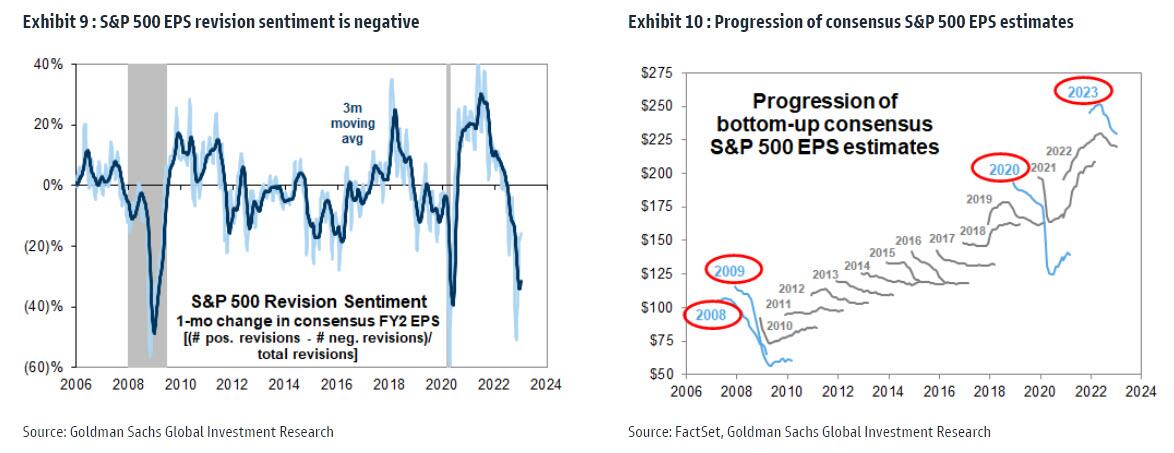
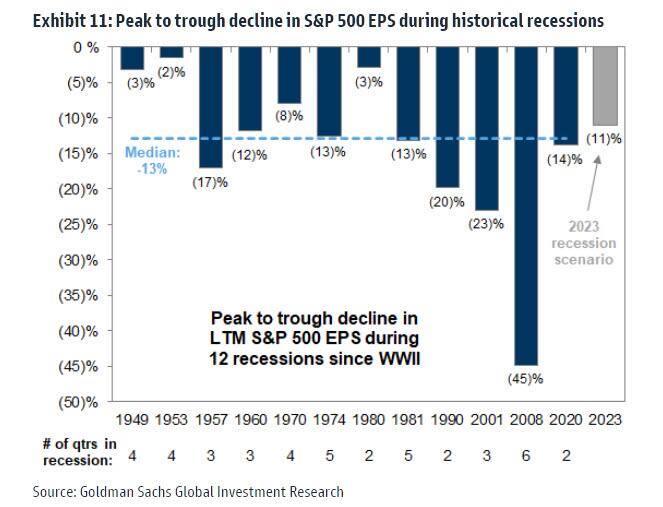
One such risk was brought up by none other than David Kostin, who remains one of the bearish holdouts withing Goldman (not for long) and continues to sound a cautious tone in a fresh note this week, urging the bank's clients to "buy protection" in his note “strategies for soft and hard landings.” According to Kostin, the biggest red flag: downward earnings revisions have been extreme and have only looked like this in past recessions (2000 and 2008).
As such, Kostin is hesitant to look through this dependable market indicator and believe prudent portfolio managers should at least consider the implications if a hard landing transpires.
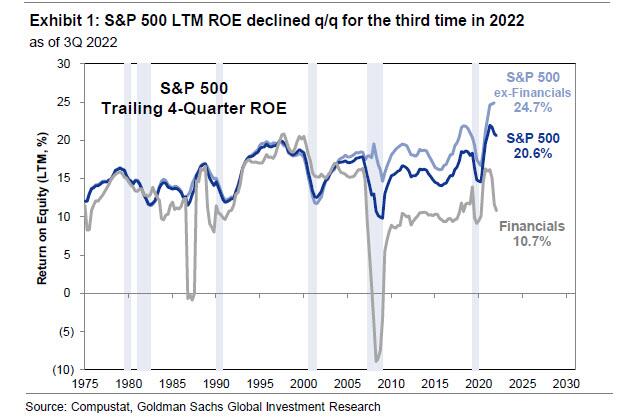
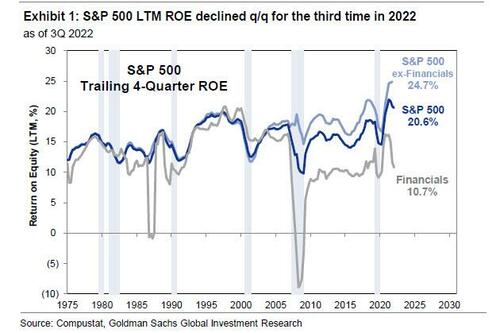
Over the weekend, Kostin continued this game of good cop (Hatzius, Wilson) vs bad cop (Kostin), writing in his latest weekly Kickstart note (available to pro subs here) that "negative consensus earnings revisions and analyst expectations for a lackluster 4Q 2022 earnings season continue the trend of weakening corporate profitability in recent quarters." Additionally, the S&P's trailing 4-quarter return on equity declined by 29 bp to 20.6% in 3Q 2022 driven by a contraction in margins: as Kostin calculates, "at a sector level 7 of 11 S&P 500 sectors experienced declining ROE, with Info Tech suffering the largest drop and Energy expanding the most." Looking ahead, Kostin warns that an upwards inflection in S&P 500 ROE will be difficult to achieve in 2023, "as headwinds from a higher cost of capital and higher taxes will place further strain on profitability."
Of course, this is all taking place as Q4 earnings season kicked off in earnest on Friday with large banks reporting mixed results, and with consensus expecting the aggregate S&P 500 index to post -1% EPS growth in 4Q 2022 vs. 4Q 2021 and decline by 5% excluding the Energy sector. As shown in the charts above, earnings revisions have recently been very negative, adding to many investors’ concerns about a potential recession on the horizon.
What does all of this mean for corporate profitability? Clearly, nothing good: according to Kostin, the increasingly negative consensus earnings revisions and current analyst expectations for a lackluster 4Q 2022 earnings season continue the trend of weakening corporate profitability in recent quarters. To wit, S&P 500 trailing 4-quarter return on equity declined by 29 bp to 20.6% in 3Q 2022. The decline in ROE represented the third consecutive quarterly decline following the metric’s all time high of 22% in 4Q 2021 (despite the recent declines the latest figure still ranks in the 99th percentile of S&P 500 ROE going back to 1975, meaning there is a lot more downside from here).
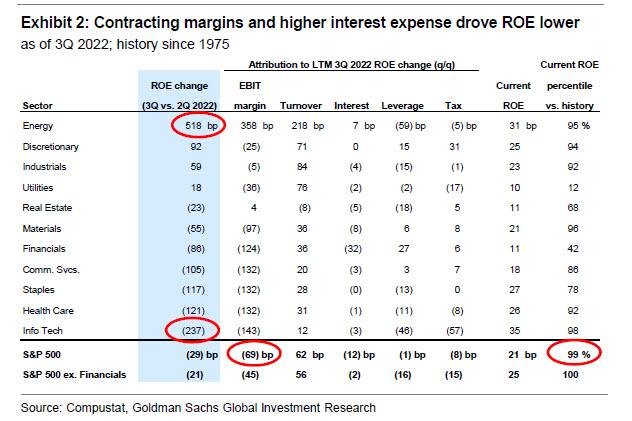
The Goldman strategist finds that contraction in profit margins was the main reason for the ROE decline last quarter: "We use a five-factor DuPont decomposition to analyze the drivers of ROE.Falling EBIT margins drove 69 bp of ROE contraction (Exhibit 2). Margins had already begun to decline in both 1Q and 2Q 2022 after a full year of expansion in 2021, and the trend continued in 3Q 2022. Index-level LTM EBIT margins contracted q/q by 48 bp in 3Q (vs. -90 bp in 2Q and -47 bp in 1Q). Slightly higher interest and tax expenses also weighed on ROE during 3Q (contributing -20 bp total). These headwinds were offset by higher asset turnover, which contributed +62 bp to ROE."
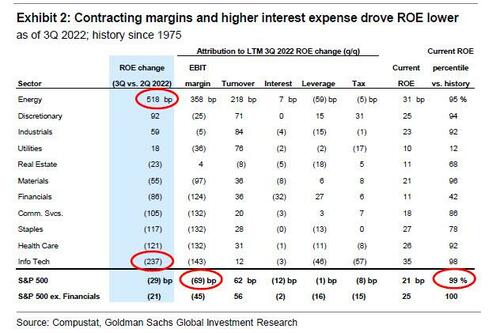
Financial jargon aside, while most sectors saw ROEs fall last quarter, they also enjoy profitability well above historical averages. 7 of 11 S&P 500 sectors experienced declining ROE, with Info Tech suffering the largest drop (-237 bp) and Energy expanding the most (+518 bp). The increase in Energy ROE was driven by margin expansion, contrasting with contracting margins in every other sector except for Real Estate. In addition to Energy, Consumer Discretionary, Industrials, and Utilities saw slight ROE gains. Despite lackluster ROE growth over the past three quarters, 9 of 11 sectors’ levels of ROE still stand above their historical sector averages, and 6 have ROEs currently in the top decile vs. their sector’s history.
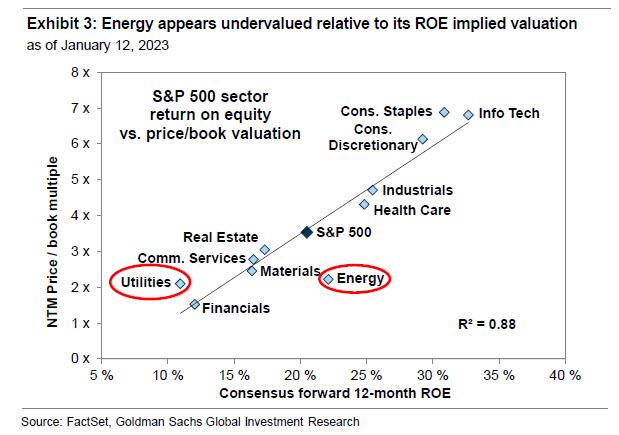
Ironically, while to some this may mean that Energy - which was the blowout outperforming segment in 2022 - is overvalued, the reality is just the opposite, and with most sector P/B valuations currently well-ordered based on ROE, Energy and Utilities remain outliers. Energy remains below the P/B implied by its expected ROE while Utilities’ valuation appears stretched. In the case of Energy, the lackluster valuation is likely due to consensus expectations for -15% EPS growth in 2023 (after +161% growth in 2022) and lower long-term growth expectations relative to other sectors. Meanwhile, utilities valuations have benefitted in part due to the attractiveness of the sector’s defensive attributes amid heightened recession concerns.
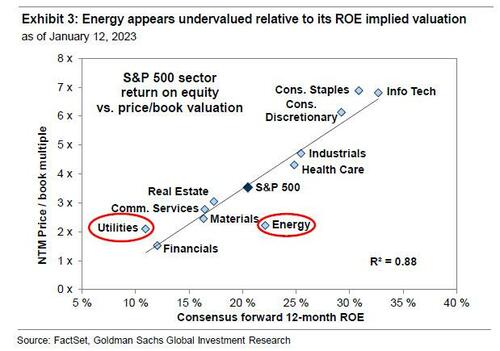
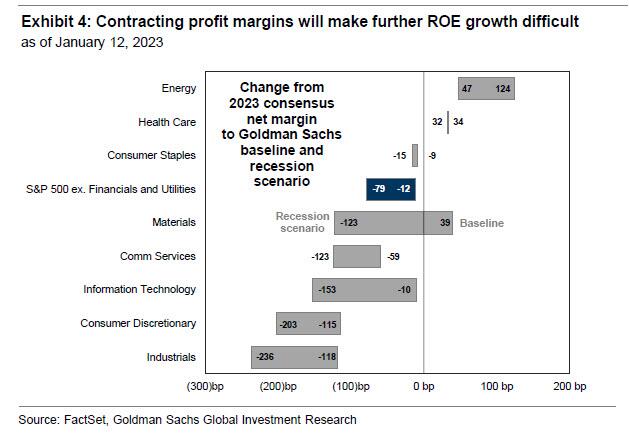
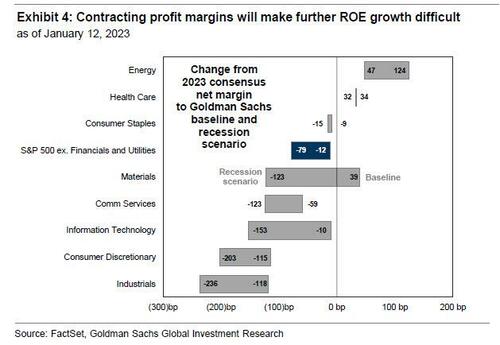
Looking ahead, the bearish Goldman strategist concedes that "an upwards inflection in S&P 500 ROE will be difficult to achieve in 2023" and he expects margins for most sectors to contract while also expecting further cut in current consensus EPS estimates to bring them closer to Goldman's baseline and recession scenarios (which is odd since Goldman chief economist Jan Hatzius is adamant that a recession will not happen, but that's all part of Goldman's "good cop, bad cop" CYA routine). As other ROE headwinds, Kostin lists taxes, leverage, and borrow costs.
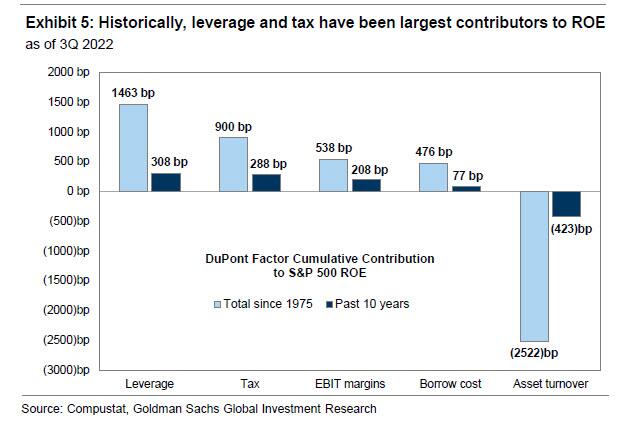
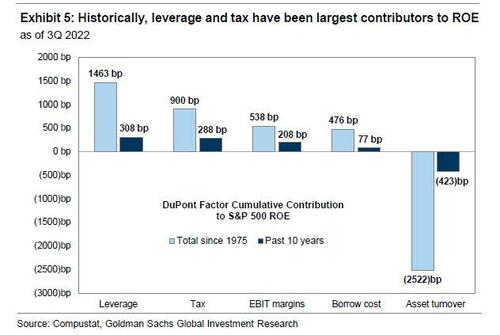
Taking a closer look at margin hurdles, Goldman notes that historically, higher leverage and lower taxes have been the largest contributors to ROE. Indeed, since 1975, declining interest rates and corporate tax rates have been the strongest tailwinds to corporate profitability. Declining interest rates have allowed firms to utilize higher leverage to bolster equity holder returns, resulting in a cumulative contribution of +1463 bp to ROE while lower borrow costs have contributed +476 bp to ROE over the period. Similarly, declining corporate tax rates have contributed +900 bp. On the other hand, lower asset turnover has been the largest detractor from ROE, shaving off -2522 bp over time.
Here, Kostin warns that "near-term improvements to ROE from higher leverage will be unlikely given higher cost of capital", i.e. the Fed's tightening. The weighted average cost of capital (WACC) for US firms has spiked by 200 bp to 6%, the highest level in a decade and the largest 12-month rise in 40 years, or since the Volcker Fed.
Goldman expects the WACC in 2023 will remain near the current level (which of course, is as good as tell as any that Powell will very soon be slashing rates). The direct consequence of a higher WACC is costlier leverage, which will ultimately disincentivize firms from boosting ROE through this channel in 2023. As an aside, despite higher WACC, borrow costs will be less of a dramatic headwind, as most S&P 500 debt is fixed rate with long maturities. 75% of S&P 500 debt is fixed, and only 24% of total debt is expected to mature between 2023 and 2025.
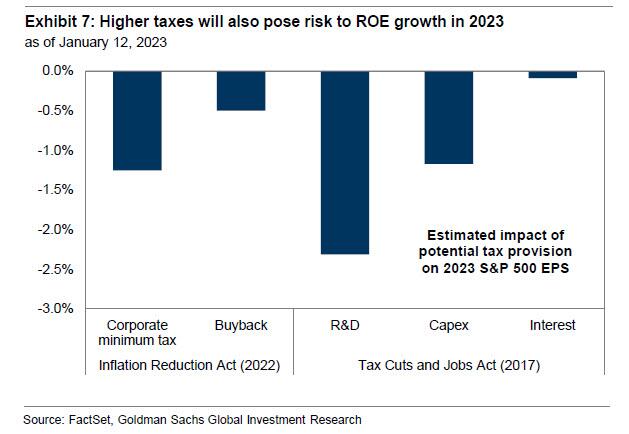
Finally, Goldman warns that higher taxes in 2023 will also be a headwind for ROE expansion. While new corporate taxes from the Inflation Reduction Act (IRA) should reduce S&P 500 EPS by less than 2% in 2023, the direction of the change in tax expense will now weigh on ROE instead of supporting it.
According to the Goldman strategist, This impact should be pronounced for sectors with low effective tax rates such as Info Tech and Health Care which will face a larger impact from minimum tax provisions. Sunsetting provisions from the 2017 Tax Cuts and Jobs Act and the new 1% excise tax on buybacks introduced in the IRA will place additional tax-related strain on ROE.
Of course, none of what Kostin claims above is incorrect (he goes on to note that in a challenging environment for ROE growth, stocks that were expected to grow ROE outperformed the S&P 500 by 10 pp in 2022 and then pitches Goldman's ROE growth basket which contains 50 stocks with the highest consensus-expected ROE growth during the next 12 months, the full list available to pro subs) but what we find most notable is that now that even Goldman fully embraces the core pillar of the 2023 bear case (as laid out by Michael Wilson some 6 months ago), the reality is that while sellside analysts may be slow to trim their optimistic outlooks, most on Wall Street have applied their own personal discounts to consensus, and more importantly, the margin contraction and EPS shrinkage narratives are both fully priced in by now, and only a full-blown recession can lead to further downward repricings. In other words, now that a sharp slide in inflation is the base case, the longer the Biden Dept of Labor ignores reality and pretends that job growth is there, the higher stocks will rise.
(ZH) Why Was Hunter Paying Joe Biden $50k Per Month To Rent House Where Classifi

Why Was Hunter Paying Joe Biden $50k Per Month To Rent House Where Classified Documents Found?

A Thursday tweet from the NY Post's Miranda Devine containing a background check for Hunter Biden has people asking questions.

"The now-52-year-old began listing the Wilmington home as his address following his 2017 divorce from ex-wife Kathleen Buhle — even falsely claiming he owned the property on a July 2018 background check form as part of a rental application," the Post reported.
Of note, this is the same house where classified documents were found.
Yet, upon closer inspection, Hunter lists the "Monthly Rent" as $49,910 - or roughly $550,000 for the 11 months he indicated he lived there?
A Zillow search reveals that the most expensive home currently for rent in Wilmington, Delaware is going for $6,000 per month.
According to Town & Country magazine, Biden's home is worth around $2 million.
Could Hunter, a crackhead, have accidentally listed the annual rent payment to his father for the house which contained classified documents? Sure. But why was his wealthy ex-VP dad charging him rent in the first place, when Hunter was allegedly broke?
Trending Politics asks the quiet part out loud; was this Hunter's way of funneling money to his father?
After Hunter’s divorce was finalized in May of 2017, he was included in an email from his business partner James Gilliar about a venture with Chinese state-funded energy company CEFC China Energy. The email stated that Hunter and his partners would receive 20% of the shares in the new business, with 10% going to Hunter’s uncle James Biden and the other 10% being “held by H for the big guy.”
Tony Bobulinski, another one of Hunter’s former business partners, claims that he had a meeting with Joe Biden regarding the CEFC venture on May 2, 2017, and that the president was the individual referred to as the “big guy” in Gilliar’s email. Additionally, Gilliar himself confirmed that Joe Biden was the “big guy” mentioned in a message found on the laptop.
And as the NY Post reports, "The following year, federal investigators began looking into whether Hunter and his business associates violated tax and money laundering laws during their dealings in China and other countries. Emails and other records related to the deals were found on the laptop, which Hunter dropped off at a Delaware repair shop in 2019 and never reclaimed."
"I hope you all can do what I did and pay for everything for this entire family for 30 years," Hunter told his daughter Naomi in January, 2019. "It’s really hard. But don’t worry, unlike pop, I won’t make you give me half your salary."
As the Post continues:
The laptop doesn’t contain any direct evidence of such money transfers but shows Hunter was routinely on the hook for household expenses — including repairs to the Wilmington home.
In December 2020, weeks after his father was elected president, Hunter Biden announced that his “tax affairs” were being investigated by federal authorities in Delaware, and said he was “confident that a professional and objective review of these matters will demonstrate that I handled my affairs legally and appropriately.”
Recent reports have indicated investigators believe they have enough evidence to charge the first son with tax crimes — as well as with lying about his drug abuse on a federal form so he could buy a gun in 2018.
So, was the $49,910 'monthly' rent a simple crackhead mistake when that was in fact the annual payment amount, or did Hunter create "Exhibit A" for any honest prosecutors to pursue? We aren't holding our breath on the latter.

FT : Ford to cut dependence on VW for next generation of electric cars

Ford to cut dependence on VW for next generation of electric cars
US group prepares to launch vehicles using its own technology

Ford is poised to cut its dependence on Volkswagen technology for its next generation of electric cars in Europe, unravelling a core part of the alliance formed between the rival carmakers two years ago.

The US brand is preparing to launch two vehicles this year and in 2024 that use VW’s electric “MEB” system, which includes assembling VW-sourced batteries at Ford’s plant in Cologne, Germany.

But from the middle of the decade Ford expects to launch vehicles that use its own in-house system, which is being engineered by Ford in the US, said Martin Sander, the head of electric vehicles in Europe.

The new system had “no kind of integration [with VW], it is very versatile, very capable”, he said. “We are exploring all kinds of opportunities, how far can we go, what kind of segments can we cover with this.” 

He said a “final decision” was not taken on the future of its collaboration with VW on electric cars, saying Ford is “open” to building future vehicles on other systems, whether by VW or “another company”.

The two global carmakers formed an alliance in 2020 in order to join forces on electric cars, self-driving technology and commercial vehicles, one of several partnerships across the industry as auto groups team up in the face of rising development bills.

VW and Ford recently stopped joint work on driverless cars, after the closure of the Argo AI business, though the pair still work closely together on commercial vehicles for Europe.

The US group will still build VW’s next delivery van, as well as its next pick-up truck, and a future electric van.

Ford has been reshaping its business in Europe and positioning the brand to sell fewer types of vehicles. It hopes they will be more distinctive as the market becomes saturated with increasingly indistinguishable electric vehicles.

It recently announced the phaseout of the Fiesta, a historic small car that was the best selling model in the UK for several years, but has no plans to replace it with a battery version for the foreseeable future.

“We are not looking at entry-level vehicles at the moment,” said Sander, although it is something that the company is open to in future if battery costs fall sufficiently.

He said it depends on “the overall feasibility of making an entry level vehicle work financially”, adding: “We know we have a big customer base.” 

In 2021, Ford carved its company into three units — electric vehicles, engine models and commercial vehicle services — to help its teams work in a more focused way as it shifts towards an era selling only electric vehicles.

Sander said Ford expected to make a profit in the European wing of its electric car unit in 2025, which is in line with industry estimates that high costs and relatively low sales will hamper profitability in the short term.

The company would also pass through the rising costs of batteries into its models, he added.

The group may also withdraw petrol or hybrid models from sale before its 2030 deadline for ending engine sales, if demand has shifted to electric models faster than expected.

“We keep them running as long as our customers want them,” he said. “If we see in 2028 that there is no demand for [internal combustion engine] products, then maybe we make a call. But at the moment our plan is to keep Puma and Kuga [its two engine-based models] running until 2029, 2030.”

The EU plans to phase out new petrol and diesel sales by 2035 under plans that some carmakers want delayed.

Sander said a 2035 cut-off for passenger cars was a “very theoretical conversation because I can’t believe that there would be a big number of consumers asking for [internal combustion engine] products in 2035”.

The European Commission is also considering tightened rules on engine emissions from 2025, which some carmakers have said would force them to divert spending from electric cars into older models to keep them compliant.

Sander said the new rules would be “dramatic for the whole industry” if introduced in 2025, rather than later on in the decade, and would make it likely that Ford ended some vehicle production early.

Bringing in the new rules, which are not yet finalised, in 2025 would force Ford to make decisions “soon” including fewer engine variants, and “most likely that one of the other [internal combustion engine] products will be discontinued earlier”, he added.

FT : Bayer shifts pharma focus away from ‘innovation unfriendly’ Europe

Bayer shifts pharma focus away from ‘innovation unfriendly’ Europe
German group’s drugs chief warns EU and UK are dissuading investment as company prioritises US and China

Bayer has said it is shifting the focus of its pharmaceutical business to the US and away from Europe and the UK, where governments are making “big mistakes” in how they manage health budgets.

Stefan Oelrich, head of the German conglomerate’s drugs business, told the Financial Times that Europe was becoming “innovation unfriendly” because policymakers were making it more difficult to generate commercial returns on their investments. The expansion of a medicines levy in the UK designed to limit the NHS’s drugs bill and similar schemes in Germany were dissuading investment, he added.

“Europe is making some real big mistakes,” he said during an interview at the JPMorgan Healthcare conference in San Francisco, California.

“European governments are trying to create incentives for research investments, but they are making our lives miserable on the commercial side. If you have no sales, you can benefit on the cost side as much as you want but it is not a good equation,” said Oelrich.

He added that Bayer was “deprioritising Europe to some degree” and focusing on the US and China, where its pharma division has already established a significant market presence. Beijing was increasingly welcoming of innovation, while higher drugs prices in the US enabled the company to compensate for the explosion of costs caused by high inflation, said Oelrich.

“We are really shifting our commercial footprint and the resourcing of our commercial footprint much away from Europe,” he added.

The pharmaceutical industry is becoming increasingly concerned about new levies and taxes in Europe that threaten profits. The sector has warned that it risks denting EU and UK policymakers ambition for their countries to become leaders in life sciences research and innovation.

Bristol Myers Squibb said last month that the expansion of the UK’s voluntary scheme for branded medicines pricing and access could divert investment away from the country.

This scheme is an agreement between the Department of Health and the pharma industry that required drug companies to pay a portion of their revenues from their products to the government if the NHS’s overall bill for medicines rises by more than 2 per cent annually. In 2022, the rate was set by the department at 15 per cent, generating $1.8bn in industry rebates. In 2023, the rate increased to 26.5 per cent and is forecast to cost $3.3bn.

Oelrich said the UK levy increased rebates to the NHS and translated into lower net prices. These were “significant cuts” and Bayer was reducing its commercial footprint and jobs as a result, he added.

“It [the levy] means we reduced net pricing in an environment with 10 per cent inflation. And we have no opportunity to pass on pricing in countries like the UK to the market,” he said.

The UK corporate tax rate is also set to rise to 25 per cent on April 1, up from the current rate of 19 per cent, delivering a further blow to corporate profits.

Also, the German parliament passed a new law in October aimed at shrinking the nation’s drugs bill, amid rising healthcare costs and budget pressures.

Bayer’s criticism of European and British health policies coincided with a visit by Nus Ghani, the UK’s minister of state at the department of business, energy and industrial strategy, to JPMorgan Healthcare to promote the UK as a life sciences research hub.

The UK government said it disagreed with the assessment by Bayer.

“The Life Sciences Vision sets out our ambitious plan to make the UK the most attractive place in the world for life sciences innovation. It has attracted £1bn of investment to the UK from leading global companies,” said a UK government spokesperson.

Bayer’s pharma division generates about 40 per cent of its sales in Europe, the Middle East and Africa, while North America and the rest of the world make up 23 per cent and 37 per cent respectively.

Oelrich said the company was investing heavily in the US, where it recently acquired biotech companies Asklepios BioPharmaceutical and Vividion Therapeutics in deals worth up to a combined $5.5bn.

The US expansion was bearing fruit, he said. At the JPMorgan conference, Bayer more than doubled its combined peak sales forecast for its four key fastest growing drugs — Nubeqa, Kerendia, Asundexian and Elinzanetant — to €12bn, up from €5bn.

The success of Bayer’s US pharma unit stands in contrast to the company’s disastrous $63bn takeover of Monsanto in 2018, which has cost it $16bn in legal settlements so far linked to claims that its weed killer Roundup caused cancer.

Activist investor Jeff Ubben announced last week that his investment fund had taken a stake in the German conglomerate and called on it to hire a new chief executive from outside its management ranks.