Business Of Fashion : Can Chinese Luxury Investors Get Back on Track?

Can Chinese Luxury Investors Get Back on Track?
After weathering the challenges of zero-Covid, the owners of international brands like Lanvin and Carven are betting on economic recovery in their home market.
Owners of international brands like Lanvin and Carven faced challenges in their home market under ‘zero-Covid’ rules but China’s economic recovery is now on the horizon. (Getty Images)

KEY INSIGHTS
  • Chinese investment into foreign brands is often underpinned by a growth strategy that prioritises the scaling of the business in the China market.
  • Analysts don’t expect a rush to close more international deals but they do predict a gradual return of Chinese investors and more ‘selective’ acquisitions.
  • There are signs of some players shifting their focus from pure luxury turnaround targets to accessible luxury acquisitions and Asian brands.

The revolving door at Lanvin Group is still swinging. On the heels of the sudden departure of group chief financial officer Shang Koo last month, the Shanghai-based firm said on Feb. 24 its executive president and co-chief operating officer Grace Zhao is stepping down. Zhao will be transferred to a new role within corporate parent Fosun International effective March 1. But these recent changes at the group behind five international luxury brands suggest it is still troubleshooting the makeup of its senior management team.
Lanvin Group, led by chief executive Joann Cheng, is arguably the boldest attempt by Chinese investors to build such a portfolio but, of the major ventures, including Qiu Yafu’s Ruyi Group and early attempts made by Victor K Fung’s Fung Group, it has had the bumpiest start. The company listed on the New York Stock Exchange via a SPAC deal in December. Investors redeemed 97 percent of their shares at the merger, an abnormally high rate that often indicates dissatisfaction with a SPAC’s target. The withdrawals also forced parent Fosun International to place more funds. The stock price ended Monday at $6.41, down from its $10 debut price.
Even when China’s economy was on a tear, the thesis that Chinese ownership was an easy route to supercharging a luxury brand’s growth was optimistic. Now, with the country’s growth stalling as it encounters numerous headwinds after emerging from zero-Covid lockdowns, the path has only grown more difficult. Although the economy is on an upward trajectory, it’s looking more like a U-shaped recovery than the V-shaped rebound of 2020.
But putting aside the fact that Chinese owners now need to address significant challenges in their home market, there are other stumbling blocks that predate the pandemic. Owners’ relative inexperience in managing high-end labels which require long-term vision and brand-building prowess is apparent in firms with origins in manufacturing and sourcing like Ruyi and Fung Group. Moreover, a cultural gap appears to exist between some companies and their Western brand acquisitions.

Lanvin Group shared top-line figures this month that surged high double digits. To be sure, its namesake label and other brands like Wolford and Sergio Rossi, have improved on multiple fronts including product design, marketing, and customer experience but the results were on the back of store openings as the group plans to triple its retail footprint in the next three years. Profitability is of course another matter. As it stands, retail productivity at flagship brand Lanvin is one-third of that of peers, according to Bernstein.
Part of the challenge is that the competitive dynamics of the luxury market — which is complicated by both accelerating speed and escalating complexity — favour the scale of megabrands, according to Luca Solca, head of luxury goods at Bernstein. Lanvin “lacks even a distant resemblance to a mega-brand,” said Solca.
Bernstein research shows that while LVMH owns 75 brands it is Louis Vuitton that generates over half of the group’s profit. Kering, similarly, owns 10 brands, and yet its fortunes are dictated by the performance of Gucci, which contributes 72 percent of group profit.
“Even if Lanvin plans to overinvest in terms of marketing in the coming years [allocating] 15-20 percent of sales for the top brands, their relative power is inconsequential,” Solca said.
Lanvin Group did not immediately respond to BoF’s request for comment. The group’s namesake brand, designed by creative director Bruno Sialelli, is scheduled to show its latest womenswear collection this weekend at Paris Fashion Week.
The megabrand void is also a challenge for Ye Shouzeng’s ICCF, the group behind sustainability-minded Chinese fashion brand Icicle, which bought Carven back in 2018. Since the purchase, the French brand has been very quiet and without a creative director. Only in the last week did the group finally indicate what it plans to do with the brand, naming Louise Trotter to the position and announcing a September return to Paris Fashion Week.
On the other hand, minority stakes specifically geared towards helping overseas brands expand in the Chinese market are typically more effective: for example, Chinese investment into Self-Portrait and Alexander Wang, which has been the latter’s saving grace while it tries to redeem itself in the West after sexual assault accusations. Following the deals, each of these two labels have opened a flurry of stores in China to bolster business.
Not all investors follow this path. There has been no sign of a monobrand rollout for Mary Katrantzou since Wendy Yu’s Yu Holdings took a stake in the London brand.

Some companies are looking to categories outside of fashion, which don’t have to answer to the unrelenting pace of showing new seasonal collections. Yatsen Holdings, the Guangzhou-based parent to digital-first cosmetics brand Perfect Diary bought British skincare line Eve Lom two years ago. Its challenge is to pivot from mass makeup to prestige skincare. The jury is still out but given that prestige beauty is more affordable than luxury fashion — and that distribution is mostly done through wholesale channels instead of monobrand stores so operations can be delegated to an experienced partner — this business model could be easier than cultivating the competency to do it all in-house.
Jewellery, which tends to be more culturally specific than fashion, is another matter altogether. Gansu Gangtai acquired Buccellati in 2017 but quickly offloaded it to Richemont two years later. Chow Tai Fook Jewellery Group bought American jewellery brand Hearts on Fire in 2014 for $150 million. But the brand focuses mainly on diamonds and Chow Tai Fook, a legacy retailer heavily tilted towards offline distribution and to gold products. In 2021, it wrote off HK$614 million (US$78 million) in the brand’s value and is now in the midst of repositioning it further upmarket.
One strength some Chinese companies wield over Western counterparts is in e-commerce, with the reach and speed of partners like Alibaba, JD.com and Pinduoduo outstripping capabilities in the West.
Venture capital firm Sequoia Capital China, which counts former Vogue China editor-in-chief Angelica Cheung among its partners and is operated separately from its American parent, took a stake in the Canadian ecommerce platform Ssense.com in 2021. The platform too has not been immune to headwinds and trimmed its workforce for the first time last month. However, investments by the fund represent a different kind of acquisition as the assets are not in need of a revamp but already on a promising path.
“Sequoia is successfully taking on growth stories,” said Mario Ortelli, who runs a luxury M&A advisory firm. “On the contrary, the other Chinese companies mainly bought turnaround stories, which are quite complex and timely to execute if you do not have a strong experience in the relaunch of luxury brands.”
RTG Consulting chief executive Angelito Tan also highlighted the fund’s majority purchase of Parisian menswear brand Ami.
“This is also one of the more interesting deals in the last few years as unlike many traditional brand acquisitions, Sequoia retained the operational structure of the brands [as] Ami’s CEO and founders are still in place, while providing them with resources for growth and expansion,” Tan said.
Another move by Sequoia Capital China a year ago to acquire South Korean designer label We11done for an undisclosed sum may indicate where Chinese M&A activity is headed next. Not only is the brand more accessibly priced but its Asian sensibilities could be easier to integrate with Chinese ownership. More importantly, Sequoia’s goal to scale the brand, which is already popular with Chinese Gen Z, further in the country is a lot more modest and achievable.

What does all this signal for the future of Chinese investment in international fashion? While an uneven recovery in their home market may mean M&A activity may be slow among Chinese investors in the short-term, Ortelli believes there will be more deals on the horizon.
“There was a period that there was a run of Chinese investors buying brands and after that initial enthusiasm they are becoming more selective,” he said. “They will still be active in the market. It’s a different pace but still they will evaluate opportunities as they have done before.”


TechCrunch : Jack Dorsey-backed Twitter alternative Bluesky hits the App Store a

Jack Dorsey-backed Twitter alternative Bluesky hits the App Store as an invite-only app

Bluesky, the Twitter alternative backed by Twitter co-founder and CEO Jack Dorsey, has hit the App Store and more testers are gaining access. Though the app is still only available as an invite-only beta, its App Store arrival signals that a public launch could be nearing.
We haven’t heard much from Bluesky since October 2022, when the team behind the project shared an update on the Bluesky blog, detailing the status of the social protocol that powers its new Twitter-like app, also called Bluesky.
AT (originally called ADX, or “Authenticated Transfer Protocol,”) is Bluesky’s main effort while the Bluesky mobile app serves to showcase the protocol in action. Similar to the ActivityPub protocol that powers Mastodon, AT offers the means of creating a federated and decentralized social network. However, there’s been some criticism of the project, notably from Mastodon and other developers, who pointed out that ActivityPub — a recommended W3C standard — already powers a large and growing “Fediverse” of interconnected servers.
And that Fediverse has been gaining traction following Musk’s Twitter acquisition, as users left the microblogging network to try the open source, decentralized alternative, Mastodon. The latter has also benefited from the work of former Twitter third-party app developers who have since rolled out polished Mastodon clients like Ivory and Mammoth, most recently.
Other companies have also committed to or at least discussed embracing the ActivityPub standard, including Flipboard, which announced its plans today, as well as Medium, Tumblr and possibly Flickr. Where that leaves Bluesky’s future is unclear.

Image Credits: Bluesky on App Store

The Bluesky project, now a public benefit company, had originally been incubated within Twitter starting in 2019 when Jack Dorsey served as CEO. Twitter also provided its financial backing for years. Though its founding was well ahead of the company’s sale to current owner Elon Musk, the two execs more recently had discussed the idea of an open source protocol over text messages ahead of Musk’s Twitter acquisition.

In texts, Dorsey explained to Musk that a “new platform is needed. It can’t be a company. This is why I left [Twitter].” (Dorsey exited the CEO role at the social network in November 2021 but remained on Twitter’s board through May 2022.)
Shortly after giving up his CEO duties, Dorsey took to Twitter to publicly talk about Bluesky, describing it as “an open decentralized standard for social media.” That discussion had taken place around the time when Dorsey was sharing his thoughts about Twitter’s decision to ban President Trump from its platform. Bluesky, he believed, would reduce the ability for large, centralized platforms — like Twitter — to have so much power in terms of deciding which users and communities could engage in speech and who would be responsible for moderating that content.
But with Musk now at the helm of Twitter, it’s not clear if or how the two projects may remain intertwined. Bluesky last year said it had received $13 million to ensure it had the freedom and independence to get started on R&D and noted Jack Dorsey was on its board. It also said Twitter’s funding of Bluesky was “not subject to any conditions except one: that Bluesky was to research and develop technologies that enable open and decentralized public conversation.”
Today, however, Twitter has been drastically cutting its costs, including through layoffs, auctions, office closures and even not paying its bills. It would be surprising if a side project like Bluesky would remain a priority.
Hands-on with Bluesky
Now the Bluesky app is out publicly and some users are being invited to try it. According to app intelligence firm data.ai, the Bluesky iOS app debuted on February 17, 2023 and has somewhere north of 2,000 installs. Given its invite-only status, this likely represents only the newly added beta testers at this time. The app isn’t yet ranking on any Top Charts in the U.S., and it’s not available on Google Play.
We received an invite to the service and found it to be a functional, if still rather bare-bones, Twitter-like experience.
Users create a handle which is then represented as @username.bsky.social as well as the display name that appears more prominently in bold text, as on Twitter.

Image Credits: Bluesky screenshot; who took my handle?

As a brand-new app, Bluesky’s suggested user list didn’t immediately impress with big names of public figures during onboarding. Mastodon, meanwhile, has managed to attract more high-profile individuals in the wake of the Musk-prompted Twitter exodus, by comparison.
The app itself presents a simplified user interface where you can click a plus button to create a post of 256 characters, which can include photos. (Though, unlike Mastodon, it doesn’t prompt you for alt text for accessibility’s sake).
Where Twitter asks “What’s happening?,” Bluesky asks “What’s up?”
You can search for and follow other individuals, much like on Twitter, then view their updates in a Home timeline. User profiles contain the same sort of features you’d expect: a profile pic, background, bio and metrics, like the number of followers and posts a user has, as well as how many people they’re following. Profile feeds are also divided into two sections, like Twitter: posts and posts & replies.

Image Credits: Bluesky screenshot

Bluesky users can share, mute and block accounts, but advanced tools, like adding them to lists, are not yet available.
The discover tab in the bottom center of the app’s navigation is useful, offering more “who to follow” suggestions and a running feed of recently posted Bluesky updates. The latter gives you the opportunity to find more people who you might like to follow, based on their posts rather than just a bio.
Posts themselves can be replied to, retweeted, liked and, from a three-dot menu, reported, shared via the iOS Share Sheet to other apps, or copied as text.
Another tab lets you check on your Notifications, including likes, reposts, follows and replies, also much like Twitter. There are no DMs.

Image Credits: Bluesky screenshot

The app was experiencing a bug when we tested, showing errors when you try to click into various sections at times, but a Bluesky developer replied to our post that a fix was coming in an hour. (As Bluesky is not open to the public, this is easily forgivable.)
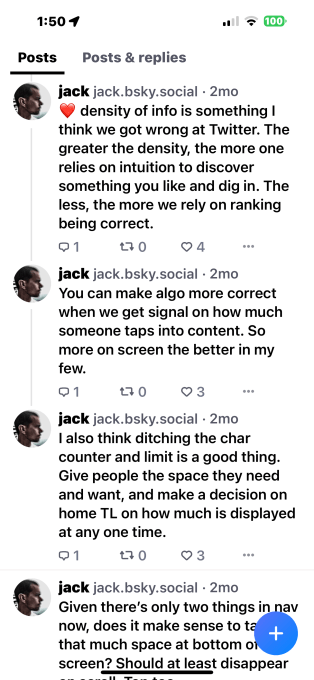
There’s something ironic about leaving Twitter to use an app that looks and feels so much like Twitter, right down to posts from Jack Dorsey as he muses over product concerns like “density of info,” character count or in-app navigation. Bluesky’s larger promise is the new underpinning technology of the AT protocol, but the app itself feels like a stripped-down Twitter.
In a way, it’s nice to be away from Twitter’s mean tweets, crypto scams and clout-chasing posts (including from its new owner). But there are already so many Twitter clones now in the works, including the yet-to-launch-publicly projects like T2, Spill and Post; it’s hard to imagine carving out time to use another app, as well. (Of course, if Twitter adopted AT, things could get more interesting. But who knows what Musk is up to these days.)

Image Credits: Bluesky screenshot of @Jack

Arguably, some are not sold on the promise that the web needed another decentralized protocol that serves the same purpose as ActivityPub, either. After all, a million little Fediverses is not the decentralized web of our dreams.
Bluesky’s plans to run a beta were first announced in October, but the app itself was not publicly available at the time.
Bluesky declined to comment or answer further questions about the project, app or beta, noting it’s not doing press at this time as it’s focused on working through bugs.

9to5 : USB-C iPhone speeds will be limited if you use non-MFi cables, claims lea

USB-C iPhone speeds will be limited if you use non-MFi cables, claims leaker
Those of us who’ve been waiting impatiently for a USB-C iPhone, so we can finally use a single set of cables for all our Apple devices, will be getting our wish in this year’s iPhone 15 lineup. But a leaker with a decent track record warns that there may be a catch.
ShrimpApplePro, who got hardware details right for the iPhone 14, says that we’ll need to use a new lineup of MFi USB-C cables to get full functionality …
Apple’s switch to USB-C
Apple began its switch to USB-C with Macs, the 12-inch MacBook being the first model to get the then-new port back in 2015. The company went all-in on USB-C ports in the MacBook Pro a year later, before backtracking a bit in 2021 by restoring MagSafe, HDMI, and SD card slots.
The iPad made the switch from Lightning to USB-C in 2018, with the 11-inch and 12.9-inch iPad Pro models.
But the iPhone continued to use a Lightning port all the way up to the current iPhone 14. That’s set to change with the iPhone 15, when Apple will finally replace Lightning with USB-C for wired charging and data transfer.
USB-C iPhone catch
However, ShrimpApplePro – who established credibility with Dynamic Island and iPhone 14 RAM leaks – says there will be a catch.
Yeah usb-c with MFI is happening. Foxconn already in mass production accessories like EarPods and cables […] Cables w no MFI will be software limited in data and charging speed.
We’re already expecting the base model iPhone 15, and iPhone 15 Plus, to have their data transfer speeds capped to USB 2.0 – while the Pro models will get dramatically faster transfers.
Kuo says that the iPhone 15 and iPhone 15 Plus will retain the same USB 2.0 transfer speeds as Lightning. This means data transfer speeds will be capped at 480 Mbps. This continues Apple’s strategy of further bifurcating the iPhone lineup between Pro and non-Pro models.
As such, Kuo reports that the iPhone 15 Pro and iPhone 15 Pro Max (or Ultra?) will feature “at least USB-C 3.2 or Thunderbolt 3” data transfer speeds. USB-C 3.2 could improve data transfer speeds to as high as 20 Gbps, while Thunderbolt 3 would boost that even further to 40 Gbps.
But if this latest report is true, then the Pro models will only get those speeds if you use either official Apple cables, or third-party ones with MFi certification. Wired charging speeds will also be limited without approved cables.
This could potentially mean that we can’t use all our existing USB-C cables if we want to get full capabilities from the two Pro models.

>>> 7.2 Percent Of US Adults Identify As LGBT

7.2 Percent Of US Adults Identify As LGBT

A total of 7.2 percent of U.S. adults identified as LGBT in 2022, a new record high.
As Statista's Katharina Buchholz notes, Gen Z, newly added in the Gallup survey's 2020 edition, is the gayest generation in terms of self-identification.
Almost 20 percent of those born between 1997 and 2004 identified as LGBT, compared with around 11 percent of Millennials.
You will find more infographics at Statista
While scientists believe that the share of LGBT individuals has not actually changed over time, younger people in the U.S. are more likely to be openly gay, lesbian, bisexual or transsexual.
Even within the generation of Millennials, defined as those born between 1981 and 1996, self-identification quotas rose in the past years. In 2014, only 6.3 percent of Millennials had said they identified as LGBT.
For older generations, levels of self-identification did not change majorly in the past decade.
The Gallup survey question did not ask respondents to identify as other sexes, sexual identities or sexual orientations like intersex, asexual or queer.

FT : UK warned of risk to key net zero goal without power grid plan

UK warned of risk to key net zero goal without power grid plan
National Audit Office says government delays will increase chances ‘it does not achieve its ambitions’

The government risks failing to meet its goal of decarbonising the UK’s power sector by 2035 because it lacks a clear and comprehensive delivery plan, the public spending watchdog warned on Wednesday.

The National Audit Office said a focus on the energy crisis sparked by the Ukraine war meant ministers had made “little progress” on a long-term strategy for decarbonising power, despite having planned to release one by October last year.

In a sign of grid infrastructure struggling to keep pace with changes to the power system, the watchdog found that generators were being paid up to £62mn a day to cut output when supply outstripped demand and could not be stored.

NAO chief Gareth Davies said that since decarbonisation was “the backbone of [the government’s] broader net zero ambition”, the longer it took to produce a comprehensive plan, “the higher the risk that it does not achieve its ambitions, or it does so at a greater than necessary cost to taxpayers and consumers”.

The lack of a modernisation plan spanning the entire power system risked undermining industry and investor confidence, the watchdog said.

The government has set an ambition for all UK electricity to be generated using clean sources, including nuclear, by 2035. Greenhouse gas emissions from UK power generation have fallen by 73 per cent since 1990, according to official data, but 41 per cent of the nation’s electricity still comes from natural gas, a polluting fossil fuel.

The NAO said meeting the 2035 target would require a rapid expansion of wind, solar and nuclear power. Although offshore wind capacity has grown in recent years, the rise has been accompanied by a jump in the amount of money paid out to power generators for them to reduce output, the watchdog found.

It said “constraint costs” — which occur when generators cannot access the grid or generation exceeds network capacity or demand — had been between zero and £62mn a day since 2018. Noting that total annual charges had recently risen, the NAO warned that they could increase further “if network capacity does not keep pace with electricity generation expansion”.


Experts said the grid network could distribute only so much before overheating or overloading, adding that it was designed for a smaller number of large power stations, rather than the more complex structure of many smaller generators, such as wind and solar farms.

Chris Hewett, head of industry group Solar Energy UK, said a lack of rapid grid investment was “probably the big constraint for solar and energy storage”.


“Capacity in the grid is now an economic growth constraint,” he said, adding that “billions of pounds” worth of solar power projects had already obtained planning permission but would not be able to launch for years.

In its report, the NAO called on the new Department for Energy Security and Net Zero to outline an overall decarbonisation plan, bringing together the various power sector and network goals and explaining how they would be met. Progress on the plan should be reported annually to parliament, it said.

The energy security department said its focus during the energy crisis had been “delivering essential cost of living support”, adding: “We haven’t taken our foot off the pedal and our commitment to decarbonise the UK’s electricity system by 2035 remains resolute.”

FT : Dior, diamonds and Duncan Grant – the passions of Kim Jones

Dior, diamonds and Duncan Grant – the passions of Kim Jones
Obsessed with the Bloomsbury Group since childhood, the Dior Men’s designer has amassed one of the world’s greatest collections of its works. Is he also creating a comparable gang for 2023?

Kim Jones moves along his bookshelves in a kind of reverential awe. The 43-year-old designer, better known as the artistic director of Dior Men and Fendi womenswear and couture, is standing in the library of his west London home, a brutalist bunker he has lived in for four years. Scrolling along the floor-to-ceiling bookcases, which were designed based on a sketch by Jean Prouvé, he pulls out treasure after treasure from the shelves. Here, a first edition of Virginia Woolf’s Orlando. And another. And another. And another. There are seven. He shows me the edition sent to Vita Sackville-West, to whom the book was dedicated by her then lover. Accompanied by a black-and-white portrait of Woolf in her most radiant early 20s, it is inscribed with a cursory “Vita from Virginia” on the inner sleeve. 

There are other favourites: Twelve Original Woodcuts, by Roger Fry, published by the Hogarth Press in 1921; a copy of To the Lighthouse, a publisher’s proof; as well as the letter to TS Eliot in which Woolf outlined the writing of Mrs Dalloway. He uses gloves for only the rarest of editions. “People don’t realise, you can be pretty rough with books,” he says. He turns over a first edition of The Waves, signed by Woolf to her secretary. “I love holding something that has touched the writer’s hand.”

Jones doesn’t look like your typical antiquarian. He has a baby face but dresses like a geezer, and has a cool composure that could read as shyness, or perhaps a bit aloof. Over the course of several meetings – in London, Sussex, Paris and Cairo – he wears a blue shirt by Miu Miu, a heavy conker-coloured leather Miu Miu jacket and bib-front cream-coloured trousers by a Japanese brand called Goodenough that he has been wearing since he was 19. He styles his watch like the Italian industrialist Gianni Agnelli, over his shirt cuffs, and wears one on each wrist. “That’s a ’70s Rolex Submariner with a Tiffany dial, and this is a Paul Newman Daytona 1968,” he says of his current favourites; the Daytona was a gift to himself after his first Fendi show. Around his neck, a pair of wraparound Oakley glasses glitter with encrusted diamonds. On his finger sits a gigantic diamond globule given to him by a fan. “It’s just shiny stuff,” he says of his penchant for flashy statements. “But I think everyone loves that.”

Jones loves stuff. Loves buying it. Loves giving it away as presents. Loves sharing it with other people. His munificence is all part of his astonishing success as one of the most influential designers in the industry – albeit one you might not know by name. A graduate of Central Saint Martins, where he studied menswear under Louise Wilson, he first garnered attention at his namesake label before being made creative director of Dunhill in 2008. In 2011 he was appointed style director of menswear at Louis Vuitton where he drove wild growth for the LVMH-owned behemoth through cult collaborations with Jake and Dinos Chapman and the streetwear giant Supreme. As artistic director of Dior Men since 2018, he has created similarly bold collections, seamlessly blending the atelier techniques of the maison with traditional tailoring and elevated casualwear. 

His tenure has been fruitful: a recent HSBC study estimated that sales at Christian Dior have quadrupled since 2018, surging 35 per cent from €6.5bn in 2021 to €8.8bn last year alone. “Kim Jones masters the art of reinventing Dior’s priceless legacy while celebrating it,” says Pietro Beccari, the brand’s former chair and CEO. Beccari has since been replaced by Delphine Arnault, allowing Beccari to take on a bigger role at Louis Vuitton. “Kim draws inspiration from the archives and twists them magnificently into an ultra-contemporary spirit that merges elegance, practicality and haute couture.” 

Jones pays close attention to the numbers, just as he uses coloured spreadsheets to keep track of items on his shelves. “My mother set up libraries in Africa,” he says of his love for order. “Plus I’m a Virgo with a rising sign of Virgo – just like Karl Lagerfeld.” Like Lagerfeld, he well understands his obligations. Unlike Lagerfeld, he’s not remotely comfortable being centre stage. When we last speak, Pharrell Williams has just been appointed creative director of menswear at Louis Vuitton. “I’m sure he will do very well for them; he’s an old friend,” he says of Williams, with whom he has started projects in the past. Although it cannot be lost on the designer that in bringing so many cultural influencers to the maison, he has himself been partly responsible for the shift towards celebrity – or non-fashion – fashion designers in recent years.

Jones himself prefers to remain a bit more under the radar. He keeps his private life elusive, and prefers not to discuss his romantic relationships. He’s very clear about the precarious position of even the most successful creatives. “I work for the customer,” he shrugs of his professional ethos. “And if the customer wants something, we’ll make it.”

The Bloomsbury books are only a fraction of Jones’s extensive collection; several portraits by Roger Fry, plus a screen, and some Duncan Grants are hung around his London walls. There are also ceramics, jars and “approximately 25 pieces” of Omega furniture (made at the short-lived design workshop founded by Roger Fry). At one point he produces the most delicate of shell necklaces – one belonged to Woolf, the other to Vanessa Bell. All combined, it puts him in possession of one of the most extensive private Bloomsbury collections in the world.

He clearly has a massive income, and equally expensive taste. What has he been buying recently? “God, what? I’m trying to think… A copy of Two Stories, by Leonard and Virginia Woolf… There’s also a Lucian Freud portrait of a pigeon [Jones’s enthusiasms are by no means Bloomsbury exclusive]. A Duncan Grant and a Vanessa Bell. But I’m giving them to the Trust.”

The Trust is the Charleston Trust, the East Sussex seat of the Bloomsbury Group, now a museum and exhibition space, with which Jones regularly works. Leased in 1916 by Vanessa Bell and her friend and lover Duncan Grant, and Grant’s partner David Garnett, Charleston was a small farm a few miles outside Lewes that was quickly reconvened as a progressive artistic hub. It was also the scene of torrid sexual romances and a fulcrum for countercultural thought. Vanessa and Duncan painted every stick of it in the distinctive palette that has since become the signature of decorative bohemianism and regular visitors included the writer Lytton Strachey, art critic Clive Bell (husband of Vanessa) and the economist John Maynard Keynes. 

Jones first discovered Charleston farmhouse as a teenager while spending weekends with his step-family in Lewes. It made a fast impression; he still has the lino cut of swimmers that he recreated having seen it displayed on one of the farm’s doors. The building has since loomed large in Jones’s imagination. He shot a campaign for his first couture collection at Fendi at the farmhouse, and rebuilt a scaled-down model, including garden, for his SS23 menswear show at Dior. “That period, in between the wars, where the world was either slumping or going crazy and shifting away from the values of what had been before,” he explains. “Imagine these people born in Victorian-era England, deciding that this is not how we want to live. That’s why I think I like the Bloomsbury Group so much. They were reacting against their times.”

An armchair psychologist might have further thoughts on Jones’s particular obsession. The son of a British hydro-geologist, his father, and a Danish librarian, Jones enjoyed a peripatetic, disrupted childhood that took the family to Ecuador, Ethiopia, Kenya, Tanzania, Botswana and the Caribbean. His parents separated when he was five, and he resettled in London for his senior schooling, but his mother was ill for much of his early adolescence and died when he was 17. His discovery of Charleston coincided with that formative period; his interest in fashion was also awakened at that time. “At home I was the carer and looker-after,” he remembers, “because Mum was never very well. And so [Sussex] was like freedom. I became curious and saw a lot of the world from a very early age.”

In future, Jones plans to move his hoard of Bloomsbury books to Rodmell, the village in East Sussex where Virginia Woolf lived in Monk’s House. He has bought a handsome property in the village that he is furnishing in a Bloomsbury-modern style. On a tour around the house one winter morning he points out numerous Vanessa Bell paintings, a chaise covered in fabric designed by Cecil Beaton and a guest suite with a tiny bed that once belonged to Maynard Keynes, from Heal’s. The house is buzzing with activity; Jones’s good friend Nathaniel Hepburn, the director and chief executive of Charleston, is chatting to the various Dior representatives, friends and housekeepers assembled while the atmosphere is punctuated with the grunts and snuffles of Lolita, a friendly Mexican rescue mutt. Everywhere features delicious points of interest. Everyone is in a buoyant mood. At one point he waves a blue-and-white painted teapot – a birthday present to Woolf from Vanessa Bell – but doesn’t use it to make tea. 

Jones describes himself as being an “organised hoarder”, admitting that his acquisitional obsessions may stem from the fact he was only allowed “to bring three toys” each time he moved country as a child. Like many children, he first started collecting Star Wars figures: the pristine unopened boxes still line the office bookshelves in his London home. Later, he got into fashion, buying selvedge jeans and early Vivienne Westwood. He keeps all of it, and claims to have only ever sold one item: a parachute shirt, by Westwood, to fund an early collection from his namesake label in 2003.

The Bloomsbury passion runs deeper. Almost part of his branding at this moment, it subtly informs the romantic but rebellious aesthetic he has steered at Dior. And, just as the Bloomsbury Group orbited around key players, Jones is the centrifugal force around his own creative gang. Kate Moss is a stalwart figure of the inner circle, alongside Naomi Campbell, Demi Moore and Lily Allen, who slept on his sofa when she was still a precocious teen. Yoon Ahn (who does the Dior costume jewellery) Hiroshi Fujiwara (often described as the godfather of modern streetwear), Shawn Stussy and Tremaine Emory (the Denim Tears founder and current creative director of Supreme) were all friends for years before they worked together. Jones’s breathtaking resort show in front of the pyramids of Giza last December was accompanied by a live performance by the Max Richter Orchestra; for the recent AW23 show in Paris in January, he worked with the director Baillie Walsh of Abba Voyage.

Gwendoline Christie, the statuesque Game of Thrones actress, first met Jones around 1998 when he was studying at Central Saint Martins: she performed a reading of The Waste Land at his most recent menswear show. “We are firmly bonded over our shared love of all things Bloomsbury,” she says. “We also share a love of literature and [of] the books themselves. I find Kim’s library so romantic; it’s impressive but it’s just so personal – it’s a beautiful representation of Kim’s rich inner world.”

Ask about his starry associations, however, and Jones likes to keep it humble: they’re just people whom he’s “always” known. He likes “washing dishes” and “doing the potatoes” and “sitting in the corner” – albeit in the corner “chatting with [Kate Moss’s] mum”. Christie describes him as “one of the most hilarious and fun people you could hope to be around with an outrageous zest for life”. When he can, he likes to take friends on safari. But he also loves to get them round a craft table making things with Fimo clay. 

One of Jones’s most visible signatures as a designer has been in his work with contemporary artists. His first show for Dior was set before a giant KAWS sculpture adorned with thousands of pink roses. He has also worked with Raymond Pettibon, Amoako Boafo, Daniel Arsham and Peter Doig. 

“I think Kim’s vision for Dior is about engaging artists and looking at possibilities of creation through their lens,” says Arsham, who worked on the SS20 show. “So we used themes that were present in my work [such as erosion, gradient colour palettes and crystal material] and filtered them through the possibilities of wearable art. I worked on everything with Kim, from jewellery to bags, all the clothing, accessories, as well as on the stage set. It was a pretty magical experience for me and the single largest engagement that I’ve had with fashion thus far.” 

Beccari also notes Jones’s talent for “forging alliances with other artists” – just as Christian Dior, a former gallerist, did when starting up the house. Asked about what makes Jones so successful, Beccari cites “his open-mindedness and sense of dialogue. His ability to listen and to understand the desires of clients. And his ultra-responsiveness makes him the best ally on both strategic and creative fronts”.

Lucy Beeden has been Jones’s “right-hand woman” for almost 18 years. “Kim is a fantastically generous boss,” she says. “He has this incredibly open culture that breeds creativity because he lets everyone express themselves without fear. He spends time talking to young people, and he really listens to people talking about what they want to wear. The only things that really frustrate him are incompetence and people who don’t listen. He knows what he wants, so you’d better not make him repeat himself!”

Jones’s Dior may be elegant, modern and romantic, but as a hired name within a big corporation he is pragmatic too. “What I do is meant to give people some optimism, really. There’s not ever going to be a political discussion in my work,” he says. “My role is to think about Dior as the past [the archive], the present, and what will be the future. My job is to consider what you’re bringing to keep it going, and what I’m doing to make it relevant.”

A man of many interests, Jones is in a permanent state of doing. In addition to the challenges of making now some 22 collections a year, and his Bloomsbury project, he travels constantly and does “lots of conservation projects on the side. Charleston’s one of my big passions, but conservation is another”. One project, the Douc Langur Foundation, supports endangered monkey colonies in Vietnam, Cambodia and Laos. 

At this point in his Bloomsbury collection there aren’t so many gaps left. Can he feel his attention shifting to other things? “I can be quite completist and then I move on,” he says of his new passions. Lately, he’s become “quite Francis Bacon obsessed”. No surprise that Jones is drawn to another darkly romantic cultural icon, not to mention one of the most expensive artists on the market today. “I know. It’s silly,” he says of his aspirations. “But I’ve been collecting the preliminary works. Bacon is dark, but it’s also interesting. Just the fact that he started as an interior designer, and then through his work and association with [the abstract artist] Roy De Maistre… I’ve got a painting, which is gorgeous, it’s almost like you couldn’t tell who did what. And so there’s an interest in the works on paper, the bits of fragments, Screaming Popes… Carpets. And then the more I think about the house in Sussex, I’m thinking about furniture as well.”

Ultimately, Jones wants to design a permanent library in the old school building in Rodmell that will house his book collection and provide another point of interest for those people doing the Bloomsbury tour. “I have quite a big collection of things now, and they’re quite important things to other people,” he says. “That’s why I bought the schoolhouse. I thought if you go to see Virginia Woolf’s house, surely you’d want to go and see the books as well?”

For a man who barely stays in one place for a minute, it seems incredible to imagine that Jones is putting down some roots. But his father’s death, followed by his uncle’s, has made him more circumspect. Both died without a will, and sorting out the estates of each has galvanised Jones’s determination not to leave his own affairs in any kind of mess. “It’s not about being morbid,” he argues, more that things are “kept together” when he’s gone.

“You get to a point in your life where you’re homing in on your childhood, almost,” Jones reflects. He is sitting in the living room in Rodmell on a pale sofa; a perfect cream carpet lines the room beneath his feet. “And the one thing for me is, I always wanted to feel secure.” By filling the house with Bloomsbury portraits, pots and first editions, he now possesses those things that gave him an early taste of freedom, but also creative opportunity and the confidence that he might do just as he pleased. Home is somewhere he can play with the books without putting any gloves on; he can fill that teapot and get Kate Moss to play with clay. More importantly, home – whether in London, Paris, Rome or in Sussex – is where no one will ever put an upper limit on his toys. 

FT : Rouble slides to 10-month low as falling energy prices bite

Rouble slides to 10-month low as falling energy prices bite
Russian currency has lost around 20 per cent of its value in gradual decline since start of December

The Russian rouble has fallen to its weakest level in 10 months, losing around 20 per cent of its value since the start of December, as western sanctions, Moscow’s waning energy revenues and high military spending exert pressure on the currency.

With capital controls in place and foreign trading in the currency largely moribund, analysts said the value of the currency no longer reflected a forward-looking assessment of the state of the economy but more of a short-term snapshot.

“Trade flows have become the main factor behind the rouble moves,” said Natalia Lavrova, chief economist at BCS Global Markets.

The currency is trading at around Rbs75 to the dollar, from the peak of Rbs50 it reached at the end of July and around the level it was at before the full scale invasion of Ukraine a year ago. After the war started it collapsed to around Rbs140 to the dollar, according to Bloomberg data, following the imposition of sanctions, and then recovered after interest rates were raised to 20 per cent and capital controls imposed.

The currency’s decline this year is being driven by lower energy revenues, a result of western sanctions on Russian oil exports including a $60-a-barrel price cap imposed by the EU in December. Moscow is now selling much of its oil to China and India, which can demand a discount on the price, particularly since February 5 when G7 sanctions were extended from Russian crude to oil products.

The spread between Brent crude and Russian Urals was $29.24 on Tuesday, compared to $18.55 at the start of November. Revenues in January fell 46 per cent year on year, the finance ministry said.

The rouble’s fall is being tempered by the central bank selling renminbi holdings from its national wealth fund, in accordance with its “budget rule”: when energy revenues are lower than expected, the bank sells assets from the fund to cover the difference.


In January, according to the finance ministry, Russia sold Rbs54.5bn of renminbi and plans to triple this amount in February. If it did, this would account for less than 6 per cent of the fund’s total renminbi holdings, suggesting that the strategy can be maintained for some time.

“These sales are not aimed to strengthen the rouble, as they cannot outweigh the trade flows, although may have a minor supporting effect,” said Vladimir Osakovsky, the chief Russia economist at the Bank of America.

A weaker rouble gives Russia higher export revenues as it receives energy income mostly in dollars and euros, while government spending is largely in the local currency.

“When the exchange rate goes one rouble down, the budget receives an extra Rbs120bn,” Lavrova said.

The recent decline is not necessarily bad news for Moscow: last year the government worried that the currency had strengthened too much. Economy minister Maxim Reshetnikov said after it hit Rbs50 to the dollar that “the profitability of many industrial enterprises became negative at the current exchange rate”.

Too weak a currency, however, poses risks for inflation — through more expensive imports — and financial stability as it triggers demands for liquidity, analysts at the Kyiv School of Economics Institute analysts said in a report this month.

Government statistics demonstrate the pressure on the currency. In January, the current account surplus, the difference in net value between exports and imports, fell to $8bn. This was a year-on-year drop of almost 60 per cent.

Falling oil and gas revenues also put pressure on government finances. But instead of tightening its belt, the state increased spending in January by 59 per cent year on year. By the end of February, Russia had spent 17 per cent of the 2023 budget but earned only received 5.3 per cent of its expected annual revenue, according to finance ministry data.

“The scale of spending increase in January is quite unusual as the government usually trims spending at the start of the year,” Osakovsky said. He argued that the spending surge could be another reason behind the rouble’s decline, as “part of the rouble inflows could have been used to buy dollars to pay for imports”.

It is unclear how low the rouble will fall. A recent central bank survey of Russian analysts forecast that the currency would trade in the Rbs67-Rbs77 range this year, a level which first deputy prime minister Andrei Belousov last year had described as “the most comfortable for Russian industry”.

Analysts believe that the currency’s future direction will be determined by the same factors that are driving it now — the shifting pattern of imports and exports, particularly in the energy sector.

Sofya Donets, chief Russia economist at Renaissance Capital, said: “The rouble exists in a relatively sterile environment and reflects one fundamental aspect of the Russian economy — the trade balance.”

FT : Losses from bond purchases put Bundesbank in political line of fire

Losses from bond purchases put Bundesbank in political line of fire
Rising interest rates leave the German central bank and ECB at risk of public backlash

Germany’s central bank will on Wednesday reveal how big a financial hole it faces from rising interest rates, which analysts warn will saddle it with mounting losses in the coming years and increase political scrutiny of its massive bond purchases.

The Bundesbank is being squeezed by the growing gap between the rapidly rising interest it pays to commercial banks on their deposits and what it earns on the €1tn of debt it bought in recent years as part of the European Central Bank’s bond-buying programmes, many of which yield negative rates.

The gap risks tipping the Frankfurt-based institution into its first loss since the 1970s and could put a dent in its hard-earned credibility, economists say, even though it is likely to draw on €20bn of provisions it has built up in recent years to absorb any losses for 2022.

Daniel Gros, a fellow at the Centre for European Policy Studies think-tank, estimated the German central bank would suffer €193bn of losses on its investments in government bonds over the next decade, more than any other national central bank in the eurozone.


The deterioration of the Bundesbank’s performance will have a knock-on effect on German public finances.

Over the past decade, the central bank has distributed more than €22bn of its profits to the government. But it is not expected to pay a dividend for the third consecutive year at a time when Berlin’s finances are also coming under strain from rising interest rates.

German finance minister Christian Lindner warned this week that the annual interest the country pays on its debt had risen tenfold in two years — from €4bn to €40bn — following the ECB’s decision to stop buying extra bonds and to raise interest rates by 3 percentage points. “That is money that cannot be spent elsewhere,” he told Bild Zeitung, the German tabloid.

The losses could also trigger fresh criticism of the ECB, which has frequently come under attack in Germany for its decision to purchase trillions of euros of mostly government bonds to support the region’s economy.

Bild recently dubbed ECB president Christine Lagarde “Madame Inflation”, blaming her for being too slow to raise rates in response to record inflation. The German press also depicted her predecessor Mario Draghi as a vampire and a gangster.

“The public criticism will increase,” said Ulrike Neyer, professor of monetary economics at Heinrich Heine University Düsseldorf. “First, because there will be no payments to [the] government. Second, because people may argue that the central bank’s independence is at risk. However, I think this criticism is not totally justified.”

Former Bundesbank president Jens Weidmann was regularly outvoted on the ECB’s decision to buy bonds. A legal challenge against the bond purchases is still pending in Germany’s constitutional court.

The German central bank, which presents its annual report in Frankfurt on Wednesday, is not alone in confronting tougher times. Several national central banks, including those in the Netherlands and Belgium, have warned their governments that they expect to make significant losses and to stop paying dividends.

The ECB said last week it made no profits in 2022 and scrapped its dividend for the first time in 15 years. In January, the Swiss central bank reported a record annual loss of SFr132bn ($143bn), mainly caused by foreign exchange losses.

Most analysts think these shortfalls should not matter as central banks do not aim to make profits and cannot go bust when they have the power to print money.

“Profits are always better than losses,” said Jörg Krämer, chief economist at Commerzbank. “But various central bankers have rightly made clear in the past that they could even operate at negative equity as long as their credibility with the people is intact.”

Bundesbank president Joachim Nagel is on Wednesday likely to emphasise that there is little risk of it facing a situation of negative shareholder equity — in which liabilities exceed its assets — as it has more than 3,350 tonnes of gold worth about €170bn sitting in Frankfurt, New York and London.


But with central bankers in Europe facing criticism for maintaining ultra-low rates for too long as inflation spiralled upwards, economists say the losses could increase pressure on them to shrink their balance sheets.

Volker Wieland, professor of monetary economy at Frankfurt’s Goethe university, said: “It is better to let the balance sheet decline rather quickly along with rising interest rates.” 

The ECB has announced plans to reduce its almost €5tn bond portfolio by €15bn a month from March by not reinvesting the proceeds of some maturing bonds. But Wieland said it was moving “at a glacial speed”, adding that by keeping such a large balance sheet the ECB “opens itself up to considerable pressure from the political side”.

The Bundesbank won widespread public admiration for its swift interest rate rises in the 1970s that helped Germany to avoid the double-digit inflation that plagued much of the western world. Its solid reputation was summed up by a quip from former European Commission president Jacques Delors that “not all Germans believe in God, but they all believe in the Bundesbank”. 

WSJ : Paramount Turned Down $3 Billion-Plus Offer for Showtime From Former Execu

Paramount Turned Down $3 Billion-Plus Offer for Showtime From Former Executive
David Nevins was latest Showtime suitor to be rebuffed by Paramount over past few years

Former Paramount Global PARA -3.03% executive David Nevins offered to buy Showtime for more than $3 billion in recent weeks but was turned down by Paramount executives, according to people familiar with the situation.

Mr. Nevins’s approach, which was backed by private-equity firm General Atlantic, was the latest in a number of offers Paramount has received over the past few years for Showtime, people familiar with the matter said. Other suitors included Mark Greenberg, another former Showtime executive who most recently ran the premium network Epix, and Lions Gate Entertainment Corp. , some of the people said.

Paramount has decided to hold on to the premium channel and streaming service while it seeks cost savings and revenue from folding the Showtime streaming service into Paramount+ this year, as The Wall Street Journal first reported. As part of that change, Paramount Global—home to the Paramount movie studio, the Paramount+ streaming service and cable channels including Nickelodeon and Comedy Central—will increase the price of the ad-free premium tier of Paramount+, which will include the Showtime programming, to $11.99 from $9.99.

Paramount’s decision not to sell Showtime indicates the tough calls entertainment companies are making as they decide what scale and portfolio they need to compete in the quickly changing media landscape. Paramount is betting the plan will result in cost savings and revenue generation that exceed what the company could get by selling Showtime, whose shows include hits like “Billions” and “Yellowjackets.”

Paramount, like many of its peers, is struggling with declines in pay-television subscribers and a volatile advertising market. The company has said it would have negative cash flow this year as it hits peak spending, but will hit positive cash flow and earnings growth in 2024.

Mr. Nevins, a seasoned entertainment executive, offered to buy Showtime shortly after leaving Paramount Global, where he was chairman and chief executive of the Paramount Premium Group and chief creative officer of scripted content for Paramount+. He also oversaw Showtime, Paramount Television Studios and Black Entertainment Television.

Mr. Greenberg expressed interest in buying Showtime recently, but discussions didn’t advance, according to some of the people. It wasn’t the first time Mr. Greenberg had made an approach, the people said: Around two years ago, Mr. Greenberg offered about $6 billion for Showtime, in an offer backed by Blackstone Inc. Lions Gate Entertainment in recent years also has approached Paramount about merging Showtime with Starz, according to other people familiar with the situation.

Earlier this month on Paramount’s earnings call, executives were asked by an analyst why the company chose to fold Showtime into Paramount+ instead of selling it for cash, in light of “credible multibillion-dollar offers for Showtime.”

“We think there’s enormous value to unlock with the integration of Showtime and Paramount+,” Paramount CEO Bob Bakish said in response. The company reviewed the offers and concluded that its operating plan would create more value for shareholders, Mr. Bakish said.

WSJ : Apollo in Talks to Buy Aerospace-Parts Maker Arconic

Apollo in Talks to Buy Aerospace-Parts Maker Arconic
Arconic’s advisers have also reached out to other potential buyers

Private-equity firm Apollo Global Management Inc. APO 0.68% is in talks to acquire aerospace-parts maker Arconic Corp. ARNC 19.48% , according to people familiar with the matter.

Apollo submitted a bid in February and has debt financing in place, the people said.

Arconic’s advisers at Goldman Sachs Group Inc. GS -3.80% and Evercore Inc. EVR 1.06% have also reached out to other potential acquirers, the people said. There is no guarantee there will be a deal with any of them.

Arconic stock shot up nearly 20% to close at $26.44 on Tuesday after The Wall Street Journal reported on the bid, giving the Pittsburgh company a market value of about $2.6 billion. It also has a hefty debt load of more than $1.5 billion. Should there be a deal, it would be expected to carry a significant premium, the people said.

Arconic, which makes parts for the aerospace, automotive, building and energy industries, has had a bumpy history.

After being separated in 2016 from the aluminum business that is now called Alcoa, the company faced a campaign from activist investor Elliott Investment Management LP, which resulted in the resignation of Arconic’s then-chief executive, Klaus Kleinfeld, and an overhaul of its board.

Arconic is now run by Timothy Myers, who took the CEO role in 2020.

The Journal reported in 2018 that Apollo had expressed interest in a deal for Arconic. Apollo ultimately came close to an agreement to pay upward of $10 billion for the company, but the deal never happened. Arconic instead further divided into two independent, publicly traded businesses in 2020.

Arconic’s Engineered Products and Forgings businesses remained in the existing company, which was renamed Howmet Aerospace Inc. HWM -0.33% Its Global Rolled Products group became part of a new company that is now known as Arconic Corp.

Arconic recently reported that its revenue for the fourth quarter totaled $1.9 billion, down 9% from the prior year as higher interest rates fanned anxiety about the economy. Its net loss widened to $273 million, or $2.70 per share, from $38 million, or 36 cents, a year earlier.

The deal would come at a muted time for private-equity buyouts. A tough financing market—coupled with a disconnect between buyers and sellers on price after equity values plummeted last year—has created roadblocks to deals.

Private-equity firms have turned more to private lenders, while some have opted to put more of their cash to work in new investments. Apollo, which has a large credit arm, has the ability to be creative in the structuring of its deals.

The firm, which has over $500 billion in assets under management, recently led the purchase of $900 million in convertible preferred stock of Western Digital Corp. , along with Elliott.