China’s battery plant rush raises fears of global squeeze
State subsidies follow steel and solar panel playbook in reinforcing race for market share
China is building battery plants far beyond levels needed to meet domestic demand for electric cars and grid energy storage, underlining vast state subsidies and unchecked bank lending that are expected to underpin the international expansion of Chinese manufacturers.
Production capacity at China’s battery factories is expected to reach 1,500 gigawatt hours this year — enough for 22mn EVs — more than twice demand levels, forecast at 636GWh, according to data from CRU Group, a research firm.
Battery manufacturers are following a pattern exhibited in other industries such as steel, aluminium and solar panels, industry executives warned, where Chinese companies benefit from subsidies to take a huge share of the global market and squeeze out competition internationally.
“We are worried,” said Olivier Dufour, co-founder of Verkor, a French battery start-up backed by Renault. “What I see there is very similar to what I knew in aluminium. It’s more than preoccupying,” added Dufour, a former executive at mining company Rio Tinto.
Regions of China are racing against each other to take advantage of government subsidies and become production epicentres for batteries in anticipation of surging future demand, risking a glut of production.
The battery production rush has concerned Chinese leader Xi Jinping, who warned the industry in March about the risk of over-expansion and the potential for a boom and bust cycle, which has befallen some fast-growing Chinese industries, including property and solar.
Sam Adham, head of battery materials at CRU Group, said Chinese battery production at roughly 550GWh last year outpaced the 450GWh that went into end products and were exported. “Many manufacturers are overproducing and continuously building up their stocks,” he said.
Based on announcements to build battery plants, the overcapacity is set to surge to nearly four times what the country needs by 2027, its data shows, and twice the volume of what China’s entire car fleet would need to go completely electric by 2030.
According to one senior western motor industry executive in China, manufacturers’ expansion plans are “totally unrealistic” and have come despite hopes of industry consolidation. Now, as overcapacity issues worsen, there is a risk that more companies turn to exports, in line with the solar industry, and add to geopolitical tensions between China and the west.
“Will they dump them on other markets? We don’t know. But it is certainly a possibility,” the person said.
In a presentation to EU officials seen by the FT, Verkor warned that a 500GWh supply gap in Europe in 2030 could be “compensated” by 1,100GWh of overcapacity in China.
Patrik Andreasson, vice-president of strategy and sustainability at Northvolt, the Swedish battery manufacturer, warned that Europe’s grid energy storage sector is particularly vulnerable to Chinese exports. “A large import of Chinese, low-budget batteries would decrease” Europe’s sustainability ambitions and “likely be seen as a strategic mistake”, he said.
While China is likely to face obstacles in flooding the global market with battery exports, its battery makers are being incentivised to set up locally because of protective policies and incentives in Washington and Brussels.
Despite bans and restrictions on its technology, China’s battery manufacturers including CATL, the world leader with 37 per cent global market share, are planning to expand into the US and Europe.
CATL — the only battery maker making full use of its factories in China — signed a deal in February with Ford to license its technology for use in the US carmaker’s Michigan plant, while AESC is set to play a key role in Tata’s UK battery factory.
Some argue overcapacity fears are overblown as batteries are poised to play a key role in China backing-up electricity from intermittent renewable energy during a historic transition from coal. Goldman Sachs has forecast that China’s battery energy storage requirements will increase 70-fold by 2030.
However, as it stands, the average estimated utilisation rate, which measures actual battery production versus the capacity to which a plant is designed to produce at, is 55 per cent, CRU analysis shows.
In contrast, European battery plants cannot receive debt financing unless they can guarantee a rate above 70 per cent, says Adam Panayi, chief executive of Rho Motion, a battery consultancy.
Rolex buys Bucherer: the battle of hard luxury titans begins
By Astrid Wendlandt
03/09/23
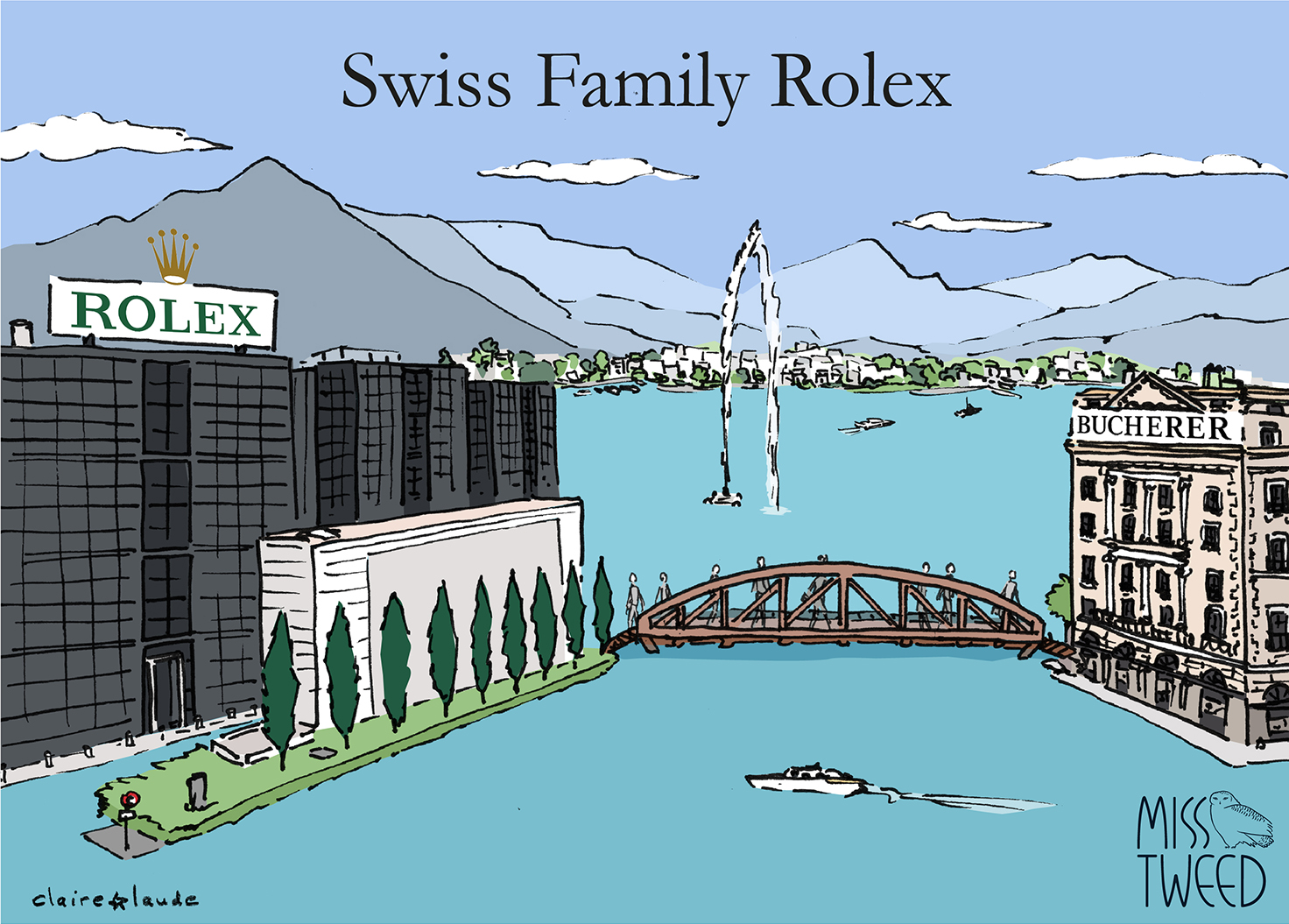
There’s a new battle of the titans brewing in the world of European luxury. For years, rivalry between Bernard Arnault and François-Henri Pinault propelled the sales of expensive bags, clothes and shoes to ever greater heights. Now Rolex’s acquisition of Bucherer, Europe’s leading watch and jewelry distributor, creates a similar standoff in the world of hard luxury. The deal pits Rolex owner, the Hans Wilsdorf Foundation, squarely against the Rupert family at Richemont and the Hayeks of the Swatch Group. This new combination will have a substantial impact on the global watch industry, and hard luxury generally, for years to come.
That’s what industry insiders, executives and experts told Miss Tweed at the Geneva Watch Days (GWD) event this past week. The timing of the deal announced on Aug. 24 is crucial. It comes as the industry is suffering a slowdown likely to extend well into next year. “Even though Bvlgari watches have grown strongly, August included, the reality check will be in October at the end of the tourist season,” LVMH’s Bulgari CEO Jean-Christophe Babin told Miss Tweed at the GWD.
Demand in the US remains lackluster and business in China has not picked up as much as many expected with the country’s economy slowing down. “We expect growth in the watch industry to be more muted in the next 12-24 months,” Niels Eggerding CEO of the Frederique Constant group, part of Japan’s Citizen group told Miss Tweed. In this climate, only a few independents and the world’s strongest brands – Rolex and Cartier, of course, but also Audemars Piguet, Richard Mille, Breitling and Richemont’s Vacheron Constantin, are enjoying growth. Most other brands are either in decline or stagnating, watch bosses and analysts said at the GWD.
Into this moment of industry malaise, the Rolex-Bucherer deal came like a bolt of lightning, vaulting the combined group into luxury’s big leagues. The watch brand Rolex is already the industry leader with estimated annual sales of more than 9.3 billion Swiss francs (€9.72 billion). Adding Bucherer’s 2.2 billion Swiss francs in annual revenue (€2.3 billion) creates a hard luxury group with combined annual revenues of some €12 billion. That potentially puts the Rolex-Bucherer group in the No. 2 position in the global ranking behind industry leader Richemont. In the year to March, Richemont, owner of Cartier and Van Cleef & Arpels made €17.3 billion in watch and jewelry sales.
The deal also places Rolex-Bucherer on equal standing with the hard luxury division of LVMH, the world’s largest luxury conglomerate, owner of jewelers Tiffany & Co, Bulgari, Chaumet and watch brands Tag Heuer, Zenith and Hublot. The combined group is also larger than another leading family-controlled luxury player: Hermes. “They are now bigger than Hermès with only one category of product,” noted Jean-Philippe Bertschy Vontobel Managing Director. Hermes made €11.6 billion in sales last year.
Ever since Rolex was founded a little over a century ago, the company has been saying that it was not interested in watch retail and distribution. Its focus was on production, and creating and manufacturing the highest quality timepieces. It owned one boutique in Geneva and relied on third-party retailers providing a network of some 1,500 points of sale. Another family-controlled brand, Patek Philippe, operates in a similar manner. Acquiring Bucherer, a venerable Swiss institution founded in the same era as Rolex and which has sold the latter’s watches since 1924, marks a clean break with past strategy. Not only has Rolex become a major watch retailer with more than 100 stores around the world, it now has access to volumes of precious information about its customers, something it will be able to analyze and put to good use. Rolex will be able to improve its relationship with customers as well as in-store and after-sales service, putting pressure on other distributors to up the ante in terms of customer experience. Rolex will also have more visibility on who are those who buy its watches not to wear them but to speculate on their future value.
STRATEGY
Rolex used to be regarded as a rather predictable company, sticking to the same roadmap for decades. In less than a year, it has made two unexpected and major strategic moves. Its entry into retail comes after its announcement in Dec. 2022 that it was going to launch its own certified pre-owned program – a booming market - partnering with Bucherer first and then opening up the program to other official distributors.
The company’s owner Jörg Bucherer, 87, a third-generation member of the Zurich-based company, was keen to sell to Rolex because he did not have heirs. Selling to Richemont, LVMH or Swatch Group was not a palatable option and to private equity firms even less, industry insiders say. Jörg Bucherer is the last person in the company to have dealt directly with Rolex founder Hans Wilsdorf, who died 63 years ago.
Selling to Rolex allows Bucherer to remain in Swiss hands. “Rolex’s mission is to preserve and protect Swiss watchmaking,” the CEO of a major watch brand told Miss Tweed at the GWD.
“It wants to be a good citizen. Its ethics and morals are irreproachable.” For example, Rolex has been pushing for the Watches & Wonders trade fair, traditionally dominated by Richemont, to welcome more small and independent brands. Many industry insiders believe that should Patek Philippe’s owners, the Stern family, wish to sell, they will want Rolex to buy it for the same reasons. Rolex is the only company able to guarantee the preservation of the company’s spirit and the Sterns would want Patek to remain under Swiss control.
While the acquisition is opportunistic, Rolex also judged the time was right to get into retail. Top rivals such as Audemars Piguet, Richard Mille, LVMH, Richemont and Swatch Group brands have been investing in building their own network of boutiques in the past decade to better control image and stocks and pocket the retail margin. Now it’s Rolex’s turn and it may not stop here.
Another target could be Zurich’s Beyer Watches & Jewellery, located on the popular Bahnhofstrasse retail strip. Founded in 1760, it is the oldest watch retailer in the world. Since 1996, it is run by owner René Beyer, part of the eighth generation. Like Jörg Bucherer, Beyer has a succession problem, industry sources say. Selling to Rolex may prove to be the best solution.
Rolex takes a lot of time to make a decision but once it has determined a strategy, it goes full steam ahead. Hence, you can expect it to expand by acquiring more retailers, industry sources predict.
The Rolex-Bucherer deal has already shaken up the industry. Some industry analysts argue that if Rolex wanted to enter retail earlier, it could have just bought London-listed Watches of Switzerland, currently worth £1.4 billion (€1.63 billion) on the London stock market. The company’s shares fell as 20 percent when the Rolex-Bucherer deal was announced.
Investors feared the newly combined entity would steal market share from the London-based retailer. Its shares have recovered since as investors over-reacted to the news. Rolex stressed in its statement that buying Bucherer would not affect its relationships with other distributors and their allotment of watches. Bucherer would keep its name and management and continue to be independently run.
BIG GROUPS TO EXIT FROM BUCHERER
Bucherer and Rolex may say nothing will change, but few analysts and executives believe them. “It is likely that in the future, Rolex is going to open more boutiques with Bucherer than with other retailers such as Watches of Switzerland,” said Bertschy, adding that Rolex represented a major source of profit for the company. “When your main source of profit becomes a competitor, it can potentially be a problem.”
One obvious consequence of the acquisition of Bucherer by Rolex is that major luxury groups are likely going to stop working with the specialist retailer. Richemont has already started to close down accounts with the Swiss company and it will continue. The group has removed some of its best-selling brands including Vacheron Constantin, Jaeger-LeCoultre from major Bucherer boutiques such as its flagship in Paris. Bucherer has refused to answer any of Miss Tweed’s questions.
Swatch Group, owner of Longines, Omega and Tissot, will also progressively sever ties with Bucherer, executives and analysts predict. Swatch Group CEO Nick Hayek said back in July that he planned to significantly downsize the group’s retail network and even aimed to have only directly operated stores at some point in the future. Hayek will not want Rolex to have access to his brands’ sales and customer data. When a watch brand works with a third-party distributor, it reveals its plans for the next 2-3 years: what models are in the pipeline and what will be its product and price strategy. Neither the Swatch Group nor Richemont want Rolex to know about those – even though Rolex probably does not care much about them since it is so successful. Analysts estimate that the Swatch Group and Richemont each make several hundreds of millions of euros of revenues in sales from Bucherer.
Tensions are already high between Rolex and the Swatch Group. Some of them are of a personal nature and concern mainly Hayek and Rolex CEO Jean-Frédéric Dufour and Chairman Nicolas Brunschwig, industry sources say.
Brunschwig is heir of the Geneva family that founded retailer Bon Génie in 1891, which later evolved into the major Swiss department store chain Bongénie Grieder. In 2014, Swatch Group bought the more-than-century-old gothic style building that houses the Grieder flagship in Zurich on Bahnhofstrasse. The group has decided to kick out Grieder which occupied the building since 1913 as well as Louis Vuitton, which operates in it a big boutique.
The exit of Richemont and Swatch Group from Bucherer will not happen overnight. It may take several years, executives and analysts predict. It will have two consequences. First, it will free up space for small independent watchmakers – excellent news for them. Watch lovers are increasingly interested in small brands as they are tired of chasing popular models by big brands such as Audemars Piguet, Richard Mille, Patek Philippe and Rolex that are tough to get.
Bucherer will be keen to welcome more small and independent brands to replace lost business with the big groups. Second, Richemont and the Swatch Group will put pressure on other major watch and jewelry distributors to give them more space. Once they leave Bucherer, they will have to find new retail spaces to sell their stock. Elbowing their way into other retailers will make it more difficult for rival watch and jewelry brands to preserve their own space or expand their presence at a given retailer.
Many distributors are mom and pop shops, people who are passionate about watches and have built a strong address book of customers over the years. To some degree, they are more motivated than brand-owned boutiques since their existence and very future depends on their performance. The director a brand-owned boutique is paid a fixed salary every month – no matter what - and a bonus ever year.
DOWNTURN
Small independent watch brands continue to enjoy strong demand. However, some are suffering from the fact that Rolex has increased its output this year, making its watches more easily available. Previously, buyers fell back on smaller brands because they could not get the Rolex they wanted or the timepiece they dreamed of for a long time from one of the strongest brands. Last year, the second-hand bubble burst and since then, the price of some of the most popular brands and models have fallen between 20 and 40 percent.
“We see a normalization of demand,” Maximilian Büsser, founder and CEO of independent watch brand MB&F. “Many of the speculators who were buying watches to sell them and make a profit have left the market and this is a good thing. Now most people who buy an expensive watch is because they want to wear it and not only because they consider it a good investment.”
His view was echoed by peer Edouard Meylan, CEO of H. Moser & Cie. “My retailers say that business this year and next year is likely to be a bit more complicated,” Meylan told Miss Tweed, adding that demand for his own brand remained strong.
Cravan, a Paris Cocktail Bar With a Music Kiosk on the Roof
This surreal 17th-century townhouse on Boulevard Saint-Germain is the latest project of historian-turned-restaurateur-turned-mixologist Franck Audoux in collaboration with Moët Hennessy.
Where can you find a bookstore, two cocktail menus, three centuries’ worth of French culture — and a music kiosk?
Neatly packed in a 2,700-square-foot 17th century townhouse on Boulevard Saint-Germain that is now home to Cravan, the five-story cocktail-centric venue imagined by historian-turned-restaurateur-turned-mixologist Franck Audoux.
A cursory glance from the street could lead one to believe this is just another chic cocktail bar, with stools neatly lined at a wood counter and a clutch of alcoves dotted along wood-paneled walls.
But from the entrance with its 1:15-scale model of the building that contains an even tinier replica of itself, stepping inside is the start of a surreal continuation of the universe Audoux created in the first Cravan bar — a 17-seat slip of a place located in a 1911 building in the 16th arrondissement. They are named after Arthur Cravan, a poet, boxer and Dadaist figure who was a nephew of Oscar Wilde.
The 120-seat Saint-Germain townhouse means to be “the kind where you can get lost in,” where “the higher you go, the deeper you are steeped in references that nourish Cravan,” explains Audoux, who before veering into mixology spent a decade working in contemporary art and another in gastronomy as one of the cofounders of noted fine dining restaurant Le Chateaubriand in the 10th arrondissement.
The original bar applied what he learned during the research for his “French Moderne: Cocktails from the 1920s and 1930s” book, published in 2019 at Rizzoli. Tapping into their history as an embodiment of a time of social and cultural change, Audoux turned the idea of “French excellence in an American or English drink” into contemporary concoctions that drew rave reviews.
They continue to be the star here, served without flourishes or fancy garnish. Ice cubes only appear in long drinks and if there’s one secret Audoux is willing to share, it’s that a dry, rather than sweet, finish is key to avoid saturating the taste buds and to make the next sip as palatable as it is desirable.
For all the sophistication and legerdemain involved in these beverages, “apparent simplicity” remains key for its founder, whose work hinges around two to three ingredients at most.
“That opens a door towards gastronomic complexity. But the base ingredient had better be top notch,” he says, explaining that a cocktail is above all “about the tension between ingredients.”
Case in point: the Royal Basilic, on the menu at both Cravan outposts. This two-ingredient cocktail, an infusion of Sicilian basil flowers bolstering a floral facet in Ruinart’s Brut Champagne, is the very first Cravan recipe and “encapsulates all of Cravan’s know-how” for Audoux.
He took the idea further with Cravan’s bottled cocktails, one of the stars of the new venue.
The principle behind these tipples, developed in conjunction with 75-year-old distillery Nusbaumer, a family-owned company based in the eastern French region of Alsace, is “how to work on a spirit, barely touching it, keeping its typicality and playing with it,” hand-in-hand with cellar masters.
Take “Archi,” an 18-year-old Glenmorangie whisky whose pear notes were bolstered by the tart twist of a pear cordial. That particular conversation had him feeling like a watchmaker adjusting minute gears before heading to Edinburgh to consult “Doctor Bill,” the single-malt distillery’s director of distilling, whisky creation and whisky stocks Bill Lumsden.
“It’s important to have a conversation, an exchange of know-how and a common vision,” says Audoux, who developed six bottled recipes. Two, including Archi, can also be bought to be enjoyed at home.
Congruent with the idea of liquid gastronomy and offering ingredients in their truest expression, drinks are left unfiltered to give a fuller-bodied sip. “If you remove texture, it would be like serving a dinner with nothing but espumas,” quips Audroux.
The same ideas holds true for the sharing plates, eclectic recipes meant as a travel diary of sorts, including the Gilda, a famous pintxo finger food from the Spanish border town of San Sebastian made of a guindilla pepper, an anchovy fillet and an olive; a “tamago” onsen egg parfait, floating in an impeccable dashi broth; as well as the “Eton bleau,” a moreish strawberry, cream and meringue that’s a hybrid between England’s Eton mess and France’s Fontainebleau.
More than sustenance, however, Audoux sees each creation — alcoholic or not, drink or dish — as a key that unlocks a gateway toward “books you wouldn’t normally reach for, music you’d not listen to, stylists or designers you wouldn’t know, films you wouldn’t see elsewhere,” he explains.
This second iteration of Cravan was born in the dog days of France’s lockdowns, when, like others in gastronomy and hospitality, Audoux felt there was a need for reinvention. He reached out to the wine and spirits division of LVMH Moët Hennessy Louis Vuitton, seeking a partner to “amplify what was done in the ‘Petit’ Cravan to make it accessible to a greater audience.”
With its “very sophisticated experience around fine, elegant cocktails, and discoveries,” Audoux’s concept fell in step with Moët Hennessy’s stated ambition of “crafting experiences,” offering an approach that goes from the gustative to the intellectual, recalls its chairman and chief executive officer Philippe Schaus.
Describing Cravan as “a unique fusion between a very chic cocktail bar in a beautiful hotel, a private club open to the public and the home of an interior decoration buff,” the executive said it and projects like the six-month pop-up experience of Casa Eminente or Harrods’ Moët bar were milestones “towards more proximity with the consumer, more competency in creating experiences and bringing them alive — every time you pass a step like this, you’re enlarging your horizon.”
Each floor at Cravan has been imagined as “a 17th-century house, with cubes telling the story of another time slotted in.” Paris-based Belgian designer Ramy Fischler sourced 80 percent of the materials through reclamation, from unused theater decors to deadstock luxury textiles drawn from Nona Source.
Plywood structures, apparent upon exiting each bar space, recast the place as a succession of decors to embody the idea that “since we are telling stories, we embrace that the settings are stages,” according to Audoux.
The ground floor is an apothecary, with a replica of the Petit Cravan (bar and painted ceiling included) simply slotted in the middle of the space; the first floor contains an elegant salon bisected by a stainless steel and marble bar redolent of ’70s architecture icon the Drugstore Publicis on the Champs-Elysées.
Then comes the second-floor library, where the “contemporary box” is Paris’ first and only Rizzoli bookstore where tomes can be browsed or bought on everything from Japanese designers and streetwear labels to skater Mark Gonzales and Spike Jonze’s book on the Beastie Boys, selected with editor-turned-friend Ian Luna.
The third floor, with its stately chimney, faux-peeling frescoes and antique rugs collaged together, is home to Cravan’s bottled cocktails. One floor up is an artist’s workshop only accessible by invitation, lined with shelves filled with Cravan’s eclectic book collection and fitted with a cinema screen and state-of-the-art music system, which is slated to open in September.
And that music kiosk? Another metal spiral staircase hidden behind a wall of realistic-looking fake book spines — not stately tomes but smart paperbacks that you could find in any French household — leads up to the roof, where it is improbably (but securely) perched.
It’s not one of those party rooftops with sweeping vistas of the City of Light and its monuments. Instead, there’s the Saint-Germain-des-Prés church and a plunging view on Café de Flore and neighborhood favorite bookstore L’Ecume des Pages, a sight he finds refreshingly domestic.
But cinematic as the townhouse may be, Audoux is adamant it serve as a mere backdrop for a moment to have a very good drink. No bottles on display, no shakers being thrown in the air, elegant glassware that highlights the contents without distracting from them. There’s the sense that even the backstory of Cravan could be optional since the cocktail and its mixologist are the start of the story.
“Less is more,” he says. “Taste, flavor, balance, your experience of the cocktail. And then we can talk about it – if you so wish.”
Cravan, 165 Boulevard Saint-Germain, 75006 — open Tuesday to Thursday, from 5 p.m. to 1 a.m.; Friday and Saturday, from 5 p.m. to 2 a.m.
Fabio Zambernardi is to Exit Prada Group: Sources
The parting between the Prada and Miu Miu design director and the Italian brand is said to be amicable.
After more than four decades working closely with Miuccia Prada, Fabio Zambernardi will exit the Prada Group, according to market sources.
The parting is said to be amicable and Zambernardi is expected to leave his role as Prada and Miu Miu design director in October following the spring 2024 collections for both brands.
The Prada Group did not comment.
Zambernardi, 59, was named to his current role in November 2002 for all divisions ranging from ready-to-wear to footwear and accessories.
He has been collaborating with the brand since 1981. He was promoted shoe design director in 1997 and design fashion coordinator in 1999.
While known to keep a low profile, Zambernardi is very much respected in fashion circles and is considered influential within the company. He also worked with Prada and her husband Patrizio Bertelli, group chairman and executive director, on the development of image strategies.
Prada Group, as reported, has been enjoying strong brand momentum at both Prada and Miu Miu, which helped register strong profitability and revenues in the first half. In the six months ended June 30, group net profit soared 62 percent to 305 million euros and revenues amounted to 2.23 billion euros, up 17 percent compared with the same period last year.
Andrea Guerra joined the group as chief executive officer in January.
1 death reported at Burning Man while festival attendees remain stuck in the Nevada desert from heavy rains
CNN —
As thousands of people remain unable to leave the Burning Man festival in the Nevada desert after heavy rains inundated their campsites with ankle-deep mud Saturday, authorities say they are investigating a death at the event.
Attendees were told to shelter in place in the Black Rock Desert and conserve food, water and fuel after a rainstorm swamped the area, forcing officials to halt any entering or leaving of the festival.
The remote area in northwest Nevada was hit with 2 to 3 months worth of rain – up to 0.8 inches – in just 24 hours between Friday and Saturday mornings. The heavy rainfall fell on dry desert grounds, whipping up thick, clay-like mud that festivalgoers say is too difficult to walk or bike through.
“More rain is expected over the next few days and conditions are not expected to improve enough to allow vehicles to enter the playa,” the Bureau of Land Management said in a statement obtained by the Reno Gazette Journal.
The Pershing County Sheriff’s Office said it’s investigating “a death which occurred during this rain event.” Authorities did not publicly name the person or provide details on the circumstances of the death.
“The family has been notified and the death is under investigation,” the sheriff’s office said in a late Saturday news release.
Authorities have not provided information on when roads could reopen, but the sunshine is expected to return Monday after more showers Sunday.

“We do not currently have an estimated time for the roads to be dry enough for RVs or vehicles to navigate safely,” Burning Man organizers said in a Saturday evening statement. “Monday late in the day would be possible if weather conditions are in our favor. It could be sooner.”
Organizers did note that the rain falling on an already saturated playa overnight and Sunday “will affect the amount of time it takes for the playa to dry.”
For now, the gate and airport into Black Rock City remain closed and no driving is allowed into or out of the city except for emergency vehicles, the organizers said on social media. Black Rock City is a temporary metropolis that is erected annually for the festival and comes complete with emergency, safety and sanitary infrastructure.
The rain “made it virtually impossible for motorized vehicles to traverse the playa,” the Pershing County Sheriff’s Office said, noting that people were advised to shelter in place until the ground has dried enough to drive on safely.
Vehicles trying to drive out will get stuck in the mud, Burning Man organizers said Saturday. “It will hamper Exodus if we have cars stuck on roads in our camping areas, or on the Gate Road out of the city,” the organizers added.
“If you are in BRC, please shelter in place & stay safe,” organizers said.
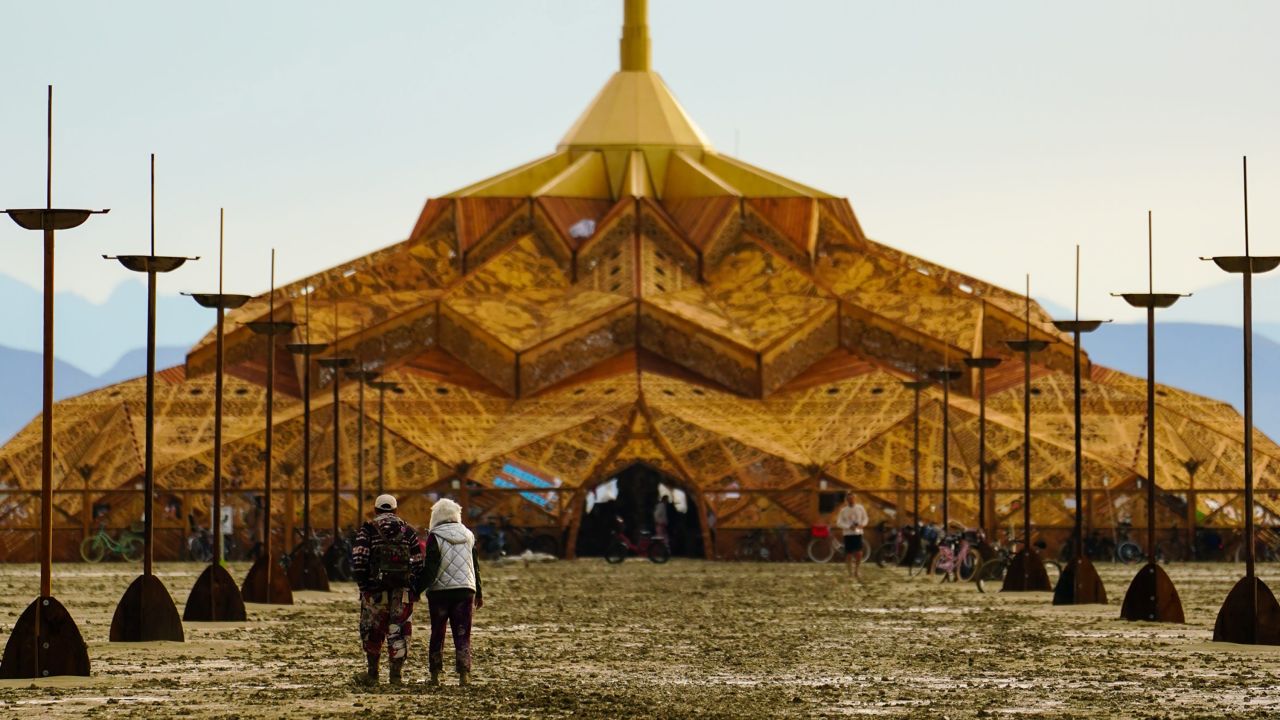
Some festival-goers hiked miles on foot in the thick mud to reach main roads while others stayed at their camps, hoping for conditions to improve.
Hannah Burhorn, a first-time attendee at the festival, told CNN people were trudging through the mud barefoot or with bags tied around their feet.
“People who have tried to bike through it and have gotten stuck because it’s about ankle deep,” Burhorn said. The mud is so thick that it “sticks to your shoes and makes it almost like a boot around your boot,” she added.
It’s unclear exactly how many people are stranded at the festival, but typically more than 70,000 people attend the weeklong event. It’s being held from August 28 to September 4 this year.
There weren’t any reports of injuries as of Saturday afternoon, Sean Burke, the director of emergency management for Pershing County, told CNN.
Amar Singh Duggal and his friends managed to leave the festival after hiking about 2 miles in the mud, he told CNN. He estimated it took them about 2 hours to get to a main road where they arranged to be picked up and taken to Reno, about a 120-mile drive from the event grounds.
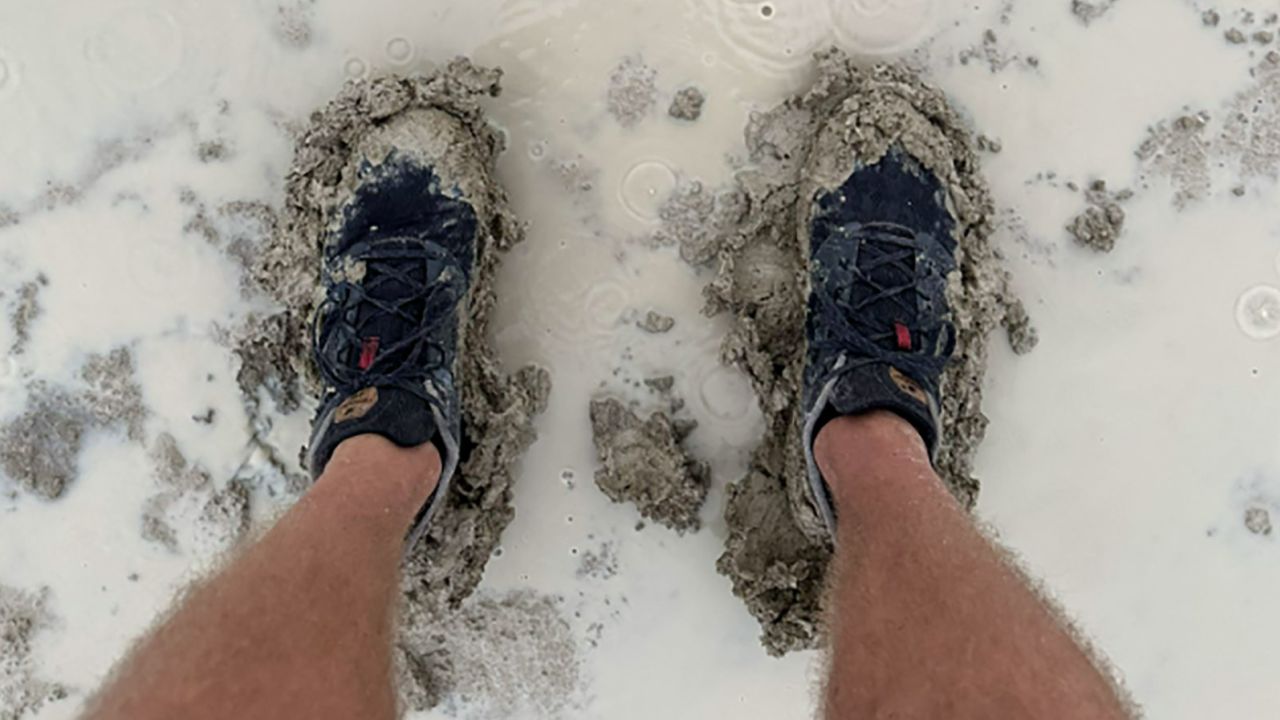
“We made it, but it was pure hell (walking) through the mud,” Duggal said. “Each step felt like we were walking with two big cinderblocks on our feet.”
Meanwhile, attendees who typically dedicate their time to making art and building community are now also focused on rationing supplies and dealing with connectivity issues.
“There is super limited bandwidth and a lot of people at the camp (are) trying to cancel flights and arrange for extended time here” due to the weather, Burhorn told CNN via text message from a Wi-Fi camp.
Still, the poor conditions have not stopped the creativity, said Burhorn, who had traveled from San Francisco.
“People are building mud sculptures,” she said.

Organizers announced Saturday night they’ll be putting mobile cell trailers in different positions, configuring the organization’s Wi-Fi system for public access and deploying buses to nearby Gerlach to take people who might walk off the playa to Reno.
“This is not likely a 24-hour operation at this time,” the festival said in a statement on its website.
Organizers are also resourcing four-wheel drive vehicles and all-terrain tires to help ferry medical and other urgent situations to the blacktop.
There have been people who managed to walk to a main road and were waiting for transport from the festival organizers Saturday night, the Pershing County Sheriff’s Office said.
Resources have been brought in from around northern Nevada to help people with medical needs on the event grounds, the sheriff’s office said.
“Burning Man is a community of people who are prepared to support one another,” Burning Man said on its website. “We have come here knowing this is a place where we bring everything we need to survive. It is because of this that we are all well-prepared for a weather event like this.”
“We have done table-top drills for events like this,” organizers added. “We are engaged full-time on all aspects of safety and looking ahead to our Exodus as our next priority.”
CNN’s Para
Heavy Rain Leaves Burning Man Stuck in Mud
Organizers closed the gates and encouraged tens of thousands of participants to shelter in place following a storm
BLACK ROCK CITY, Nev.—An overnight storm dropped nearly an inch of rain on the arid desert where Burning Man is taking place, covering the typically dusty playa in a thick layer of mud and prompting organizers to close the gates to traffic and order tens of thousands of participants to shelter in place.
By Saturday afternoon, following hours of steady overnight rain, mud was blanketing roads and campsites. Organizers banned participants from driving cars or riding bicycles, and encouraged people to conserve food, water and fuel.
Many attendees were covered in mud, which caked their boots and made traversing the massive temporary city difficult. The overnight rain flooded tents, causing some participants to scramble to find new accommodations.
For now, attendees had little choice but to wait. The gates were closed to all vehicles, except emergency services, to prevent a rush of traffic from getting stuck in the mud. Weather forecasts predicted that more rain could drench the desert early Sunday morning, potentially worsening conditions.
The atmosphere at the event remained festive on Saturday night as the clouds cleared. But some attendees were worried about reports of more rain amid widespread concerns that outdoor toilets could overflow and another storm could cause further flooding.
Trapped in the desert for the foreseeable future, several attendees said they were struggling to find cell phone service or an internet connection to change their flights home. Some said they feared they could be stuck for days.
Burning Man veteran Eddie Codel, who has been attending the festival since 1997, said conditions are “very slip-and-fall” muddy, but it hasn’t dampened spirits too much.
“Most people are in a positive mood. There is plenty of food and water to go around,” said the California-based videographer, who has been sleeping in a Shiftpod tent.
It was unclear whether organizers would hold Burning Man’s signature event: the burning of a massive effigy of a man. It had been scheduled for Saturday night.
Each year, 80,000 or more people trek to the Black Rock Desert 90 miles north of Reno for a nine-day event that features music, art installations and all-night partying.
Burning Man was founded on principles of self-reliance, self-expression and decommodification. Money largely isn’t exchanged during the event, and organizers rely on participants to build and deconstruct the city each year in an effort to leave no lasting effect on the ecologically sensitive area.
Difficult weather conditions are a hallmark of Burning Man. Dust storms regularly whip through the city, causing temporary whiteout conditions, and temperatures exceeding 100 degrees Fahrenheit are a common occurrence. But heavy rain is rare, veterans of the event said.
“At Burning Man, people are really good at turning very inhospitable conditions into a party,” said Amy Edwards, 32, of Oakland, Calif., who is attending her fourth Burning Man.
The Burning Man grounds received an estimated 0.6 to 0.8 inch of rain overnight, according to organizers. Another quarter inch of rain could be dropped on the area in the coming day. While that amount of precipitation wouldn’t have a devastating effect on other regions of the country, dry desert areas are less capable of absorbing rain, making flooding more of a risk.
Dans l’hôtel particulier du milliardaire Xavier Niel, sur l’île Saint-Louis
Racheté par l’homme d’affaires Xavier Niel à la famille princière du Qatar en 2022, l’hôtel Lambert est un joyau architectural dont l’histoire remonte au XVIIe siècle. Il fut le théâtre de mondanités grandioses et successivement la propriété de grandes fortunes, la Seine pour seule voisine.
Une transaction immobilière record en 2022
C’est début 2022, il y a un an, que Xavier Niel fait l’acquisition de l’hôtel Lambert en vue d’y installer une fondation culturelle — la transaction avoisinerait les 200 millions d’euros, un record sur le marché immobilier parisien. L’homme d’affaires milliardaire âgé de 55 ans, fondateur de Free et à la tête d’un empire médiatique, figure à la 12e place des grandes fortunes de France, selon le magazine Challenges. Il rachète la demeure au prince Abdullah bin Khalifa al-Thani, qui en était le propriétaire depuis 2007. Ce dernier crée d’ailleurs la polémique lorsqu’il souhaite « moderniser » cet hôtel particulier, classé au titre de monument historique, pour installer un ascenseur, un système de climatisation et un garage creusé sous le jardin. Xavier Niel est aussi propriétaire d'une maison au Cap-Ferret.
L’incendie dévastateur de 2013
Dans la nuit du 9 au 10 juillet 2013, un incendie se déclare sous la toiture et ravage l’hôtel Lambert, détruisant le Cabinet des bains, œuvre du peintre Eustache Le Sueur et trésor du décor mural français du XVIIe siècle. La galerie de l’hôtel, aussi appelée galerie d’Hercule, est épargnée ; la voûte de Charles Le Brun, premier peintre du roi, demeure intacte. Bertrand Delanoë, maire de Paris à l’époque, déclare que « c’est une épreuve sur le plan du patrimoine, c'est un hôtel particulier absolument exceptionnel ». Pharaonique, le coût de la reconstruction atteint la somme de 120 millions d’euros. Les travaux durent jusqu’en 2018.
Le théâtre des mondanités
Avec 3900 mètres carrés au compteur, l’hôtel Lambert est commandé en 1639 par Jean-Baptiste Lambert à l’architecte Louis Le Vau, à qui l’on doit une partie du château de Versailles et la cour Carrée du Louvre. Dominant la Seine avec sa rotonde, il devient la propriété des grandes fortunes à l’image de la famille princière polonaise Czartoryski avant d’être racheté par les Rothschild en 1975. Il devient leur lieu de réception, entre bals et somptueux dîners dont les invités ne sont autre que Mick Jagger et son épouse Bianca Jagger, la princesse Caroline de Monaco, la créatrice Ghislane de Polignac ou encore l’acteur autrichien Helmut Berger.
Billionaire founder of Foxconn leaves board to pursue Taiwan presidential bid
Terry Gou still largest shareholder of world’s biggest iPhone maker
Terry Gou, the billionaire founder of Apple supplier Foxconn, has left the company’s board following his decision to run to be Taiwan’s next president.
The move to step down, which Foxconn announced on Saturday night, appeared aimed at shielding the world’s largest contract electronics manufacturer from any political fallout from his campaign for the election on January 13.
Gou could also cite it to respond to concerns that Foxconn’s massive investments in China could subject him to pressure from the Chinese Communist party, which wants to unify Taiwan under Beijing’s control.
He remains a major Foxconn shareholder with a 12.5 per cent stake in the company and has not said whether he intended to put his shares into a trust or sell them to avoid possible conflicts of interest.
The Foxconn founder has joined a crowded presidential race, which he looks unlikely to win. According to the latest survey by Taiwan pollster Formosa, conducted this week, his support stands at 11.6 per cent. He trails behind two other opposition candidates as well as Lai Ching-te, the vice-president and candidate of the ruling Democratic Progressive party, who leads the race with 35 per cent support.
As China is waging a campaign of military pressure against Taiwan, Gou and other opposition candidates cast the election as a choice between peace and war and blame the DPP government for rising tension with Beijing.
Gou backs closer economic ties with China and has promised to bring 50 more years of peace to the country, a claim that critics said raised concerns over what concessions he might make to Beijing.
Foxconn operates the world’s largest iPhone plant in China, one of dozens of large-scale factory complexes in the country where it assembles and makes components for gadgets from television sets to personal computers.
Although it is expanding in other locations including Vietnam, India and Mexico in response to pressure from customers who want to diversify their supply chains, some 75 per cent of the company’s operations remain in China, according to Liu.
The 72-year-old tycoon handed the reins of Foxconn to new chair Young Liu four years ago when he first entered politics, seeking the nomination of the opposition Kuomintang for the last presidential election.
Pressed on whether he would sell or freeze his shares if elected when he announced his presidential candidacy on August 28, Gou said he had never done business with the Taiwan government. “Not a single deal! So I can withstand scrutiny,” he said.
The company said Gou resigned as a director due to “personal reasons”. It said there was no need to immediately replace him.