FT : There is no green future for Europe without an upgraded power grid

There is no green future for Europe without an upgraded power grid
Electrifying the EU economy must be made easier, cheaper and quicker

In 2022, the EU witnessed a record surge in wind and solar power. Three million heat pumps were sold. Almost one in four new cars is now electric. This is thanks to the European Green Deal and our work to end imports of Russian fossil fuels. These trends are predicted to accelerate this year.

But Europe will only ensure its energy security and deliver on its climate ambitions if we sustain a fast pace in the rolling out of renewables and the electrification of our economy. With supply and demand booming across Europe, we now need to ensure that clean electricity can be delivered across the continent. For this to happen, our power infrastructure must be ready.

Our 11mn kilometres of grids need to grow and change to serve increasing demand. Electricity consumption is expected to increase by about 60 per cent between now and 2030.

Grids will need to integrate a large share of intermittent renewable power and adapt to a more decentralised electricity system: with millions of rooftop solar panels and electric vehicles, electrolysers producing green hydrogen, and local energy communities sharing resources, we will need flexibility, speed and digitalisation.

Today, completed renewable projects can face long waits to be connected to the grid. Securing permits for grid reinforcements can take up to 10 years.

When there is no certainty about connection timelines or costs, planned generation projects are simply abandoned. Even existing renewables plants are often penalised. Solar panels are frequently the first technology to be switched off when grids are overloaded, because they are flexible and easy to manage. This is wasteful and costly.

Across Europe, grid interconnection projects are delayed due to cost overruns, inflation and rising interest rates. But by placing a stronger focus on its transmission and distribution grids, the EU can turn a potential barrier into a powerful enabler.

The EU’s regulatory framework has reduced the length of the permitting procedure for electricity transmission priority projects to under three and a half years on average. And emergency legislation introduced last year accelerated authorisation of new renewable projects. If extended into the broader grid connections, it could help fast-track progress without cutting corners on environmental safeguards. More technical assistance and sharing of best practices could also help national administrations to move faster.

We must invest more and better. Europe needs to invest €584bn in its grids by 2030. There are avenues to explore. In July, the European Investment Bank increased financing by 50 per cent to help mobilise more than €150bn in new green investments. Furthermore, the EU taxonomy on sustainable activities can offer opportunities to increase the financial attractiveness of transmission and distribution operators.

A rapid agreement on the proposed electricity market reform would also help change the remuneration mechanisms for grids projects, boosting anticipatory investments.

We also need to make progress on cross-border interconnections where they still lag behind, despite the commission’s 15 per cent interconnection target. This would increase security of supply and bring down prices.

Finally, we must not underestimate the industrial and commercial opportunities for Europe. The world’s three largest cable manufacturers are European. A better alignment of investment in grids and in manufacturing capabilities is needed.

If we boost our industrial capacity, expand the pool of skilled labour and improve supply chains, this would have a positive effect in terms of jobs and growth. As a start, the EU Net Zero Industry Act will support cable manufacturing along with other clean technologies, for our domestic and export markets. In this way, European industry could also tap into the global surge in grid investment — 80mn km of new grids are needed worldwide by 2050.

The answer to the grid challenge does not necessarily mean “more cables and lines”. There are ways to reinforce the networks without building more physical infrastructure. The European Commission’s “digitalisation of energy action plan” points to various solutions. Flexible storage, and demand response solutions can be crucial.

Europe faces a fundamental challenge in ensuring its energy independence and deliver on its climate goals. It is time to shift our attention from targets and rules to what is needed to make things happen. This means placing the issue of grids at the heart of the debate. Upgrading the power grid will plug Europe into a sustainable future.
FT : Burning Man organisers plot ‘exodus’ of people trapped in desert mud

Burning Man organisers plot ‘exodus’ of people trapped in desert mud
Annual Nevada festival has become magnet for tech and finance execs and social media influencers

Organisers of the Burning Man festival have announced an “exodus” of thousands of attendees stranded in the Nevada desert after torrential rains transformed an event that has become a magnet for technology executives, venture capitalists and social media influencers into a “nightmare” of muck and broken toilets.

“Exodus likely to begin around noon [Pacific] today, Monday 9/4,” the organisers of the event in Black Rock City, Nevada said, days after they urged attendees to shelter in place and conserve food and water as deepening mud shut roads away from the venue.

The burning of a human effigy and temple that culminates the annual event is now planned for Monday night.

News that roads away from the event would reopen as the mud dries ends days of misery for thousands of festival-goers attending what was once the US’s signature counterculture event, but now attracts celebrities alongside older hippies and families.

Burning Man, which began in San Francisco more than three decades ago with a few dozen people witnessing the effigy’s immolation, moved to a barren stretch of the Nevada desert in 1990.

It draws tens of thousands of attendees who travel in trailers or even private aircraft to a “playa” to witness a dizzying agenda of electronic music and light shows, punctuated by a “Man Burn” and a similar razing of a “Chapel of Babel”.

Organisers say the event aims to “generate society that connects each individual to his or her creative powers”.

This year’s Burning Man aimed to celebrate the animal world and challenge the belief that “somehow, despite all evidence to the contrary, mankind is somehow not part of the animal kingdom”.

But heavy rains intervened, transforming the normally parched landscape that can accommodate air-conditioned recreational vehicles and campers into a muddy “hellscape”, as one attendee described it on TikTok, with broken toilets surrounded by six inches of muck.

Some famous attendees such as comedian Chris Rock and former US solicitor general and current Hogan Lovells partner Neal Katyal hiked for miles to flee the muck and find road transport to Reno.

“People are having to change their flights and work schedules if they can’t work remote,” Angie Peacock, 44, a holistic health coach from Missouri, told the Financial Times.

The portable toilets have started to work again, but not cleaning facilities, said Peacock, who has not showered in 10 days. Peacock and others in her camp have passed the time with playing music and participating in naked mud runs.

Music executive Bryan Freeman, 54, and his travel partner bought a $94,000 motorhome and drove from Los Angeles to Burning Man, where he celebrated his birthday in the “beautiful” playa that was lit like Times Square.

But that changed on Friday when the deluge of cold rain brought “horrific” and “miserable” conditions, he told the FT.

After portable toilets overflowed, rumours of disease surfaced on social media, causing Burning Man’s organisers to state “online rumours of transmissible illnesses in Black Rock City are unfounded and untrue”.

Freeman’s travel partner had planned to leave by private jet on Monday from the makeshift airport set up by Burning Man, but his flight was postponed to Tuesday.

But he said one of the event’s 10 principles, “radical self reliance”, meant most attendees had packed sufficient supplies — including “enough food and alcohol” to last through Monday.

“I will be back,” Freeman said. “If you ask people out here what their biggest fear was, it wouldn’t be that something bad is going to happen on the playa . . . It would be that this event goes away.”

FT : Disney/Charter: for millions, Iger vs Malone is a can’t-watch contest

Disney/Charter: for millions, Iger vs Malone is a can’t-watch contest
Sports fans in the US are losing out because of a clash over cable and internet

The hottest rivalries in sport right now include Novak Djokovic versus Carlos Alcaraz in tennis and Aaron Rodgers against Josh Allen in the National Football League. For millions of American fans those face-offs are inaccessible because of another star showdown: “Battlin’” Bob Iger taking on John “Cable Cowboy” Malone.

Disney channels including ESPN have gone dark on the screens of around 15mn Charter Communications pay-TV customers. Such “carriage” disputes occur sporadically. But this one may be existential. “Cord-cutting”, as the cancellation of cable subscriptions is called, has accelerated. Cable and satellite TV have lost their shine for the likes of Charter. These boast booming broadband businesses. 

For Disney, the Charter relationship is a cash cow that generates more than $2bn annually in high margin fees. Such returns have subsidised the billions of continuing losses in streaming.

Charter argues that Disney wants it both ways — charging high prices for traditional cable TV rights while creating a cheap streaming product. Disney claims that its content remains the centrepiece of the cable bundle.

There must be a creative solution. But the collective action conundrum is sufficiently complex to ensure no one has identified it over the tail-end of the US summer holiday period.

In 2018, Charter had 16.6mn video customers. That figure has eroded to just 14.7mn. The company still generates several billion dollars of free cash flow annually.

Charter shares are up 40 per cent in the last five years for an enterprise value of more than $150bn. Disney stock has fallen a quarter. The House of Mouse blames its partner for supposedly charging too much.

The days of plentiful profits for content makers and distributors are over.

Iger vs Malone is a clash over which conduit should dominate viewers’ lives: cable or internet. But the audience for that fight is niche. The pair need to resolve their differences and bring sports back on offer fast — for the sake of both their businesses.

FT : Vladimir Putin says he is ‘open to negotiations’ on Black Sea grain deal

Vladimir Putin says he is ‘open to negotiations’ on Black Sea grain deal
Russian president to discuss UN-brokered accord with Turkey’s Recep Tayyip Erdoğan in the city of Sochi

Russian president Vladimir Putin said Moscow was “open to negotiations” about returning to a UN-brokered Black Sea grain deal, ahead of a meeting with Turkey’s Recep Tayyip Erdoğan.

Giving a joint statement before today’s meeting in the city of Sochi, Putin said the two sides “would not bypass issues, related to the Ukrainian crisis”.

“I know you want to raise the question about the grain deal. We are open to negotiations,” Putin said.

Erdoğan said any agreement on the grain deal would be “very important” for developing countries in Africa. “The world is waiting for what will be the result from here today,” Turkey’s president said.

Putin and Erdogan’s meeting comes nearly two months after Moscow pulled out of the grain agreement, which had allowed roughly 33mn tonnes of grain to be exported from Ukraine across the Black Sea.

Erdoğan has sought to position himself as a middleman between Russia and the west. Ankara has declined to sign up to western sanctions on Russia, and the two countries have deepened their economic ties since the Ukraine war began last year. Turkey, a Nato member, played a key role in negotiating the initial grain agreement, which was negotiated in July 2022.

More than half of the food had been delivered to developing countries, including Turkey, according to the deal’s co-ordination committee. Russia’s exit from the agreement has sparked fears of a potential food crisis in parts of Africa, the Middle East and Asia.

Without safe access to Black Sea ports, Ukraine’s farmers have been forced to reroute their grain exports via land and its Danube ports. These routes carry significantly higher costs and could lead them to plant fewer crops, exacerbating fears of a food shortage down the line.

In a sign of the extent to which the situation has deteriorated in recent weeks, Russia has launched a series of attacks on Ukraine’s southern Odesa region including its Danube ports such as Izmail. Kyiv claimed overnight strikes on Monday crashed across the river on to the territory of Nato-member Romania.

The European Commission said the “general expectation is that Russia at least rejoins the Black Sea grain deal” and that it would stop “targeting especially the Ukrainian grain export”.

The strikes on Danube ports “further demonstrate how Russia is exacerbating the global food crisis with its actions which are putting at risk millions of vulnerable people around the world,” the commission added.

Ahead of the meeting with Erdoğan, Moscow had laid out a list of demands for rejoining the accord. Russia has long alleged that the original deal was unfairly implemented, claiming that western sanctions had prevented the enforcement of a parallel deal to allow Moscow’s own agricultural exports.

Western diplomats said Moscow had been particularly aggravated because it was unable to export ammonia, a key fertiliser ingredient, through Ukrainian controlled territory.

(ZH) US Stock-Bond Ratio Poised To Keep Downward Bias

US Stock-Bond Ratio Poised To Keep Downward Bias

The growth in the US stock-bond ratio is poised to keep falling, but yields on nominal and inflation bonds both bouncing from very oversold levels are likely to be choppy.

It’s generally a frustrating time after big moves as markets take time to settle down, and a new clear, tradeable trend becomes apparent. We are in one of those periods now, but yields should have an overall downwards bias, enough to keep pressure on the stock-bond ratio.

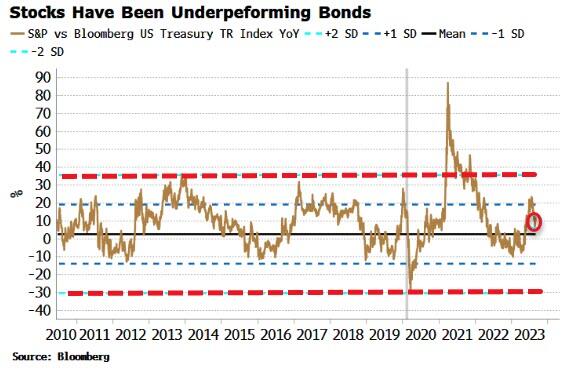
I highlighted a couple of weeks ago that stocks were on the overbought side versus bonds, and we may see a reversal. Since then the annual change of the stock-bond ratio has fallen from its one standard-deviation level.
Equities have run into some resistance around the 4500 level on the S&P. Countervailing forces from rising recession risks and a Fed still drumming the “higher for longer” mantra will conspire to keep equities in a range until the logjam is broken.
Bonds, though, may have a slight edge as they bounce from very oversold levels.
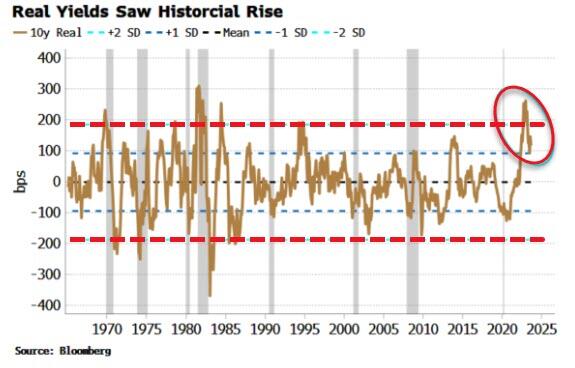
Real yields’ rise at the beginning of 2023 was close to the sharpest they had experienced in over 50 years. Their annual rate of change subsequently fell, but then has bounced again over the last few weeks.
Historically when moves have been very extreme it can lead to periods of choppiness in the breaks of the overall normalization trend. And even though real yields are less overbought, they are still stretched to the upside, meaning in the medium term they should have a downwards bias.
It’s similar for nominal yields. They are less overbought than they were, and face choppiness, but they should have an overall downwards bias in the longer term.
Moreover, as volatility settles down, +4% yields will look increasingly attractive to many buyers – leveraged and unleveraged – especially if recession risks are perceived to be rising (even though investors should not assume the usual investment rules apply in inflationary recessions)

(ZH) German Electricity Imports Hit New Record As Nuclear Phase-Out Increases Pr

German Electricity Imports Hit New Record As Nuclear Phase-Out Increases Production Cost

Despite closing its nuclear power plants to focus on renewable energy production, more than a fifth of imported electricity last month was produced from nuclear power...
Germany is importing more electricity than ever before after purchasing a record 6,505 gigawatt hours from abroad in August, according to the Federal Network Agency.
The federal government has replaced much of the electricity produced by its recently closed nuclear power stations with imported electricity, almost half of which was ironically produced using nuclear power and fossil fuels.

This resulted in a significant electricity trade balance deficit, with the country importing €557 million worth of electricity more than it exported to its EU neighbors last month.
Electricity imports typically occur through the construction of transmission lines or undersea cables that connect power grids across national borders. The energy can be generated from various sources including hydroelectric, nuclear, fossil fuels such as gas and coal, or renewable energy.

And despite the German federal government seeking to prioritize renewable energy sources to generate power, evidenced by its policy decision to shut down the country’s remaining nuclear power plants earlier this year, 21 percent of the imported electricity last month was generated by nuclear power and 28 percent was generated by burning coal and gas, according to the Bild newspaper.

Chancellor Olaf Scholz sought to play down concerns over rising imports back in July, claiming that “every year there are phases in which we buy electricity from other countries.”

However, electricity imports into Germany have increased significantly since the closure of the country’s nuclear power plants on April 15.

As Tim Meyerjürgens, the managing director of transmission system operator Tennet, explained, the rising imports don’t necessarily imply that Germany isn’t capable of generating enough electricity itself, but they do “say something about the price of production,” namely that is has become more expensive.

Following the nuclear phase-out, much of Germany’s electricity has been produced through natural gas and coal-fired plants when renewable energy production hasn’t been viable.
“These are often more expensive than renewables and nuclear power abroad,” Meyerjürgens explained, implying that the federal government is approving imports of nuclear-produced electricity when it could have simply produced this itself with domestic nuclear plants at a cheaper rate.

WSJ : How Worried Should We Be About AI’s Threat to Humanity? Even Tech Leaders

How Worried Should We Be About AI’s Threat to Humanity? Even Tech Leaders Can’t Agree.
Artificial-intelligence experts debate whether to focus on averting an AI apocalypse or problems such as bias, disinformation

Artificial-intelligence pioneers are fighting over which of the technology’s dangers is the scariest.

One camp, which includes some of the top executives building advanced AI systems, argues that its creations could lead to catastrophe. In the other camp are scientists who say concern should focus primarily on how AI is being implemented right now and how it could cause harm in our daily lives.

Dario Amodei, leader of AI developer Anthropic, is in the group warning about existential danger. He testified before Congress this summer that AI could pose such a risk to humankind. Sam Altman, head of ChatGPT maker OpenAI, toured the world this spring saying, among other things, that AI could one day cause serious harm or worse. And Elon Musk said at a Wall Street Journal event in May that “AI has a nonzero chance of annihilating humanity”—shortly before launching his own AI company.

Altman, Musk and other top AI executives next week are expected to attend the first in a series of closed-door meetings about AI convened by U.S. Senate Majority Leader Chuck Schumer (D., N.Y.) to consider topics including “doomsday scenarios.”

The other camp of AI scientists calls those warnings a science-fiction-fueled distraction—or even a perverse marketing ploy. They say AI companies and regulators should focus their limited resources on the technology’s existing and imminent threats, such as tools that help produce potent misinformation about elections or systems that amplify the impact of human biases.

The dispute is intensifying as companies and governments worldwide are trying to decide where to focus resources and attention in ways that maximize the benefits and minimize the downsides of a technology widely seen as potentially world-changing.

“It’s a very real and growing dichotomy,” said Nicolas Miailhe, co-founder of the Future Society, a think tank that works on AI governance and is working to bridge the divide. “It’s the end of the month versus the end of the world.”

For all the attention it has been getting, serious public discussion of AI’s existential risk—or “x-risk” as those most worried about it like to call it—had until recently remained confined to a fringe of philosophers and AI researchers.

That changed after OpenAI’s release of ChatGPT late last year and subsequent improvements that have delivered humanlike responses, igniting warnings that such systems could gain superhuman intelligence. Prominent researchers including Geoffrey Hinton, considered one of the godfathers of AI, have contended it contains a glimmer of humanlike reasoning. Hinton left his role at Alphabet’s Google this year to more freely discuss AI’s risks.

With existential risk warnings, “there’s been a taboo that you’ll be mocked and treated like a crazy person and it will affect your job prospects,” said David Krueger, a machine learning professor at the University of Cambridge. Krueger helped organize a statement in May saying that extinction risk from AI was on par with the dangers of pandemics and nuclear war. It was signed by hundreds of AI experts, including top officials and researchers at Google, OpenAI and Anthropic.

“I wanted researchers to know that they’re in good company,” Krueger said.

Some in the field argue that there is a paradoxical upside for AI companies to emphasize the x-risk of the systems because it conveys a sense that their technology is extraordinarily sophisticated.

“It’s obvious that these guys benefit from the hype still being fueled,” said Daniel Schoenberger, a former Google lawyer who worked on its 2018 list of AI principles and now is at the Web3 Foundation. He said policy makers should focus more on near-term risks, such as AI making it cheaper to mount campaigns to disseminate false and misleading information, or concentrating more power in Silicon Valley.

“There is the risk of dominance, of Big Tech becoming Big AI,” Schoenberger said.

AI leaders worried about existential risks say their concerns are genuine, not a ploy. “To say, ‘Oh the governments are hopeless, so the call for regulation is some sort of 4D chess move’—it’s just not how we think. This is an existential risk,” OpenAI’s Altman said in June.

So-called doomers don’t say that AI will necessarily rise like Skynet in the Terminator movies to destroy humans. Some worry that AI systems trained to seek rewards could end up with hidden power-seeking urges, inadvertently harm humans while carrying out our wishes or simply outcompete humans and take control of our destiny. Research in this community focuses largely on what is called alignment—how to make sure tomorrow’s computer minds have goals intrinsically in sync with ours.

Specialists in AI ethics and fairness, by contrast, are concerned about how the tools are, accidentally or intentionally, exploiting workers and deepening inequality for millions of people. They want tech companies and regulators to implement training standards and techniques to reduce that threat.

Diversity is a flashpoint. AI ethicists have shown how AI systems trained on historical data can bake past discrimination into future high-stakes decisions such as housing, hiring or criminal sentencing. Research also has shown that generative AI systems can produce biased images. They also argue that a lack of diversity among AI researchers can blind them to the impact AI could have on people of color and women.

The debate can get spirited. “What is your plan to make sure it doesn’t have an existential risk?” Max Tegmark, president of the Future of Life Institute, demanded of Melanie Mitchell, a prominent AI researcher and professor at the Santa Fe Institute, during a public forum on x-risk in June. “You’re not answering my question.”

“I don’t think that there is an existential risk,” Mitchell shot back, adding that people are working hard “on mitigating the more immediate, real-world risks,” while Tegmark widened his eyes.

Mitchell said in an interview that the discussion over existential risk is “all based on speculation, there’s really no science.”

Tegmark, a professor at the Massachusetts Institute of Technology whose nonprofit aims to prevent technology from creating extreme, large-scale risks, said that he thinks companies have an interest in stoking a divide between people focused on fairness issues and existential risk to avoid regulation.

“People on both sides of this are doing themselves a disservice if they don’t agree with the other side,” he said in an interview.

The conflict has caused sparks for years. In 2015, some academics and scientists gathered to discuss AI’s risks on the sidelines of a conference hosted on Google’s campus. One side confronted existential-risk proponents, arguing that the focus should be on present-day harms, including bias.

The x-riskers retorted that with humanity’s future in the balance, no one should worry about AI’s causing a quarter-point difference on a mortgage, recalled Steven Weber, a professor at the University of California, Berkeley who was present.

“I almost thought it was going to be a fistfight at an academic meeting,” Weber said.

Those concerned about an apocalypse are far from unified, with some doomers arguing that even executives at big companies who say they are worried aren’t doing enough to avoid it.

“We’re seeing a ridiculous death race to godlike AIs from all the major players,” said Connor Leahy, chief executive of Conjecture, an AI company working on solutions to the alignment problem. He said that he takes larger tech companies’ professions of concern about existential risk with a grain of salt. “Watch the hands, not the mouth,” Leahy says.

There are efforts to bridge the divide, too. Some ethics researchers say they don’t entirely discount existential risk, but just think it should be tackled as part of more well-defined problems that exist today. Some doomers say that the path to catastrophe could well come from concerns highlighted by the ethics community, such as industrialized disinformation toppling governments or starting wars. Both sides are interested in being able to pierce the black-box of how AI thinks, called the interpretability problem.

“Some people are really trying to bridge these two spaces,” said Atoosa Kasirzadeh, an assistant professor of AI ethics at University of Edinburgh who previously worked for Google DeepMind. “Hopefully those communities can be convinced they are all concerned about the same sort of things deep down.”

WSJ : Western Officials Plan to Warn U.A.E. Over Trade With Russia

Western Officials Plan to Warn U.A.E. Over Trade With Russia
Requests to stop exporting items that can be used in war against Ukraine have been largely ignored, Western officials say

U.S., U.K. and European Union officials plan to jointly press the United Arab Emirates this week to halt shipments of goods to Russia that could help Moscow in its war against Ukraine, according to U.S. and European officials.

Officials from Washington and European capitals are visiting the U.A.E. from Monday as part of a collective global push to keep computer chips, electronic components and other so-called dual-use products, which have both civilian and military applications, out of Russian hands.

The U.A.E., along with most other non-Group-of-Seven countries, has declined to join in sanctions imposed by the U.S., U.K. and EU, but has said it doesn’t want the country to be used as a hub for Western companies to evade sanctions by transshipping goods.

U.S. and European officials say they have become increasingly concerned that more Western-made goods are being channeled to Russia through the U.A.E. as the U.S. has pressed other countries, including neighbors of Russia such as Armenia, to clamp down on the trade.

A U.S. State Department spokesman said officials were seeking help from all countries that “are being used to circumvent export controls and divert prohibited goods to Russian end-users.”

U.S., U.K. and EU sanctions envoys also have traveled jointly and separately to countries such as Turkey and Kazakhstan to press authorities to prevent Western dual-use products from reaching the battlefield.

Other countries have also helped Russia receive key dual-use technology. Trade between Russia and China boomed after the invasion, with Beijing exporting over $300 million worth of semiconductors and integrated circuits to Russia, up from $230 million the year before, according to United Nations trade data.

The U.A.E., a longtime U.S. partner in the Middle East, has condemned the invasion of Ukraine at the U.N. several times but has also tried to maintain ties with Russia, part of a foreign-policy strategy of broad international engagement in a world order that its leaders see as becoming increasingly multipolar.

U.A.E. President Mohamed bin Zayed has visited Russian President Vladimir Putin, communicating with U.S. officials before and after the trips. The U.A.E. has deep ties with the U.S., where its sovereign-wealth funds have invested tens of billions of dollars. The U.S. and the U.A.E. also cooperate on counterterrorism.

A U.A.E. official said the country abides by U.N.-imposed sanctions and is in close dialogue with international partners, including the U.S. and EU, about the conflict in Ukraine and its implications for the global economy.

The official said the Gulf state is monitoring the export of dual-use products and is committed to protecting “the integrity of the global financial system.”

The geopolitical climate and the country’s reputation as a stable investment hub have caused capital inflows to the U.A.E., where more than 200 nationalities now live, including nonsanctioned Russians and Ukrainians, the official added.

Russia’s Industry and Trade Minister Denis Manturov said in February that bilateral trade between Russia and the U.A.E. grew 68% year-on-year to $9 billion in 2022, according to a report by Russian state news agency TASS.

According to Russian trade data collected by the Ukraine-based Kyiv School of Economics, the U.A.E. exported $149 million worth of computer components and modules to Russia in the first five months of this year, compared with $1 million in the same period last year. Exports of communications equipment grew to $64 million from zero in the same period last year, while exports of electrical and electronic equipment increased to $20 million from $1 million.

It is unclear how many of these products are subject to Western sanctions.

Armenia, which became a key transshipment hub for U.S. and European dual-use items to Russia last year, exported only around $1.2 million worth of computer components and modules to Russia in the first four months of this year, according to U.N. trade data.

Armenia’s foreign ministry didn’t respond to a request for comment on the trade flows.

In November, the U.S. sanctioned two Dubai-based companies that it said were involved in the shipping of Iranian drones. In March, the U.A.E. said it had revoked the license of Russia’s MTS Bank after it was added to a new round of U.S. sanctions.