Weekend Papers Summary
NEW YORK TIMES
-Why did a drug gang kill 43 students? The Mexican police and others secretly colluded with a cartel that kidnapped 43 students. Wiretaps show just how much the authorities helped the gang.
-Jimmy Buffett has died at the age of 76. With songs like “Margaritaville” and “Cheeseburger in Paradise,” he became a folk hero to fans known as Parrot Heads. He also became incredibly wealthy.
-A brutal path forward for Ukraine, village by village. As Ukraine pushes slowly forward in its counteroffensive, it’s relying heavily on the effort of hundreds of small-scale assault groups.
-Russia said it had thwarted a Ukrainian attack on a vital bridge that links Russia to occupied Crimea.
-President Biden struggles to make ‘Bidenomics’ a plus, not a minus. Wages are up, inflation has slowed and the White House has a new slogan. Still, President Biden’s poor marks on the economy are making Democrats worried.
-Biden team isn’t waiting for impeachment to go on the offensive. The White House has enlisted two dozen attorneys, legislative liaisons and others to counter Republican efforts to impeach President Biden.
-President Biden said he would meet Gov. Ron DeSantis after Hurricane Idalia. The governor’s aide said he had no such plans.
-One of Montana’s top elected officials has made banning the app a top priority, putting the state at the center of a geopolitical storm. Lobbying groups, businesses and influencers have defended TikTok on billboards and in court filings against a Montana proposal.
-Mongolia, a nation with few Catholics gives pope a welcome fit for an emperor. Although it was the first trip to Mongolia by a Roman Catholic pontiff, Pope Francis noted that the two entities have ties dating back many centuries.
-Why Charter and Disney Are Fighting, and What It Means for Viewers. Subscribers to Charter’s Spectrum service cannot watch the U.S. Open or college football games this weekend, with deeper implications for the industry.
-Europe’s boars still hold radioactivity. What surprised scientists is why. Some boars in Germany have radiation levels exceeding the limit deemed safe for humans consumption. Research suggests it’s not just because of Chernobyl.
-As the anniversary of women’s uprising nears, Iran cracks down. Sept. 16 marks one year since Mahsa Amini died in the custody of the morality police, setting off protests. The authorities are trying to quell new unrest.
-Can plastic recycling ever really work? Many plastics that carry the “chasing arrows” symbol, like soda cups and yogurt tubs, are rarely recycled. A new California law is raising the bar.
THE FINANCIAL TIMES
-New data confirming that the world’s largest economy is cooling has given the US Federal Reserve room to hold interest rates steady, economists say, even as it leaves open the possibility of resuming a historic monetary tightening campaign later in the year.
-Igor Kolomoisky, an influential Ukrainian oligarch who backed Volodymyr Zelenskyy’s presidential campaign, has been named as a suspect in a fraud and money laundering case. Zelenskyy’s administration is attempting to beef up its anti-corruption credentials to assuage concerns of western allies, which have poured billions of dollars in economic and military support into the country in the wake of Russia’s full-scale invasion.
-The impact of the Hollywood strikes on California’s economy has reached almost $5B four months after script writers took to the picket lines, a figure that is expected to grow after the latest talks between union representatives and studios ended in acrimony. The first joint strike by actors and writers in 60 years has shut down most Hollywood productions, creating a knock-on effect for caterers, dry cleaners, drivers, rental companies and other small enterprises that support the industry, said Kevin Klowden, chief global strategist at the Milken Institute, who conducted the research.
-An influx of cash from Saudi Arabia stoked a record-breaking summer transfer window for European football, with clubs in the English Premier League spending more than £2B on new players for the first time.
-Hedge funds have upped bets against Argentina’s bonds as the emergence of radical rightwing candidate Javier Milei has sparked investor fears that the country is on course to elect a leader who will struggle to govern in the throes of an economic crisis. The total value of Argentina’s bonds borrowed by investors to wager on a fall in prices has jumped by 65% since Milei, a self-described “anarcho-capitalist”, won a primary poll last month ahead of a presidential election in October.
-The Florida-based start-up, Magic Leap, was valued at $6.4B in 2018, having secured funding from investors including Alibaba, Google and Qualcomm. But poor sales of its consumer-oriented headsets led to lay-offs, a restructuring and a pivot to business customers. Its valuation fell to $2B by late 2021, when Saudi Arabia’s Public Investment Fund bought a controlling stake in the company, infusing it with more cash and taking total funding to $4B.
-Six industry groups told a Texas-based federal appeals court that the Securities and Exchange Commission overstepped last week when it adopted new rules for private fund managers. The package requires increased disclosure and puts new limits on the way the industry treats customers — mostly pension funds, endowments and other institutional investors.
-Xi Jinping’s decision to send Premier Li Qiang to the G20 Summit summit (rather than attend himself), which western officials say was conveyed to them by Chinese counterparts, has yet to be confirmed by Beijing. But the absence of China’s president will be a blow to India’s rotating presidency of the multilateral gathering and the status of the New Delhi summit. It also shakes the stature of the G20 as the pre-eminent global leadership forum, amid deep fissures between its members.
-By the time Omar Bongo Ondimba died in 2009 after 41 uninterrupted years as president of Gabon he had fathered as many as 50 children. In that crowded field it was the French-educated Ali Bongo, one of seven “official sons” and a jazz-funk musician, who emerged as his successor. Ali, now 64, was elected president a few months after his father’s death, a position he held until this week when he became the latest African head of state to be swept out of office in a coup. Thousands poured on to the streets of Libreville, the seaside capital, to celebrate the apparent demise of the Bongo dynasty.
NY POST
-Support for Florida Gov. Ron DeSantis’ campaign “collapsed” after the first Republican presidential debate, according to a new poll.The poll, published Saturday in the Wall Street Journal, showed former President Trump’s lead over his top rival at a yawning 46 points — nearly double the gap in the Journal’s last poll in April. In a survey of 600 Republican primary voters, 59% said Trump would be their first choice, followed by 13% for DeSantis. That’s down from the 24% the Florida governor previously logged, when he was seen as closing in on Trump. Former South Carolina Gov. Nikki Haley was third at 8%.
-Amazon shareholders are suing the e-commerce giant for allegedly refusing to consider Elon Musk’s SpaceX for a profitable satellite contract because of his ongoing feud with Amazon founder Jeff Bezos. Cleveland Bakers and Teamsters Pension Fund (CB&T) filed a lawsuit on Monday in the Delaware Court of Chancery on behalf of Amazon against Bezos, current CEO Andy Jassy, and other top executives at the company. The shareholders accused Amazon’s founder and executives of “consciously and intentionally breached their most basic fiduciary responsibilities” in its decision to purchase rocket launchers for its Project Kuiper satellite internet system. The lawsuit alleges that Amazon’s board awarded contracts worth $2.7B to Blue Origin, Bezos’ space company, and did not consider rival SpaceX, which is owned by Musk, as an alternative launch provider despite its track record. - Source TradeTheNews.com
Barron’s Weekend Summary: Warner Bros. Discovery David Zaslav CEO has a big salary and a big task at the parent company for CNN and Max
Cover Story:
Warner Bros. Discovery David Zaslav CEO has a big salary and a big task at the parent company for CNN and Max: turning around a media giant saddled with high debt and multiple challenges. Zaslav, or Zas, as he is known in the industry, has also become a bit of a lightning rod. Discovery was founded 38 years ago, shortly after which Tele-Communications, a company controlled by billionaire John Malone, who would become a mentor to Zaslav, bought a big stake. Zaslav, who previously worked at NBC, was named CEO of Discovery in 2006 and took the company public two years later. Zas—who “always plays offense,” according to company veteran J.B. Perrette, now WBD’s top streaming executive—deserves credit for growing Discovery revenue nearly 10 times from its initial public offering in 2008, to $33.8 billion in 2022. Zaslav achieved this early on, in part by replacing Discovery’s sleepy nature documentaries with unscripted, low-budget, lowbrow content like Shark Week, Naked and Afraid, and Dirty Jobs.
Interview:
- China debt watcher Charlene Chu, senior analyst at Autonomous Research talks to Barron’s about China’s real estate crisis. China’s property developers are under duress again, re-igniting concerns about a debt crisis. But with a faltering economy and diminished confidence among households and companies, Chu worries the ingredients are there for a broader financial crisis for the first time. The property sector, which holds 70% of Chinese households’ wealth, is ailing. Existing home prices slid 9% month over month in big cities in July, the steepest decline in a decade.
Tech Trader:
No update this week
The Trader:
-US government data on Friday showed a larger-than-expected gain of 187,000 nonfarm payrolls in August, but significant downward revisions for the previous two months totaling 110,000 fewer jobs than initially reported, putting the three-month average job growth near 150,000—below February 2020. The unemployment rate jumped to 3.8% from 3.5%, while the labor-force participation rate rose 0.2%, for its first increase since March. Even the monthly gain in average hourly earnings slowed, while average hours worked rose.
- Health-care stocks have been deeply out of favor this year. While the S&P 500 has gained 18% year to date, the 65 health-care companies in the index have lost an average of 1%. Pharmaceutical and biotech stocks, in particular, have been hit or miss. For every Eli Lilly, which has soared 50%, Zoetis, which has gained 32%, and Vertex Pharmaceuticals, which has jumped 21%, there’s a Moderna, Pfizer, or Organon, which have fallen 35%, 30%, and 20%, respectively. The divergent performances exemplify the risk that investors take by betting on drug developers. There are some with recent scientific and commercial wins—like Lily’s upcoming Alzheimer’s treatment Donanemab and its diabetes drug Mounjaro, which may soon be approved in the US as a weight-loss treatment. On the other hand, Pfizer and Moderna have yet to follow their Covid-19 vaccine successes with new blockbusters.
Features:
-Trouble spots at the IRS agency remain, and continued improvements in service hang in question now that the agency’s 2024 base funding—along with extra funding promised under the 2022 Inflation Reduction Act (IRA) for upgrades—is on lawmakers’ chopping block. Of the $80B allocated to the IRS under the IRA in August last year for improvements over 10 years, $20B was already rescinded under the Fiscal Responsibility Act in June this year. President Biden is calling for an increase in IRS appropriations for the 2024 fiscal year to $14.1B from $12.3B to account for inflation and a 2% cut made in 2022; House Republicans are aiming to cancel unspent IRA funds and slash $1.1B out of the annual budget, reducing it to $11.2B.
Europe:
Chinese manufacturers are raising the intensity of the race to dominate the electric-vehicle market. China’s BYD and Tesla are likely to come out as the winners, while European manufacturers like Volkswagen and Renault are set to lose out, according to analysts at UBS. BYD is the key company driving competition in the EV space now, with a sustainable cost advantage of around 25% over the legacy car companies, according to UBS analysts led by Patrick Hummel.
BYD’s Seal battery-electric vehicle exemplifies the threat to the rest of the industry. It recently cut the price on the model to less than $30,000. UBS estimates BYD is achieving a 16% gross margin and 5% earnings before interest and tax margin on the Seal, similar to profits made on mass-market internal combustion engine cars globally.
Emerging Markets:
-The wobbly Chinese property market is only making people more nervous and government efforts to boost consumption have been mis-targeted and insufficient, when they aren’t simply absent. “Boosting consumption may be the best solution, but the government’s plans to do so don’t seem credible,” said Adam Wolfe, emerging markets economist at Absolute Strategy Research.Chinese have reasons to save beyond the falling value of their homes, which are their core nest eggs. China’s once revered pension system’s future is becoming muddier each year. The country’s rapidly aging population soon will not be able to be supported by a dwindling number of working-age contributors to the social security system, and the pension system is already feeling the effects.
Commodities:
-Could Hurricane Idalia push gasoline prices down? Hurricanes often damage oil refineries, causing prices of fuels like gasoline to soar. Hurricane Idalia, which made landfall in Florida on Wednesday, looks like it will be an exception. In fact, there’s a chance that the net effect of the hurricane actually will be to drag fuel prices lower. Previous hurricanes—such as Hurricane Harvey in 2017 and Hurricane Ida in 2021—had major impacts on refineries, inflicting damage and causing several facilities to shut down. Harvey damaged refineries owned by Exxon Mobil, among others, causing more than 4 million barrels of refining capacity per day to go offline temporarily. Total U.S. refining capacity is about 18 million barrels. Gasoline prices rose about 20 cents per gallon in the days afterward.
Streetwise:
No update from Jack Hough this week.
Selling a Vision, and a $2 Million Hypercar, at Pebble Beach
A spin around Monterey Car Week with Lukas Czinger, who with his father Kevin Czinger, is using 3D-printed sports cars as the ultimate marketing vehicles.
The chassis lurking under the skin of most cars is a pretty pedestrian thing—mostly sections of stamped and welded steel perforated with mounting points for the engine, suspension and everything else required to make the machine whole.
The 3D-printed chassis of the Czinger 21C, however, has an unnervingly organic look. Imagine a car not so much designed as evolved out of a puddle of primordial goo, formed around a skeleton of high-end alloys—destined to cradle two lucky souls who sit in the cockpit, like Maverick and Goose, one ahead of the other.
The Czinger (pronounced “zinger”) is the brainchild of battery and electric vehicle entrepreneur Kevin Czinger and his son, Lukas. It has a wholly novel design, thanks to its entirely different manufacturing process. A traditional automotive factory has a lot of big machines stamping out parts, with foundries and suppliers making the smaller stuff, all of it meticulously designed and coordinated for months or years ahead of mass production. Any little change of component specification or output volume requires the sorts of logistical nightmares that have driven Tesla’s Elon Musk to a state of mania.

The 3D-printed chassis of the Czinger 21C looks not so much designed as evolved out of a puddle of primordial goo.
The Czinger 21C, which is produced by the Czingers' sibling company Divergent 3D, relies on additive manufacturing—aka 3D printing—to create parts that are stronger and lighter than anything made through traditional techniques. The car also opens the door to something more broadly disruptive: call it manufacturing as a service. “If you think big picture, that means Divergent can essentially act like Amazon Web Services,” said Lukas. “We build these modular factories all over the world.…You want a part made that’s a run of 10? We’ll make 10. You want 10,000? We’ll make 10,000.”
The 28-year-old former investment banking analyst is chief operating officer at Divergent 3D and a co-founder of Czinger, the hypercar company he started in 2019 with his father. Kevin, who previously co-founded and helmed battery fabricator and EV manufacturer Coda Automotive, founded Divergent 3D back in 2013.
The 21C is the first product from Czinger, and as I witnessed at this month’s Monterey Car Week, it’s a marvel of engineering: a $2 million, 1,250 horsepower hypercar that weighs less than a Honda Civic. More than just a really fast car (top speed: 253 miles per hour), it also does double duty as a proof of concept and a marketing tool for additive manufacturing in the automotive world. Divergent and Czinger “work very, very closely together under one roof,” Lukas said. “They complement each other and they earn business for each other."
For the ultrawealthy elite who flock to Monterey Car Week every year, a car like the Czinger is but one mild indulgence among many. Buyers with garages full of such toys are often shuttled out on chartered jets arranged by their dealers, hosted for a comped week of high-end festivities and auctions that culminate in the Pebble Beach Concours d’Elegance, the world’s most prestigious car show.
While Sunday’s Concours celebrated the past (this year’s Best in Show was a 1937 Mercedes-Benz), another part of Car Week focused much more on the future. At a Friday gathering called Quail, a Motorsports Gathering, Czinger unveiled the Blackbird, a special edition of the 21C hypercar meant to honor the iconic Lockheed SR-71 Blackbird, still the fastest aircraft in the world (or at least the fastest our military is ready to tell us about). The Blackbird features 1,350 horsepower (100 more than a base 21C), and is lavished with special touches like custom wheels, a different exhaust system and an interior that evokes the SR-71 with orange highlights referencing the signature glow of its afterburners.

Kevin and Lukas Czinger, promoting the $2.8 million special-edition Blackbird during Monterey Car Week.
When it eventually goes into production—the Czingers are promising the first vehicles later this year—the entire 21C run will be just 80 cars. Czinger will produce four special Blackbirds, each priced at $2.8 million. Yes, a single car for the price of 28 Porsche 911s. Blackbird was just one of dozens of high-tech, high-performance machines making their international debuts at Quail, many of them priced well into seven figures.
Lukas spent the day fielding interviews, chatting with clients and smiling for the cameras in front of the Blackbird. Despite the glaring afternoon sun shining down, the hypercar was a dark, menacing specter on Czinger’s stage, its doors splayed to the sky like wings. Few there could hope to afford one, but buying one takes more than a bounteous bank account.
Lukas told me the company was looking not just for customers, but for “long-term ambassadors” who would offer the brand their own level of exposure, access and prestige. “Once you sell someone a $2 million–plus car, they don’t go away. They’re either your problem or, you know, your happiness. You think pretty carefully about who that first 80 are.” At Quail, those sorts of people are not in short supply. By the next day, all four of the special-edition Blackbirds had been pre-ordered.

Lukas and I spoke early the following morning, just a few hours after the last visitors left the Blackbird party celebrating the car’s unveiling. The Czingers transformed Carmel’s Sunset Center into a makeshift speakeasy, one requiring QR codes instead of secret phrases to enter. (Had any party like this happened during the real Prohibition, it wouldn’t have survived long. You could hear the bass from a block away and see the LED lights shining into the sky from even farther afield.)

The Czinger 21C Blackbird edition.
At the party, Lukas was surrounded by fans and clients, a common theme for the weekend. He lamented he’d barely had any time to himself, just a few minutes here and there to mentally reset. But, he told me, that’s often enough. “It sounds kind of trite, but I just step back and breathe in a different way. Give myself a kind of step back of perspective and recharge pretty quickly. Focus, regroup and, you know, enjoy again.”
This practice is part of Lukas’ broader meditative mindset, something he developed while studying electrical engineering at Yale University, where he also played soccer and suffered a traumatic concussion in a match. To recover, he had to take a year off from school and work. “I found myself alone a lot, not able to do a lot of the things that I had learned to love,” he said. The aftereffects of a brain trauma—light and sound sensitivity, an inability to focus—left him with little to do but meditate, which he’d do for upward of four hours a day.
While the side effects lingered for years, Lukas recovered enough to get back to work. He’d previously spent summers doing mergers and acquisitions at various investment firms before accepting a job with Centerview Partners at the company’s San Francisco offices. He loved his life, despite working upwards of 18 hours a day. He did, though, take a little time off to see his father speak at the 2015 Solid Conference in San Francisco, focusing on future advancements in hardware.
Kevin spoke about reinventing manufacturing, radically reducing the amount of materials required to build a car and ultimately reducing its environmental footprint. “It was basically a pitch,” Lukas said. “It was him really teasing interest and declaring that he would like to start something.” That something would prove the potential of Divergent's technology—and would ultimately become the Czinger company and the 21C.
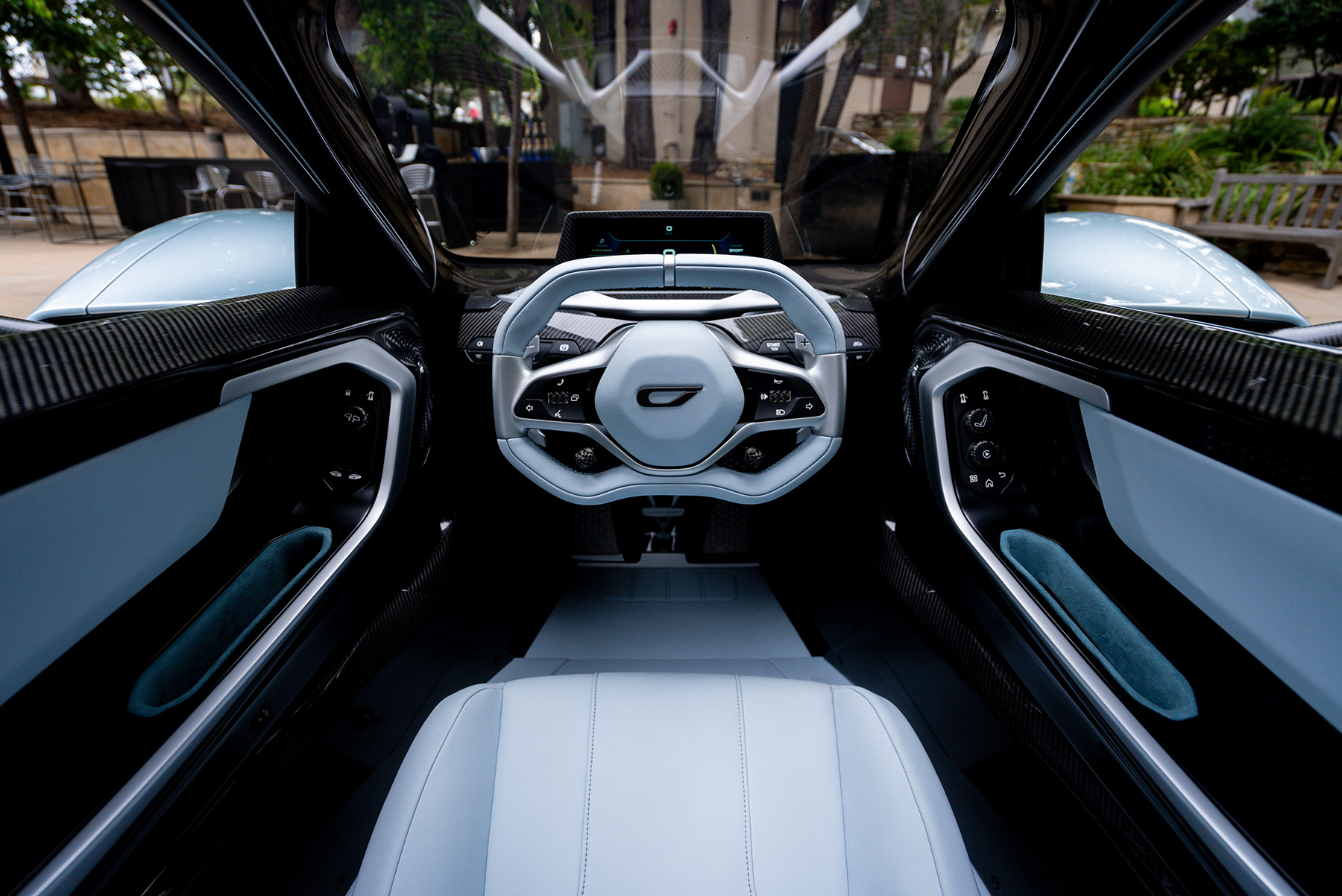
The 21C is a two-seater, with the driver and passenger sitting single-file, like fighter pilots in a cockpit.
Lukas decided to leave his fledgling finance career and build Czinger with his father. Since then, Divergent and Czinger have raised over $700 million, with Stockholm-based investment group Hexagon AB contributing $100 million—“plenty of capital for the next few years,” Lukas said.
That's despite some aggressive goals. Divergent plans to have 30 factories around the globe by 2030, each able to churn out high-quality parts at volume using additive manufacturing, meaning no lengthy and expensive tooling. The company already has numerous clients in the aerospace and automotive industries, including Aston Martin and another unannounced major automaker.
For Czinger, its biggest test comes soon, when the rubber literally meets the road. The first of the 21C hypercars ships later this year. After the Pebble Beach Concours festivities, Lukas was off to let a few lucky customers get early test drives. “I get nervous every time you put customers in the car,” he said. “I hope they love it.”
They had better, because while the 21C has become a marketing tour de force for Divergent, the only thing that matters to Czinger drivers is whether it’s a great car. And for $2 million-plus, it will have to be more than great
MEMRI : Signs Of Possible War In September-October
Lately there have been growing indications that a war against Israel may break out in September or October 2023. The trigger may be spiraling violent clashes resulting in many casualties, or the use of new weapons leading to many fatalities on the Israeli side, in the face of which Israel will be unable to suffice with its regular counterterrorism measures.[1] While neither Hamas nor Hizbullah are eager to start a comprehensive confrontation with Israel,[2] such a confrontation could result from an uncontrolled deterioration on the ground or from the use of new and unusually deadly weapons by these movements.
The following are some of the factors pointing to the possibility of a war breaking out in the coming months:
1. Growing Provocations By Hizbullah On Israel's Northern Border
In the recent months, Hizbullah has repeatedly instigated increasingly bold provocations on the border. These included setting up tents in the Har Dov area, inside Israeli territory;[3] dismantling surveillance cameras along the border fence near Fatima Gate,[4] and firing an anti-tank missile into Israel.[5] In addition, Hizbullah, which does not recognize the Blue Line as the international border between Lebanon and Israel, has recently made a new territorial claim, demanding that Israel give Lebanon sovereignty over the northern Rosh Hanikra railway tunnel, likewise in Israeli territory.[6] At the same time, it also demands to curtail UNIFIL's freedom of action in South Lebanon. [7]
2. Adoption Of Gaza Fighting Methods By Islamist Terrorist Organizations In The West Bank, Such As The Firing Of Rockets And Excavation Of Command-And-Control Tunnels
The Palestinian terror organizations, especially Hamas and the Palestinian Islamic Jihad (PIJ), seek to change the mode of operation against Israel in the West Bank by duplicating the fighting methods used by the terrorists in Gaza.[8] This is manifest in the firing of rockets from the West Bank into Israel, the excavation of "command-and-control tunnels" in the West Bank (though not, as yet, tunnels infiltrating Israeli localities), and in military cooperation between different terror organizations, following the example of the Joint War Room in Gaza. There has also been an increase in efforts by Iran and Hizbullah to smuggle weapons into the West Bank, similar to the smuggling of weapons into Gaza.[9] PIJ secretary-general Ziad Al-Nakhaleh said that, during his June 2023 meeting with Iranian Leader Ali Khamenei, the latter had "reiterated [the need to] develop the arming of the West Bank and the resistance there." Nakhaleh added: "We, as Palestinians and as resistance forces and movements, understand the importance of arming the West Bank, but this requires efforts by the Palestinians themselves, and also the assistance of our brothers in the Islamic Republic of Iran."[10]
3. Possibility Of Clashes In Al-Aqsa During The Jewish Holidays In September, Potentially Sparking Violence Outside Jerusalem As Well
During the Jewish holidays in September and October, Jews are likely to visit the Al-Aqsa compound, as happens every year. Hamas and Hizbullah spokesmen have stressed that this could lead to a regional war. Saleh Al-'Arouri, deputy chairman of Hamas' Political Bureau and head of the movement's military wing in the West Bank, said in an interview with the Al-Mayadeen channel: "There are some in the [Israeli] cabinet who are contemplating measures like taking over and dividing the Al-Aqsa mosque, and carrying out assassinations." These people, he added, "know that this may lead to regional war." He recalled statements made by Hizbullah secretary-general Hassan Nasrallah, that "any attack on the Al-Aqsa mosque or on Jerusalem will prompt a regional war." [11]
4. Increased Threats Of Comprehensive Regional War
The leaders of the terror organizations have recently increased their threats of a comprehensive regional war,[12] in response to Israeli threats to assassinate terror operatives and those who dispatch them, including Hamas leader Saleh 'Arouri. In an interview with the Al-Mayadeen channel, the latter threatened to escalate the confrontation with Israel to the point of comprehensive war: "We are preparing for a comprehensive war and are discussing this in closed chambers with all the elements and components [of the resistance axis] that are connected to this war." He added that the resistance axis has "the presence, the motivation and the desire for a regional war to occur, and has an interest in this."[13]
In this context, the heads of the resistance axis held a series of meetings in Lebanon.[14] Iranian Foreign Minister Hossein Amir Abdollahian met in Beirut with PIJ Secretary-General Al-Nakhaleh, Hamas official Al-'Arouri and other PIJ and Hamas senior officials. In the meeting Abdollahian stressed the statements of Supreme Leader Khamenei about the need "to help the West Bank" and about Iran's "ongoing [commitment to] assisting the resistance with all its might."[15] He added that "the establishment of the joint Hamas-PIJ [war] room reflected a smart move on the part of the resistance."[16]
Abdollahian also met with Hizbullah Secretary-General Nasrallah,[17] who then met with Al-'Arouri and Al-Nakhaleh to "make a joint assessment of the situation in the West Bank, the escalation of the resistance activity and the latest Israeli threats." The participants of this meeting underscored "the steadfastness and steadiness of all the forces of the resistance axis in the struggle against the Zionist enemy," and the importance of coordination between the "resistance movements" in Palestine and Lebanon.[18]
5. Possibility Of Unprecedented Rise In Number Of Israeli Fatalities Following Use Of Deadly New Weapons, Compelling Israel To Respond Even At Cost Of Comprehensive War
There have recently been increasing reports about the potential use of new weapons by Hizbullah, Hamas and the PIJ that can cause a large number of Israeli fatalities. In this situation, Israel will likely be compelled to undertake a large-scale response, above and beyond its routine counterterrorism measures, even at the cost of an all-out war.[19]
It was reported lately that Israel had thwarted an attempt to smuggle into the West Bank, via Jordan, powerful explosive devices manufactured in Iran that spread large amounts of deadly shrapnel. The use of such explosive devices seriously threatens Israeli troops operating in the West Bank and can result in numerous casualties. Journalist 'Abd Al-Bari 'Atwan, editor of the online Arabic daily Al-Rai Al-Yawm, wrote in an article that "the coming days and weeks will see the resistance [fighters] in the West Bank receiving advanced weapons, provided by a number of countries and organizations, including Kornet anti-tank missiles."[20]
[1] On the face of it, a large number of Israeli fatalities will be nothing new, but we assess that, in the present circumstances, Israel will undertake an unprecedented, comprehensive response, even at the cost of a comprehensive war with Iran, which is activating the Islamist resistance organizations on the ground.
[2] Recall that both movements are involved to some extent in regional natural gas initiatives that will be undermined by a major confrontation.
[3] Al-Akhbar (Lebanon), June 1, 2023.
[4] Twitter.com/alishoeib1970, July 14, 2023.
[5] According to the Lebanese online daily Al-Mudun, the rocket was fired by "Lebanon" (i.e., Hizbullah) in protest against Israel's "annexing" of the village of Ghajar, which straddles the Israel-Lebanon border. The daily stressed that the firing of the rocket had been deliberately timed to coincide with Hizbullah's issuance of a statement on this matter. (almodon.com, almanar.com.lb, July 6, 2023).
[6] Al-Akhbar (Lebanon), July 16, 2023.
[7] See, for example, remarks by Ahmad Qabalan, a Shi'ite cleric close to Hizbullah, who said recently that "there is no room for international forces of any kind that come at the expense of Lebanon's sovereignty… We will not agree to any alternative to the national formula for defense of the homeland… The time of violating Lebanese territory has passed, and what happens in the [UN] Security Council does not interest us" (almanar.com.lb, August 28, 2023).
[8] See MEMRI Inquiry and Analysis No. 1707 – Palestinian Terror Organizations Are Duplicating Gaza Strip Fighting Methods In West Bank, August 8, 2023
[9] It should be noted that the armament efforts in the West Bank are energetically assisted by the Islamic Republic of Iran, and on orders of Iranian Supreme Leader Ali Khamenei. Khamenei issued these orders a decade ago, and successive commanders of Iran's Islamic Revolutionary Guards Corps have declared numerous times that they are implementing these orders. Hamas and PIJ leaders regularly thank Iran publicly for its military aid to their organizations, including inside the West Bank. On this see MEMRI reports: Inquiry and Analysis No. 1107, Qods Day In Iran: Tehran Calls For Annihilation Of Israel And For Arming The West Bank, July 25, 2014; Special Dispatch No. 10721 - Palestinian Islamic Jihad (PIJ) Secretary-General Ziad Al-Nakhaleh In Interviews With Iranian Media: We Manufacture Weapons Thanks To Aid Provided By Iran And Seek To Arm All West Bank Cities; No Jew Anywhere In The World Lives In Greater Danger Than The Jews In Palestine – July 24, 2023; Special Dispatch No. 10124 - In Tehran Visit On The Eve Of The Gaza-Israel Conflict, Palestinian Islamic Jihad (PIJ) Leader Nakhaleh, Iranian Regime Heads Praise Iran's Support For PIJ; IRGC Qods Force Commander Qa'ani: 'The Palestinian Fighters Are At The Stage Of Planning To Strike The Final Blows Against The Rotting Body Of The Zionist Regime, When The Time Is Right' – August 8, 2022; Special Dispatch No. 9946 - On International Qods Day, Instituted By The Iranian Regime, Hamas, Palestinian Islamic Jihad, Hizbullah And Other Iran Allies Call For Jihad Against Israel, Threaten Regional War – May 4, 2022; Special Dispatch No. 9717 - On Second Anniversary Of Iranian General Qassem Soleimani's Killing, Hamas, Palestinian Islamic Jihad Continue To Praise Him; Controversy In Gaza Over Billboards Commemorating Him – January 10, 2022; Inquiry & Analysis Series No. 1588 - Destruction Of Israel By The Sword Or By Referendum – Part II: Senior Iranian Regime Officials Link Iran To The May 2021 Gaza Conflict, Urge Hamas And Palestinian Islamic Jihad To Continue Their Fight Against Israel – July 22, 2021; Special Dispatch No. 9123 - Marking Anniversary Of Killing Of IRGC Qods Force Commander Qassem Soleimani, Hamas Continues To Signal Loyalty To Iran, Resistance Axis – January 5, 2021.
[10] See MEMRI Special Dispatch No. 10721 - Palestinian Islamic Jihad (PIJ) Secretary-General Ziad Al-Nakhaleh In Interviews With Iranian Media: We Manufacture Weapons Thanks To Aid Provided By Iran And Seek To Arm All West Bank Cities; No Jew Anywhere In The World Lives In Greater Danger Than The Jews In Palestine – July 24, 2023.
[11] Almayadeen.net, August 25, 2023.
[12] These threats of regional war join the rhetoric that the Palestinian resistance factions have long been voicing about establishing a balance of terror and deterrence vis-à-vis Israel, and about uniting the resistance fronts in any future confrontation with Israel. See e.g. MEMRI TV Clip of statement by PIJ Secretary-General Al-Nakhaleh in April 2023; see also MEMRI Special Dispatch No. 10562 - Lebanese Media Reports: On The Evening Before The April 6, 2023 Rocket Attack On Israel, Iranian Qods Force Commander Esmail Qaani Visited Lebanon, Met With Officials From Hizbullah, Hamas, Palestinian Islamic Jihad – April 13, 2023.
[13] An exchange of threats has also been ongoing between Israel and Hizbullah. In response to a statement by Israeli Defense Minister Galant that, "if Hizbullah starts a war we will send Lebanon back to the Stone Age" (ynet.co.il, August 8, 2023), Nasrallah said: "You too will go back to the Stone Age if you start a war against Lebanon" (alahednews.com.lb, August 14, 2023). In a May 25, 2023 speech, Nasrallah said in response to threats by Israeli PM Netanyahu, "You are not the ones threatening a large-scale war. It is we who threaten you with such a war. Any large-scale war will include all the borders, and hundreds of thousands of fighters will participate in it" (It should be noted that the resistance organizations do not have such a number of fighters) (alahednews.com.lb, May 25, 2023).
[14] It should be mentioned that resistance axis officials also met just before an April 6, 2023 incident in which dozens of rockets were fired from Lebanon into Israel. In that meeting – between the commander of the Iranian IRGC's Qods Force, Esmail Qaani, and the heads of Hizbullah, Hamas, the PIJ and other Iran-backed militias – the participants reportedly decided on the rocket attack. See MEMRI Special Dispatch No. 10562 - Lebanese Media Reports: On The Evening Before The April 6, 2023 Rocket Attack On Israel, Iranian Qods Force Commander Esmail Qaani Visited Lebanon, Met With Officials From Hizbullah, Hamas, Palestinian Islamic Jihad – April 13, 2023.
[15] Almayadeen.net, August 31, 2023.
[16] IRNA (Iran), September 1, 2023.
[17] Almanar.com.lb, September 2, 2023.
[18] A report on Hizbullah's Al-Manar TV emphasized that the "iconic" picture of these leaders together conveyed a clear message to Israel, namely that the components of the resistance are united in their struggle against the Israeli enemy, especially in light of the threats of assassination (Almanar.com.lb, September 2, 2023).
[19] In this context it should be mentioned that the Islamist resistance organizations always have the option of renewing the suicide bombings in crowded places like buses and restaurants. Such attacks are nothing new, but will nevertheless force Israel to respond with measures that are not part of its regular counterterrorism policy.
[20] Raialyoum.com, August 25, 2023.
Should the US implement a ‘robot tax?’
MIT economists Arnaud Costinot and Iván Werning discuss the potential impact a proposed 'robot tax' could have on automation and jobs
A big and often unremarked upon aspect of being a reporter is knowing your audience. It’s not always as straightforward as it sounds — particularly when writing about tech. You’re always walking that tightrope between over- and under-explaining. Assuming too much knowledge makes text impenetrable for the non-expert, but getting caught up the finer details is recipe for condescension.
On Friday, I asked LinkedIn to air their annoyances about mainstream robotics coverage (i.e., big publications that don’t specialize in the topic or even technology more broadly). For me, the headline “The Robots Are Coming” has been a minor source of annoyance that seems to crop up at least once a week.
Other people’s responses are more or less what I was anticipating: robopocalypse/killer robots, a lack of historical context, too much focus on gimmicks and flashy form factors like humanoid robots. That’s all fair and certainly feedback I will apply to my own work going forward. “Robopocalypse” is a term I dropped from my vocab a while back, aside from references to the internet’s knee-jerk reaction to any new robot.
Another thing that cropped up in people’s complaints is the job conversation. As with robopocalypse headlines, I absolutely agree that things trend toward the sensationalistic. The “Robots Are Coming” is often amended to include “For Your Job.” It runs parallel to the “AI is taking your job” talking point. As a general rule, the AI conversation focuses on white-collar jobs and the robots on blue. It’s not one to one, but that’s largely how these things go: a robot in the factory, an AI in the office.
Sensationalism isn’t just a robotics thing. It’s an online journalism thing. My industry has been dying for longer than I’ve been a part of it (which is, itself, quite a long time). There are days when it feels like we’re all fighting for the same scraps of attention, hoping people can look up from TikTok long enough to skim a news article. When you’re vying for ever-shortening attention spans along with every other piece of instantly accessible information, you think a lot about framing.
Such blunt force not only does a disservice to the robotics industry, but it also drains all subtlety from what needs to be a truly nuanced conversation. I’m sure there are those who would rather skip the jobs conversation altogether, but I firmly believe that approach is equally problematic.
So let’s start from a point I think we can all agree on: Robots have and will continue to impact jobs. The presence of robots in the workforce is growing at a rapid rate. The more prevalent and sophisticated automation becomes, the greater impact it will have on the way we work.
I very intentionally chose “impact” as a neutral term. From a purely semantic standpoint, it’s neither inherently negative nor positive. The workforce of the future will be different, and robotics will almost certainly be a primary driver of that change.
I’ve attempted to take a nuanced approach to the jobs question in the pages of TechCrunch. Ultimately, it’s up to you to figure out whether I’ve succeeded on that front. A vast majority of people I speak to believe the impact will be positive — that the robots will either replace bad jobs or at the very least make them better. There’s plenty of truth in these statements, but I try to remain conscious of the fact that most of the people I speak to about robots are either roboticists or investors — roles that require a general sense of bullishness.
I don’t believe my role is devil’s advocate, but I do feel a sense of responsibility to remind readers that jobs aren’t just numbers. There’s a human behind each of them. In a position that requires me to frequently write stories about layoffs in the tens of thousands, it’s very easy to lose sight of that fact. I’ve certainly been guilty of leaning into the abstraction. This is why, for example, I frequently post job listings in Actuator. For a vast majority of us, our survival hinges on our ability to work. That’s just how the world operates.
It’s important to have conversations about automation’s long-term impact. It’s debate that will continue to rage on into the foreseeable future, and I’m glad any time people are discussing it with all of the context and nuance required. I do, however, believe that we often discuss it at the expense of short-term impact — that is, those jobs that are immediately affected. This is where the controversial and less controversial topics of safety nets and upskilling come in. Those are topics we’ll have to dive into some other day.
We are not, however, avoiding controversy outright this week. In fact, in some circles the topic du jour is even more radioactive than either of the above — the robot tax. It’s also something we’ve not discussed much in Actuator, so it felt like time. Given the nature of this newsletter, what follows is going to be far from the be-all and end-all on the subject, but it’s a good opportunity to address something that has been in the ether for a long time.
Brookings described the concept thusly:
The basic idea behind a robot tax is that firms pay a tax when they replace a human worker with a robot. Such a tax would in theory have two main purposes. First, it would disincentivize firms from replacing workers with robots, thereby maintaining human employment. Second, if the replacement were made anyway, a robot tax would generate revenues for the government that would cover the loss of revenue from payroll taxes.
The Institute’s views on the topic notwithstanding, I think that largely covers the idea in broad strokes, though I would add to it. When I consider the concept, the “loss of revenue from payroll taxes” is secondary to the more pressing issue of the potential human toll.
Way back in 2017, we ran a column by Steve Cousins that concluded with:
Getting companies to pay their fair share of taxes won’t solve the larger societal challenge that automation will eventually displace low-skilled workers, nor would a robot tax. Instead, governments should focus on using corporate tax revenues to create free or low-cost education programs to prepare people to work alongside automation.
For those unable to find work in tomorrow’s tech-driven society, governments could provide universal basic income or other safety nets for the least-advantaged.
To which I say, these concepts are far from mutually exclusive. In fact, from where I sit, funding a social safety net is perhaps the strongest argument in favor of a robot tax. The following statement is the most political I’m going to get in today’s newsletter. Ready? Okay. I believe that feeding and housing those without means should be regarded as an essential function of government. So pairing these two concepts seems logical.
That said, I am neither advocating for or against a robot tax. Honestly, I’m currently riding the fence on the subject. There are valid points on either side. Having discussed some of the pros above, I would say the primary argument against is concern over stifling innovation. At its heart, it’s the same basic argument against any manner of business tax, though with the robot tax, I would suggest that slowing innovation is kind of, sort of the point.
The question ultimately, I think, comes down to what’s more important — maintaining workplace status quo in an effort to keep more people employed or maintaining U.S. competitiveness? Again, I’m not operating under any illusion that you’re going to find the answers in this week’s robot newsletter. If I get more people thinking about the topic, however, I’ll consider it a job well done.
Hopefully at some point in the near future, I’ll have the time and bandwidth to do a deeper dive on the topic. For this week, however, I’m leaning heavily on a study out of MIT published late last year.
Published in the Review of Economic Studies, “Robots, Trade, and Luddism: A Sufficient Statistic Approach to Optimal Technology Regulation” seeks to a provide “general theory of optimal technology regulation.” The MIT economists behind the study — Arnaud Costinot and Iván Werning — ultimately settle on a sweet spot that includes modest taxation.
“Our finding suggests that taxes on either robots or imported goods should be pretty small,” Costinot told MIT at the time. “Although robots have an effect on income inequality . . . they still lead to optimal taxes that are modest.”
Prominent figures, including Bill Gates and Bernie Sanders, have called for some form of taxation over the years. In 2017, Gates told Quartz, “You ought to be willing to raise the tax level and even slow down the speed.” He cited, among other things, a broad, simultaneous displacement of jobs across a spectrum of industries.
Asked on CBS Sunday Morning about Gates’ position on the subject, Sander answered, “That’s one way to do it. Absolutely.” His broader take on automation is exactly what you’d expect from the Vermont senator: “So if we can reduce the workweek, is that a bad thing? It’s a good thing. But I don’t want to see the people on top simply be the only beneficiaries of this revolution in technology.”
For a counterargument, we go back to Brookings, which highlights the aforementioned potential for automation to create more jobs in the long run:
“[T]he existing research suggests that firms adopting robots actually experience an increase in employment, undercutting a main argument in favor of a robot tax,” writes senior fellow Robert Seamans. “In addition, a robot tax would necessitate a definition of what comprises a robot. Settling on an appropriate definition will not be easy. Instead, policymakers should consider other policy changes to help workers, potentially including changing how capital and labor are taxed, but also focusing more broadly on labor market reforms.”
To date, only South Korea has come close to passing legislation, though that country’s approach is reducing tax credits by two percentage points, rather than introducing an altogether new tax.
To understand their research a bit better, I conducted an email interview with Costinot and Werning.
Automatic mass production line with robots and automated machines running by itself. which there is no human to control. Business and automation technology and industry concept. 3D illustration rendering
TC: “Robots, Trade, and Luddism” was published late last year. Have any more recent developments impacted your findings?
AC/IW: Since we wrote the paper, there have been huge advances and concerns about AI technologies. The results of our paper can be applied to this technology.
We provide a general formula that takes as input the impact of technology on the distribution of wages. This important input is not known for AI, and there is much ongoing work and speculation.
When discussing “redistribution,” is the idea that the taxes collected will directly benefit those whose jobs have been displaced by automation?
The main point is not the revenue from the robot tax, as much as the fact that the tax will shape demand for labor and thus wages and jobs. In particular, the potential wages people can earn may become more unequal with new technologies and the idea is that the tax can mitigate these effects. In a sense, one can think of this as pre-distribution, affecting earnings before taxes, instead of redistribution.
I’ve seen very mixed reactions with regard to the efficacy of “upskilling.” What is your sense on such campaigns when it comes to displaced blue-collar roles?
We have not studied this in detail. At a general level, the same forces are at play: Skill acquisition can be approached with an analysis similar to ours, and it represents the other side of the coin. If training can improve the distribution of skills, there is a force for subsidizing it. However, we have not surveyed the empirical literature on its efficacy or studied this question in detail.
You suggest that 1% to 3.7% on value is the sweet spot for taxing these systems. What begins to change above that threshold?
Yes, to be perfectly clear, this is what our formulas deliver given the available tentative evidence. But the impact on the wage distribution from automation is a key input for which there is much uncertainty.
To your question: At the optimum, you are trading off improving the pre-tax wage distribution with the efficiency losses of the tax, reaching a sweet spot. If the tax is too high, you have gone too far along this trade-off and the efficiency losses have started to be more important. A key element in evaluating this trade-off is whether you have other tools to redistribute: If you do not, then you may want higher taxes. However, in our benchmark, we allow for a nonlinear income tax as is available in the U.S. and advanced countries. In our calibration, in line with the literature, this income tax turns out to be relatively efficacious, explaining why we find a relatively low tax rate.
We didn’t come into this expecting this, and the relatively low number did surprise us. But the theory and the evidence pointed us there.
Does the implementation of a robot tax risk stifling innovation/competition? Is it viewed as an obstacle to increasing domestic manufacturing?
Yes, it would have both effects in principle, unless they are counterbalanced with other policies. In general, you can think of these as some of the efficiency losses [that] are part of the trade-off we considered, as discussed above, and the reason the tax is not found to be higher.
Professor Werning told MIT, “We think it’s incorrect to discuss this tax on robots and trade as if they are our only tools for redistribution.”
What are other potentially more impactful tools for addressing inequality?
The income tax in the U.S. (consolidated with state taxes, EITC [Earned Income Tax Credit], etc.) is a very important tool for redistribution and is a key policy instrument (as reflected by its size and broadness and the discussion and political debates about it). This to us is key and we feel that many discussions surrounding these issues seem to not incorporate this.
At New York Fashion Week, a Big Return and a Big Debut
New York Fashion Week kicks off on Friday, bringing the return of Ralph Lauren and Peter Do’s first collection for Helmut Lang. Plus, what else to watch for this week.
September is here, and with it, another New York Fashion Week.
The city’s Spring/Summer 2024 showcase — which begins with Peter Do’s Helmut Lang debut and ends with Raul Lopez’s homegrown-and-hyped Luar — is noticeably slimmer than past iterations. Around 70 designers are on the official schedule, down from over 100 last September, including absences from CFDA chair Thom Browne and Do’s namesake line. NYFW fixtures such as Michael Kors, Carolina Herrera, Altuzarra, Gabriela Hearst and Jason Wu are all set to show.
The dominant sentiment around New York Fashion Week over the past decade has been that it’s lacking in comparison with its European counterparts in Milan and Paris. That’s been underscored by the fact that several standout American designers, once they reach a certain level of success, begin showing in Paris; beyond Do, The Row, Vaquera and Rick Owens are all on the schedule in Paris. Meanwhile, other New York-born standouts like Marc Jacobs and Telfar opt to show off-schedule or not at all, and Tom Ford, once the week’s centre of gravity, is headed to Milan under its new creative director Peter Hawkings.
Even so, there’s still lots to look out for. Ralph Lauren is on the schedule for the first time since September 2019; Jonathan Cohen and Philip Lim are also returning. NYFW mainstay Coach will technically present off-calendar with a show on Sept. 7, the day before the week’s official kick-off, celebrating creative director Stuart Vevers’ 10 years with the brand. The industry will also be watching for clues as to whether Do will be able to breathe life back into the once-agenda-setting, now-sleepy Helmut Lang brand, which underwent restructuring in 2018. Expect a marriage of Do’s clean tailoring and modernist perspective with Helmut Lang’s minimalism and deconstructive bent.
Lately, though, it’s the newer names that are driving excitement in New York. Post-pandemic, emerging designers seized on the opportunity to fill the quiet left by mega-brands. Perhaps most popular among them is Khaite, a favourite of TikTokkers and fashion insiders alike, which opened its first store on Mercer Street earlier this year. Luar and Puppets & Puppets, both known for their popular bags and community-focused ethos, continue to draw fans. Bach Mai, increasingly a red carpet fixture, will put on his first runway show. Newcomers to the schedule include Advsry, the label from 22-year-old Keith Herron; and Fforme, led by former The Row designer Paul Helber.
But as New York’s place on the global fashion circuit continues to be in flux, the spotlight, it seems, is anyone’s for the taking.
Monday
Labour Day (US)
Wednesday
American Eagle, Express report earnings
Thursday
G-III Apparel, Designer Brands report earnings
Coach stages Spring/Summer 2024 show
Toronto International Film Festival begins
Friday
Rent the Runway reports earnings
NYFW Day 1: Helmut Lang, Christian Siriano, Ralph Lauren
Saturday
NYFW Day 2: Proenza Schouler, Khaite, Eckhaus Latta
US Open women’s singles final
Sunday
NYFW Day 3: Jason Wu, Phillip Lim, Area, Staud, Who Decides War
US Open men’s singles final