Rolex buys Bucherer: the battle of hard luxury titans begins
By Astrid Wendlandt
03/09/23
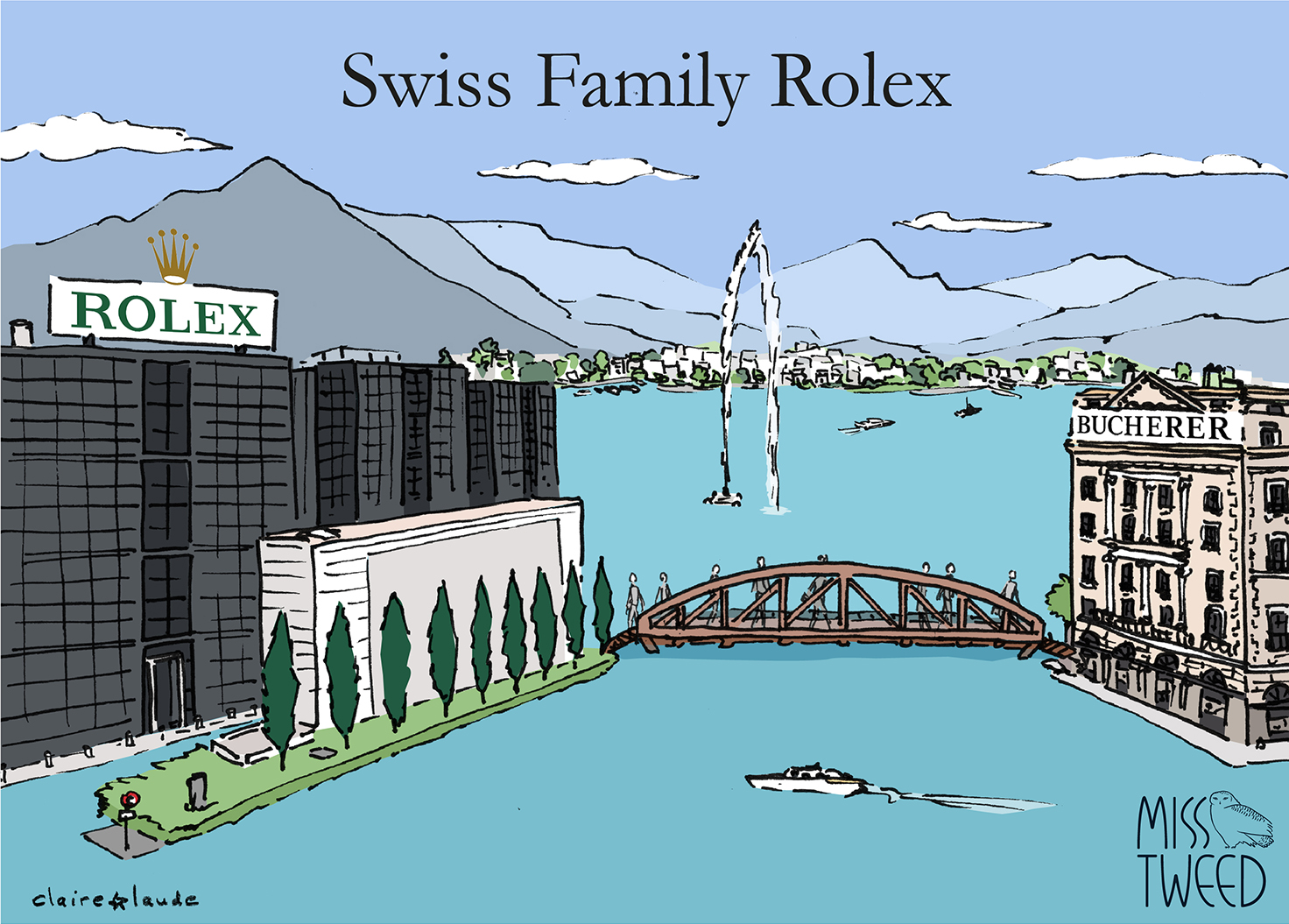
There’s a new battle of the titans brewing in the world of European luxury. For years, rivalry between Bernard Arnault and François-Henri Pinault propelled the sales of expensive bags, clothes and shoes to ever greater heights. Now Rolex’s acquisition of Bucherer, Europe’s leading watch and jewelry distributor, creates a similar standoff in the world of hard luxury. The deal pits Rolex owner, the Hans Wilsdorf Foundation, squarely against the Rupert family at Richemont and the Hayeks of the Swatch Group. This new combination will have a substantial impact on the global watch industry, and hard luxury generally, for years to come.
That’s what industry insiders, executives and experts told Miss Tweed at the Geneva Watch Days (GWD) event this past week. The timing of the deal announced on Aug. 24 is crucial. It comes as the industry is suffering a slowdown likely to extend well into next year. “Even though Bvlgari watches have grown strongly, August included, the reality check will be in October at the end of the tourist season,” LVMH’s Bulgari CEO Jean-Christophe Babin told Miss Tweed at the GWD.
Demand in the US remains lackluster and business in China has not picked up as much as many expected with the country’s economy slowing down. “We expect growth in the watch industry to be more muted in the next 12-24 months,” Niels Eggerding CEO of the Frederique Constant group, part of Japan’s Citizen group told Miss Tweed. In this climate, only a few independents and the world’s strongest brands – Rolex and Cartier, of course, but also Audemars Piguet, Richard Mille, Breitling and Richemont’s Vacheron Constantin, are enjoying growth. Most other brands are either in decline or stagnating, watch bosses and analysts said at the GWD.
Into this moment of industry malaise, the Rolex-Bucherer deal came like a bolt of lightning, vaulting the combined group into luxury’s big leagues. The watch brand Rolex is already the industry leader with estimated annual sales of more than 9.3 billion Swiss francs (€9.72 billion). Adding Bucherer’s 2.2 billion Swiss francs in annual revenue (€2.3 billion) creates a hard luxury group with combined annual revenues of some €12 billion. That potentially puts the Rolex-Bucherer group in the No. 2 position in the global ranking behind industry leader Richemont. In the year to March, Richemont, owner of Cartier and Van Cleef & Arpels made €17.3 billion in watch and jewelry sales.
The deal also places Rolex-Bucherer on equal standing with the hard luxury division of LVMH, the world’s largest luxury conglomerate, owner of jewelers Tiffany & Co, Bulgari, Chaumet and watch brands Tag Heuer, Zenith and Hublot. The combined group is also larger than another leading family-controlled luxury player: Hermes. “They are now bigger than Hermès with only one category of product,” noted Jean-Philippe Bertschy Vontobel Managing Director. Hermes made €11.6 billion in sales last year.
Ever since Rolex was founded a little over a century ago, the company has been saying that it was not interested in watch retail and distribution. Its focus was on production, and creating and manufacturing the highest quality timepieces. It owned one boutique in Geneva and relied on third-party retailers providing a network of some 1,500 points of sale. Another family-controlled brand, Patek Philippe, operates in a similar manner. Acquiring Bucherer, a venerable Swiss institution founded in the same era as Rolex and which has sold the latter’s watches since 1924, marks a clean break with past strategy. Not only has Rolex become a major watch retailer with more than 100 stores around the world, it now has access to volumes of precious information about its customers, something it will be able to analyze and put to good use. Rolex will be able to improve its relationship with customers as well as in-store and after-sales service, putting pressure on other distributors to up the ante in terms of customer experience. Rolex will also have more visibility on who are those who buy its watches not to wear them but to speculate on their future value.
STRATEGY
Rolex used to be regarded as a rather predictable company, sticking to the same roadmap for decades. In less than a year, it has made two unexpected and major strategic moves. Its entry into retail comes after its announcement in Dec. 2022 that it was going to launch its own certified pre-owned program – a booming market - partnering with Bucherer first and then opening up the program to other official distributors.
The company’s owner Jörg Bucherer, 87, a third-generation member of the Zurich-based company, was keen to sell to Rolex because he did not have heirs. Selling to Richemont, LVMH or Swatch Group was not a palatable option and to private equity firms even less, industry insiders say. Jörg Bucherer is the last person in the company to have dealt directly with Rolex founder Hans Wilsdorf, who died 63 years ago.
Selling to Rolex allows Bucherer to remain in Swiss hands. “Rolex’s mission is to preserve and protect Swiss watchmaking,” the CEO of a major watch brand told Miss Tweed at the GWD.
“It wants to be a good citizen. Its ethics and morals are irreproachable.” For example, Rolex has been pushing for the Watches & Wonders trade fair, traditionally dominated by Richemont, to welcome more small and independent brands. Many industry insiders believe that should Patek Philippe’s owners, the Stern family, wish to sell, they will want Rolex to buy it for the same reasons. Rolex is the only company able to guarantee the preservation of the company’s spirit and the Sterns would want Patek to remain under Swiss control.
While the acquisition is opportunistic, Rolex also judged the time was right to get into retail. Top rivals such as Audemars Piguet, Richard Mille, LVMH, Richemont and Swatch Group brands have been investing in building their own network of boutiques in the past decade to better control image and stocks and pocket the retail margin. Now it’s Rolex’s turn and it may not stop here.
Another target could be Zurich’s Beyer Watches & Jewellery, located on the popular Bahnhofstrasse retail strip. Founded in 1760, it is the oldest watch retailer in the world. Since 1996, it is run by owner René Beyer, part of the eighth generation. Like Jörg Bucherer, Beyer has a succession problem, industry sources say. Selling to Rolex may prove to be the best solution.
Rolex takes a lot of time to make a decision but once it has determined a strategy, it goes full steam ahead. Hence, you can expect it to expand by acquiring more retailers, industry sources predict.
The Rolex-Bucherer deal has already shaken up the industry. Some industry analysts argue that if Rolex wanted to enter retail earlier, it could have just bought London-listed Watches of Switzerland, currently worth £1.4 billion (€1.63 billion) on the London stock market. The company’s shares fell as 20 percent when the Rolex-Bucherer deal was announced.
Investors feared the newly combined entity would steal market share from the London-based retailer. Its shares have recovered since as investors over-reacted to the news. Rolex stressed in its statement that buying Bucherer would not affect its relationships with other distributors and their allotment of watches. Bucherer would keep its name and management and continue to be independently run.
BIG GROUPS TO EXIT FROM BUCHERER
Bucherer and Rolex may say nothing will change, but few analysts and executives believe them. “It is likely that in the future, Rolex is going to open more boutiques with Bucherer than with other retailers such as Watches of Switzerland,” said Bertschy, adding that Rolex represented a major source of profit for the company. “When your main source of profit becomes a competitor, it can potentially be a problem.”
One obvious consequence of the acquisition of Bucherer by Rolex is that major luxury groups are likely going to stop working with the specialist retailer. Richemont has already started to close down accounts with the Swiss company and it will continue. The group has removed some of its best-selling brands including Vacheron Constantin, Jaeger-LeCoultre from major Bucherer boutiques such as its flagship in Paris. Bucherer has refused to answer any of Miss Tweed’s questions.
Swatch Group, owner of Longines, Omega and Tissot, will also progressively sever ties with Bucherer, executives and analysts predict. Swatch Group CEO Nick Hayek said back in July that he planned to significantly downsize the group’s retail network and even aimed to have only directly operated stores at some point in the future. Hayek will not want Rolex to have access to his brands’ sales and customer data. When a watch brand works with a third-party distributor, it reveals its plans for the next 2-3 years: what models are in the pipeline and what will be its product and price strategy. Neither the Swatch Group nor Richemont want Rolex to know about those – even though Rolex probably does not care much about them since it is so successful. Analysts estimate that the Swatch Group and Richemont each make several hundreds of millions of euros of revenues in sales from Bucherer.
Tensions are already high between Rolex and the Swatch Group. Some of them are of a personal nature and concern mainly Hayek and Rolex CEO Jean-Frédéric Dufour and Chairman Nicolas Brunschwig, industry sources say.
Brunschwig is heir of the Geneva family that founded retailer Bon Génie in 1891, which later evolved into the major Swiss department store chain Bongénie Grieder. In 2014, Swatch Group bought the more-than-century-old gothic style building that houses the Grieder flagship in Zurich on Bahnhofstrasse. The group has decided to kick out Grieder which occupied the building since 1913 as well as Louis Vuitton, which operates in it a big boutique.
The exit of Richemont and Swatch Group from Bucherer will not happen overnight. It may take several years, executives and analysts predict. It will have two consequences. First, it will free up space for small independent watchmakers – excellent news for them. Watch lovers are increasingly interested in small brands as they are tired of chasing popular models by big brands such as Audemars Piguet, Richard Mille, Patek Philippe and Rolex that are tough to get.
Bucherer will be keen to welcome more small and independent brands to replace lost business with the big groups. Second, Richemont and the Swatch Group will put pressure on other major watch and jewelry distributors to give them more space. Once they leave Bucherer, they will have to find new retail spaces to sell their stock. Elbowing their way into other retailers will make it more difficult for rival watch and jewelry brands to preserve their own space or expand their presence at a given retailer.
Many distributors are mom and pop shops, people who are passionate about watches and have built a strong address book of customers over the years. To some degree, they are more motivated than brand-owned boutiques since their existence and very future depends on their performance. The director a brand-owned boutique is paid a fixed salary every month – no matter what - and a bonus ever year.
DOWNTURN
Small independent watch brands continue to enjoy strong demand. However, some are suffering from the fact that Rolex has increased its output this year, making its watches more easily available. Previously, buyers fell back on smaller brands because they could not get the Rolex they wanted or the timepiece they dreamed of for a long time from one of the strongest brands. Last year, the second-hand bubble burst and since then, the price of some of the most popular brands and models have fallen between 20 and 40 percent.
“We see a normalization of demand,” Maximilian Büsser, founder and CEO of independent watch brand MB&F. “Many of the speculators who were buying watches to sell them and make a profit have left the market and this is a good thing. Now most people who buy an expensive watch is because they want to wear it and not only because they consider it a good investment.”
His view was echoed by peer Edouard Meylan, CEO of H. Moser & Cie. “My retailers say that business this year and next year is likely to be a bit more complicated,” Meylan told Miss Tweed, adding that demand for his own brand remained strong.