>>> US Early premarket gappers

Early premarket gappers
  • Gapping up:
    • FFIE +11.5%, AMC +9%, HSTM +4.3%, SMTC +4.1%, YUMC +3.2%, DDD +2.7%, SSYS +2.4%, DVAX +2.3%, TRIN +1.8%, AMZN +0.7%, SNPS +0.7%
  • Gapping down:
    • PCT -14.2%, BNOX -12.3%, IE -12.2%, IBEX -11.1%, VTLE -8.4%, SCNI -3.8%, ALNY -3.7%, IMAX -1.9%, EPRT -1.7%, CTLP -1.5%, V -1.4%, SBOW -1.2%, NEWR -0.6%, SBUX -0.5%

ArtNet : Gagosian Wins an Initial Victory in a Long-Running Lawsuit Brought by a

Gagosian Wins an Initial Victory in a Long-Running Lawsuit Brought by a Photographer Who Claims Richard Prince Appropriated His Work

Prince's series, which depicts appropriated Instagram photos, has been at the center of an ongoing copyright debate.

Gagosian Gallery is not liable for profits from any sales of Richard Prince’s “New Portraits” series, works by the appropriation artist at the center of an ongoing copyright case, according to a decision in the U.S. District Court for the Southern District of New York filed on September 11.

The “paintings,” which were printed screengrabs of Instagram posts from various influencers and celebrities, have prompted both widespread critical debate and legal action since the artist presented them at Gagosian in New York in 2014, where they sold for $100,000 each. In the latest development in one protracted legal saga related to the series, the court sided with Gagosian’s motion for summary judgment and dismissed photographer Donald Graham’s claims seeking compensation for “indirect and unrealized profits attributable to the alleged infringement of Graham’s photograph.”

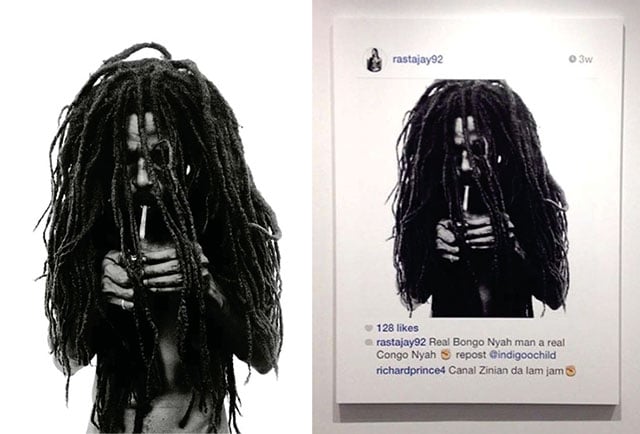
Graham, whose Instagram photo in the series depicts a Rastafarian man smoking a joint, initiated a lawsuit against Gagosian in 2015 alleging copyright infringement, after originally filing a cease and desist that went unheeded. The gallery bought the work that appropriated Graham’s image, which is called Untitled (Portrait of Rastajay92), prior to the show. Graham’s lawsuit came down to what this week’s opinion calls “indirect and unrealized profits,” that Gagosian makes in a hypothetical sale of the work

Graham asserted that he is entitled to a cut of those unrealized profits, seeing as this specific work was used as promotional imagery for selling the other 76 works from the series. Graham’s suit also claimed that there was “a causal connection between the infringement and unrealized profits” and “a method for determining the amount of unrealized profits.” But the court deemed such theoretical gains “not sufficiently connected to the alleged infringement and overly speculative,” and granted the gallery’s motion.
Donald Graham’s original photograph and Richard Prince’s appropriation of the photograph for his “New Portraits” series.

In May, Graham won an early motion in the saga, when a judge rejected a request for summary judgment from Prince and ruled the copyright case can proceed to trial. Today’s ruling only shot down the concept of “unrealized profits,” and curtailing any liability by Gagosian, which has not offered the work for sale, according to a Bloomberg Law report.

Four other photographers have pursued similar legal actions related to the “New Portraits” series in the past, but these claims have not found success. The artist and Gagosian maintain that the images are “transformative,” and thus not subject to copyright—and courts have mostly sided with them.

In 2016, makeup artist Ashley Salazar, who goes by Mynxii White, sued Prince for the use of one of her photos in the series, but the complaint was dismissed in U.S. District Court for the Central District of California due to improper venue.

But artists whose work was appropriated have sometimes notched small victories, too.

Another photographer, Eric McNatt, had his lawsuit against Prince’s use of his photo of Kim Gordon greenlit by a judge earlier this year, and the case awaits trial.

Prior to the “New Portraits” series and the corresponding lawsuits, Prince was brought to court regarding other imagery depicting Rastafarians. In 2009, Patrick Cariou sued the artist for his “Canal Zone” works, which appropriated photos that Cariou took in Jamaica and published in his book “Yes Rasta.”

A 2011 ruling sided with the Frenchman, calling for the destruction of the remaining copies of the catalogue and the unsold “Canal Zone” paintings, and that Gagosian could also be held liable. However, the decision was largely overruled on appeal in 2013 and Cariou dropped all claims in the matter in 2014.

Haaretz : Did the Jews Take the Custom of Tashlikh From the Iranians?

Did the Jews Take the Custom of Tashlikh From the Iranians?
Clues in Babylonian texts lead to a Zoroastrian fertility rite as a plausible source for the custom of casting away one's sins.


On the afternoon of the first day of Rosh Hashanah, observant Jews go to a river, lake or sea, or if those aren’t available, to a well, into which they ritualistically throw the contents of their pockets, and recite verses from Micah, Psalms and Isaiah. This custom is called tashlikh, literally “casting away:” It is a ritual casting away of one's sins so as to start the new year with a clean slate.

The word tashlikh comes from a verse in Micah: "Thou wilt cast all their sins into the depths of the sea" (7:19).

But tashlikh is not an ancient custom derived from the Bible, or even the Talmud. (Absence of mention in these and other rabbinic writing over hundreds of years is tantamount to proof that the ritual didn't exist in ancient times, since the rabbis expounded on every minute detail of Jewish life.) The first mention of it appears in the medieval book Sefer Maharil, written by Rabbi Jacob Moellin of Mainz (1365 - 1425).

Over the subsequent centuries, the custom spread from Ashkenaz (roughly including today's eastern France and western Germany) to the rest of the Jewish world. It is not clear where it did originate, but we may find a pointer in commentary on the Talmud penned by Rashi (1040-1105).

Hassids from the Sadigura sect preparing to perform a tashlikh ceremony for boys, using a small blue plastic swimming pool. Credit: Gil Cohen Magen

Clues in Babylonian texts

Analyzing an obscure word in Shabbat 81b, the sage from Troyes wrote of a Rosh Hashanah custom he encountered in the writings of the Gaonim, the heads of the Babylonian Talmudic academies during the Abbasid Caliphate (approximately 600-1000 CE).

According to the Gaonim, Rashi wrote, it was a custom to "make packets from date fronds filled with soil and animal manure 22 or 15 days before Rosh Hashanah. Each man makes one for every boy and girl in his household. Then he plants a fava bean or a bean in each. They are called pufisa. Then they grow and on the night of Rosh Hashanah each [child] takes his own and twirls it around his head seven times, saying ‘this is in my stead, this for me.’ And then he throws it into the river."

It seems likely that this custom evolved into the tashlikh as Jews slowly migrated from the east and into Ashkenaz, so that by the time Rabbi Jacob Moellin encountered it, the packet of dung and fava beans had been forgotten, and only the sins, represented by the pockets' content, were thrown into the river.

But where did this custom come from? The Jews in the Near East seem to have adopted it from their Zoroastrian neighbors.

Zoroastrian rite in Chak Chak, IranCredit: Ebrahim Noroozi, AP


Zoroastrian fertility rite

Zoroastrianism, the ancient religion of Iran and one of the most popular religions in the Middle East before being supplanted by Islam, had, and still has in its surviving pockets, a strikingly similar fertility rite that its adherents perform in their New Year, Nowruz.

Several weeks before Nowruz, little packets of soil called sabzeh are prepared, in each of which a seed is planted, which sprouts in time for the holiday. The seedlings are placed on the holiday table. After the meal, they are kept for 13 days, and then in a ritual called Sizdah Bedar, the house's single women take the seedlings and throw them in a river while reciting, "Next year in the house of the husband with a child on my lap."

If the Jews really did adopt tashlikh from the Iranians, it could also explain the Rosh Hashanah customs of eating apples and honey, and fish (gefilte for Ashkenazi Jews, chraime for Sephardim). The Zoroastrians also have a custom of gracing the holiday table with apples, honey and live goldfish in a bowl.

>>> Europe : Brokers Upgrades & Downgrades - 14th of September 2023 V3(++)

>>> Up
* 1&1 Raised to Buy at Citi; PT 18 euros
* AB Foods Raised to Add at Investec; PT 2,195 pence
* Arcure Raised to Outperform at Oddo BHF (+)
* Brooks Macdonald Raised to Buy at Numis; PT 2,450 pence (+)
* Campari Raised to Neutral at BNPP Exane; PT 11.80 euros
* Carnival Raised to Buy at Redburn (+)
* Intrum Raised to Buy at SEB Equities; PT 84 kronor (+)
* Keywords Studios Raised to Buy at Stifel; PT 1,800 pence (+)
* KPN Raised to Outperform at BNPP Exane; PT 3.80 euros
* Neste Raised to Buy at Goldman; PT 46 euros
* Norwegian Cruise Raised to Buy at Redburn (+)
* Scanfil Raised to Accumulate at Inderes; PT 10 euros
* Telefonica Deutschland Raised to Buy at Citi; PT 2 euros
* TomTom Raised to Add From Reduce by AlphaValue
* United Internet Raised to Buy at Citi; PT 23 euros
* Vestas Raised to Buy at Deutsche Bank After Recent Declines

>>> Down
* ADP Cut to Reduce at HSBC; PT 104 euros
* Aena Cut to Reduce at HSBC; PT 129 euros
* BBS-Bioactive Bone Substitutes Cut to Reduce at Inderes
* Biophytis SA Cut to Reduce at Kepler Cheuvreux; PT 1 euro cent (++)
* BMW Cut to Underweight at Barclays; PT 92.50 euros
* Esprinet Cut to Hold at Intesa Sanpaolo; PT 5.40 euros (+)
* EVS Broadcast Raised to Buy at Bank Degroof Petercam (++)
* Galp Cut to Neutral at BNPP Exane; PT 14.50 euros
* KPN Cut to Neutral at Citi; PT 3.55 euros
* Lanxess Cut to Equal-Weight at Morgan Stanley; PT 30 euros
* MoonLake Immunotherapeutics Cut to Neutral at Bryan Garnier (+)
* Pernod Ricard Cut to Neutral at BNPP Exane; PT 190 euros
* Remy Cointreau Cut to Underweight at Barclays; PT 128 euros
* Snam Cut to Hold at SocGen; PT 5.10 euros
* Telefonica Cut to Underperform at BNPP Exane; PT 3.20 euros
* VAT Cut to Hold at Kepler Cheuvreux; PT 350 Swiss francs (++)
* Wise PLC Cut to Reduce From Add by AlphaValue
* WPP Cut to Add From Buy by AlphaValue
* Zurich Airport Cut to Reduce at HSBC; PT 156 Swiss francs

>>> Initiation
* Basler Rated New Hold at Hauck & Aufhaeuser; PT 12 euros
* Bouygues Rated New Hold at Stifel; PT 32 euros
* Enapter Rated New Buy at Bryan Garnier; PT 15 euros (+)
* Icape Holding Rated New Buy at TP ICAP Midcap; PT 20 euros (+)
* Kering Rated New Accumulate at CLSA; PT 530 euros
* LVMH Rated New Buy at CLSA; PT 970 euros
* Moncler Rated New Accumulate at CLSA; PT 68 euros
* NTG Nordic Transport Group Rated New Buy at DNB Markets
* Richemont Rated New Buy at CLSA; PT 151 Swiss francs
* VW Rated New Buy at DBS Bank; PT 141 euros (++)

>>> Call
* Aena, Flughafen Zurich Fall as HSBC Cuts, Sees Drop in Traffic (++)
* BARCLAYS CUTS EUROPEAN LUXURY VIEW TO NEUTRAL FROM POSITIVE
* Bernstein Strategists See European Energy Stocks Outperforming (++)
* BMW Cut to Underweight at Barclays On Limited Ebit Expansion
* Deutsche Bank Strategists Upgrade Chemicals, Real Estate Sectors (++)
* European MedTech Under Pressure From China Crackdown: Citi (++)
* Goldman Says Korea Stocks Top Bet as Some China Worries May Fade
* Lanxess Downgraded at Morgan Stanley on Delayed Cycle Recovery
* LVMH, Luxury Sector Cut at Barclays on Risk of China Slowdown (++)
* Pernod, Remy Double-Downgraded at Barclays on China Demographics
* UBS Strategists See More Profit Warnings, Volatility in Europe (+)
* Vestas’s Drop Is a Reflection of Peer Woes, Deutsche Bank Says (++)
WWD :Remo Ruffini on Icons as Moncler Launches Yearly Re/Icons Project

Remo Ruffini on Icons as Moncler Launches Yearly Re/Icons Project

MILAN — Moncler has long placed great value in its mountain heritage and history spanning more than seven decades and on Thursday it kicks off the Re/Icons project by reimagining its signature and archival Karakorum jacket.

Moncler launched the Karakorum jacket in 1954, named after the mountain range in Asia in the Kashmir region, but using the Italian spelling.

The original Moncler Karakorum was worn by Achille Compagnoni and Lino Lacedelli, the first to reach the summit of K2 in 1954, reflecting the technical excellence of the garment.

Asked to define an icon and to explain how he envisions making it contemporary, Moncler’s chairman and chief executive officer Remo Ruffini told WWD that “an iconic piece is way more than just a product. I see Moncler icons as a timeless representation of the brand’s DNA that recalls a universe of cultural meanings. Icons are timeless, cutting through trends, eras and different generations. What I love is that it is not the brand to define an icon, they are a consequence of a shared love with our communities over the years, creating a unique and special feeling for those must-have styles.”

He observed that for the company, introducing a concept such as Re/Icons “represents a unique opportunity to celebrate some of our timeless and most iconic styles by remastering, reimagining and reintroducing them to current and new generations of Moncler lovers.”

Icons, he continued, “are a representation of where we come from and a reminder not to lose connection with our roots while the brand continues its natural evolution.”

The Re/Icons project offers Moncler “the opportunity to celebrate each year with a different iconic style from our rich history.”

The Karakorum jacket is one of Moncler’s best-known styles, and it is fitting to celebrate it and reinterpret it now, Ruffini believes. “The Karakorum jacket also has something epic within its history. It was born in 1954 out of an expedition, and since then has been playing an important role for the brand over the past 70 years. Other iconic styles will come in the next years.”

The Karakorum jacket, available for men and for women in select Moncler boutiques and on the brand’s online store, retails at between 1,650 euros and 2,000 euros.

Moncler was founded in 1952 in Monestier-de-Clermont, and the mountains are not only the brand’s physical birthplace, but also symbolic of its goal to aim higher, Ruffini has often said.

Last year, Moncler marked its 70th anniversary and part of the celebrations included reimagining the Maya jacket. This kicked off the idea that became Re/Icons.

Last September, the company took over Milan’s landmark Piazza del Duomo during fashion week with a performance opened by the prima ballerina of Teatro alla Scala di Milano Virna Toppi and comprising 1,952 artists — representing the founding year of the brand — and all wearing a white Moncler Maya 70 jacket.

As part of the celebrations, the Maya was tweaked and reimagined in a limited edition with 13 special colors, ranging from metallic platinum to a range of pastels or forest green, campfire orange and woodland violet.

Also marking the milestone, Ruffini asked seven designers to revisit the Maya jacket including Francesco Ragazzi of Palm Angels; Thom Browne; Fujiwara of Frgmt; Rick Owens; Giambattista Valli; Pierpaolo Piccioli, and Pharrell Williams.

As reported, for the first time in its history, Moncler Group revenues exceeded the 1 billion euro mark in the first half of the year, climbing 24 percent compared with the same period in 2022.

In the first half, Moncler brand revenues totaled 935 million euros, up 29 percent. Moncler’s direct-to-consumer channel rose 45 percent at constant exchange in the second quarter driven by solid double-digit growth in all of its three main regions.

WWD : Kim Jones Said Eying Collaboration With Stefano Pilati

Kim Jones Said Eying Collaboration With Stefano Pilati
According to sources, Jones is mulling a project at Fendi with the former Zegna and YSL designer.

FASHION FRIENDS: Could Kim Jones, who has a penchant for collaborations, be plotting one with his fashion buddy Stefano Pilati?

According to market sources, the collaboration under discussion would be at Fendi, where Jones has already unfurled projects with two other designers with whom he is very friendly — Donatella Versace and Marc Jacobs.

It is understood the proposed tie-up could be unveiled as early as November.

Fendi officials could not immediately be reached for comment.

Best known for his tenures at the design helm of Yves Saint Laurent and Zegna, Pilati has recently dabbled in furniture design alongside his Berlin-based fashion collection Random Identities.

He is prized for his keen fashion instincts, voluptuous, innovative tailoring — and knack for eye-catching shoes and handbags.

The dapper Italian designer made a splash during Paris Fashion Week last June, taking in Jones’ spring 2024 men’s show for Dior, and walking the runway for Pharrell Williams’ debut as menswear creative director at Louis Vuitton.

Last fall, Pilati rebooted his Random Identities label after a two-year hiatus and lined up a like-minded distribution partner in Dover Street Market Paris.

Random Identities was boundary-breaking when it was first unveiled in 2018, initially as a joint venture with Canadian online retailer Ssense. Genderless, seasonless and luxurious, but at a contemporary price point, it draws on gay and club culture in Berlin, where Pilati has based himself since leaving Ermenegildo Zegna in 2016 following a three-year stint.

The designer is best known for succeeding Tom Ford at Yves Saint Laurent, where he served as creative director from 2004 to 2012. Earlier in his career, he worked in senior design and fabric development positions for a number of Italian design houses, including Miu Miu, Prada and Giorgio Armani.

Jones, who in September 2020 signed on as Fendi’s artistic director of haute couture, ready-to-wear and fur collections for women, wasted little time in pursuing collaborations and in September 2021 unveiled a full-scale brand swap with Versace.

Last year, he tapped Jacobs to create a collection within spring 2023 Fendi women’s collection, and also teamed with Tiffany & Co. for special Baguette handbags.

Challenges : La saga Nord Stream ou comment Poutine a piégé l’Allemagne

La saga Nord Stream ou comment Poutine a piégé l’Allemagne

Dans un livre, publié ce jeudi, la journaliste Marion Van Renterghem retrace l'histoire des gazoducs sous-marins permettant d'acheminer le gaz russe de la Sibérie à l'Allemagne, en contournant l'Ukraine. Un marché de dupes.


C’est l’histoire d’un aveuglement collectif. De gros sous parfois dans le cas de Gerhard Schröder, enrôlé par le géant Gazprom, et qui célébrait encore, en mai 2023, la fête nationale russe à l’ambassade de Berlin. Mais le plus souvent d'une corruption intellectuelle, sur fond d’intérêts industriels bien compris et de rejet de l’énergie nucléaire. Dans son livre Le piège Nord Stream (Les Arènes), publié ce jeudi, la journaliste Marion Van Renterghem raconte avec brio comment Vladimir Poutine a manipulé l’Allemagne grâce à son projet de double gazoduc sous-marin, long de plus de 1.200 kilomètres, chargé d’acheminer le gaz naturel de Sibérie vers l’Europe, en contournant l’Ukraine. Une saga économique passionnante, doublée d’un thriller géopolitique puisque les gazoducs seront la cible d’un mystérieux sabotage en pleine mer, en septembre 2022.

Dans ce livre didactique, à l’écriture fluide, la journaliste, déjà biographe d’Angela Merkel, complice plus ou moins passive de Nord Stream, retrace les racines profondes du projet. Depuis les accords gaziers des années 1970 avec l’Union Soviétique, durant la politique d’ouverture vers l’Est, la fameuse Ostpolitik initiée par Willy Brandt. Jusqu’au discours du jeune président Vladimir Poutine, en allemand, devant le Bundestag, en septembre 2001. La construction d’un deuxième gazoduc, Nord Stream 2, se poursuivra dans les années 2010, malgré l’annexion de la Crimée et la dérive autoritaire du régime russe, pour s’achever peu de temps avant le déclenchement de la guerre en Ukraine. Tout sauf une coïncidence.

La journaliste a eu accès à une partie des acteurs clefs du dossier. Les hiérarques socio-démocrates fautifs, comme l’ancien ministre de l’Economie, Sigmar Gabriel (voir extraits ci-dessous), qui se livre à une auto-critique saisissante, et l’actuel président allemand Frank-Walter Steinmeier. Des Français aussi, l’ancien chef de l’Etat, François Hollande, et Jean-François Cirelli, l’ex-patron de Gaz de France (devenu Engie), l’une des quatre entreprises européennes actionnaires de Nord Stream 1, même si l’Hexagone n’a pas joué un rôle moteur dans le projet. Et enfin des protagonistes ukrainiens rencontrés à Kiev, de l’ancienne égérie de la Révolution Orange, Ioulia Tymochenko, la "princesse du gaz", à Andriy Kobolyev, ex-patron de la compagnie nationale Naftogaz, qui a tenté en vain d’alerter les capitales occidentales des visées impérialistes du Kremlin.


Extraits (Pages 97 à 99)

La Basse-Saxe est à Schröder ce que Saint-Pétersbourg est à Poutine : le socle des amitiés fidèles. Les membres du réseau de sociaux-démocrates embarqués par Poutine sont tous de ce Land du nord-ouest de l’Allemagne, bordé par la mer du Nord et situé au sud de la ville-État de Hambourg, le plus grand d’Allemagne après la Bavière et une région clé pour ses échanges commerciaux, avec sa quinzaine de ports et ses sites de production industrielle. Volkswagen, le plus important fabricant d’automobiles d’Allemagne, y a son siège social. BASF, la plus grande entreprise chimique au monde, basée à Ludwigshafen (Rhénanie-Palatinat), y a une installation importante. Vladimir Poutine lui-même a rendu hommage à cette Basse-Saxe sociale-démocrate à qui il doit tant : pour les 60 ans de Gerhard Schröder à Hanovre, en 2004, le président russe est arrivé à la fête, accompagné d’une chorale cosaque de quarante personnes qui ont entonné pour le chancelier l’hymne local, le Niedersachsenlied. Dans le trio de tête des Bas-Saxons du SPD, chacun a son profil. Schröder est aussi joyeux et bon vivant que Steinmeier est calme et sérieux. Gabriel, lui, est inventif et bon orateur mais d’un tempérament plutôt cyclothymique et incontrôlable. Il a les yeux gris, de bonnes joues et sourit peu.

Sigmar Gabriel me reçoit à Berlin, dans son bureau situé sur les berges de la Spree et dont l’immeuble, par un étonnant hasard, jouxte celui ou Angela Merkel a son appartement privé, face à l’île des Musées. Il fut ministre plusieurs fois dans ses gouvernements de coalition – à l’Environnement de 2005 à 2009, à l’Économie de 2013 à 2017, aux Affaires étrangères de 2017 à 2018 – et son vice-chancelier de 2013 à 2018. Dans ces années où Gerhard Schröder était passé lobbyiste en chef de Gazprom, le gaz russe arrivait plein pot par le gazoduc Nord Stream 1, en plus des autres passant par l’Ukraine, la Pologne, la Turquie. Les discussions à propos d’un second gazoduc direct, Nord Stream 2, avaient commencé dès l’achèvement du premier en 2011. Mais les temps changeaient. Les signes précurseurs du plan impérialiste de Vladimir Poutine, perceptibles dès son arrivée au pouvoir, devenaient difficiles à occulter même pour les plus réticents à ouvrir les yeux. Depuis 2008, Poutine occupait 20 % de la Géorgie. En 2013, il commençait une campagne de bombardements en Syrie contre les villes tenues par les ennemis de son allié Bachar el-Assad. En 2014, il commençait la guerre d’Ukraine en annexant la Crimée ukrainienne et en armant les indépendantistes du Donbass. Pour les partisans de Nord Stream 2, lancé en 2015 malgré l’annexion de la Crimée, l’affaire se compliquait. De l’Europe aux États-Unis, de Bruxelles à Washington en passant par Varsovie, les oppositions au projet grandissaient. L’Allemagne s’isolait. Angela Merkel s’obstinait. Le trio Schröder-Gabriel-Steinmeier restait parmi les plus mobilisés. A l’exception notable des Verts, militant pour l’opposition à l’autocratie russe, et de quelques voix dissidentes à l’intérieur des partis, l’ensemble des grandes formations politiques allemandes persistaient à soutenir Nord Stream 2 : la grande majorité de la CDU et de la CSU, sa sœur bavaroise, la grande majorité des libéraux du Parti libéral-démocrate (FDP), la grande majorité du SPD – y compris celui qui fut le dernier vice-chancelier et ministre des Finances d’Angela Merkel, l’actuel chancelier Olaf Scholz.

FT : Corporate debt gets a shorter fuse

Corporate debt gets a shorter fuse
At the sector level, at least, and relative to historical medians. (The index seems fine)

The phrase “investment-grade maturity wall” might sound odd to people who have been in (or around) markets for the past decade.

Normally, investors get warnings about so-called maturity walls for junk-rated bonds. Companies with lower credit ratings tend to have more trouble paying down or refinancing debt when rates rise, so when a whole lot of risky bonds come due, that could mean a whole lot of defaults.

For investment-grade companies, the main risk is that companies will have less cash on hand to do other things, like buy back shares or acquire/invest in other companies. What’s more, companies did an absolute ton of long-term borrowing when rates were close to zero approximately two years ago.

So it’s hard to get too worked up about the recent increase in the share of short-term bonds in the investment-grade bond index, which Bank of America highlighted in a note Wednesday. See the chart below, which excludes banks and other financial companies:

Presumably, before any of these bonds defaulted, they would be downgraded to junk. (One would hope.)

Still, there are signs of rising financial pressure even in investment-grade markets.

Companies’ overall levels of short-term borrowing jumped above the long-term median in the second quarter, for example. This is odd, because companies should absolutely be selling longer-dated bonds right now; it’s one of the rare times that it’s cheaper to borrow for longer periods, with the yield curve inverted.

So it may not be a great sign that companies’ aggregate share of short-term debt jumped by a full percentage point in the second quarter, via BofA:
The historical data in the chart above reinforces the idea that companies shouldn’t (and mostly don’t) want to rely too much on short-term debt. The share of short-term borrowing rose ahead of the 2013 oil collapse and ensuing mini-meltdown, the Fed’s tightening cycle in 2017 and 2018, and of course the Covid-19 mess.

Bank of America doesn’t provide an explanation for the most recent rise (nothing to see here folks!) but it seems reasonable to think that inflation could finally be nibbling at companies’ cash hoards. Perhaps they think that rates are not going to stay high so they don’t want to lock in expensive debt. And it’s very possible that tightening credit conditions have started affecting buyers’ habits, whether those buyers are individuals or businesses.

Regardless, it does seem like shareholders will be facing some competition for extra corporate cash as companies refinance at higher rates.

FT : China attacks EU’s ‘naked protectionist act’ on electric cars

China attacks EU’s ‘naked protectionist act’ on electric cars
Beijing warns anti-subsidies investigation will have negative impact on relations

Beijing has attacked the EU’s anti-subsidies investigation into China’s electric car industry as a “naked protectionist act” and warned that it will have a negative impact on relations in its first official comments on the probe.

China’s commerce ministry vowed to protect the “legitimate rights” of its companies and reminded the EU of the strong presence and long history of European producers in the world’s second-largest economy.

“It is a naked protectionist act that will seriously disrupt and distort the global automotive industry supply chain, including in the EU, and it will have a negative impact on China-EU economic and trade relations,” the ministry said in a statement.

European Commission president Ursula von der Leyen announced the investigation on Wednesday, kicking off what might be one of the most serious battles with Beijing in the bloc’s efforts to “de-risk” from China.

Chinese electric vehicles still represent only a small share of the bloc’s market, but they are rising fast and could hit 15 per cent within two years. Their ascent has worried the EU, which had its solar panel market dominated by Chinese producers more than a decade ago.

For China, the EV industry is a bright spot in an economy that is struggling to emerge from the pandemic. Beijing is looking to advanced technology industries and the green transition to help China’s economy reduce its dependence on the property sector.

German carmakers in particular have enjoyed a strong position in China’s car market but have recently come under pressure from an explosion in electric-vehicle sales from domestic producers.

China’s EV makers themselves are suffering from oversupply problems. Exports to the EU were one of the great hopes for the industry after the US limited access by levying heavy tariffs on Chinese car imports while offering subsidies for domestically produced electric vehicles.

“EU automobile companies have invested and operated in China for many years, and the Chinese market has become the largest overseas market for many EU automobile companies,” China’s commerce ministry said.

“China has always upheld an open and co-operative attitude and welcomes EU automobile companies to further expand investment in China, including investment in electric vehicles.”

It added that China’s EV industry had achieved its competitiveness “through hard work”, was favoured by consumers including in the EU and had made important contributions to tackling climate change and the “green transformation including the European Union”.

“China will pay close attention to the EU’s protectionist tendencies and follow-up actions, and firmly safeguard the legitimate rights and interests of Chinese enterprises,” the ministry said.

Shares in Chinese carmakers fell on Thursday, with Warren Buffett-backed BYD, the world’s biggest seller of battery electric cars and hybrid plug-ins, down 1.4 per cent in Hong Kong.

Hangzhou-based Geely, which owns Volvo and Lotus, slid 0.3 per cent. EV start-up Nio declined 0.8 per cent, while Xpeng rose 0.5 per cent.