WSJ : Musk Warns Senators About AI Threat, While Gates Says the Technology Could

Musk Warns Senators About AI Threat, While Gates Says the Technology Could Target World Hunger
Tech leaders debate perils and possibilities of artificial intelligence at closed-door Senate session

WASHINGTON—Elon Musk, Bill Gates, Mark Zuckerberg and other technology heavyweights debated the possibilities and risks of artificial intelligence Wednesday in a closed-door meeting with more than 60 U.S. Senators who are contemplating legislation to regulate the technology.

Musk, the CEO of Tesla and owner of X (formerly Twitter), warned about what he views as AI’s potential to threaten humanity, according to a participant. Microsoft MSFT 1.29%increase; green up pointing triangle co-founder Gates said the technology could help address world hunger, said Sen. Chuck Schumer (D., N.Y.), who convened the session.

Other speakers included Facebook founder Zuckerberg and the CEOs of Google, Microsoft, Nvidia NVDA 1.37%increase; green up pointing triangle and IBM IBM 0.16%increase; green up pointing triangle, along with union leaders.

Schumer at one point asked the guests if they agreed that the government needed to play a role in regulating artificial intelligence. Everyone present raised their hands, Schumer said during a break in the daylong session.

Despite that consensus—and Schumer’s vow to move toward passing legislation within months—the meeting also laid bare some of the tension points ahead.

One debate centered on the practice of making certain AI programs “open source,” or available for the public to download and modify. Some in the room raised concerns about the practice, which has the potential to put powerful AI systems in the hands of bad actors, according to one participant.

But Zuckerberg, whose company Meta Platforms has released powerful open source models, defended the practice. He told Senators in his opening statement that open source “democratizes access to these tools, and that helps level the playing field and foster innovation for people and businesses,” according to excerpts released by the company.

Another point of tension related to workers who see AI as a potential threat to their jobs. Sen. Maria Cantwell (D., Wash.) recounted a moment where the head of the Writers Guild of America West, Meredith Stiehm, described the views of members who are on strike seeking a new contract with Hollywood studios in part to address those fears.

Also in the room: The head of the Hollywood trade group Motion Picture Association.

“That was, like, two sides right there,” Cantwell said. “Lots of different viewpoints.”

The closed-door nature of the session drew criticism from some quarters. Sen. Josh Hawley (R., Mo.) questioned whether the meeting was designed “to prevent senators from asking tough questions the CEOs don’t want to answer,” and called on Schumer to bring AI legislation up for a vote.

“This is a lot of song and dance that covers the fact that actually nothing is advancing,” Hawley told reporters Wednesday.

Schumer, who organized the meeting with a bipartisan group of three other senators, said the format was designed to allow a frank debate.

“They talked at each other unvarnished,” he said. “Everyone learned from everybody else.”

The tech leaders arrived just before 10 a.m. on Wednesday, stepping out of tinted SUVs and strolling past a phalanx of cameras—with the exception of Musk, who arrived in a jet black Tesla sedan. They gathered around a table with name cards inside the marbled Kennedy Caucus Room.

Most of the tech leaders avoided the cameras stationed outside. Musk told reporters as he departed that he didn’t believe Congress was ready to regulate AI, while adding that it also made sense for them to study the issue before writing legislation.

“I saw very little disagreement actually,” he said of the meeting in a video posted by CBS News.

Schumer described Wednesday’s meeting as the first in a series designed to develop legislation addressing rapid adoption of powerful artificial intelligence tools.

Lawmakers are far from consensus on what that legislation will say, but Schumer’s involvement gives the effort more justice than Congress’ previous tech-regulation efforts, many of which the majority leader never called up for a vote on the Senate floor.

One open question is what areas the legislation will cover. Issues previously raised by participants in Wednesday’s meeting cover a wide range of potential concerns involving esoteric areas of law. Among them: Copyright violations, privacy invasions, racial discrimination, economic ties with China, and the use of AI by the government for military or other purposes.

“You want to be able to maximize the benefits and minimize the harms,” Schumer said. “That will be our difficult job.”

FT : Arm shares expected to price above initial IPO range ahead of debut

Arm shares expected to price above initial IPO range ahead of debut
Pricing for SoftBank-backed UK chipmaker could reach as much as $52 a share, sources say

Shares in UK chip designer Arm are expected to be priced above the initial range at as much as $52 per share, which would give the company a valuation of nearly $54bn, according to three people involved in the initial public offering.

Arm and its parent company SoftBank will officially price its shares with underwriters later on Wednesday, with trading set to begin on Thursday on the Nasdaq exchange. These people cautioned that pricing could still change ahead of the final decision.

The people said that the IPO price is expected to be set above the prior range of $47-51 a share due to high demand that resulted in its stock being more than five times oversubscribed.

The listing has been watched closely as a barometer for new tech IPOs. It is the largest IPO in two years, since electric-truck maker Rivian debuted in 2021, raising about $12bn. Tech valuations have slumped from their coronavirus pandemic-era highs in the past 18 months amid economic uncertainty and rising interest rates.

A $52-per-share price tag would value Arm at about $53.9bn by market capitalisation, and raise approximately $5bn for SoftBank, which has offered 9.4 per cent of the company’s stock.

Arm declined to comment ahead of the pricing decision.

A series of big tech customers of Arm’s chip designs, including Apple, Google, Nvidia, Samsung, Intel and TSMC, are expected to purchase $735mn worth of Arm shares at the IPO price.

The banks underwriting the listing closed orders for shares on Tuesday, a day earlier than planned. Goldman Sachs, JPMorgan and BofA Securities are among a 28-strong army of banks selling the Arm IPO.

High demand has helped to crack open a window for tech listings in the US after a dearth of deals this year.

On Monday, the San Francisco-based ecommerce company Instacart announced the price range for an IPO that would raise up to $616mn. On a fully diluted basis the IPO would value Instacart at up to $9.3bn, less than a quarter of its private valuation two years ago.

Marketing automation company Klaviyo also announced its IPO pricing on Monday. It said it would sell 19.2mn shares at a range of $25 to $27 a share. This would value the company at up to $6.3bn. It was last valued by venture capitalists at $9.5bn.

SoftBank paid $32bn to acquire Arm in 2016, but the IPO price is set to be below the $64bn valuation implied less than a month ago in a transaction with its own Vision Fund, the $100bn Saudi-backed investment vehicle the Japanese company manages.

Arm’s core market of smartphone chips has stagnated this year, but it is hoping for growth from artificial intelligence and data centre customers, despite playing only a peripheral role in the technology required to build the kinds of large language models that power ChatGPT and other generative AI systems.

SoftBank originally hoped the deal would value Arm at as much as $70bn. However, it reported flat sales in its latest financial year, and investors have expressed concerns about a drop in profits in the past quarter and the company’s exposure to multiple risks in China.

FT : Birkenstock: $8bn IPO valuation could lead to blisters

Birkenstock: $8bn IPO valuation could lead to blisters
Revenues are rising but the ambitious sandalmaker might have to accept a discount on this flotation figure

Birkenstocks are having a moment. The sandals, once associated only with comfort, are now a fashion accessory. They appear in the pages of Vogue magazine and were spotted on the normally stiletto-clad feet of Barbie in this summer’s blockbuster film. Yet a mooted $8bn market valuation looks uncomfortably high. 

The company is putting its best foot forward. Revenues in 2020 were $728mn The following year it was bought for €4bn ($4.3bn) by L Catterton, a private equity house backed by luxury group LVMH. In 2022, revenues had grown to $1.24bn — a two-year compound annual growth rate of over 30 per cent.

Birkenstocks have mass-market appeal. They retail for around $100 with luxury goods margins. LVMH is forecast to make a 35 per cent ebitda margin this year, according to S&P Capital IQ. Birkenstock achieved that in the year to September 2022, albeit on an adjusted basis.

Investors might reasonably question whether Birkenstock can keep on striding at such a brisk pace. Revenues are rising much faster than units sold. Ambitions to expand beyond sandals will be hard to pull off.

A strategy to take control of sales channels by opening retail space and selling directly to consumers will be pricey. Rising operating costs in the first half of 2023 point to the perils. 

An initial public offering valuation of $8bn would price the shoemaker at around 18 times forecast adjusted ebitda for this year. That is about in line with sportswear behemoth Nike, which has lower margins but many more products to sell. Dr Martens, which has scarcely put a foot right since it was floated by private equity house Permira in 2021, trades at 7.5 times ebitda. 

L Catterton may have to accept a discount. That is especially true if it wants to take advantage of the recently reopened IPO window. Equity markets are quiet and companies planning to list are cutting valuations. It would be prudent to take a markdown before the other shoe drops.

WSJ : Tech Titans Look to Lobby Washington on AI—In Different Directions

Tech Titans Look to Lobby Washington on AI—In Different Directions
Elon Musk and Mark Zuckerberg will take center stage on Capitol Hill in debate over the future of AI

WASHINGTON—Titans of Silicon Valley are descending on Washington Wednesday to brief U.S. senators on artificial intelligence, in a meeting aimed at advancing nascent efforts to regulate the new technology.

The closed-door all-senators’ session, organized by Senate Majority Leader Chuck Schumer (D., N.Y.), will feature Elon Musk, Mark Zuckerberg, Bill Gates and more than a dozen other executives and civil-society leaders.

These tech bosses are already locked in a market-driven race to roll out sophisticated artificial-intelligence systems, especially generative tools that can quickly produce humanlike outputs. The Capitol Hill gathering gives them a chance to shape the priorities of lawmakers, some of whom are racing just as fast to place guardrails on AI development.

Wednesday also might be the first time Musk and Zuckerberg find themselves in the same room following their called-off cage match.

Assuming the tech leaders keep their fisticuffs in check, their previous comments suggest they will try to pull senators in different directions.

Here are where some of the key players stand:

Sam Altman: Regulate Us
Sam Altman, chief executive of OpenAI. PHOTO: DAVID PAUL MORRIS/BLOOMBERG NEWS

Altman is the chief executive of OpenAI, the company that kicked off an industry arms race last year when it launched the viral chatbot ChatGPT. He is among the tech leaders driven by pursuit of so-called artificial general intelligence, or AGI, a computer program that could match human reasoning.

Altman says his goal is to ensure AI benefits all of humanity, helping us become more productive and creative. He has also argued that the government must intervene to make sure AI doesn’t cause economic or geopolitical catastrophe.
In 2021, Altman proposed that Congress implement a new tax system that would impose levies on big companies and landholders. The proceeds would be paid out to Americans, ensuring citizens a minimum income in a world where AI is capable of performing more and more jobs.

More recently, Altman has asked lawmakers to consider creating a new agency that would impose safety standards on AI systems that have certain high-level capabilities, such as the potential to develop bioweapons. This idea has also been backed byMicrosoft, whose views will be represented Wednesday by CEO Satya Nadella and Gates, currently an adviser to the company he founded.


Mark Zuckerberg: Open Up AI Development
Mark Zuckerberg, CEO of Meta Platforms. PHOTO: DAVID PAUL MORRIS/BLOOMBERG NEWS
Zuckerberg, who has led the social-media companyMeta Platforms for nearly two decades, is trying to catch up to rivals by asserting Meta as a champion of the “open-source” approach to AI. Open-source software typically is made widely available for use, modification and sharing by the public—and there is some debate about whether Meta’s AI models live up to that spirit.

In July, Meta debuted a new model, dubbed Llama 2, which would be free for commercial use. This week, The Wall Street Journal reported that Meta was looking to build an even larger AI model that would be as capable as the most advanced system currently offered by OpenAI. Zuckerberg, the Journal reported, is personally insisting the new software be open sourced as well.

Meta’s methods cut against the approach of other companies at the Senate meeting, including OpenAI and Google, which are keeping their models under much tighter control. The companies say this allows them to put in place stronger guardrails against misuse—for instance, by programming chatbots to avoid parroting racist language or providing instructions on how to make a bomb.

Some tech-industry watchdogs have even called on Congress to stop the practice of making large, powerful AI systems open source. That hasn’t stopped Zuckerberg from embracing them.

Elon Musk: Focus on Existential Risk
Elon Musk, owner of the social-media platform X. PHOTO: MARLENA SLOSS/BLOOMBERG NEWS
For at least a decade now, Musk has tried to accomplish two, seemingly opposite goals: steer the development of artificial intelligence and warn others that AI could be humanity’s greatest threat yet.

Musk was one of the earliest investors in AI research company DeepMind, and even launched a last-minute bid to purchase the company before losing out to Google. He then helped start OpenAI, but left after losing a power struggle to Altman.

Yet Musk also brings to the Senate meeting a more ominous outlook than many of his peers. This year, as generative AI tools boomed in popularity, Musk began sounding the alarm about the race to develop new AI systems. He was one of the first signatories of an open letter calling for a six-month pause in the breakneck development of powerful new AI tools, partly because the technology was advancing more quickly than experts expected and could eventually outsmart humans.

Companies “will not heed this warning, but at least it was said,” he wrote in a post on X, the social-media platform previously known as Twitter, which he owns.

Inioluwa Deborah Raji: It’s the Bias, Stupid
Inioluwa Deborah Raji, an AI researcher. PHOTO: LIZ DO/UNIVERSITY OF TORONTO ENGINEERING

Many of the executives who will attend Schumer’s forum Wednesday will argue that AI presents a future threat that could imperil humanity. But Deb Raji has her feet firmly planted in the present.

Researchers have found that AI systems trained on historical data can perpetuate past discriminatory practices into future decisions around housing, hiring or criminal sentencing. Research also has shown that generative AI systems can produce biased images.

Raji’s work at the University of California, Berkeley, the Mozilla Foundation and elsewhere has focused on evaluating modern-day AI systems and holding their developers accountable for their harms. In 2020, she published a paper with Google’s Ethical AI team outlining how companies can better internally assess AI systems.

FT : VinFast says most of its electric vehicles have been sold to a related part

VinFast says most of its electric vehicles have been sold to a related party
Filings underscore limited demand for EVs from Vietnamese start-up that briefly had higher market cap than Ford

More than half the electric vehicles sold by Vietnamese start-up VinFast this year have been to a related party, underscoring how small the market demand is for models produced by a company whose valuation briefly eclipsed those of Ford and General Motors.

Of the 11,300 vehicles sold by VinFast in the first half of 2023, 7,100 were sold to Green and Smart Mobility (GSM), a Vietnamese taxi company controlled by the carmaker’s parent Vingroup.

The details of Nasdaq-listed VinFast’s sales were contained in filings to the US Securities and Exchange Commission in July and September.

VinFast made history with the rapid climb of its stock price following its listing through a special purpose acquisition company last month. Despite selling just 24,000 cars last year, its $200bn valuation at one point in September propelled it into the ranks of the world’s most valuable automakers — far surpassing rivals such as Volkswagen, Ford and General Motors, whose sales are in the millions.

The market capitalisation of the lossmaking Vietnamese company, which has monthly sales far behind those of other electric vehicle producers such as Tesla and China’s BYD, has since plunged 80 per cent to just below $40bn. That valuation still makes it worth more than Hyundai, Nissan or Renault.

More than 99 per cent of VinFast is controlled by its billionaire founder Pham Nhat Vuong, Vietnam’s richest man even before the listing. The small amount of shares available for trading has made it prone to wild swings.

VinFast said in its filing to the SEC published on Tuesday that a further portion of its revenue came from sales of goods and battery-related spare parts to VinES and from sales of e-buses to VinBus. Both enterprises are owned by Vingroup.

In March, a VinFast subsidiary entered into a 24-month agreement with GSM for the sale and delivery of up to 30,000 VinFast EV models. VinFast has said it expects to sell 50,000 vehicles this year.

VinFast has big international ambitions, but early reviews of the six-year-old company’s EVs by professional US car reviewers were scathing, calling them “simply not ready”, and “abysmal”.

Its first shipment of cars to the US in December was heavily delayed and it was forced to carry out a big recall after the US National Highway Traffic Safety Administration warned of a software error that could increase the risk of a crash.

It is not uncommon for shares in newly listed EV businesses to rise before falling back. Weeks after its 2021 initial public offering, Rivian, the lossmaking California-based electric truckmaker, was briefly worth more than Volkswagen.

The valuations achieved by new EV businesses have been a source of intense frustration to established carmakers, who consider themselves underrated by investors.

Renault chief executive Luca de Meo last week decried the “bullshit” valuations offered by US investors to EV start-ups.

“Do you think that VinFast can be worth more than BMW? Let’s be serious,” de Meo told the FT.

VinFast is continuing its overseas expansion despite the setbacks. Deliveries in Europe were expected to begin in the second half of 2023, it said.

The filings also indicate it plans to add a third plant in Indonesia to its operations in Vietnam and a factory it is building in North Carolina in the US. The company said it aimed to invest about $1.2bn in the Indonesian market in the long term, of which $200mn would be reserved for the plant.

WWD : Louis Vuitton Launches Podcast Hosted by Loïc Prigent

Louis Vuitton Launches Podcast Hosted by Loïc Prigent

CULTURE CLUB: Fans of French fashion journalist and documentary maker Loïc Prigent’s YouTube channel will know he recently dropped his fly-on-the-wall video of Pharrell Williams’ debut menswear show for Louis Vuitton in June.

Now, fashion followers can delve even deeper with the launch of the house’s first podcast, “Louis Vuitton [Extended,]” designed to cement its aura as a “cultural” brand.

Episode one, set to go live on Thursday, features the “Happy” singer talking about his sources of inspiration and the creation of the show, which drew the likes of Beyoncé, Rihanna and Zendaya, and ended with a concert by Jay-Z.

Hosted by Prigent, the English-language podcast will provide a bimonthly “deep dive into the creative heart, minds and projects of the maison,” Vuitton said.

Participants will be varied, ranging from the house’s creative directors to a chef who has worked with Louis Vuitton on one of its many culinary projects, or an artist on a collaborative design project, for example. The episodes, lasting 20 to 40 minutes, will be available for free on the main audio streaming platforms.

In the inaugural episode, Williams explained his decision to invite Voices of Fire, the gospel choir he recruited via a 2020 Netflix series, to perform his original song “Joy (Unspeakable)” at the event.

“I wanted people to be clear that the universe had the sun shining on me, and so I felt like the greatest way to express that on the end of it was with the song ‘Joy’ by Voices of Fire,” he said. “It’s like a Hallmark card for encouragement. When you’re feeling low, and you feel like you don’t have any other answers, faith is a very powerful thing.

“And it doesn’t mean that it’s, like, 100 percent on everybody at the time that they want it, but it’s 100 percent because it does come around. Maybe not on your time, but it’s gonna come around on the universe’s time. And I don’t know, there was just a feeling from that, that I wanted the world to feel,” Williams continued.

Prigent also hosts his own podcast in French, “Au coeur de la mode,” in which he provides behind-the-scenes commentary on fashion shows with his cameraman Julien Da Costa, recorded in the car between venues.

(ZH) The Lag Effect Unveiled

The Lag Effect Unveiled

Despite surging interest rates, there are few signs they are impeding economic activity or causing distress amongst borrowers. It may seem strange that higher rates are not proving troublesome for an economy with such a high amount of leverage. Don’t breathe a sigh of relief quite yet. There is often a delay, called the lag effect, between higher interest rates and economic weakness.
Changes in interest rates only impact new borrowers, including those with maturing debt who must reissue debt to pay back investors of the maturing bonds. Accordingly, higher rates do not impact those with fixed-rate debt that is not maturing. The lag effect occurs due to the time it takes for the new debt issuance to bear enough weight on the economy to slow it down.
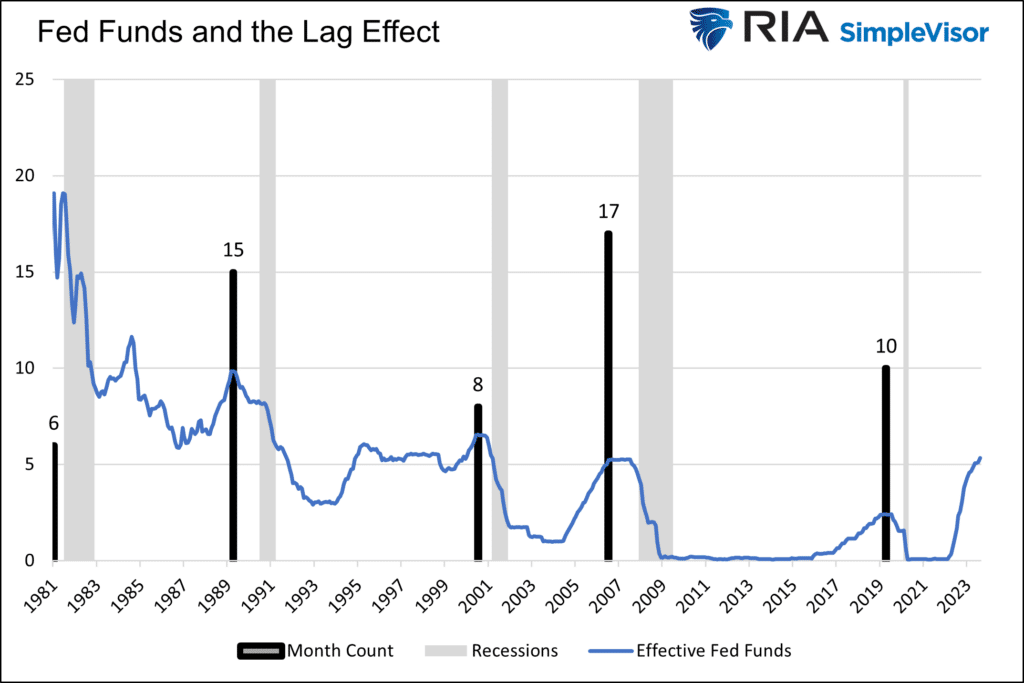
The graph below shows the Fed Funds rate and the time, as measured in months, from the last in a series of rate hikes preceding each recession since 1981. The average delay between the final rate increase and recession has been 11 months. The last Fed hike was in July 2023. Assuming that was the Fed’s final rate increase for this cycle, it may not be until June 2024 before a recession occurs.
This so-called lag effect is even more pronounced when rates were very low for extended periods before the rate hikes.
We examine government, corporate, and consumer debt to appreciate the current lag effect and better gauge when it will rear its ugly head.
Government
There is over $32 trillion of U.S. Treasury debt outstanding. Simple math asserts that each 1% increase in interest rates pushes the government’s interest expense up by $320 billion. That math is wrong.
The reality is only a small portion of the federal debt matures in any given month and must be reissued. Further complicating matters, some maturing debt was issued when interest rates were similar to or higher than current levels. For instance, the 30-year bond issued on August 16, 1993, with a coupon of 6.25%, just matured in August. Reissuing debt to replace the bond saved the government about 2% on $11.50 billion, or $230 million.
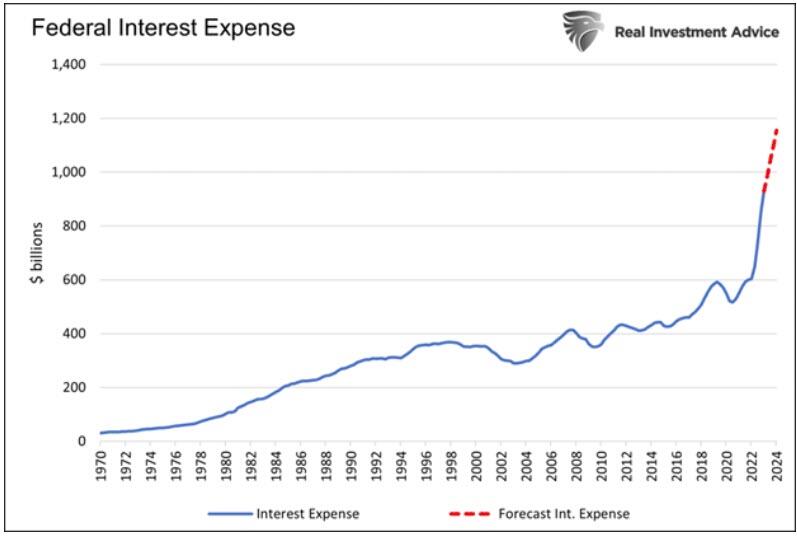
In our article, The Government Can’t Afford Higher For Longer, we quantified how rising interest rates affect and will affect the government’s interest expense. As we share below, its interest expense will increase more between 2022 and 2024 than in the 51 years prior!
Higher interest rates are unsustainable for the government. A $2 trillion deficit, as we have now, during a robust and peace-time economy with high-interest rates will force the government to cut its spending. While that is good in the long run, it hurts the economy in the short run. Ergo, as each month passes and interest expenses consume more of the deficit, government spending in other areas is likely to slow.
Rather than reduce spending, the easier, albeit fiscally irresponsible, way to keep running massive deficits is to ensure inflation normalizes so rates can drop significantly and interest costs are not burdensome. That has been the Fed and Treasury playbook for the last 30 years and will continue.
Corporate Debt
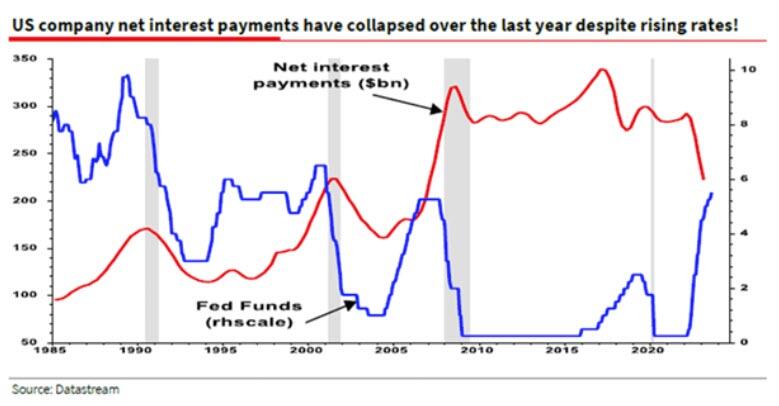
In aggregate, higher interest rates are currently helping corporate borrowers. As the graph below from Albert Edwards shows, net interest payments for U.S. corporations have fallen while Fed Funds have risen significantly. We touched on this graph in a recent Commentary titled Albert Edwards Ask What On Earth Is Going On?
To help explain why higher interest rates are currently helping corporations, consider the following quote per our article:
Albert surmises that many companies borrowed heavily in 2020-2021 at very low-interest rates, and the proceeds remain in deposit accounts earning more than the interest on the debt. Consequently, net interest is reduced.
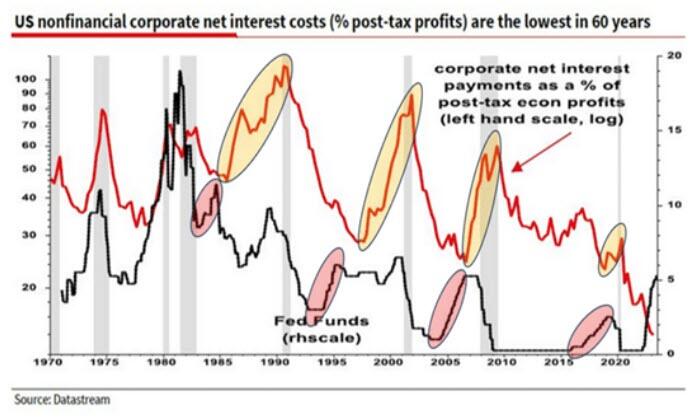
The following graph, also from our Commentary, shows that such a circumstance is common when the Fed raises rates. The red circles highlight four instances in which interest costs as a percentage of profits fell while the Fed was hiking rates. The yellow circles show that interest expenses lagged but rose after the Fed stopped raising rates.
Such is the lag effect. Most companies spread out their debt, so only a small amount matures in any year. Therefore, it can take time until more expensive debt replaces cheaper maturing debt
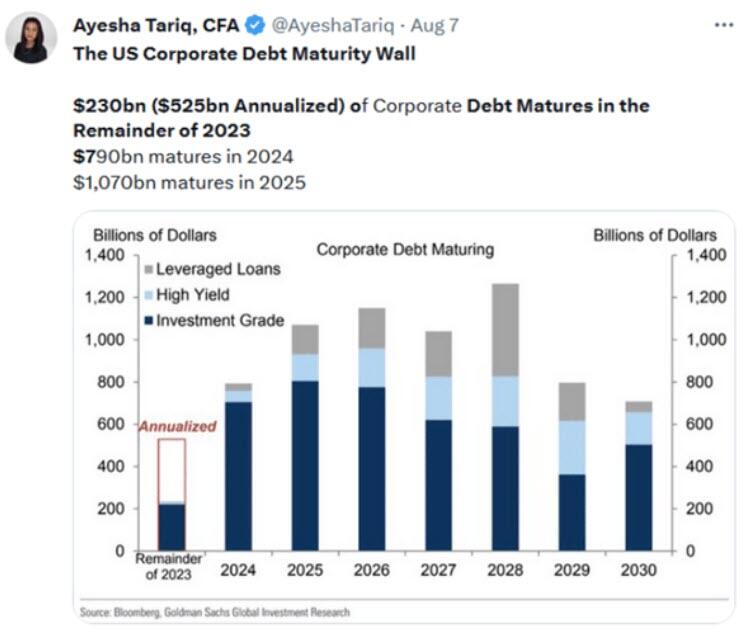
The tweet below shows a wall of maturing debt is approaching quickly.
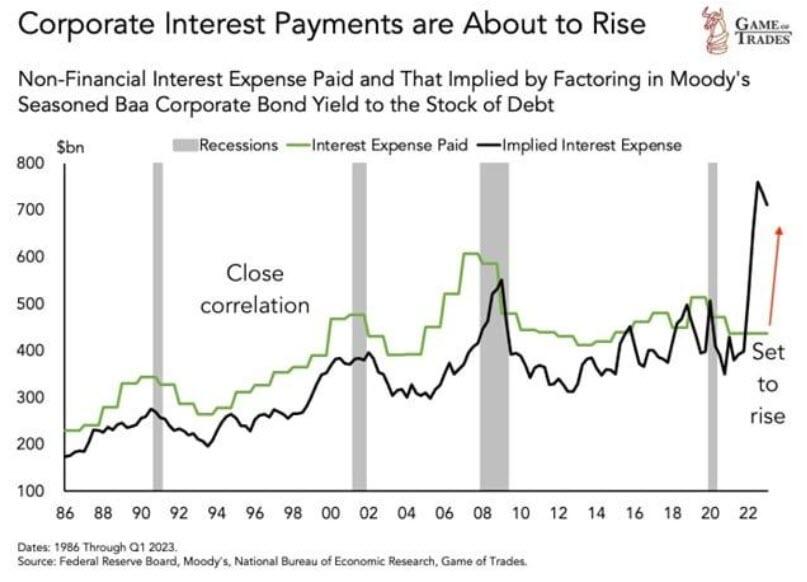
The following graph, courtesy of Game of Trades, shows what will happen to corporate interest expenses over time if rates stay at current levels. As it shows, corporate interest expenses will triple!
Individuals
The impact on individuals is similar to corporations and the government. Marginal purchases on credit result in the financial recognition of higher interest rates.
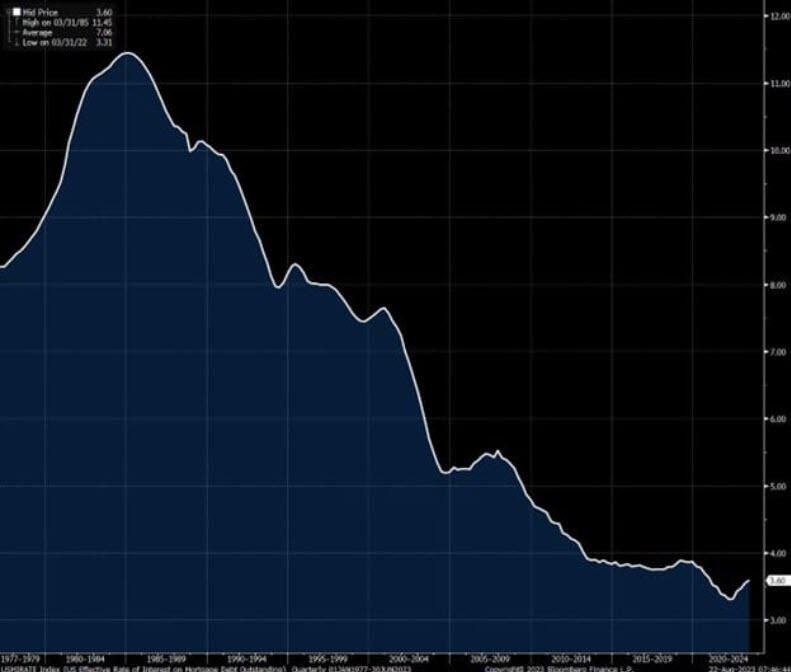
The graph below shows the weighted average mortgage rate. Currently, mortgage rates are well over 7%, about 4% higher than the lowest mortgage rates set in early 2022. Despite the sharp increase, the weighted average rate has barely ticked up. Only those buying houses are affected by the new mortgage rates, and there aren’t many home buyers. Existing home sales are at levels last seen during the depth of the financial crisis.
Unlike houses, cars do not have as long a shelf life. Per a recent study by ISH Markit, the average length of car ownership is 79 months or just over 6.5 years. As such, about 15% of car owners will have to pay cash or borrow at high auto loan interest rates.
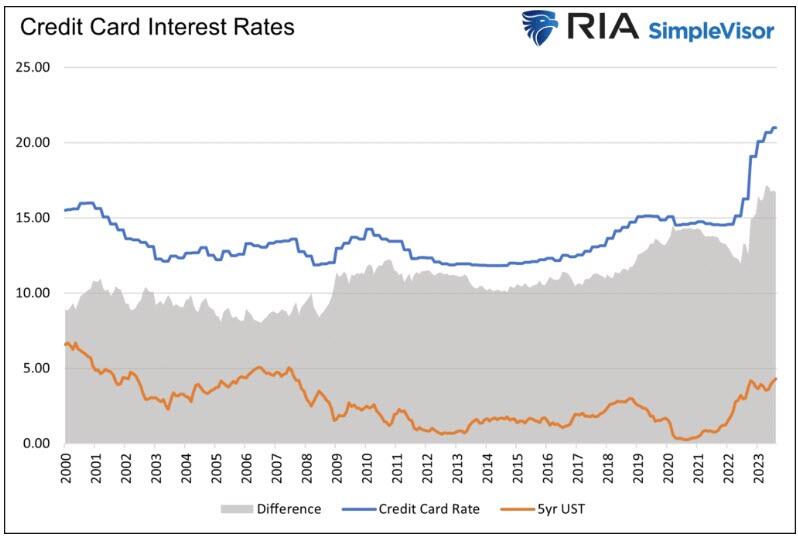
Interest rates on credit cards float monthly. Therefore, cardholders who do not pay their entire balance monthly are immediately impacted by higher rates. According to the Fed and shown below, the average credit card interest rate is 21%, up over 6% since the Fed started raising rates. Credit card rates have risen significantly more than U.S. Treasury rates and Fed Funds.
Record Low Rates Before 2022 Increase the Lag
When contemplating how corporations and individuals have thus far insulated themselves from higher interest rates, consider that when interest rates are held low for long periods, the weighted average rate for every type of loan is lowered. The longer, the more borrowers benefit. And, the less borrowers are immediately impacted by higher interest rates.
As we showed, sub 3% mortgages in 2020 and 2021 and meager rates before the pandemic allowed a large majority of borrowers to extend their debt and avoid, for a period, the wrath of higher interest rates.
Over time, however, corporate and government debt matures, people need new cars or houses, and the reality of higher interest rates hits.
Summary
The lag effect is a ticking time bomb. Each day that passes, another borrower feels the impact of higher interest rates. The financial impact is slow but steadily increasing. Also, remember that the various types of pandemic-related stimulus are quickly exiting the economy. Normalizing economic activity and the slow but steadily growing lag effect will likely result in a recession.
Given the leverage the economy depends upon, “higher for longer” is not possible without breaking something.

WSJ : A Picasso From 1932 Asks $120 Million at Auction

A Picasso From 1932 Asks $120 Million at Auction
‘Woman with a Watch,’ expected to be the second-most expensive Picasso ever sold, will serve as a test for a slumping market

Sotheby’s just landed the chance to sell the undisputed star of the fall auction season: A royal blue, green and red portrait of Pablo Picasso’s young mistress curled up in a chair, “Woman with a Watch,” estimated to top $120 million this November.

The 1932 portrait hails from the estimated $400 million estate of Emily Fisher Landau, a New York collector who died in March at age 102. Fisher Landau’s 120-piece trove includes major examples by Jasper Johns, Ed Ruscha and Andy Warhol, so market watchers will be closely following the estate’s performance to gauge global bidder interest during the current slump. The Picasso, which carries the artist’s second-highest asking price ever, will come under the most scrutiny.

“Masterpieces are incredibly market resilient,” Brooke Lampley, Sotheby’s head of global fine art, said. Lampley confirmed the house won the consignment in part by guaranteeing Fisher Landau’s heirs that the house itself would buy her pieces, including the Picasso, if no other bidders stepped up during the Nov. 8-9 sales.

To break Picasso’s record, “Woman with a Watch” will need to sell for more than the $179.4 million paid in 2015 for a 1955 harem scene, “Women of Algiers (Version O).”

Collectors tend to pay a premium for Picasso’s works from the 1930s, with half of the artist’s top 10 priciest works hailing from that decade, according to auction database Artnet. Three date to the same year Sotheby’s example was painted: 1932, a seminal period in Picasso’s career when he was readying works for a retrospective and reveling in a secret love affair with Marie-Thérèse Walter. In 2010, Christie’s sold another Picasso from 1932, “Nude, Green Leaves and Bust,” for $106.5 million.

Museums including London’s Tate Modern have devoted entire shows to that singular year when Picasso used a lush, jewel-tone palette to paint his mistress lounging in voluptuous repose. The Tate Modern didn’t borrow Fisher Landau’s Picasso, but at least six other museums have exhibited it over the years, most recently a 2022 show of her collection at West Palm Beach’s Norton Museum of Art.

Emily Fisher Landau died in March at age 102. PHOTO: PATRICK MCMULLAN VIA GETTY IMAGES

Fisher Landau, born in 1920 and raised in New York, bought the Picasso with her first husband, real-estate developer Martin Fisher, in 1968 when she was just starting to collect art. The following year, armed burglars disguised as repairmen broke into their Upper East Side apartment and stole her jewels out of her safe. She decided to spend the insurance payout on art.

“She never bought important jewelry after that,” said her daughter, Candia Fisher, also a collector. “She’d point out women wearing big pieces at galas and say, ‘Think of the art they could buy.’”

Her mother later married clothing manufacturer Sheldon Landau, and in 1991 the couple arrayed much of the collection—estimated then to be around 1,500 works—in a former parachute harness factory in Queens. The Fisher Landau Center for Art regularly mounted shows until 2017 when Candia Fisher said her mother was no longer able to oversee it and no one else in the family wanted to take over.

The family is holding on to some of those pieces. Fisher Landau also gave around 400 pieces to New York’s Whitney Museum of American Art, where she served as a longtime trustee. In 1994, the museum named the fourth floor of its former Breuer Building in her honor.

In a twist, the Breuer now belongs to Sotheby’s. But since the house is still transforming the space into an auction hub, Fisher Landau’s estate will be auctioned off at its current York Avenue headquarters across town.

Andy Warhol’s camouflage ‘Self Portrait,’ 1986, is also included in the sale. PHOTO: SOTHEBY’S/ 2023 THE ANDY WARHOL FOUNDATION FOR THE VISUAL ARTS, INC./LICENSED BY ARTISTS RIGHTS SOCIETY (ARS), NEW YORK

Other sale highlights include Jasper Johns’s “Flags” from 1986, a side-by-side view of two U.S. flags that Sotheby’s expects to sell for at least $35 million, and Andy Warhol’s camouflage “Self Portrait” dated to the same year, which is estimated to sell for at least $15 million.

Willem de Kooning’s wispy red-and-blue abstract “Untitled XV” from 1983 is estimated to sell for at least $6 million, and Georgia O’Keeffe’s “Pink Tulip” from 1925 is estimated to sell for at least $3 million.

Another work to watch: Ruscha’s “Securing the Last Letter (Boss),” a 1964, blue-and-orange wordplay painting in which the conceptual artist paints a clamp that appears to be squeezing the second “s” in the word boss. Sotheby’s said it still hasn’t finalized an asking price for that work, but expectations will likely run high as its sale coincides with the artist’s must-see retrospective at the Museum of Modern Art.

Fisher Landau was known to have one of the world’s biggest collections of Ruscha’s work and visited him often at his studio in Los Angeles. “Mom used to get so excited about seeing Ed,” her daughter said, adding, “Artists were her rock stars.”