>>> What to look at today - 13th of June 2025

Stocks fell along with equity-index futures as investors rushed to the safety of haven assets after Israel attacked Iran’s nuclear program sites in a major escalation of tensions in the Middle East. Crude oil jumped as much as 9.3%. Contracts for US equities retreated around 1.5% as Israel’s Prime Minister said the operation “will continue for as many days as it takes to remove this threat.” Asian stocks dropped 0.4%. Treasuries advanced with the 10-year yield dropping three basis points to 4.33%. The yen strengthened 0.2% to 143.16 against the dollar and gold rose over 1%. Bitcoin and Ether led a drop in cryptocurrencies. West Texas Intermediate crude traded at $73.39 a barrel, which is 28% more than a low hit in early May. Oil is on course for the biggest weekly gain since 2022. The moves erased the losses for this year, driven by the fall-out from global trade tensions and a decision by OPEC+ to revive shuttered capacity at a faster-than-expected clip. Israel attacked Iran in a major escalation in the standoff over Tehran’s atomic program. The move came amid renewed questions about diplomatic efforts to resolve tensions over Iran’s atomic work. US and Iranian negotiators are scheduled to hold a sixth round of talks in Oman on Sunday, but President Donald Trump said this week he’s less confident about the chances of a deal. The attack is “poised to echo through global markets—not just as a geopolitical flashpoint, but more as a stark wake-up call,” said Hebe Chen, an analyst at Vantage Markets in Melbourne. “Investors now have to face the mounting threat of multi-front tensions, where potential new hot wars and intensifying trade wars collide, reshaping risk sentiment in real time.” Israel declared a state of emergency after conducting the “preemptive strikes,” Israeli Defense Minister Israel Katz said. Israel’s move came after repeated warnings by Israeli Prime Minister Benjamin Netanyahu about striking Iran and crippling its nuclear program. Earlier on Thursday, Iran had said it would inaugurate a new uranium-enrichment facility in response to censure by the UN atomic watchdog over its nuclear program. Israel is already involved in a major military operation in Gaza where it’s been bombarding and blockading the civilian population for the past 20 months as it tries to destroy Hamas following the group’s deadly attack on the Jewish state on Oct. 7, 2023.  US Secretary of State Marco Rubio said the US is not involved in the air strikes and Israel took unilateral action against Iran. A gauge of the dollar rose 0.2% after initially falling on the report. The currency hit a three-year low Thursday. US After Hours RH +19.2% up big on earnings; ADBE -0.6% ticks lower on earnings

Nikkei -1.13% Hang Seng -0.98% CSI -0.84% Shanghai -0.85% Shenzen -1.36%

Eur$ 1.1527 CNH 7.1881 CNY 7.1845 JPY 143.60 GBP 1.3567 CHF 0.8094 RUB 80.0037 TRY 39.4654 WTI$ 74.40 +9.40% Gold 3,428 +1.58% BTC 104,500 -1.44% ETH 2,515 -4.89%

S&P -1.52% Nasdaq -1.71% EuroStoxx -1.69% FTSE -0.46% Dax -1.67% SMI -1.38%

Macro :
- Trump Says He May Raise Auto Tariffs in ‘Not Too Distant Future’
- Hedge Funds Present All Long Trading Ideas at Sohn Monaco
- CAC 40 ESG : In : EN, DSY ,EL, ERF, STLAF Out : ALO, ADP, AKE, GEC, LI SW
- Senators to Propose Ban on Drug Advertising to Consumers -- WSJ
- RFK Jr.’s Vaccine Panel Includes Paid Witnesses Against Merck

Keep an eye on :
- AEDAS SM : Apollo Said to Ready €750 Million Loan for Neinor’s Aedas Bid
- AGS BB : Foreign Buyers in $10 Billion Scramble for UK Takeover Targets
- AMD US : AMD Dips After Discussing New Products at AI Event: Street Wrap
- ANTIN FP : United Rentals Cut to Neutral at Redburn; PT $760
- AAPL US : Apple Targets Spring 2026 for Release of Delayed Siri AI Upgrade
- MT NA : Italy to Increase State Funds for Ex-Ilva by €200 Million: Urso
- BBVA SM : BBVA’s New MREL Requirement Set at 23.13% of Total RWAs
- BA US : Boeing CEO Ortberg Canceling Trip to Paris Air Show: Reuters
- BPCE : BPCE Is Said to Near Almost €7 Billion Deal for Novo Banco (1)
- CAMX SS : Camurus Holder Sandberg Development Offers SEK1.3 Bln in Shares, Camurus Offering by Holder Prices at SEK580/Share
- ACA FP : Crédit Agricole Buys Majority Stake in Comwatt; No Terms
- CVC NA : Antin, CVC Could Bid for Exor’s Lifenet Healthcare: Sole
- EQNR NO : Equinor Says Trump U-Turn on Wind Farm Curbs Appetite to Invest
- EXO NA : Antin, CVC Could Bid for Exor’s Lifenet Healthcare: Sole
- FSKRS FH : Fiskars Lowers FY Comparable Ebit View on Tariff Impact
- FNOX SS : Fortnox to Hold EGM July 9 on Request by EQT X and First Kraft
- FRA GY : Fraport May Frankfurt Airport Passengers +1.8%
- G IM : Generali Started Evaluation of Mediobanca Bid on Banca Generali
- HER IM : Hera, Edison May Compete for Unoenergy’s Clients Portfolio: MF
- ITAB SS : Itab Shop Concept Holder WQZ Offers About 6.2m Shares
- IVG IM : Leonardo Faces Pressure to Boost Bid for Iveco Defense Unit
- KVUE US : Kenvue Mulls Sale of Some Skincare, Beauty Brands: Reuters
- KESBKOB FH : Kesko May Comparable Sales -2.1%
- LEG GY : LEG Adjusts Conversion Price for Convertible Bond Due Sept. 1
- LDO IM : Leonardo Faces Pressure to Boost Bid for Iveco Defense Unit
- MRK US : Merck’s Keytruda Gets FDA OK for Head and Neck Cancer
- MU US : Micron boosts US investment plan by $30 billion amid Trump's onshoring push https://t.co/UWd202bf0H https - Reuters
- 3659 JP : Tencent Studies Deal for $15 Billion Game Developer Nexon
- NOVOB DC : Novo Nordisk to Advance Amycretin Into Phase 3 Development
- OKLO US : Oklo Offering of $400 Million of Shares Prices at $60/Share
- 1913 HK : Prada - 5.70%
- OMC US : Omnicom Extends Drop on Report FTC Mulling IPG M&A Restrictions
- PROX BB : Proximus Completes Luxembourg Mobile Tower Infra Sale for ~€111m
- PROX BB : Proximus Sells 92.7% Stake in Be-Mobile; Enterprise Value €170M
- SHEL LN : Shell to sell WestWind stake, target new opportunities in wind
- SSE LN : Sohn Monaco: Knight Vinke’s Founder Pitches Power Supplier SSE
- TMO US : Thermo Fisher Seeks to Sell Part of Its Diagnostics Unit: FT
- TSLA US : Waymo Fleet Manager Targets Funding That Would Lift Valuation Past $1 Billion
- X US : Nippon Steel US Deal May Stall If Not Enough Freedom: Nikkei
- UCB BB : UCB to Grow US Footprint With New Biologics Manufacturing Plant
- VOYG US : Voyager Technologies Shares Fall in Second Trading Day Post-IPO
- ZURN SW : Zurich Airport May Passenger Traffic +0.1%
>>> Europe : Brokers Upgrades & Downgrades - 13th of June 2025

>>> Up
* DocMorris Raised to Buy at Octavian; PT 20 Swiss francs
* Intrum Raised to Neutral at JPMorgan; PT 45 kronor

>>> Down
* AFRY Cut to Hold at Pareto Securities; PT 170 kronor
* AQ Group Cut to Hold at Pareto Securities; PT 190 kronor
* Clas Ohlson Cut to Hold at Pareto Securities; PT 310 kronor
* CrowdFundMe Cut to Neutral at Corporate Family Office
* LyondellBasell Cut to Sell at CFRA
* Mitie Cut to Hold at Jefferies; PT 145 pence
* Soitec Cut to Hold at Jefferies; PT 50 euros
* Tim Brasil ADRs Cut to Hold at HSBC; PT $19.50
* Voestalpine Cut to Accumulate at Erste Group; PT 26.50 euros

>>> Initiation
* Air Products Rated New Outperform at RBC; PT $355
* Chevron Rated New Buy at Punto Casa de Bolsa; PT $165.58
* Linde Rated New Outperform at RBC; PT $576

>>> Call

>>> Telegram, the FSB, and the Man in the Middle

Telegram, the FSB, and the Man in the Middle - https://dub.sh/RuGCQo7

The technical infrastructure that underpins Telegram is controlled by a man whose companies have collaborated with Russian intelligence services.

Key Findings
  • A company owned by a Russian network engineer named Vladimir Vedeneev controls thousands of Telegram IP addresses and maintains its servers.
  • Vedeneev’s other companies have a history of collaborating with Russia’s defense sector, the FSB security service, and other highly sensitive agencies.
  • Because of the way Telegram’s encryption protocols work, even users who use its “end-to-end” encryption features are vulnerable to being tracked by anyone who can monitor its network traffic.
June 10, 2025
Telegram, the wildly popular chat and messaging app, is the pride of the Russian IT industry. According to Pavel Durov, the enigmatic entrepreneur who created the service twelve years ago, it now has over a billion monthly active users around the world.
Among the reasons for this success is Telegram’s reputation for security, coupled with Durov’s image as a free speech champion who has defied multiple governments.
“Unlike some of our competitors, we don’t trade privacy for market share,” he wrote this April. “In its 12-year history, Telegram has never disclosed a single byte of private messages.”
Credit: Steve Jennings/Getty Images for TechCrunch/Flickr
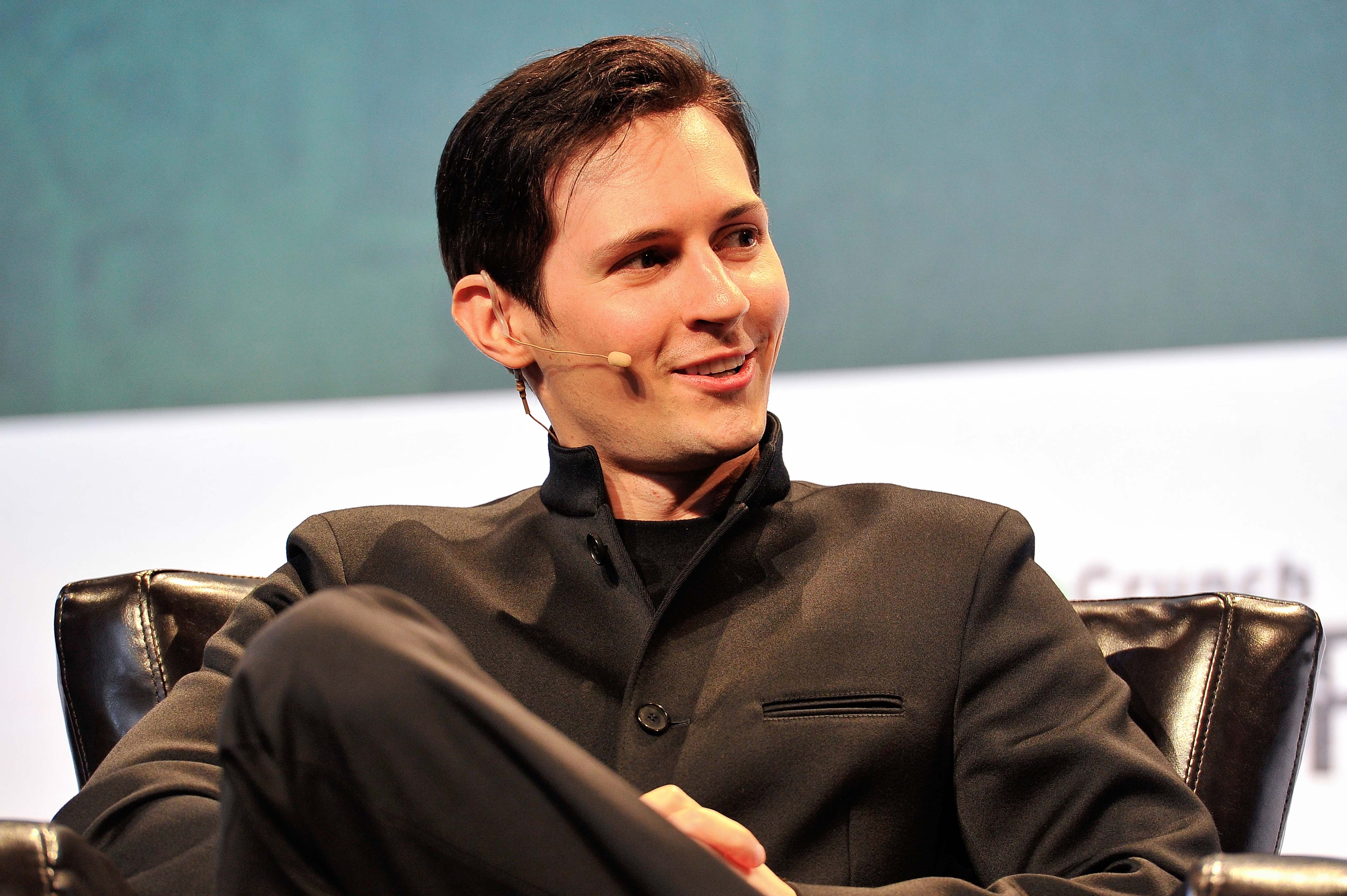
Telegram founder Pavel Durov.
But a new investigation by OCCRP’s Russian partner, Important Stories, reveals a critical vulnerability.
When reporters investigated who controls the infrastructure that keeps Telegram’s billions of messages flowing, they found a man with no public profile but unparalleled access: Vladimir Vedeneev, a 45-year-old network engineer.
Vedeneev owns the company that maintains Telegram’s networking equipment and assigns thousands of its IP addresses. Court documents show that he was granted exclusive access to some of Telegram’s servers and was even empowered to sign contracts on Telegram’s behalf.
There is no evidence that this company has worked with the Russian government or provided any data. But two other closely linked Vedeneev companies — one of which also assigns Telegram IP addresses, and another which did so until 2020 — have had multiple highly sensitive clients tied to the security services. Among their clients is the FSB intelligence agency; a secretive “research computing center” that helped plan the invasion of Ukraine and developed tools to deanonymize internet users; and a flagship state-owned nuclear research laboratory.
Credit: Alexander Kazakov/Kremlin Pool/Russian Government / Alamy Stock Photo
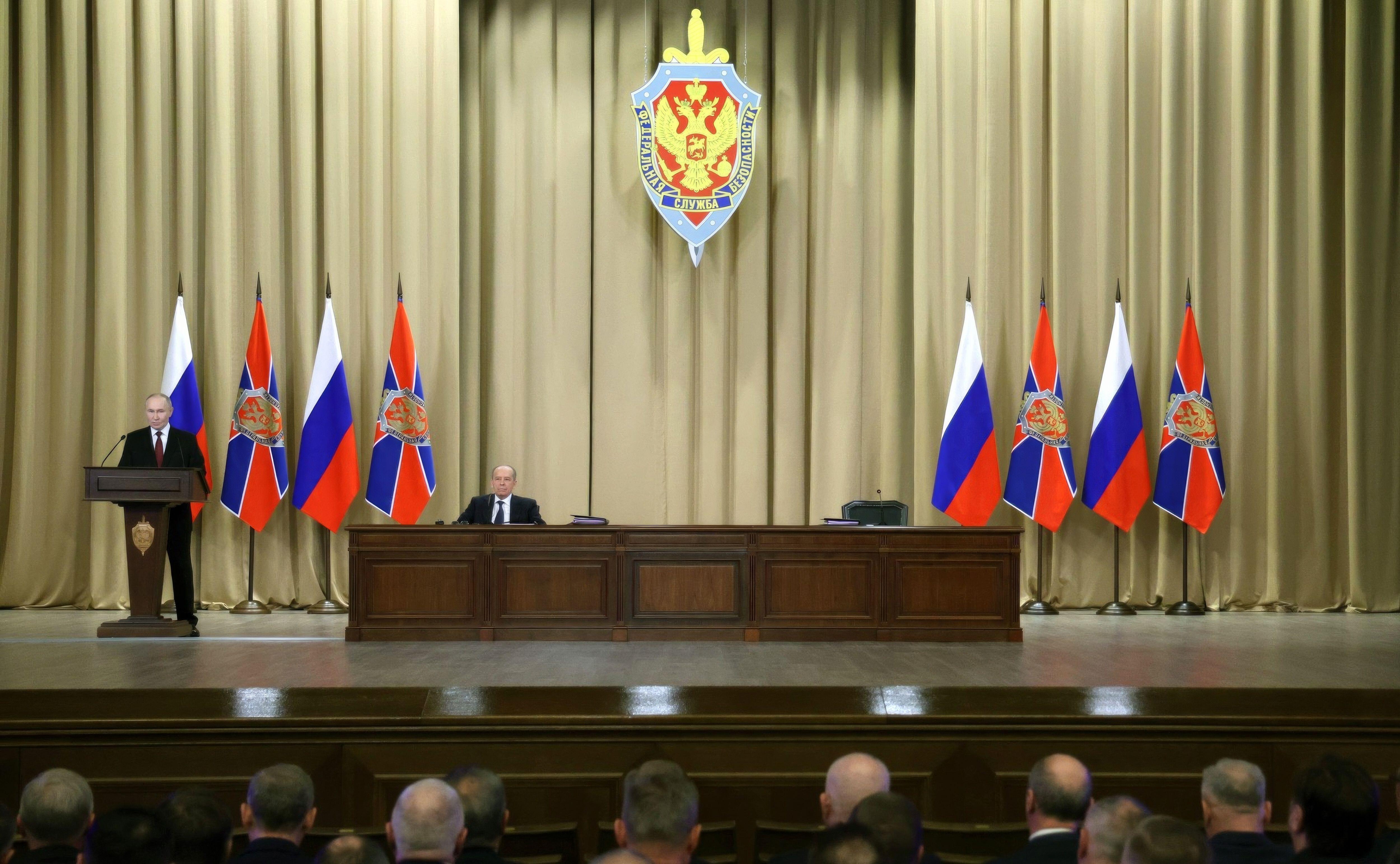
Russian President Vladimir Putin speaks at the annual meeting of the FSB Board, with FSB Director Alexander Bortnikov, on February 27, 2025, in Moscow.
“If true, this reporting highlights the dangerous disconnect between what many believe about Telegram’s security and privacy features, and the reality," said John Scott-Railton, a Senior Researcher at The Citizen Lab. "When people don't know what is actually going on, but assume they have metadata privacy, they can unknowingly make risky choices, bringing danger to themselves and the people they’re communicating with. This is doubly true if the Russian government sees them as a threat."
A Ukrainian IT specialist who spoke with reporters on condition of anonymity said that the Russian military has used “man-in-the-middle” type surveillance in his country after capturing network infrastructure.
"You get physical access to the data transmission channel and install your equipment there,” he said. “In such an attack, the hackers aren’t even interested so much in the user's correspondence. They get metadata to analyze. And that means IP addresses, user locations, who exchanges data packets with whom, the kind of data it is… really, all possible information.”
Durov is currently under investigation in France after being arrested last August on charges related to the circulation of illegal content on Telegram. The company has since implemented a number of measures to crack down and step up its collaboration with the authorities. Durov has been released under judicial supervision and is allowed to travel.
He did not reply to requests for comment. Vedeneev spoke with reporters but declined to make any of his comments public.
Leaving Russia
The story of Telegram begins with another social networking site that is less well-known outside of Russia: VKontakte.
Created by Durov in 2006, when he was just 21 years old, the site quickly earned a large userbase because it duplicated many of Facebook’s popular features and provided free access to vast troves of pirated music and videos.
But VKontakte’s rise ran up against Russian President Vladimir Putin’s growing authoritarianism. When opposition groups used the site to help organize mass anti-government protests in 2012, the authorities demanded that Durov ban them.
“Armed policemen [came] to my house, tried to break in because I refused,” he told right-wing commentator Tucker Carlson in an interview last year, explaining that this episode gave him the idea of creating a new, more secure messaging service.
Credit: Bogomolov.PL/Wikimedia Commons
An anti-government rally on Moscow's Sakharov Avenue in December 2011.
Facing further pressure from the authorities, who now demanded that he disclose the personal data of Ukrainians protesting the Kremlin-aligned government in Kyiv, Durov left Russia in 2014. He sold his stake in VKontakte — which was taken over by people close to the Kremlin — and even published a manifesto: “Seven Reasons Not to Return to Russia.”
Then, along with his brother, a talented mathematician named Nikolai, Durov created Telegram — a new messenger service with an emphasis on privacy. From the beginning, he claimed that his product was “safer” than its competitors and that “messages sent through Telegram cannot be bugged by third parties.”
He has denied that Telegram had any infrastructure in Russia, and even claims never to have visited his home country since he left in 2014. “I don't go to any of the big geopolitical powers, countries like China or Russia or even the U.S.,” he told Carlson. (Last year, reporters from Important Stories revealed that this was untrue. A leaked database of border crossings showed that Durov had traveled to Russia more than 50 times between 2015 and 2021.)
In the meantime, Telegram’s reputation for privacy contributed to its massive growth. Russian users saw the messenger as a safe alternative to VKontakte. The app became a mainstay not only for pro-Kremlin propagandists and security services, but also for independent media outlets and opposition figures. Millions from other countries also joined after WhatsApp made clear that it could share certain data with its parent company, Facebook.
Telegram’s official FAQ stresses its security features and emphasizes transparency: “Anyone can check Telegram’s open source code and confirm that the app is not doing anything behind their back,” it reads.
But the reality is more nuanced. Unlike other apps like WhatsApp or Signal, Telegram chats do not use end-to-end encryption by default. The option is available for users who enable it, but as Durov’s former colleague Anton Rosenberg pointed out as far back as 2018, the vast majority do not do so, instead corresponding through regular “cloud” chats, which are stored on the company's servers.
Telegram assures users that their data is safe: “Cloud chat data is stored in multiple data centers around the globe that are controlled by different legal entities spread across different jurisdictions,” the company’s FAQ reads. “The relevant decryption keys are split into parts and are never kept in the same place as the data they protect. ... Thanks to this structure, we can ensure that no single government or block of like-minded countries can intrude on people's privacy and freedom of expression.”
But network security experts warn that even Telegram’s end-to-end encrypted chats can leave users vulnerable to being tracked. The app’s MTProto protocol, which governs how its encryption works, specifies that an unencrypted element is attached to the beginning of each encrypted message.
“The unencrypted part is called ‘auth_key_id,’” said Michał “rysiek” Woźniak, a security specialist who used to work for OCCRP as head of infrastructure and information security. “This makes it possible to identify a specific user device.”
“If I know your device’s ‘auth_key_id,’ and I can listen in on the network that handles the data … I know it is your specific device communicating with Telegram servers,” he explains. “By looking at the network packets … I also get your IP address at a given time, which tells me your rough geographic location.”
This means that whoever controls Telegram’s network traffic may be able to track users, even if the messages themselves cannot be read.
Woźniak conducted several tests to confirm these claims. He has published the technical details in a blog post. Other experts have also pointed out the ‘auth_key_id’ issue.
The Man in the Middle
To learn how Telegram messages travel, reporters messaged each other through the service and recorded the traffic using Wireshark, a network traffic analyzer. The results showed that the IP addresses were controlled by a company registered in Antigua and Barbuda called Global Network Management (GNM).
Analyzing additional IP ranges managed by the company, reporters found that it had leased over 10,000 IP addresses to Telegram, meaning that it plays a significant role in the messenger’s infrastructure.
Documents from an otherwise unremarkable court case filed in Florida in 2018 — a dispute between GNM and a contractor — reveal much more.
GNM’s owner, they show, is a Russian network engineer named Vladimir Vedeneev. He tells the court that his company “is involved in the installation of client equipment — in this case for the Telegram Messenger — and further technical support of this equipment.”
According to his company’s legal filings, Vedeneev was the only person authorized to access Telegram servers in a Miami data center. He also testified that his company owns a router in the Telegram server room.
“If a company controls the routers that distribute traffic passing through Telegram servers, this means that it, or anyone to whom it grants such access, can see the identifiers of messenger users,” says Woźniak, the security specialist.
Documents from the court case also show that Vedeneev’s relationship with Durov goes beyond providing network infrastructure.
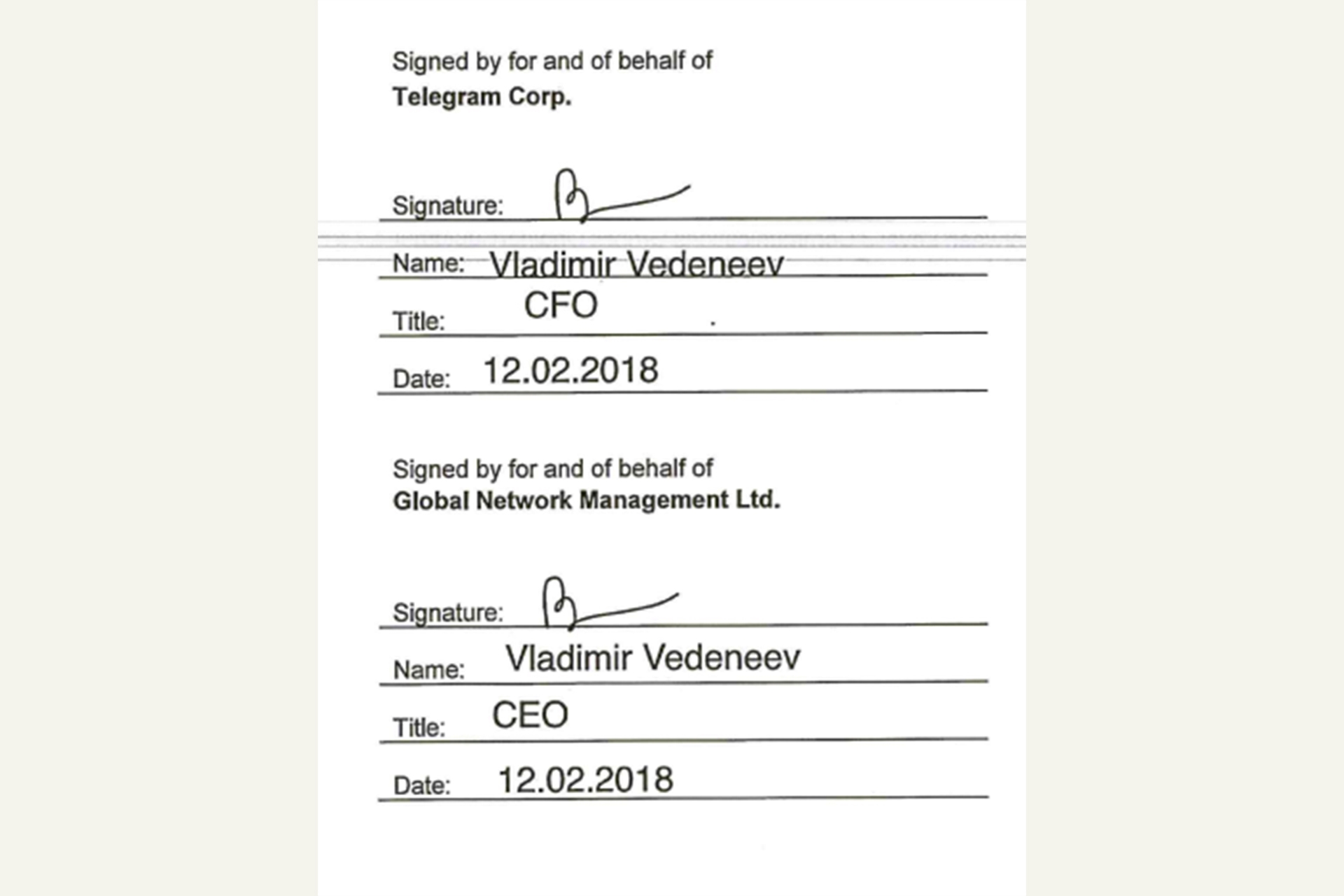
As far back as nine years ago, they show, Durov had empowered Vedeneev to sign documents as Telegram’s CFO. One contract found in the case materials empowers Vedeneev’s GNM to deal with a third-party contractor on Telegram’s behalf. It is signed by Vedeneev twice: Once as GNM’s director and once as Telegram’s CFO.
Credit: Screenshot of court document obtained by Important Stories
A contract signed by Vedeneev in two roles: As CFO of Telegram and as CEO of General Network Management.
In his testimony, Vedeneev describes the arrangement as “informal” and says he was never paid by Telegram as an employee. But he also tells the court that he “had a power of attorney to sign documents on behalf of Pavel Durov and on behalf of Telegram.”
Neither Elies Campo, a former partnership development manager with Telegram who spoke with reporters, nor others familiar with Telegram’s corporate structure, have ever heard of Vedeneev. Given Telegram’s secretive corporate culture — not even all of its top managers are publicly known, and the company maintains a strict “No LinkedIn” policy — this may be no surprise.
In fact, Vedeneev is a key player in the Russian telecommunications market. He is the founder of GlobalNet, a St. Petersburg backbone telecom operator that controls 18,000 kilometers of backbone infrastructure from Siberia to Western Europe in two dozen countries. (Last year, Vedeneev handed over his majority share in the company to relatives.)
Until 2020, the Telegram IP addresses now assigned by GNM were controlled by GlobalNet.
But GlobalNet is not just any network provider. Among its clients is the Main Research Computing Center of the Presidential Property Management Department of Russia (GlavNIVTS). Officially, this organization provides technical support for President Putin’s public “direct line” question-and-answer events, summits, and other high-level meetings.
But GlavNIVTS is also perhaps the most secret and little-studied special service in Russia. The agency helped plan the invasion of Ukraine, upgraded a major bot network, developed a centralized video surveillance system, and built tools to track and deanonymize internet users.
More About GlavNIVTS
In 2019, former GlavNIVTS employees told reporters from Meduza that the center has access to secret materials and works in the interests of a litany of security agencies, including the FSB, the FSO, the Interior Ministry, the Defense Ministry, and the GRU military intelligence service.
GlavNIVTS specialists have also “cleaned up” the digital traces of Russian military personnel in Syria and eastern Ukraine, developed tools to predict the results of strikes on Ukrainian infrastructure, helped upgrade a major network of pro-Kremlin bots, and developed a centralized video surveillance system with facial recognition technology.
In addition, GlavNIVTS helped develop a Russian analogue to Palantir, the American mass data analysis system used by the military and CIA. Elements of the “Russian Palantir” — which used names like “Media Monitor,” "Sherlock," and "PSKOV" — help the government track and deanonymize internet users, as reported by Meduza in 2019.
Show more
According to data from Russia’s official state procurement portal, GlobalNet also provides communications infrastructure to the Kurchatov Institute, a flagship state-owned nuclear research laboratory led by Putin ally Mikhail Kovalchuk and sanctioned by the United States.
Shortly after Russia’s full-scale invasion of Ukraine in 2022, GlobalNet said it was the first Russian operator to implement a system for monitoring user traffic called Deep Packet Inspection (DPI) “according to [Russian internet regulator] Roskomnadzor rules.”
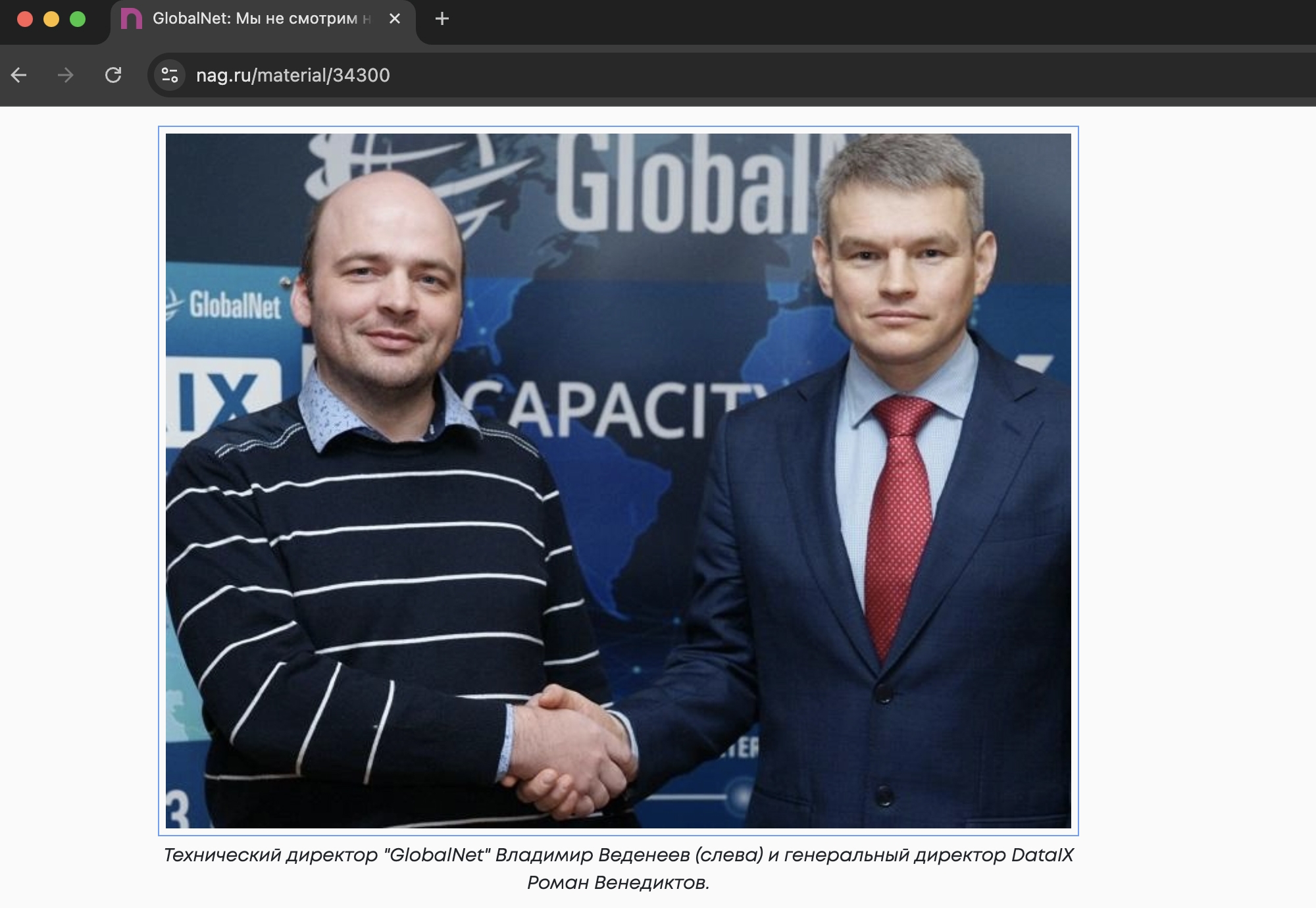
It also has a notable minority co-owner: Roman Venediktov, a Russian space forces officer.
A graduate of the elite Mozhaisky Academy, Venediktov, who owns four percent of GlobalNet’s shares, served for nearly 10 years in a defence ministry spacecraft testing center outside Moscow.
Venediktov began to cooperate with the Durov family about 15 years ago, when he became the joint co-owner of their St. Petersburg company “Peering,” which owned the traffic exchange network DATAIX and handled traffic for VKontakte. He did not respond to requests for comment.
Credit: Screenshot of nag.ru website
Vladimir Vedeneev (left) and Roman Venediktov (right) featured on telecommunications supplier website Nag.ru.
Vedeneev’s GlobalNet bought DATAIX in 2018, making him, the Durov family, and the space forces officer business partners for years. He transferred his share in GlobalNet to relatives last year. GlobalNet did not respond to requests for comment.
At the same time, he also transferred his share of another company called Electrontelecom — a telecom operator that is also related to Telegram's infrastructure: the company assigned more than five thousand of the messenger’s IP addresses.
Reporters obtained the company’s internal accounting documents for 2024 which show that one of its most important government clients is the FSB.
The documents show that Electrotelecom installs and manages equipment for a system that is being used by the FSB offices in St. Petersburg and the Leningrad region for surveillance.
“I am shocked, but not surprised,” said Woźniak, the security expert, about reporters’ findings. “If someone has access to Telegram traffic and cooperates with Russian intelligence services, this means that the device identifier becomes a really big problem — a tool for global surveillance of messenger users, regardless of where they are and what server they connect to.”

>>> Stoxx 600 Pre-Market Indications

  • Frontline PLC (HF6 TH) +4.1%
    • Oil Spikes as Israeli Attacks on Iran Stoke Fears of Wider War
  • Equinor (DNQ TH) +4%
  • BP (BPE5 TH) +4%
  • Aker BP (ARC TH) +4%
  • OMV (OMV TH) +3.9%
  • TotalEnergies (TOTB TH) +3.4%
  • RENK Group (R3NK TH) +3%
    • Israel Strikes Iran’s Nuclear Sites, Warns More Attacks to Come
  • BAE (BSP TH) +2.5%
  • Shell (R6C0 TH) +2.4%
  • Eni (ENI TH) +2.1%
  • TUI (TUI1 TH) -3%
  • Stellantis (8TI TH) -3.1%
  • Raiffeisen (RAW TH) -3.2%
  • Kion (KGX TH) -3.4%
  • Bawag (0B2 TH) -3.4%
  • Credit Agricole (XCA TH) -3.6%
  • Erste (EBO TH) -3.6%
  • Ferrari (2FE TH) -4.3%
  • Infineon (IFX TH) -5.4%
  • Lufthansa (LHA TH) -5.9%

>>> TradeGate Pre-Market Indications

DAX:
  • Rheinmetall (RHM TH) +1.8%
    • Israel Disregards Trump With Major Attack on Iran Nuclear Sites
  • Commerzbank (CBK TH) -2.1%
  • BASF (BAS TH) -2.3%
  • Siemens Energy (ENR TH) -2.5%
  • Zalando (ZAL TH) -2.6%
  • Infineon (IFX TH) -3.5%
MDAX:
  • RENK Group (R3NK TH) +3.7%
    • Israel Disregards Trump With Major Attack on Iran Nuclear Sites
  • Hensoldt (HAG TH) +2.3%
  • Hochtief (HOT TH) -2.9%
  • Jungheinrich (JUN3 TH) -2.9%
  • Aixtron (AIXA TH) -3.1%
  • TUI (TUI1 TH) -3.2%
  • Lufthansa (LHA TH) -6%
    • Oil Spikes as Israeli Attacks on Iran Stoke Fears of Wider War
SDAX:
  • Patrizia (PAT TH) -1.9%
  • Wacker Neuson (WAC TH) -2%
  • Heidelberger Druck (HDD TH) -2.1%
  • Siltronic (WAF TH) -2.6%
  • Grand City Properties (GYC TH) -3%

WSJ : Chinese AC & Heat Tech Company Plans $1 Billion IPO in Hong Kong

Chinese AC & Heat Tech Company Plans $1 Billion IPO in Hong Kong
The company has entered into cornerstone investor agreements for as much as 57.7% of the shares on offer

Key Points
  • Zhejiang Sanhua plans a US$1 billion secondary listing in Hong Kong.
  • Sanhua will offer 360.33M shares, priced between HK$21.21-HK$22.53, with trading starting June 23.
  • Cornerstone investors, including Schroders & GIC, have agreed to purchase up to 57.7% of the offered shares.

China’s Zhejiang Sanhua Intelligent Controls 002050 -2.59%decrease; red down pointing triangle, a maker of refrigeration components, is planning a US$1 billion secondary listing in Hong Kong, underpinning the revival of the city’s IPO market.

The supplier of air conditioning and refrigeration parts is looking to raise up to 8.12 billion Hong Kong dollars, equivalent to US$1.03 billion.

China-listed Sanhua said in a filing that it aims to sell 360.33 million shares for HK$21.21 to HK$22.53 each. It expects to start trading in Hong Kong from June 23.

The company has entered into cornerstone investor agreements for as much as 57.7% of the shares on offer, depending on offer size adjustments, overallotment options and final pricing. Investors include U.K. asset manager Schroders, Singapore wealth fund GIC, and ICBC Wealth Management.

Sanhua’s shares were down 2.3% Friday morning in Shenzhen, where it went public in 2005. The stock is up 8.6% so far this year.

A flurry of Chinese companies have sought secondary listings in Hong Kong in recent quarters, driving a rebound in activity.

In the first half of 2025, Hong Kong IPOs and spin offs of China-listed companies boosted average listing proceeds over fivefold from a year earlier, according to an EY report. EY said the number of IPO deals has risen 33% so far this year.

In May, Chinese battery giant Contemporary Amperex Technology raised over US$4.6 billion in what was then the biggest IPO of the year. Chinese drugmaker Jiangsu Hengrui Pharmaceuticals followed with an offering that raised about US$1.25 billion.

Sanhua, whose components are used for cold-chain transport, heat pump systems and home appliances, said it would use the proceeds for research-and-development, product innovation and growing overseas production.

Though the company exports to various markets, it doesn’t expect additional U.S. tariffs to significantly hurt its business or expansion plans.

Sanhua’s products are subject to U.S. tariffs on shipments heading to America from China, Mexico and Vietnam, where it has factories.

“However, there continue to be significant uncertainties around changes to U.S. trade policies,” it said.

As of end-December 2024, Sanhua had around 48 factories worldwide, including in the U.S., where it also has two R&D bases.

CICC and BOCI are among the banks advising Sanhua on its IPO.

WWD : Inside VivaTech: LVMH Spotlights AI and Sustainability at Innovation Award

Inside VivaTech: LVMH Spotlights AI and Sustainability at Innovation Awards
LVMH CEO Bernard Arnault missed the ceremony due to "diplomatic duties."

PARIS — Bernard Arnault, chairman and chief executive officer of LVMH Moët Hennessy Louis Vuitton, was working his second job Thursday morning, missing the annual Innovation Awards at the VivaTech fair.

LVMH’s head of communication, image and environment, Antoine Arnault, stepped into his father’s shoes to apologize to the crowd and congratulate the winners.

“You might have noticed that, on top of his multiple hats, he also became recently a diplomat, and his diplomacy skills made him unable to attend today,” said the younger Arnault of his father’s whereabouts. “But it’s nothing more than that, and he’s very sad that he couldn’t be here,” he added, heading off any speculation at the pass.

The winners were selected from LVMH’s Maison des Startups and judged on new criteria this year, including the ability to collaborate with brands and capability to scale quickly.

Real-time predictive audience segmentation AI Kahoona, partnered with Dior, took the best business prize for its ability to read the “digital body language” of anonymous site visitors; soil health measurement system Genesis, collaborating with Moët Hennessy, took the Impact Prize; and digital twin 3D AI content creation studio OMI, partnering with Guerlain, took the Most Promising prize.

Tiffany & Co. stepped in for the first time to create the trophy, and on stage, representatives from each winning team asked Arnault a question on business leadership.

“You need a little bit of craziness sometimes, and you need to take crazy decisions once in a while,” he said, citing the decision of Bernard Arnault hiring John Galliano to head the house of Christian Dior when he was just a “young British [designer] with a bit of a bad reputation.”

Imparting the lessons he’s learned from the luxury business, Arnault said that when Amazon started growing into the shopping behemoth it is today, his father went against the grain and opened bigger, flashier retail spaces to transform shopping into entertainment.

“He tried to prove that you needed temples — not to worship luxury products — but at least to have a great experience, and to go in there and meet people, drink a glass of Champagne, take your time, and then maybe take a crazy decision on buying very expensive products,” he said.

After the ceremony, winners were treated to a live engraving of their name on the trophy, Oscars-style.

Other heavy hitters made their way to the convention center in the south of Paris, including French President Emmanuel Macron and prime minister François Bayrou. The newly minted superstar speaking slot went to Nvidia CEO Jensen Huang.

Overall, this year’s programming bid bye-bye to blockchain and adios to AR — the exhibitor and speaker lineup was heavy on companies with an AI angle.

However, this is a generational shift and not just another trend, said LVMH chief information officer Franck Le Moal.

“AI and genAI are definitely a strong transformation,” he told WWD. “It will not be a kind of buzz word, a bit like ‘metaverse’ was. It’s really becoming part of the day-to-day processes” integrated throughout systems across the company, he said.

Le Moal said LVMH is supporting its workforce in learning AI as a tool and has created two academies within the conglomerate to educate staff at all levels on a “new way of working.”

He highlighted several use cases being tested at LVMH, including using AI in marketing to adjust content for different countries and social platforms, and using generative AI to create photo-realistic content.

The company also renewed its partnership with Google Cloud, focusing on developing new AI, including an internal version of Google’s Gemini called MaIA, and is developing AI agents for retail sales and client outreach. AI is already deployed in supply chain forecasting and inventory optimization.

“We can use technology to adjust and make our supply chain even more efficient in a very unpredictable context,” he said, framing production within the current climate and geopolitical challenges. “We are facing agility, being able to answer very quickly to the context in China, in the U.S., in Europe, being able to adjust our production and distribution.”

Kahoona’s tech uses what cofounder Gal Rapoport called “digital body language,” finger size, movements, and signals that can be analyzed by AI to identify and understand the personality of an anonymous shopper. Rapoport said research shows that 96 percent of visitors to a website are anonymous, and only 0.5 to 3 percent of those visitors convert to a sale. Early data demonstrates that the hyper-personalization and segmentation that comes along with personality detection drives engagement up over 10 times.

Brands in Control of AI Advertising
Advertising is now in the hands of the brands, which can create product campaigns or use virtual models that can be ordered up in minutes.

Most Promising Prize winner OMI’s tech makes a digital twin of any item, which can then be used inside an “endless photoshoot,” manipulating positioning, light reflecting, and altering ratios for platform compatibility. OMI’s rendered images are photorealistic and give the power to the brands to create their own ads and media, be it the design, marketing or e-commerce team — pretty much any team in an organization — with the same 3D model at the core.

“The main advantage is that it’s a non-technical skills-related solution,” said OMI product manager Swen Hueber. Without need for an engineer, it significantly reduces ad production costs and time down to a few hours.

Elsewhere, brands can now mix-and-match model features, much like shopping online, with AI photo studio Veeton. The start-up’s tech can replicate a full photoshoot within two hours, said cofounder and CEO Flore Lestrade.

Fashion brands have been working with existing tech like Midjourney to create images, but they can still wander in the uncanny valley. “That’s something fashion brands are actively working on — de-AI-ifying those images,” said Lestrade.

Veeton offers a menu of virtual models to select from, adjustable for body types, pose, race, style and age. Users can upload flat pack shots, and the AI will create a look from its dataset of over 50 million fashion images. Subtleties such as facial expressions or posture can be adjusted with prompts to match creative direction without the need for engineers or editors, she said.

Veeton has already worked with Showroomprivé and will roll out to more fashion brands and retailers soon.

Smart Tech vs. Style
EssilorLuxottica CEO Paul du Saillant and Publicis Groupe Chair Emeritus Maurice Levy took the stage to tout the eyewear maker’s partnership between its Ray-Ban brand and Meta to create connected glasses. Du Saillant said Google’s attempt at connected glasses didn’t work a decade ago because they “did not address the style element.”

Levy said he doesn’t go into a meeting these days without wearing a pair of the glasses — which can record video and audio, amplify sound, and alert wearers of emails and text messages in real time.

The eyewear company is preparing to “expand aggressively” and will roll out more styles and possibly partnerships with other brands soon.

Sustainability as a Long-term Strategy
EBay France general manager Sarah Tayeb and Vestiaire Collective chief impact officer Dounia Wone both addressed the apparent contradiction of using AI, which consumes significant amounts of energy and water, to simplify resale or refurbished goods shopping. Both use tech that can help create and translate listings, as well as assist with search to help nudge consumer behavior.

“We need to take a step back,” said Wone. AI can help these businesses “grow in an industry that is very much a huge polluting industry,” she said, and help create a circular economy. By adding ease, AI support enables more people to enter the resale ecosystem and has helped double sales of suggested items.

“It’s an opportunity, because sustainability tech needs to be aligned with growth,” she said.

Sustainability data management platform Sweep works with fashion brands including Burberry, Lacoste, and The Kooples, and beauty brands such as Caudalie, to collect and monitor environmental and carbon data throughout their supply chains, as well as build transition plans.

Sweep cofounder and CEO Rachel Delacour emphasized that companies should see sustainability as a key driver of transformation, as it helps break down departmental silos and establishes sustainability as a core business pillar.

It’s a tricky global moment with the new Trump tariffs upending global trade and the EU potentially rolling back some sustainability reporting regulations, but Delacour said that while fashion brands are becoming more cautious, they aren’t abandoning sustainability altogether.

“The fashion brands we are talking with are telling us, ‘We can’t waste four years of data collection,’” she said. Instead, the uncertainty is acting as an accelerator for companies to make a stronger business case for sustainable supply chains.

Regardless of how the regulations play out, both European and U.S.-based companies see sustainability as necessary to future-proofing their businesses.

“It has actually accelerated the sustainability understanding and how they must engage with their value chain and [demonstrate] the ROI of all this for the CEO and the board members,” she said. “There are finite resources on this planet. There will be winners and losers. The ones who are not able to transition to a low carbon economy in their business and in their value chain, they won’t be here in the next 10 years.”

FT : Canada to fast-track ‘Ring of Fire’ mining project over First Nations’ obje

Canada to fast-track ‘Ring of Fire’ mining project over First Nations’ objections
Ontario premier insists development of remote critical minerals reserve is a priority in response to Trump’s tariffs

Canada is fast-tracking development of a critical minerals reserve over indigenous opposition to generate much-needed revenue in response to US President Donald Trump’s devastating tariffs.

Trump is a “wake-up call” for the country to kick start its economy and developing the Ring of Fire” project in the far north of Ontario is “a top priority”, the province’s premier Doug Ford told the Financial Times.

Ring of Fire “has more critical minerals than anywhere else in the world”, Ford said. “Our goal is to get things going in 24 months and seeing progress, building roads, and getting the transportation up there.”

The deposit, about 1,000km north of Toronto, was discovered in 2008 and covers roughly 5,000 square kilometres. Named for its crescent shape and geological formation it contains vast quantities of minerals, including nickel, copper and platinum elements.

But its location on lands belonging to First Nations tribes, as well as the huge costs and environmental risks involved in developing the region have delayed its progress.

Indigenous groups, along with environmental and civil liberties organisations, fear the provincial government is using the tariff threat as a pretext for pushing through the project without proper consultation.

“Long before Trump was elected, long before the tariffs, this was Ford’s plan,” said chief Wilfred King from Gull Bay First Nations. “He stated publicly that he would even ‘drive the bulldozer to the Ring in Fire,’ so he’s not fooling anybody but himself.”

Ford says he has “great partnerships” with Aroland, Webequie and Marten Falls Nations, but King said the First Nations have not been consulted or informed about government plans to develop the site.

On Monday Aroland chief Sonny Gagnon criticised Ford’s “misleading and incorrect” comments and called for a “proper assessment” of the project to protect wildlife, water and climate.

“Aroland does not in any way indicate . . . consent for mining in the Ring of Fire,” he said.

Ontario’s provincial legislature earlier this month passed bill 5 — dubbed the Unleashing the Economy Act — which aims to speed up large projects such as the Ring of Fire as part of Canada’s push to diversify its economy in the wake of US tariffs.

Last week Prime Minister Mark Carney’s government introduced wide-ranging economic legislation, known as the One Canadian Economy Act, that gives Ottawa broad powers to fast-track projects it identifies as in the national interest.

The prime minister mentioned the Ring of Fire as one of a “long list of projects that bring the country together, diversify our markets, make us more resilient, create good jobs and grow, have very good prospects of indigenous partnerships and beyond”.

He added cutting red-tape would accelerate infrastructure projects. Industry has long complained mining permits and approval processes cause lengthy delays to projects.

Luca Giacovazzi, chief executive of Perth, Australia-based Wyloo, which acquired mineral rights in the region four years ago, said the Ring of Fire site contains six or seven ore bodies that could be tapped as soon as 2030.

The project was the subject of a fierce bidding war in 2021 when Australian miners BHP and Wyloo, part of the billionaire iron ore magnate Andrew Forrest’s Tattarang operations, battled to buy out Canadian miner Noront, which had started developing the Eagle’s Nest mine in the Ring of Fire region.

Forrest compared the Ring of Fire’s potential to the Western Australian Pilbara area, which produces much of the world’s iron ore.

“What we’re seeing now is the right alignment between both the federal government and the provincial government to move forward,” Giacovazzi said.

Ford said Ontario has committed C$1bn (US$735mn) to building a road that would improve access to the Ring of Fire region, which can currently only be reached by plane.

“We have to make sure we get shovels in the ground and get the minerals out, and there’s nowhere else I want to ship them to than our closest allies and friends in the US,” he said.

But according to King, “Ford does not have blanket First Nations support for this”. He said Ontario’s first nation chiefs will meet later this month to discuss the project and “obviously, litigation would be one avenue”.

Ford said First Nations communities in the region have been offered a potential C$3bn equity stake in the project, which could bring much-needed jobs and income.

He called those who oppose the development “a bunch of hypocrites”.

FT : China’s car industry runs on empty as supply chain bills go unpaid

China’s car industry runs on empty as supply chain bills go unpaid
Beijing has acted to ease stresses of a damaging price war with carmakers pressed to settle invoices within 60 days

Chinese carmakers’ price war is putting the industry’s balance sheet under strain, a Financial Times analysis has revealed, as Beijing demands more action to protect suppliers in the world’s largest car market.

Current liabilities exceeded current assets at more than a third of publicly listed car manufacturers at the end of last year, according to FT calculations based on their most recent financial reports. 

The weakening liquidity picture highlights how China’s leading carmakers are being forced to squeeze suppliers to maintain working capital and fund their fight for market share amid heavy discounting.

The dominant electric-vehicle maker BYD is deepest in negative territory with its working capital, followed by rivals Geely, Nio, Seres and state-backed BAIC and JAC, while the total net current assets of 16 major listed Chinese carmakers fell to Rmb104.3bn ($14.5bn) by December 31 — a 62 per cent decline from their Rmb290.5bn peak in the first half of 2021.

Yin Xinchi, a car industry analyst at Citic Securities, said a decline in net current assets indicated an increasing rate of cash consumption, with liquidity risks as the numbers turned negative.

“Given the current downward trend, China’s auto industry is expected to enter an industry-wide elimination phase . . . in 2026 at the latest,” he warned. “During the process, some companies will die of liquidity crises.”


Beijing showed its concern about the state of the market last week. In a meeting with 16 major domestic carmakers, government officials issued verbal warnings about aggressive discounting and overdue payments to suppliers, according to two people familiar with the matter. The “zero-mileage” practice of selling brand-new cars as cut-price second-hand vehicles has also been criticised.

This week, companies that attended the meeting, including BYD, Geely, Xiaomi and state-backed GAC and FAW, committed to 60-day bill settlements with the aim of “ensuring supply chain stability”.

Citi analysts noted in a report that only a handful of Chinese EV makers — BYD, Li Auto, Xpeng, Leapmotor and Changan — currently had sufficient net cash to cover the decline in cash reserves that would follow the implementation of a shorter payment cycle.

Other analysts have noted BYD’s heavy use of working capital rather than debt financing to fuel its rapid growth.

“None of BYD’s recent growth has been financed with conventional debt. Instead, it has relied on funding from working capital,” said Nigel Stevenson, an analyst at Hong Kong-based GMT Research, who also referred to company practices such as delaying payments to suppliers to maintain cash flow.

“This means that debt as normally measured is understated,” he added.

By the end of 2024, BYD’s current assets of Rmb371bn were exceeded by Rmb496bn in current liabilities. That widened BYD’s working capital deficit to Rmb125.4bn — 36 per cent higher than two years earlier when the price war commenced, according to FT research.

Its smaller rivals — Geely, Nio, Huawei’s EV partner Seres, BAIC and JAC — recorded a total working capital deficit between them of Rmb17.8bn in comparison.

BYD recently came under pressure to defend its financial numbers and business practices after Wei Jianjun, chair of rival Great Wall Motor, called for a comprehensive audit of all major domestic carmakers.

“An Evergrande exists in [China’s] auto sector at the moment — it just hasn’t blown up,” he told local media, raising the spectre of the industry following the property sector into a spiralling debt crisis.


In response, BYD’s public relations head Li Yunfei called Wei’s remarks “astonishing”. In a social media post, he said BYD’s interest-bearing debt stood at Rmb28.6bn in 2024 — significantly lower than that of competitors such as Geely, at Rmb86bn, and Volkswagen, at Rmb1tn.

“The larger a company grows and the higher its revenue, the greater its procurement and collaboration volume,” Li added, in response to criticism of BYD’s extended payment periods.

BYD declined to comment when contacted by the FT.

In another sign of increasing competition, margins are becoming wafer-thin.

In the first quarter of 2025, carmakers’ operating profit margins averaged 3.9 per cent, a drop of 0.7 percentage points from a year earlier, according to data from the National Bureau of Statistics, although BYD’s margins have been improving. The industry’s aggregate profits dropped 6.2 per cent year on year to Rmb95bn in the three-month period.

Concerns about a looming “growth without profits” scenario have prompted industry associations and regulators to issue a series of warnings about China’s EV boom.

“Price wars . . . are pushing the industry into a vicious cycle,” the China Association of Automobile Manufacturers said last month, while asking “leading companies” not to monopolise the market or undermine the survival of other groups.

China’s Ministry of Industry and Information Technology, the country’s top automotive regulator, said in a statement it supported the association and would expand its efforts to prevent a “rat race” and “unfair” competition. 

“It’s hard to do anything in the domestic market,” complained an executive at a state-owned carmaker, who asked to remain anonymous. “Everything is fiercely competitive, leaving a brutal and bloody battlefield.”

While analysts have been predicting for years that cut-throat competition will lead to consolidation as the worst-performing companies are wiped out, the process is unfolding more slowly than expected.

State support for the industry has remained strong. In one example, Nio was rescued by a near-$1bn bailout in 2020 by state-owned investors from Anhui in eastern China.

FT : China delays approval of $35bn US chip merger amid Donald Trump’s trade war

China delays approval of $35bn US chip merger amid Donald Trump’s trade war
Beijing’s antitrust regulator postpones sign-off on Synopsys and Ansys deal

A $35bn US semiconductor industry merger is being delayed by Beijing’s antitrust regulator, after Donald Trump tightened chip export controls against China in a move that exacerbated trade tensions between the world’s two largest economies.

China’s State Administration for Market Regulation has postponed its approval of the proposed deal between Synopsys, a maker of chip design tools, and engineering software developer Ansys, according to two people with knowledge of the matter.

The transaction between the American groups, which has received the blessing of authorities in the US and Europe, had already entered the last stage of SAMR’s approval process and was expected to be completed by the end of this month, said the people.

The delay comes as Washington moved to ban chip design software sales by US companies, including Synopsys, to China in late May. That decision has contributed to the complexity of China’s approval process for this deal, according to a person with knowledge of the situation.

The person added that approval, while taking longer than expected, could still come through if Synopsys were able to submit solutions that addressed the Chinese regulator’s concerns.

However, another person with knowledge of the matter said SAMR’s approval process had recently been prolonged from its original 180-day schedule due to the complexity of the deal itself, rather than being directly linked with the ongoing trade war.

On the company’s latest earnings call on May 28, Synopsys chief executive Sassine Ghazi said the company was “working cooperatively and actively negotiating with SAMR to secure China regulatory clearance”, and that it expected to close the deal “in the first half of this year”.

The deal agreement includes a January 15 2026 “drop dead clause”, according to company filings.

Synopsys declined to comment. Ansys did not respond to a request for comment. A call made to SAMR outside regular working hours was not answered.

The move comes amid US-China trade talks. This week, Trump said the two sides had reached an agreement in London to reinstate the trade war truce reached in Geneva in May, when the US and China significantly cut the high level of tariffs they had imposed on each other.

A senior White House official said this week that Trump could ease controls on technology exports to China if Beijing agreed to speed up shipments of rare earths.

There have also been signs of a potential loosening of the US ban on selling chip design tools. Synopsys, which earlier stopped all sales to Chinese clients, has restarted selling intellectual property and hardware, while so-called electronic design automation-related software tools are still restricted, according to a person with direct knowledge of the matter.

licon Valley-based Synopsys’s tools and intellectual property are used by chipmakers including Nvidia and Intel to help design and test their processors.

The semiconductor designer has grown in recent years as Big Tech companies including Microsoft, Google, Meta and Amazon strive to create more of their own chips, in particular to handle artificial intelligence systems in the cloud.

Ansys, which is based in Pennsylvania and has its origins in structural analysis tools, makes engineering simulation software used in industries from cars and construction to healthcare and defence.