(ZH) Gordon Johnson: Tesla "Engaged In Accounting Games" To Make Their Q2 Profit

Gordon Johnson: Tesla "Engaged In Accounting Games" To Make Their Q2 Profit
Gordon Johnson of GLJ Research put out a note after Tesla's earnings telling us what we already know for the most part: Tesla's growth story is an illusion and the company was only able to turn a profit when it reported yesterday due to the sale of regulatory credits an other financial engineering.
Post-earnings, Johnson wrote that it was how the company achieved the numbers that was the real feat.
Johnson had predicted prior to earnings that the company would turn a profit, though even his wildest expectations in terms of how many regulatory credits the company would sell would turn out to be way short of the massive $428 million worth that they sold this quarter (a new record).
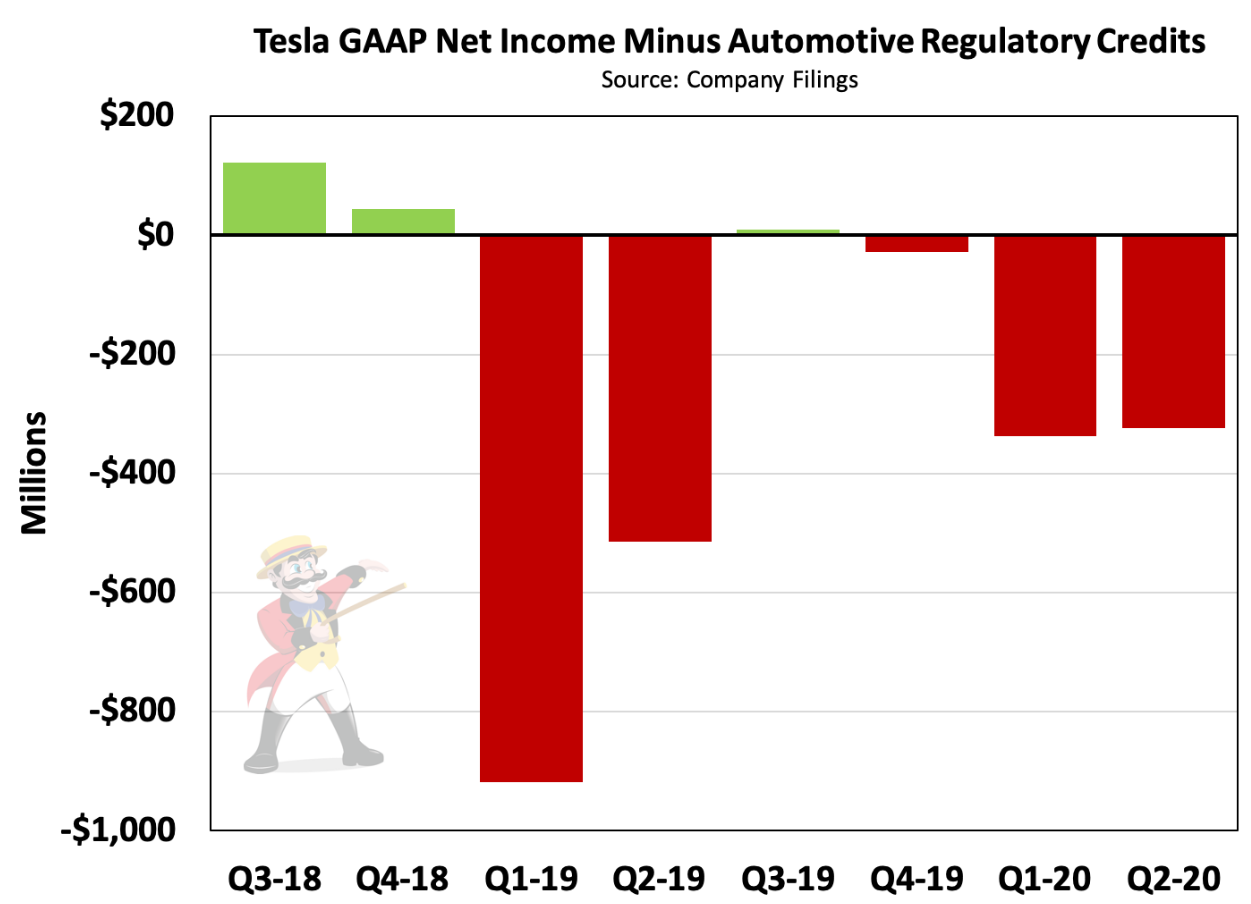
Without regulatory credit sales, as @TeslaCharts points out, it is a starkly different picture for Tesla's earnings:
Johnson wrote in his note that Tesla's CFO, Zach Kirkhorn, pointed out on the company's conference call that the ongoing sale of regulatory credits was not a guarantee going forward.
“We don't manage the business with the assumption that regulatory credits will contribute in a significant way to the future. Yeah, I do expect regulatory credit revenues to double in 2020 relative to 2019, and it will continue for some period of time, but eventually this stream of regulatory credits will reduce,” Kirkhorn said on the call.
Johnson also noted that in Q2, the company broke out its A/R distribution by segment for the first time:
That is, in 2Q20, TSLA, for the first time, disclosed that its accounts receivable ("A/R") distribution was segmented by: (1) $594mn - Regulatory Credits (40%), (2) $448mn - Auto Sales (30%), and (3) $448mn - Mystery (30%).
He then made note of the fact that there were tons of regulatory credit revenues still stuck in A/R. He thinks this is a result of revenue recognition engineering - or even Tesla possibly not selling the credits to begin with:

Stated differently, half of 1Q20, and all of TSLA's 2Q20 regulatory credit revenues are still in accounts receivable ("A/R"). So what's the big deal? Well, we interpret this as one of two things, namely: (1) TSLA sent a regulatory credit invoice to a customer and claimed it as revenue up-front (i.e., we'll give you a price break on the regulatory credits you are buying, and let you pay us at a later date when the credits are actually needed, if you "buy" the credits now - such a transaction would create a receivable), or (2) TSLA did not sell the credits to anyone. We see the former as the most likely scenario.
Reading the tea leaves, Johnson also notes that this was a key quarter to make numbers (S&P inclusion depended on it) and that the company immediately guided these credits lower and backed away from them for Q3:
Why? Well, when looking at TSLA's credit-revenue-per-car-sold by quarter 1Q18-2Q20, we notice a sharp spike in both 1Q20 and 2Q20. Furthermore, and also rather telling, coincidentally right after the quarter in which TSLA needed to achieve positive GAAP net income (i.e., 2Q20), its CFO is guiding 3Q20 regulatory credit sales to fall >50% QoQ (likely pushing the company back into deep losses) - at risk of stating the obvious, we see TSLA's 1H20 quarterly credit sales as highly arbitrary/managed/inorganic.
Recall, pre-earnings Johnson had predicted regulatory credit sales of $249 million.
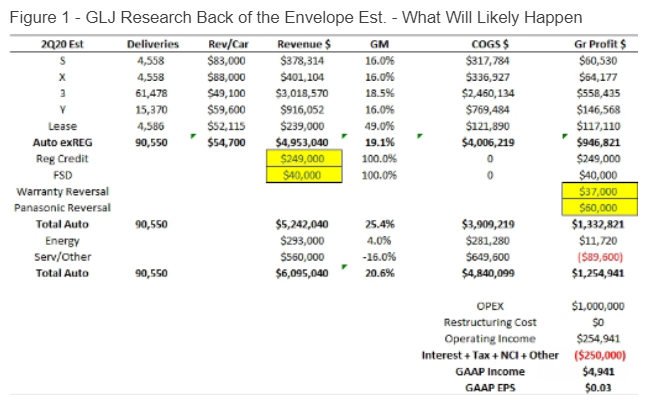
Johnson's conclusion post-earnings is that Tesla may have "pulled forward cashless/one-time regulatory credit sales based on cars Tesla may not have sold to people who have not paid for them, enabling 'goal-sought' 100% gross-margin 'paper' sales in order to be included in the S&P 500."
"We see this quarter's earnings as among the lowest in TSLA's history," he concluded.
For our full wrap-up of Tesla's earnings yesterday, you can view our write-up here.

FT : Tesla’s cash to be collected: redux

All seemed well with Tesla’s second-quarter earnings results released Wednesday night. The headlines, again, glowed — Tesla reported yet another positive GAAP earnings number, $400m of free cash flow and a slight dip in revenues when every other auto manufacturer has been crushed by coronavirus.

So was this the time the company proved the doubters wrong and delivered another clean profit from its automotive business to the market?

Well, not quite. Over 100 per cent of Tesla’s $327m operating profit in the quarter came from the sale of $428m of regulatory credits. As a reminder, these are the credits Tesla earns from the state incentive schemes when it sells electric cars, which it then flips to other auto manufacturers who need them to meet emissions standards. Without this windfall, Tesla’s core business of shifting souped-up go-karts to 1 percenters would have made a loss.

It wasn’t the only accounting funny. Morgan Stanley’s Adam Jonas, perhaps with a knowing smile, ran through a few more:

In our opinion, bears really would have to nit pick at the release to construct a materially negative narrative here. One could point to the unsustainable cuts to fixed costs during the quarter (ie. labour) that will not last, lower sequential ASPs [average sale prices], lower volume ex-China, help from software revenue (which btw — is that a bad thing?) or how regulatory credits accounted for roughly 400 per cent of 2Q GAAP profit, etc. We’re not suggesting these aren’t issues worth considering, but we don’t think they materially hit the quality of the quarter.

You’re right Adam, one could point to all these issues — but who cares with the stock taking on a life of its own?

That being said, we did get some clarity on one topic that has had Alphaville puzzled for some time now: Tesla’s accounts receivables balance.

You might recall that Greenlight Capital’s David Einhorn had a very public swing at Tesla back in December, and one of his bug bears was Tesla’s cash-to-be-collected.

Einhorn’s argument was simple. Tesla mainly receives cash from its customers when it delivers a vehicle to them. Therefore there shouldn’t be a significant amount of time between the revenue being recognised, and the cash arriving in Tesla’s coffers.

Yet, this doesn’t seem to be the case for Elon Musk’s company. Tesla has regularly run a net accounts receivable’s balance at around 20 per cent of revenues going back all the way to 2014:

In 2020’s second quarter, this figure was the second highest in the past six years — at 25 per cent of revenues, versus 21 and 18 per cent for the previous two quarters.

You’d expect to see accounts receivables scale with revenue growth, but this wasn’t the case. Tesla’s top line declined 5 per cent year-on-year, while its accounts receivables grew 30 per cent.

Despite being a classic red flag in accounting — as it suggests an aggressive approach to recognising revenues — a high accounts receivables balance isn’t, in and of itself, a problem if the company’s explanation is reasonable.

Yet Tesla’s explanations for the balance have changed more times than Thom Yorke’s haircut. In 2018’s third quarter, it was blamed on the period ending on a weekend. Then, in 2019’s third quarter, the finger was pointed at European banks being slow to transfer customer funds. Which, as we suggested at the time, didn’t make much sense.

In 2020’s first quarter, however, we got some further clarity from Tesla’s 10-Q:

As of March 31, 2020, one entity represented 10 per cent or more of our total accounts receivable balance, which was related to sales of regulatory credits.

So those pure profit regulatory credits that powered the second quarter’s earnings were at least part of the issue. But not all of it.

Helpfully though, we got some more colour from chief financial officer Zachary Kirkhorn on Wednesday evening’s conference call. From the transcript (provided by Sentieo):

A few things to note on working capital, particularly accounts receivable. While our AR balance is usually about 20 per cent of revenue, it can fluctuate depending upon a number of factors. First, overall, less than 30 per cent of our receivables is associated with new car sales. Second, due to payment terms associated with financing and enterprise customers, settlement times for certain methods of cash payments and geographic mix of our deliveries, our cash balance and associated receivables are impacted significantly by how many cars are delivered in the final weeks and days of the quarter. Third, roughly 40 per cent of the balance is attributed to payment terms on regulatory credit sales and statutory EV incentive programs, both of which have been increasing.

Mystery solved: “less than 30 per cent” of $1.5bn of receivables was related to car sales. Yet $500m — or 8 per cent of sales — still seems like a lot for a cash upfront business.

As for who owes the rest of the balance, especially with regards to the regulatory credits, we’re none the wiser. Hopefully we’ll find out when the 10-Q drops over the next fortnight.

FT : Dubai court freezes NMC founder Shetty’s assets

Dubai court freezes NMC founder Shetty’s assets
Injunction follows latest creditor move to recover funds from collapsed hospital operator

A Dubai court has issued a worldwide freezing order on the assets of NMC founder BR Shetty at the request of a Dutch bank, as creditors scramble to recover funds from the collapsed hospital operator.

Credit Europe Bank’s Dubai business has brought proceedings against NMC and Mr Shetty for non-payment of $8.4m in outstanding debt relating to a 2013 facility, according to recently unsealed court documents. It said roughly $25m in security cheques issued by Mr Shetty bounced.

The Indian entrepreneur argued he was not liable to repay because his signature in the lending agreements was forged and he never gave a personal guarantee or security cheques, the documents show — claims the bank disputed.

NMC was placed into administration in April as the healthcare group imploded amid accusations of fraud and the discovery of billions of dollars in unreported debt.

Mr Shetty has blamed the “serious fraud” on various former and current executives, claiming they used bank accounts in his name of which he had no knowledge.

The DIFC Courts’ injunction, issued in April, ordered Mr Shetty not to dispose of assets up to the value of $8.4m without the lender’s consent, pending resolution of the claim. But if Mr Shetty maintains that amount of unencumbered value within the Dubai International Financial Centre, he can sell other assets.

The order, which called on Mr Shetty to detail all his worldwide assets valued at more than $10,000, allows him to spend $7,000 a week on living expenses and “a reasonable sum” on legal advice and representation.

Credit Europe Bank Dubai, a trade and commodity finance specialist, referred to an accounting certificate placing Mr Shetty’s net wealth in May 2018 at $2.2bn after accounting for $120m in UAE loans.

The sum included $1.9bn in NMC shares, representing his then one-fifth stake that has since declined and is now likely to be worthless, along with $181m in UAE property, $121m of shares in his other companies and a luxury Mercedes car worth $885,000.

Europe Credit Bank did not respond to a request for comment. Lawyers for the parties were either unavailable or declined to comment. Mr Shetty and NMC’s administrators declined to comment.

The freezing order, made public months after it was implemented, complicates attempts by NMC’s administrators to keep the healthcare provider solvent during the pandemic.

Mr Shetty has also been hit with injunctions in Indian courts, including a claim for repayment from the Bank of Baroda.

Abu Dhabi Commercial Bank, which successfully pushed for NMC to go into administration, has also filed a criminal complaint in the UAE capital against several parties it claims were involved in the alleged fraud.

“One process would be easier,” said one person involved in the administration. “The various civil and criminal claims from banks muddy the waters.”

FT : Blackstone claws back pandemic investment losses

Blackstone claws back pandemic investment losses
Performance revenues a third lower than at end of 2019 as coronavirus takes economic toll

Blackstone clawed back some of the investment losses it incurred when the coronavirus hit financial markets earlier in the year, recording a swing in investment income to $1.6bn in the last quarter from a loss of $4.2bn the previous three months.

Chief executive Stephen Schwarzman called the results “a strong quarter for our firm despite the continued market volatility”.

“Investment performance rebounded sharply,” the billionaire financier said, adding that Blackstone “continued to deploy capital in high-conviction sectors” while adding to a war chest that has reached a record $156bn.

But the group’s dulled investment portfolio betrayed the economic damage wrought by the pandemic. Accrued performance revenues, which private equity groups book in anticipation of selling investments at a profit, are one-third lower than at the end of the last year — even after Blackstone added $595m to the inventory of expected spoils between April and June.

The seesawing investment performance of Wall Street’s biggest investment companies mirrors the trajectory of the US economy as the coronavirus affected millions of Americans, shutting large tracts of the economy, and triggered unprecedented action by central banks.

The huge spike in unemployment was initially reflected in asset markets, that reached a low-point in the penultimate week of March.

Since then, however, trillions of dollars of government stimulus, together with a promise by central banks to buy a widening range of virus-hit assets, have airbrushed some of the damage to asset valuations.

While that has helped shore up the value of Blackstone’s portfolio, asset sales have all but ground to a halt. Blackstone sold just $83m worth of assets in the second quarter, compared with four times that amount a year earlier. “In this kind of environment, it’s not a great time to sell assets,” Blackstone chief operating officer Jon Gray said in April.

Despite the shocks to its investments, Blackstone itself has enjoyed a steady stream of profits, recording net income of $1.4bn in the quarter, up from $647m in the preceding three months.

The group received $967m in management and advisory fees during the period — payments that add stability to quarterly earnings because they are typically fixed in advance and must be paid regardless of whether asset values rise or fall.

Blackstone also continued to garner fresh capital, with inflows of $20bn during the quarter. That continues a decade-long streak during which yield-starved investors have looked to alternatives managers to boost their returns. Total assets under management rose $26bn to $564bn.

BArrons : Were Tesla’s Earnings High or Low Quality? The Debate Rages On.

Bulls and bears continue to debate Tesla and its highflying stock. That won’t change after the latest stellar quarterly report from the electric-vehicle maker.

Even after Tesla (ticker: TSLA) smashed second-quarter earnings estimates, bears still question the quality of the results. They note, for instance, Tesla earns money from selling regulatory credits—earned by selling zero-emission vehicles—while also questioning accounting issues from accounts receivable to automotive leasing.

Do they have a point?

Zero Emission Vehicle, or ZEV, Credits
Tesla does sell a lot of regulatory credits—$428 million in the second quarter just reported. Over the past four quarters, Tesla has sold about $1 billion worth of credits. The company generated $1.2 billion in total operating income, including those emission-credit sales, over the same span.

Tesla Quarterly ZEV Credit Sales

Is that a problem? It is for the bears.

But bulls, as well as Tesla’s management, know emission-credit sales are coming. And Tesla‘s pricing has always been influenced by a variety of environmental incentives.

It’s also true that Tesla is receiving more emission-credit value per vehicle sold. Another potential problem. But the amount is approaching the fine of $5,000 per car that California, and other state regulators, have established for companies that don’t sell enough zero-emission vehicles. Auto makers buying credits from Tesla should just pay the fine if credit values exceed that amount.

Tesla Quarterly ZEV Credit Sales Per Vehicle Sold

Still, the amount recognized in a quarter doesn’t have to equal $5,000, or any other number. There are timing issues, as well as Tesla’s own need to bank credits.

There are also overseas credits earned by Tesla that are a function of different environmental laws. Fiat Chrysler (FCAU) and Tesla agreed to pool their European Union fleets around 2019 so Fiat could meet European emissions standards. Fiat said the deal would save the company up to $2.3 billion in potential fines. It’s real money.

There is a natural upward pressure on emission-credit values because emissions standards keep getting tighter. ZEV-type credits are just part of existing laws around the globe.

Emission credits will be a source of income for Tesla for a while. More EV sales by other auto manufacturers could hurt emission-credit values, but Tesla is still the largest generator of excess ZEV credits in the marketplace.

Accounting
ZEV credits aren’t the only source of controversy. Bank of America analyst John Murphy wrote Wednesday “creative accounting and presentation helps [Tesla] on a transitory basis.” He took a shot at the company’s accounting practices.

Car-lease revenue recognition, working capital management, warranty accrual, and timing of capital expenditures were four of five areas highlighted in his report. The fifth accounting area related to Solar City—Tesla’s solar-panel division—and transparency. Murphy would like more detail about Solar City’s performance.

It’s a lot for an investors to digest. Starting with working capital, cash management has improved at Tesla over the years. Tesla’s cash conversion cycle—which is roughly how long it takes to convert production into cash—has shortened. Cash conversion has ticked back up in recent quarters, but it isn’t close to prior peaks.

Tesla Cash Conversion Cycle

As for leasing, some of the practices Murphy questions stopped around 2018—Tesla adopted new procedures—and leasing sales as a percentage of total automotive sales is falling.

Tesla Leasing Sales As Percentage of Automotive Sales

Low or High Quality?
The charts above aren’t definitive when judging earnings quality. In fact, Barron’s isn’t going to answer the high or low quality earnings question. The market—like it or not for both bulls and bears—will sort it all out. In any case, business execution, rather than accounting choices, will determine the long-term direction of the stock price.

Murphy, for his part, rates shares the equivalent of Sell and has an $800 price target for the stock.

He isn’t a lone bear—15 out of 36 analysts covering Tesla stock rate shares at Sell. The average Sell-rating ratio for stocks in the Dow Jones Industrial Average is about 7%. The average price target among analysts is about $850, only a little above Murphy’s level—as well below where the stock trades currently. The entire Street struggles with Tesla’s valuation.

The bulls have had the upper hand on bears for a while. Tesla stock is up about 512% over the past year. The S&P 500, for comparison, is up about 9% over the same span.

Tesla shares were up about 4.6% to $1,665 in premarket trading, following the company’s earnings report.

BArrons : Bill Ackman’s Blank-Check Company Just Started Trading. What You Need

Bill Ackman’s Blank-Check Company Just Started Trading. What You Need to Know.
By Nicholas Jasinski

A special-purpose acquisition company, or SPAC, sponsored by Bill Ackman’s Pershing Square Capital Management, made its debut on the New York Stock Exchange on Wednesday in the largest-ever blank-check initial public offering. The offering includes 200 million units at $20 each, raising $4 billion in proceeds. Each unit consists of one common share and one-ninth of a warrant, exercisable at $23. Trading started at $21.10, and the units rose as high as $21.84 in the afternoon before falling to $21.26 at the close.

SPACs raise money from IPO investors, and then the cash sits in a trust until sponsors agree to a merger with an operating business. When the companies combine, SPAC shares convert to shares in the target, which goes public in the process. The market has seen a flood of SPAC IPOs and deals in 2020, and high-profile players getting involved. SPAC mergers have brought to market some of 2020’s hottest stocks, including Nikola (ticker: NKLA), DraftKings (DKNG), and Virgin Galactic Holdings (SPCE).

Ackman’s SPAC, Pershing Square Tontine Holdings, will initially trade under the ticker PSTH.U. Within a few months, the units will split and shares and warrants can be traded separately, under the symbols PSTH and PSTH.WS, respectively.

The SPAC will have even more cash at its disposal to pursue potential merger targets over the next two years. Pershing Square also has a forward purchase agreement to acquire between $1 billion and $3 billion of additional units at the time of an eventual combination. That means that Ackman, who is CEO of the SPAC, could have as much as $7 billion at his disposal.

Pershing Square Tontine Holdings intends to seek a minority position in a “private, large capitalization, high-quality, growth company,” according to its IPO filings. That includes “mature unicorns,” which are privately owned and possibly venture capital-backed tech companies that have ballooned to large valuations and moved past the peak loss-making stage of their growth. Some have suggested Airbnb and Palantir as possible targets in that mold. Large family-owned businesses are also potential targets. Bloomberg LP has been the most commonly cited name there.

In addition to Pershing Square Tontine Holdings’ massive size, the offering includes several innovations in SPAC terms. By convention, SPAC units tend to IPO at $10 each, and include a common share and a fraction of a warrant exercisable at $11.50—often one-half or as low as one-fifth, depending on the quality of the sponsor.

Ackman’s SPAC includes a “tontine” structure for its warrants, which refers to a type of annuity conceived in the 17th century. Income from the tontine’s pool is shared by all investors, and each individual’s share grows as others pass away. In addition to the 22,222,222 warrants issued at the time of Pershing Square Tontine Holdings’ IPO, another 44,444,444 warrants will be distributed to shareholders who choose to participate in the proposed deal.

At the time of a SPAC’s business combination, common stock can be redeemed for a proportionate share of a SPAC’s trust. That can sometimes leave SPACs without enough cash to complete agreed-upon mergers. By including the tontine terms for its warrants, Pershing Square Tontine Holdings is giving an extra incentive for shareholders to not redeem their shares. It believes that will give it better negotiating power with potential targets, and lead to a better deal.

IPO investors certainly appear interested. The now-$4 billion offering was upsized after first filing at an already record-breaking $3 billion last month.

FT : Publicis predicts advertisers’ Facebook boycott will continue

Publicis predicts advertisers’ Facebook boycott will continue
Shares rise sharply after ad group beats sales expectations despite pandemic

The head of Publicis, the world’s third-biggest advertising group by sales, has predicted that big brands will continue their boycott to press Facebook to root out hate speech but said it was too soon to tell whether the campaign would succeed.

“I don’t see it quietening down because I can see the determination . . . of our clients to make things change,” Arthur Sadoun, chief executive, said in an interview.

Since June, hundreds of big companies including Verizon, Unilever, Danone and Microsoft have paused marketing on the social network, joining a protest started by civil rights advocacy groups in the US amid the Black Lives Matter protests.

The boycott caused advertising spending on Facebook in North America to decline 32 per cent in the last two weeks of June, according to Social Bakers, a social media marketing company. Facebook is the second-biggest seller of online ads globally after Google, ahead of Alibaba and Amazon.

Asked whether the boycott would peter out as similar movements by advertisers in recent years have done, Mr Sadoun said: “The past does not lead me to be optimistic, but I want to be hopeful for the future.”

In 2018, some advertisers pulled spending after the Cambridge Analytica scandal exposed Facebook’s weak privacy controls, while Google’s YouTube video site has faced separate boycotts in protest at extremist and child exploitation content.

The Facebook boycott comes as big companies are cutting back on their marketing spending to cope with the global recession brought on by Covid-19. Magna, a market forecaster owned by Interpublic Group, has predicted that global advertising spending will fall by 12.8 per cent this year, to $144bn.

The downturn translated into a 13 per cent decline in like-for-like sales, on revenue of €2.3bn, in the three months to the end of June. However, analysts had expected a 20 per cent like-for-like contraction and sales of €2.2bn, according to a consensus of estimates compiled by the company.

Julien Roch, analyst at Barclays, wrote in note that the results were “far far ahead of expectations, adding: “Since the market started rallying, Publicis has underperformed by 12 per cent, which, in our view, is unwarranted based on these very strong results.”

Publicis shares rose as much as 15 per cent in Thursday morning trading to €30.85, before paring some of the gain to reach €30.20.

The steepest sales decline came in Europe, where like-for-like revenue dropped 23.5 per cent to €510m. In North America it fell 7.6 per cent to €1.5bn and in Asia decreased 5.7 per cent to €215m.

Net income in the second quarter fell by 10 per cent to €417m, despite a cost-cutting drive that squeezed out nearly €286m in savings from a recruitment freeze, elimination of freelance work and other cuts to general expenses.

Publicis did not give any financial guidance for the second half of the year because of the uncertainty stemming from the pandemic.

Mr Sadoun said the group’s “strong fundamentals” would help it weather the crisis. He added that it was being helped by its stronger US business, which accounts for 60 per cent of sales and where it has won new clients such as beauty retailer Sephora. Like-for-like sales in the US fell by only 6.8 per cent in the second quarter, better than the 18 per cent decline that forecasters had predicted.

Publicis is the first major ad agency to report second-quarter results at a time when the sector has been largely left out of recent stock market rallies. Sector leader WPP’s shares have fallen 42 per cent this year to Friday’s open, while the second-biggest player, US-based Omnicom, has fallen 32 per cent, while Interpublic’s are down 23 per cent.

>>> US Gapping down

Gapping down
In reaction to disappointing earnings/guidance
:

  • TRN -6.4%, ALGN -4.1%, KMI -3.2%, DGX -2.6%, DFS -2%, CMG -1.7%, SUI -1.7%, MSFT -1.5%, ALLE -1.4%, CSX -1%, SU -0.9%, GGG -0.9%, DOW -0.8%, CNS -0.7%, ADS -0.7%, STL -0.6%, TECK -0.6%, RS -0.6%

Other news:

  • LLNW -9.1% (prices offering of $110 mln of 3.50% convertible senior notes due 2025)
  • JMIA -8.8% (files for company ADS offering and offering by selling shareholder)
  • AUPH -7.3% (prices offering of 13,333,334 common shares at $15.00 per share)
  • QIWI -2.7% (cancels stock offering)

Analyst comments:

  • KHC -1.3% (downgraded to Sell from Neutral at Guggenheim)
  • HCSG -1% (downgraded to Neutral from Outperform at Robert W. Baird)
  • HSBC -0.6% (downgraded to Underperform from Neutral at Credit Suisse)

>>> US Gapping up

In reaction to strong earnings/guidance:

  • BCOV +17.6%, NTGR +10.8%, PLXS +10.5%, MTH +9.8%, AN +8.7%, HZO +8.1%, UFPI +7.7%, UN +7.5%, EFX +5.4%, TWTR +5.4%, HNI +5.1%, CLB +4.7%, ECHO +4.4%, WST +4.4%, GTLS +4.2%, PHM +4%, ENTG +3.8%, POOL +3.7%, WHR +3.4%, STM +3.1%, GL +3%, TSLA +2.9%, DHR +2.8%, TSCO +2.8%, PNR +2.8%, PTEN +2.7%, KMB +2.4%, HBAN +2.3%, HRI +2.2%, HSY +2.2%, CLGX +2.2%, VMI +2.1%, TRV +1.8%, CTXS +1.7%, UMPQ +1.5%, T +1.2%, SAVE +1.1% (also announces stock offering), WSO +1.1%, AAL +1%, FCX +1%

Other news:

  • BXG +16.3% (declares special dividend)
  • AMAG +11.7% (enters into exclusive licensing agreement for ciraparantag in Europe, Australia, and New Zealand with Norgine B.V.) KLDO +7.7% (initiates a controlled clinical study (K032) being conducted with Massachusetts General Hospital, evaluating KB109 added to Supportive Self-Care for outpatients with mild-to-moderate COVID-19)
  • YCBD +6% (extending its Official CBD marketing partnership with Bellator MMA)
  • BCLI +5.9% (completes first milestone in developing exosome-based platform technology for the treatment of severe COVID-19 infection)
  • OMC +3.2% (in sympathy with advertising peer Publicis - reported better than expected results in EU)
  • WPP +1.6% (in sympathy with advertising peer Publicis - reported better than expected results in EU)
  • BRKL +1.2% (files for $200 mln mixed securities shelf offering)
  • BNTX +1.2% (upsizes offering by 500k shares and prices 5.5 mln ADSs at $93.00 per ADS)
  • INCY +1% (announces that Phase 3 REACH3 ruxolitinib trial met primary and key secondary endpoints)

Analyst comments:

  • GNFT +4.2% (upgraded to Buy from Hold at Stifel)
  • BLMN +2.5% (upgraded to Neutral from Underperform at BofA Securities)
  • SRDX +2% (upgraded to Buy from Hold at Needham)
  • APA +1.9% (upgraded to Overweight from Neutral at JP Morgan)
  • MRO +1% (upgraded to Overweight from Neutral at JP Morgan)
  • TXN +1% (upgraded to Buy from Hold at DZ Bank)

>>> US Early premarket gappers

Early premarket gappers

  • Gapping up:
    • BCOV +17.7%, BXG +12.1%, PLXS +10.5%, NTGR +9.8%, UN +7.6%, UFPI +7.4%, MTH +6.7%, EFX +5.4%, TSLA +5.3%, PHM +5.2%, HNI +5.1%, ENTG +5.1%, TSCO +4.8%, ECHO +4.4%, STM +3.5%, GL +3%, CLB +2.9%, PTEN +2.7%, WST +2.6%, VMI +2.1%, DHR +2.1%, FITB +1.7%, WHR +1.6%, DOW +1.6%, HRI +1.6%, UMPQ +1.5%, GTLS +1.5%, LUV +1.5%, BRKL +1.2%, NYT +0.8%, BNTX +0.8%
  • Gapping down:
    • AUPH -7.6%, JMIA -6.6%, TRN -5.4%, LLNW -5.1%, SLM -3.7%, MSFT -2.4%, CSX -2.4%, SU -2.2%, ALGN -1.7%, KMI -1.3%, QIWI -1.1%, CMG -1.1%, GGG -0.9%, COP -0.8%, CNS -0.7%, STL -0.6%, TECK -0.6%, LVS -0.5%