Reuters - Israel coronavirus cases top 60,000 as infections jump

Israel coronavirus cases top 60,000 as infections jump

JERUSALEM (Reuters) - The number of people to test positive for coronavirus in Israel topped 60,000 on Saturday as the government struggles to contain a resurgence in infection rates.

The latest daily tally showed 1,770 new infections, bringing the total number of cases to 60,496, the country’s health ministry reported.

With a population of 9 million, Israel has reported a total of 455 fatalities from the pandemic.

Israel was one of the first countries to impose a nationwide lockdown and initially was successful in clamping down on the outbreak. Daily cases that numbered in the hundreds dropped to low double digits.

Concerned about the economic toll, the government eased those restrictions - too quickly, some officials have since acknowledged - and infection rates resurged.

Renewed sporadic closures of various sectors of the economy have deepened public vexation, sparking daily demonstrations.

NY Post : Carlos Ghosn’s son sent $500K in bitcoin to American in escape effort:

Carlos Ghosn’s son sent $500K in bitcoin to American in escape effort: feds

Carlos Ghosn’s son sent about $500,000 in bitcoin earlier this year to one of the Americans accused of helping the ex-Nissan CEO flee house arrest, according to the feds.

Anthony Ghosn made the cryptocurrency payments over about four months to Peter Taylor after he and his father — former Green Beret Michael Taylor — allegedly ferried Carlos Ghosn from Tokyo, where he was facing criminal charges, to Lebanon where he is from, federal prosecutors said in a Wednesday court filing.

The feds cited the money as evidence that the Taylors should remain behind bars while they await extradition to Japan over their alleged role in the escape, given that they “now have access to Ghosn’s vast resources with which to flee.”

Anthony Ghosn sent the first payment on Jan. 21, less than a month after the Taylors allegedly carried out the complex caper, which captured attention worldwide, according to records the feds obtained from Coinbase, a digital currency exchange. The last payment worth more than $100,000 arrived on May 15 — five days before the father-son duo was arrested, the records show.

Carlos Ghosn himself wired nearly $900,000 to a company controlled by Peter Taylor leading up to the escape operation last year, prosecutors alleged earlier this month.

Prosecutors detailed the bitcoin payments in response to a lawsuit the Taylors filed asking a judge to release them from jail while Japan tries to extradite them on allegations that they helped Carlos Ghosn skip bail while he was awaiting trial on financial-crime charges. Ghosn, 66, has denied the criminal allegations and said he fled “persecution.”

In arguing against the Taylors’ release, the feds said they own a home and have been expanding their business in Lebanon, where Ghosn has been camped out since December. Lebanon does not have an extradition treaty with Japan.

“Petitioners can remain comfortably in Lebanon for an indefinite period of time to avoid the justice systems of Japan and the United States,” prosecutors said in the filing.

An attorney for the Taylors declined to comment Friday. A hearing in their lawsuit is scheduled for Tuesday morning.

>>> Weekend Papers Summary

Weekend Papers Summary
NEW YORK TIMES
Saturday
• The Centers for Disease Control and Prevention issued a call to reopen schools in a statement that aligned with Trump’s pressure on cities and states to end lockdowns, listing numerous benefits of being in school and downplaying the potential health risks.
• In Latin America, where authorities have been unable to control the coronavirus pandemic and where few people can afford quality medical care, interest is growing in dubious medicines such as chlorine dioxide, touted as cures for the virus.
• Several progressive challengers upset entrenched incumbents in the New York Legislature in the recent Democratic primary, cementing their movement’s influence in Albany and making it likely that the state government will become one of the most liberal in the nation.
• Trump signed several executive orders Friday targeting the high price of prescription drugs, including a tentative plan to link the price that Medicare pays for some drugs to the low prices that foreign countries pay, but major changes aren’t likely to occur anytime soon.
• The Trump administration is bypassing an arms control deal to sell large, armed drones to countries such as Saudi Arabia and the United Arab Emirates, but arms control officials and lawmakers trying to limit the proliferation of such drones oppose the move.
• The Trump administration is pressing forward with policies limiting transgender rights, even though many rules that have been in development for years have now either been finalized or have gone into effect.
• American intelligence officials warned that China, Russia, and Iran are expanding their influence in the US ahead of the presidential election, but Democrats briefed on the matter said the threat was far more urgent than what the administration described.
• The Dodd-Frank financial law succeeded at making banks safer, but empowered shadowy corners of finance—such a class of hedge funds that had been caught on the wrong side of a trade with ample risks—that nearly wrecked the system in March.
• As the back-to-school season approaches this year, 16 states are temporarily exempting clothing, shoes, notebooks, and other school supplies, sometimes including computers, from state, and often local, sales taxes.
Sunday
• The US and China are dismantling decades of political, economic, and social engagement, setting the stage for a new era of confrontation shaped by the most hawkish voices on both sides—cementing what the Trump administration hopes to be one of its key legacies; related story says the US-China trade deal is providing a rare point of stability as relations between the countries fray over Hong Kong, the coronavirus, and accusations of espionage.
• Across the pharmaceutical and medical industries, senior executives and board members of companies developing coronavirus vaccines are making millions of dollars selling shares that go up after the companies announce positive developments.
• North Korea said it had locked down a city near its border with South Korea and declared a “maximum” national emergency after finding what its leader, Kim Jong-un, said could be the country’s first case of COVID-19 there.
• The Global Antitrust Institute—part of the law school at George Mason University and bankrolled in large part by tech companies such as AMZN, GOOGL, and QCOM—promotes the belief that the best way to foster competition is to maintain a hands-off approach to antitrust law.
• Despite the stock market’s distaste for the prospect of a Democratic presidential victory, stocks could prosper if Joe Biden wins in November according to a new analysis by Bank of America Global Research, with the coronavirus and trade likely to be two major factors in the outcome.

WALL STREET JOURNAL
Weekend
• In a diplomatic dust-up that coincides with Washington’s tougher rhetoric toward Beijing, the US and China each moved Friday to shut one of the other’s consulates and evict diplomats, unprecedented steps that were followed by calls on both sides to ease rising tensions.
• The US has appeared increasingly multiracial in recent decades partly because since 2000 residents have been able to check off more than one race on the decennial census, but the resulting data has brought confusion as well as clarity to the question of just how blended America is.
• The US economy lagged in July and Europe’s bounced back, according to fresh surveys of purchasing managers, evidence that the two economic powerhouses are recovering at different speeds from the coronavirus pandemic.
• A federal judge denied a temporary injunction sought by Oregon’s top law-enforcement officer, handing the Trump administration a victory in a legal battle over its deployment of federal agents to Portland.
• US Immigration and Customs Enforcement said on Friday that newly enrolling international students won’t be allowed to come to America if their courses will be taught entirely online, but that they won’t be forced to leave if in the fall a hybrid system reverts to fully remote.
• Scientists are developing a clearer picture of the extra risk of dying from COVID-19 borne by those with underlying health conditions, an aspect of the disease that researchers say might help explain why some countries—including the US—suffer worse outbreaks than others.
• Millions of people that are out of work because of the pandemic have become day traders chasing stock market returns—a boon for firms such as ETFC and Robinhood Markets—and some of these retail investors are gaining influence in financial markets.
• Former Bridgewater Associates co-chief executive officer Eileen Murray filed a lawsuit against the firm alleging it is withholding an estimated $20-100M million in deferred compensation because she disclosed her gender-discrimination dispute.
• As the work-from-home trend continues, cracks are starting to emerge—some employers say their workers appear less connected, and bosses fear that younger professionals aren’t developing at the same rate as they would in offices where they can learn from and teach their colleagues.
• H.O.T.S.: Schools adopting online or even hybrid models will make it impossible for millions of parents to work, adding further strain to the economy; Leading oil-field-services companies HAL, BKR, and SLB have quickly confronted their new reality and are ruthlessly cutting costs; The pandemic has hurt property-and-casualty insurers, but people sheltering at home also benefits them.

FINANCIAL TIMES
Weekend
• Front page story reports on the $3.9B settlement GS struck with Malaysia over losses the country suffered in a corruption scandal when billions of dollars were plundered from state investment fund 1MDB, ending a fraught legal battle.
• Renowned short seller Jim Chanos made almost $100M betting against fraudulent German payments company Wirecard, executing the trade across several of his firm’s funds, according to insiders.
• Germany’s finance ministry announced a sweeping reform of financial regulation in the country in the wake of the Wirecard scandal as authorities face growing pressure about their failure to detect fraud at the payments company.
• The pandemic appears to be sidelining efforts by governments and consumers to reduce plastic waste, especially with a huge spike in demand for personal protective gear, which “is the tip of a mountain of toxic plastic waste” that must be dealt with.
• Big Read piece on the European Union recovery fund says that “As the coronavirus pandemic spread in Italy in March, many in the country felt the EU had abandoned them, but with a historic budget deal this week that expands its powers, Brussels hopes to heal the divide.”
• Lex Column: Generating power and selling it are two different things—which explains NRG’s $3.6B bid for Centrica, which should double the size of its retail customer base; The luxury industry depends on two factors: travel and Chinese demand, and growth could be stunted if either or both remain stalled; Despite eye-catching top-line growth and fat margins, dairy alternative Oatly remains a lossmaking company.
• Comment: US efforts to bring China’s tech juggernaut to a halt will likely fail, says James Kynge. The country’s tech companies are backed by ample state resources, and are world leaders in 5G, high-speed rail, digital payments, some areas of artificial intelligence, and other fields.

NEW YORK POST
Saturday
• The House Judiciary Committee’s antitrust panel could release its report on antitrust allegations against four of the country’s largest tech juggernauts by late summer or early fall, according to aides.
• MSFT has partnered with the National Basketball Association to put “virtual” fans in the stands of each game the league plays after resuming a season that was interrupted by the coronavirus.
Sunday
• Former Nissan chairman Carlos Ghosn’s son sent about $500K in Bitcoin earlier this year to one of the Americans accused of helping the executive flee house arrest in Japan, according to federal officials.
• Hurricane Hanna, the first storm of the hurricane season, has reached the southern tip of Texas in Padre Island, just off the Gulf of Mexico, according to the National Weather Service.
Barrons : A Danish Energy Giant Has Switched to Wind Farms. Its Stock Is Blowing

Weekend Papers Summary
NEW YORK TIMES
Saturday
• The Centers for Disease Control and Prevention issued a call to reopen schools in a statement that aligned with Trump’s pressure on cities and states to end lockdowns, listing numerous benefits of being in school and downplaying the potential health risks.
• In Latin America, where authorities have been unable to control the coronavirus pandemic and where few people can afford quality medical care, interest is growing in dubious medicines such as chlorine dioxide, touted as cures for the virus.
• Several progressive challengers upset entrenched incumbents in the New York Legislature in the recent Democratic primary, cementing their movement’s influence in Albany and making it likely that the state government will become one of the most liberal in the nation.
• Trump signed several executive orders Friday targeting the high price of prescription drugs, including a tentative plan to link the price that Medicare pays for some drugs to the low prices that foreign countries pay, but major changes aren’t likely to occur anytime soon.
• The Trump administration is bypassing an arms control deal to sell large, armed drones to countries such as Saudi Arabia and the United Arab Emirates, but arms control officials and lawmakers trying to limit the proliferation of such drones oppose the move.
• The Trump administration is pressing forward with policies limiting transgender rights, even though many rules that have been in development for years have now either been finalized or have gone into effect.
• American intelligence officials warned that China, Russia, and Iran are expanding their influence in the US ahead of the presidential election, but Democrats briefed on the matter said the threat was far more urgent than what the administration described.
• The Dodd-Frank financial law succeeded at making banks safer, but empowered shadowy corners of finance—such a class of hedge funds that had been caught on the wrong side of a trade with ample risks—that nearly wrecked the system in March.
• As the back-to-school season approaches this year, 16 states are temporarily exempting clothing, shoes, notebooks, and other school supplies, sometimes including computers, from state, and often local, sales taxes.
Sunday
• The US and China are dismantling decades of political, economic, and social engagement, setting the stage for a new era of confrontation shaped by the most hawkish voices on both sides—cementing what the Trump administration hopes to be one of its key legacies; related story says the US-China trade deal is providing a rare point of stability as relations between the countries fray over Hong Kong, the coronavirus, and accusations of espionage.
• Across the pharmaceutical and medical industries, senior executives and board members of companies developing coronavirus vaccines are making millions of dollars selling shares that go up after the companies announce positive developments.
• North Korea said it had locked down a city near its border with South Korea and declared a “maximum” national emergency after finding what its leader, Kim Jong-un, said could be the country’s first case of COVID-19 there.
• The Global Antitrust Institute—part of the law school at George Mason University and bankrolled in large part by tech companies such as AMZN, GOOGL, and QCOM—promotes the belief that the best way to foster competition is to maintain a hands-off approach to antitrust law.
• Despite the stock market’s distaste for the prospect of a Democratic presidential victory, stocks could prosper if Joe Biden wins in November according to a new analysis by Bank of America Global Research, with the coronavirus and trade likely to be two major factors in the outcome.

WALL STREET JOURNAL
Weekend
• In a diplomatic dust-up that coincides with Washington’s tougher rhetoric toward Beijing, the US and China each moved Friday to shut one of the other’s consulates and evict diplomats, unprecedented steps that were followed by calls on both sides to ease rising tensions.
• The US has appeared increasingly multiracial in recent decades partly because since 2000 residents have been able to check off more than one race on the decennial census, but the resulting data has brought confusion as well as clarity to the question of just how blended America is.
• The US economy lagged in July and Europe’s bounced back, according to fresh surveys of purchasing managers, evidence that the two economic powerhouses are recovering at different speeds from the coronavirus pandemic.
• A federal judge denied a temporary injunction sought by Oregon’s top law-enforcement officer, handing the Trump administration a victory in a legal battle over its deployment of federal agents to Portland.
• US Immigration and Customs Enforcement said on Friday that newly enrolling international students won’t be allowed to come to America if their courses will be taught entirely online, but that they won’t be forced to leave if in the fall a hybrid system reverts to fully remote.
• Scientists are developing a clearer picture of the extra risk of dying from COVID-19 borne by those with underlying health conditions, an aspect of the disease that researchers say might help explain why some countries—including the US—suffer worse outbreaks than others.
• Millions of people that are out of work because of the pandemic have become day traders chasing stock market returns—a boon for firms such as ETFC and Robinhood Markets—and some of these retail investors are gaining influence in financial markets.
• Former Bridgewater Associates co-chief executive officer Eileen Murray filed a lawsuit against the firm alleging it is withholding an estimated $20-100M million in deferred compensation because she disclosed her gender-discrimination dispute.
• As the work-from-home trend continues, cracks are starting to emerge—some employers say their workers appear less connected, and bosses fear that younger professionals aren’t developing at the same rate as they would in offices where they can learn from and teach their colleagues.
• H.O.T.S.: Schools adopting online or even hybrid models will make it impossible for millions of parents to work, adding further strain to the economy; Leading oil-field-services companies HAL, BKR, and SLB have quickly confronted their new reality and are ruthlessly cutting costs; The pandemic has hurt property-and-casualty insurers, but people sheltering at home also benefits them.

FINANCIAL TIMES
Weekend
• Front page story reports on the $3.9B settlement GS struck with Malaysia over losses the country suffered in a corruption scandal when billions of dollars were plundered from state investment fund 1MDB, ending a fraught legal battle.
• Renowned short seller Jim Chanos made almost $100M betting against fraudulent German payments company Wirecard, executing the trade across several of his firm’s funds, according to insiders.
• Germany’s finance ministry announced a sweeping reform of financial regulation in the country in the wake of the Wirecard scandal as authorities face growing pressure about their failure to detect fraud at the payments company.
• The pandemic appears to be sidelining efforts by governments and consumers to reduce plastic waste, especially with a huge spike in demand for personal protective gear, which “is the tip of a mountain of toxic plastic waste” that must be dealt with.
• Big Read piece on the European Union recovery fund says that “As the coronavirus pandemic spread in Italy in March, many in the country felt the EU had abandoned them, but with a historic budget deal this week that expands its powers, Brussels hopes to heal the divide.”
• Lex Column: Generating power and selling it are two different things—which explains NRG’s $3.6B bid for Centrica, which should double the size of its retail customer base; The luxury industry depends on two factors: travel and Chinese demand, and growth could be stunted if either or both remain stalled; Despite eye-catching top-line growth and fat margins, dairy alternative Oatly remains a lossmaking company.
• Comment: US efforts to bring China’s tech juggernaut to a halt will likely fail, says James Kynge. The country’s tech companies are backed by ample state resources, and are world leaders in 5G, high-speed rail, digital payments, some areas of artificial intelligence, and other fields.

NEW YORK POST
Saturday
• The House Judiciary Committee’s antitrust panel could release its report on antitrust allegations against four of the country’s largest tech juggernauts by late summer or early fall, according to aides.
• MSFT has partnered with the National Basketball Association to put “virtual” fans in the stands of each game the league plays after resuming a season that was interrupted by the coronavirus.
Sunday
• Former Nissan chairman Carlos Ghosn’s son sent about $500K in Bitcoin earlier this year to one of the Americans accused of helping the executive flee house arrest in Japan, according to federal officials.
• Hurricane Hanna, the first storm of the hurricane season, has reached the southern tip of Texas in Padre Island, just off the Gulf of Mexico, according to the National Weather Service.

Barrons : A Danish Energy Giant Has Switched to Wind Farms. Its Stock Is Blowing

A Danish Energy Giant Has Switched to Wind Farms. Its Stock Is Blowing Higher.

Danish energy giant Ørsted is shifting from oil and gas to become the world’s biggest developer of wind farms.

The power firm, which is listed on Nasdaq Copenhagen and develops, builds, owns, and operates wind farms, has seen its shares rise from 252 Danish kroner ($38) in 2016 to DKK915. The stock is up about 32% in 2020.

The stock (ticker: ORSTED.Denmark) could blow higher on the back of coronavirus as countries rebuild their economies in more environmentally focused ways. The European Union’s 750 billion euro rescue deal agreed on July 21 includes some requirements to expand the green economy.

Ørsted is also partway through a $30 billion investment plan to move away from fossil fuels to become one of the few future renewables majors. The Danish state holds a 50.1% stake in the company.

The Covid-19 crisis could boost Ørsted as its more challenged and leveraged rivals pull out of bids for renewables projects, wrote John Musk, an analyst at RBC Capital Markets, in a report this month.

Subsidies introduced by different countries that encourage a shift to green energy could also boost the firm, with Japan and Poland likely to announce details of their subsidy regimes later this year.

Tom Erik Kristiansen, an analyst at Norwegian investment bank Pareto Securities, rates the stock a Buy.

“The world’s most sustainable company will continue to deliver profitable growth ahead of its own guidance and market expectations,” he wrote in a July note.

“We see upside risk to our current win-rate and profitability assumptions, which if realized could lift the share price to above DKK1,000/share over the next couple of years,” he wrote.

The business, which employs 6,600 workers and is valued at DKK321 billion ($48 billion), fetches 46.6 times this year’s expected earnings and is valued at a 10% discount to its peers.

In January, it posted an annual pretax profit of DKK8.8 billion in 2019, down from DKK23 billion in 2018, when it benefited from a one-off gain in selling a United Kingdom wind farm. Sales for 2019 were DKK67.8 billion.

CEO Henrik Poulsen, who announced plans to step down, said in a statement, “Ørsted maintains a leading position in the global high-growth market for green energy.” He added, “We are well on track to deliver on our financial targets of 20% average growth in profits from operating renewable assets for the period 2017-23.”

Dansk Olie og Naturgas was founded in 1972 and generated 85% of its energy from coal and oil, and 15% from renewables. In 2009, it committed to switching this over a 30-year period. In 2017, it divested its oil and gas assets and changed its name to Ørsted—after Hans Christian Ørsted, one of Denmark’s best-known scientists and innovators. Last year, the company announced that it had achieved its switching goal 20 years early. It now has a 30% market share and producing assets in five countries, with six onshore wind farms in the U.S. and 12 in the U.K.

It has a strong balance sheet, with liquidity of DKK30 billion, and it benefits from a raft of future contracts that have already secured 80% of the estimated earnings before interest, taxes, depreciation, and amortization, or Ebitda, from 2020 to 2040. These earnings are protected by fixed-price contracts with governments in developed markets or large corporations, according to Kristiansen.

Substantial cost reductions have made offshore wind more cost competitive, and gave governments the incentive to increase capacity ambitions, he said.

If Ørsted continues to deliver under new leadership, its shares could have the wind at its back.

WSJ : A Big Unknown in Covid-19 Vaccine Development: How Long Will Protection La

A Big Unknown in Covid-19 Vaccine Development: How Long Will Protection Last?
Early trials suggest vaccines can induce antibody production, but it is too early to know how long they will work

If any of the most-advanced Covid-19 vaccines prove to work safely, they may protect people for months or years rather than the rest of their lives, according to emerging science and health experts.

Only a handful of vaccines generate lifetime immunity for most people, such as the ones for measles, a viral infection that naturally produces lifelong immunity. Experts caution against expectations of such longevity for Covid-19, citing experience with other respiratory viruses plus emerging data on the longevity of the antibodies that can prevent the virus from entering human cells and replicating.

To fill in knowledge gaps on vaccine duration, researchers and vaccine developers are looking closely at emerging science of immune responses in recovered patients, and how that science can be applied to vaccine development. They are also looking at previous coronaviruses and harnessing vaccine technologies that have worked against other viruses.

“Unfortunately, the questions of duration and immunity do take time to uncover,” said Philip Dormitzer, viral vaccine R&D chief for Pfizer Inc., which is developing a vaccine candidate with partner BioNTech SE.

Vaccine-makers usually learn how long a shot protects during a second-phase study in hundreds of patients that may require months or years to complete. However, to save time for Covid-19 vaccines, trial phases are being compressed or combined, so less is known about durability near the end of the testing process than normal.

The first Covid-19 vaccine study is expected to be completed in the fall, but scientists don’t have the luxury to wait until the science is settled, or at least better understood. An emergency authorization by regulators could come before duration is known. Trials are progressing as natural-immunity studies are rapidly pouring in from labs onto online servers and the pages of scientific journals.

Francis Collins, director of the National Institutes of Health, said it would be hard to know whether a Covid-19 vaccine protects for a year after testing it for only a few months, but he said recovered patients who don’t become reinfected after a year “would be a good sign that the vaccine ought to work” for at least that long.

A growing number of studies suggest most patients mount a robust immune response, including producing antibodies or other molecular defenses, to fight the virus after infection. One preliminary study from Mount Sinai in New York of nearly 20,000 people with suspected or confirmed Covid-19 found most had moderate or high levels of antibodies.

These findings are mirrored by preliminary results of experimental vaccines developed by Moderna Inc., MRNA -2.81% Pfizer Inc. and Oxford University that produced an immune response, which experts said is encouraging for the viability of vaccine candidates.

What remains unclear is how long natural defenses last and whether they protect people against reinfections—information that can be applied to understanding vaccine duration.

“For me, it’s the most important question in the field,” said Lynda Stuart, deputy director of vaccine development at the Bill & Melinda Gates Foundation.

Other early research suggests antibodies against SARS-CoV-2, the coronavirus that causes Covid-19, decline in some patients roughly two to three months after the onset of symptoms. A preliminary study of 65 patients posted online by U.K. scientists this month found that neutralizing antibodies, those that would prevent the virus from entering cells and replicating, declined over a 94-day period in experiments.

In a small study, Moderna’s vaccine increased neutralizing antibodies, especially during the two weeks after the second dose. But by four weeks after the second dose, those antibody levels had declined somewhat, though they were still elevated compared with the start of the study.

When the Mount Sinai researchers called back roughly 120 participants three months after they first got sick, most had antibodies, though they had waned a bit.

“That’s not unexpected,” noted Ania Wajnberg, an associate professor of internal medicine at Mount Sinai and lead author of the study. “Your body doesn’t need as many antibodies when it’s not sick anymore.”

That antibodies remain suggests even mild disease could induce a strong antibody response, raising hopes that a vaccine would be able to do the same, she said. Most patients in the study weren’t hospitalized and had mild to moderate Covid-19.

Moderna Chief Medical Officer Tal Zaks said it is too early to make any conclusions about durability based on the first study. Still, he said some of the company’s other experimental mRNA-based vaccines for other diseases have induced immune responses that last for months, though some decline over time.

Data doesn’t yet exist on whether antibodies or T-cells, which recognize and eliminate infected cells, will be more important for long-term protection against Covid-19, experts said. In a study published in the journal Nature this month, researchers found that patients who recovered from SARS and Covid-19 had T-cells that could recognize a SARS-CoV-2 protein.

Candidates from Pfizer, Moderna and Oxford all have shown some level of T-cell response.

Both Moderna and Pfizer are tracking volunteers to see how long immunity responses last. Their vaccines are slated to begin separate 30,000-person trials this month.

Oxford researchers said that the duration of its potential vaccine is currently unknown, but it is conducting studies to learn more about how long protection might last.

Experts also say Covid-19 vaccines may be easier to develop because SARS-CoV-2 appears to mutate less frequently than influenza, another RNA-based respiratory virus whose seasonal shifts have made an effective vaccine for the broad population elusive.

Some vaccines in development rely on technology that successfully boosted antibodies for other diseases for at least a year.

A candidate under development by Merck MRK -1.23% & Co. and nonprofit International AIDS Vaccine Initiative uses the same technology as its Ebola vaccine, which has shown in studies to provide protection from Ebola and generate antibodies that are maintained for at least three years. Human testing is expected to start later this year, said Nick Kartsonis, who oversees vaccine clinical research at Merck.

Johnson & Johnson’s JNJ -1.00% candidate, expected to start human testing this month, is using the same technology as its experimental shot against the Zika virus, which was able to generate elevated antibody levels for more than a year.

How well any vaccine stacks up against one another is a critical question, given the varying risk among some populations, experts said.

“It’s important to do a head-to-head trial…That to me is the biggest thing I want to know and am concerned about,” said Stanley Perlman, a University of Iowa coronavirus researcher. “We don’t know which part of the immune response will be induced best by each of these vaccines.”

WSJ : At Boeing and Airbus, Finished Airplanes Pile Up

At Boeing and Airbus, Finished Airplanes Pile Up
Airlines are putting off jet deliveries amid coronavirus, depriving manufacturers and their suppliers of cash

Boeing Co. BA -1.52% and Airbus SE EADSY -0.75% are making planes that airlines aren’t collecting, straining their finances as the coronavirus pandemic wreaks havoc on travel and the aerospace industry.

Airlines in many cases say they don’t want the aircraft for now, because they are unable to fill them profitably during a historic plunge in demand for flying. Travel restrictions are also hindering employees of some airlines from getting to the U.S. and Europe to pick up planes from factories.

The result: finished airplanes with nowhere to fly, and less cash for Boeing, Airbus and their suppliers as they slash production and payrolls. Customers generally pay more than half the purchase price when they receive aircraft. Boeing delivered 20 aircraft in the second quarter, down from 90 in that period last year. It was the lowest quarterly total since 1963, the early part of the jet age, according to an analysis of Boeing delivery data.

Airbus reported delivering 74 jets in the second quarter, down from 227 in the same period a year before. Among the European plane maker’s undelivered jets are four ordered by Delta Air Lines Inc., according to consulting firm Ascend by Cirium. Delta has said it won’t take delivery of new jets this year.


“Clearly, we’re in a situation where we don’t need any aircraft,” Delta Chief Executive Ed Bastian said on a call earlier this month.

The drop in deliveries has added financial stress at the plane makers, which analysts expect to report burning through billions of dollars in cash during the second quarter. The fallout is expected to extend to suppliers such as aircraft-engine maker General Electric Co., which like the plane makers receive much of their payment when a plane is delivered.

Boeing, Airbus and GE are slated to report their second-quarter earnings this week.

A big reason for the pileup at Boeing is the grounding of the 737 MAX since March 2019. More than 420 remain undelivered after regulators banned the MAX from carrying passengers following two fatal crashes that took a total of 346 lives. MAX production, which Boeing halted for more than four months starting in January, is set to reach 31 a month next year, about half the rate before its grounding. The Federal Aviation Administration isn’t likely to grant the MAX approval to resume commercial service until late October or early November, according to U.S. government and industry officials.

A slowdown in wide-body deliveries has left Boeing stuck with those aircraft too. Demand for those planes, which are often used in international travel, is expected to recover more slowly than that for smaller planes used for short-haul trips. An estimated 35 wide-body 787 Dreamliner, 777 and 747 jets were awaiting delivery in early July, according to Ascend by Cirium.


Boeing had been producing 14 Dreamliners and five 777s a month before saying in April it would cut production rates. As parking near its factories fills up, Boeing has begun storing some jets at an airfield in Victorville, Calif., a person briefed on the company’s plans said.

Boeing Chief Financial Officer Greg Smith said earlier this month that the company is negotiating delivery timing with customers that will help determine production rates. Boeing already has slashed production and moved to cut 10% of its 160,000-employee global workforce in response to plunging air-travel demand.

Airbus has said it plans to cut 15,000 jobs and has cut production by about a third. Airbus had about 130 jets awaiting delivery at the end of June, a spokesman said. Airbus customers in some cases have performed virtual checks of aircraft or picked up planes from different locations as a result of quarantine requirements, the spokesman said.

“Comparisons with previous years are meaningless when the Covid-19 pandemic is affecting the world economy in an unprecedented manner,” the Airbus spokesman said.

Some Boeing and Airbus customers are also canceling orders outright. Norwegian Air Shuttle AS A said in June that it was canceling outstanding orders with Boeing for five Dreamliners and 92 MAXs. Four finished Dreamliners that the discount European carrier had been slated to operate are parked at Charleston International Airport in South Carolina and Paine Field in Washington state, according to Ascend by Cirium and aviation-tracking service Flightradar24. Norwegian declined to comment.


Boeing had been producing 14 Dreamliners and five 777s a month before saying in April it would cut production rates. As parking near its factories fills up, Boeing has begun storing some jets at an airfield in Victorville, Calif., a person briefed on the company’s plans said.

Boeing Chief Financial Officer Greg Smith said earlier this month that the company is negotiating delivery timing with customers that will help determine production rates. Boeing already has slashed production and moved to cut 10% of its 160,000-employee global workforce in response to plunging air-travel demand.

Airbus has said it plans to cut 15,000 jobs and has cut production by about a third. Airbus had about 130 jets awaiting delivery at the end of June, a spokesman said. Airbus customers in some cases have performed virtual checks of aircraft or picked up planes from different locations as a result of quarantine requirements, the spokesman said.

“Comparisons with previous years are meaningless when the Covid-19 pandemic is affecting the world economy in an unprecedented manner,” the Airbus spokesman said.

Some Boeing and Airbus customers are also canceling orders outright. Norwegian Air Shuttle AS A said in June that it was canceling outstanding orders with Boeing for five Dreamliners and 92 MAXs. Four finished Dreamliners that the discount European carrier had been slated to operate are parked at Charleston International Airport in South Carolina and Paine Field in Washington state, according to Ascend by Cirium and aviation-tracking service Flightradar24. Norwegian declined to comment.

FT : Critics hit out at ‘stupid’ cuts to EU’s green transition fund

Critics hit out at ‘stupid’ cuts to EU’s green transition fund
Reduction in finance to switch away from fossil fuels undermines climate change fight

EU leaders’ decision to cut tens of billions of euros from a fund to help Europe’s green transition risks undermining Brussels’ attempts to accelerate emissions-cutting goals over the next decade, experts warned. 

During its marathon summit that ended on July 21, EU27 leaders took the axe to a proposed “Just Transition Fund” for the most polluting regions of Europe, scaling it back from a planned €40bn to €17.5bn in an attempt to strike a deal on the union’s €750bn response to the coronavirus pandemic. 

The JTF supports the green shift in the poorest and most polluting regions in Europe and is aimed at convincing fossil-fuel dependent countries such as Poland and the Czech Republic that they will not suffer disproportionately as the EU seeks to become the first carbon-neutral continent by 2050.

But drastic cuts to the JTF mean beneficiaries have further reason to resist attempts to speed up carbon-cutting targets. Poland was in line to suffer at least a 50 per cent cut in aid under the smaller JTF, an EU official said, down from a projected €8bn from the previous proposal.

“The decrease in the JTF is not helpful — it is stupid,” said Bas Eickhout, a Green MEP from the Netherlands. He warned that the scale of the cuts — pushed for by the “frugal” alliance of Austria, Denmark, the Netherlands and Sweden to reduce the final volume of a coronavirus spending package — would give an “easy argument” to countries who oppose higher emissions goals. “It was stupid prioritisation from the frugals,” he said. 

Brussels has promised to upgrade its 2030 emissions goals from a current 40 per cent reduction to 50-55 per cent, with the precise target dependent on a European Commission assessment of the economic costs. A final decision, expected in the autumn, needs the backing of the majority of the 27 member states.

Poland was the only member that failed to back the EU target for net zero emissions by 2050 at a summit in December. Warsaw’s ruling Law and Justice party said it needed more time but has since said it does not oppose the goal of carbon neutrality for the bloc as a whole. The leaders’ draft agreement states that half of the JTF funds are conditional on a member state signing up to the climate law.

The Polish economy relies on coal to produce 74 per cent of its electricity, posing huge challenges for its fossil-fuel heavy regions.

The head of PGE, Poland’s biggest energy utility, said 55 per cent emission cuts by 2030 would be prohibitively expensive for the country. If Poland’s current level of emissions was maintained, it would cost €68.5bn to buy up the necessary emissions permits, Wojciech Dabrowski added.

“This cost would be unacceptable in light of the very high prices for households and industry. This amount is four-times the capital that PGE is planning to spend on low-emission investments by 2030,” said Mr Dabrowski.

Johannes Hahn, EU budget commissioner, said the €17.5bn JTF was still higher than the €7.5bn proposed before the pandemic struck. “It’s still significant”, he said, adding that the amount would be enough for Poland’s government to sign up to the bloc’s 2030 and 2050 goals. 

A final deal on the EU’s next long-term budget must be signed off by the European Parliament. It will now enter into negotiations with the commission and member states to finalise the terms of the spending plan which is worth €1.07tn from 2021-27.

Sebastian Mang, climate and energy policy adviser at Greenpeace, said MEPs were likely to push for the most ambitious 2030 emissions goal and more spending for the green transition in the EU budget. “With the European Parliament playing hardball there is still lots to play for,” said Mr Mang. 

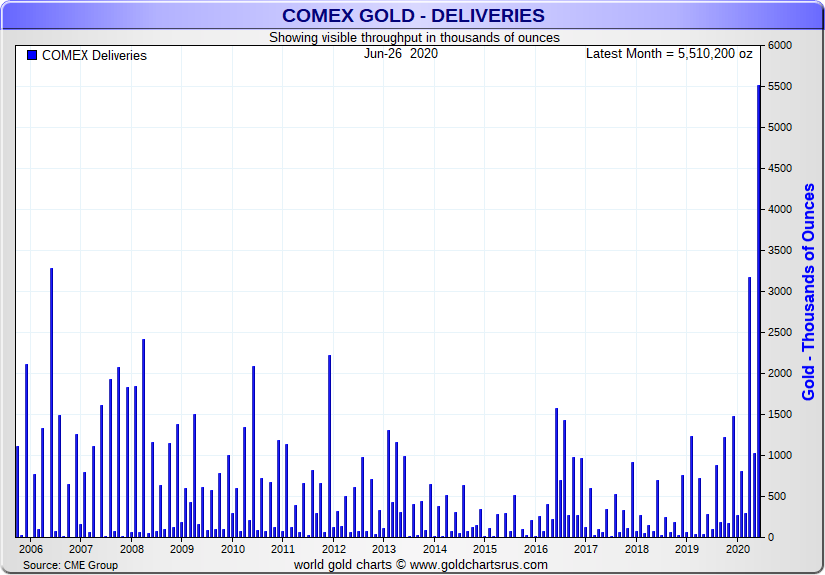
(ZH) A Record 170 Tons Of Physical Gold Were Just Delivered On The COMEX: Here's

A Record 170 Tons Of Physical Gold Were Just Delivered On The COMEX: Here's Why

Submitted by Jan Nieuwenhuijs of Voima Gold
Three elements cause physical delivery on the COMEX to have reached record highs this year: strong demand for futures in New York, a persisting spread between the price of futures in New York versus spot gold in London, and arbitrage.

Physical delivery on the largest gold futures exchange in the world, the COMEX in New York, has reached all time highs this year. In June more than 170 tonnes were physically delivered (5.5 million ounces). Usually, delivery is “neglectable.” What has changed?

An important change in the global gold market occurred on March 23, 2020. On that day the price of gold futures in New York started drifting higher than the price for spot gold in London. Ever since, the spread has persisted, though it continuously widens and narrows. The reason for this disturbance in the market can be read in my previous article “What Caused the New York vs. London Gold Price Spread and Why it Persists.”
To understand the shift in deliveries, first let's have a look at how the global gold market operated before March 23, when things still ran smoothly.
The Global Gold Market Before March 23, 2020
The world’s most dominant gold spot market is the London Bullion Market, where mostly “loco London” gold is traded. Meaning the metal is physically settled within the environs of the M25 London Orbital Motorway. The most dominant gold futures market is located in New York, where metal can be physically delivered within a 150-mile radius of the City of New York.
Before March 23, the price in London (spot) and the price in New York (near month futures contract) always traded in tight lockstep because of arbitrage. If, for example, the futures price would trade above spot, arbitragers would “buy spot and sell futures” until the spread was closed. Arbitragers would hold their positions—long spot, short futures—until maturity of the futures contract, because at expiry the price of the futures contract was guaranteed to converge with the spot price. In this example we can see that strong demand in New York would be translated into spot buying in London.

Worth noting is that when a futures trader rolled its position into the next month, and his initial futures buying was translated into spot buying in London by an arbitrager, on a systemic level the arbitrager would roll its position as well.
Of course, the opposite happened as well. When futures traded below spot, arbitragers would “buy futures and sell spot” until the spread was closed.
So far, a simplified version of the market before March 23.
The Global Gold Market After March 23, 2020
Since March 23 of this year, futures have persistently been trading above spot, though the spread isn’t constant. As a result, arbitragers aren’t assured the futures price in New York will converge with the spot price in London. An arbitrage trade as described above, through a position in both markets, incurs risk.
What arbitragers currently do to profit from the spread is buy spot, sell futures, fly the metal to New York, and physically deliver the gold. This is how the profit is locked in. If the spread between spot and futures is $40 per ounce, the arbitrager’s profit is $40 minus costs for transport, insurance, storage, etc.
Now you can see why the persistent spread between New York and London has increased physical delivery on the COMEX through arbitrage.
Conclusion
Physical delivery on the COMEX is elevated because of the current unusual situation in the global gold market. The gold delivered in New York has been imported from spot markets such as Singapore, Switzerland and Australia. U.S. imports directly from the U.K. are rare, because in London 400-ounce bars are traded and the main futures contract in New York requires smaller bars for delivery.
You might wonder who takes delivery from arbitragers that make delivery on the COMEX. Possibly, these are arbitragers, too. In the chart below you can see the spread between the “near month futures contract” and the “next near month futures contract.” This spread has also blown out on March 23. Arbitragers can buy the near month, and sell the next near month for a higher price. Subsequently, they take delivery of the near dated contract and make delivery of the further dated contract.
At the time of writing the near month (August) is trading at $1,849.8 dollars, while the next active month (October) trades at $1,860.5 dollars. Arbitragers can buy long August and sell short October to collect $10.7 dollars per ounce.
One reason I can think of why the spreads persist, is because bullion banks are currently less active on the COMEX. Previously, bullion banks—having access to cheap funding—often performed the arbitrage trades.