Notable earnings/guidance movers: ISRG +4.6%, TXN +2.5%, UAL +1.3%; SNAP -5.4%, USNA -2.9%
- Earnings/guidance gainers: NAVI +11.9%, AIR +5.5%, ISRG +4.6%, REXR +2.6%, SUM +2.6%, TXN +2.5%, UAL +1.3%, FULT +1.2%, CSL +1.1%
- Earnings/guidance losers: SNAP -5.4%, HCSG -4.7%, COF -3.7%, USNA -2.9%, IRBT -2.8%, WTFC -1.6%
Closing Stock Market SummaryThe S&P 500 increased just 0.2% on Tuesday, as selling in the last hour of trading spoiled a 0.8% intraday gain in the benchmark index. Relative weakness in the mega-cap stocks took the Nasdaq Composite down 0.8% after it set an intraday high at the open, while the Dow Jones Industrial Average (+0.6%) and Russell 2000 (+1.3%) outperformed.
It was largely a rotation trade after yesterday saw mega-caps and growth stocks surge at the expense of seemingly almost everything else. Today, advancing issues outpaced declining issues by a 3:1 margin at the NYSE and a 2:1 margin at the Nasdaq, the S&P 500 energy sector rallied 6.2%, and the financials (+1.9%) and industrials (+1.3%) sectors followed suit.
Positive factors that helped broaden out the gains included another round of better-than-expected earnings reports and the EU agreeing to a €750 billion fiscal stimulus package. The market wasn't up more, though, because of the off-day for the mega-cap stocks within the information technology (-1.1%), consumer discretionary (-0.4%), and communication services (-0.4%) sectors.
Regarding the late selling, there were reports that attributed it to Senate Majority Leader McConnell saying he doesn't expect the next fiscal stimulus bill to be completed by the end of next week. Such reports are dubious, though, considering that the news was first mentioned in a tweet from a Politico reporter about 30 minutes prior to the selling.
Separately, IBM (IBM 126.06, -0.31, -0.3%) was one of those companies that exceeded quarterly expectations, but shares were swept up with the rotation out of technology stocks. Fellow Dow component Coca-Cola (KO 47.20, +1.08, +2.3%) gained 2% after beating earnings estimates.
Elsewhere, U.S. Treasuries and gold prices ($1843.60/ozt, +26.50, +1.4%) finished the day higher. The 2-yr yield declined one basis point to 0.14%, and the 10-yr yield declined one basis point to 0.61%. The U.S. Dollar Index fell 0.7% to 95.20. WTI crude gained 2.3%, or $0.93, to $41.76/bbl.
Investors did not receive any notable economic data on Tuesday. Looking ahead, investors will receive a trio of housing data on Wednesday: Existing Home Sales for June, the FHFA Housing Price Index for July, and the weekly MBA Mortgage Applications Index.
- Nasdaq Composite +19.0% YTD
- S&P 500 +0.8% YTD
- Dow Jones Industrial Average -6.0% YTD
- Russell 2000 -10.9% YTD
Silicon Valley’s richest are getting richer just as the pandemic is getting worse
The net worth of Jeff Bezos grew by a record $13 billion on Monday.
striking contrast with the fate of other Americans during the worst economic downturn since the Great Depression.
When the coronavirus pandemic began to ravage the economy, those who worry about inequality expressed concern that billionaires — and particularly tech billionaires — would amass more power and that the income gaps would grow more dramatic. And their worries appear to have been well founded.
People like Jeff Bezos, Elon Musk, and Steve Ballmer have added tens of billions of dollars to their net worths since the beginning of the calendar year, according to the Bloomberg Billionaires Index. The success of the very richest was punctuated on Monday when Bezos’s net worth grew by $13 billion, the largest single-day jump since Bloomberg began tracking the day-to-day changes in 2012.
It’s easy to lose track of precisely how wealthy the ultra-wealthiest have become. Terms like “billionaires” can generalize and disguise the scale of the fortunes created in today’s economy. A billion here, a billion there — the very rich remain very rich. Exactly how rich can feel irrelevant.
But the particulars of their staggering success matter because at the other end of America’s income inequality divide, the extra money would not feel so irrelevant. More than 30 million Americans are now depending on unemployment benefits, some of which are set to expire at the end of the month. Low-wage workers are especially prone to layoffs. And the pandemic is pounding poorer neighborhoods in particular, where the number of Covid-19 cases is higher.
Voices on the left see this as zero-sum — those extra billions can make a difference if redistributed — and are calling for a remaking of the American economy after this crisis. They would like to see the very wealthy pay more in taxes in order to repair what they believe is an insufficient safety net.
Market-oriented thinkers argue that these billionaires are becoming rich because they are creating value for their shareholders — which is a basic imperative of capitalism — and the billionaires happen to be some of these companies’ largest shareholders.
That argument, though, is why it is worth assessing the figures in the uppermost echelon of America’s elite. Over the last few weeks in particular, tech fortunes have climbed to new heights.
That’s true for no one more than Bezos, whose assets in 2020 have climbed by $75 billion; his net worth is now nearing almost $200 billion.
That historic wealth gain is due to the rise of Amazon, which has proved indispensable as people around the world stay at home in response to the pandemic. Its stock has skyrocketed 70 percent since the start of the year. That’s a boom for him as well as for his ex-wife, MacKenzie Bezos, whose shares in the company have put her on the doorstep of becoming the world’s wealthiest woman, a position held now by Francoise Bettencourt Meyers. On New Year’s Day 2020, MacKenzie Bezos was the world’s 25th wealthiest person — now she’s 13th, with $63 billion to her name, per Bloomberg.
Amazon is not the only big tech company whose relative success has made the rich richer. The S&P 500 may be about flat in 2020, but the stock appreciation at Facebook, Apple, and Google parent company Alphabet has created even more winnings for its billionaires. But the rise of two other tech companies and the billionaires behind them have changed the tippiest of the tippy-top.
Ballmer, the longtime CEO of Microsoft, is not a household name for most Americans, who are far more familiar with his predecessor, Bill Gates. (Many of the country’s richest people are not faces you would recognize if you passed them on the street.)
But Ballmer is not just any rich person — he has sneakily become America’s fifth-richest person thanks to the enormous growth in Microsoft’s stock, which has almost quadrupled over the last five years. That could draw more scrutiny to Ballmer, who remains in the public eye primarily as the animated courtside presence at the home games of the Los Angeles Clippers, which he owns. Ballmer began the year as the 15th-richest person.
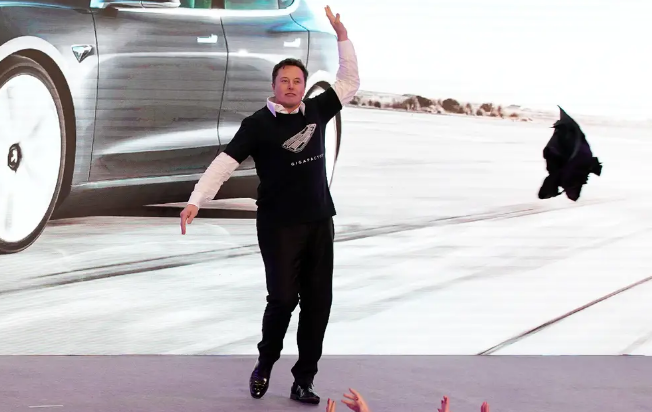
The other tech billionaire who has turned a fortune into a super-sized fortune amid the recession is Musk, the idiosyncratic founder of Tesla and SpaceX. At the start of 2020, Musk ranked as the 35th richest person. But his net worth has nearly tripled over the last seven months, and Musk is now the sixth wealthiest person in the world with almost $75 billion. Tesla’s stock has almost quadrupled this calendar year.
All told, the coronavirus is proving to offer pretty good times for Big Tech’s leaders. Nine of the 15 richest people in the world come from America’s technology sector, according to the Bloomberg rankings, compared to seven at year’s beginning. Almost every tech billionaire is in the black, not the red, this year.
Not many Americans can say the same. And if the American economy drops further, the tech billionaire will loom — fairly or unfairly — as an easy scapegoat.
Hedge Fund Flows Are All That Matter, New Study Finds
With every passing day, the bizarre Stalinist freakshow that was once known as the "market" gets even more bizarre. And we use the term "market" in its loosest, legacy sense, one where it represented more than just the centrally-planned intentions of a few central banking academic and politicians. Why? Because as BofA's CIO Michael Hartnett reminded us in in a recent Flow Show report, the disconnect between macro and markets has never been greater - i.e., they have never been more broken - but that is to be expected for the following three reasons:
- Markets rationally being "irrational": government and corporate bonds have been fixed ("nationalized") by central banks, so why would anyone expect markets to connect with macro, why should credit & stocks price rationally.
-
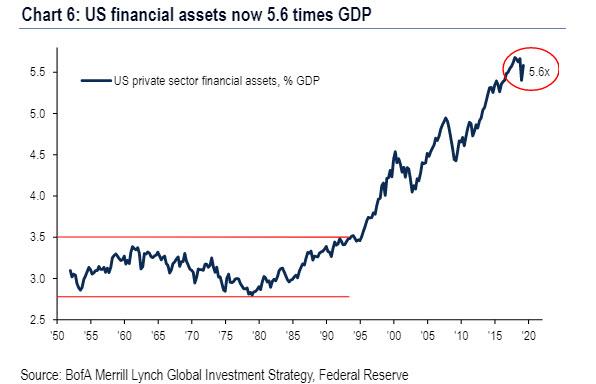
Markets leading macro: policy makers (see China this week) know higher asset prices necessary condition for macro recovery (Wall St assets are 5.6x size of US GDP)...
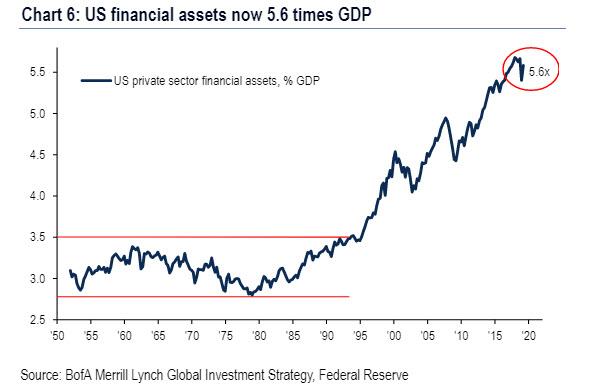
...V-shape recovery on Wall St leading V-shape recovery on Main St (see PMI's & housing activity); gasoline demand good US mobility signal, up sharply to 9mn barrel/day from spring lows, watch to see if virus again negatively impacts economy. - Markets rationally pricing-in Max Liquidity, Minimal Growth backdrop, as they have done for 10 years; of 3042 stocks in MSCI ACWI currently 2141 >20% below their all-time highs, i.e. in a bear market.
So in this artificial, centrally-planned world where neither fundamentals, nor newsflow, nor data have an impact on "irrational" markets, does anything matter?
Well, yes, and it's perhaps the one things we have been focusing on in recent weeks, namely smart money flows, of the kind discussed in "Hedge Funds Flood Into Stocks, Take Net Leverage Highest In Over Two Years":

Well, as it turns out, our frequent obsession with fast money flows is actually justified: according to a recent research paper titled "Which Investors Matter for Equity Valuations and Expected Returns?", hedge funds exert far more power on equity prices than most other classes of investors, while the passive cohort are among the least influential. The paper's conclusion, as per Bloomberg: "The fast money has more than three times the impact on equity valuations, per dollar under management, than long-term investors like pension funds."

It was not immediately clear where central bank fund flows rank in order of market impact priority although we would tend to guess toward the top.
“The influence of hedge funds is remarkable given their relatively small size,” the authors wrote. Smaller investment advisors had the second-greatest impact on price, and proved even more influential across a host of other characteristics, Koijen et al found.“Small, active investment advisors are most important for the pricing of payout policy, cash flows, and the fraction of sales sold abroad,” they said.
The findings, as Bloomberg concludes, "provide ammo for stock allocators who front-run the buying and selling activity of their influential peers, in a world that can famously punish those trading on the basis of fundamentals." It also suggests that contrary to growing speculation, passive investing vehicles such as ETFs have far less of an impact on market pricing. However, it's only a matter of time before passive takes over the priority chain: having lured assets away from active vehicles for years, passive investing makes up an increasingly significant chunk of daily trading, "there are worries it could ultimately disrupt price discovery." Oddly enough, there are no worries about central banks doing the same, even though the Fed and its peers have now made a total mockery of price discovery.
While the research didn’t speculate on the future, it did note that if hedge funds were to shift to a market index strategy, that would mean bigger price moves are needed to have any impact on a large passive portfolio.
“If these investors would hold a market-weighted strategy instead of their current strategy, the coefficient of valuation ratios on the fraction of sales that is exported would decline by more than 10%,” the trio wrote. “These investors therefore play an important role in determining the cost of capital of global firms.”
Did Tesla Engage In A "Discounted Fleet Sale" To Make Its China Numbers?

A Chinese car dealer group is offering a group buy on Tesla Model 3 vehicles at a discount, but Tesla denied any involvement — including offering a lower price.
Some automakers or dealerships will offer group buy discounts for larger volumes, but Tesla is not one of them.
The California-based automaker prides itself on offering the same prices to everyone — although the automaker has deviated from this policy once or twice in the past.
It’s why it raised a few eyebrows when Yiauto, a Chinese car dealer group, announced a group buy of discounted Tesla Model 3 vehicles on online platform Pinduoduo.
The company claimed that they could sell Tesla’s China-made Model 3 vehicles at 251,800 yuan ($36,017), which is 19,750 yuan below the price listed on Tesla’s official website in China:
The Tesla shorts are already spreading theories that the automaker sold fleets of vehicles to resellers in China to improve its delivery results in the last quarter.
However, Tesla China has denied any involvement in this deal (via China’s Shine):
“This promotion activity has not yet started and is scheduled for July 26. In response, the US electric carmaker said there is no cooperation between Tesla and Pinduoduo or Yiauto on this activity, adding that Tesla does not have any form of entrusted sales service with Pinduoduo or Yiauto. Tesla said it did not sell any vehicles to Pinduoduo or Yiauto for this promotion.”
The group may be only testing interest in a group buy without checking with Tesla if it is even possible.
In the second quarter of 2020, Tesla delivered around 30,000 vehicles in China. It means that the country represented around one-third of Tesla’s entire global deliveries during the second quarter.
Electrek’s Take
This is a strange one.
As it is often the case, the shorts are wrong about this one. The most likely explanation is that this is being done completely independently from Tesla.
In Quebec, Tesla resellers were actually not uncommon until recently when Tesla changed its policy on that front. People would buy Tesla vehicles from resellers for a higher price than directly from Tesla because the resellers would offer better prices on the trade-ins — compensating for the higher price.
Since the deal would also include the trade-ins, it would also result in lower taxes.
This deal could offer similar benefits and the dealer could offer other services to compensate for the discount. Of course, I’m speculating, but I think there are many better explanations than Tesla trying to unload cars through a reseller to boost its Q2 numbers.
FTC: We use income earning auto affiliate links. More.
After yesterday's headline of potential record deliveries this quarter leaked from none other than electrek (who else?), Gordon Johnson had a sobering assessment of the situation in a note he released during the day on Tuesday.
Johnson claims that Chinese media has reported "heavily discounted long-range Tesla Model 3 cars currently offered by car dealership YiAuto on the e-commerce site Pinduoduo."
His note made light of the fact that Tesla has denied such promotions but Johnson concludes that Tesla "engaged in a discounted fleet sale (the magnitude of which remains unknown – i.e., was it 5K cars, 10K car, or more/less) in June to hit is delivery numbers in China, and now those cars are being liquidated by the fleet buyer on Pinduoduo."
He also questions what the discount Tesla offered the cars at was, given that they are being offered for a $5.7k discount on Pinduoduo. Recall, we reported in May that Tesla had slashed its price on the Model 3 in China to qualify for subsidies - and we reported this month that the company had slashed prices in the U.S. of its Model Y.
The conclusion is obvious, Johnson says: "Demand for TSLA’s cars, however marginal, is not as strong as it appears."
KEY TAKEAWAY? Assuming our opinions here are correct, we see this as yet another sign of troubled demand for TSLA’s cars in China (and, as touched on below, even assuming TSLA’s denial is accurate, we still see this as indicative of a demand problem for TSLA’s cars in China). By way of background, we note that YiAuto, established in 2015, is a leading domestic automobile integrated service platform, which claims to have 50+ self-operated and 400+ alliance stores across China.
He says that gross margins will suffer as a result and that the sell side has selectively ignored this issue:
Gross margins will suffer incrementally (however, as we noted this am, with a number of non-organic/seemingly-deceptive accounting levers – our opinion – TSLA employs each quarter, where these discounts show up will likely prove nearly impossible to “audit”); and our sell-side peers continue to ignore items like this, which get to what we believe is complicity in consistently pushing a narrative of TSLA “beating” Street estimates (why is the Consensus est. for TSLA’s 2Q20 EPS -$1.20/shr, despite nearly EVERYONE assuming profit, and thus the run in the shares over the past few months on the expectation of S&P 500 inclusion).
After reiterating that Tesla has denied selling any cars to Pinduoduo or YiaAuto, Johnson ends his note by saying he is "skeptical" and that he does not believe "any automotive service platform in China is in the business of taking massive losses on the sale of automobiles."
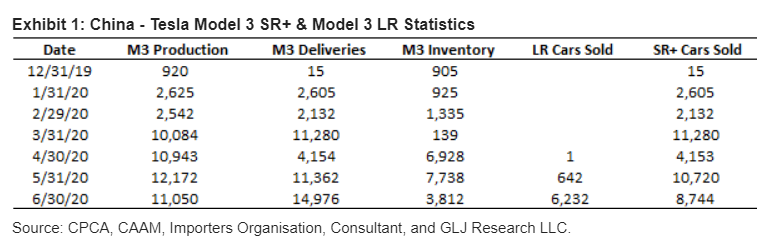
Even if Tesla is telling the truth about not selling the cars at a discount, he questions sustainability of demand in the country, which has a saturated EV landscape. "Caveat emptor," his note concludes.
Coronavirus Threatens the Luster of Superstar Cities
Urban centers, with a dynamism that feeds innovation, have long been resilient. But the pandemic could drive a shift away from density.
Cities are remarkably resilient. They have risen from the ashes after being carpet-bombed and hit with nuclear weapons. “If you think about pandemics in the past,” noted the Princeton economist Esteban Rossi-Hansberg, “they didn’t destroy cities.”
That’s because cities are valuable. The New York metropolitan area generates more economic output than Australia or Spain. The San Francisco region produced nearly one of five patents registered in the United States in 2015. Altogether, 10 cities, home to under a quarter of the country’s population, account for almost half of its patents and a third of its economic production.
So even as the Covid-19 death toll rises in the nation’s most dense urban cores, economists still mostly expect them to bounce back, once there is a vaccine, a treatment or a successful strategy to contain the virus’s spread. “I end up being optimistic,” said the Harvard economist Edward Glaeser. “Because the downside of a nonurban world is so terrible that we are going to spend whatever it takes to prevent that.”
And yet there is a lingering sense that this time might be different.
The pandemic threatens the assets that make America’s most successful cities so dynamic — not only their bars, museums and theaters, but also their dense networks of innovative businesses and highly skilled workers, jumping among employers, bumping into one another, sharing ideas, powering innovation and lifting productivity.
Compelled by the imperative of social distancing, the cutting-edge businesses that flocked to cities to exploit their bundles of talent have been experimenting with technologies that allow them to replicate their social interactions even if everybody is working from home.
As Mr. Rossi-Hansberg put it, “There’s a little bit of a realization that we can still do things,” even when we all stay home.
Covid-19 is not the deadliest disease to have ravaged cities through the ages. But it is showing us that they might not be as essential as they once were. “Cities are more in danger than in the 19th century even though this plague is less severe,” Mr. Glaeser said, “because we are rich enough to imagine a deurbanized world.”
Mark Zuckerberg, Facebook’s chief executive, has said he wants to reconfigure the company so half of its employees could work from home within the next decade. Twitter has said it will allow employees to work from home indefinitely. Jonathan Dingel and Brent Neiman of the University of Chicago estimate that almost 40 percent of the nation’s jobs can be done from home. If this model catches on, it could reconfigure the geography of America’s tech industries.
A survey by the market research firm Reach Advisors found that companies facing high real estate and labor costs were the most interested in pursuing remote work into the future. “The biggest shift away from density will likely be in markets such as the Bay Area and New York City,” said the company’s president, James Chung. By shifting to remote work, “they can dramatically widen their labor pool and evade the labor-wage trap that they are in.”
Paradoxically, America’s big cities are becoming more valuable, churning out an increasing share of the nation’s economic output.
They have benefited from the rise of economic complexity and the explosive growth of technologies that reward the most highly educated workers. Complex industries like information technology, biotechnology and finance concentrate in large cities where they can find the most skilled employees.
These cutting-edge businesses don’t mind paying top dollar for the talent, not least because — research has found — highly skilled workers tend to be more productive and innovative when they are surrounded by others like them.
Despite the stratospheric rents, which have been pushing low-wage workers out, highly educated workers have continued to flock to the nation’s megalopolises in search of the high pay and urban amenities that have emerged to serve this affluent clientele.
From 1980 to 2018, the income per person in New York’s metropolitan area rose from 118 percent of the national average to 141 percent, according to government data. Boston’s rose from 109 to 144 percent, San Francisco’s from 137 to 183 percent, and Seattle’s from 120 to 137 percent.
But if big-city businesses find that work from home doesn’t hit their productivity too hard, they might reassess the need to pay top dollar to keep employees in, say, Seattle or the Bay Area. Workers cooped up in a two-bedroom in Long Island City, Queens, might prefer moving to the suburbs or even farther away, and save on rent.
Mr. Glaeser and colleagues from Harvard and the University of Illinois studied surveys tracking companies that allowed their employees to work from home at least part of the time since March. Over one-half of large businesses and over one-third of small ones didn’t detect any productivity loss. More than one in four reported a productivity increase.
Moreover, the researchers found that about four in 10 companies expect that 40 percent of their employees who switched to remote work during the pandemic will keep doing so after the crisis, at least in part. That’s 16 percent of the work force. Most of these workers are among the more highly educated and well paid.
Will they stay in the city if they don’t need to go to the office more than a couple of times a week? Erik Hurst, an economist at the University of Chicago, argues that people will always seek the kind of social contact that cities provide. But what if their employers stop paying enough to support the urban lifestyle? Young families might flee to the suburbs sooner, especially if a more austere new urban economy can no longer support the ecosystem of restaurants and theaters that made city life attractive.
The overall economy might be less productive, having lost some of the benefits of social connection. But as long as the hit is not too severe, employers might be better off, paying lower wages and saving on office space. And workers might prefer a state of the world with somewhat lower wages and no commute.
Municipal governments in superstar cities might have a tough time doing their job as their tax base shrinks. The survival of brick-and-mortar retailers will be threatened as social distancing accelerates the shift to online shopping.
Smaller cities might benefit. If they don’t have to go into the office more than a couple of times a year, highly skilled workers in places like Seattle or Los Angeles might prefer Boulder or Vail.
“Everybody agrees on what are the key forces,” said Gilles Duranton, an economist at the Wharton School of the University of Pennsylvania. “The question is which will play out, and where are the tipping points?”
One of the big remaining questions is whether remote work will prove sustainable. The productivity increases captured in the surveys examined by Mr. Glaeser’s team might prove fleeting.
“In the more likely state of the world, we realize that we can carry on a project remotely for one or two days but ultimately we do need face-to-face interaction,” said Enrico Moretti, an expert in urban economics at the University of California, Berkeley. Remote education has proved inferior. In the long run, people may still need to live close to where they work.
And yet, technology continues to improve. “There are more incentives to invest in more technologies to stay at home,” Mr. Rossi-Hansberg said.
So what would the post-Covid city look like?
Mr. Rossi-Hansberg suggests that a reconfigured urban America could look a bit more like the 1980s, before technology set in motion the forces that produced the present-day superstars, leaving other places behind. “This would flatten the distribution of cities and reduce the occupational polarization of cities,” he said.
It would be a different world. But it might not be too terrible for urban living.
Consider life in a reconfigured New York City. Rents are lower, after the departure of many of its bankers and lawyers. There are fewer fancy restaurants, but probably still many cheaper ones. People with lower incomes, including the young, can again afford to live in town. City services may be reduced, but if a fifth or more of workers aren’t going to the office on any given day it will be easier to get around.
Mr. Duranton argues that the cities that will be devastated by Covid-19 are the ones that have been falling for a long time: the Rochesters and the Binghamtons, which lost their sustenance once the manufacturing industries that supported them through much of the 20th century folded or moved away.
But for a city like New York, he said, Covid-19 offers an opportunity for redemption. “New York was running into a dead end, turning into a paradise for the rich,” he said. “Culturally dead.” Moving back to a cheaper, messier, more diverse equilibrium may carry a silver lining.