>>> TradeGate Pre-MArket Indications

DAX:
  • E.On (EOAN TH) -0.8%
MDAX:
  • Evotec SE (EVT TH) +3.4%
    • Evotec Gets DoD Contract for Virus Treatment Process Development
  • Commerzbank (CBK TH) +1.7%
  • Lufthansa (LHA TH) -1.1%
    • Lufthansa, IAG, United, American Seek U.S.-EU Covid-Tests Accord
  • Fraport (FRA TH) -1.4%
SDAX:
  • Hamborner REIT (HAB TH) +3.1%
    • Hamborner REIT Sees Higher FY20 Rental Income, Lower NAV/Shr
  • LPKF (LPK TH) +2.7%
  • Aixtron (AIXA TH) +1.2%

(ZH) Tom DeMark Sees The S&P Hitting 3,486 Before The Rally Ends

Tom DeMark Sees The S&P Hitting 3,486 Before The Rally Ends

In a world where fundamentals no longer matter to the market, there is still some hope that at least the voodoo that is "chart analysis" perhaps works. If so, the best source of forecasting the future by looking at the past is the man who an icon among technicians: Tom DeMark. And with good reason: while it could certainly could have been a lucky guess, in March, DeMark whose D-Wave strategy is a favorite of such trading legends as Steve Cohen, predicted that a market bottom was forming on the day the S&P 500 ended a 34% plunge (although his projection for the index to drop below 2,100 was off, as the bottom - so far - was 2,191.86, and his call for an 11% rally followed by a range trading proved too conservative).
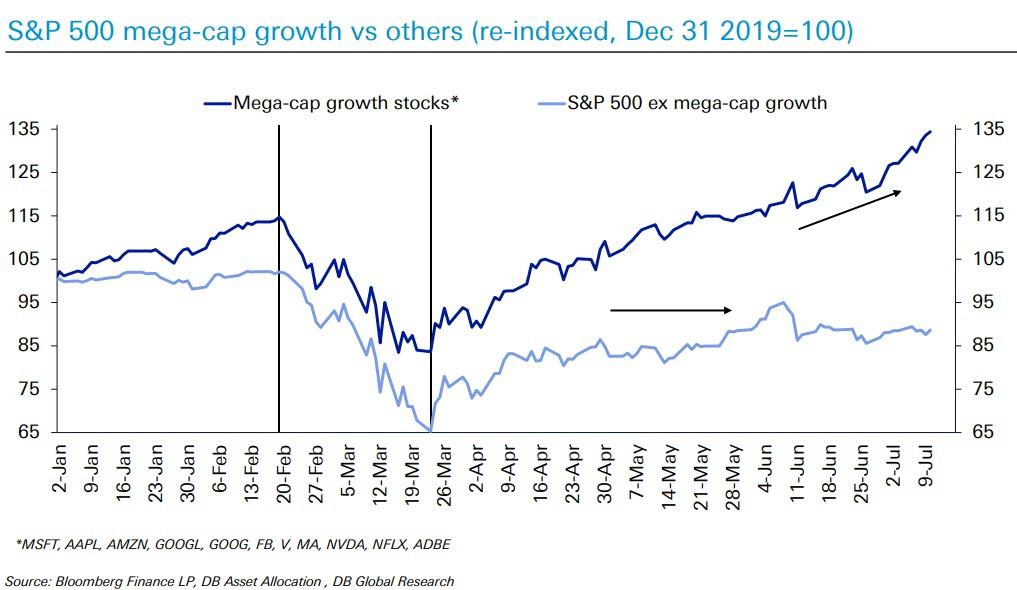
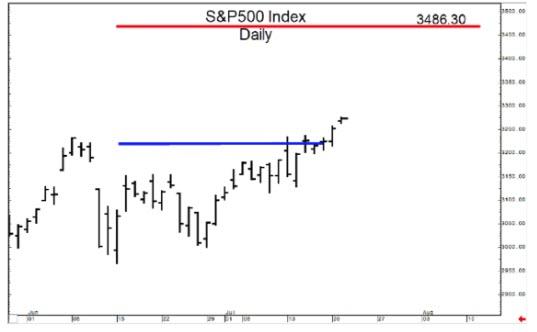
So what does DeMark think will happen next? According to Bloomberg, the famous technician sees the rally accelerating from here, and according to his D-Wave forecast the S&P will climb to 3,486 - a new all time high - in the next few weeks as the rally that has gripped the tech sector spills over to the broader market. As a reminder, since the end of Q1, all of the market upside has been thanks to just 10 mega-cap stocks. The other 490 stocks in the S&P500 have gone nowhere as shown in the chart below.
DeMark's target is 7% higher from the current levels and would be 100 points above the all-time high reached in February.

"The catch-up will be fast," DeMark told Bloomberg, adding that "it’s going to catch people off guard", although one look at the overnight moves, DeMark should probably have been talking about gold and silver which are exploding at this moment.
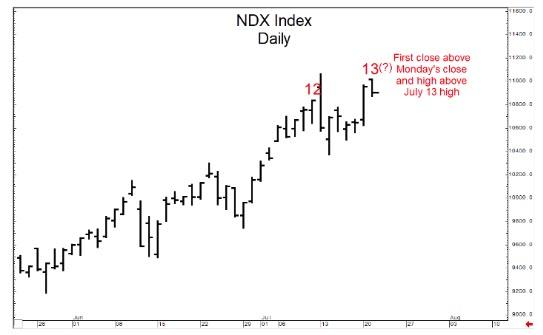
As Bloomberg notes, the prediction was based on DeMark’s “countdown” study that involves comparing a security’s closing price to its highest or lowest levels two days earlier. Cycles of “exhaustion” develop when a pattern continues 13 times. The S&P 500 just produced its sixth count Monday and the Nasdaq 100 was on count 12.
Looking at the recent surge in stocks, DeMark notes that while Monday’s advance was led by tech darlings, Tuesday resumed a recent trend in which investors seek out laggards, a process of widening market participation that to DeMark usually coincides with the final phase of a rally. Last week, in a rare inversion of the trend observed since the March 23 low, the Nasdaq 100 fell for the first time in three weeks while the S&P 500 advanced, bolstered by industrial and commodity shares.

DeMark was less optimistic on the Nasdaq which has soared 19% YTD and is hitting daily record highs: "The Nasdaq is going to struggle," DeMark said. "It may wait for the S&P 500 to record its high” before a meaningful selloff.
And there you have it: that said, if DeMark is indicative of the other trends that dominate this bizarro, insane "market" the best trade here may be to fade everything the famed technician is recommending and just go long the Nasdaq while shorting everything else. After all, that's the trade that has become synonymous with central bank takeover of capital markets, and there is nothing that suggests this creeping Sovietization of "markets" will ever end.

>>> Europe : Brokers Upgrades & Downgrades - 23rd of July 2020

>>> Up
* Altice Europe Raised to Overweight at JPMorgan; PT 4.70 euros
* Dechra Pharma PT Raised to 3,515 pence at Jefferies
* DP Eurasia Raised to Buy at VTB Capital; PT 50 pence
* EasyJet Raised to Buy at Berenberg; PT 800 pence
* Generali Raised to Buy at Berenberg; PT 18.50 euros
* Ipsen Raised to Overweight at JPMorgan; PT 96 euros
* Proximus Raised to Buy at HSBC; PT 23 euros
* Sartorius PT Raised to 385 euros at Bankhaus Metzler
* Sobi Raised to Overweight at Barclays; PT 230 kronor
* Somfy Raised to Buy at SocGen; PT 124 euros
* Sunrise Raised to Overweight at Morgan Stanley

>>> Down
* Alrosa Cut to Neutral at Citi
* Axa Cut to Hold at Berenberg; PT 21.80 euros
* Koenig & Bauer Cut to Hold at LBBW; PT 21 euros
* Lindt & Spruengli Cut to Underweight at Barclays
* Uniper Cut to Hold at Bankhaus Metzler; PT 29.80 euros

>>> Initiation
* Hiag Immobilien Rated New Add at Baader Helvea

>>> Call
* Dechra Pharma Gets Street-High PT on Clearer Outlook: Jefferies
* Evolution Gaming Estimates Raised on Strong 2Q: Morgan Stanley
* Post-Virus Green Push Isn’t End of Big Oil, Citi’s Morse Says
* Sunrise Upgraded on Growth, Superior Visibility: Morgan Stanley

>>> What to look at today - 23rd of July 2020

Stocks traded mixed on Wednesday amid uncertainty over the timing of a fresh U.S. stimulus program. The dollar extended losses, while gold soared above $1,850 an ounce.
Shares climbed in China and Hong Kong, while those in Japan edged lower. Australian shares underperformed as the country recorded its worst day of virus cases. Futures on the S&P 500 ticked up after U.S. equities finished well off Tuesday’s session highs, with Senator Mitch McConnell casting doubt on reaching a fresh rescue bill before some current benefits expire. Tech stocks led the Nasdaq Composite lower. Silver climbed as precious metals jumped.
US after Hours TXN +1.2% and ISRG +1.3% report strong earnings, OLLI +11.6% up on strong guidance; SNAP -6.6% falls on earnings

Nikkei -0.52% Hang Seng -0.20% CSI +1.31% Shanghai +1.09% Shenzen +1.54%

Eur$ 1.1537 CNH 6.9711 CNY 6.9731 JPY 106.83 GBP 1.2715 CHF 0.9323 RUB 70.7427 WTI$ 41.54 -0.91%

S&P +0.00% Nasdaq +0.05% EuroStoxx -0.35% FTSE -0.27% Dax -0.36% SMI -0.44%

Macro :
- Tom DeMark Sees S&P 500 Rallying Toward 3,500 Before Topping Out
- Silver To Win An Extra Boost as Precious Metals Gain, Citi Says

Keep an eye on :
- ABBN SW : ABB Second Quarter Operating Ebita Beats Estimates
- AIR FP : Cathay Pacific Reaches Pact With Airbus to Defer Jet Deliveries
- AF FP : KLM Resumes Flights to China After Covid-19 Halt
- AKZA NA : Akzo Nobel Second Quarter Coatings Revenue 1.8% Below Estimates
- ATL IM : Benettons’ Edizione Confirms Mion as Chairman, To Name New CEO
- BAYN GY : Judge in Roundup Schedules Hearing for Aug. 6, Susquehanna Says
- BOL SS : Boliden Second Quarter Operating Profit Beats Estimates
- CLNX SM : Benettons Rejected Stonepeak Offer for Cellnex Stake Part: Sole
- CWD LN : U.K.’s Real Estate Agency Countrywide Searching for New CEO: Sky
- COV FP : Covivio First Half EPRA EPS EU2.17
- DTE GY : Dutch Government Raises EU1.23b in First Part of 5G Auction
- EFGN SW : EFG International AUM CHF147.8 Bln, -3.9% H/H
- FGR FP : Eiffage: APRR 1H Rev. Ex-Construction Fall 25% to EU934.3 Mln
- ENI IM : Italy Prosecutor Seeks 8 Years Jail for Eni CEO on Bribe Charge
- ENI IM : Eni Says Prosecutor’s Requests for Conviction Are Groundless
- EVT GY : Evotec Gets DoD Contract for Virus Treatment Process Development
- FCA IM : Fiat Chrysler, Waymo in Tie-Up for Automated Delivery Trucks
- HAB GY : Hamborner REIT Sees Higher FY20 Rental Income, Lower NAV/Shr
- HSBA LN : Joshua Wong says HSBC Inquired on His Bank Account: Cable TV
- ISP IM : Intesa Says Consob Approved New Prospectus for UBI Bid Raise
- KPN NA : KPN 5G Spectrum Comes at Modest Cost, Improves Position: React
- MOVE SW : Medacta First Half Revenue EU135 Mln, -11% Y/y
- NENTB SS : NENT Second Quarter Adjusted Ebit Misses Estimates
- NESN SW : Nestle Explores Sale of Chinese Bottled Water Business, CNN Says
- NOVN SW : Novartis Bid to Block Regeneron’s Eye Syringes to Be Probed
- NHY NO : Norsk Hydro 2Q Underlying Ebit Beats Highest Estimate (1)
- ORP FP : Orpea Second Quarter Organic Revenue -5.5%
- PHIA NA : Philips Said to Court Asian Rivals, PE Firms on Appliance Sale
- PMAG AV : PIERER Mobility AG Sees Full Year Rev. Above EU1.40 Bln
- RUI FP : Rubis Terminal Boosts Chemicals Storage with Tepsa Acquisition
- RYA ID : Ryanair Says It Plans to Cut Frankfurt Base, May Cut Others: Sky
- SOW GY : Software AG Second Quarter Adjusted Ebita Beats Highest Estimate
- SO FP : Somfy Second Quarter Sales EU277.6 Mln
- TSLA US : Elon Musk Unlocks $2.1 Billion Award as Tesla Hits Milestone
- UBI IM : UBI Investors Tendered 8.5% Shares in Intesa Bid
- FR FP : Valeo Posts 1H Net Loss of EU1.22 Billion; Plans to Cut Jobs
- FR FP : Valora 1H Ebit Loss CHF10.9 Mln Vs. Profit CHF42.8 Mln Y/y
- VOW3 GY : VW’s Traton Seeks 6,000 Job Cuts, Works Council Chair Tells BZ
NYP : NYC is now the worst place to do business, retailers say

New York City’s progress fighting the coronavirus is doing little to help retailers, who say business in the city that never sleeps has become worse than anywhere else in the country.

National retailers — from Shake Shack, Applebees, and cap seller Lids — say their Big Apple stores are bouncing back slower than even neighboring states like New Jersey and Pennsylvania, which were also hard hit by the coronavirus.

The problem, sources say, is Manhattan, which used to be teeming with tourists and commuters who have largely stayed away since the coronavirus pandemic hit in March. Wealthy Manhattanites also have more resources and flexibility to escape, indefinitely, to greener pastures, like the Hamptons, experts say.

The city’s ghost-town vibe has Shake Shack, which runs 162 restaurants in 20 states, reporting that its Big Apple stores will “take a longer period of time to fully recover than other parts of the country.”

The burger chain made the statement on July 7 as it reported that NYC same-store sales for the week of July 1 had fallen 58 percent compared to a year earlier — the steepest decline among all its regions. Sales in the chain’s Northeast and Southeast stores, by contrast, fell just 24 percent and 32 percent, respectively.

While Shake Shack didn’t mention Manhattan specifically, Zane Tankel, who owns 35 Applebee’s in the NY-metro area, told The Post that he’s reopened 18 restaurants in neighboring regions, including Brooklyn and Queens. But he sees no point in reopening his two Manhattan stores — not even for curbside pickup.

“I drive around the city all the time and it was an easy determination to see that there’s not enough traffic to open those restaurants,” said Tankel, CEO of Apple Metro. Prior to the pandemic, the Manhattan Applebee’s, located at 205 W. 50th St. and at 234 W. 42nd St., were his most productive locations — representing $25 million in revenues.

Macy’s, whose Manhattan flagship occupies over 1 million square feet of retail space, is also concerned. Asked how its NYC stores, which reopened on June 22, are performing compared to the rest of the country, a spokeswoman said it’s too soon to tell while also noting that “continued work-from-home trends mean fewer commuters coming into the city,” and that international and domestic tourism “remains low.”

Starbucks also appears affected, said Mark Kalinowski, restaurant analyst and founder of Kalinowski Equity Research, who pointed to the Seattle coffee seller’s June statement that just 5 percent of its company-operated US stores remained completely closed, even for takeout.

The bulk of the closed stores, Starbucks said, “are primarily located in the New York City metro area.”

“It’s not normal to see Central Park and Times Square empty,” Kalinowski explained.

Lawrence Berger, chairman of sports cap company Lids, said he’s been floored by the drop in business at the chain’s two best performing New York stores — 1501 Broadway and 2 Times Square — since they reopened on June 22.

Foot traffic at those stores have been down 85 percent from a year ago — compared with a 20 percent average decline at Lids’ 900 other stores that have reopened across the country, said Berger, a partner of Ames Watson, which bought the 1,200-store chain last year.

Customer traffic at Lids stores in neighboring NJ and Pennsylvania, meanwhile, have actually increased 30 percent from a year ago, Berger added. And they all reopened at the same time.

“We expected New York City to be like the rest of the country when we reopened our stores here, but it’s a complete outlier,” Berger said. “There is no way to make money. It’s not an economically viable situation.”

FT : Wealthy widen their UK property aspirations

Wealthy widen their UK property aspirations
Half of people moving home stay within a three-mile radius, Savills research finds


What does the chart show?

It shows that wealthier households in the UK tend to go further afield than less affluent ones when moving to a new home. 

The chart, produced by estate agent Savills, measured the proportion of people staying within three miles of their home when buying or renting a new property against the level of deprivation of their neighbourhoods.

Overall, Savills found that 50 per cent of us stay within a three-mile radius when moving home, either as buyers or renters. 

In the 24 local authorities with the highest deprivation rating, some 60 per cent of home movers stay within a three-mile radius. However, this falls to 37 per cent of home movers in the 39 wealthiest local authorities.

Savills used data from 2017-19 provided by Experian, the credit reporting company, as well as figures from the UK’s Office for National Statistics. 

Lucian Cook, residential research director at Savills, says employment and social networks, schooling and retirement hotspots all played a part in encouraging people to trade up within an area they already knew.

“It does show that for a lot of the population, once they put down roots they are very much home birds and we form a strong bond with the local area,” he says.

What’s the connection between moving distance and income?

More affluent households have greater buying power over a much wider area and therefore have more flexibility over where they move. In less affluent areas, people are far more likely to be constrained when it comes to their housing options. 

The same research found the UK regions where people moved furthest were the south-west and south-east, while the north-east and north-west were the regions where people stayed closer to their departure point.

Across the two northern regions, 57 per cent of people moved within a three-mile radius, compared with 45 per cent in the south. Londoners choosing to move were the least likely to stay within three miles. 

Part of the explanation lies in the capital’s far-flung and efficient transport network, which enables hundreds of thousands of commuters to make the daily work trip over much greater distances than between cities and their hinterlands across the north. Another is the higher levels of housing equity among owner-occupiers in the south, giving them a bigger market to choose from when moving.

The research found that the local authorities of Hartlepool, Barrow-in-Furness and South Tyneside had the highest percentage of home movers who relocated within a three-mile radius — all places that rank highly on the deprivation measure.

Places with the lowest percentage of home movers from within a three-mile zone included authorities in the affluent south-east such as South Cambridgeshire, South Buckinghamshire, Braintree and Sevenoaks.

Will the steep rise in working from home cause this picture to change?

It’s quite likely to deepen it. As Covid-19 forced large sections of the population to work from home for months, there was a shift in attitudes among those looking for a new property. In a survey of buyers in April, Savills found 39 per cent of those under the age of 50 were looking for more space following the pandemic and 49 per cent said the size of garden or outside space had become more important in their search. 

Mr Cook says: “I suspect the experience of Covid-19 is going to mean that people will consider moving over a longer distance because they are looking more closely at their work-life balance. That’s going to be easier for the more affluent households where we know they have the existing housing wealth to give them more options as to where they can move and the type of property they can buy.” James Pickford

FT : Big Oil can play big role in frontier markets’ energy transition

New on show this week: Mount Fuji rises serenely at Musée Guimet
A Paris exhibition presents rare snowscapes from fragile ukiyo-e woodblock prints


The time is out of joint. A hawk dives over bare, frozen marshland in Hiroshige’s “Jumantsobo Plain”. A few travellers wobble on a snow-laden pontoon in Hokusai’s “Boat Bridge at Sano”. A white mountain peak rises in a black frame, a dramatic picture within a picture, or view through a window, for Utamaro’s gang of courtesans “Laughing Women”.

So winter descends in midsummer in one of Paris’s very few new exhibitions of the season: Musée Guimet’s Fuji, Land of Snow. Opened last week, this presentation of rare, ethereally delicate snowscapes from ukiyo-e woodblock prints, too fragile to be often exposed, considers from an oblique, refined, historical angle several preoccupying themes of recent months: beauty wrought from mutability and desolation; nature and man; artifice and interiority.

Around 1830, 70-year-old Hokusai became obsessed with Mount Fuji as symbol of monumentality yet transience. His perfectly cone-shaped, eternally snow-capped volcano - glowing red at dawn in “Fine Wind, Clear Morning”, cut with jagged lightening under pellucid skies in “Rainstorm beneath the Summit”, towering serenely over abstracted bands of white-green waterlogged fields where peasants lead oxen top-heavy with reed bundles, in “New Paddies at Ono” - is perhaps the most famous emblem in all art of nature as steadfast and mighty in the face of changing weather, light, seasons, everyday human life.


If Hokusai is inevitably the heart of the show, the Guimet, one of Europe’s great museums of Asian art, adds to our understanding of his celebrated images by context: two centuries of printmaking innovation emerging and consolidated within an affluent, self-aware society.

The show begins in the first half of the 18th century, with self-taught Okumura Masanobu’s monochrome, lacquer-like “Itinerant Monk Observing Mount Fuji”, and concludes with Hasui Kawase’s melancholy vision of a city shrouded in a film of blue, “Snow at Shiobara” from 1946 — after Hiroshima. In the 1760s Suzuki Harunobu, from a wealthy samurai family surrounded by connoisseur collectors, pushed the ukiyo-e form into colour, thickly, luxuriantly applied, in contrast to his thin, light figures such as “Young Woman in the Snow”, who seem to float through space. By the late 19th century the print had mass, patriotic appeal: Mizuno Toshikata’s “Seven Courageous Soldiers” commemorates Weihaiwei, the winter battle of the 1895 Sino-Japanese War.


The snow motif is an inspired point of connection across centuries, and allows insight into the genre’s technical inventiveness: snow suggested by leaving the paper blank, flakes by carving nicks out of surface colour to imply softly falling flecks, white pigment flicked on or brushed through a stencil. The suppression of depths for flatness, expanses of strong colour, bold outlines, were inestimable gifts to the Parisian avant-garde when Japan opened to world trade in the 1850s-60s.


Hokusai’s tremendous “Turban-shell Hall of the Five-Hundred Rakan Temple”, for example — a group on a balcony enjoying a panoramic view of Fuji, with different vanishing points — was the model for Monet’s design and multiple perspectives of figures gazing out to sea from a terrace in his landmark 1867 “Garden at Sainte-Adresse”. It is flat, glittery-bright, a painting, like Hokusai’s, about the pleasure of looking, which radically declared its own pictorial artifice.

Japanese art offered the Impressionists stylisation without abandoning depiction of nature, a lineage extending from Van Gogh to Hockney — joyful and consoling then and now.

‘Fuji, Land of Snow’, Musée Guimet, Paris, to October 12 guimet.fr/event/fuji-pays-de-neige/

FT : Big Oil can play big role in frontier markets’ energy transition

Big Oil can play big role in frontier markets’ energy transition
Large E&P groups have capabilities critical in making projects in developing countries work

Recent multibillion-dollar asset writedowns by BP and Shell, signalling that at least a portion of their portfolio did not represent future value, have come amid the rising tide of references to oil and gas as a sunset industry.

Perhaps the exploration and production business has passed its apogee. But that does not mean oil and gas companies have lost their purpose as energy producers. The future of E&P companies may be different than the future of the E&P industry itself. 

Larger E&P or Big Oil companies have important capabilities critical for the energy transition especially in developing countries. The E&P business is a unique, extraordinarily collaborative business and should have a significant role to play in developing large renewable investments in emerging and frontier markets.

Over decades, global E&P companies have developed an ability to assemble partnerships with diverse groups of financial, technical and service companies. They are skilful in working with governments and regulatory agencies and, in fact, have helped spawn entire energy sectors in emerging markets.

Moreover, they have developed co-operative relationships with local and global NGOs to work on the issues ranging from the environment to indigenous peoples.

Larger E&P companies have demonstrated their ability to execute energy projects of scale — the sort that meets the needs of developing societies and populations. They have the flexibility and knowhow to operate in new areas. They can mobilise capital and are familiar with innovative technologies and commercial applications.

Most large E&P companies have announced their intent to reduce emissions even though there are important differences between companies.

Broadly, the European companies’ strategic premise is they want to be leaders of the transition and must offer a sustainable investment proposition by producing increasing amounts of renewable energy.

They are engaging in offshore wind farms, green hydrogen and carbon reduction technologies in north-west Europe. They believe that participating in the renewables business will give them the social licence to continue to operate as fossil fuel producers during the transition and have announced a net portfolio emissions target of zero.

The larger US companies believe the world will consume oil and gas for decades and they intend to be the lowest cost, lowest emissions providers of these fuels. Their renewables investments support their core business. Solar energy investments are being made in areas adjacent to the Permian Basin in the US.

Either way, their skills needed to develop large E&P projects can be used to develop large scale renewable projects in complicated, higher-risk settings.

Renewables projects in many frontier markets require multi-decade investing, and often the countries lack a sound regulatory environment as well as the commercial infrastructure for these assets to generate returns.

Other than in China and India, large-scale green investments are not being made in the developing world. Renewable technology investors avoid projects in most developing countries due to regulatory volatility, lack of transparency and vested interests of the incumbent energy providers.

But for governments with aspirations for large-scale, national energy projects, larger E&P companies have the financial, operational and strategic stamina to lead sector-wide development and infrastructure projects. They are also familiar with managing risks in this terrain and they can deploy their skills to make these investments work.

Several regions provide opportunities for large-scale, integrated E&P in the renewables arena. Investments could be married with ExxonMobil’s development of oil and gas offshore Guyana. Similarly, with Total and Apache’s project offshore Suriname in the same basin.

Large natural gas investments offshore Mozambique could incorporate a renewables component for operators Eni, ExxonMobil and Total. Offshore South Africa, Ghana, Cyprus, Brazil, Colombia and other areas have developments offering potential. 

Easy? No, but these are the sorts of large-scale project challenges taken on by the E&P businesses of oil and gas companies for decades.

There is a new urgency for investments in renewables and a growing appreciation that we need to develop a different, comprehensive, global energy system in just 30 years.

Concerns about climate change and systemic crises have been heightened by the pandemic, mobilising governments and nongovernment organisations to call for faster change in energy systems. Clearly, there is a strong convergence between those calling for a sustainable energy future and Big Oil’s aspirations and capabilities.

FT : Fiat Chrysler signs deal with Waymo as it steers away from Aurora

Fiat Chrysler signs deal with Waymo as it steers away from Aurora
Agreement will help Google sibling in attempt to bring its technology into the mainstream

Fiat Chrysler Automobiles said on Wednesday it has signed an “exclusive” deal to work with Google sibling Waymo on self-driving technology, ending its 18 month relationship with Amazon-backed Aurora.

As FCA is merging with France’s PSA in a $50bn deal to create one of the world’s largest carmakers, the agreement marks a win for Waymo as it tries to bring the technology it has been building since 2009 into the mainstream.

FCA and Waymo also agreed to build a fleet of autonomous vans for Waymo Via, the goods delivery service.

“Deepening our relationship with the very best technology partner in this space, we’re turning to the needs of our commercial customers by jointly enabling self-driving for light commercial vehicles, starting with the Ram ProMaster,” said Mike Manley, FCA chief executive.

FCA was the first car group to team up with Waymo in 2016, selling it Chrysler Pacifica minivans for use in a public ride-hailing fleet. Waymo has since entered into deals with Jaguar — agreeing to buy up to 20,000 vehicles in 2018 — as well as Volvo, Renault and Nissan.

Waymo has agreed to only deploy FCA products for its delivery service, but it can still work with its other partners on cars.

For the first time, FCA is allowed to use Waymo technology across its global portfolio. FCA has long been considered an industry laggard for its in-house self-driving technology, but now it will have access to top technology without having to develop expensive systems itself.

Two people familiar with the matter said the partnership would end FCA’s relationship with Aurora, a self-driving start-up led by former Waymo technology head Chris Urmson. Aurora was valued at $2.5bn last year when it raised $530m in a round led by venture capital group Sequoia, with Amazon contributing.

Aurora said in a statement that it would continue to work with custom built Chrysler Pacificas, but two people said formal collaboration had been discontinued. That could be a blow to Aurora, coming 13 months after Volkswagen ended its relationship in favour of investing in rival Argo AI. A month ago Amazon acquired driverless start-up Zoox for $1.3bn.

Waymo’s agreement to build delivery vans with FCA marks another example of how leaders in self-driving are pushing the technology into logistics and goods delivery, as it becomes clear that the quest to build a driverless Uber service will take much longer than expected.

Aurora is also heading in that direction, announcing on Monday that its “first commercial product will be in trucking”.

In 2018, a year of peak hype for robotaxis, Waymo agreed to purchase up to 62,000 Chrysler Pacificas from FCA in anticipation of scaling up its Waymo One service.

More than two years later, however, that service is confined to a single area in Phoenix, where its fleet operates between 1,000 and 2,000 rides a week — 5 to 10 per cent of which are driverless. The Waymo fleet of vehicles is still assumed to be in the hundreds, and certainly not in the tens of thousands, though a spokesperson declined to clarify.

Still, Waymo is widely considered the industry leader and it has test vehicles in 25 cities. Earlier this year it raised $3bn at a valuation of more than $30bn.

>>> US After Hours Summary: TXN +1.2% and ISRG +1.3% report strong ear

After Hours Summary: TXN +1.2% and ISRG +1.3% report strong earnings, OLLI +11.6% up on strong guidance; SNAP -6.6% falls on earnings

After Hours Gainers:

Companies trading higher in after hours in reaction to earnings/guidance: OLLI +11.6% (guides JulQ revs well above consensus), NAVI +9.4%, CALX +9%, AIR +4.8%, BBY +4.4% (provides JulQ update), TER +4.1%, FULT +3.7%, REXR +2.7%, ISRG +1.3%, SUM +1.2% (also names new CEO), TXN +1.2%, CSL +1.1%, CNI +0.8%, IBKR +0.8%, PNFP +0.6%, UAL +0.3%

Companies trading higher in after hours in reaction to news: AUPH +8.1% (FDA acceptance of NDA filing for voclosporin), MESO +4.2% (FDA schedules advisory committee meeting to review data for BLA for RYONCIL), BBBY +3.5% (BBBY and FLWS reach settlement to complete sale of PersonalizationMall.com), BSX +2.1% (FDA approval for the WATCHMAN FLX), ACI +1.7% (tentative agreement with UFCW unions), APT +1.3% (Trump says all Americans should wear masks in public places), UBER +0.6% (files mixed securities shelf offering), DPZ +0.1% (acquires non-controlling interest in franchisee Dash Brands for $40 mln)

After Hours Losers:

Companies trading lower in after hours in reaction to earnings/guidance: SNAP -6.6% (disappointing DAUs and no Q3 guidance weigh on stock), COF -4.2%, HWC -2.8%, IRBT -2.8%, USNA -2.3%, WTFC -1.6%, AMTD -1.3%, NBHC -0.3%

Companies trading lower in after hours in reaction to news: CASI -7.2% (stock offering), HTLD -3.2% (stock offering by selling stockholder), FE -3.1% (discloses receipt of subpoenas), PINS -1.3% (in sympathy with SNAP earnings), ICLK -0.7% (files for offering by selling shareholders), FB -0.6% (in sympathy with SNAP earnings)