(ZH) Is Turkey Pursuing Nuclear Weapons Or Not?

Is Turkey Pursuing Nuclear Weapons Or Not?

It is very likely that some analysts will answer in the negative to the above question.
Their negative answer is mainly based on the following:
  1. Turkey is a NATO member, and there are 50 US B-61 nuclear bombs stored on its territory, at Incirlik Air Base.
  2. Turkey is a party to the Treaty on the Non-Proliferation of Nuclear Weapons (NPT) and has ratified the Treaty on the Complete Prohibition of Nuclear Testing.
Photo Source: fas.org
However, Turkish President Recep Tayyip Erdogan is “very close” to nuclear Pakistan, which likes to share nuclear technology. Turkish environmentalists also point to the paradox that Erdogan’s nuclear program is wasteful and largely unnecessary.
At the same time, there are four very important indications, which may lead us to the conclusion that Turkey is advancing day and night its ultimate goal of becoming a nuclear power. These are:
President Erdogan openly says he wants the bomb.
In the autumn of 2019, Turkey complained to the UN General Assembly that the NPT prohibits countries like Turkey from developing nuclear weapons, but is unaware that other states have. He went on to say that nuclear weapons are a huge source of strength for Israel.
Earlier, he told members of the Justice and Development Party that “some countries have nuclear warheads, not one or two, but they tell us we can’t have them. I cannot accept that.”
Turkey’s Nuclear Energy Program does not make its energy independent.
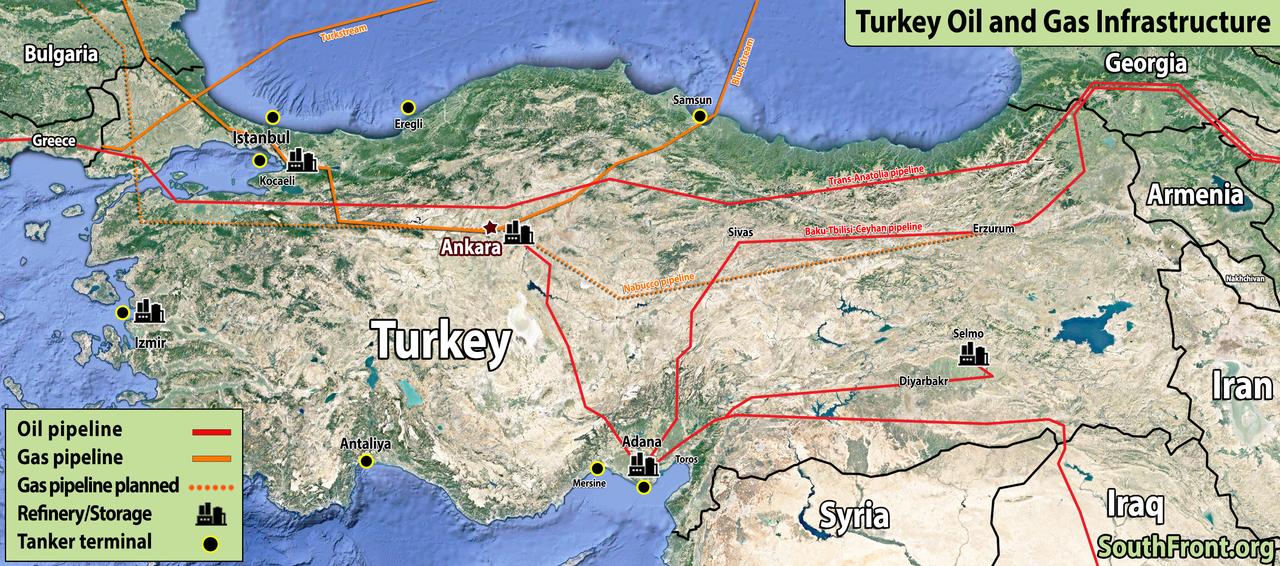
Under the plan, along the Turkish Mediterranean coast, the Russians are building four large civilian nuclear reactors at the Akkuyu nuclear facility. Erdogan hopes the Russians will complete the first reactor by 2023, in time for the centennial celebration of modern Turkey foundation. Ankara says it needs nuclear energy to reduce its dependence on gas imports from unreliable partners – Russia and Iran – and to meet electricity demand. This demand has grown at the highest rate of all OECD countries since 2005.
The following is an indication of Turkey’s energy demand:
  • Turkey’s daily electricity consumption rose 16% to record 908,395 megawatt-hours (MWh) in early July, according to official data from the Turkish Electricity Transmission Company (TEIAŞ).
  • The majority of production came from natural gas units at 216,331 MWh. Hydroelectric power stations and imported coal followed with 199,943 MWh and 188,980 MWh, respectively.
  • President Recep Tayyip Erdogan said Turkey has nearly tripled its installed capacity from about 31,000 MW to more than 91,000 MW by 2020.
  • The country has an annual increase in installed capacity of more than 6% among the OECD countries.
  • Turkey ranks first among all OECD countries with this increase in production capacity, according to Energy and Natural Resources Minister Fatih Dönmez.
  • In the first five months of 2020, Turkey increased electricity production from domestic and renewable sources to 66%. The country ranks second in Europe in the production of electricity based on renewable resources.
Launch of construction of the third block of Akkuyu. Photo Source: Sputnik
Nevertheless, the Akkuyu nuclear plant does not make Turkey any less dependent on external powers. Russia will own and operate the facility and, in fact, the Akkuyu plant is not a so good investment.
While ROSATOM, Russia’s state-owned nuclear power plant, “pays the bill” for the first reactor, it will not do the same for the other three Akkuyu reactors. Despite many years of searching for private investors, no one was found for this project. To complete Akkuyu, the Turkish government will have to finance it through foreign investment which are constantly decreasing or through public debt.
If President Erdogan had seen the energy market, he would have known that gas and renewable energy were hitting nuclear power. Even before the COVID-19 pandemic, Turkey imported gas for a fragment of the price of electricity of the Akkuyu plant – an unprofitable price of 12.35 cents per kilowatt hour.
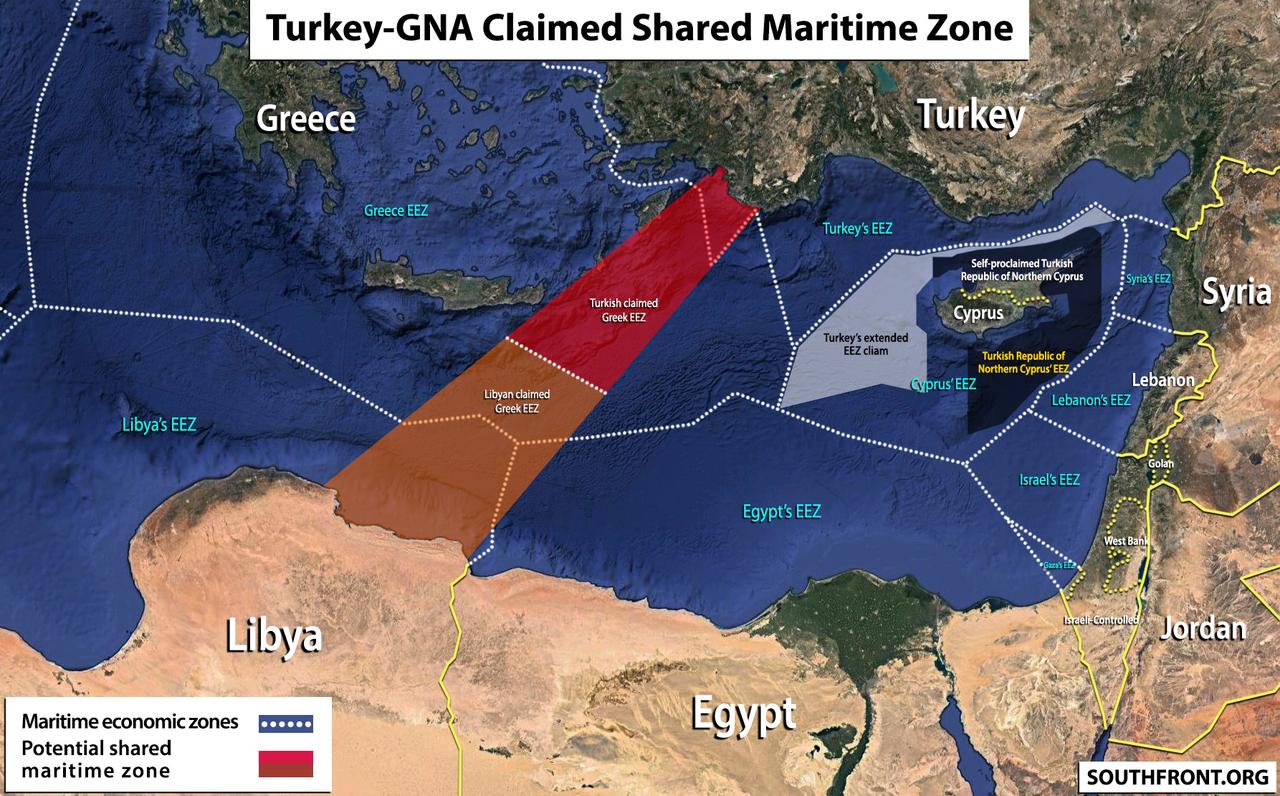
But Erdogan wants both. He also wants the natural gas, which he is trying to steal from Cyprus-Greece-Libya with the well-known accusations and completely illegal actions, such as the completely non-existent Turkish-Libyan pact, but also the foolish things he guesses in relation to International Law, that islands do not have an Exclusive Economic Zone (EEZ). He also wants nuclear weapons, since an objective observer must wonder why the country’s poor economies did not weaken Erdogan’s nuclear ambitions.
Acquiring more gas will allow Turkey to meet its electricity demand today, as it stands, 10% of Turkish electricity comes from solar and wind energy sources. One of Turkey’s leading universities recently stated that these sources could cover 30% of Turkey’s electricity demand by 2026, given the appropriate investment.
The coverage of nuclear energy for the acquisition of nuclear weapons.
What is particularly worrying is that Turkey could use nuclear energy as a cover for the supply of technology and material related to the construction of nuclear weapons. The transfer of technology is already taking place.
Since the Akkuyu project began, Turkish engineering students have become the second largest national nuclear science team in Russia. Let’s see something similar. As Russia builds an Iranian civilian power plant in Bushehr, side deals have led to the transfer of equipment and the exchange of scientists who helped Iran acquire its nuclear weapons program.
Many experts argue that the case of Turkey is not the same as that of Iran, as the former has signed an additional protocol agreement with the International Atomic Energy Agency, opening the country to closer inspections than Iran to prevent military nuclear of fissile materials into weapons.
However, we must point out that fuel is not the only problem, as UN inspectors cannot go into detail about “monitoring intangible technology and dual-use transport” that is critical to the development of nuclear weapons.
Close cooperation between Turkey and Pakistan.
Erdogan is militarily cooperating with a nuclear-armed Pakistan, a country not close to the Turkish border. For decades, Turkish-Pakistani relations have been warm but superficial.
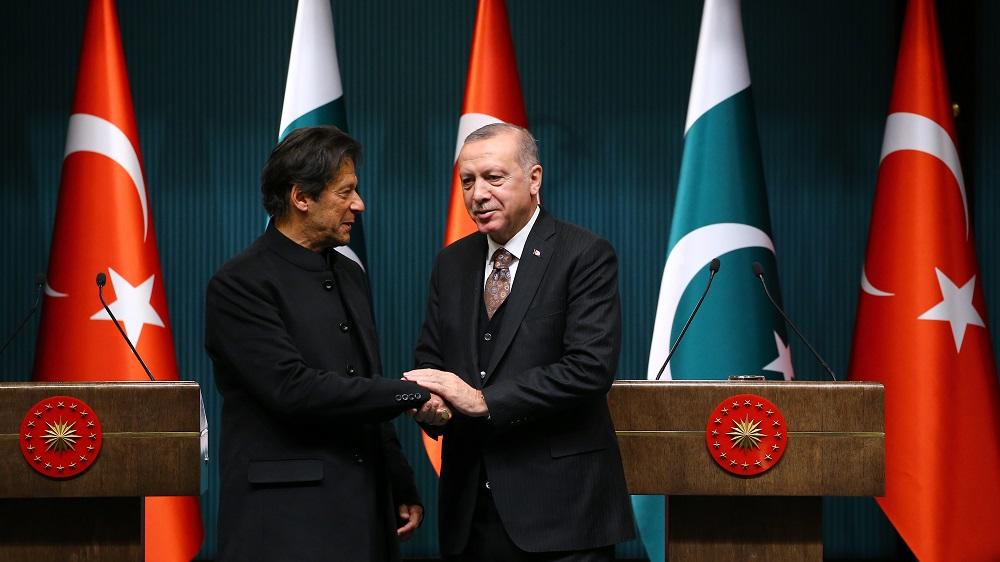
ANKARA, TURKEY – JANUARY 04: Turkish President Recep Tayyip Erdogan (R) shakes hands with Pakistani Prime Minister Imran Khan (L) as they pose for a photo following their joint press conference at the Presidential Complex in Ankara, Turkey on January 04, 2019. ( Halil Sağırkaya – Anadolu Agency )
Since 2018, Erdogan has significantly strengthened these ties. Last year, he addressed a joint session of the Pakistani parliament for the fourth time, passionately supporting Pakistan’s position in the Kashmir dispute. Not only has Erdogan suddenly become keenly interested in Kashmir, but he is providing the Pakistani military with sophisticated weapons.
Just two years ago, Turkey won its largest defense contract ever, a multi-billion dollar contract to build four large naval vessels for the Pakistan Navy. In addition, a Turkish company is building Pakistan’s largest domestic warship in Karachi.
Turkey is also upgrading Pakistani Agosta 90B Class submarines, selling T129 attack helicopters and maintenance and modernization of the PAF’s F-16s. Overall, only China is Pakistan’s largest military supplier.
Erdogan’s current influence in Islamabad exceeds that of North Korea, Iran and Libya, which have received nuclear aid from Pakistan.
The Turkish plan.
Turkey thirsts for energy. Its moves regarding the Cyprus-Greek and Libyan EEZ are aimed at embezzling the gas and oil it needs in order to meet its energy needs and its goal to become a major regional power.
The acquisition of nuclear weapons is one of its goals and it is trying to achieve it day and night under the tolerance-weakness of the previous Trump administration, the always opportunistic Putin and the weak military and politically reluctant EU.
The future of Greek-Turkish relations is one-way and leads to war, since the interests of Turkey, as I mentioned above, demand illegal actions on Greek and Cyprus’ EEZs and the natural gas and oil fields that are within it.
The purpose of the exploratory contacts on the part of Turkey is to give it the time it needs to secure its backs militarily from Greece and in fact with the intervention of the EU, while claiming that it can gain through dialogue.
At the same time, it will deploy a large part of its naval forces and a significant part of its air force in Libya in order to equip its air and naval base there, making it a protectorate and exploiting its oil and gas, but also conducting research for possible offshore deposits, within the Libyan and Greek EEZ, implementing the completely unacceptable Turkish-Libyan memorandum.
One hopes that the US-EU will block Turkey’s path to acquiring nuclear weapons and the rest of its plans that were mentioned above.

(ZH) On The Verge Of A Global Crisis: One Bank Warns Of A "Biblical" Surge In Fo

On The Verge Of A Global Crisis: One Bank Warns Of A "Biblical" Surge In Food Prices

Biblical, Lean, and Mean: 'Dreams' of an agri-commodity super-cycle
Then Pharaoh said to Joseph: “Behold, in my dream I stood on the bank of the river. Suddenly seven cows came up out of the river, fine looking and fat; and they fed in the meadow. Then behold, seven other cows came up after them, poor and very ugly and gaunt, such ugliness as I have never seen in all the land of Egypt. And the gaunt and ugly cows ate up the first seven, the fat cows. When they had eaten them up, no one would have known that they had eaten them, for they were just as ugly as at the beginning. So I awoke.”
- Genesis 41:17-21
Summary
  • Key feed and food prices have been pulled to 9-month and 7-year highs
  • We explore the ‘dream’ of Biblical scarcity; its origins and impacts; and draw comparisons with Joseph, the trader and central planner who avoided starvation for ancient Egypt
  • One point is clear: global food insecurity falls heaviest on lower income, importing nations, who spend a far greater share of their income on food than the richer ones
  • The Fed would play an ironic role in this process even as it embraces fighting poverty and inequality alongside inflation
  • This could exacerbate (geo)political risk – potentially even regarding institutional architecture
Our Base Commodity Call
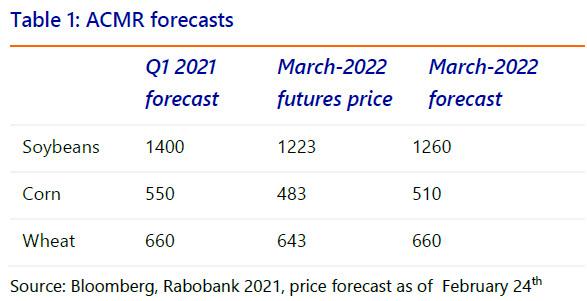
At time of writing, our forecasts for three of the world’s key agri commodities, soybeans, corn, and wheat are as follows:
The First Big Commodity Call
In the Bible, Joseph interpreted Pharaoh’s dream as meaning great abundance for seven years would be followed by an equal famine. He was then entrusted with ensuring Egypt’s storehouses were full of grain so the country could survive – which he, and it, did.
In short, Joseph made the first agri commodity cycle call, where survival came before profits. Today we have seed technology, automated agriculture, and global markets. Yet we still have lean and fat years for reasons meteorological, logistical, political, and geopolitical. This report will try to do several things:
  1. Summarise price action in key agri commodities to consider if we are seeing anything unusual – we will show we are, reflected in our elevated base price forecasts;
  2. Disaggregate and define the main drivers of these price movements. While the agri market is very old, new developments could produce striking new price patterns;
  3. Imagine what a Biblical scarcity would look like, putting forward simplified assumptions to estimate what each of them in isolation could do to food prices;
  4. Look at global food insecurity to ascertain how many countries are suffering already and would do so in the scenario that prices rise higher; and
  5. Consider the worrying (geo)political implications.
1) Supplies Shaken, not Stored
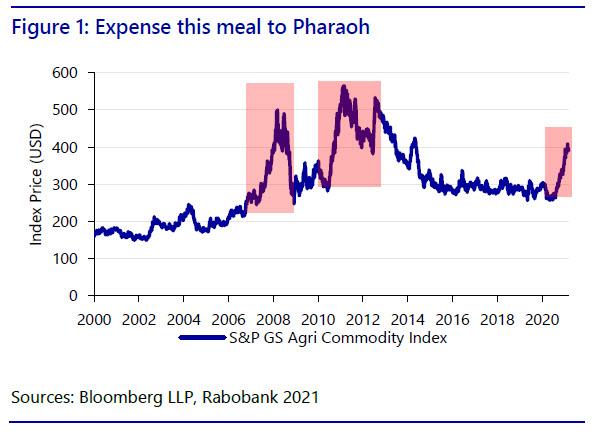
For key feed and food commodities, the message for markets and institutions is a simple one: they are going up. The S&P global agricultural index is up for a 9th straight month, to its highest level in 7 years (see Figure 1). Even though we are coming off a low base of comparison, which helps the base effects, the last period to see such a rapid rise was 2011, and prior to that 2007.
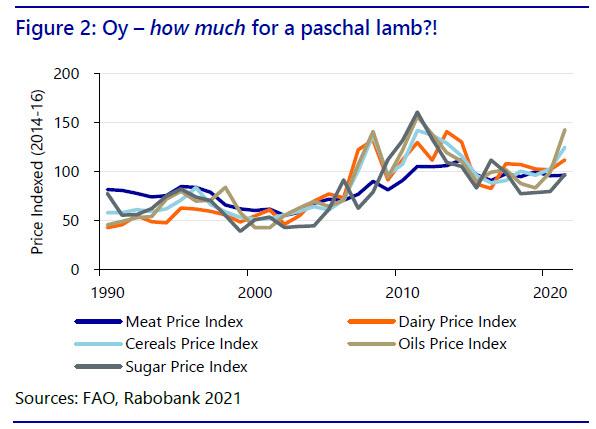
When we look at key commodities one by one the picture is similar, whether it is grains, vegetable oils, dairy, meat, or sugar (see Figure 2). This correlation makes sense, especially as many of these products share characteristics, are complementary, or are planted on the same land.
Most of the above markets have shifted into strong backwardation, indicating near-term supply scarcity that should ease with harvest replenishment. However, we remain sceptical about the resupply.
Rabobank’s price forecasts for soy, corn, and wheat --the critical building blocks for bread, meat, dairy, biofuels, and more-- are in line with present levels and above the futures curve into 2022.
2) A Bull-run of Many Colors
Today’s elevated price trajectories shows nobody had the foresight, fortitude or financial power to stockpile in the years of plenty, but there are many more factors at play. Rabobank’s recent report already covered the key drivers of the agri bull market. We will quickly reprise them as follows:
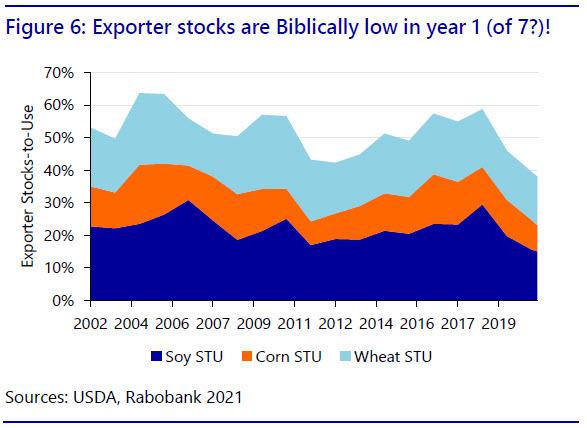
  1. Exporters stocks have fallen rapidly to 7-year lows;
  2. China is importing on a vast scale;;
  3. It’s hard to increase supply rapidly;
  4. Adverse weather conditions;
  5. Countries are engaging in food protectionism;
  6. Logistical costs are rising, notably in freight; and
  7. Speculators are holding more commodities futures.
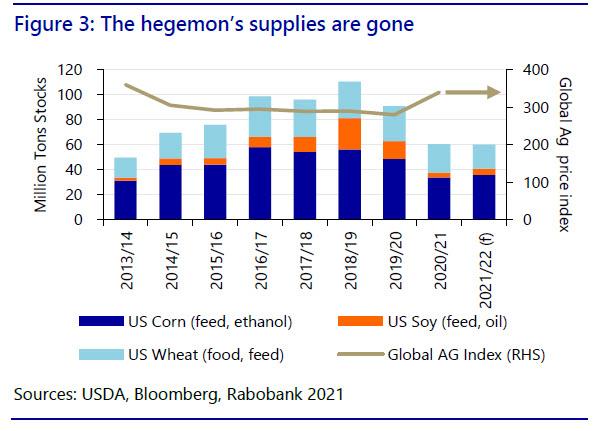
#1 Seven years of plenty ironically leave global agri commodity stocks low. Before the recent run-up, the S&P GS Agri Commodities Market Index had fallen over the last seven years as the price shock of 2010-12 incentivized diversified supplies and a shift from high cost to low cost producers/exporters. This was good news for importers, but bad for the high-cost US, who saw its stocks steadily increase through 2019. The US-China trade war and Covid-19 also saw US farmers adjust acreage lower in response.
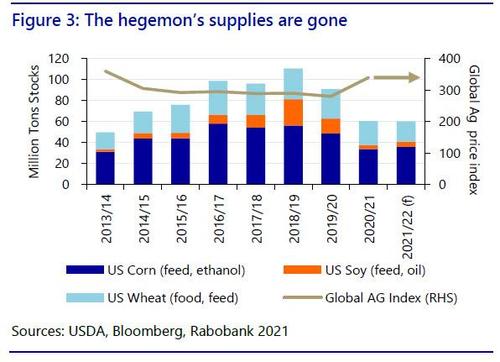
When demand then surged in mid-2020, higher cost exporters, especially the US, sold both their production and stores. In short, the US --the global food reserve bank-- has seen its grain and oilseed stockpiles slip nearly 30% y/y (see Figure 3), primarily in corn and soybeans. Moreover, we forecast only a slight increase in 2021 as our base case.
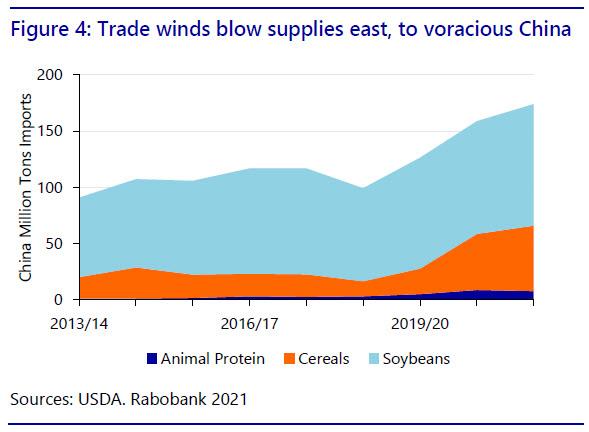
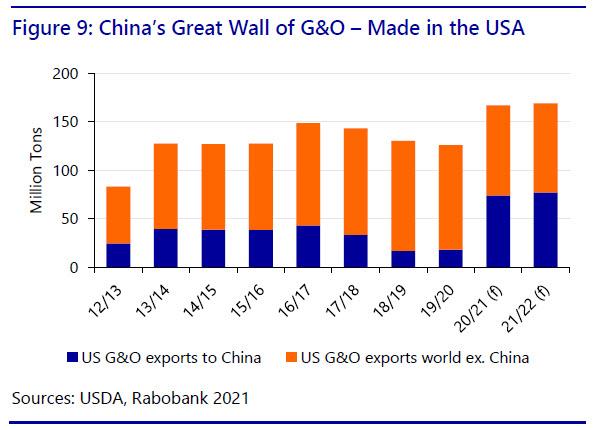
#2 China is driving demand. It is aggressively bidding for supplies to fill shortfalls and pad inventories (see Figure 4). Convalescence from dual pandemics --African Swine Fever and Covid-19-- has led to a surge in agri import demand, and hence global prices. The most remarkable increases have been in feed grain, the energy source for animal protein and ethanol: China’s imports of these have risen almost three-fold in a year to address a structural supply gap that cannot be addressed by domestic production. Indeed, China is so stretched for feed it is resorting to using old domestic wheat reserves for livestock -- 35m metric tonnes this year alone, equivalent to Canada’s production-- in addition to vegetable oil, and even pig lard.
China’s moves are singlehandedly testing supply chains to their limits. The saving grace for global markets has been that world demand across many of China’s favoured imports was absent or squeezed until now; when it returns, global supplies could be stretched further.
#3 Supplies are on a tight-rope. Coming months will see a scramble by farmers to plant and harvest. With many products facing scarcity, competition for limited arable land will limit the potential resupply. The US, for example, can only increase its summer plantings by about 5%; any production on top needs to come from yield improvement.
#4 Everything depends on the weather, where key exporters face an uphill battle. Large swathes of South America are too dry or too wet; meanwhile, much of the spring planting area in the US faces significant dryness.
#5 There is a heightened risk of protectionist policies. Many critical agri exporters are already putting up tariffs or export quotas, threatening free trade and curtailing local farm prices and domestic production to keep prices affordable. Rather than fulfilling their critical global role, such exporters are increasingly insulating themselves from global markets: Russia, the world’s largest exporter of wheat, has implemented grain export taxes; Ukraine export quotas; and Argentina, the largest exporter of protein feed, has dabbled in export quotas too.
#6 Logistics are tight. If a rising tide lifts all boats, a lack of boats lifts prices. ASF, Covid, and weather events all drive demand shifts that suppliers have been unable to anticipate or react to easily. Freight prices have jumped to a record for containers: bulk (measured by the Baltic Dry Index) has also seen large increase, and this has delayed and displaced shipments: naturally, these higher prices fall heavily on importers.
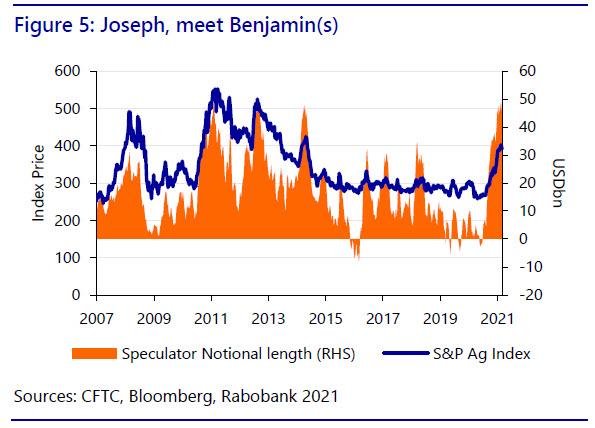
#7 Speculators. Wall Street funds already hold in-the-money positions in soy and corn – by far their largest net long position. Financial market investors currently hold contracts of grains, oilseeds and livestock worth almost 50bn USD net length or 35% of the value of all US agricultural exports in 2020. (see Figure 5.)
What makes this significant, apart from the scale, is that this is happening due to the actions of central banks. While Joseph was second only to Pharaoh, so central banks are second only to governments: yet they are not helping to smooth out food cycles like Joseph did.
Markets have grown used to extreme monetary policy since 2008. However, the aggressiveness of the Fed’s current policy stance, now aimed to let the economy “run hot”, and the shift to massively expansionary US fiscal policy too, has altered market perceptions of future inflation risks. Investors have responded by holding assets as a hedge: stocks, property, and gold/ Bitcoin.
Yet Wall Street is now holding/speculating with agri commodities too - even though this pushes up inflation!
3) A Biblical rally
Having then listed the various structural reasons for agri commodity prices to have risen so fast, we free our minds to ‘dream’ (if that is the right word) of a Biblical price rally. Our bull market stands on four legs:
  • (i) Normal supply and demand (which is how day-to-day markets are supposed to work);
  • (ii) China (given its import appetite makes it the marginal buyer that matters most);
  • (iii) Politics (covering changes to trade flows, protectionism/tariffs, and export controls); and
  • (iv) ‘Wall Street’ (where could equally say ‘the Fed’)
Leg one: Normal supply and demand:
As noted, the FAO price index at 7-year highs is supported by rises in all of its components; sugar, cereals, meat, oils and dairy. In our dream we ruminate on the products who’ve risen the most, and are thus closest to scarcity: cereals and oilseeds. They are currently so tightly balanced a small weather issue --a regular occurrence in agricultural markets-- could tip the scales towards global scarcity.
The USDA, today’s high priests of agriculture, expect maximum acreage and healthy yields in the US to maintain, but not reflate, stocks. Yet they are arguably dreaming! The US has seen two consecutive disappointing summer crops (feed grains: 359 and 375 million metric tons, soy: 93 and 113 million metric tons); and yields can often worsen, rather than improve, on expanded --less ideal-- acreage. Imagine a third consecutive lacklustre US summer harvest.
Even if last year’s average, not poor, yields were repeated in corn or soy, supplies would fall below 2012 levels, a time prices were 35% higher than today. All else equal, even a 3-4% drop in production could move soy and corn prices up by a third.
In normal times, alternative grain and oilseed export surpluses might help cushion the blow of a US supply shock – but if we take these into account too, cumulative exporter stocks-to-use are still close to 2012 levels (see Figure 6).
We started with soy and corn: but feed grains and oilseeds compete for acreage with other commodities. Moreover, soy and corn are the primary feed components for both animal protein and dairy, and produce cooking oil and biofuels.
Wheat, for one example, exhibits slow demand growth in line with slowing global population growth, but also little elasticity. The upside is that there are so many substantive exporters, which distributes supply risk. Yet global exporter stocks are again already near 2012 lows: a 10% production cut in major suppliers like the EU, US, or Russia could lift prices 30% to levels last seen in 2012.
Can this Pharaoh’s dream be interpreted to see any one commodity evading inflationary capture? Current futures market positioning may be too somnolent.
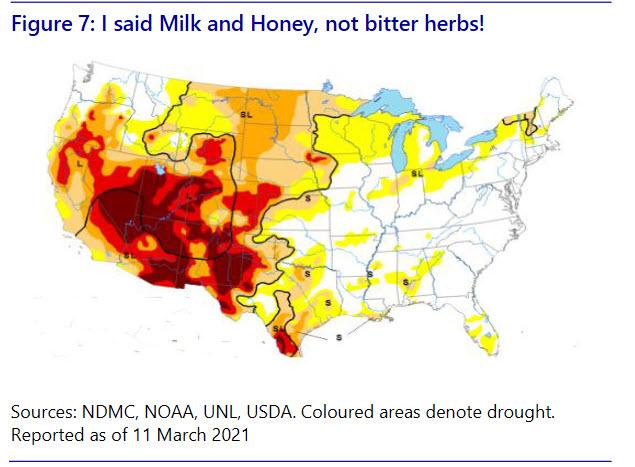
As noted, adverse weather is already affecting major production areas. Over 90% of the US Northern Plains (the area most likely to boost overall acreage), 50% of the Midwest, and 59% of the South are already in some form of drought (see Figure 7).
With winter wheat emerging, and soy, corn, and cotton about to be planted, the terrain looks nothing like the promised land the USDA is projecting. Perhaps they shouldn’t have slept on the National Oceanographic and Atmospheric Association report predicting three months of dry, warm US conditions ahead.
And what if we were to get a real US drought, as in ancient Egypt? Obviously this would be far, far worse on all fronts.
Leg two: Politics
Any crisis in food inflation risks being exacerbated by food politics. Emergent food export heavyweights like Argentina, Ukraine, and Russia have played a role in driving prices higher through export taxes and controls; and trade wars have been destabilizing and inefficient for agri flows.
In short, global supply chains appear bereft of the underlying geopolitical stability assured until recently.
In the case of a future supply issue, however modest, there is a risk of heavier exports controls. For one key hypothetical example, if Russia re-implemented its ban of 10 years ago on even half its export potential – 19m tons, the ensuing burden on the US and others could double wheat prices to the USD12/bushel last seen back in 2008.
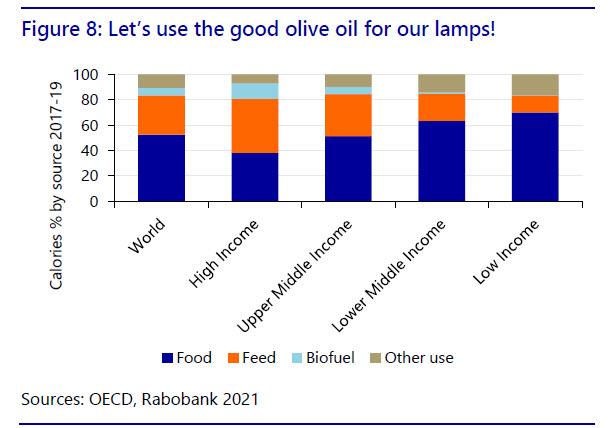
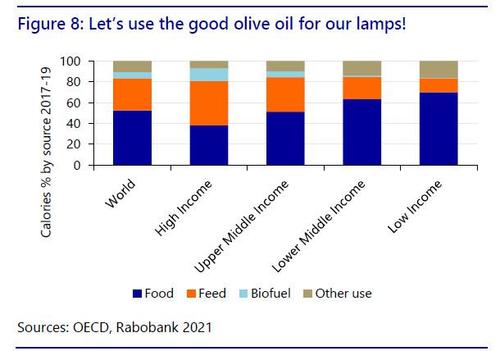
A further ‘political’ catalyst is biofuels, beneficial for farmers and the environment, but which exacerbate agri commodity supply stresses by shifting production from food towards renewable energies made from agri commodities: namely biodiesel and ethanol. Figure 8 shows higher income nations employing over 12% of their caloric inputs (primarily vegetable oil and feed grains) for biofuel ingredients.
The ethanol market was largely absent last year amid a surge in feed demand; its return could exacerbate supply pressures. For the US, a 500 million bushel rise in ethanol usage fully offsets potential acreage expansion in 2021, for example. Assuming a doubling of ethanol exports (to China), it would not be unrealistic to assume corn prices could potentially rise a further 15%. Full implementation of biodiesel and renewable diesel mandates in Indonesia, Europe, Brazil and others, supported by high diesel prices, would potentially drive support for key component vegetable oils like palm and soy near or to record levels.
In short, in the short term --where politics happens-- the Green transition could mean higher food prices.
Leg three: China
China is the single biggest swing factor besides weather/production. It has the potential to disrupt global agri balance sheets for years to come.
In the past, China has implemented Joseph-like policies and holds large stockpiles of wheat and rice, However, amid elevated domestic prices and imports of dairy, pork, oils, and grains, it is far from apparent that China is purely engaging in strategic “restocking”: rather in our ‘dream’ we interpret that China is rapidly destocking in products including feed grains and oilseeds.
Higher imports and domestic production increases are the apparent solution. China is expected to import 35-45 million metric tonnes of feed grains per year for the coming years - much more if rosy production expectations are unfulfilled. If China’s domestic output disappoints, it would exacerbate a structural deficit requiring yet higher imports of grains and oilseeds --by as much as 15m metric tonnes-- and raise global prices of corn and soy by additional 30%.
Leg four: Wall Street
As already noted, Wall Street is an established player in the agri commodity space and has room to grow its inflation-hedging bets from here. Despite current long positions, the overall net position is still nearly 10% below the record.
Wall Street probably wouldn’t increase its positions in a vacuum: but if any of the above ‘legs’ come to pass, it would likely respond. Funds could easily extend their speculative length, not just in feed, but also wheat. This ‘dream’ could help push agri prices up to the 2012 peak 40% higher from here.
Moreover, should US ultra-loose monetary and fiscal policy produce significant US inflation, or stagflation, and/or yield curve control to peg the long-term cost of borrowing, Wall Street would again likely increase its agri commodity inflation hedges.
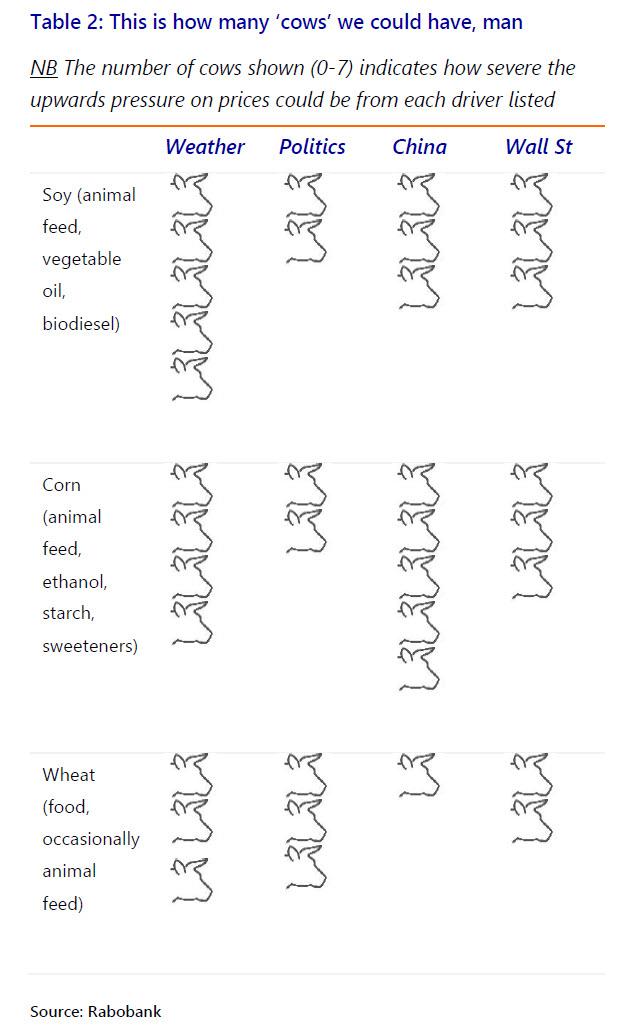
We summarize the relative impact on soy, corn, and wheat in this (bad) dream scenario below:
For soy, the primary price driver ahead is weather (5 from a maximum 7), then China and Wall Street equally (3), then potential political actions (2). For corn, China is the largest potential factor (5), followed by weather (4), then Wall Street (3) and politics (2). For wheat, weather (3), politics (3), and China (3) are all equally important, with Wall Street relatively less so (2).
Of course, all cows stand on four legs, and any one of the factors above could play out individually for any one commodity to significant effect. Yet as with any cow, where one leg goes, the others usually follow.
In short, if we were to see bad weather; and protectionism/sustainability-related regulations; and further heavy buying from China; and a surge in Wall Street speculation then it is hard to say just how high prices could reach before demand destruction kicked in.
(4) Food Security
The impact on food security should be obvious: indeed, it already is:
  • In the MENA countries --the highest per capita consumers of bread-- the 30% increase in international wheat prices seen so far in 2021 leaves them just shy of levels seen during the revolutionary Arab Spring;
  • Asia’s burgeoning middle class is grappling with 30-50% increases in pork, cooking oil, sugar, and dairy prices; and
  • Africa, with lower GDP per capita, has an even clearer predicament.
Yet in our dream, things get worse. The impact of price increases will fall disproportionately on poorer, importing countries, reversing the improved economic outlook for some of the new global middle class - and even lower income deciles in the wealthiest countries would feel it. We attempted to summarise these risks with simple snapshots.
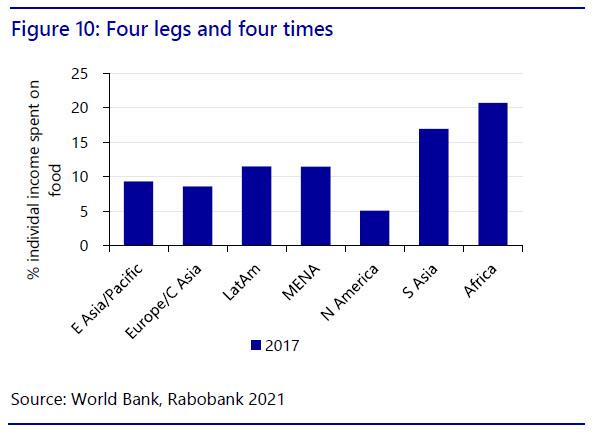
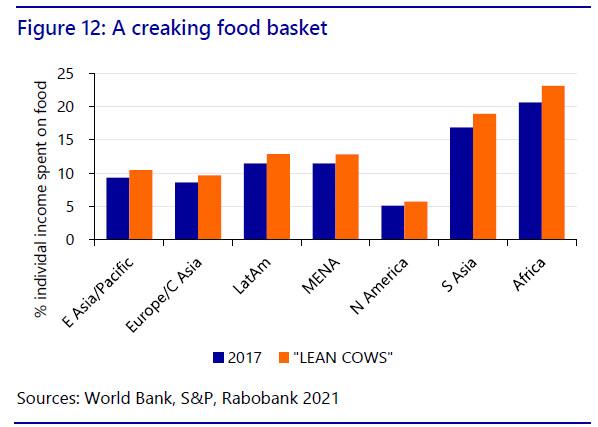
World Bank data from 2017 show USD income per capita around the world at purchasing power parity. The same data also show the amount spent on food per capita. One can then calculate the percentage of income allocated to food (see Figure 10). Obviously, the figures vary between wealthy regions, such as North America, and poorer ones, like Africa, where the differential is over a factor of four.
Holding income figures constant (as this is just an indicative exercise), we then change agri commodity inflation. Although such agri price changes have and will vary by commodity, we use the aggregate index as a base to avoid having to break down the complexities of varying national diet patterns.
As we showed, since 2017, agri commodity inflation has been substantial (45%). We then project a hypothetical doubling of the agri commodity basket for our ‘lean cows’ dream on top.
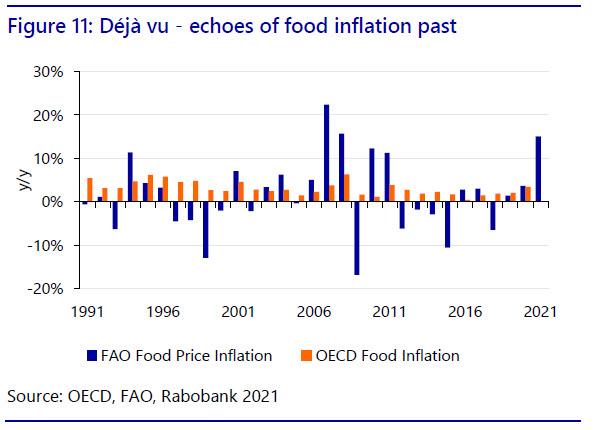
We must then consider how much of the change in price in the agri commodity basket is actually passed on to higher food prices. One might be surprised how little of the cost of the foods we eat actually reflects the raw ingredients as opposed to labour, rent, logistics, etc. (See Figure 11.)
Keeping all of these factors unchanged, we presume that agri commodity inflation of around 100% would translate into recorded global food price inflation of around 12%. This reflects OECD food inflation of 6-8% in recent scarcity events, while recognizing that in some sectors and markets this has tended to be higher, in particular for import dependent countries.
As can be seen in Figure 12, on a regional basis we can see that for East Asia and the Pacific, the percentage of individual incomes spent on food rises from 9.3% to 10.4%; in Europe and central Asia from 8.6% to 9.6%, Latin America from 11.5% to 12.9%; the Middle East the same 11.5% to 12.9%; North America 5.1% to 5.7%; South Asia from 16.9% to 19.0%; and sub-Saharan Africa from 20.7% to 23.2%.
Of course, the actual impact may be less given incomes would have risen in most places in the past four years in line with GDP growth – but then again Covid-19 could well have seen these gains partially reversed in many locations.
To put this into perspective, one also needs to consider where a crisis threshold lies in terms of food affordability.
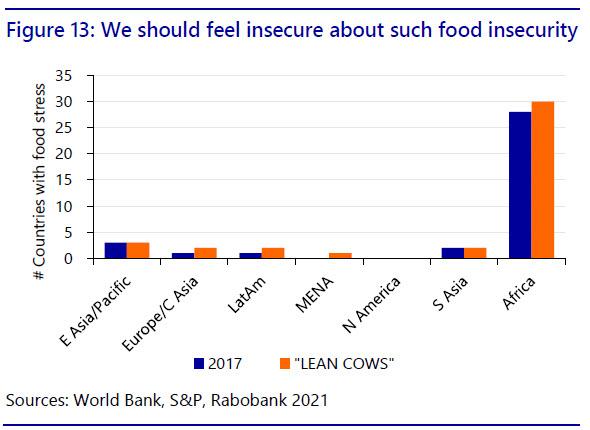
Although this again varies for a number of reasons, if one selects the 20% of income as the key level, double the world average, then the global impact of this ‘dream’ agri commodity price shift cannot be understated.
Figure 13 shows the total number of countries in each region that were already at risk of food insecurity using the World Bank’s 2017 data compared to the number projected ahead using our “lean cows” assumption. As can be seen, Central Asia sees 1 additional country slip into food scarcity; Latin America 1; MENA 1; and Africa 2. Again, this is presuming a 12% increase in food prices: if more lean cows were to emerge, more people would also get leaner.
Even as is, 42 countries globally would be food insecure: and a staggering 102 countries would see a relative decline in their purchasing power of food, representing a step backwards down the pyramid – Maslow’s pyramid of basic needs. We would be back below 2011 levels in terms of food affordability, representing over a lost decade in the fight against hunger.
At the very least, steady progress experienced by much of the emerging world’s middle class could be frozen or reversed. That’s a process we have seen end in populism in Western economies already.
‘Yum’ Kippur?
We are talking here about a potential surge in parts of the agri-commodity complex. However, our global macro inflation thesis remains very different.
We continue to recognise the significant near-term upwards price pressures in many areas of the economy, which stem from a combination of base effects, Covid-related supply disruptions, genuine demand increases - or shifts, and looming US fiscal stimulus. Yet as we have argued for many years, structurally one only sees inflation sustained if either supply is too weak (and outside agri commodities and semiconductors, this is not an issue), or demand too strong – and workers still do not have the bargaining power to push for pay rises in most sectors of most economies. The present US fiscal stimulus does not address this issue at all.
Indeed, the greater likelihood is still that after an upwards surge in H1 2021, there will be a downshift in aggregate inflation pressures again into 2022. Were we to see a bounce in the US dollar on the back of higher long end US rates, this would exacerbate that trend: it could also partially weigh against some of the bullish agri-commodity trends we consider.
Moreover, were we to see an economic slump after the current US fiscal ‘sugar rush’, then presumably agri commodity prices would come under further downward pressure: note that previous spikes have often been rapidly followed by just such a slump. (More like seven lean then seven fat months in that case!) In that case, the Wall Street speculation we have already underlined would also be rapidly reversed: and what has helped make for fat markets would then make for lean ones. In short, volatility would be amplified in both directions.
Nonetheless, let’s dream agri commodity prices stay high for structural/political factors even as aggregate inflation falls back due to a weak global economy. We have seen something similar to this hypothetical backdrop previously if one shifts the kind of oil one is thinking of.
Indeed, think of the oil price spike experienced after the Yom Kippur War of 1973 and Arab oil producers responding with reduced supply into what was then a far more Keynesian, fiscally-driven world economy.
WTI oil, for example, jumped from USD3.56 in July 1973 to USD4.31 at the end of that year --a 21% increase-- and then again to UDS10.11 --a 293% increase from the July 1973 price-- at the start of 1974 in response to Arab oil-state’s actions (see Figure 13). This necessarily pushed general inflation much higher in tandem globally.
As we know, the demand-led policies of Western economies, which were still far more regulated, far less globalised, and had far stronger unions at that time, led to inflation-matching pay rises, so setting off a wage-price spiral. Consequently, oil prices marched as high as USD39.50 --a 390% increase over January 1974 and 1,109% over July 1973-- before eventually declining.
What is critical to recall is that this episode was arguably the key political driver of the structural reforms put in place to globalise and liberalise Western economies in order reduce the power of labour in favour of capital, capping inflation pressures in the process. With global populism rising, and critics pointing out those reforms have gone too far, producing socio-economic problems of an entirely different but just as damaging kind, the key hypothetical to ponder is this:
Could a sustained rise in agri-commodity prices prompt a political backlash away from neoliberalism and back towards deglobalisation and regulation? Could the Yom Kippur-driven reforms be reversed by a ‘Yum’ Kippur?
Of course, nobody knows. However, you don’t have to be Joseph to see that political developments such as Brexit, and obvious examples of agri protectionism, mean it would be dangerously naïve to rule this risk out entirely.
This in itself would then open up a new discussion of what such a structural shift might mean for the increasingly-turbulent geopolitical backdrop, and how that then might flow back to markets.
After all, there was open talked of an Arab “oil weapon” after the 1970s: and the emergence of the “Petro-dollar” was intimately linked to how the huge oil surpluses Arab states then began to accumulate were recycled: in short, into the US, in exchange for US military protection.
This brings us firmly to geopolitics.
And Pharaoh said to Joseph, “See, I have set you over all the land of Egypt.”
5) Not Just Any Dream Will Do
After all, let’s not forget that Egypt was the ancient world’s superpower because of its grain harvests: the flow-through from food prices to geopolitics today should be obvious:
First, weaker states could find themselves at risk of significant instability: it’s not a coincidence the last global agri commodity price surge coincided with the Arab Spring. Given even developed economies have experienced major socio-political unrest, the risks should be self-evident. In short, an agri commodity price spike, like Covid-19, could be an accelerant to pre-existing political trends.
Second, we live in a new age of Great Power politics, centred around an unfolding US-China rivalry, in which US food production and a Chinese food deficit plays no small part. Would higher agri prices mean the US-China Phase One Trade Deal holds, or breaks, for example?
More broadly, a key question is whether an agri commodity price shift higher would help force changes in the structure of the global economy and financial system. We have covered the likelihood of a paradigm shift away from the USD many times, and have always been highly sceptical. Yet hunger is a powerful incentive for action.
Such a ‘lean’ backdrop could accelerate efforts to shift the global trading system away from the USD. Both China and Europe could push for adoption of alternative payments systems, or at the very least for commodity pricing in EUR or CNY.
China is already trying to boost local agri production and diversify its agri imports. However, it would require an entire network of major agri producing countries to make a FX/trading paradigm shift away from the USD in tandem with it in order to break free from the US(D) yoke in agri markets. Until then China would remain in a relatively weaker position vis-à-vis the US on this key front. Its huge appetite for agri commodities (and by extension, USD) would remain: and if it were to continue to snap up global agri supplies, then resentment could rise against it too along with said prices.
On one hand, this suggests a weaker CNY, as we saw under previous periods of structural stress (over exports to the US, and technology controls): on the other hand, a stronger CNY would help make agri imports cheaper. In short, China would have difficult strategic choices to make, with each option coming with major trade-offs.
Europe would be better placed in terms of food security due to its comfortable agri surplus and high incomes. It also has plans to broaden the international usage of EUR. Yet its twin Achilles’ Heels are still that relies on a US-controlled Eurodollar and a US-owned defence umbrella.
Emergent global middle powers would have to adapt to a multipolar, volatile geopolitical environment, and ponder what food (in)security means for their own strategic positioning: for exporters and importers it obviously implies very different opportunities/risks. More concretely, would they side with the US or China if forced to make a choice in the global trade/FX paradigm?
Meanwhile, there would likely be a new “Race for Africa”. China has been extremely active there in recent years; so has Russia; and Turkey; and the EU sees itself as having a major role in both Africa and the Middle East. America is also likely to be involved, albeit under the guise of national security – which in a way it of course is.
Ultimately, however, just as the gold-pegged USD segued to a new, bigger fiat role as the “Petro-dollar”, backed by US military might, so the stronger global “Eurodollar” would be supported by the US being a major net food producer and exporter (and military power). Indeed, global food insecurity would underline the extent to which the US can ride out food price cycles that batter other economies, supporting its hegemon status.
For countries unable to afford food imports priced in USD, the US would be in the position to bail them out with FX swaps or loans as it saw geopolitically advantageous – or to support multilateral organisations doing the same. It might not be able to produce extra food at short notice, but it could produce the USD to buy existing food, even if it forced prices to spiral even higher in the process.
Yet at the same time, however, global resentment of the US would likely rise if these actions did not materialise; and/or on the perception that the old adage of “the dollar is our money and your problem” were the US starting point. How much global patience would there be for the Fed (and US government) to echo Dr. Martin Luther King, Jr.’s “I have a dream” on equality if the global outcome was greater food insecurity? How does one sell helping the poorest in one of the world’s richest economies if it also hurts the poor in the world’s poorest economies?
In short, it is the stuff of (bad) dreams: but high global food prices would deepen and widen pre-exiting geopolitical fault lines, and open up new ones. This could easily flow back to agri commodity markets in a reflexive process.
What Dreams May Come
Although nobody’s dreams correctly tell the future, there appears a worrying risk that many individual factors (weather, politics, China, and Wall Street) could individually --and in a worst case, collectively-- push up global agri commodity prices significantly on top of the marked increase that we have already seen in 2021 to date.
Were this to prove the case, food insecurity would obviously increase, with the impact potentially felt by billions, most so in sub-Saharan Africa and South Asia: we would face a potential lost decade for reducing food insecurity and improvements in disposable income; and the rapid growth of their middle classes could be stunted for years. In terms of food affordability, 42 countries would be worryingly insecure, and 102 would be worse off than they were in 2011.
Critically, this would not be something the current global political economy would passively accept. Shortages of luxuries or electronics are one thing: food is quite another. Rising populism among a weakened middle class in the West, 2020’s scramble for PPE, and 2021’s dash for vaccines already all show just how easily the rules of the global trading order can be up-ended when local politics dictates.
All of this would only exacerbate geopolitical tensions that are already evident across various locations.
Moreover it could, in some scenarios, such as last seen in the 1970s, shift our global political economy and financial architecture in new (or rather, old) directions: at least it may see attempts at such, even if not successful.
Food for thought (Joseph), as we consider how Pharaoh this rally still has to run.

WSJ : Bank of Japan Drops Stock-Buying Target After Market’s Rise

Bank of Japan Drops Stock-Buying Target After Market’s Rise
The central bank has become the single largest shareholder in the Tokyo market

TOKYO—The Bank of Japan dropped its annual target for stock purchases Friday, a shift for the central bank after years of building a stock portfolio worth hundreds of billions of dollars.

Since 2016, the Bank of Japan had said it would seek to buy about ¥6 trillion, equivalent to $55 billion, in exchange-traded stock funds annually. In March 2020, when the coronavirus pandemic was developing, it added that it could buy up to twice that amount annually when the market was falling rapidly.

On Friday, it dropped the ¥6 trillion target but reiterated it was ready to step in with larger purchases if needed. It said the higher purchase limit, previously described as a temporary pandemic response, would continue even after the pandemic subsides.

The move came after a rapid rise in stock prices over the past year that has brought the Nikkei Stock Average near a 30-year high. As of March 1, the BOJ’s stockholdings were worth more than $450 billion, according to NLI Research Institute, making it the single largest holder of shares in the Tokyo market.

Some critics including former BOJ officials have said the outsize presence of the central bank is interfering with the independence of the stock market, and they have called on the BOJ to pull back.

Also Friday, the BOJ said the 10-year Japanese government bond yield could move more freely around its zero target. It said it would let the 10-year JGB yield move in a range between minus 0.25% and plus 0.25%, compared with the previous guidance for a band between minus 0.2% and plus 0.2%.

The bank maintained its target for short-term interest rates at minus 0.1%.

It also released measures to ease side effects of the negative interest rate in preparation for future rate cuts.

The pandemic has caused prices to fall and made it unlikely that the BOJ’s 2% inflation target will be achieved soon. Most Federal Reserve officials said earlier this week that they expected the Fed would hold rates near zero through 2023.

WSJ : Insurance Giant Chubb Offers to Buy Rival Hartford

Insurance Giant Chubb Offers to Buy Rival Hartford
The 211-year-old target says it is considering the proposal

Chubb Ltd. CB -2.63% , one of the nation’s biggest, oldest and best-known property-casualty insurers, has made a preliminary proposal to acquire Hartford Financial Services Group Inc., HIG 18.71% another storied name in the industry.

The Connecticut-based Hartford said in a release Thursday afternoon that it “has received an unsolicited, non-binding proposal from Chubb” to acquire the 211-year-old company. Hartford said its board of directors “is carefully considering the proposal with the assistance of its financial and legal advisors.”

In a statement after the market closed, Chubb said the proposal would value Hartford at $65 a share, saying the combination “would be strategically and financially compelling for both sets of shareholders and other constituencies.”

At $65, the offer is 12% above the stock’s opening price Thursday of $57.94. Chubb said it submitted its proposal March 11.

“We have not yet received a response to our proposal but are looking forward to constructive, private discussions in order to expeditiously consummate a fair transaction that benefits all of our respective stakeholders,” Chubb said in the statement.

The offer signals that Chubb’s chief executive officer, Evan Greenberg, is ready for another bold deal.

In 2016, Mr. Greenberg was CEO of business and home insurer Ace Ltd. when he combined it with the then New Jersey-based Chubb Corp. in an approximately $30 billion transaction. The merger turned Chubb into an international powerhouse.

Mr. Greenberg and his team have delivered strong financial results, and Chubb has become one of the biggest global insurers, with market capitalization of more than $75 billion as of Thursday. Its shares were down 2.6% at the market’s close.

After news of Chubb’s takeover approach for Hartford was first reported Thursday by Bloomberg News, shares of Hartford surged. They jumped yet further after the insurer’s midafternoon news release, to finish the day up nearly 19%. Its market capitalization stands at about $24 billion.

Hartford was one of the hardest-hit U.S. insurers during the 2008-09 global markets meltdown. The firm took federal aid, which it has since fully repaid. In the years since, Hartford divested various units to focus mostly on property-casualty insurance for businesses and individuals, offerings for employers’ benefit programs and a mutual-funds business.

Its chief executive, Christopher Swift, made some acquisitions over the past few years as the firm narrowed its focus. Those deals included buying a specialty business insurer, Navigators Group, and a unit from Aetna Inc. that provides life insurance, disability income and other products for companies’ employee-benefit programs.

Before its merger with Ace, Chubb was known by the public as a leading provider of homeowners’ insurance to wealthy Americans through its pricey, but extensive Masterpiece coverage.

Evercore ISI analyst David Motemaden said Hartford was a logical choice for a company like Chubb, which is trying to reinforce operations to insure small-business clients. In a research note, he said Hartford’s small-commercial franchise could complement Chubb’s leading position in insuring large companies, while Hartford’s business of insuring midsize companies would bolster Chubb’s operations in that part of the market.

Hartford said in its release that its board of directors “is committed to acting in the best interests of shareholders over the long term.”

FT : Bottled water should be a luxury, not a necessity

Bottled water should be a luxury, not a necessity
The profits of brands such as Evian and Perrier can pay for environmental offsets

Emmanuel Faber’s ousting this week as chief executive of Danone, the French maker of Activia yoghurt and Alpro soya milk, was a victory for activist investors who disliked his style. He might have lasted longer but for the pandemic’s heavy toll on one of Danone’s biggest products — bottled water.

Bottles of Evian from Évian-les-Bains and of Volvic from the Auvergne sold well across Europe until Covid-19. As many restaurants and offices closed, people spent less on mineral water and drank more of their own water at home. Danone’s like-for-like sales of bottled water fell 17 per cent in 2020.

It feels like a lesson in the bare necessities of life: most of us have perfectly good water, literally on tap, and do not need to drink spring water from plastic or glass bottles. As Richard Wilk, an anthropology professor, once wrote of bottled water, “getting people to pay for things that they already have in abundance” is a perverse feat.

This is not the only objection to products such as Evian, or Nestlé's Perrier and S. Pellegrino. Transporting water long distances in bottles that can end up in landfill sites or oceans, rather than piping it in bulk, hurts the environment in ways that companies have been slow to address.

But fancy mineral water drunk by people who already have potable water on tap is a luxury that can pay for its environmental remedies. The greater problem is that billions of people drink bottled water out of necessity, either because the public alternative is not safe, or because there is none at all.

Adam Smith, the 18th-century economist, identified the paradox that water, which is essential to life, was priced lower than diamonds, a luxury. The answer was that someone who has plenty of water does not value another glass of it highly — its marginal utility is low. Natural diamonds are scarce, so each additional one is valuable.

Mineral water’s rise in popularity is a story of companies such as Nestlé persuading consumers that the liquid that comes in bottles is healthier and more tasty than that from pipes. By branding it and controlling supplies, they turned it into a scarce consumer good with a high price. Voilà!

It is not wholly an illusion; Badoit and Perrier do have a distinctive taste and fizz. But if you have a water filter and a SodaStream machine at home, as I do, you can save a lot of money, effort and waste while drinking carbonated water that is just as satisfying as most supermarket “spring water”.

It took too long for companies to recognise that bottled water was good for people, but not very healthy for the planet. They are still some way from making these brands ecologically responsible by using recycled plastic for bottles, and curbing transport emissions, although Evian was certified as carbon neutral last year.

The good news is that luxury water is pricey. A bottle of S. Pellegrino costs about four times as much a litre at a British supermarket as a pallet of Costco’s private label Kirkland Signature “bottled at source in Chase Spring, Lichfield”. The profit can pay for environmental offsets such as replenishing water tables.

This is the special stuff. Most bottled water does not flow from a French spa: it is from humbler aquifers, or is just purified municipal water, such as Coca-Cola’s Dasani. Much is sold in countries where the public water supply is contaminated or scarce — 70 per cent of Danone’s bottled water sales by volume fall into this category, such as its Aqua brand in Indonesia.

That is a more pressing worry than whether Evian bottles are ferried across Europe by train or truck from Évian-les-Bains. Access to drinking water should be a human right, but even bottled water in Nigeria can be contaminated with bacteria, and half a billion people in the world face severe shortage all year round, according to one study.

The US is not immune — supplies were contaminated in Flint, Michigan, in 2014 after the city pumped water from the Flint River, forcing citizens to drink from bottles instead. Nestlé, which used spring water elsewhere in Michigan for bottling, faced a backlash and last month sold its North American brands including Poland Spring, Deer Park and Arrowhead.

Companies such as Danone are not primarily to blame for the failures of cities and countries to distribute clean water: I am grateful for bottles when visiting China or India. But private water should not displace public supplies. Nongfu Spring, China’s largest bottled water group, is valued at about $65bn thanks to its extraction rights to 10 water sources,

Climate change and water scarcity add to the challenge in many countries, and tempt them to hand over responsibility to the private sector. That is one reason why Morgan Stanley places bottled water at the top of its “Magnificent Seven” group of consumer staples with global growth prospects.

But bottled water should be a luxury, not a necessity. When the pandemic ends, restaurants will serve more Evian and Perrier again, but the prime task is to make ordinary water flow safely.

FT : Deliveroo offers a slice of the action

Deliveroo offers a slice of the action
IPO should help retail investors develop a taste for shareholder democracy

A friend has received an email from Deliveroo. It’s a bit different to the usual offers of free pudding on Valentine’s Day, the PR stunts around Bake Off, the Mother’s Day credits or suggestions that we all learn to love Wagamama’s hirata buns.

His message tells him “Deliveroo is considering becoming a publicly listed company” and expects “to make up to £50m of shares available to our customers”.

He can click on a special link that takes him through to a firm called Primary Bid and he will find himself on a priority list for an allocation of the food delivery firm’s shares.

I’m a little cross I haven’t had one of these emails — my family are enthusiastic Deliveroo users and I like being on VIP lists (any kind will do). But I am also a little thrilled. One of the maddening things about the recent boom in both IPOs and secondary offerings in the UK over the past year has been the way that ordinary investors have been excluded.

You weren’t allowed to participate in the recent listings of Moonpig or Dr Martens for example. And that is not a new thing: in the three years to October 2020, say the chief executives of the UK’s biggest retail investment platforms (who have written to the City minister to complain), ordinary investors were excluded from more than 90 per cent of new listings.

This seems a shame, to say nothing of a tad unfair. Research from Interactive Investor suggests the average share price of a new entrant to the Aim market since the end of 2018 popped 12 per cent by the end of the first day of trading. It would be nice if we were all offered a piece of that success.

Deliveroo’s offer to retail investors is far from perfect. Fifty million pounds is small beer in the context of the £1bn the firm hopes to raise in the IPO — and even if you are on the special list you can only apply for a maximum of £1,000 worth.

There’s also good reason to be wary of buying any at all. January saw the best month for IPOs on record globally. I’m pleased about that (more listed companies is a good thing). But you can also have too much of a good thing: floods of listings tend to come towards the end of bull markets, when punters are a little too free with their cash and investment banks are a little too keen to flog them stuff they might not so easily get away with offering in more testing times.

Deliveroo operates in a fickle, very competitive market — jammed full of alternative and just as easy-to-find food methods as the one it offers. I cook. I use Uber Eats and Just Eat. I occasionally walk to an actual restaurant and collect supper. And I have some residual hope — which I try to suppress on the basis that regular disappointment is not good for one’s health — that I will soon sit down in a place of my choosing away from my own home to eat. Maybe even inside.

We also have no firm idea how the company will be priced. It’s owners and bankers will definitely be hoping that the market will be prepared to value it as a tech business rather than a delivery outfit.

That makes some sense. It doesn’t employ the 100,000 riders it works with. It doesn’t own any restaurants or bikes — just the technology platform that puts them together and an awful lot of customer data.

The latter is clearly valuable stuff. But it would still be nice to see a few more companies come to market with more than data woo woo to offer. Profits, even. Deliveroo made an operating profit in some months of last year, but nonetheless reported an overall loss in 2020 — a year in which we were all mostly locked in our houses ordering food online. 

That was also before Uber this week agreed to implement a key Supreme Court ruling and treat its drivers more like employees — almost certainly driving up labour costs in the gig economy.

Finally, new investors might be a bit nervous of Deliveroo’s planned dual class share structure. There will be A shares and B shares. Each B share will come with 20 votes. Each A share will come with one vote. Deliveroo founder Will Shu will get the B shares. You will get the A shares. Obviously. I don’t much mind this — the Bs turn into As after a few years anyway, but you might.

Whether you end up buying or not (I will be nicking my friend’s link to sign up on the basis that I spent £100 on Deliveroo-facilitated pizza last week so am surely eligible), the key point is that this is going to be one of the biggest IPOs in the UK for a long time. And you have been given the option.

Shareholder democracy has been in retreat for years. That matters — the more we are all invested in companies we understand and are rooting for, the better capitalism should work. Well-known brands letting us into their IPOs is a good step forward. The next one is something I reckon Deliveroo could also help with. For shareholder capitalism to work, we need to be properly engaged with the companies we own.

That means voting — something most of us can’t be bothered to do because of the admin and so simply don’t do. Now we hold most of our shares on platforms it isn’t that straightforward.

Perks might help. In the past, listed companies offered shareholders fun stuff — discounts, vouchers, the odd free gift — just for holding shares. Some still do. Deliveroo could do the same but go one further: encouraging shareholder democracy by offering perks for participation. 

How about a doughnut voucher for every 100 shares voted perhaps? That should be enough to get shareholders who use platforms to start demanding that they figure out a simple route to them getting full shareholder rights. What’s in it for Deliveroo? No immediate threat to the founder’s plans (remember the B shares). But over the longer term, the company gets a group of investors genuinely interested in their business and perhaps having the “emotional connection” to their brand that the IPO blurb says they want. Plus even more free PR than the £50m offer is already getting them. 

You might say Krispy Kreme kickbacks aren’t the right way to deepen shareholder democracy. I’d say it doesn’t matter how we do it. Incentives work. Send the doughnuts.

FT : Johnson urges EU to step back from coronavirus vaccine war

Johnson urges EU to step back from coronavirus vaccine war
UK prime minister spoke to European Commission head as Britain faces shortfall of jabs

Boris Johnson has privately urged European Commission president Ursula von der Leyen to avert a coronavirus vaccine war, as Britain’s Covid-19 inoculation programme braces for a surprise shortfall of jabs next month.

The UK prime minister raised his concerns after von der Leyen publicly floated possible controls on EU-made vaccine exports, in a move widely seen as targeted at Britain. UK ministers insisted that contracts to supply vaccines — including BioNTech/Pfizer doses made in Belgium — must be honoured.

The EU has long complained that Britain has not exported any UK-made vaccines to the bloc even as millions of jabs have flowed in the other direction. However British ministers have pointed out that AstraZeneca signed an early deal with the UK government to supply 100m doses of the vaccine it developed with Oxford university.

Downing Street and the European Commission declined to comment on the conversation between Johnson and von der Leyen, which happened on Wednesday, but people briefed on the call confirmed the content. Some British officials said the commission president had not made any explicit threats about which vaccines might be blocked from reaching the UK.

Von der Leyen has said all options are on the table, as Brussels insists that countries benefiting from EU vaccine production show “reciprocity”.

The disclosures came as the European Commission fleshed out plans to tighten up rules on exports of vaccines to countries that it believes should be sending jabs to the EU.

The proposals, which are likely to be discussed by EU leaders next week, have triggered a mixed response among member states, however, as some capitals fret that the bloc risks damaging its reputation as a reliable supplier of jabs to the world. 

UK health secretary Matt Hancock said Thursday: “I’m sure the EU will live up to the commitments and statements it has made — including President von der Leyen herself.”

Johnson struck a conciliatory note at a Downing Street press conference, saying he wanted to “co-operate with our European friends” and promising the public: “We will get on and deliver all the second doses of Pfizer.”

The UK prime minister insisted Britain’s “progress along the road to freedom remains unchecked”, even as he confirmed the country will be hit next month by a shortfall of vaccines.

He confirmed Britain’s inoculation programme would be knocked off course in April by the delayed arrival of an estimated 4m vaccines from India and a need to retest a batch of 1.7m AstraZeneca doses.

The shortfall of vaccines will mean a dramatic drop in the number of Britons receiving first doses in April, but Johnson insisted that the “road map” for the phased lifting of Covid-19 restrictions in England remained intact.

Johnson revealed that he would receive his first jab — an AstraZeneca dose — on Friday, adding: “The Oxford jab is safe and the Pfizer jab is safe. The thing that isn’t safe is catching Covid.”

His comments came as Britain’s Medicines and Healthcare products Regulatory Agency said on Thursday there was no evidence to suggest that blood clots in veins were caused by the AstraZeneca vaccine, echoing a verdict of the European Medicines Agency.

The MHRA is conducting a further review into a “very rare” type of blood clot in the cerebral veins reported in fewer than one in a million people vaccinated in the UK. A causal association had not been established.

Some EU nations suspended use of the AstraZeneca vaccine because of concern about a possible link to blood clots, but the EMA said on Thursday the AstraZeneca jab was “safe and effective”.

Johnson confirmed there had been a delay to the “scheduled arrival from the Serum Institute” of India-made doses of the AstraZeneca vaccine.

British officials identified a 4m-jab shortfall. Johnson said the delay was caused by “technical” issues, adding: “The Indian government hasn’t stopped any export.”

Hancock said at least 12m people would still receive a second Covid-19 vaccine dose next month. But the number of first doses would be cut dramatically and supply in April would be “tighter than this month”, he added.

The health secretary said all over-50s would be offered a jab by April 15 and all adults would be covered by the end of July — in line with the government’s targets. A new Moderna vaccine would arrive in the “coming weeks”, he added.


One person familiar with the situation said first doses would fall by at least 80 per cent month-on-month following an NHS edict on Wednesday that no further new jab appointments should be booked for April because of the shortfall of vaccines.

A total of 10m AstraZeneca vaccine doses had been expected to enter the UK from the Serum Institute, the world’s biggest vaccine maker, according to people briefed on the matter. Although there had been no timeframe specified for the shipments from India, 5m of those doses were sent several weeks ago, they said.

Hancock said that in the last week a batch of 1.7m doses was delayed because of “the need to retest its stability”.

Allies of the health secretary added the checks — said by health officials to relate to AstraZeneca vaccines — had nothing to do with fears of any link between the jab and blood clots.

AstraZeneca referred to a statement it issued on Wednesday, which said its UK “supply chain is not experiencing any disruption and there is no impact on our delivery schedule” to Britain.

Pfizer said it had an agreement with the UK government to supply 40m doses by the end of the year, adding that first quarter deliveries “remain on track”.

>>> US After Hours Summary: OLLI +4.6%, FDX +3.6% rise on earnings; NKE -2.9% lo

After Hours Summary: OLLI +4.6%, FDX +3.6% rise on earnings; NKE -2.9% lower on earnings; several NFL deals signed with AMZN, FOXA, VIAC

After Hours Gainers:

Companies trading higher in after hours in reaction to earnings/guidance: ALTG +9.1%, MP +8.2%, OLLI +4.6%, FDX +3.6%

Companies trading higher in after hours in reaction to news: KNSA +8.4% (announces FDA approval of ARCALYST for recurrent pericarditis), SRPT +6.7% (shares new results from ongoing study of SRP-9003), TRIL +5.4% (files mixed securities shelf offering), LLNW +2.7% (announces actions to improve growth and profitability; announces workforce reduction), WPRT +2.1% (announces co-investment agreement with Tier 1 injector manufacturing partner to expand China production footprint), FOXA +1.5% (announces a new and expanded media rights agreement with the NFL), BTU +0.6% (announces upcoming departure of CEO), INTC +0.3% (Xe HPG DG2 discrete gaming GPUs may get revealed next week, according to TheVerge), AMZN +0.2% (signs deal with NFL for exclusive Thursday Night Football broadcasts), TSLA +0.2% (NHTSA investigating another Tesla crash in which Autopilot was allegedly used, according to TheVerge), UDR +0.1% (increases dividend)

After Hours Losers:

Companies trading lower in after hours in reaction to earnings/guidance: HIMS -6.3%, NKE -2.9%, LAZR -0.9%, TWI -0.2%

Companies trading lower in after hours in reaction to news: IDRA -65.1% (announces results from ILLUMINATE-301 trial; primary endpoint of ORR was not met), ROAD -4.6% (stock offering), UK -3.4% (stock offering), WIMI -2.6% (stock offering), NBEV -1% (stock offering), ILMN -0.9% (new chair of board), CYCN -0.7% (Chief Medical Officer departs), VTVT -0.4% (initiates study exploring the effects of TTP399 on ketone body formation; also files for $250 mln stock offering), VIAC -0.3% (signs new rights agreement with NFL; Paramount+ granted new and expanded rights for streaming, CBS to air three Super Bowls), MED -0.2% (increases dividend), INCY -0.2% (announces results from Phase 3 DEVENT trial; study did not meet its primary endpoint), EXR -0.1% (stock offering), BHLB -0.1% (new CFO), BALY -0.1% (stock offering; also files mixed securities shelf offering), GPMT -0.1% (increases dividend)