>>> Up
* Aegon Raised to Hold at SocGen; PT 4.10 euros
* Aegon Raised to Hold at SocGen; PT 4.10 euros
* AstraZeneca Raised to Buy at SEB Equities; PT 8,336.71 pence
* LondonMetric Raised to Overweight at JPMorgan; PT 250 pence
* Ryanair Raised to Hold at Peel Hunt; PT 16.30 euros
* Sika’s Raised Guidance is a ‘Strong Signal,’ Baader Helvea Says
* VGP NV Raised to Overweight at JPMorgan; PT 170 euros
>>> Down
>>> Down
* Hexagon Cut to Sell at Handelsbanken; PT 795 kronor
* Schaeffler Cut to Hold at Stifel; PT 9 euros
>>> Initiation
* Schaeffler Cut to Hold at Stifel; PT 9 euros
>>> Initiation
* Azimut Rated New Equal-Weight at Barclays; PT 22.10 euros
* Banca Generali Rated New Overweight at Barclays; PT 41 euros
* Banca Ifis Rated New Market Perform at KBW; PT 12.40 euros
* BE Semiconductor Rated New Buy at Needham; PT 90 euros
* FinecoBank Rated New Equal-Weight at Barclays; PT 15.30 euros
* Galapagos Rated New Buy at Deutsche Bank; PT 110 euros
* Genmab Rated New Buy at Deutsche Bank; PT 2,750 kroner
* Ipsen Rated New Hold at Deutsche Bank; PT 80 euros
* Kendrion Rated New Corporate at Edison Investment Research
* Kendrion Rated New Corporate at Edison Investment Research
* Mediolanum Rated New Overweight at Barclays; PT 10 euros
* Recordati Rated New Hold at Deutsche Bank; PT 45 euros
* Scandic Re-Initiated Hold at Handelsbanken; PT 40 kronor
* SOL Rated New Buy at Tradition; PT 28.80 euros
* Sound Energy Rated New Buy at SP Angel; PT 6.50 pence
>>> Call
>>> Call
* Atos Shares May Drop Following 1Q Revenue Miss: Morgan Stanley
* Philips Earnings Momentum is Fading, Cut to Hold: Commerzbank
* Ryanair Upgraded to Hold at Peel Hunt, But Risks Still Seen
* Sika’s Raised Guidance is a ‘Strong Signal,’ Baader Helvea Says
* Sika’s Raised Guidance is a ‘Strong Signal,’ Baader Helvea Says
* Traton’s Pre-Release Shows Significant 1Q Beat, Jefferies Says
Asia stocks were mixed Tuesday after weakness in the technology sector pulled U.S. indexes from all-time peaks, with investors weighing corporate earnings and recent spikes in virus cases. The yen hit its strongest levels since early March.
Shares slid in Japan and Australia, and climbed in China. U.S. futures also advanced, after the tech-heavy Nasdaq 100 Index underperformed in the U.S. session, while the S&P 500 Index also fell. Tesla Inc. slumped after concerns about a fatal crash of one of its electric vehicles, which appeared to have no driver. Treasury yields traded around 1.61%, well off recent highs, and the dollar dipped.
Chinese delivery giant Meituan raised $9.98 billion from a record top-up placement and a convertible bonds sale. Meituan’s shares were volatile on Tuesday, though higher in afternoon trade.
US After Hours IBM +3.3%, HXL +3% trade higher on earnings; JCOM +4% to separate into two publicly traded cos; UAL -1.8% lower on earnings
US After Hours IBM +3.3%, HXL +3% trade higher on earnings; JCOM +4% to separate into two publicly traded cos; UAL -1.8% lower on earnings
Nikkei -1.95% Hang Seng +0.34% CSI +0.42% Shanghai +0.29% Shenzen +0.49%
Eur$ 1.2060 CNH 6.4907 CNY 6.4934 JPY 108.20 GBP 1.4005 CHF 0.9145 RUB 76.1288 TRY 8.0832 WTI$ 63.95 +0.90% Gold 1,770.70 -0.04% BTC 55,155 +230
S&P +0.25% NAsdaq +0.20% EuroStoxx -0.05% FTSE -0.08% Dax +0.02% SMI +0.30%
Macro :
- Citi Says Markets Not Pricing in Risk of Dovish BOC Surprise
Keep an eye on :
Macro :
- Citi Says Markets Not Pricing in Risk of Dovish BOC Surprise
Keep an eye on :
- AF FP : Air France-KLM Raises $1.25 Billion, Giving France a 28.6% Stake
- ANTO LN : Antofagasta Seeks Approval for $1 Billion Water, Transport Spend
- ATO FP : Atos 1Q Rev. EU2.69B, Est. EU2.77B; Plans Review of Assets
- ATO FP : Atos to Conduct Full Accounting Review of Two U.S. Entities
- BMW GY : BMW Prelim 1Q Automotive Ebit Margin +9.8%
- BPE IM : BPER Banca Sells UTP Loans for Gross Book Value of Over EU420M
- ACA FP : Petrus Advisers Reject Latest Offer From Crédit Agricole
- CSGN SW : Credit Suisse Prime-Brokerage Heads to Leave After Archegos Loss
- CVAL IM : Creval Board Says Credit Agricole Offer Still Undervalues (1)
- BN FP : Danone Says Worst Over as Sales of Baby Formula, Water Plummet
- DEZ GY : Deutz Prelim 1Q Orders EU464.8M
- DEZ GY : Deutz Prelim 1Q Orders EU464.8M
- DWS GY : DWS, CDPQ Said to Near EU3b Deal for SNCF Leasing Unit Ermewa
- ELM LN : Mark Kleinman: Exclusive: Elementis, the FTSE-250 chemicals group, has received a £1bn-plus takeover approach from Nasdaq
- ENG SM : Enagas 1Q Net Income Misses Estimates
- ENGI FP : Engie Agrees to Sell 60.5% Stake in Engie EPS to TCC
- EPS FP : Engie Says Engie EPS Stake Sale to Cut Net Debt by About EU165m
- FLOW NA : Flow Traders 1Q Net Trading Income EU142.2M
- HLNG NO : Hoegh LNG: Buyout Set to Be Completed During Week of May 3
- MERY FP : Mercialys 1Q Like-for-like Rental -6%
- MOWI NO : Mowi Preliminary 1Q Operational Ebit About EU109m
- NOD NO :
- POM FP : Plastic Omnium 1Q Revenue EU1.99B Vs. EU2.03B Y/y
- SIKA SW : Sika 1Q Sales CHF2.00B Vs. CHF1.81B Y/y
- 8TRA GY : Traton Sees FY Trucks Return On Sales 5% to 7%
- VK FP : Vallourec Plans Restructuring by End-June After AGM Backing
- VIV FP : Italy Rejects Berlusconi’s $3.6 Billion Damage Claim Vs Vivendi
- ROSE SW : Zur Rose 1Q Sales CHF420.9M Vs. CHF365M Y/y
After Hours Summary: IBM +3.3%, HXL +3% trade higher on earnings; JCOM +4% to separate into two publicly traded cos; UAL -1.8% lower on earningsAfter Hours Gainers:
Companies trading higher in after hours in reaction to earnings/guidance: IBM +3.3%, HXL +3%, FNB +1.9%, WTFC +1.3%, CCK +1.2%, ZION +0.5%, ELS +0.1%
Companies trading higher in after hours in reaction to news: AVNW +5.2% (signs multi-million dollar 5G network agreement with Africell), JCOM +4% (to separate into two publicly traded companies), GNK +1% (outlines strategy for dividend payouts, growth and deleveraging), AMGN +0.4% (FDA grants Breakthrough Therapy Designation for investigational bemarituzumab), MTX +0.2% (signs agreement for construction of PCC plant), RE +0.1% (provides Q1 data on catatrosphe losses), GRA +0.1% (licenses its UNIPOL PP process technology and UNIPPAC software to Sinochem), TRQ +0.1% (provides production updates for Oyu Tolgoi mine)
After Hours Losers:
Companies trading lower in after hours in reaction to earnings/guidance: UAL -1.8%, STLD -0.9%
Companies trading lower in after hours in reaction to news: FUTU -6.3% (ADS offering), ZLAB -5.7% (ADS offering), SPNE -4.2% (announces limited commercial launch of 3D-printed WaveForm TO Interbody System), AAL -1.4% (to reduce flights to certain destinations in South America amid reduced demand related to COVID-19, according to Reuters), NCNA -1.4% (NCNA files patent infringement suit against GILD), PRI -0.4% (to acquire e-TeleQuote), IBP -0.3% (acquires Alpine Construction Services), GNW -0.3% (files registration statement for IPO), JNJ -0.2% (will not pursue regulatory submissions based on Phase 3 ACIS study), APD -0.1% (reports Kochi is supplying syngas to Bharat Petroleum)
Israeli and UAE firms develop joint venture in normalisation push
Deal is the most significant yet as the countries seek to develop closer commercial ties
State affiliated companies from Israel and the UAE have agreed to form a joint venture focusing on artificial intelligence and big data, in the most significant commercial deal since the two states normalised relations last year.
Israel’s state-owned Rafael Advanced Defense Systems and Group 42, a private technology company with links to Abu Dhabi’s ruling family, on Monday said the new company, Presight.AI, would establish a research and development centre in Israel, using local talent to work on technologies for use across sectors including banking, healthcare and public safety.
“The new JV between Rafael and G42 is not just two companies coming together,” said Mohamed Al Khaja, the UAE’s ambassador to Israel, who attended the signing ceremony in Herzliya. “(It is also) a strategic collaboration that further strengthens the relationship between Israel and the UAE as the countries explore multi-faceted opportunities for bilateral economic growth.”
Since the so-called Abraham Accords were unveiled in August last year, Israel and the UAE have accelerated the development of commercial and tourism ties. Shared concerns over Iran’s interference in the Middle East have also strengthened the strategic impetus for their newfound partnership.
By transferring technology with a state-owned Israeli defence company, the G42-Rafael tie-up is an example of the economic and strategic benefits envisioned by Abu Dhabi’s leadership through normalising relations with Israel.
“First and foremost, this co-operation signifies another leap in the relationship between our countries,” said Yoav Har-Even, Rafael chief executive.
Rafael, which has about 8,000 employees, develops wide-ranging defence systems spanning air, land and sea applications to cyber- and space-related technologies.
No financial details of the tie-up were released. In July, G42 signed memorandums of understanding with Rafael and another Israeli company over research efforts to combat coronavirus.
G42 has been at the forefront of the UAE’s campaign against Covid-19, deploying AI technologies into nationwide detection and diagnostic solutions.
Sean Teo, chief executive of Presight.AI, was working in G42’s analytics business in the early days of the pandemic in January 2020, modelling forecasts that 100m would be infected and 2m could die over the next 12 months.
G42 collaborated with the Abu Dhabi authorities to set up a pandemic management platform, using artificial intelligence algorithms and big data technologies to trace the virus.
The company, which is the regional distributor for Sinopharm, has been central to the UAE’s successful vaccination effort, which is second only to Israel among populous nations. G42 has started manufacturing the inactivated Chinese vaccine, which is the most widely administered jab in the UAE, under the name Hayat-Vax.
G42’s shareholders include its chair, Sheikh Tahnoon bin Zayed al-Nahyan, who is the UAE’s national security adviser; Peng Xiao, group chief executive; Mubadala, one of Abu Dhabi’s sovereign wealth funds; and Silver Lake, the US private equity firm.
Silver Lake announced last week it had paid about $800m for the stake in G42, deepening the fund’s ties with the oil-rich emirate.
Omnicom to Acquire Majority Stake in Digital Marketing Company Areteans
Areteans adds 600 staffers to Omnicom’s data and digital consulting unit Credera
Omnicom Group Inc. has agreed to take a majority stake in technology firm Areteans Technology Solutions Private Ltd. as the advertising holding company continues to grow its capabilities in digital transformation, marketing and consulting.
The acquisition of Hyderabad, India-based Areteans, which employs 600 people, will expand Omnicom’s data and digital consulting unit Credera.
Areteans uses technology, including customer relationship management software from Pegasystems Inc., to help clients acquire and retain customers as well as to build digital marketing and e-commerce capabilities. Customers for its services include Unilever PLC, Macquarie Group Ltd. and QBE Insurance Group Ltd.
Marketers are looking for more efficient ways to deliver personalized messages as consumers spend increasing amounts of time shopping and devouring content online. They also are investing increasing amounts in digital marketing as technology that supports those efforts gets more sophisticated, said Luke Taylor, chief executive officer of Omnicom Precision Marketing Group, which houses Credera.
“You’ve got better software platforms, more competitive dynamics and you’ve got a more demanding consumer who expects a degree of relevance,” Mr. Taylor said.
“Clients are ultimately looking at how effectively they can reconcile third-party, second-party and first-party data,” he added, referring to classes of consumer information defined by the distance between a company and the consumer. Marketers’ use of data supplied by third parties is under pressure amid new privacy regulations and coming policy changes by Google and Apple Inc.
Companies also are focusing on how they can use algorithms to help deliver “the right content to the right person at the right time across all channels,” Mr. Taylor said.
The planned transaction also is a play to gain share from large technology consulting firms, said Mr. Taylor. “We talk about Accenture moving in our direction, but this is a credible move in their direction, and it’s an area that’s scaling for us very fast,” said Mr. Taylor.
Consulting firms in recent years have been treading on agencies’ turf with ambitions to add the chief marketing officer to their robust C-suite Rolodex, and to service technology and data projects that are increasingly overseen by marketing teams. Accenture PLC in 2019 acquired advertising agency Droga5, for example, and Deloitte in 2016 acquired creative agency Heat.
The latest Omnicom deal will bolster the company’s presence in India, where a majority of Areteans’s staffers are based, said Mr. Taylor.
The transaction is expected to close in the second quarter, Omnicom said.
Tesla Faces New China Test After Woman’s Auto-Show Protest Goes Viral
Demonstrator draws wide sympathy after climbing atop Tesla Model 3 sedan and shouting allegations about faulty brakes, and videos show her being dragged away
SHANGHAI—A single protester with a disputed claim about the safety of Tesla Inc. electric vehicles has hit a nerve in China, sending complaints about the company ricocheting across the Chinese internet and refocusing attention on alleged quality issues in a critical market for Tesla.
The woman climbed atop a Tesla Model 3 sedan at the Auto Shanghai expo on Monday, shouting allegations about faulty brakes on Tesla vehicles while wearing a T-shirt that read “The Brakes Don’t Work” and “Invisible Killer.”
Videos uploaded by visitors then showed her being dragged away by security guards, who had previously attempted to use open umbrellas to hide the woman from onlookers. When the Journal visited the Tesla stand later on Monday morning, the company had beefed up security.
The protest at the Tesla booth, a rare public display of defiance in China, was picked up by state media outlets and quickly went viral on the Chinese internet. Within a few hours, more than 150 million people had viewed a hashtag of the incident on China’s Twitter -like Weibo platform, remarking on how Tesla’s booth had become “a platform for rights defenders.”
Many users sympathized with her plight, with one accusing Tesla of “hoodwinking Chinese consumers” and others calling on the public to turn to Chinese competitors. Another user with more than 5 million followers who claims to have purchased three Tesla vehicles said in another widely liked post that he never had any problems with the braking system but offered up his own litany of complaints about other alleged glitches.
A company media representative at the booth said that the protest was a matter for the police and that she couldn’t comment on the allegations of quality defects.
Tesla said in a statement on Weibo that the protester was a Tesla customer from Henan province whose father was involved in a February accident in which his Model 3 had crashed into another vehicle.
The woman had demanded a full refund, claiming that a technical problem with the car had caused the crash, according to Tesla. However, the company said that the woman’s father had crashed due to excessive speed. The company said it had been in contact with the woman and was willing to help her find a solution.
In an earlier statement concerning the accident, the company identified the woman as a Ms. Zhang, who has staged other protests against the company.
The woman’s claims couldn’t be independently verified, and she couldn’t be reached for comment.
In her own Weibo post following the incident, a woman claiming to be Ms. Zhang said that she would seek justice through the legal system, and that the incident exposed the true face behind Tesla’s vaunted brand. By Monday evening, the post had been shared more than 2,000 times and had garnered more than 17,000 “likes.”
Grace Tao, a Tesla vice president and one of the company’s top executives in China, has downplayed Tesla’s quality issues. Technical problems were rare and were treated seriously whenever they came to light, Ms. Tao said in an interview last month with Chinese online automotive news channel Dongchedi. “I can say confidently that most [of these customer complaints] are based on a misunderstanding,” she said.
Tesla has maintained a relatively low-key presence at this year’s auto show—which alternates annually between the cities of Beijing and Shanghai—and held no launch events, in contrast to most of the other auto makers exhibiting here.
Even so, the protest served as the latest publicity setback for Tesla in China, ensuring that the American EV maker became the center of attention for the wrong reasons.
Tesla sales have grown rapidly in China since the company began building cars in Shanghai more than a year ago. March was Tesla’s best month in China to date, with 35,478 made-in-China Model 3 and Model Y cars sold, according to the China Passenger Car Association.
As it has grown, though, the company has faced a growing chorus of complaints from disappointed customers, including several allegations of brake failures, prompting regulators in Beijing to summon Tesla for a public dressing-down over quality problems in February. The company responded by vowing to make improvements.
Chief executive Elon Musk spoke last month by video link at the China Development Forum, a high-profile government conference, to deny that Tesla vehicles could be used to spy on Chinese facilities.
The government had earlier banned military personnel and employees at state-owned companies from driving Tesla cars in case they were being used to send sensitive data to the U.S.
Stock Market Leverage In La-La Land, Rises To Historic WTF High
Archegos shows how leverage is the great accelerator of stock prices on the way up, and on the way down. One of its bets, ViacomCBS, after skyrocketing, collapsed by 60%.
Vast, unreported, and at the time unknown amounts of leverage blew up Archegos Capital Management, dishing out enormous losses to its investors, the banks that brokered the swaps, and holders of the targeted stocks. The amount of leverage became known only after it blew up as banks started picking through the debris. ViacomCBS [VIAC] was one of the handful of stocks on which Archegos placed huge and highly leveraged bets, thereby pushing the shares into the stratosphere until March 22, after which they collapsed by 60%.
Archegos is an example of how leverage operates: It creates enormous buying pressure and drives up prices as leverage builds, and then when prices decline, the leveraged bets blow up as forced selling sets in. Most of the leverage in the markets is unreported until it blows up. The only type of stock-market leverage that is reported is margin debt – the amount that individuals and institutions borrow against their stock holdings as tracked by FINRA at its member brokerage firms. Margin debt is an indicator for overall leverage, and it has reached the zoo-has-gone-nuts level.
FINRA reported on Friday that margin debt jumped by another $9 billion to $823 billion in March, having soared by $163 billion in five months, and having exploded by 72% from March 2020 and by 51% from February 2020, to historic WTF highs:
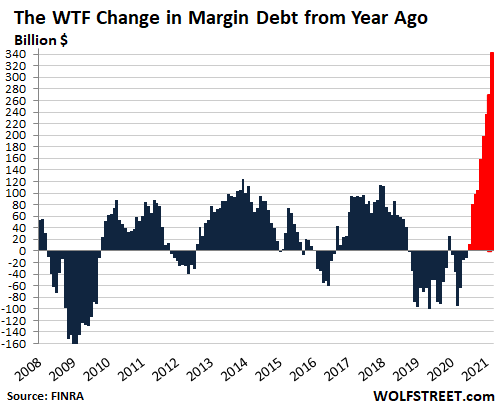
Archegos is an example of how leverage is the great accelerator of stock prices, on the way up, and on the way down. Its massive bets on a handful of stocks, powered by huge leverage, drove up prices of those stocks because it created buying pressure with borrowed money. As prices rose, Archegos could borrow more to increase its bets. And then suddenly, when these stocks started selling off because other investors got out, Archegos got the margin calls, and leverage became the great accelerator on the way down.
While we don’t know how much total stock market leverage there is, we can look at margin debt as a measure of the trend. And the trend has reached whopper proportions. History shows that a big surge in margin balances preceded – and perhaps was a precondition for – the biggest stock market declines:
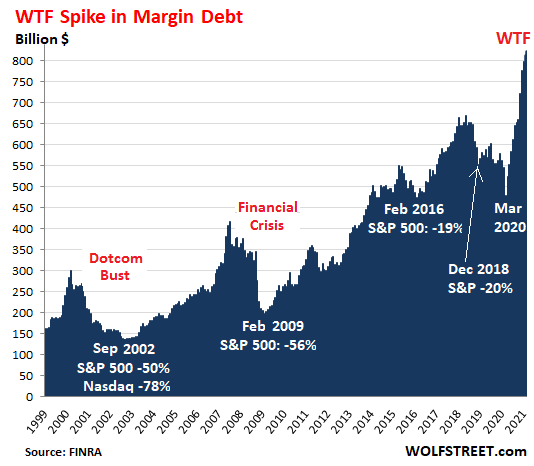
In a chart like this that covers over two decades, the long-term increases in the absolute dollar amounts are not critical since the purchasing power of the dollar with regards to stocks has dropped. What is critical are the steep increases in margin debt before the selloffs.
As the world has seen unfold with Archegos, the amounts of other types of stock market leverage aren’t known. Even Wall Street banks that deal with their clients don’t know about their clients’ total leverage at other banks. Each bank knew how much leverage Archegos had with it, but not how much it had with other banks, or that it had any leverage with other banks.
And when banks issued their margin calls – said to have been the second largest margin call in US history, after Lehman – and liquidated the underlying shares, they were selling those shares against each other. The first-out-the-door, including Goldman Sachs, came away relatively unscathed. Late movers, such as Credit Suisse got mauled.
That’s also a feature of leverage: The first-out-the-door pocket the gains and get away unscathed. Late movers get crushed.
And since everyone knows this, everyone is trying to get out the door first, which is not possible, but it speeds up the selloff.
Among the types of stock market leverage, in addition to margin debt, are derivative products, such as the swaps that sank Archegos, portfolio-based lending, and Securities-Based Loans. Each broker knows what they have on their books, presumably, but they don’t know what other brokers have on their books, and no one knows the total, and no one knows just how leveraged the markets are.