>>> Europe : Brokers Upgrades & Downgrades - 19th of April 2021

>>> Up
* Avance Gas Raised to Buy at Pareto Securities; PT 50 kroner
* BW LPG Raised to Buy at Pareto Securities; PT 74 kroner
* Coface PT Raised to 11.20 euros at Deutsche Bank

>>> Down
* Bilfinger Cut to Hold at HSBC; PT 35 euros
* FDJ Cut to Hold at Deutsche Bank; PT 44 euros
* Finnair Cut to Hold at SEB Equities; PT 75 euro cents
* Nordea Bank Cut to Hold at Arctic Securities; PT 92 kronor
* SEB Cut to Hold at Arctic Securities; PT 110 kronor

>>> Initiation
* Medios Rated New Buy at Deutsche Bank; PT 50 euros
* Tinybuild Rated New Buy at Berenberg; PT 295 pence
* Vantage Towers Rated New Hold at HSBC; PT 27 euros

>>> Call
* TinyBuild Has Exciting Growth Potential, Initiate Buy: Berenberg

>>> ERYP FP : Completes first cohort in a Phase I investigator sponsored trial o

ERYTECH Completes first cohort in a Phase I investigator sponsored trial of Eryaspase in first-line pancreatic cancer Announced the completion of enrollment of the first treatment cohort and the escalation to the next and potentially final dose levelin aPhase 1investigator sponsored clinicaltrial (IST), named rESPECT,of its lead product candidate eryaspase for the first-line treatment of pancreatic cancer.

The rESPECT IST (NCT04292743) is a single arm, dose escalating Phase 1 clinical trial to evaluate the safety of eryaspase in combination with modified FOLFIRINOX. The trial is conducted by Dr Marcus Noel, Associate Professor of Medicine at Georgetown University, Washington DC, USA, and will enroll approximately 18 patients who have received no prior chemotherapy for the treatment of locally advanced or metastatic pancreatic cancer.

FOLFIRINOX is one of the most commonly utilized first-line chemotherapy regimens for the treatment of pancreatic cancer, despite its toxicity.

The trial was launched at the end of last year and has now enrolled the first cohort of three patients. After review of the safety data, the Dose Escalation Committee concluded that no dose-limiting toxicity (DLT) had been observed in the first cohort treated at a therapeutic dose of 75 U/kg eryaspase, and as of the date of this press release, treatment was observed to be well tolerated in the cohort.Interestingly, two of the three patients treated had a partial response and significantly decreased levels of CA19-9, a pancreatic cancer tumor marker, and the third patient had stable disease after the first cycle of treatment. The trial will now be escalated to the next cohort, where the dose level will be increased to 100 U/kg eryaspase. This will be the highest dose level cohort in the trial and the presumed maximum tolerable dose (MTD) assuming no dose limiting toxicity is observed.

>>> DIC GY : concludes 2021 scrip dividend with high acceptance rate of 47.27% -

DIC GY : concludes 2021 scrip dividend with high acceptance rate of 47.27% - Gross Proceeds of ~€19.0M- Issued 1.27M new shares

- all shareholders were given the choice of receiving all or parts of the dividend of EUR 0.70 per share - as approved by the Annual General Meeting 24 March 2021 - either in cash or in the form of new shares. In order to cover possible tax obligations, the amount of EUR 0.20 per share will be disbursed on 22 April 2021, regardless of whether a cash or scrip dividend was chosen. That same day, the balance from converting the dividend into shares, if any, will be paid out in cash. Overall, a total of roughly 38 million pro-rata dividend claims in the amount of EUR 0.50 per share were exchanged for 1,274,135 new shares in the company. The subscription price was EUR 14.95 while the subscription ratio was 29.9 to 1.

FT : Grab co-founder set to dramatically increase voting rights with Nasdaq list

Grab co-founder set to dramatically increase voting rights with Nasdaq listing
Anthony Tan will have 60.4% of the voting power while owning just 2.2% of the Singaporean tech group

Malaysian internet entrepreneur Anthony Tan is set to dramatically increase his control over his company Grab when the south-east Asian tech group joins Nasdaq later this year.

In a move that would be the envy of his Silicon Valley peers, the Grab chief executive and co-founder will have 60.4 per cent of the voting power in the company while owning a stake of just 2.2 per cent.

This is a feat comparable to that of Facebook’s Mark Zuckerberg and unprecedented for a deal involving a special purpose acquisition company.

The holdings were contained in papers filed last week after the Singapore-based company unveiled a record deal to combine with a New York-listed Spac launched by Altimeter, a Silicon Valley group, valuing the business at almost $40bn.

The filing also revealed that the company, whose superapp offers everything from ride-hailing to deliveries and financial services, has reported potential violations of anti-corruption laws to the US Department of Justice.

Proponents say Tan needs the control to make quick and difficult decisions in navigating Grab’s eight markets. The deal is a crucial test of international investor appetite for a tech company with operations sprawled across the vastly diverse and emerging region of south-east Asia.


But his grip on the SoftBank-backed company’s direction marks the first time a Spac deal has entrenched a founder’s voting rights to this degree, say experts.

Such an overriding majority voting right for a chief executive is “unprecedented” for a company seeking a Spac route, said Robson Lee, a partner at law firm Gibson Dunn in Singapore. “While it is not unusual for high tech companies seeking a listing to entrench management shares with additional voting rights, a 60 per cent absolute majority will be the first in the market,” Lee said.

Others put it more bluntly.

“By bypassing a traditional IPO, Grab has attracted less scrutiny over Anthony’s control,” said one investment banker with direct knowledge of the deal.

While common in the tech space, such arrangements are not always popular, as evidenced by the backlash against Adam Neumann, WeWork’s messianic co-founder, and shareholder protests faced by Zuckerberg, who holds about 60 per cent of the voting power at Facebook.

Details of Tan’s control did not surprise Grab’s rival, Indonesia-based super app Gojek. Merger talks between the two companies were abandoned late last year before Grab began considering a Spac merger, and people close to the talks said Tan had demanded control indefinitely as a “CEO for life”. Grab has denied the reports.

One long-term Grab investor said that Tan, who comes from one of Malaysia’s wealthiest families, “needs a high level of power” to negotiate a seat at the table at the region’s messily interlinked world of family-run conglomerates, politics and regulation.

“The issue is south-east Asia in itself is not a homogeneous market . . . It’s a collection of different markets with their own sets of regulatory considerations,” said Lawrence Loh, director of the Centre for Governance and Sustainability at the National University of Singapore.

In its filing, Grab outlined several risks including an investigation it launched into potential violations of anti-corruption laws related to its operations in one country. The company reported the potential violations to the DoJ but declined to comment on them when contacted by the Financial Times.

The onus is on Grab and Tan to justify the dichotomy between ownership and voting shares and prove it is in the interest of the shareholders, said Nirgunan Tiruchelvam, head of consumer sector equity research at Tellimer Group.

“If he can argue that such a disproportionate share of voting would be beneficial to shareholders and add value for further direction of the company, then it’s possible shareholders would be comfortable with it.”

But even key shareholders have had their voting power diluted via the dual-class share structure — similar to Facebook. SoftBank, Grab’s biggest shareholder, has an 18.6 per cent stake that will translate to just 7.6 per cent voting power. Uber’s 14.3 per cent stake has a 5.8 per cent voting power and Didi Chuxing’s 7.5 per cent stake, just 3.1 per cent.

“For now we are just happy with the liquidity, but longer-term we want to see genuine progress towards profitability,” said one investor.

That is still years away. Grab has lost money every year since its inception in 2012 as it has grappled with other well-financed competitors. Accumulated losses hit $10bn at the end of 2020. Last year it reported a net loss of $2.7bn against net revenues of $1.6bn and it does not expect to break even until 2023.


On top of that, Grab has not said if it will appoint any independent board directors, nor does its filing say what checks and balances are placed on Tan. Information on succession or who inherits Tan’s stock has not been released.

“Further details will be in the F-4 registration statement that will be filed with the SEC [the US Securities and Exchange Commission], and to comply with this regulatory process, we will not be able to share more until the F-4 is finalised,” Grab said in a statement.

Jeffrey Seah, a partner at Singapore-based venture capital firm Quest Ventures, said: “While he has supervoting rights, he has kept his management team intact. That is a [type of] check and balance.”

But even the supervoting shares held by Grab’s co-founder Tan Hooi Ling and president Ming Maa will be beneficially owned by Tan under a deed that will be entered at the time of the merger.

So far, Grab’s big-name investors seem happy to back Tan. Funds investing in the deal include BlackRock, T Rowe Price, Fidelity, Janus Henderson, Abu Dhabi’s Mubadala, Singapore’s Temasek, Malaysian fund Permodalan Nasional Berhad as well as a number of wealthy Indonesian family offices.

The test will come when Grab joins the Nasdaq, said Loh. The deal has been approved by both Grab and Altimeter Growth boards, and it could close by July.

“The moment of truth will be when we discover the listing price and when it’s actually traded . . . If there are concerns, all investors will probably give it a discount,” he added.

FT : Wirecard inquiry: Germany’s political and financial elite exposed

Wirecard inquiry: Germany’s political and financial elite exposed
The investigation into corporate fraud reaches a climax with Merkel and Scholz to appear before MPs

It was an innocuous question, posed shortly before midnight some nine hours into an exhausting parliamentary hearing into the Wirecard scandal.

“Did you ever actually own Wirecard shares?” Cansel Kiziltepe, the Social Democrat MP, asked Ralf Bose, head of Germany’s auditor watchdog Apas. His answer caused a political earthquake and brought an abrupt end to his more than 30-year career.

A former partner at KPMG, Bose ran a government agency that is normally protected from public scrutiny by stringent secrecy laws. But those laws do not apply to the Bundestag’s inquiry into Wirecard. Bose disclosed that he had bought and sold Wirecard stock while Apas was investigating Wirecard’s auditor EY. Just hours later the German government started to probe the transactions. And within a matter of weeks Bose had been fired.

His late-night admission last December was one of the high points of an inquiry that has electrified Berlin’s political class and has led to a swath of resignations among top regulators and financial executives.

“[With Bose] it was one of those moments when you knew there and then that this person would have to go,” says Matthias Hauer, one of the MPs leading the probe.

Constituted last October, the inquiry’s overriding objective is to find out why German regulators failed to spot one of the country’s worst ever cases of corporate fraud and take steps to prevent it — and to figure out how to stop it happening again. German authorities seemed blindsided when Wirecard announced last June that €1.9bn were missing from its accounts and days later collapsed into insolvency.

The inquiry reaches an emotional climax this week when MPs interrogate Germany’s two most powerful politicians — Angela Merkel, the veteran chancellor, and finance minister Olaf Scholz. Coming just five months before a national election — and at an extraordinarily fluid time in German politics — the encounters could shape the political debate for weeks to come.

MPs will want to know why Merkel lobbied for Wirecard in China when reports about suspected fraud at the company had been in the public domain for months. Scholz will be asked to explain how BaFin, the financial regulator he oversees, not only failed to uncover the Wirecard fraud but went after short-sellers and Financial Times journalists who first highlighted irregularities at the company.

Scholz, who is running as the Social Democrats’ candidate for chancellor in September’s election, has placed the bulk of the blame on Wirecard’s auditors. He has also sought to appease his critics by initiating a wide-ranging reform of financial regulation in Germany, substantially beefing up BaFin’s powers and poaching Mark Branson, the respected head of Swiss regulator Finma, as BaFin’s new head.

But that hasn’t dispelled lingering criticism of his ministry’s inaction before Wirecard’s collapse. Lisa Paus, one of the Green MPs on the inquiry, says Scholz was driven by a desire to nurture one of Germany’s rare examples of high-tech success.

“You have this impression that this was an emerging Dax company that the finance ministry wanted to somehow protect,” she says. “At all the critical junctures they decided in favour of Wirecard.”

The inquiry’s deliberations are ongoing, but they have already provided moments of high drama that have left MPs gasping in disbelief. They have expressed amazement at the scale of the Wirecard lobbying operation, with its network of former police chiefs, ministers and spymasters, and at revelations that BaFin employees traded Wirecard shares while the company was under investigation. They also expressed shock at the fanciful stories cooked up by Wirecard lawyers alleging journalists’ attempts to blackmail the company.

“The lockdown may have shut down all the theatres in Germany, but this inquiry has compensated for that in full,” says Michael Maier, a veteran Austro-German journalist and publisher of the Berliner Zeitung daily.

It will be many weeks before the committee’s members compile their final report, which needs to be published by the end of the parliamentary term in September. But one thing is already clear, MPs say: that the Wirecard scandal could have been prevented if authorities such as BaFin had connected the dots and not ignored the profusion of warning signs about the company’s suspicious behaviour.

“We can say today that there were compelling, substantiated indications of criminal activity at Wirecard, for our authorities, for BaFin, for prosecutors in Munich, for other supervisory agencies and also for politicians sitting in the finance ministry,” says Florian Toncar, an MP for the opposition Free Democrats.

Yet these weren’t acted upon. On the contrary, “state and sovereign institutions fell over themselves to be duped by a criminal gang”, says Fabio De Masi, a leftwing MP and one of the most prominent members of the investigative committee.

Dogged pursuit
The inquiry has been one of the most exhaustive ever undertaken by the Bundestag. Equipped with subpoena powers akin to those of criminal prosecutors, MPs have amassed nearly a terabyte of data and 174,000 pages of documents and interrogated more than 80 witnesses and experts, some of them repeatedly.

They have also mandated two special investigators, one to probe Wirecard’s connections to the law enforcement agencies and secret services, and another to evaluate the work of its auditor, EY, which resulted in a damning report.

Sometimes the hearings have verged on the theatre of the absurd — particularly the interrogation of former Wirecard chief executive Markus Braun, who was the inquiry’s first witness.

Braun, who had been summoned out of police custody and gave his address as “Augsburg penitentiary”, made clear he would not go beyond a brief introductory statement — but MPs interrogated him for a good three hours anyway. His robotic answers to some 150 questions alternated between, “I can’t answer this today”, “I exercise my right to remain silent” and, “I refer to my statement”. Braun even refused to confirm he had a daughter, or what the title of his PhD thesis was.

Though they made little headway with Braun, MPs have doggedly pursued lines of inquiry that have led to a string of resignations. The most prominent were BaFin head Felix Hufeld and his deputy Elisabeth Roegele, who were forced out in January.

Then there is Edgar Ernst, head of the accounting watchdog FREP: Hubert Barth, EY’s Germany head; Alexander Schütz, a member of the supervisory board of Deutsche Bank; Jana Hecker, UniCredit’s head of equity capital markets; and Commerzbank analyst Heike Pauls. Deutsche Bank’s head of audit Andreas Loetscher, a former EY partner who was in charge of the Wirecard audit, has also stepped aside. And of course there’s Bose, the former head of Apas, who was fired in mid-January.

“Judged on the number of resignations, the inquiry’s track record has been pretty respectable,” says De Masi.

The pressure has been relentless. In order to squeeze the proceedings into the final 11 months of a four-year parliamentary term, MPs have worked round-the-clock, with witness questioning often dragging into the early hours of the morning.

“Any sceptic of parliamentary democracy should attend one hearing, and they would immediately be converted,” says Maier.

‘Siding with criminals’
A key focus of the investigation has been BaFin’s controversial decision in February 2019 to impose a ban on the short selling of Wirecard shares, despite misgivings expressed by the Bundesbank, Germany’s central bank.

“That . . . was probably the biggest mistake our authorities made,” says Danyal Bayaz, a Green MP on the committee. “It was at that moment that they sided with criminals, and investigated journalists and market participants who were posing critical questions.”

But none of Germany’s regulatory authorities have emerged from the Wirecard proceedings with their reputation unscathed. The Munich criminal prosecutors currently investigating Markus Braun and other Wirecard executives for fraud have also come under mounting scrutiny.

MPs have criticised them for failing to issue an arrest warrant for Jan Marsalek, Wirecard’s former chief operating officer, on the day the company revealed the massive hole in its balance sheet. Marsalek, who is considered one of the masterminds of the fraud and is currently on an Interpol wanted list, was able to flee to the Belarusian capital Minsk and has not been seen or heard of since.

The Munich prosecutors’ role in the BaFin short selling-ban has also proved controversial. The chief prosecutor Hildegard Bäumler-Hösl told MPs that two years ago she had a curious phone call with a star Munich lawyer who was working for Wirecard. He told her that Bloomberg reporters had attempted to blackmail the payments company: they purportedly threatened to “take up an offer from the FT” and publish negative stories about Wirecard, unless it paid them €6m.

Bäumler-Hösl sent a memo to BaFin summarising the information. Fearing a so-called “short attack” on Wirecard, BaFin then issued its now infamous short selling ban, which appeared to suggest Wirecard’s biggest problem was the speculators betting on its falling share price rather than the allegations of fraud swirling round the company.

But the blackmail story was a fiction. Chats unearthed by MPs on the messaging platform Telegram between Marsalek and the head of Wirecard’s legal department show “that he dreamt up this whole story himself”, says Jens Zimmermann, a Social Democrat MP on the investigative committee.

Bäumler-Hösl insisted in parliament that her team had simply passed on the information to BaFin without assessing its accuracy. BaFin, on the other hand, said prosecutors stressed in a number of phone calls that they deemed the information credible. Yet in a letter to Bloomberg at the time, Wirecard itself cast doubt on the veracity of the blackmail claim. Bloomberg has also denied its reporters ever tried to pressure Wirecard.

“Everyone on the committee was surprised a story which was invented by Wirecard . . . ended up being the cause of the short selling ban,” says Zimmermann.

‘Too big and complex’
Other agencies have also been found wanting, such as the money-laundering authority in Lower Bavaria where Wirecard was based. MPs were shocked at how ill-equipped it was to supervise a company of such complexity. It even lacked a comprehensive database of the firms under its jurisdiction.

“You have six to seven full-time employees who oversee thousands of car dealers and estate agents,” says Hauer. “How are they supposed to supervise a Dax-listed company with 58 subsidiaries, many of them based abroad?”

Germany’ accounting watchdog FREP has also been in the MPs’ crosshairs. Its outgoing head, Ernst, admitted to MPs that the body, which was founded in the aftermath of the Enron accounting fraud, lacked the resources to conduct forensic audits on questionable companies. Ernst said FREP’s budget was deliberately kept small to limit the financial burden on German companies, which fund the body.

Yet in early 2019, BaFin asked FREP to investigate Wirecard’s accounts. It was still waiting for the agency’s report in June the following year, when Wirecard collapsed into insolvency.

“FREP is definitely one of the culprits, because they knew Wirecard was too big and too complex for them to deal with and still they didn’t say anything,” says Zimmermann.

FREP’s woes climaxed earlier this year when the inquiry committee revealed that Ernst had ignored the agency’s strict corporate governance rules. He told MPs he had joined the supervisory board of German wholesaler Metro despite a rule imposed in 2016 that barred the agency’s staff from taking on any more outside directorships. In February he was forced to step down.

Another casualty was Schütz, the member of Deutsche Bank’s supervisory board. His fate was sealed in mid-January, when MPs on the investigation committee questioned Deutsche Bank chief executive Christian Sewing.

Zimmermann confronted him with an email sent by Schütz to Braun in early 2019, just after the Financial Times had reported whistleblower allegations of accounting fraud in Singapore. Schütz told Braun he had recently bought additional shares in Wirecard, and urged Braun to “do this newspaper in!! :-)”. The advice was striking considering Wirecard’s reputation for intimidating, spying on and hacking its critics.

A flustered Sewing declined to comment on the email. But Deutsche later described it as “unacceptable” and Schütz later announced his resignation from the bank’s board.

For MPs, the Schütz correspondence showed the extent of Wirecard’s vast network of businessmen, politicians and lobbyists. One of those on its payroll was Waldemar Kindler, the former Bavarian chief of police. Lawmakers discovered during the inquiry that he used his influence to procure a firearms licence for Braun’s driver.

“You maybe expect that kind of thing in Sicily, but not in Bavaria,” says Maier.

Another adviser lavishly paid by Wirecard for his services was the former German defence minister Karl-Theodor zu Guttenberg. He asked Merkel in September 2019 to intercede for Wirecard over an acquisition it was making in China. The chancellor duly raised the issue on her official trip to China a few days later.

Hans Michelbach, an MP for the governing CDU/CSU bloc, says the inquiry had revealed that Wirecard spent €62.4m just in the four years from 2016 until 2020 on lobbying activities — an unusually large figure for a German company.

“The fact that former ministers, state secretaries, a former police chief and an active Berlin politician all allowed themselves to be harnessed by Wirecard leaves me speechless,” he says.

None of their efforts were able to save Wirecard, whose collapse wiped out €24bn in market value. “That was the money of small investors . . . people who now have to get up at 5am and do a double shift because their family savings were destroyed,” says De Masi.

He says he and his colleagues feel they owe it to those people to get to the bottom of the Wirecard debacle — even if it often means working until the small hours to do so.
(ZH) "Stunning Divergence": Latest Bank Data Reveals Something Is Terminally Bro

"Stunning Divergence": Latest Bank Data Reveals Something Is Terminally Broken In The Financial System

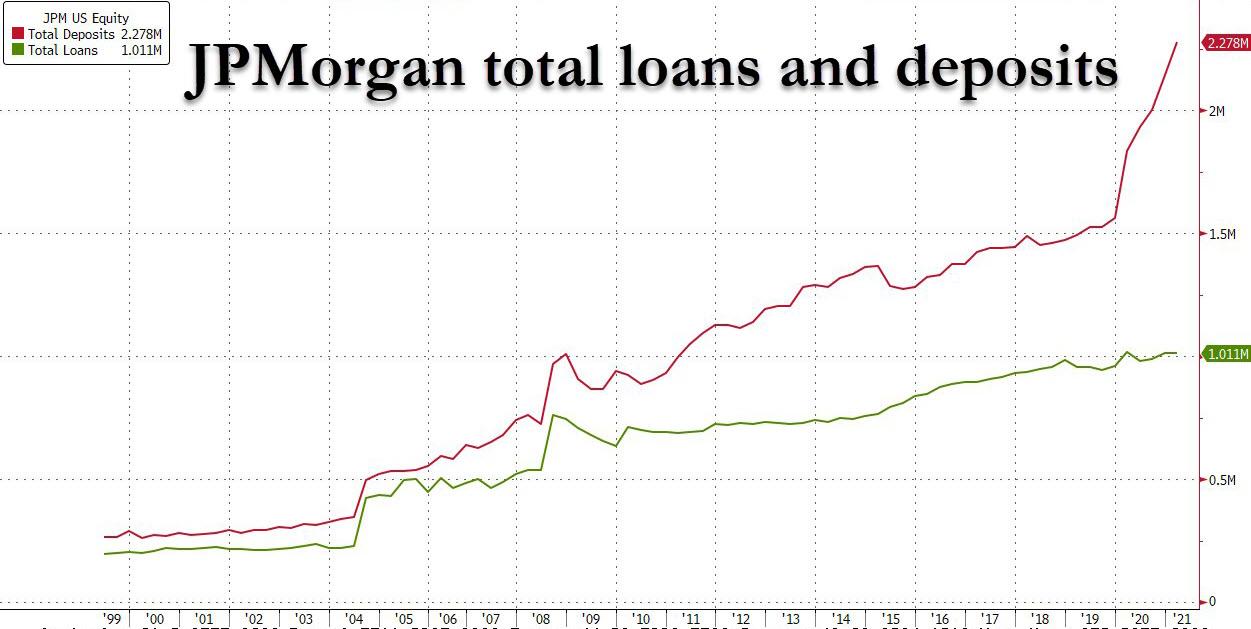
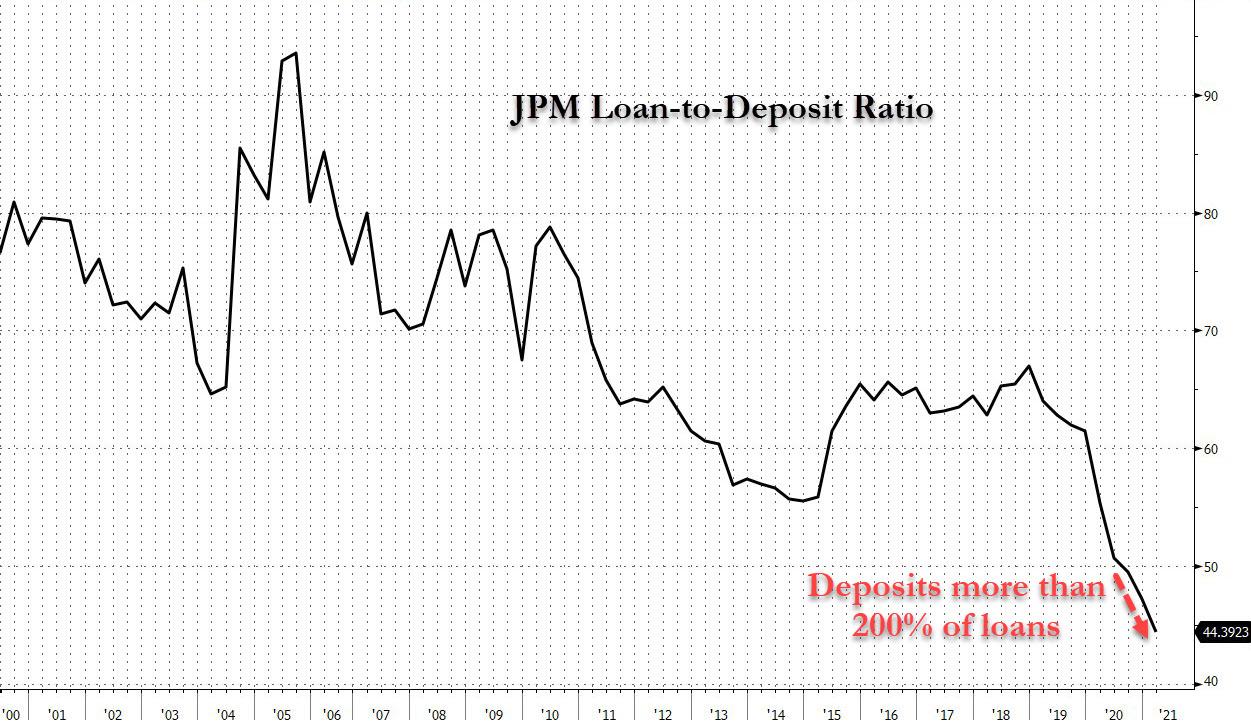
There was a remarkable disclosure in the latest JPMorgan earnings report: the largest US bank - an entity that historically has best been known for making loans to the broader population - reported that in Q1 its total deposits rose by a whopping 24% Y/Y and up 6% from Q4, to $2.278 trillion, while the total amount of loans issued by the bank was virtually flat sequentially at $1.011 trillion, and down4% from a year ago.
In other words, for the first time in its history, JPM had 100% more deposits than loans, or inversely, the ratio of loans to deposits dropped below 50% for the third quarter in a row after plunging in the aftermath of the covid pandemic:
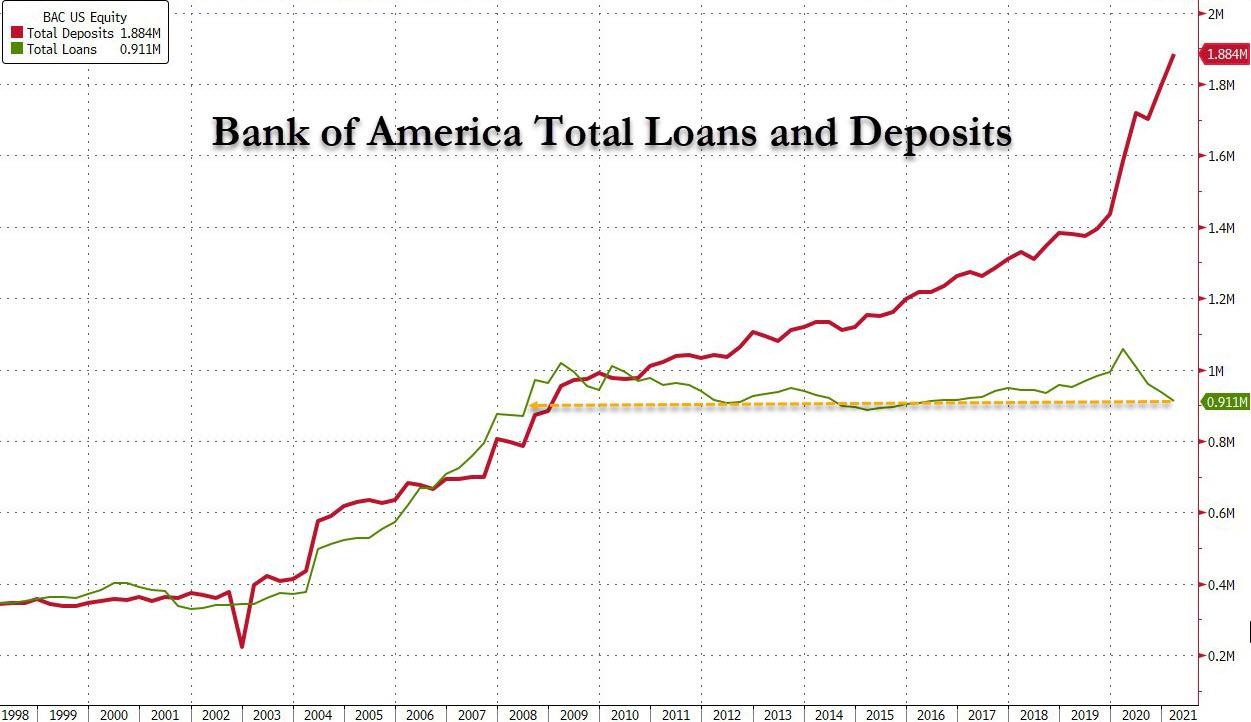
An even more stunning divergence between total deposits and loans, emerges at Bank of America where deposits similarly hit a new all time high of $1.88 trillion, even as the bank's loans have continued to shrink at an alarming, deleveraging (and deflationary) pace and are now at $911 billion, below their level during the great financial crisis: in other words, there has been 12 years with zero loan growth at Bank of America!
It's not any better at either Citigroup...
... or even Wells Fargo (which while having been limited by the Fed in how much loans it can issue, apparently has had no limit on how many deposits it can collect):
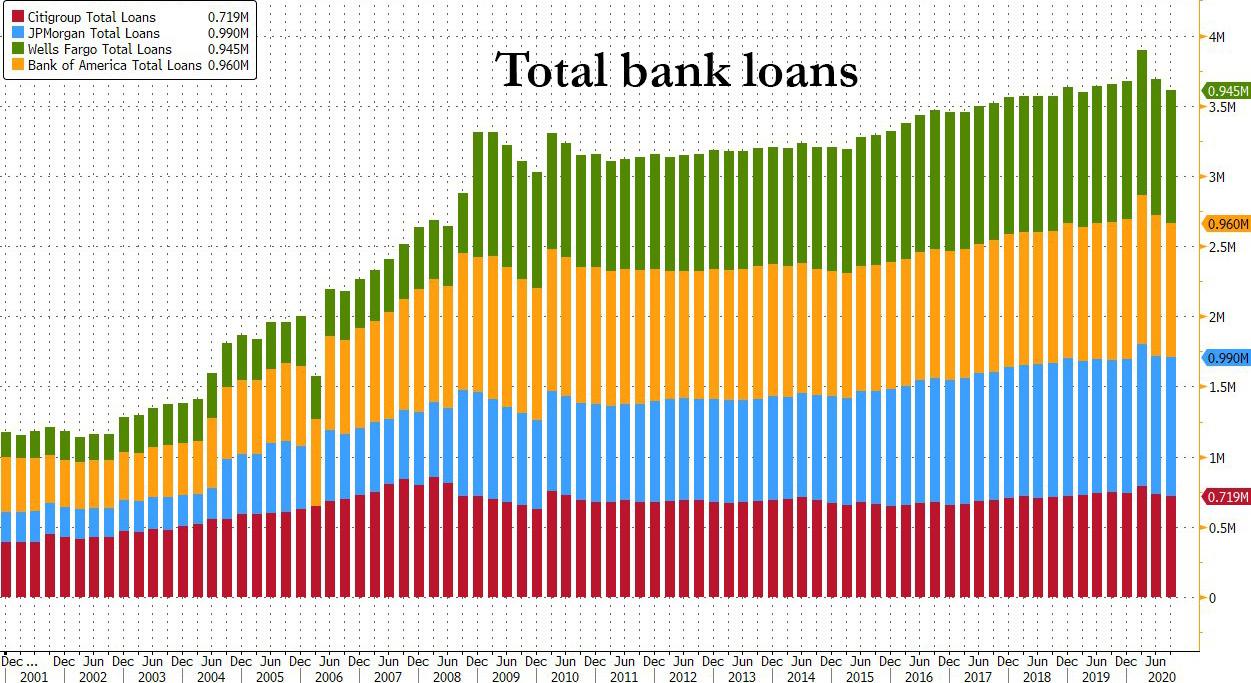
Summarizing the above data, we get the following picture breaking down total loans by Big-4 bank:
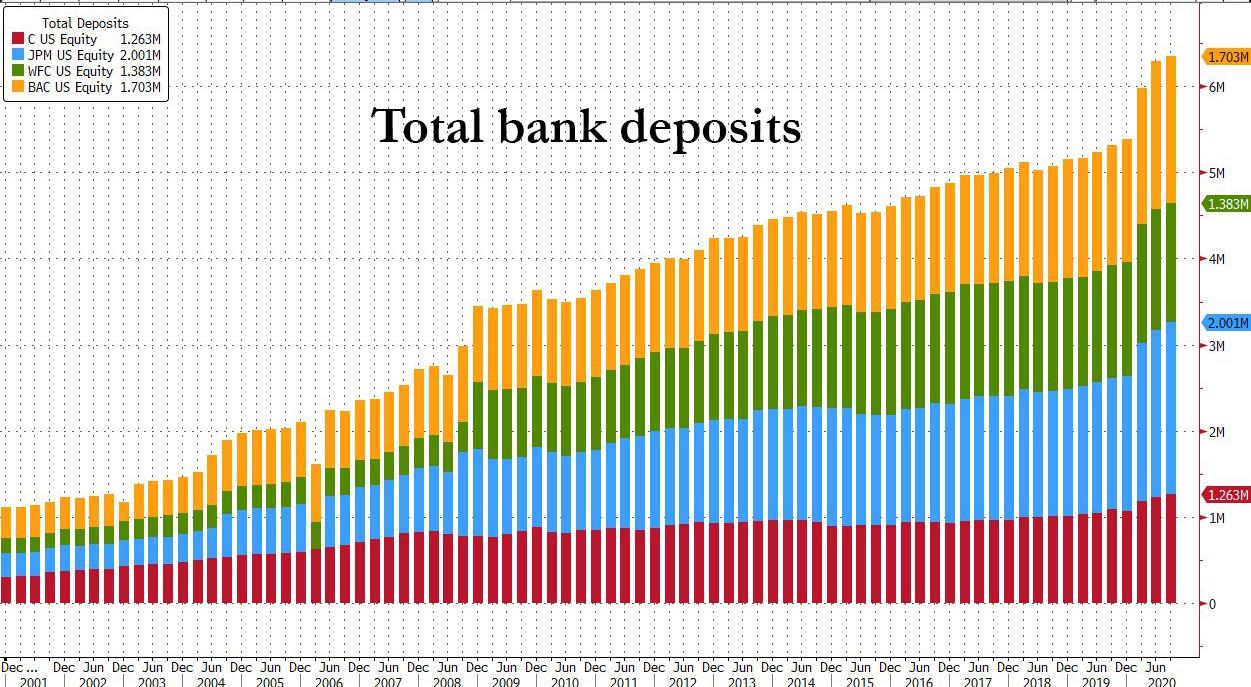
And total deposits.
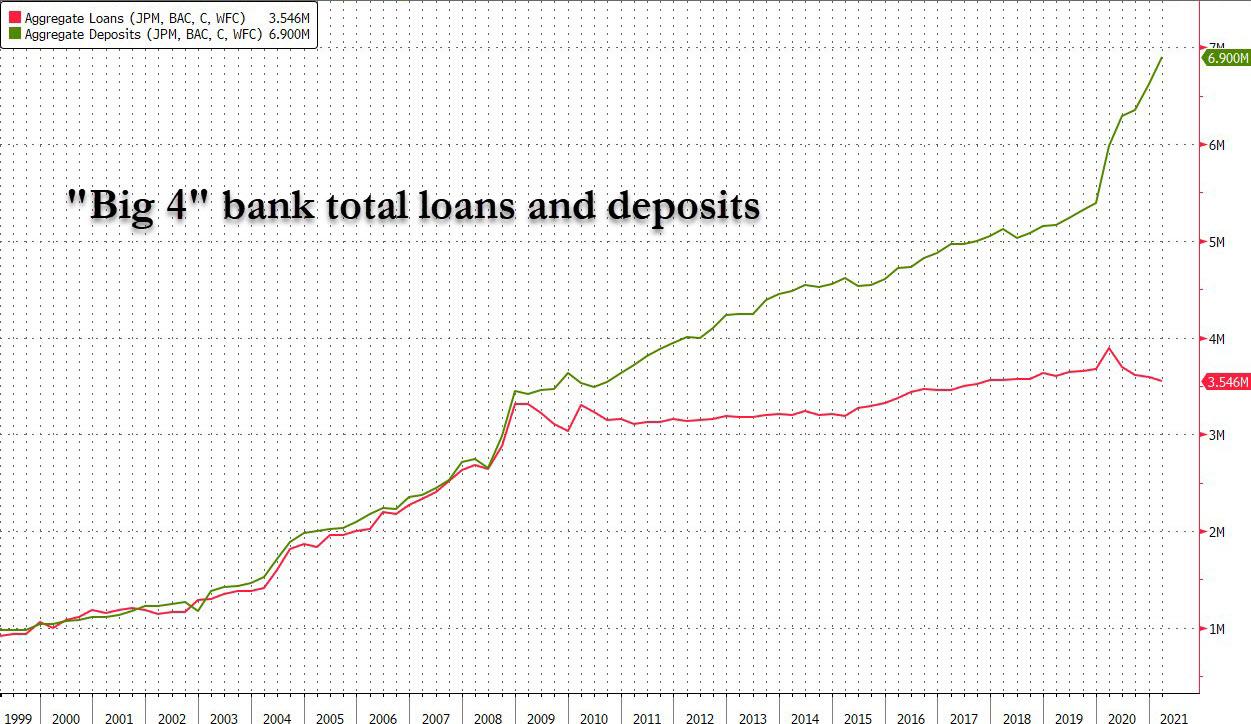
Finally, aggregating the data across the big 4 banks shows something striking: there has been no loan growth since the global financial crisis, while total deposits have doubled!
There are two major implications one should draw from the collapsing loan-to-deposit ratio. The first, more superficial one is that this ratio is a closely watched metric that measures how much lending a bank is doing when compared to its capacity to lend.
The second, and far more profound implication, is arguably the most fundamental question in modern fractional reserve banking: what comes first, loans or deposits, in other words do private, commercial banks create the money in circulation (by first lending it out) or is the central bank responsible for money creation?
One thing that is now beyond debate: there are now far more deposits than there are loans in the US banking system.
This is a problem because most conventional monetarists will argue that loans always come first, and only then do banks receive deposits.
It gets worse: as everyone now knows, we live in an MMT world where the Fed and Treasury have merged and where one basically monetizes what the other has to sell. And since the rainbows and unicorns world of MMT says that there is nothing to worry about from such debt monetization, even respected economists have been swept into this absolute idiocy and are urging the US to issue as much debt as it possibly can (with the Biden administration glad to oblige).
There is just one problem: as of this moment, the core tenet of MMT is no longer applicable. As a reminder, according to MMT loans create deposits not the other way around, and this socialist crackpot theory further claims that Reserve balances have nothing to do with this – they are part of the banking system that ensure financial stability. Don't believe us? Watch the following clip from one of the priests of MMT, Warrn Mosler who explains how "loans create deposits."

Only... clearly that's no longer the case, and the empirical data shown above makes patently obvious that the core, anchor theory of MMT on which all its other laughable theories are built is false, with huge consequences for a world that has thrown its future into a world prescribed by said crackpot theory.
The recent loan and deposit data also means that the conventional process of deposit creation via loans is terminally broken.
Indeed, that's precisely the case with the missing link being - drumroll - the Fed, as we explained all the way back, in 2014. Here is the punchline of what we said then, when we did a similar analysis observing what was already a record amount of excess deposits over loans:
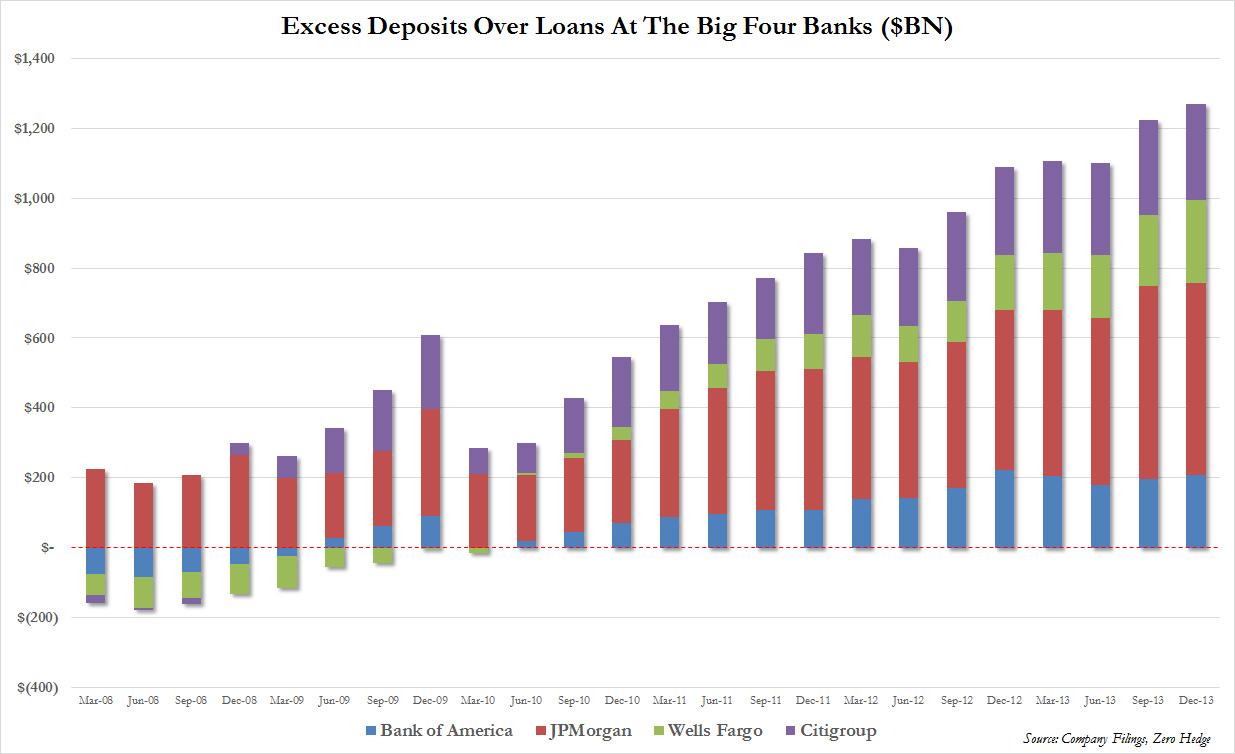
... how does the record mismatch between deposits and loans look like? Well, for the Big 4 US banks, JPM, Wells, BofA and Citi it looks as follows.
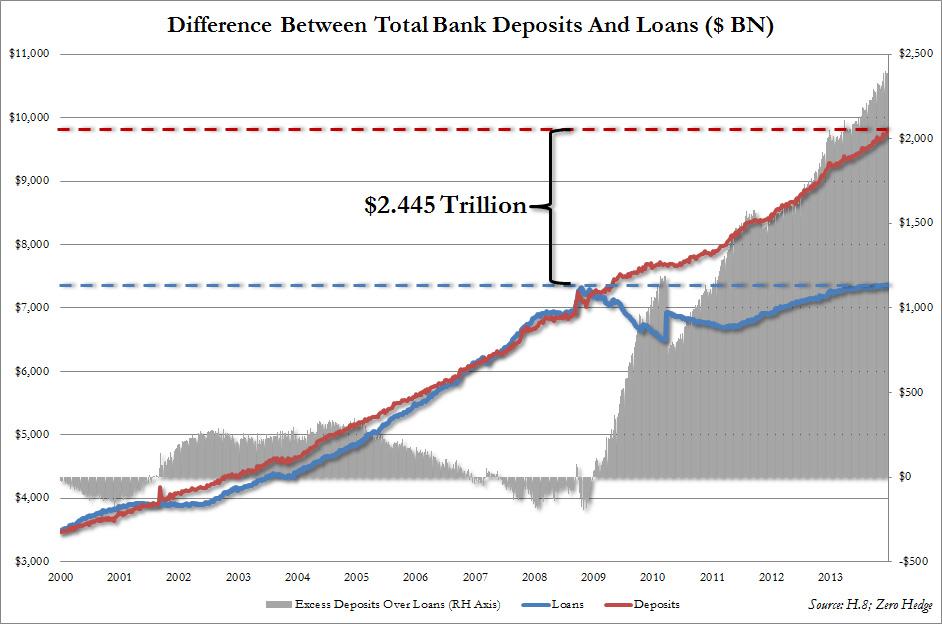
What the above chart simply shows is the breakdown in the Excess Deposit over Loan series, which is shown in the chart below, which tracks the historical change in commercial bank loans and deposits. What is immediately obvious is that while loans and deposits moved hand in hand for most of history, starting with the collapse of Lehman loan creation has been virtually non-existent (total loans are now at levels seen at the time of Lehman's collapse) while deposits have risen to just about $10 trillion. It is here that the Fed's excess reserves have gone - the delta between the two is almost precisely the total amount of reserves injected by the Fed since the Lehman crisis.
So what does all of this mean? In a nutshell, with the Fed now tapering QE and deposit formation slowing, banks will have no choice but to issue loans to offset the lack of outside money injection by the Fed. In other words, while bank "deposits" have already experienced the benefit of "future inflation", and have manifested it in the stock market, it is now the turn of the matching asset to catch up. Which also means that while "deposit" growth (i.e., parked reserves) in the future will slow to a trickle, banks will have no choice but to flood the country with $2.5 trillion in loans, or a third of the currently outstanding loans, just to catch up to the head start provided by the Fed!
It is this loan creation that will jump start inside money and the flow through to the economy, resulting in the long-overdue growth. It is also this loan creation that means banks will no longer speculate as prop traders with the excess liquidity but go back to their roots as lenders. Most importantly, once banks launch this wholesale lending effort, it is then and only then that the true pernicious inflation from what the Fed has done in the past 5 years will finally rear its ugly head.


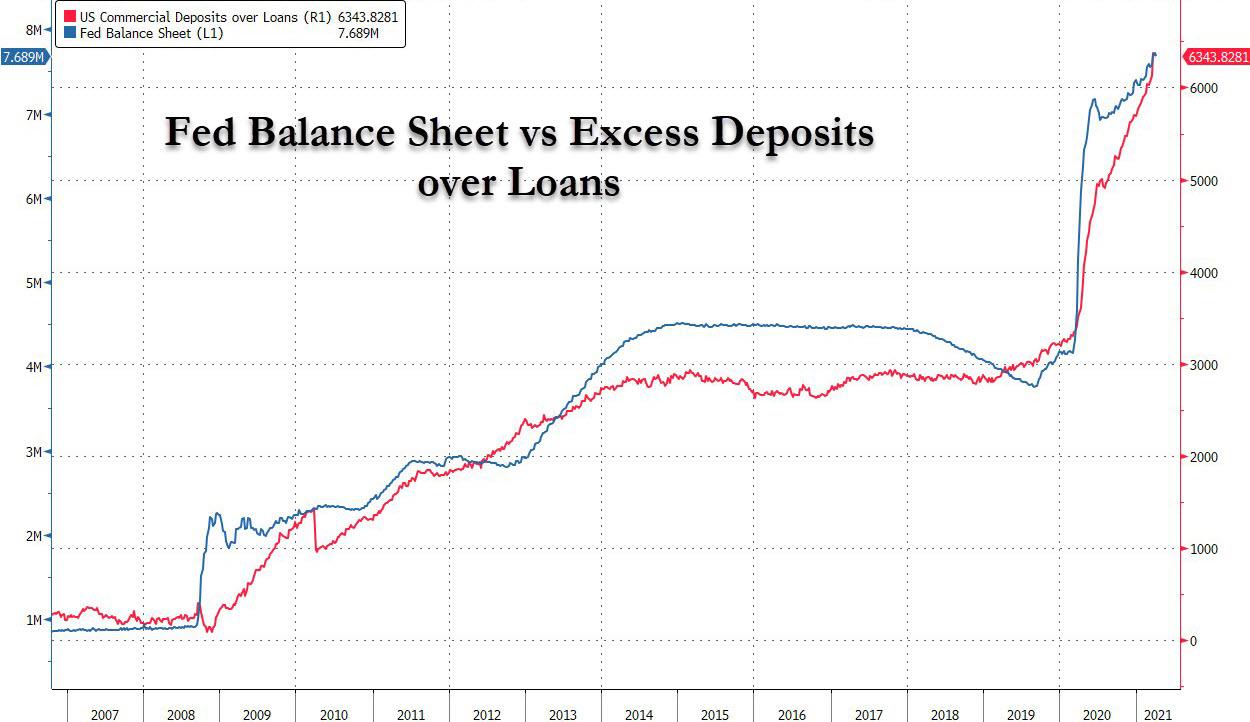
It will also come as no surprise to anyone, that updating the chart we first showed in 2014 correctly explains today's reality, something which MMT is completely incapable of doing: as shown below the excess deposits over loans is entirely driven by the trillions in reserves pumped by the Fed!
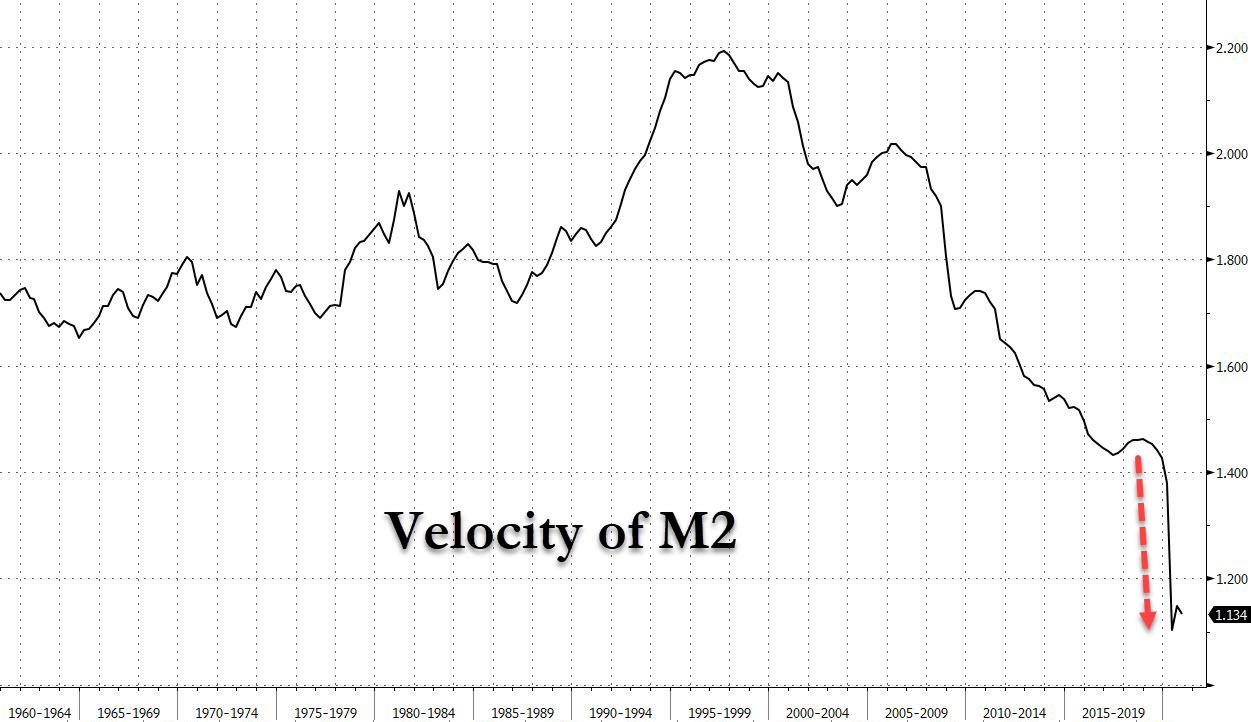
The above also explains why even as the Fed has pumped trillions in reserves into banks, which by transformation have ended up as deposits on bank balance sheets, the velocity of M2 money has plunged to an all time low (and will soon drop below the fractional reserve system singularity of 1.0x), as loan demand is nowhere near enough to offset the Fed's forced deposit creation which incidentally ends up not in the economy but in capital markets, resulting in broad deflation offset by asset price hyperinflation.
One final reason why this data is absolutely critical: in a world where the dominant daily argument is whether the US is facing deflation or inflation, and where many have become convinced that we are facing a surge in higher prices, continued loan destruction is about the most deflationary thing possible. But don't take our word for it - here is an excerpt from the latest "Flows and Liquidity" report from JPMorgan strategist Nick Panigirtzoglou titled "The challenge from weak bank lending" in which he confirms all of the above observations, and writes that "a common feature of this week's US bank earnings reports has been the weakness in loan growth. Indeed, weekly data from the Fed's H8 release shows that the pace of US bank lending remains in negative territory, exhibiting persistent weakness since last summer"
This persistent weakness, Panigirtzoglou writes, "followed a temporary spike in bank lending during Q2 2020, immediately after the virus crisis erupted, and is reminiscent of the US bank lending trajectory after the Lehman crisis. After a temporary spike immediately after the Lehman crisis, driven by companies and consumers tapping bank credit lines, the pace of US bank lending had remained largely in negative territory up until the middle of 2011. Although it entered positive territory after 2011, the pace of US bank lending had stayed significantly below pre -Lehman crisis levels, an important feature of the secular stagnation thesis."
The JPM quant then concedes that it remains to be seen "whether the protracted post Lehman period weakness in bank lending would be repeated in the current post virus cycle" although what is likely to be the case "is that the future trajectory for bank lending would be important in determining both the inflation and liquidity picture over the longer term."
And the JPM punchline:
"A repeat of the post Lehman period protracted weakness in bank lending would cast doubt to the idea of a sustained inflation impulse over the coming years. It would also act as a drag for money supply and liquidity creation going forward, reducing a key driver of asset prices."
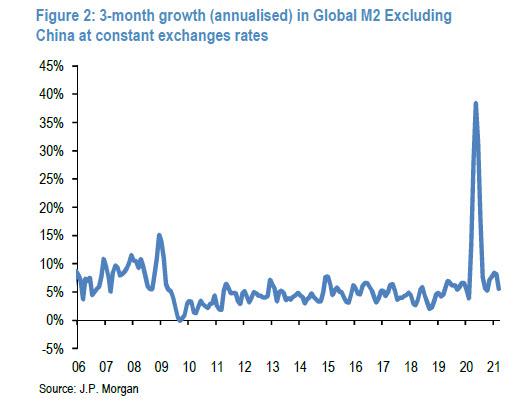
Indeed, the next chart shows that money creation has been already normalizing from the torrid pace of the first half of 2020.
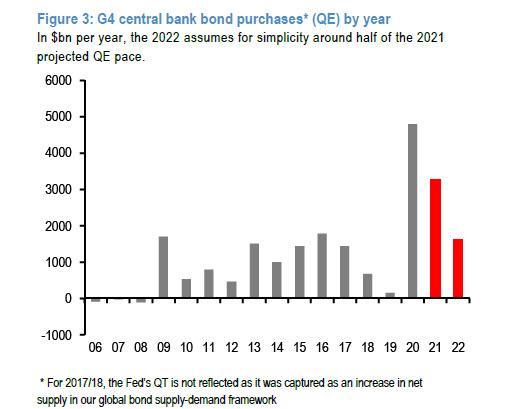
Looking ahead, central bank tapering in 2022 - or whenever it arrives...
.. would likely induce further slowing in money creation over the coming years according to JPM, unless bank lending improves avoiding the protracted weakness of the post Lehman period.
JPMorgan's ominous concludes, "whether the protracted post Lehman period weakness in bank lending is repeated in the current post virus cycle will be critical in determining both the inflation and liquidity picture over the longer term. So far the trajectory for bank lending shows more similarities than differences to the post Lehman crisis period."

FT : Global savers’ $5.4tn stockpile offers hope for post-Covid spending

Global savers’ $5.4tn stockpile offers hope for post-Covid spending
Households amass extra cash equivalent to 6% of world output since pandemic began

Consumers around the world have stockpiled an extra $5.4tn of savings since the coronavirus pandemic began and are becoming increasingly confident about the economic outlook, paving the way for a strong rebound in spending as businesses reopen.

Households around the globe accumulated the excess — defined as the additional savings compared with the 2019 spending pattern and equating to more than 6 per cent of global gross domestic product — by the end of the first quarter of this year, according to estimates by credit rating agency Moody’s.

And booming global consumer confidence suggests shoppers will be willing to spend again as soon as shops, bars and restaurants reopen when restrictions to control the spread of the virus are eased. In the first quarter of this year the Conference Board global consumer confidence index hit its highest level since records began in 2005, with significant uplifts in all regions of the world.

Mark Zandi, chief economist at Moody’s Analytics, said: “The combination of an unleashing of significant pent-up demand and overflowing excess saving will drive a surge in consumer spending across the globe as countries approach herd immunity and open up.”


If consumers spend about a third of their excess savings they would boost global output by just over 2 percentage points both this year and next, Moody’s estimated.

Despite the global economy last year suffering its largest fall in output in modern history, household incomes have largely been protected by unprecedented government stimulus schemes in most advanced economies. Consumers also reduced spending in the face of high uncertainty about jobs and incomes, and because many service businesses were shut or restricted.

As a result, in 2020 household saving rates in many advanced economies reached their highest levels this century, according to OECD data, and bank deposits increased rapidly in many countries.

Zandi said excess saving was highest in developed economies, in particular North America and Europe where lockdowns have been widely implemented and government spending has been high.

In the US alone, households have piled up more than $2tn in extra savings, Moody’s estimated. That is before the giant transfers from President Joe Biden’s $1.9tn stimulus programme kick in. Together they are enough to potentially fuel an “extended consumption splurge”, said Krishna Guha, economist at the investment banking adviser Evercore ISI.


Silvia Ardagna, economist at Barclays, expects “a fairly rapid acceleration in household spending this year” in the US and “to lesser extent” in the UK, though she warned that “a slower vaccination rollout may mean any pent-up demand is not realised in the euro area” in the next two quarters.

A number of Middle Eastern countries where government support has been generous also have significant excess savings, while in Asia, accumulated excess savings were lower than in other regions as the pandemic has been contained and the impact on household behaviour was less pronounced.

In South America and eastern Europe savings were lower as a result of the heavy hit from the pandemic and less government support.

However, the impact of the pandemic has been highly unequal and savings have been largely accumulated by richer households in all regions.

The Morning Consult consumer confidence index showed overall steady improvements between January and April across 15 large economies but a larger share of lower income households reported their financial conditions had worsened compared with a year ago.

More than one-third of richer households in many countries, including China, Australia, Italy, Russia and the US, said now was a good time to make big purchases, but that was not the case for poorer households, data from Morning Consult showed.

Jan Hatzius, economist at Goldman Sachs, estimated that nearly two-thirds of US excess savings were held by the richest 40 per cent of the population and suggested this could hold back the scale of the economic boost because “high-income households will hold [rather than spend] the bulk of excess savings”.


Adam Slater, lead economist at Oxford Economics, said: “If excess savings are mostly held by wealthier households and these are treated as a wealth increase rather than an income addition, we would expect a much lower level of [additional] spending.”

Nearly three-quarters of the UK households that reported increased savings plan to continue to hold them in their bank accounts, according to the Bank of England. Others plan to use their savings to pay off debts, invest or top up their pensions.

This is in line with the Conference Board findings that showed double-digit percentage point increases in the proportion of consumers who increased savings and investments in shares in the first quarter of 2021 compared with the same period last year.

>>> Weekend Papers NYT, WSJ, FT, NY Post

Weekend Papers Summary
NEW YORK TIMES
Saturday
• After the Biden administration announced it would maintain the Trump administration’s historically low refugee cap, backlash from Democrats and human rights activists prompted the White House to reverse course and announce it will permit an increase.
• Over the past month or so, Russia has deployed what analysts are calling the largest military buildup along the border with Ukraine since the outset of Kiev’s war with Russian-backed separatists seven years ago.
• The pandemic is undoing decades of progress for India, which has slowly brought hundreds of millions of people out of poverty, only to see that progress erode amid deep structural problems and prime minister Narendra Modi’s erratic policies.
• A Hong Kong court sentenced pro-democracy leader Jimmy Lai to 12 months in prison for his role in a peaceful demonstration in 2019 against Beijing’s harsh policies, and gave sentences of eight to 18 months to three others.
• In his short time in office, Italian prime minister Mario Draghi has quickly leveraged his European relationships, his skill in navigating EU institutions, and his reputation to make Italy a player on the continent in a way it has not been in decades.
• The Treasury Department put Taiwan, Vietnam, and Switzerland on notice over their currency practices, but it struck a more conciliatory tone than the Trump administration by stopping short of labeling any of them a currency manipulator.
• The National Association of Realtors is advocating an end to a pandemic-era order meant to keep renters in their homes, just as the real estate market heats up and realtors prepare to sell more homes.
Sunday
• The US government invested $800M in plasma when the country was desperate for Covid-19 treatments, but a year later, the program has fizzled after strong evidence for its success never materialized.
• Japan, South Korea, and Australia were able to counter the pandemic in its early stages, but only a small portion of their populations have received coronavirus vaccines, which could undo their earlier successes. • Critics say that after nearly 16 years in office, chancellor Angela Merkel’s Christian Democrats party lacks ideas on how to keep Germany thriving when its industrial model is outdated, faith in the US is down, and China and Russia are more assertive. • President Biden’s choice for deputy attorney general, Lisa Monaco, is a veteran of national security posts and is expected to be a key player in the administration’s push to combat domestic extremism, and investigate the January Capitol siege. • The US and China have said they will fight climate change “with the seriousness and urgency that it demands” by stepping up efforts to reduce carbon emissions, a rare demonstration of cooperation amid escalating tensions on other issues.• American shoppers are flocking to high-waisted, loose-fitting jeans in droves and companies believe they may become a hallmark of the post-pandemic world in which so-called skinny jeans, popular for more than a decade, lose ground.

WALL STREET JOURNAL
Weekend
• Investors are growing wary of special-purpose acquisition companies, one of the hottest bets on Wall Street, as regulators intensify scrutiny of black-check companies and the share prices of many of them tumble.
• Federal debt recently hit a high, thanks in part to foreign investors who are happy to park their cash in the US because of the safety and stability of its securities, but some say the traditional debt-to-GDP ratio is no longer meaningful.
• Former secretary of state Mike Pompeo and his wife violated ethics rules by asking department employees to carry out tasks of a personal nature, including pet care, according to a watchdog report.
• Most companies and trade groups that said they would suspend contributions after the Capitol riot have done so, with business and industry PAC contributions falling by about 80 percent for Republicans who voted against certifying Biden’s win.
• “Policing overhauls at the federal level have stalled, with mutual recriminations over who sunk last year’s legislative efforts—but the failure masks a growing bipartisan consensus on issues less emotionally fraught than police use of force.”
• Russia said it would expel 10 US diplomats and bar a number of senior America officials from entering the country in response to measures against Moscow over alleged election interference, cyberattacks and other damaging activity.
• Two months after arctic weather paralyzed Texas, most of the people who participate in the state’s electricity market agree that the freeze wasn’t a one-off event, and that the state’s power market should undergo major changes.
• Story profiles Sam Bankman-Fried, founder of FTX—which processes $10.7B in trades every day and is one of the world’s fastest-growing cryptocurrency exchanges—a billionaire now moving into tokenized stocks and other new markets.
• H.O.T.S.: New York’s 13 percent levy on legal cannabis sales should help it avoid the mistakes of states like California, whose hefty taxes help underground dealers; FAANG companies may eventually feel the effects of a chip shortage, but near-term results should remain strong; Two exceptionally profitable quarters for Mercedes-Benz highlight what DAI has to lose from the transition to electric vehicles.

FINANCIAL TIMES
Weekend
• “China’s economy continued its strong recovery from coronavirus in the first quarter of 2021 as the country reported a record growth rate compared to last year, but the figures masked the lingering damage left by the pandemic.”
• In a letter to investors, hedge fund manager David Einhorn criticized US regulators for allowing “quasi anarchy” in markets, with their inaction on issues such as the GME frenzy exposing small investors to harm.
• The Biden administration will invest $1.7B in federal funds to research Covid-19 variants, as public health experts warn that new strains of the virus could cause infections in the US to spike.
• Big Read piece says Britain’s record on combatting corruption is good, but abuses—such as former prime minister David Cameron’s lobbying for Greensill Capital—are hiding in plain sight.
• Lex Column: Man Group’s AHL subsidiary has provided a steadying effect for the company; On multiple metrics stock valuations look steep—on price-to-book, banks are now back to pre-crisis levels from 2020; The City of London needs to up its game to compensate for Brexit losses.
• Comment: As with much else that Joe Biden is doing these days, his decision to pull out the remaining US troops from Afghanistan will be popular, says Andrew Exum—but the withdrawal will not be without risks.

NEW YORK POST
Saturday
• Hometown International Inc., which owns a single deli in South New Jersey, has become worth more than $100M on the stock market in recent months, the latest example of the “meme stock” trend.
• New York restaurants, which are now open at 50 percent capacity, don’t have enough employees to make their businesses work, and are having trouble hiring new staff.
• Robinhood traders harshly criticized the mobile trading app after its cryptocurrency platform suffered a major outage just as Dogecoin was in the midst of a major rally.
Sunday
• Commodities trader Donald Turnbull claims in court papers he was fired from JPM’s precious metals trading group after executives discovered the extent of his cooperation with the Justice Department in a market manipulation case.
• + DAI: Mercedes-Benz unveiled a battery-powered counterpart to its top luxury sedan as German carmakers ramp up their challenge to electric upstart TSLA. - Source TradeTheNews.com