WeWork’s New Stock-Listing Plan Has Echoes of Its Past
Shared office-space company is touting fast future growth and high profitability
WeWork, which had one of the most spectacular IPO implosions in recent years, is trying to go public again. While it is a far tamer company than it was in 2019, some of the factors that raised concerns among regulators on the first deal are back again.
This time, WeWork isn’t doing an initial public offering. Instead it will start trading on a stock exchange by merging with a so-called special-purpose acquisition company. Rules around SPACs are looser than for IPOs, giving WeWork more leeway to tout its future.
The shared-office provider is expected to merge with a SPAC called BowX Acquisition Corp. BOWX -8.28% later this year. As the two entities promoted the deal to investors, they painted an optimistic scenario for the company’s growth and profitability.
BowX’s chairman described WeWork in a call with investors as a $5 billion revenue company, though that figure is a projection rather than a current number. When describing WeWork’s size, the company counted units that WeWork doesn’t own directly.
WeWork is predicting a rapid recovery from the pandemic downturn, which hit its business particularly hard because few people were using offices, much less shared space, and because it was still on the hook for long-term leases. The company is also using a new profit measure that shows higher margins than it claimed in late 2019.
In the run-up to the IPO, the Securities and Exchange Commission told WeWork to change certain profit and growth measures that it was using. The recent investor presentation by BowX has “echoes of the company’s approach in 2019,” said Minor Myers, a law professor at the University of Connecticut who specializes in corporate finance. “The SEC could push back hard again,” he said, unless WeWork tones down these claims in its official filings with regulators, expected later this month.
A WeWork spokeswoman said the company “will always work with the SEC to ensure our disclosures comply with their requirements.” An SEC spokesman declined to comment. BowX didn’t respond to requests for comment.
SPACs raise money as a shell company in an IPO and then look for a private business to combine with, a deal that transforms the target into a public company. Many of these targets are startups, often with little revenue and no profits, that have used optimistic projections to promote their deals.
SPACs have displaced traditional IPOs as the main route for private companies to list on stock exchanges. SPACs accounted for 75% of all IPOs from January through March, more than double their 35% share for the same quarter last year, according to data provider Dealogic.
The SEC earlier this month warned companies going public through SPACs against making unrealistic projections. The agency’s concern comes after several young companies, including electric-vehicle startups, touted plans to reach multibillion-dollar annual revenues in just a few years.
SEC rules limit companies doing IPOs from making projections or talking publicly. Both are permissible in SPAC deals. Backers of the SPAC process say the rules give startups a chance to chart their visions to investors, which critics say is unnecessarily difficult in IPOs.
WeWork’s proposed deal, valuing it at $9 billion including debt, is due to be voted on by BowX shareholders later this year. Trading in BowX on March 26, the day the deal was announced, was more than 100 times the volume the day before, and the shares closed at $11.71, up 13% from their $10.33 opening. On Friday, they finished at $12.07.
The WeWork call with investors included its chief executive officer, Sandeep Mathrani, and BowX’s chairman, Vivek Ranadivé, who called WeWork a $5 billion revenue company “just with their existing capacity.” Revenue isn’t projected to go over $5 billion a year until 2023, according to the company’s slides.
The pitch describes the company as a “massive growth opportunity,” with “850+ locations,” more than a million workstations and over 450,000 memberships. Those tallies include WeWork’s China and India operations, which aren’t part of the entity that is being merged and aren’t included in its financial statements, according to the small print on the slides. A person close to WeWork said including the India and China franchises gave a sense of the reach of the portfolio and platform.
The growth forecast assumes that occupancy of WeWork buildings doubles from 47% at the end of last year to 95% in 2024. Mr. Mathrani said occupancy could rise further because the company’s membership model means the same space can be sold more than once. “You can actually go over 100%,” he said.
In 2019, the SEC questioned that view. “Tell us how your assumed workstation utilization rate of 100% is realistic,” the agency asked the company in a letter reviewed by The Wall Street Journal. The prediction was dropped by WeWork.
WeWork has long been criticized, including by the SEC before the IPO, for presenting its numbers in a way that converted its loss-making business into something that appeared to be profitable. The company seems to be doing something similar today.
As many companies do, WeWork used a measure that excluded basic costs such as administrative and marketing expenses, and focused on the expected performance of sites when they were up and running.
Today, the company calls the measure “mature building margin,” which it puts at 27% based on 2019 figures. The number is calculated for buildings open a year or more and excludes various “expenses that are necessary to operate our buildings but not directly tied to an individual building.”
Under different leadership, WeWork previously reported significantly lower margins for a similar metric. In a fall 2019 investor slideshow, after the failed IPO and ouster of WeWork’s co-founder and CEO, Adam Neumann, the company said its mature “location contribution margin” was 21% for buildings open more than two years in the first half of 2019.
A person close to the company said WeWork has changed a lot since 2019, and the two metrics aren’t directly comparable.
Top European football clubs sign up to breakaway Super League
Up to 12 teams including Liverpool, Barcelona and Juventus set to join rival to Champions League
Many of Europe’s wealthiest football clubs have agreed to join a breakaway “Super League” competition that would mark the biggest transformation of the game in decades.
Up to 12 clubs have signed up to a plan, backed by $6bn in debt financing from JPMorgan, to launch a new tournament that would supersede the Champions League, currently the continent’s top annual club competition.
According to people with knowledge of the discussions, those ready to join the breakaway contest include Spain’s Real Madrid and FC Barcelona; England’s Manchester United, Manchester City, Liverpool, Arsenal and Chelsea; and Italy’s Juventus, AC Milan and Inter Milan. These clubs either declined or did not respond to a request for comment.
The new league, according to documents seen by the Financial Times, would involve 20 clubs with 15 being “permanent members”, meaning they could not be relegated and would not need to qualify through strong performances in national league competitions.
The founder members would be granted between €100m-€350m each and would continue to play in their national competitions, such as England’s Premier League and Spain’s La Liga. With expected revenues of €4bn for the competition through media and sponsorship sales, clubs would receive a fixed payment of €264m a year. JPMorgan declined to comment.
The clubs not yet signed up include France’s Paris Saint-Germain and Germany’s Bayern Munich, among the richest in Europe, according to people close to the discussions.
A declaration about the Super League is designed to head off an alternative plan for a radical transformation of the Champions League, which is run by Uefa, European football’s governing body.
Uefa’s annual conference on Monday is set to approve a radical new format for its competition, which includes 100 more matches each season and more money-spinning ties between top teams.
That move comes after the European Club Association, a body that represents the interests of more than 200 leading teams and led by Andrea Agnelli, Juventus chair, gathered last week to discuss the proposed reforms to the continent’s club tournaments.
The ECA agreed to allow Uefa to proceed with the proposed format changes, but there was widespread discontent with the plan, as leading clubs wanted to be given greater assurances over a new joint venture that would control all media and sponsorship rights for European club competitions.
Uefa’s attempts to contact Agnelli this weekend to find out whether Juventus had agreed to join the Super League have failed, according to people close to discussions. However, other key power brokers have been informed, such as La Liga’s chief Javier Tebas, who is among the football officials seeking to block the breakaway plan.
Uefa said that it was united with Europe’s top leagues, national governing bodies and Fifa in “efforts to stop this cynical project, a project that is founded on the self-interest of a few clubs at a time when society needs solidarity more than ever”.
It added that it would consider “all measures available to us, at all levels, both judicial and sporting in order to prevent this happening”.
The Times newspaper of London was first to report on Sunday that a number of clubs had agreed, in principle, to join the Super League.
Leading clubs, which have faced steep revenue shortfalls in the pandemic, are keen on the new competition, which they believe will guarantee income from European matches every season. It could also include aspects of cost control, such as potential salary caps and spending limits.
The competition would resemble the structure of “closed” North American sports leagues, where franchise owners enjoy reliable profits and with the valuation of teams steadily rising over time.
But the plan breaks with the pyramid structure of the European game, where even the smallest teams, through strong performances on the pitch, can win the biggest trophies.
UK scientists assessing spread of new Covid variant ‘on daily basis’
Health officials investigating whether B.1.617 strain is spreading within the community
Health officials say they are still assessing whether a variant of Covid-19 first discovered in India is more transmissible and vaccine evasive than other forms of the virus after the discovery of 77 cases in the UK.
Susan Hopkins, a senior medical adviser at Public Health England, said on Sunday that scientists did not have enough data to clarify whether it should be classed as a “variant of concern” — the most serious classification.
At the moment the B.1.617 variant, which has been linked with a surge in cases in India in recent weeks, has been classified by Britain as a “variant under investigation”.
Speaking on the BBC’s Andrew Marr programme, Hopkins said: “To escalate it up the ranking we need to know that it’s increased transmissibility, increased severity, or vaccine-evading, and we just don’t have that yet, but we’re looking at the data on a daily basis.”
She added that scientists were also conducting investigations to determine whether it was spreading within the community.
“The vast majority of the cases we have confirmed are known [to] have come from India and or tested on day two or day eight of their isolation period,” she said.
Concern over the variant comes as cases have risen alarmingly within India: over the weekend the country recorded 261,500 new infections and 1,501 deaths.
Boris Johnson is facing growing pressure from Labour to cancel his trip to India later this month, while some scientists have called for the country to be placed on the UK’s red list which bans travel from certain countries.
The environment secretary George Eustice on Sunday dismissed the push for Johnson to cancel his trip, describing the visit as “appropriate”. He added: “I think it is important that the business of politics does continue and doesn't stop completely — we just need to make sure we take the right precautions”.
The government said on Sunday that the decision to add and remove countries to and from the red list was “informed by the latest scientific data and public health advice”.
Despite the worry over the spread of new variants — the UK stepped up testing for a strain first discovered in South Africa last week — Hopkins argued that the latest coronavirus figures were showing signs of “positive progress”, with infections at the lowest level since September 2020.
However, she noted that it was still too soon to assess the effect of lifting restrictions in England last Monday. “We need two to three weeks’ data at least after each unlocking to be able to assess the impact of that,” she said.
Eustice said it was “too early to say” for certain whether the government would be able to reopen indoor hospitality as planned on May 17 — the next step on the government’s lockdown easing road map.
But he said the country was “on track” with the rollout of the vaccination programme, which has now vaccinated 32.8m people, including almost 10m second doses.
Eustice said that the government remained “cautious”, adding “although we’ve now got 60 per cent of the adult population vaccinated, we do just have to keep a close eye on these variants of concern and also see what the impacts are of the easements we’ve just made before moving to the next stage.”
After a weekend of brisk but restricted business, the hospitality industry called on the government to abide by its timetable for easing the lockdown and avoid being “derailed” by ideas such as vaccine passports.
Chief executives of J D Wetherspoon, Fuller’s and The Restaurant Group were among 38 leaders of hospitality companies who signed a letter in the Sunday Telegraph, which noted that two-thirds of venues were still unable to open outdoors “and none is breaking even”.
“We must be driven by data not dates — and the data say it is safe to confirm now the reopening of indoor hospitality on May 17 and the lifting of all social-distancing restrictions on hospitality on June 21,” the letter said.
Watch: Sikorsky's S-97 Raider Performs Impressive First Flight Demo
For the first time, the Sikorsky S-97 Raider flew multiple flight demonstrations this week for service leaders and soldiers at the company's test center at Redstone Arsenal in Huntsville, Alabama.
Defense giant Lockheed Martin, who owns Sikorsky, released a press release on Thursday detailing the demonstrations on Tuesday and Thursday.
"The events offered a glimpse at Sikorsky, a Lockheed Martin company's bid for the Future Attack Reconnaissance Aircraft (FARA) program, part of the U.S. Army's Future Vertical Lift (FVL) effort to revolutionize its aircraft fleet," the press release said.

The Sikorsky S-97 Raider is based on its X2 coaxial-rotor technology, making it a fast and agile aircraft, well suited for the modern battlefield. The new FVL is expected to fill a capability gap left by the retirement of the Bell OH-58 Kiowa helicopter.
"Since the first Black Hawk took to the skies in the 1970s, to when our teams broke helicopter speed records with X2 Technology in 2010, we have been working with our Army partners to develop and deliver low-risk, transformational, affordable and sustainable aircraft to support the warfighters' missions," said Sikorsky President Paul Lemmo, who was at the demonstrations.
Lemmo continued: "This is the first of what we believe will be many times our X2 Future Vertical Lift aircraft will fly at Redstone."
Sikorsky test pilots Christiaan Corry and Bill Fell piloted the S-97 at both demonstrations, highlighting the aircraft's new capabilities.

"Flying RAIDER continues to amaze me," said Corry, a former U.S. Marine with more than 4,500 flight hours in 25 different types of aircraft, including numerous helicopters.
"The combination of the coaxial rotors and the propulsor are really the enablers for this transformational technology. As we demonstrated today, in low-speed flight we are as capable as a conventional helicopter, but when we engage the prop, we are able to operate in a whole new way – it's much more like flying an airplane," he said.
In 2018, the Army selected two FARA candidates. Sikorsky is currently in the running with the S-97 Raider and Bell's V-280 Valor tiltrotor.
FARA aircraft are expected to replace the military's aging fleet of helicopters in the coming years as part of a vast modernization effort to counter China and Russia.
Watch the S-97 Raider demonstrations below:
More Stocks Are Participating in Rally, an Encouraging Sign for Bull Market
Indicators are hitting rare milestones that are viewed as bullish signs, but some investors remain concerned about the pace of stocks’ ascent
A greater number of stocks have been propelling the U.S. market higher lately, a signal that—if history is any indicator—more gains could be ahead.
What remains up for debate, however, is how smooth the climb will be.
Indicators that point to a stronger and more resilient stock market have been hitting rare milestones recently as the continuing bull run has once again widened. In the past week, stocks ranging from UnitedHealth Group Inc. UNH 0.26% to L Brands Inc. LB 0.09% to Vulcan Materials Co. VMC 0.53% hit 52-week highs, joining 184 others in the S&P 500 that did the same. Those gains have helped extend the benchmark index’s rally for the year to 11%—notching 23 records along the way.
Investors and analysts often look to technical indicators that measure the breadth of the market’s rally for clues about where it is headed next. A market is generally considered healthier when more stocks are rising together, and signs of strong participation are typically viewed as a signal that a rally has legs. In contrast, a market with poor breadth—such as the one in the late 1990s near the peak of the dot-com bubble—indicates fewer stocks with larger market capitalizations are carrying the load.
Lately, signs of strong breadth have abounded, a reversal from much of the past year when a small group of large technology stocks drove much of the market’s gains. Last week, the percentage of stocks in the S&P 500 trading above their 200-day moving averages crossed 95%, rising to the highest level since October 2009, according to data through Thursday. Only during three other periods since the start of 2000 has that measure surpassed and then hovered above 95% for several days, according to a Dow Jones Market Data analysis based on current index constituents.
“It’s so rare to see that,” said Frank Cappelleri, a desk strategist and executive director at Instinet. “It shows how strong participation must have been over the last number of months for that to occur. It’s a small sample size but typically has only happened at a beginning stage of a longer-term move.”
Indeed, during the past three times that the indicator first crossed the 95% threshold—in May 2013, September 2009 and December 2003—the S&P 500 went on to post gains both six months and a year after the threshold was breached.
Similarly, market watchers tend to keep tabs on the percentage of S&P 500 companies trading above their shorter-term 50-day moving averages and watch for when the number crosses 90%—another rare bullish sign. Stocks in the S&P 500 also surpassed that threshold last week.
During the past 15 past instances when that has happened, the index has likewise ended higher one year later 14 of the times, according to an analysis by Keith Lerner, chief market strategist for Truist Advisory Services. The average annual gain for those 15 times, according to his analysis: 16.4%.
Analysts say both indicators are optimistic signs for the market—but note they are flashing at a starkly different time than in the past. Often when such breadth milestones are hit, the S&P 500 is coming off a correction—a drop of at least 10% from a recent high—or a much bigger fall.
In contrast, market conditions today are far different—leading some analysts to question how much further the bull market can run in the months ahead. The S&P 500 has already surged 87% from its March 2020 trough.
Driving the powerful rally have been massive levels of stimulus from the Federal Reserve and Congress, as well as surprisingly strong economic data. Despite early expectations that the U.S. rebound would be lethargic, everything from employment reports to consumer-spending indicators have often come in better than expected. A faster-than-anticipated Covid-19 vaccine rollout and an eager crop of individual investors have also juiced markets.
“The one thing we know is that the stock market leads [the economy] in recovery…and the big, initial rip has likely already happened,” Mr. Lerner said. “The technicals still suggest upside…but I’d expect periodic pullbacks along the way.”
To be sure, while measures of strong breadth have historically preceded gains six and 12 months ahead, history has shown they don’t preclude short-term setbacks along the way.
And outside the S&P 500, there have been signs of weakness in parts of the market lately. Just a few weeks ago, many of the technology and growth companies that have long been investor favorites dragged the Nasdaq Composite into correction territory. Ultimately, however, owing to continued support from the Fed, laggards—especially the growth stocks that continue to dazzle investors—haven’t stayed down for long.
Still, investors and analysts see many areas for concern. Some 32% of fund managers surveyed by Bank of America Global Research in April said that they view a bond market “taper tantrum”—meaning a possible spike in Treasury yields once the Fed indicates it will tighten monetary policy—as the biggest tail risk for markets.
Investors are also closely monitoring sentiment levels, which many view as overly stretched. In the past five months, investors have plowed more money into global stock funds on a net basis than they did during the prior 12 years combined, a Bank of America analysis of EPFR data show. Meanwhile, earlier this month, nearly 57% of investors reported having a bullish outlook for the stock market over the next six months, a survey from the American Association of Individual Investors showed. That marks the highest level since January 2018.
Extreme bullish sentiment tends to appear near the end stages of bull markets, noted Jason Goepfert, president of Sundial Capital Research, which is why, he said, it has been unusual to see that occurring at the same time that technical indicators are pointing to further gains.
“It’s hard to find any instance that’s remotely similar to this. We’ve seen extremes like this before in breadth readings, but not coupled with a market that has been so strong,” he said. “It’s been a hard thing to juggle: Is [this market breadth] a sign of an impressive comeback and recovery, or is it a sign of excess speculative behavior, where everyone is buying anything?”
In addition to moving averages, investors and analysts say they are also watching other bullish indicators. The New York Stock Exchange advance-decline line—a popular cumulative indicator that tracks the number of all securities rising minus the number falling on the exchange each day—has risen, hitting a record last week, according to data through Thursday starting at the end of March 2016.
At the same time, the S&P 500 Equal Weight Index—which weights every company equally, no matter its size—has on a year-to-date basis outpaced its traditional market-cap-weighted counterpart, another signal that it isn’t only heavily weighted stocks that are driving markets higher. The equally weighted S&P 500 index is up 15% in 2021, versus 11% for the benchmark index.
For now, the wide rally will likely help offset frothy sentiment, said Liz Ann Sonders, chief investment strategist at Charles Schwab & Co. But, she noted, if participation begins to deteriorate while sentiment remains elevated, “that is what you want to keep an eye on.”
“At this stage, what I’d expect to continue to see is a rotational series of pullbacks—especially in places where there has been too much speculative excess or where the fundamentals don’t support rich valuations,” she said. “For now I don’t think there’s a high risk of something where the bottom falls out for the broader market overall.”
Bitcoin Crashes As Much As 15% Amid Unsubstantiated Report Of Money Laundering Crackdown
In a crash that started late on Saturday evening and accelerated throughout the night, Bitcoin and the entire cryptocurrency space plunged the most in more than seven weeks, just days after hitting a new all time high ahead of the Coinbase IPO.
Bitcoin fell 12% to $53,400 as of 8:0 a.m. in New York on Sunday, after plunging as much as 15.1% to $51,707.51 in the Asian day. Ethereum, the second-largest token, dropped almost 18% before paring losses.
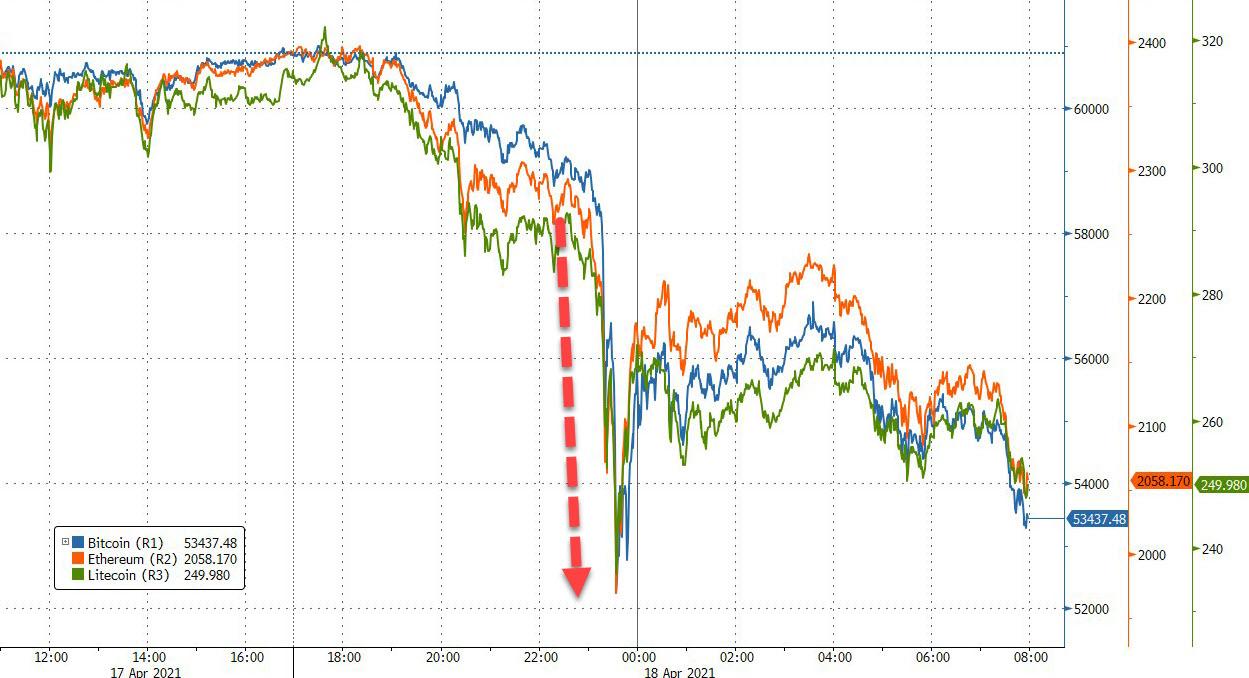
The market-wide crash has in $1.72 billion worth of long positions liquidated in just one hour alone. Expanding this range to 24-hours shows that 927,000 traders’ positions worth nearly $10 billion were wiped off, with $68.73 million being the largest liquidation so far according to FX street.
The crash appeared to coincide with an unconfirmed twitter report from a supposedly credible source that the Treasury could crack down on money laundering using cryptocurrencies.
Whereas this account traditionally blasts Reuters or Bloomberg headlines, in this case there was no such underlying report from either Reuters or Bloomberg, and Bloomberg even said that "several online reports attributed the plunge to speculation the U.S. Treasury may crack down on money laundering that’s carried out through digital assets."
Furthermore, in comments just earlier this week, regulators refused to take a position on bitcoin either way, even as speculation of a crackdown against bitcoin by the US government is ever present - indeed, the rumor of a "crackdown" against money laundering has always been present, which is why said tweet merely poured gasoline on an already jittery market.
In other words this was a case of "goalseeking a narrative" and framing it as a rumor to justify a prior action.
A more likely explanation is the the profit-taking in dogecoin led to some margin calls which quickly spilled over to selling the broader, illiquid crypto space. Dogecoin, a token created as a joke and which has been boosted by the likes of Elon Musk and Mark Cuban, rallied more than 110% Friday before tumbling the next day. Demand was so brisk for the token that investors trying to trade it on Robinhood crashed the site, the online exchange said in a blog post Friday.
“The crypto world is waking up with a bit of a sore head today,” Antoni Trenchev, co-founder of crypto lender Nexo, told Bloomberg. “Dogecoin’s 100% Friday rally was ‘peak party,’ after the Bitcoin record and Coinbase listing earlier in the week. Euphoria was in the air. And usually in the crypto world, there’s a price to pay when that happens.”
Besides the “unsubstantiated” report of a U.S. Treasury crackdown, Trenchev said factors for the declines may have included “excess leverage, Coinbase insiders dumping equity after the direct listing and a mass outage in China’s Xinjiang province hitting Bitcoin miners.”
Last week, Fed Chairman Powell directly addressed Bitcoin saying “is a little bit like gold” in that it’s more a vehicle for speculation than making payments. European Central Bank President Christine Lagarde in January took aim at Bitcoin’s role in facilitating criminal activity, saying the cryptocurrency has been enabling “funny business.”
While both top regulators had an opportunity to preview any coming "crackdown", they both failed to do so suggesting that contrary to rumors none is coming. In fact, the only place that did lash out against Bitcoin is Turkey, whose central bank banned the use of cryptocurrencies as a form of payment from April 30, saying the level of anonymity behind the digital tokens brings the risk of “non-recoverable” losses. This however only led to further loss of faith in the Turkish lira which is the year's worst performing currency. As such any more official action against crypto will be viewed as merely confirming that fiat is losing the war against crypto.
As a reminder, while the establishment (Yellen, Lagarde, Powell, and various elected officials) continue to push the "illicit use" fearmongering, Michael Morell, a 33-year veteran of the agency, published an independent paper commissioned by the newly formed lobbying group Crypto Council for Innovation (whose founding members include Coinbase, Fidelity Digital Assets, and Square) directly refuting this well-traveled narrative. In an expansive study, Morell came to two key conclusions:
- The broad generalizations about the use of bitcoin in illicit finance are significantly overstated.
- Blockchain analysis is a highly effective crime fighting and intelligence gathering tool.
But that is not all. In speaking with Forbes before the paper’s release, Morell made it clear that there will also be severe geopolitical repercussions for the U.S. vis-a-vis China if it wastes energy and resources chasing a ghost as opposed to leveraging blockchain, and fintech more generally, to build the country’s technological and economic base.
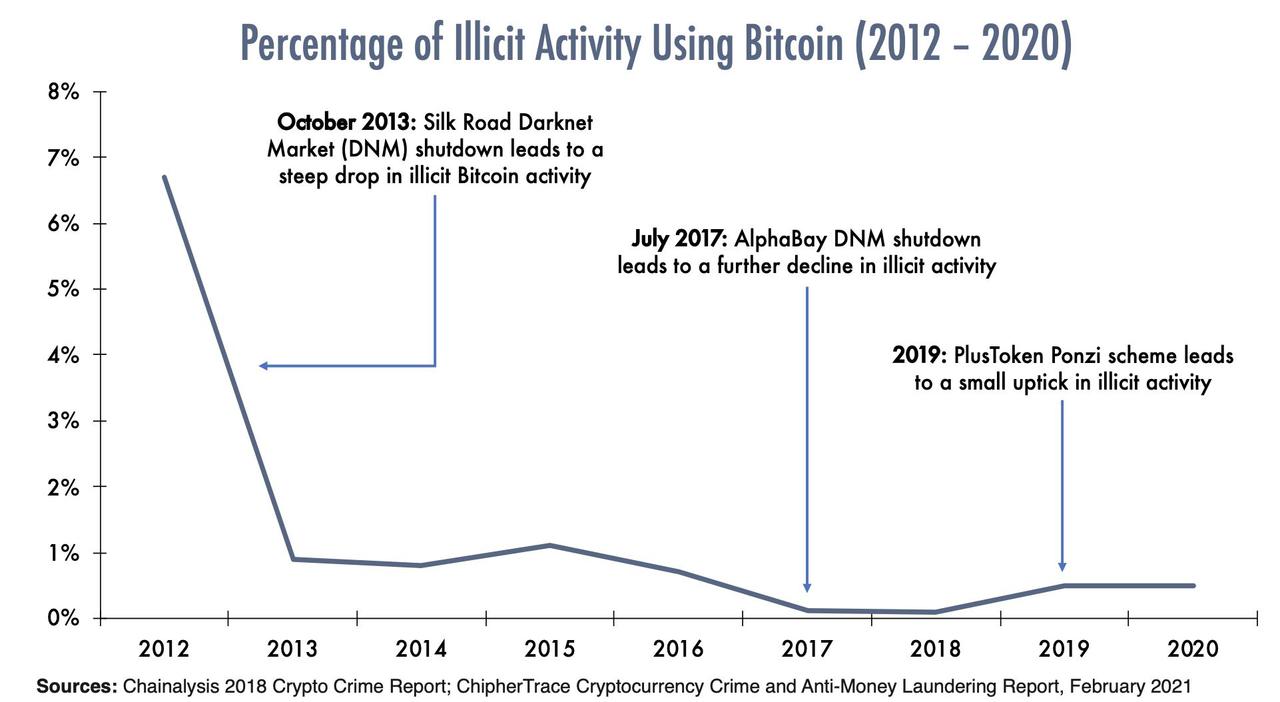
Simply put, the percentage of illicit transactions in crypto is minimal (less than 1% according to one report from Chainalysis), and falling. For additional context, he notes that estimates of illicit activity conducted through traditional intermediaries range between 2-4 percent of global GDP.
Percentage of Illicit Activity Using Bitcoin (2012-2020)
These findings will not surprise readers who have been following this industry for a long time and have encountered this narrative before, but they have never been refuted so directly by such an authoritative figure.
Meanwhile, a buy the dip moment is coming. Not only have some of the biggest crypto bulls expressed their interest in bidding up bitcoin...
.... in a note published on Friday, JPMorgan's Nick Panagirtzoglou pointed to the "hefty" futures carry over spot of around 4% over two months in both bitcoin and ethereum which "is likely to help the ethereum CME futures contract to continue to grow rapidly over the coming months as it incentivizes institutional market participants to enter the futures market in order to play the carry trade i.e. by selling the futures and buying the spot to capture the spread between the two with an annualized return of more than 20%." Indeed, most of the previous growth of the CME bitcoin futures contract started taking place from 2019 onwards once the futures to spot spread reached significant positive territory.
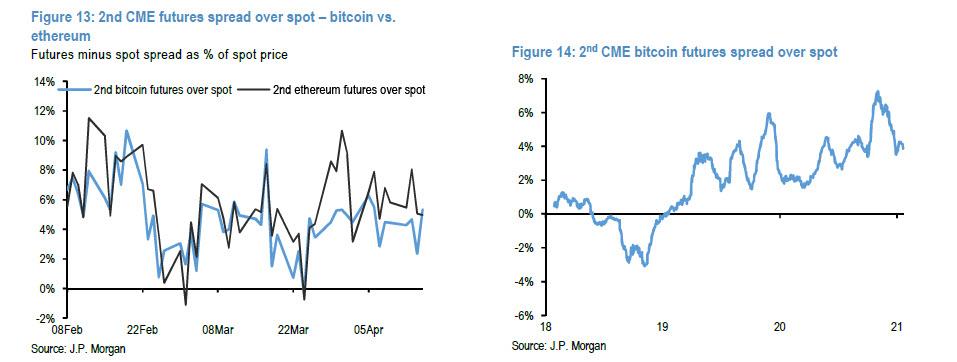
As the JPM strategist continues, this high futures to spot spread is likely a function of the high “risk-free” rate or opportunity cost implicit in crypto markets: "Lending USD in crypto markets attracts annual interest rates of 8-10% and this high “risk-free” rate is a common component in the futures vs. spot arbitrage trade across both bitcoin and ethereum futures." This high “risk-free” rate or opportunity cost is likely a reflection of how “crypto-rich” and “cash-poor” crypto markets still are.
Curiously, and as a post-script to a note we wrote last weekend discussing the steep bitcoin curve, in the case of bitcoin, neither the introduction of ETFs nor the greater institutional participation in the futures market have managed to change the “cash-poor” nature of crypto markets and cause a normalization of the futures to spot spread. Adding to this elevated “risk-free” rate storage costs of around 2% per annum and transaction costs, as a result of relative more fragmented crypto markets, "one can easily see why futures to spot spreads of around 15% per annum could be justified."
Translation: as soon as the profit-taking turmoil is over, watch as institutions flood to bid up Bitcoin and Ethereum spot while shorting 2M futures to pick up what is literally a risk-free 20% annualized carry.
DOES GUCCI NEED FIXING?
- Kering, owner of Gucci, Balenciaga, Saint Laurent and other brands, reports first-quarter financial results on April 20
- Last quarter, Gucci’s sales underperformed, amplifying concerns about slowing momentum at the brand
- Last week, Gucci, which turns 100 this year, showed its latest collection, which included a collaboration with Balenciaga
Where LVMH, Prada and other luxury giants seem to have the post-pandemic wind at their backs, Gucci risks being left out of the party. It partly comes down to timing: Gucci dominated the end of the last decade, but momentum was starting to flag by early 2020. The pandemic wasn’t the best time for creative director Alessandro Michele to debut a new direction for the brand; a collection launched via a series of short films drew plenty of attention, but sales dipped in the fourth quarter. The temporary halt to global tourism took a big bite.
To be sure, Gucci still ranks second in Brand Finance’s annual ranking of the world’s most popular brands, behind Nike. And Michele is an expert at using that clout to draw attention to his creations; last week’s show, with its Balenciaga “hack,” was an online sensation the likes of which few other brands can match.
The Bottom Line: Gucci’s latest collection appropriately had a “rebirth” theme. Kering, which relies on Gucci for a majority of its revenue and profits, is no doubt hoping Michele’s latest stunt proves as effective at drawing consumers to stores as it did at drawing online views.
Accessible Luxury’s Big Opportunity
This week, everyone will be talking about Michael Kors’ 40th anniversary show, Gucci’s first-quarter sales and Fashion Revolution Week.
THE SHRINKING CENTRE
- The brand Michael Kors is marking its 40th anniversary with a digital show on April 20
- “Accessible luxury” brands have lost market share to both more-expensive and cheaper rivals
- Handbags, a key category for these labels, are expected to see strong sales as lockdown restrictions ease
Michael Kors will be getting back to the designer’s roots with its latest collection launch, a New York theatre-themed digital event that doubles as the brand’s 40th anniversary celebration. It’s a time of transition for Kors, and the American accessible luxury category as a whole. The pricey but generally not too pricey brand, along with similarly positioned rivals like Coach and Kate Spade, is competing for a shrinking market, as wealthy consumers upgrade to luxury labels and the masses look for bargains. Piper Sandler’s latest survey of American teens illustrates what Michael Kors is up against: in 2018, 62 percent of respondents named Kors, Coach or Kate Spade as their favourite handbag brand, while 17 percent named a European luxury label. In the latest survey, the gap was much narrower, at 43 percent and 37 percent, respectively. Meanwhile, Shein, an online fast fashion retailer, cracked the survey’s list of most popular handbag brands for the first time.
It’s not all bad news. Kors might be grabbing for a smaller slice of the pie, but the pie itself is bound to get bigger as lockdowns lift and consumers seek out new heels and handbags. The long-awaited new silhouette — goodbye skinny jeans — appears to be gaining broader traction, a prime opportunity for brands that bridge the divide between runway fashion and everyday dressing. New leadership may be on the way, with former Coach head Joshua Schulman rumoured to be in line to head Capri, the parent of Kors, Versace and Jimmy Choo.
The Bottom Line: As Coach’s recent success with “Coach TV” shows, it is still possible for accessible luxury brands to win consumers’ attention. The greater challenge is convincing those customers to buy their bags at full-price boutiques instead of outlet malls and off-price stores.