Wirecard administrator agrees sale of chunk of Asia operations
Deal ushers in final stage in the dismantling of the collapsed German payments group
Wirecard’s administrator has reached an agreement to sell a large chunk of the defunct business’ operations in Asia, in a deal that ushers in the final stage of the dismantling of the collapsed German payments group.
A payments firm backed by Finch Capital, an Amsterdam-based venture capital fund, is set to buy Wirecard’s legal entities in the Philippines, Malaysia, Hong Kong and Thailand as well as the company’s regional data warehouse in Singapore, its Asia-Pacific headquarters.
An Indonesian group’s technology holding company has bought Wirecard’s unit in the country, which includes 360 staff in Indonesia and Malaysia.
“Following a challenging bidding process we succeeded in selling the companies for the best possible price and securing substantial flows to the debtors’ assets in Germany,” said Michael Jaffé, Wirecard’s Munich-based administrator. Business units “worth retaining” will continue as going concerns, he added.
Wirecard collapsed into insolvency last June in one of the country’s largest accounting frauds. Since then Jaffé has divested the company’s operations in the Americas, the UK and continental Europe. Last October, US-based Syncapay, a holding company that specialises in payment solutions, acquired Wirecard North America, while Spanish lender Santander one month later paid about €100m for Wirecard’s core business in Europe. The German company’s banking unit will be wound down.
The transactions will further shrink what is left of Wirecard in Asia-Pacific, a region where it expanded aggressively in its heyday. One of the biggest remaining assets is Wirecard’s payments business in India.
The size of Finch Capital’s deal — which includes Wirecard’s clients, licences and more than 120 staff — fell below the approximately €200m the German group paid Citigroup to acquire its merchant portfolio. Radboud Vlaar, managing partner at Finch Capital, declined to elaborate.
In 2017, Wirecard acquired 20,000 merchant clients from the US lender, spread over 11 Asia-Pacific countries, in an ambitious deal that was intended to make the company a household name across the region. Citigroup has said it exited the business globally.
Clients fled Wirecard after it admitted last year that €1.9bn supposedly held in Philippine bank accounts were missing.
The Monetary Authority of Singapore, the country’s central bank, in September ordered Wirecard to cease payment services, after the city-state launched a criminal probe into the group as well as affiliated companies and agents.
But Vlaar said there are still many blue-chip clients left, including well-known international names such as European-headquartered companies operating in Asia.
The acquisition will help Finch Capital’s Nomu Pay, which last month said it would acquire Wirecard’s Turkish subsidiary, build an ecommerce and payments company in Asia.
Vlaar added: “We always look to what extent does an acquisition help us to be faster, versus an organic route.”
Finch Capital’s deal is set to close next month subject to regulatory approval, except for the Philippines, where it could take up to three months for the central bank to give the go-ahead.
Einhorn: "The Market Is Fractured And In The Process Of Breaking Completely"
In many ways, David Einhorn's Greenlight appears to be back to its "new normal" - in a letter sent to investors, Einhorn writes that Greenlight again underperformed the market and returned -0.1% in the first quarter, badly underperforming the 6.2% return for the S&P 500 index, before proceeding to bash the Fed, broken markets, Chamath and Elon, the basket of short stocks and much more.
That said, even though as Einhorn writes Greenlight made only a handful of portfolio changes and essentially broke even, "a lot happened. In general, the investment environment – especially from mid-February through the end of the quarter – was favorable as value outperformed growth, and interest rates and inflation expectations rose."
He then asks if the tide has finally turned from Growth to Value, noting that "after a very tough decade, we have only just begun a recovery as shown in this 45-year chart from Goldman Sachs research:"
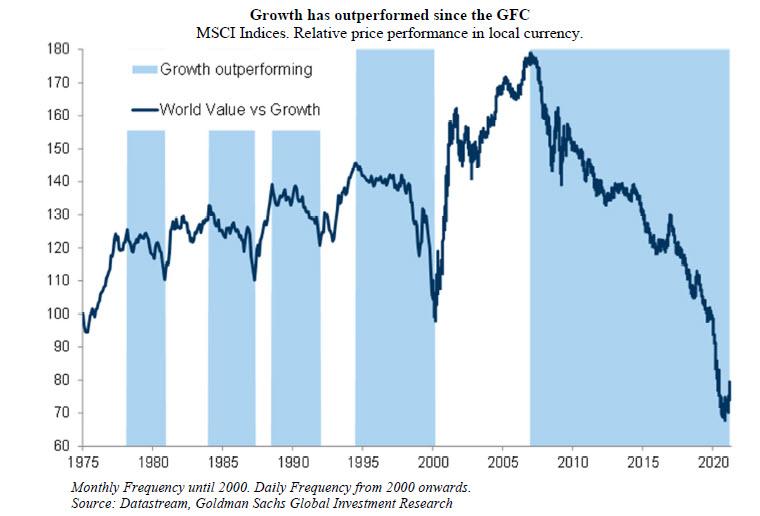
Part of the shift from growth to value, Einhorn writes, may be coming from higher inflation and inflation expectations. As measured by the inflation swap market, 10-year inflation expectations fell from 2.9% in September 2012 to 0.8% in March 2020. The only significant intervening bounce came in 2016, when expectations jumped from 1.5% to 2.3% on expectations of a major stimulus deal from the Trump admin (which never materialized). It is hardly a coincidence that that was the only year in the last decade in which value outperformed growth, as the Greenlight head notes. Fast forward to now, when after bottoming in March 2020, inflation expectations have recovered to 2.5%. The trend became clearer in the middle of May, and value started outperforming growth then, and especially since the middle of February. Indeed, aince May 15, the value-heavy Greenlight returned 80% of the S&P 500 index with half the net exposure.
Einhorn is even more optimistic about the future when it comes to the "growth to value" rotation:
When the time comes, we will have to figure out how to perform better in deflationary periods. But for now, we believe inflation is only going one way – higher – and we are optimistic about our prospects. The wind is now at our backs. The economy is in full recovery mode. Household balance sheets are stronger than they have been in a long time and household income growth was up 13% in February compared to last year. And this is before the latest $1.9 trillion – with a “T” – pandemic relief stimulus. Corporate capital spending is booming. There are shortages and bottlenecks everywhere. Last month nearly one million jobs returned. There are signs of an emerging labor shortage.
As for the Fed, the Greenlight boss writes that "it fundamentally changed its framework last August. It no longer seems to care that monetary policy works with a lag. Actually, it has embraced an asymmetrical inflation policy: The Fed wants to be ahead of the curve on the downside to protect the stock market and corporate bondholders the economy. Behind the curve is fine on the way up no matter how frothy the stock market the recovery is. Now, it says it is only going to react to actual inflation that exceeds its 2% target for a period of time."
The letter then goes on to muse how the Fed will know when it is blowing the next bubble, and to stop:
... the Fed has indicated that it believes any abnormally high inflation will be transitory. We wonder, how will the Fed know? Do price increases come with a label that says “transitory”? Our sense is that no matter how hot inflation gets in the coming months, the Fed will continue with zero interest rates and large-scale asset purchases. After all, the U.S. Treasury has a lot of debt to sell and it isn’t clear who, other than the Fed, can absorb the supply.
It's not just Powell who is throwing caution to the wind: so are such mainstream econ "experts" as John Oliver:
The bipartisan idea that deficits don’t matter has even reached popular culture. John Oliver dedicated an entire episode of Last Week Tonight to browbeating anyone who is concerned about the growing national debt. His argument boiled down to: (1) nobody knows how much debt is too much; (2) we have a good need to spend money now; and (3) it won’t be a problem until inflation shows up, and we can deal with it then.
To this, Einhorn's response is simple: "Though one can debate whether the official government statistics are contrived to avoid capturing inflation" - and as we have repeatedly noted, inflation is now decidedly a political measurement, one which has been gamed for decades to make it appears as low as possible "shortages and bottlenecks accompanied by rising demand can only be solved through increased capacity and higher prices. We have also reset the baseline income for non-working adults; it will take higher wages to bring those marginally attached to the labor force back to work."
Concluding this part of the letter, Einhorn writes that while the Fed says it has the tools to fight inflation (and according to Bernanke can cut it in 15 minutes), "it remains to be seen if it will have the stomach to use them when the time comes. That is a discussion for another day. Right now, we remain positioned for rising inflation and inflation expectations."
The Greenlight letter then goes on to lay out just how it plans to capture these rising inflation expectations, listing its top positions as follows, and how they performed in the frist quarter:
- Brighthouse Financial (BHF, +22%) benefitted from rising interest rates;
- Danimer Scientific (DNMR, +61%) began its life as a public company;
- Concentrix (CNXC, +52%) benefitted from strong demand and rising estimates;
- Resideo Technologies (REZI, +33%) was helped by the strong housing market;
- Change Healthcare (CHNG, +18%) agreed to be acquired by UnitedHealthcare;
- AerCap Holdings (AER, +29%) agreed to acquire GE Capital’s aircraft leasing business (GECAS) at a discount; and
- An undisclosed healthcare short (-41%) fell due to reduced government reimbursement for its product.
(incidentally, at quarter-end, Greenlight's largest disclosed long positions were Atlas Air Worldwide, Brighthouse Financial, Change Healthcare, Danimer Scientific and Green Brick Partners, with a net average exposure of 118% long and 81% short).
Which is not to say that there were no glitches. One was underperformance by homebuilder and land-developer GRBK, the fund's largest position (more on this in the full letter below). The other performance drag was - as usual- Greenlight's "short basket" of bubble stocks.
What follows next is a tour de force from Einhorn lashing out at all the ways the market is broken, and how the Reddit insanity of Q1 exposed it for all to see:
In late January, the market came to focus on companies with large short interests. Despite having a diversified portfolio, a number of our positions fell into this group and experienced sudden, sharp rises. We adjusted to the dynamic by reducing our exposure to single name shorts, both in number and sizing. To mitigate the potentially uncomfortable net long bias that would have resulted, we added macro hedges of market index and index option shorts. While we do not expect this to be a permanent change, we will evaluate and modify as we go. The performance of our short portfolio in 2020 and in early 2021 was unacceptable, so change is certainly needed. If we swing a little less hard, we should hit more balls. We have also revised our internal analyst incentive structure to fully emphasize alpha creation.Much has been made of the short-squeezes in late January. In fact, Congress held hearings, where it called the leaders of Robinhood, Melvin Capital and Citadel and an individual investor who made a great call on GameStop (GME) to testify. We have a few thoughts about this to share.First, it is very healthy for market participants to discuss and debate stocks. This is true both privately and publicly. There are rules about fraud and manipulation that need to be followed, but investors discussing why they think GME (or any other stock) should go up or down ought to be encouraged. There is no reason to drag anyone before Congress for making a stock pick.Second, it is also fine to make bad stock picks. If a hedge fund takes a big position in a stock and is wrong, it loses money. Isn’t this how it is supposed to work?Third, payment for order flow is just disguised commissions. We are in a world where consumers, especially young ones, expect internet services to be free, or at least free to them. A quote widely attributed to Richard Serra about commercial TV in 1973 says it best: “You’re not the customer; you’re the product.” If you want the broker to work for you, pay a commission.Fourth, Robinhood suspended trading in certain stocks because it was undercapitalized. It is possible that it wasn’t following the regulatory requirements. A regulatory sanction is probably appropriate – but as we’ll discuss below, we won’t be holding our breath.
The punchline: Einhorn slamming Chamath and Elon for pouring the "real jet fuel" on the GME squeeze:
Finally, we note that the real jet fuel on the GME squeeze came from Chamath Palihapitiya and Elon Musk, whose appearances on TV and Twitter, respectively, at a critical moment further destabilized the situation. Mr. Palihapitiya controls SoFi, which competes with Robinhood, and left us with the impression that by destabilizing GME he could harm a competitor. As for Mr. Musk, we are going to defend him, half-heartedly. If regulators wanted Elon Musk to stop manipulating stocks, they should have done so with more than a light slap on the wrist when they accused him of manipulating Tesla’s shares in 2018. The laws don’t apply to him and he can do whatever he wants.Many who would never support defunding the police have supported – and for all intents and purposes have succeeded – in almost completely defanging, if not defunding, the regulators. For the most part, quasi-anarchy appears to rule in markets. Sure, Dr. Michael Burry, famed for his role in The Big Short, reportedly received a visit from the SEC after tweeting warnings about recent market trends – and decided to stop publicly speaking truth to power. But for the most part, there is no cop on the beat. It’s as if there are no financial fraud prosecutors; companies and managements that are emboldened enough to engage in malfeasance have little to fear.
Einhorn then concludes with three anecdotes to demonstrate his argument that this is not only an "anything goes" market where crime is rampant, but proving just how broken the market has become.
First, consider the investigation of Tether by the Office of the Attorney General of New York (OAG). As Einhorn explains, "tether is a cryptocurrency that is always worth a dollar (the value is “tethered” to the dollar). Tether is one of the largest cryptocurrencies with about $40 billion outstanding, yet it has not been audited or regulated in any serious manner. In theory, Tether is supposed to have $1 of cash backing every Tether issued. Except it didn’t, at least when it was investigated." Incidentally, for anyone still confused, Tether is how the Chinese launder billions in domestic funds abroad and outside the Chinese firewall as we explained in December, although so far few have the desire to expose this reality. In any case, here is Einhorn's lament:
The OAG conducted a two-year probe and found that Tether deceived clients and the market by overstating reserves and hiding approximately $850 million of losses around the globe. Tether and its sponsor, Bitfinex, “recklessly and unlawfully covered up massive financial losses to keep their scheme going and protect their bottom lines,” said the OAG. Further, “Tether’s claims that its virtual currency was fully backed by U.S. dollars at all times was a lie.”Did the OAG shut down Tether? Did anyone get arrested or even lose their job? Was the regulatory infrastructure changed to make sure this doesn’t happen again? No, of course not. The OAG assessed an $18.5 million penalty and Tether agreed to discontinue “any trading activity with New Yorkers.” It was as if Bernie Madoff had been told to pay a small fine and stop ripping off New Yorkers, but to go ahead and have fun with the Palm Beach crowd.
Einhorn next highlights one of the stocks most hated by the bearish community: GSX:
The media is focused on how the banks allowed excessive leverage and poorly (or properly) managed their risks. The real story is how Arch-Egos was able to buy up most of the float of GSX Techedu, causing the stock to soar 400% in the face of unrefuted allegations of massive fraud. The SEC has an ongoing investigation of GSX but appears to not have noticed a single fund (or a small group of funds) essentially cornering the market. A traditionalist could say this was market manipulation and transparently illegal.
The professional poker player finally points out some of the insane moves observed in pennystocks in Q1, focusing on a tiny deli owner in rural NJ:
Strange things happen to all kinds of stocks. Last year, on one day in June, the stocks of about a dozen bankrupt companies roughly doubled on enormous volume. Recently, the Wall Street Journal reported a boom in penny stocks.Someone pointed us to Hometown International (HWIN), which owns a single deli in rural New Jersey. The deli had $21,772 in sales in 2019 and only $13,976 in 2020, as it was closed due to COVID from March to September. HWIN reached a market cap of $113 million on February 8. The largest shareholder is also the CEO/CFO/Treasurer and a Director, who also happens to be the wrestling coach of the high school next door to the deli. The pastrami must be amazing. Small investors who get sucked into these situations are likely to be harmed eventually, yet the regulators – who are supposed to be protecting investors – appear to be neither present nor curious.
We don't find it at all surprising that Einhorn's conclusion from his capital markets observations over the past quarter is identical to ours, when we discussed the insane stock moves that dominated much of January and February:
"From a traditional perspective, the market is fractured and possibly in the process of breaking completely."
Autonomous-Truck Developer TuSimple Plans Driverless Road Test This Year
The company raised $1.08 billion in an IPO Thursday that came as the U.S. is investigating the startup’s ties to China
Self-driving company TuSimple Holdings Inc. plans to test its autonomous trucks without backup drivers on public roads in Arizona later this year, executives of the newly public company said.
TuSimple, which has offices in the U.S. and China, on Thursday raised $1.08 billion through an initial public offering that sold some 33.8 million shares. The company priced shares at $40 apiece, above its indicated price range, giving it a capitalization of about $8.49 billion.
After opening at $40.25, the stock stumbled, slipping about 20%. But it regained much of its loss to close at $40.
“I guess it was a rough awakening to life as a public company for a few hours, but we are optimistic,” Chief Financial Officer Pat Dillon said.
Chief Executive Cheng Lu said the company is planning to conduct a “driver-out” pilot program without anyone at the wheel in the fourth quarter on a roughly 100-mile run between Tucson and Phoenix.
The company has a fleet of 50 trucks it is testing in the U.S. Southwest and approximately 20 more in China, running with two people in the cab. Its backers include commercial truck maker Navistar International Corp. , along with big U.S. truckload carriers including Omaha, Neb.-based Werner Enterprises Inc. and Green Bay, Wis.-based Schneider National Inc.
Mr. Lu said the driverless pilot program would move customer freight, and that the company was working closely with Arizona transportation officials to coordinate the operation. He declined to say whether the driverless pilot would involve a single truck or multiple vehicles.
“We are going to demonstrate the ability ... to take the driver out on limited routes,” he said. “We’re being very careful, and very tactical about this.”
TuSimple is the first autonomous driving company to list on a U.S. exchange, and has come under scrutiny for its strong ties to China, including a large operation and investor base there.
Mr. Lu said TuSimple and Chinese online media conglomerate Sina Corp. would comply with a probe by the Committee on Foreign Investment in the U.S., or Cfius, into a 2017 investment by a Sina affiliate. He said the companies were still preparing a joint response to the inquiry Cfius made on March 1.
Sun Dream Inc., the Cayman Islands-registered affiliate of Sina, was TuSimple’s largest private shareholder and is controlled by the Sina chairman and chief executive. According to a regulatory filing, Sun Dream planned to sell about 20% of its holdings in the IPO, but still keep two board seats.
“I can’t speculate whether it’s because of Cfius or other reasons,” Mr. Lu said of Sun Dream reducing its stake. But because of strong investor demand for the IPO, “we did suggest that maybe some of our older shareholders can sell.”
TuSimple has previously acknowledged the challenge of reassuring public market investors, who prefer predictability, even as it is still building new technology and projects its first commercial revenue in 2024. Mr. Dillon said the company has about $500 million on its balance sheet and that there were no imminent plans for additional fundraising to get to commercial launch in 2024.
The original old master is an auction-house trick
Controversy over whether Leonardo painted ‘Salvator Mundi’ conceals a messy reality
When the Spanish government imposed an export ban last week on a painting attributed to the “circle” of the 17th-century artist José de Ribera, it was acting on a tip-off about the work’s potential identity. “It’s Caravaggio, completely. It’s incredible. It has great power,” a London-based art dealer who spotted it told the New York Times.
If so, the painting could be worth €50m or more on the open market, rather than its auction starting price of €1,500 as a quasi-Ribera. There is plenty of prestige and money to be made in identifying “autograph” works — those painted entirely by famous artists rather than made by apprentices in their workshops, or later imitations of their style.
A global industry, including the leading auction houses Christie’s and Sotheby’s, is devoted to authenticating and selling works of art, but no one can honestly be sure of the status of an old master. Debate still rumbles over whether “Salvator Mundi”, which sold for $450m in 2017, is wholly the work of Leonardo da Vinci.
Christie’s gave “Salvator Mundi” its full imprimatur at the time, hailing it as “the greatest artistic rediscovery of the last 100 years” as it was acquired by Mohammed bin Salman, crown prince of Saudi Arabia. So it is decidedly awkward that a film released this week claims that experts who examined it for the Louvre concluded that Leonardo “only contributed” to the work.
“About suffering they were never wrong,/The Old Masters,” wrote WH Auden in his poem Musée des Beaux Arts. But we are often wrong about the old masters themselves. An auction house has a financial incentive to certify a painting as the sole work of a famous artist because the price will rise and there will be more prestige in selling it, but the reality is usually messier.
In theory, the origins and authorship of a painting should make no difference to the experience of viewing it: the object remains the same, no matter how it is described. The so-called Vermeers painted by Han van Meegeren, the notorious Dutch art forger, did not change form when he confessed to his captors in 1945 to having faked them.
In reality, the pleasure we gain from a painting is deeply bound up with what the art philosopher Denis Dutton called its “expressive authenticity”. Knowing — or believing we know — who painted it, what the artist meant, when and where it was done and who has owned it, is part of the experience.
People who participated in one German psychology study responded quite differently to identical images, depending on whether they were told they were original works of art or copies. The images included Leonardo’s “Portrait of an Unknown Woman”, which is in the Louvre, and what was called a copy of the work painted by an apprentice under his supervision.
If they believed it was produced by Leonardo, they were more likely to agree with statements such as “this artwork is more extraordinary than [others] I have seen before” and “[it] is triggering a pleasant emotion for me”. A portrait’s provenance stirs the soul, even if it is an illusion.
Deciding whether a painting is the work of an old master or one of their followers is a matter of judgment. It can be scanned and X-rayed to identify all the materials and rule out crude forgery or copying. “Salvator Mundi” was painted on the kind of walnut panel used by Leonardo elsewhere and characteristically has powdered glass in its paint. But a lot still rests on the expert’s “eye”.
Martin Kemp, a distinguished art historian, authenticated “Salvator Mundi” as a full-blown work by Leonardo partly because of the way Christ’s hair is painted in a vortex. Similarly, the judge in a 2015 UK court case over whether Sotheby’s was justified in deciding that a painting was not a Caravaggio ruled that “the feather in the painting has a shininess that is inappropriate”.
This underlies the complex code for degrees of authenticity, from an autograph work to one “attributed to” an artist, by a studio or a “circle”, by a “follower”, or in the “manner of”. Paintings can shift categories depending on the latest opinion or scan, with their owners pressing for promotion.
One obvious problem is that provenance is always uncertain. Despite the claims made in the film, the Louvre confirmed the attribution of “Salvator Mundi” to Leonardo in an unpublished booklet. A deeper problem is that the entire edifice of definitions is suspect for Renaissance painters because it does not reflect how they worked.
Many scholars agree that most paintings of the period were collective efforts. They were created not by what Michelle O’Malley, a professor at the Warburg Institute in London, calls a “heroic, genius artist” but in workshops led by them. The idea of the individual old master emerged in the 18th century, at the same time as auction houses.
The inconvenient truth is that there is no clear answer as to whether or not a work is by Leonardo, even if fortunes rest on there being one. Not only is it an opinion, but the question itself may not even make sense. Reflect on that, next time you are in the Louvre.
Mercedes kick-starts Tesla offensive with luxury electric car
German carmaker to launch suite of new vehicles in next 18 months
A suite of luxury Mercedes electric vehicles will hit the streets in the next 18 months, the German carmaker’s chief executive said, as he unveiled a battery-powered version of the brand’s flagship S-Class saloon, designed to lure customers away from the likes of Tesla.
Ola Källenius, who leads Mercedes’ parent group Daimler, told the Financial Times that the EQS, which is set to go on sale in the late summer, will be followed by an all-electric E-Class saloon and two sport utility vehicles based on the same platform within two years.
At the end of that period, the line-up would be available in Europe, China and the US, he added, complementing a less-expensive range of five electric compact cars, and the Mercedes EQV people carrier.
The EQS, which has received a rapturous reception from leading analysts, has an advertised range of up to 770km per full charge, outpacing Tesla’s Model S and BMW’s upcoming iNEXT.
However, some of the EQS’s features, such as the ability to offer over-the-air updates that unlock new functions, have been a mainstay in products by younger rivals, including Tesla and China’s Nio, for years.
Källenius said internal market research had shown the model could become a “conquest vehicle”, attracting customers who “maybe weren’t looking at Mercedes”.
The Stuttgart-based company had “built up a brand promise over 100 years plus, and with that brand promise comes a certain level of substance”. This would entice wealthy consumers, he added.
While profit margins for the EQS are lower than for the lucrative S-Class, Källenius said the car would “start with a healthy profitability level from the word go”, which would improve as battery costs came down.
The model, which has not yet been priced, will probably sell for between €80,000 and €150,000, Bernstein analyst Arndt Ellinghorst predicted, depending on specifications.
Mercedes would make an “easy 20 per cent [margin] on the high end version,” he added, while basic versions would make between 10 and 15 per cent.
Although it will be manufactured on the same production line as its combustion-engine sibling, Källenius said Mercedes would not limit the number of EQS cars it made in order to preserve capacity for the S-Class, which has attracted more than 50,000 orders since its launched last September.
“We are not going to artificially strangle the ramp up of our electric vehicles,” the Swedish executive said.
Mercedes, which sold 160,000 battery-powered and hybrid vehicles last year and over-fulfilled EU emissions targets, aims to almost double its sales of electrified cars in 2021.
Parent company Daimler’s shares have risen more than 200 per cent to €75.36 since lows in March last year, buoyed in part by strong sales in the Asia-Pacific region. In the three months to the end of March, Mercedes set a record in China, delivering 222,520 vehicles.
Källenius said he believed the brand would continue to see “high growth rates in the second half of the year”, because of pent-up demand, before sales level out again.
L’Oréal’s recovery picks up pace driven by China
Outgoing CEO Jean-Paul Agon maintains prediction of boom in beauty products once pandemic subsides
First-quarter sales at three of L’Oréal’s four businesses have exceeded levels from before the Covid-19 pandemic, putting the world’s biggest cosmetics maker on track for recovery this year.
The French company benefited from strong growth in China, where consumers have put the pandemic behind them to push sales up 38 per cent in the quarter, continuing a years-long run that has made the country its second-largest market after the US.
But the consumer products division, which sells mass-market brands such as Maybelline make-up and Garnier shampoos and is L’Oréal’s biggest, had lower quarterly revenues than a year ago. It has been penalised by consumers turning away from elaborate grooming rituals as they spend more time at home.
Europe also remained a sore point as a resurgence of infections and repeated lockdowns have hurt demand.
In contrast, L’Oréal’s skincare division, which sells brands like Kiehls and La Roche-Posay, has boomed despite repeated lockdowns that have closed stores and beauty salons in much of Europe.
First-quarter sales stood at €7.6bn, slightly short of the €7.7bn expected by analysts, according to Thomson Reuters Eikon.
That represented organic growth of 10.2 per cent once the impact of currency moves and acquisitions were stripped out, ahead of consensus for 8.7 per cent organic growth.
The results come at a turning point for L’Oréal, which competes with smaller rivals Estée Lauder and Coty, as well as independent brands.
Jean-Paul Agon, who has been chief executive since 2006, will step aside from May 1 to be succeeded by deputy CEO Nicolas Hieronimus.
Agon led a period of global expansion for the French company, especially in Asia, growth that was achieved largely organically without blockbuster acquisitions. Even the biggest deals under his leadership did not exceed $2bn, although L’Oréal did often buy up-and-coming brands such as Kiehl’s and then nurture their growth.
Agon will remain chair once Hieronimus takes over, and he remains a trusted confidant of the group’s biggest shareholder, the billionaire Bettencourt-Meyers family.
The stock price more than quadrupled under Agon’s leadership from €70 a share when he took over to €342 at Thursday’s close. The shares are now trading at all-time highs, up 60 per cent from a trough in mid-March last year.
Investors have piled in as L’Oréal has showed it is well positioned to thrive in the era of the pandemic because of its international presence and knowhow in ecommerce.
Ecommerce, which includes sales on L’Oréal’s own websites as well as those of its partner retailers, rose 47 per cent in the quarter, which represented a slowdown from the 62 per cent seen last year when consumers turned to online shopping while stores were closed.
In February, Agon predicted a boom for beauty once the Covid-19 pandemic subsided similar to the roaring 1920s that followed the global influenza pandemic of 1918. While this has not yet fully come to pass, L’Oréal said there were encouraging signs from countries such as China, where infections are low, and Israel, where vaccination programmes are very advanced.
“We believe our prophecy will be confirmed, and the make-up party will begin,” said Agon.
Speaking of Israel, Hieronimus said: “It may not yet be the roaring 1920s but the signs are good.”
TSMC faces pressure to choose a side in US-China tech war
Washington attempts to draw chipmaker crucial to global supply chain closer into its orbit
The world’s largest contract chipmaker is under pressure to pick a side in the US-China rivalry for technological supremacy, posing a dilemma for a company that has become crucial to the global supply chain.
Taiwan Semiconductor Manufacturing Company, which has been thrust into the spotlight in the midst of a worldwide chips shortage, faces accusations of indirectly supplying China’s military. That has further embroiled the semiconductor group in the US campaign to curtail China’s access to high-tech components.
It has also posed a big question for TSMC and other Taiwanese groups on whether to commit themselves to the larger US market, or to faster-growing China.
Taiwan on Wednesday challenged reports that technology from TSMC and Taipei-based chip designer Alchip supported Chinese military development. Wang Mei-hua, economy minister, told reporters that “our companies comply with US, domestic, and multilateral rules when they meet global demand for chips”.
That followed a Washington Post report that Chinese supercomputer maker Phytium used chips made by TSMC, which is also an important US military supplier, in machinery to test hypersonic missiles for the People’s Liberation Army.
The US Commerce Department placed Phytium and six other Chinese supercomputing companies on its “entity list” last week, barring American suppliers from exporting directly to the company without a special licence. The rules do not apply to overseas companies, but TSMC and a Taiwanese chip designer have both proactively halted sales to Phytium.
TSMC declined to comment on the matter.
Washington’s moves showed that “the US is pressuring Taiwan and TSMC to support its supply chain” over China, said Paul Triolo, an analyst at consultancy Eurasia Group. They also challenge TSMC’s historic position of neutrality and the company’s strategy of “being everyone’s foundry”.
The US last year accounted for over 60 per cent of TSMC’s sales, compared with only 20 per cent to China. However, the latter is the fastest-growing market for semiconductors, making China a lucrative opportunity for TSMC as “Chinese tech firms make cutting-edge consumer electronics, a huge source of growth for TSMC's advanced nodes”, added Triolo.
TSMC has previously been caught up in US-China tensions. Almost two years ago, the Trump administration said chips the company had sold to technology group Huawei were being used in Chinese missiles.
Washington’s efforts to draw TSMC away from Beijing have extended to the chip company moving parts of its supply chain on to American soil.
Last May, under pressure from the Trump administration, TSMC announced plans to open a plant in Phoenix, which would bring it closer to the operations of US military manufacturers Raytheon and Honeywell. Washington wants sensitive technology, such as the TSMC computer chips used in F-35 stealth fighter jets, to be manufactured in the US.
Su Tzu-yun, a director at the Taipei-based Institute for National Defense and Security Research, believed that a recent escalation in tensions between China and Taiwan meant the island’s tech companies had little choice but to side with the US. Taiwan “shares national security interests with the US, as well as values of freedom and democracy”, he added.
The US push to distance TSMC from China has yet to hit the company’s sales, with a global shortage in semiconductors ensuring strong demand.
The company has proved nimble at adapting to geopolitical shifts in the past. After suspending sales to Huawei last summer because of US sanctions, TSMC quickly replaced the lost orders with shipments to Apple as the newly released iPhone 12 drove up demand for its advanced 5 nanometre chips.
Following TSMC’s lead may be harder for other Taiwanese tech groups, many of which are reliant on the mainland Chinese market. Beijing has stepped up military manoeuvres around Taiwan in the past month, underlining the need for those companies to diversify their client bases.
Johnny Shen, chief executive of Alchip, said the company has stopped shipments to Phytium, which made up 39 per cent of its revenue last year. He added the company was “facing a very big challenge”: its Taipei-listed stock has plunged 40 per cent since Washington blacklisted the supercomputer maker last Thursday, while TSMC’s shares barely reacted. Shen told investors that the products and services provided to Phytium were for civilian, not military, use.
For the wider industry, the politicisation of the semiconductor supply chain has created uncertainty between tech groups and their clients. That “trust built up over years has been a huge source of innovation”, said Eurasia’s Triolo.
Closing Stock Market SummaryThe S&P 500 (+1.1%), Dow Jones Industrial Average (+0.9%), and Nasdaq 100 (+1.6%) set intraday and closing record highs on Thursday, as the 10-yr yield dropped 11 basis points to 1.53% despite a batch of better-than-expected economic data. The Nasdaq Composite rose 1.3%. The Russell 2000 increased just 0.4%.
Prior to the open, retail sales soared 9.8% m/m in March (consensus +5.3%), weekly initial claims dropped by 193,000 to 576,000 (consensus 695,000), the Philadelphia Fed Index for April checked in at 50.2 (consensus 35.0), and the Empire State Manufacturing Survey for April checked in at 26.3 (consensus 23.0).
Granted, the futures market had already established a positive bias even before the data was released, partially due to a prevailing bullish sentiment and better-than-expected earnings reports. The data strengthened the cause, but more notably, buying interest accelerated in the Treasury market, driving longer-dated yields sharply lower.
Longer-dated yields typically move higher when investors feel better about the economic outlook, or expect an increase in inflation, but today they continued their monthly downtrend despite the data supporting the growth outlook. The nosedive in long-term rates suggested short-covering activity was a contributing factor.
As expected, the mega-cap/growth/technology stocks benefited from the lower rates, but the gains were relatively broad with nine of the 11 S&P 500 sectors closing in positive territory. The information technology (+1.8%), health care (+1.7%), and real estate (+2.0%) sectors rose more than 1.5%. The energy (-0.9%) and financials (-0.1%) sectors closed lower.
UnitedHealth (UNH 390.01, +14.38, +3.8%) was a major contributor in the health care sector after beating top and bottom-line estimates and raising its FY21 EPS guidance. The financials sector featured better-than-expected earnings reports from Bank of America (BAC 38.74, -1.14, -2.9%) and Citigroup (C 72.53, -0.38, -0.5%).
The inability of the financials sector to rally around earnings news was largely due to the curve-flattening activity in the Treasury market. BlackRock (BLK 817.84, +16.77, +2.1%) provided offsetting support, though, after reporting assets under management rose 39% yr/yr to $9 trillion. BLK also beat revenue estimates.
The 2-yr yield decreased one basis point to 0.14%. The U.S. Dollar Index decreased 0.1% to 91.62. WTI crude futures increased 0.4%, or $0.28, to $63.44/bbl.
Reviewing Thursday's huge batch of economic data:
- March retail sales soared 9.8% m/m (consensus 5.3%) following an upwardly revised 2.7% decline (from -3.0%) in February. Excluding autos, they were up 8.4% m/m (consensus 4.9%) following an upwardly revised 2.5% decline (from -2.7%) in February.
- The key takeaway from the report is that there was a clear rebound from some of the "frozen" activity in February, the arrival of stimulus checks, and pent-up demand that was plain to see in double-digit percentage gains across various discretionary spending categories like food services and drinking places (+13.4%).
- Initial jobless claims for the week ending April 10 declined by 193,000 to 576,000 (consensus 695,000). Continuing claims for the week ending April 3 increased 4,000 to 3.731 million.
- The key takeaway from the report is that initial claims were the lowest they have been since the pandemic started; moreover, they finally dropped in a material manner that is consistent with the reopening (and rehiring) narrative feeding expectations of strong economic growth.
- Total industrial production increased 1.4% m/m in March (consensus 2.9%) following a downwardly revised 2.6% decline (from -2.2%) in February. The capacity utilization rate increased to 74.4% (consensus 75.9%) from a downwardly revised 73.4% (from 73.8%) in February.
- The key takeaway from the report is that it suggests the downturn in February was primarily a weather-driven downturn, although March could have been a bit stronger for industrial production if not for the ongoing shortage of semiconductors that continued to hold down vehicle production.
- The Philadelphia Fed Index increased to 50.2 in April (consensus 35.0) from a downwardly revised 44.5 (from 51.8) in March.
- The Empire State Manufacturing Survey increased to 26.3 in April (consensus 23.0) from 17.4 in March.
- The NAHB Housing Market Index increased to 83.0 in April (consensus 84.0) from 82.0 in March.
- Business inventories increased 0.5% m/m in February, as expected, following an upwardly revised 0.4% increase (from 0.3%) in January.
Looking ahead, investors will receive Housing Starts and Building Permits for March and the preliminary University of Michigan Index of Consumer Sentiment for April on Friday.
- Russell 2000 +14.3% YTD
- Dow Jones Industrial Average +11.2% YTD
- S&P 500 +11.0% YTD
- Nasdaq Composite +8.9% YTD