(ZH) "The Amazon Of Information": Goldman Initiates On Crypto, Sees Ethereum Ove

When Goldman officially announced two weeks ago that it was re-launching a previously rumored cryptocurrency trading team on May 6...

... some joked that this was the top-tick for the crypto space: after all, the last time Goldman launched a bitcoin trading desk, the sector imploded and just a few months later Goldman killed its expansion plans, sending cryptos tumbling even more, and starting the infamous crypto winter which lasted over two years.

In retrospect, such cynicism wasn't too far off, because bitcoin did plunge more than 40% since the day Goldman decided to relaunch its trading effort.
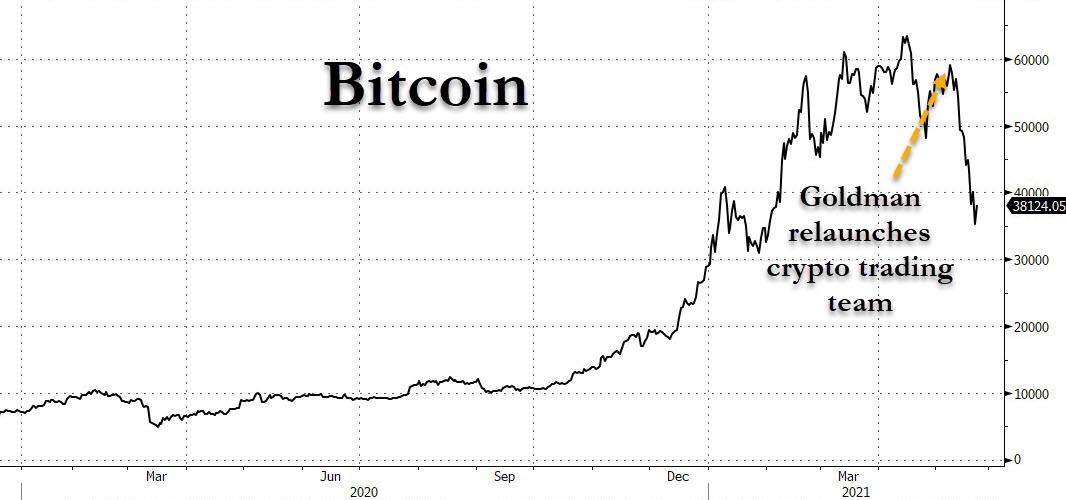
However, poor recent price action notwithstanding, we doubt that Goldman would let it go 2 out of 2 on catastrophic crypto crashes as soon as it officially gets involved.
Confirming this is an aggregate report published by Goldman late on Friday which is as close to an initiation by Goldman on the asset class as one can hope (last month Goldman already revealed its favorite "crypto-exposed" stocks), and which includes not only a handful of both "pro" crypto interviews (with Mike Novogratz leading the cheerleaders) as well as "anti" (Nouriel Roubini not surprisingly is the lead hater), but more importantly Goldman reveals its own thoughts on:
  • Bitcoin as a macro assets
  • Crypto as its own asset class
  • What is a digital store of value, and
  • The role of crypto in balanced portfolios
While the full report can be found in the usual place (for pro subscribers)...

... we wanted to highlight the one thing we found notable in the 40 page report, is the bank's preference for ethereum (an entirely new technological platform) over bitcoin (a store of value and an alternative payment system) which is not really surprising: as Mike Novogratz points out, "the three biggest moves in the crypto ecosystem—payments, DeFi, and NFTs—are mostly being built on Ethereum, so it’s going to get priced like a network. The more people that use it, the more stuff that gets built on it, and the higher the price will ultimately go." And since for the past five years much of the world has largely associated crypto with bitcoin, it will take some time for conventional wisdom to realize that there is much more to crypto than just bitcoin.
Which incidentally brings up the question, of just what is crypto, and conveniently none other than the head of commodities at Goldman, Jeff Currie, has dedicated an entire section discussing this, which also reveals how Goldman is approaching the various constituents of the crypto space: Currie argues that cryptos are a new class of asset that derive their value from the information being verified and the size and growth of their networks. Here are the details:
The term “cryptocurrencies”—which most people take to mean that crypto assets act as a digital medium of exchange, like fiat currency—is fundamentally misleading when it comes to assessing the value of these assets. Indeed, the blockchain that underlies bitcoin was not designed to replace a fiat currency—it is a trusted peer-to-peer payments network. As a cryptographic algorithm generates the proof that the payment was correctly executed, no third party is needed to verify the transaction. The blockchain and its native coin were therefore designed to replace the banking system and others like insurance that require a trusted intermediary today, not the Dollar. In that sense, the blockchain is differentiated from other “digital” transactional mechanisms such as PayPal, which is dependent upon the banking system to prevent fraud like double-spending.
In order to be trustworthy, the system needed to create an asset that had no liabilities or contingent claims, which can only be a real asset just like a commodity. And to achieve that, blockchain technologies used scarcity in natural resources—oil, gas, coal, uranium and hydro—through ever-increasing computational-power consumption to “mine” a bit version of a natural resource.
From this perspective, the intrinsic value of the network is the trustworthy information that the blockchain produces through its mining process, and the coins native to the network are required to unlock this trusted information, and make it tradeable and fungible. It’s therefore impossible to say that the network has value and a role in society without saying that the coin does too. And the value of the coin is dependent upon the value and growth of the network.
That said, because the network is decentralized and anonymous, legal challenges facing future growth for crypto assets loom large. Coins trying to displace the Dollar run headlong into anti-money laundering laws (AML), as exemplified by the recent ransoms demanded in bitcoin from the Colonial Pipeline operator and the Irish Health service. Regulators can impede the use of crypto assets as a substitute for the Dollar or other currencies simply by making them non-convertible. An asset only has value if it can either be used or sold. And Chinese and Indian authorities have already challenged crypto uses in payments.
As a result, the market share of coins used for other purposes beyond currencies like “smart contracts” and “information tokens” will likely continue to rise. However, even these non-currency uses will need to be recognized by courts of law to be accepted in commercial transactions—a question we leave to the lawyers.
The network creates the value, unlike other commodities
Unlike other commodities, coins derive their entire value from the network. A bitcoin has no value outside of its network as it is native to the Bitcoin blockchain. The value of oil is also largely derived from the transportation network that it fuels, but at least oil can be burned to create heat outside of this network. At the other extreme, gold doesn’t require a network at all.
Derived demand leaves the holder of the commodity exposed to the risk of the network becoming obsolete—a lesson that holders of oil reserves are now learning with decarbonization accelerating the decline of the transportation network, and, in turn damaging oil demand. Likewise, bitcoin owners face accelerated network decay risk from a competing network, backed by a new cryptocurrency.
As the demand for gold is not dependent on a network, it will ultimately outlive oil and bitcoin—gold entropy lies at the unit, not the network, level. Indeed, most stores of value that are used as defensive assets—like gold, diamonds and collectibles—don’t have derived demand and therefore only face unit-level entropy risk. This is what makes them defensive. The world can fall apart around them and they preserve their value. And while they don’t have derived demand, they do have other uses that establish their value, i.e. gold is used for jewelry and as a store of value.
Transactions drive value, creating a risk-on asset
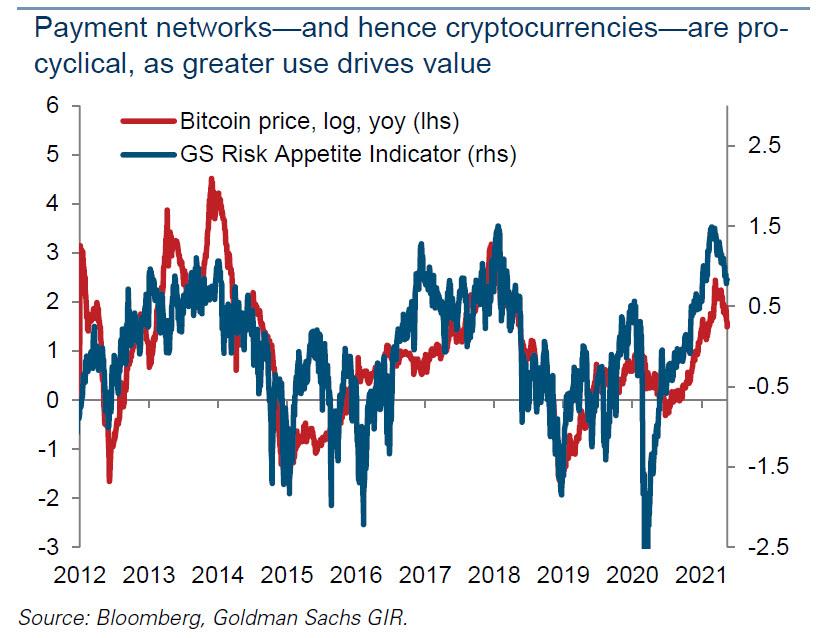
Crypto doesn’t trade like gold and nor should it. Using any standard valuation method, transactions or expected transactions on the network are the key determinant of network value. The more transactions the blockchain can verify, the greater the network value. Transaction volumes and the demand for commodified information are roughly correlated with the business cycle; thus, crypto assets should trade as pro-cyclical risk-on assets as they have for the past decade. Gold and bitcoin are therefore not competing assets as is commonly misunderstood, and can instead co-exist. Because the value of the network and hence the coin is derived from the volume of transactions, hoarding coins as stores of value reduces the coins available for transactions, which reduces the value of the network. Because gold doesn’t have this property, it is the only commodity that institutional investors hold in physical inventory. Nearly all other commodities are held in paper inventory in the form of futures to avoid disrupting the network. This suggests that, like oil, crypto investments will need to be held in the form of futures contracts, not physically, if they are to serve as stores of value.
Crypto assets aren’t digital oil, either, as they are not non-durable consumables and can therefore be used again. This durability makes them a store of value, provided this demand doesn’t disrupt network flows. The crypto assets that have the greatest utility are also likely to be the dominant stores of value—the high utility reduces the carry costs.
So what is crypto? A powerful networking effect
The network provides crypto an extremely powerful networking externality that no other commodity possesses. The operators—miners, exchanges and developers—are all paid in the native coin, making them fully vested in its success. Similarly, users—merchants, investors and speculators—are also fully vested. This gives bitcoin holders an incentive to accommodate purchases of their own products in bitcoin, which in turn, creates more demand for the coins they already own. Similarly, ether holders have an incentive to build apps and other products on the Ethereum network to increase the value of their coins.
Because the coin holders have a stake in the network, speculation spurs adoption; even during bust periods, coin holders are motivated to work to create the next new boom. After the dot-com bust, the shareholders had no commodity to promote. In crypto assets, even when prices collapse, the coin holders have a commodity to promote. They will always live for another boom, like an oil wildcatter.
It’s all about information
As the value of the coin is dependent on the value of the trustworthy information, blockchain technology has gravitated toward those industries where trust is most essential—finance, law and medicine. For the Bitcoin blockchain, this information is the record of every balance sheet in the network, and the transactions between them—originally the role of banks. In the case of a smart contract—a piece of code that executes according to a pre-set rule—on Ethereum, both the terms of that contract (the code) and the state of the contract (executed or not) are the information validated on the Ethereum blockchain. As a result, the counterparty in the contract cannot claim a transfer of funds without the network forming a consensus that the contract was indeed executed. In our view the most valuable crypto assets will be those that help verify the most critical information in the economy.
Over time, the decentralized nature of the network will diminish concerns about storing personal data on the blockchain. One’s digital profile could contain personal data including asset ownership, medical history and even IP rights. Since this information is immutable—it cannot be changed without consensus—the trusted information can then be tokenized and traded. A blockchain platform like Ethereum could potentially become a large market for vendors of trusted information, like Amazon is for consumer goods today.
Crypto beyond this boom and bust cycle
By many measures—Metcalfe’s Law or Network Value to Transactions (NVT) ratio —crypto assets are in bubble territory. But does the demand for “commodified information” create enough economic value at a low enough cost to be scaled up in the long run? If the legal system accommodates these assets, we believe so. While many overvalued networks exist, a few will likely emerge as long-term winners in the next stage of the digital economy, just as the tech titans of today emerged from the dot-com boom and bust. This transformation is happening now—there are already an estimated 21.2 million owners of cryptocurrencies in the US alone. However, technological, environmental and legal challenges still loom large.
Ethereum 2.0 is expected to ramp up capacity to 3,000 transactions per second (tps), while sharding—which will scale Ethereum 2.0’s Proof of Stake (PoS) system through parallel verification of transactions—has the potential to raise capacity to as much as 100,000 tps. For context, Visa has the capacity to process up to 65,000 tps but typically executes around 2,000 tps. PoS intends to have validators stake the now scarce and valuable coins to incentivize good behavior instead of having miners expend energy to mine new blocks into existence, as under Proof of Work, making crypto assets more ESG friendly. PoS also can significantly boost computational time in terms of transactions per second, which will further incentivize technological adoption. Ironically, this is likely where the value of and demand for bitcoin will come from—being used as the scarce resource to make the PoS system work instead of natural resources.
While overcoming the economic challenges will likely be manageable, the legal challenges are the largest for many crypto assets. And this past week was challenging for crypto assets with confirmation that the 75 bitcoin ransom over the Colonial Pipeline was actually paid. This is a reminder that cryptocurrencies still facilitate criminal activities that have large social costs.
For Ethereum, new companies which aim to disrupt finance, law or medicine by integrating information stored on the platform into their algorithms are likely to run into problems with being legally recognized. If crypto assets are to survive and grow to their fullest potential, they need to define some concept of “sufficiently decentralized” that will satisfy regulators; otherwise, the technologies will soon run out of uses.
In short: bitcoin is good, and "ironically" will be used as the "scarce resource" to make PoS systems work "instead of natural resources", but while bitcoin may end up being a one-trick pony (if quite valuable) it is the new blockchain platforms - like Ethereum - that will serve as the basis for a marketplace of trusted information, as Goldman puts it "like Amazon is for consumer goods today."
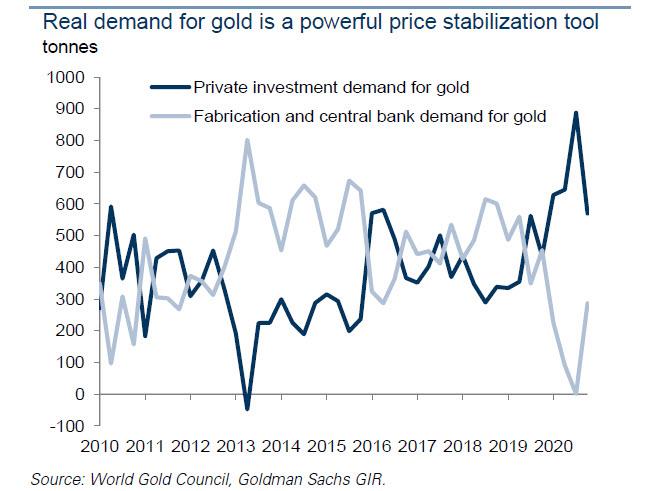
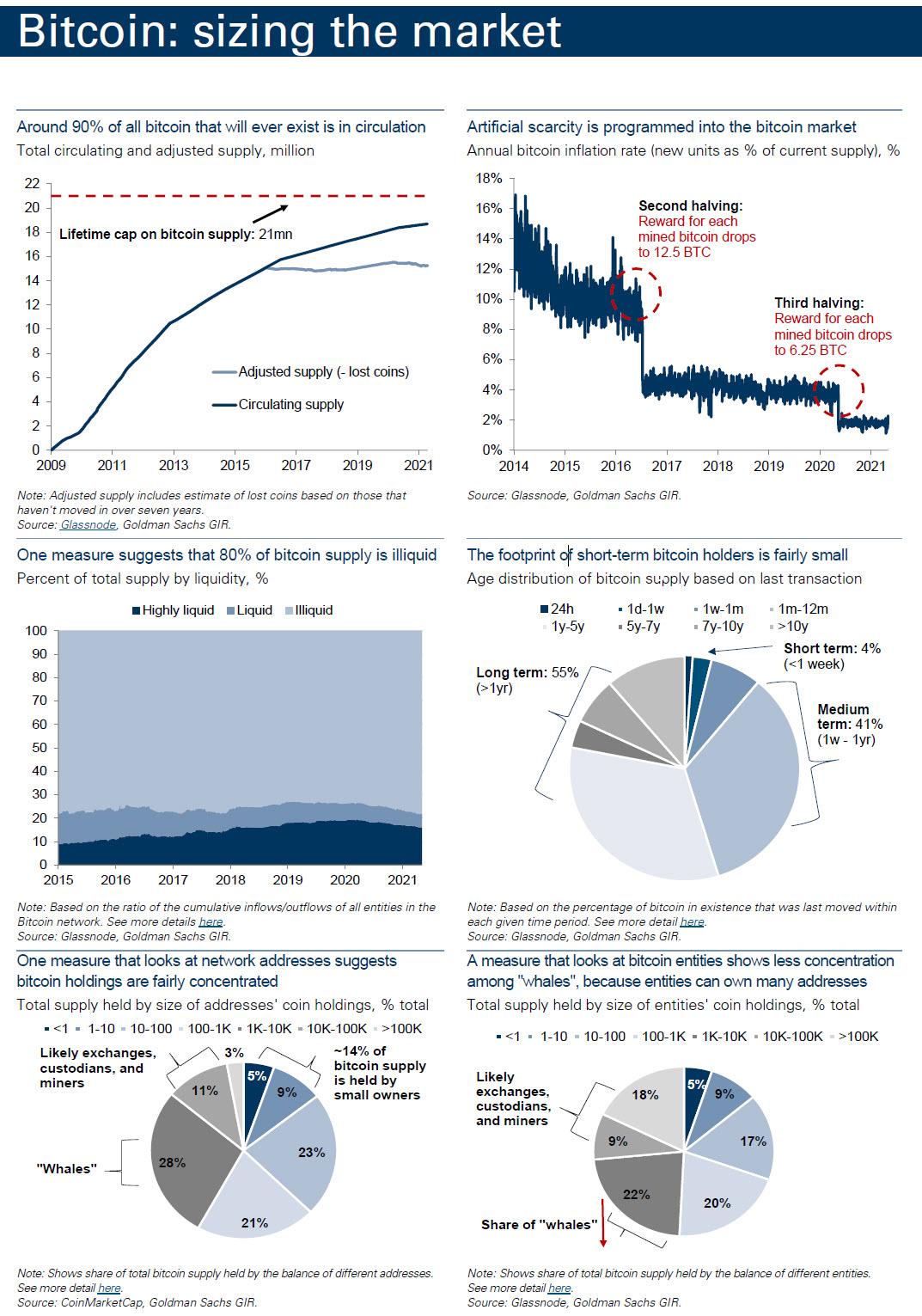
Since this is a Goldman report, it was naturally chock-full of charts and images, and below we reproduce the main ones, first, focusing on bitcoin...
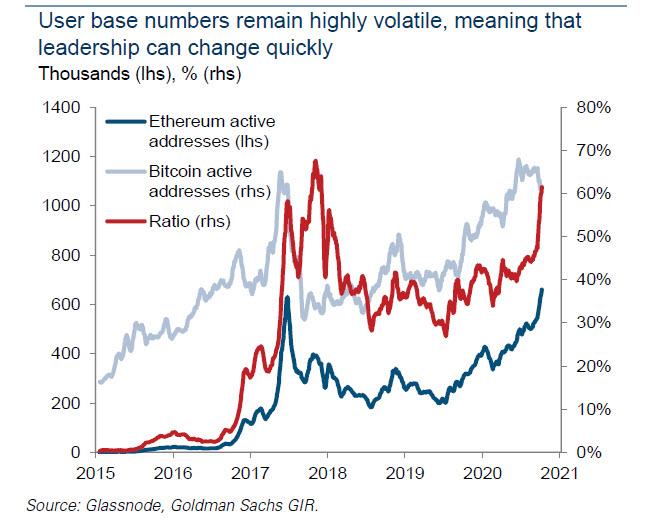
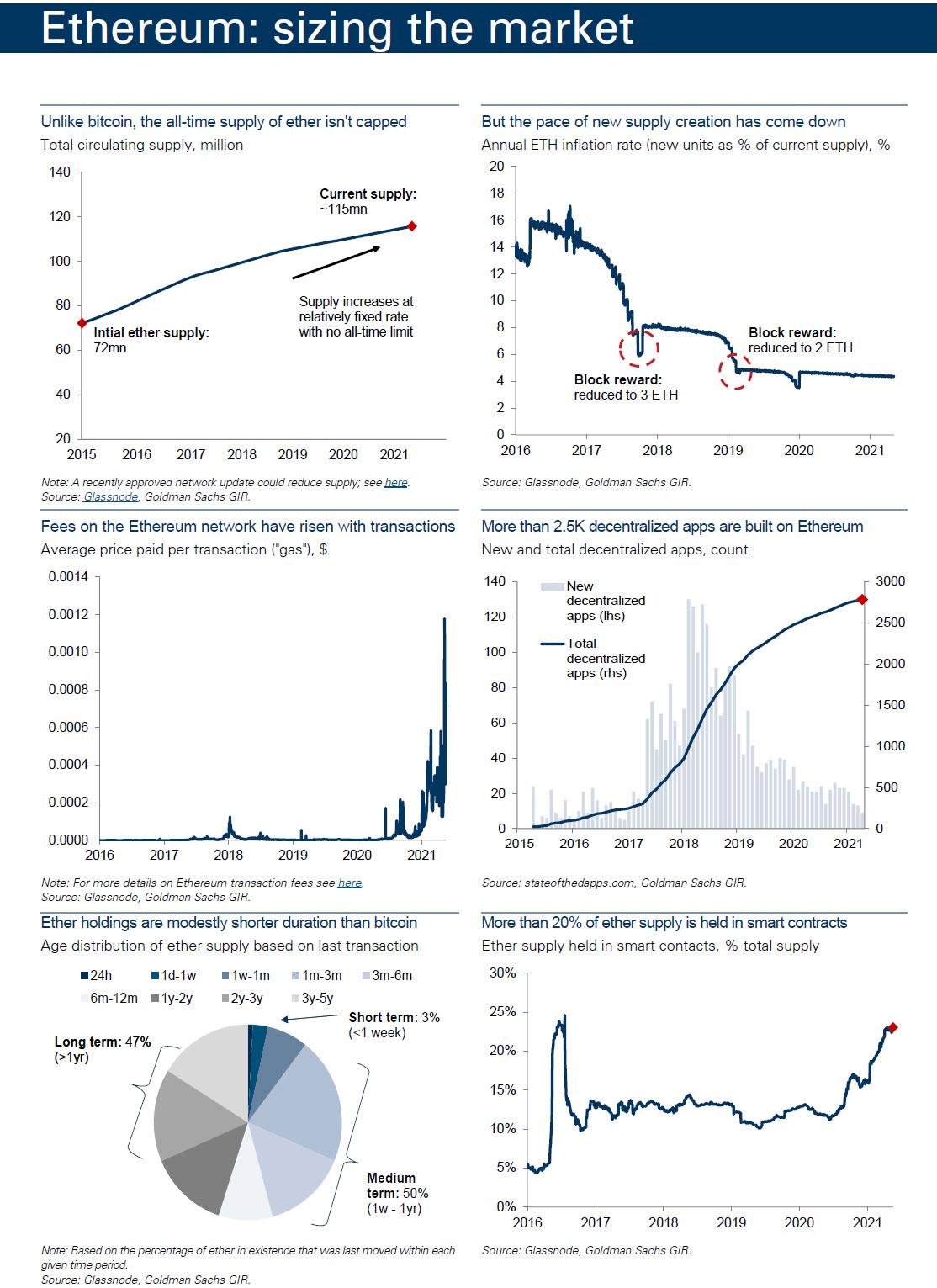
... then ethereum...
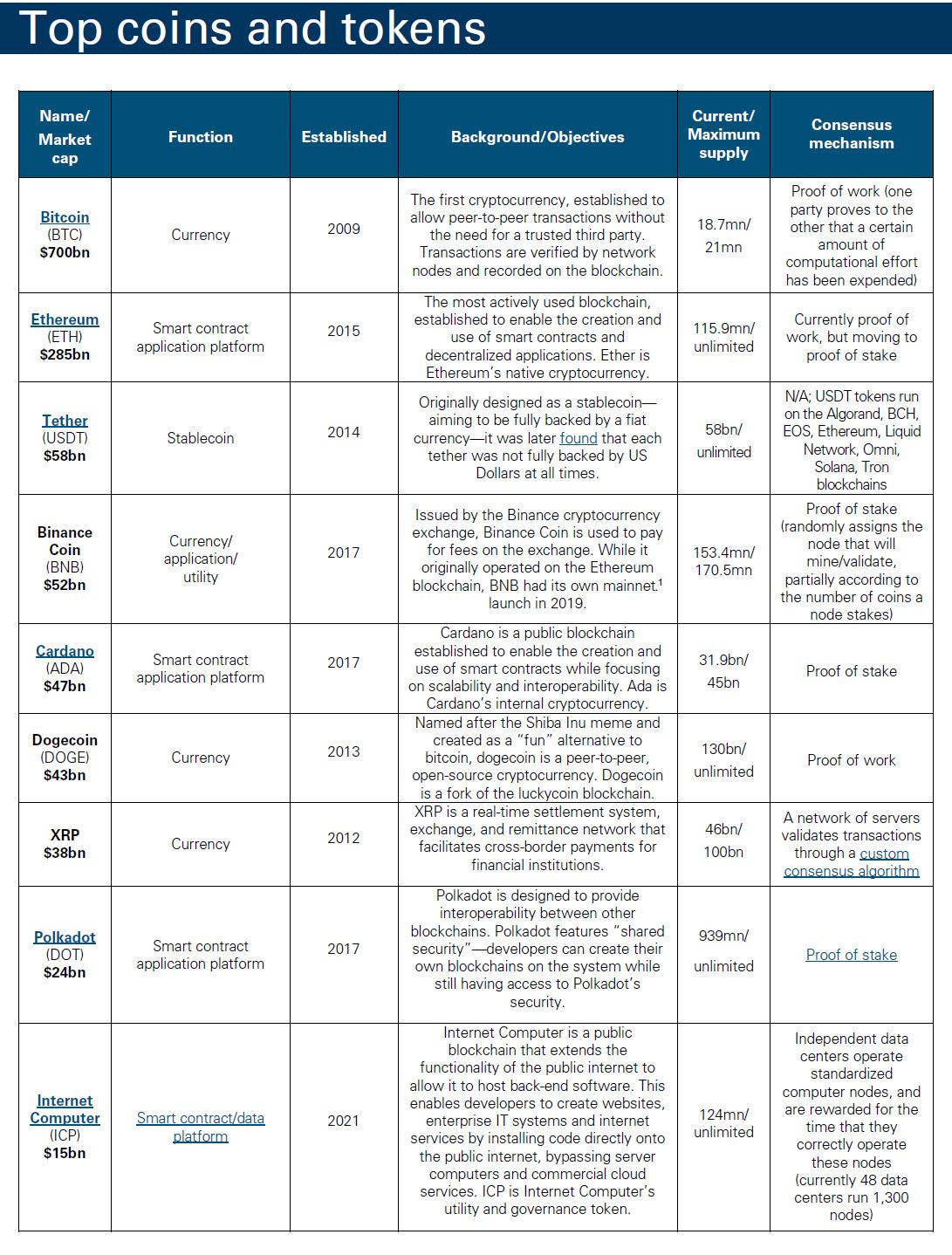
... a snapshot of all cryptos...
... and recent price performance.
And with that background in place, here is why Goldman believes that "ether has high chance of overtaking bitcoin as the dominant digital store of value." Here is Goldman explaining what is a digital store of value:
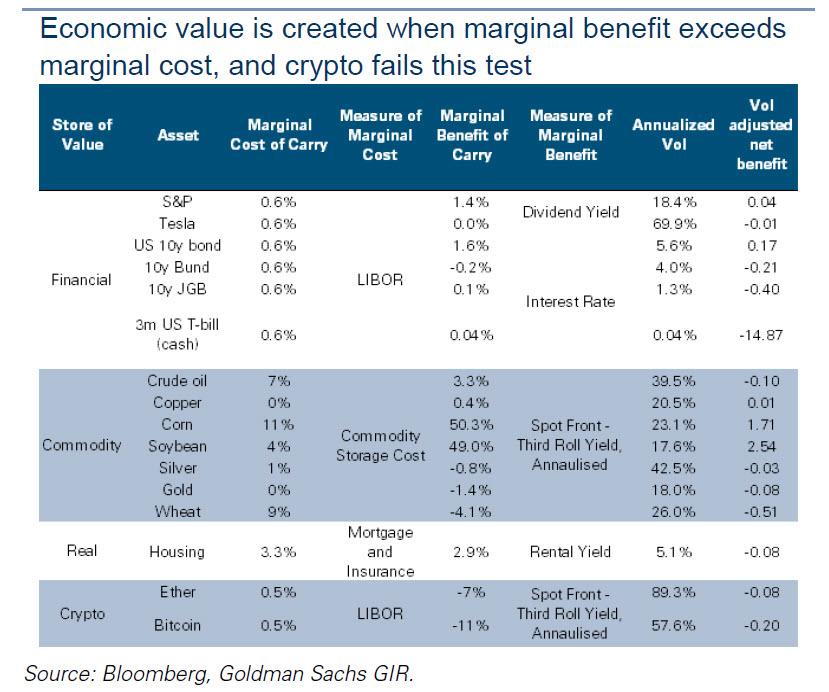
Based on emerging blockchain technology that has the power to disrupt global finance, yet with limited clear use today, bitcoin has been labeled a solution looking for a problem. Many investors now view bitcoin as a digital store of value, comparable to gold, housing, or fine wine. But all true stores of value in history have provided either income or utility, and bitcoin currently provides no income and only very modest utility.
However, unlike bitcoin, several other crypto assets have clear economic rationales behind their creation. Bitcoin’s first-mover advantage is also fragile; crypto remains a nascent field with shifting technology and consumer preferences, and networks that fail to adjust quickly could lose their leadership. We therefore see a high likelihood that bitcoin will eventually lose its crown as the dominant digital store of value to another cryptocurrency with greater practical use and technological agility. Ether looks like the most likely candidate today to overtake bitcoin, but that outcome is far from certain.
What is a store of value?
A store of value is anything that preserves its value over time. While financial stores of value like equities and bonds hold their value because they produce a given cash flow, yield is not a prerequisite for value. Art, wine, gold, and non-yielding currencies are widely used as stores of value too. Yet all of these non-yielding assets have a clear material use besides being stores of value. This usefulness generates a “convenience yield”—the incentive for people to own them—that reflects both the utility a consumer derives from using these assets and the relative scarcity of that utility—a fact captured by Adam Smith’s famous Diamond-Water paradox.
We place assets on a continuum across time by their store of value properties. We identify stores of future value, like financial assets that offer the owner the right to future yields or the promise of growing value over time, stores of present value, like consumable commodities such as oil and grains for which the utility of driving and eating today imparts a convenience yield, and stores of past value, like gold, art or even housing in which the assets store value generated in the past because of their duration.
Value always stems from use
The key to stores of past value like gold and houses is that someone demanded these assets in the past and placed value in them by exchanging something of value, usually currency, for them. Indeed, all important non-yielding stores of value developed real uses before becoming investment assets. For instance, gold was first used as jewelry to signal permanence, commitment or immortality. The economic problem was a need to signal permanence, and gold’s durable and inert elemental properties solved that problem. Given the state of technology at the time, gold was the only solution for this problem, which explains why so many societies adopted it for this use.
And when societies began to conquer each other and needed a means to standardize international trade, gold was the natural choice to solve this economic problem as most societies already owned gold and it was divisible. Real use is important for stores of value because consumption demand tends to be price-sensitive and therefore provides some offset to fluctuations in investment demand, tempering price volatility. For example, jewelry demand is the swing factor in the gold market, falling when investment demand for gold pushes prices higher, and vice versa.
Ether beats bitcoin as a store of value
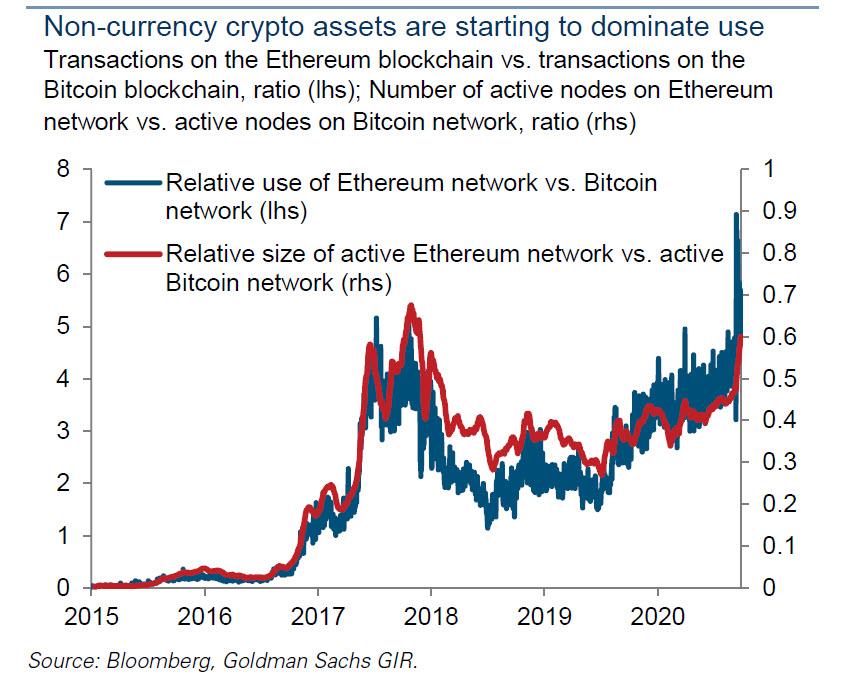
Given the importance of real uses in determining store of value, ether has high chance of overtaking bitcoin as the dominant digital store of value. The Ethereum ecosystem supports smart contracts and provides developers a way to create new applications on its platform. Most decentralized finance (DeFi) applications are being built on the Ethereum network, and most non-fungible tokens (NFTs) issued today are purchased using ether. The greater number of transactions in ether versus bitcoin reflects this dominance. As cryptocurrency use in DeFi and NFTs becomes more widespread, ether will build its own first-mover advantage in applied crypto technology.
Ethereum can also be used to store almost any information securely and privately on a decentralized ledger. And this information can be tokenized and traded. This means that the Ethereum platform has the potential to become a large market for trusted information. We are seeing glimpses of that today with the sale of digital art and collectibles online through the use of NFTs. But this is a tiny peek at its actual practical uses. For example, individuals can store and sell their medical data through Ethereum to pharma research companies. A digital profile on Ethereum could contain personal data including asset ownership, medical history and even IP rights. Ethereum also has the benefit of running on a decentralized global server base rather than a centralized one like Amazon or Microsoft, possibly providing a solution to concerns about sharing personal data.
A major argument in favor of bitcoin as a store of value is its limited supply. But demand, not scarcity, drives the success of stores of value. No other store of value has a fixed supply. Gold supply has grown nearly ~2% pa for centuries, and it has remained an accepted store of value. Plenty of scarce elements like osmium are not stores of value. In fact, a fixed and limited supply risks driving up price volatility by incentivizing hoarding and forcing new buyers to outbid existing holders, potentially creating financial bubbles. More important than having a limited supply to preserve value is having a low risk of dramatic and unpredictable increases in new supply. And ether, for which the total supply is not capped, but annual supply growth is, meets this criterion.
Fast-moving technologies break first-mover advantage
The most common argument in favor of bitcoin maintaining its dominance over other cryptocurrencies is its first-mover advantage and large user base. But history has shown that in an industry with fast-changing technology and growing demand, a first-mover advantage is difficult to maintain. If an incumbent fails to adjust to shifting consumer preferences or competitors’ technological advances, they may lose their dominant position. Think of Myspace and Facebook, Netscape and Internet Explorer or Yahoo and Google.
For crypto networks themselves, active user numbers have been very volatile. During 2017/18, Ethereum was able to gain an active user base that was 80% the size of Bitcoin's within one year. Ethereum's governance structure, with a central developer team driving new proposals, may be best suited for today's dynamic environment in which crypto technology is changing rapidly and systems that fail to upgrade quickly can become obsolete.
Indeed, Ethereum is undergoing much more rapid upgrades to its protocol than Bitcoin. Namely, Ethereum is currently transitioning from a Proof of Work (PoW) to a Proof of Stake (PoS) verification method. Proof of Stake has the advantage of dramatically increasing the energy efficiency of the system as it rewards miners based on the amount of ether holdings they choose to stake rather than their processing capacity, which will end the electricity-burning race for miner rewards. Bitcoin’s energy consumption is already the size of the Netherlands and could double if bitcoin prices rise to $100,000. This makes bitcoin investment challenging from an ESG perspective.
While PoS protocols raise security concerns due to the need for trusted supervisors in the verification process, Bitcoin is also not 100% secure. Four large Chinese mining pools control almost 60% of bitcoin supply and could in theory collude to verify a fake transaction. Ethereum too faces many risks and its ascendance to dominance is by no means guaranteed. For instance, if the Ethereum 2.0 upgrade is delayed, developers may choose to move to competing platforms. Equally, Bitcoin's usability can potentially be improved with the introduction of the Lightning Network, a change of protocol to support smart contracts and a shift to PoS. All cryptocurrencies remain in early days with fast-changing technology and volatile user bases.
High vol is here to stay until real use drives value
The key difference between the current rally in crypto and the crypto bull market of 2017/18 is the presence of institutional investors—a sign that financial markets are starting to embrace crypto assets. But bitcoin’s volatility has remained persistently high, with prices falling 30% in one day in just this past week. Such volatility is unlikely to abate until bitcoin has an underlying real, economic use independent of price to smooth out periods of selling pressure. Indeed, more recently, institutional participation has slowed as reflected in lower inflows into crypto ETFs, while the outperformance of altcoins indicate that retail activity has once again taken center stage.
This shift from institutional adoption to increasing retail speculation is creating a market that is increasingly comparable to that of 2017/18, increasing the risk of a material correction. Only real demand that solves an economic problem will end this volatility and usher in a new mature era for crypto—one based upon economics rather than upon speculation.
Goldman's conclusion: ethereum is the platform that solves economic problems here and now, while bitcoin is "a solution looking for a problem." It's also why two weeks ago, JPMorgan also laid out a bullish case for eth even as it has continued to slam bitcoin. As a reminder, JPMorgan's quant Nick Panigirtzoglou laid out six reasons why ethereum is set to continue its ascent even if there is a crackdown on bitcoin by either China or the US:
  1. The European Investment Bank (EIB) used the ethereum blockchain to issue €100mn in two-year zero-coupon digital notes last week, its first ever digital bond. The transaction involved a series of bond tokens on the ethereum blockchain, where investors purchase and pay for the security tokens using traditional fiat. The EIB digital bond is surely very significant as it represents the endorsement of the ethereum blockchain by a major official institution.
  2. The first ethereum ETF (ETHH) was launched on April 20th by Purpose Investments in Canada and three more ethereum ETFs launches followed during the same month.
  3. The structural decline in ethereum supply from the pending introduction of protocol EIP1559 in the summer. EIP 1559‘s objective is to make transaction fees on the ethereum blockchain more predictable by introducing an automatically calculated base fee for all transactions depending on network activity. Once paid with ethereum, this fee would be immediately burned, implying reduced supply of ethereum in the future. Ethereum’s theoretically unlimited supply had been a concern in the past, with ethereum in circulation rising by 5% per year over the past three years. Via burning ethereum through base fees, EIP1559 could potentially reduce the annual change of ethereum in circulation to 1-2% per year.
  4. The greater focus by investors on ESG has shifted attention away from the energy intensive bitcoin blockchain to the ethereum blockchain, which in anticipation of Ethereum 2.0 is expected to become a lot more energy efficient by the end of 2022. Ethereum 2.0 involves a shift from an energy intensive Proof-of-Work validation mechanism to a much less intensive Proof-of-Stake validation mechanism. As a result, less computational power and energy consumption would be needed to maintain the ethereum network.
  5. The sharp growth of NFTs and stablecoins in recent months are increasing the usage of the ethereum which is already dominating the DeFi ecosystem.
  6. The rise in bond yields and the eventual normalization of monetary policy is putting downward pressure on bitcoin as a form of digital gold, the same way higher real yields have been putting downward pressure on traditional gold. With ethereum deriving its value from its applications, ranging from DeFi to gaming to NFTs and stablecoins, it appears less susceptible than bitcoin to higher real yields.
In short, while one doesn't have to agree with Goldman or JPMorgan, these represent the institutional take. In other words, bitcoin and ethereum can co-exist and ostensibly become even more popular and eventually hit new all time highs (as a reminder FundStrat sees bitcoin hitting $100,000 and Ethereum rising to $10,500), but if the hammer hits and central banks in collaboration with local regulators decide to crackdown on crypto, what they will in fact be eliminating is the tax-evasion/money-laundering threat that bitcoin represents, while ethereum - and its various de-fi spinoffs - is left untouched. While that might mean ethereum has to find use within the demand confines of the so-called "establishment", we doubt those who are long it will complain if Goldman is proven right and it becomes the "Amazon of trusted information", one token trading at $20,000 or much more.

WSJ : AMC’s Largest Shareholder Wanda Group Pares Down Stake

AMC’s Largest Shareholder Wanda Group Pares Down Stake
The Chinese conglomerate had bought the theater chain in 2012 and helped to take it public

AMC Entertainment Holdings Inc.’s AMC -3.75% largest shareholder, China’s Dalian Wanda Group Co., has sold most of its shares in the movie-theater chain, according to a securities filing on Friday.

Wanda sold its stake over the past week. The theater chain’s shares have skyrocketed 160% in the past 12 months, buoyed by a Reddit-fueled frenzy that started with the videogame retailer GameStop Corp. GME 3.70% and bolstered the fortunes of other companies affected by the pandemic, including AMC. AMC -3.75%

In all, Wanda sold 30.4 million shares between May 13 through May 18 for roughly $426.9 million. Shares of AMC fell 3.8% Friday to $12.08 following news of the stock sale.

The filing didn’t provide a reason for the sale, and a Wanda representative was unavailable for comment.

AMC said in a release Friday that Lincoln Zhang, a Wanda official who serves as chairman of AMC’s board, and John Zeng, a Wanda executive and director, will resign from their board seats within the next 30 days.

Wanda’s stake in AMC goes back to 2012 when it first acquired AMC in a deal valued then at around $2.6 billion. Wanda took the company through a 2013 initial public offering and retained a majority of AMC’s shares.

“I salute Wanda for the immensely constructive role they played in building our company,” AMC Chief Executive Adam Aron said in prepared remarks Friday.

Wanda Film Group owns the largest movie-theater chain in China with some venues in Australia. It also produces Chinese-language films. AMC is the world’s largest movie-theater chain with about 950 theaters and 10,500 screens world-wide.

As coronavirus-related restrictions forced theater venues to close or significantly limit guest capacity, roiling the more than century’s old company, Wanda converted its Class B shares to Class A shares, reducing its voting power. AMC also issued 278 million new shares, which helped it raise $870 million but diluted Wanda’s stake.

Wanda also sold other AMC shares earlier in the year. Wanda now owns 10,000 of AMC’s Class A shares, or 0.002% of the total shares outstanding. No single entity holds an ownership stake above 10%, AMC said.

“With no controlling shareholder in place, now AMC will be governed just as is most other publicly traded companies, with a wide array of shareholders,” Mr. Aron said during a March earnings call.

As part of a long-term strategy agreement, some of Wanda’s films will be shown at select AMC theaters.

“This continuing communication between the two companies should create a win-win situation for both Wanda Film Group and for AMC in the cinema and film industries,” AMC said Friday.

WSJ : Apple and the End of the Car as We Know It

Apple and the End of the Car as We Know It
As cars become computers with wheels, Apple is joining other tech companies in eyeing the $5 trillion auto market

Now that the car is evolving into essentially a smartphone on wheels, it’s no wonder Apple is kicking the tires.

First, there is the transition from internal combustion engines to electric motors, which have far fewer mechanical parts. Now, enabled by that change, a second shift is under way—one that’s a prerequisite for a self-driving future.

For a century, the automobile was a system of interoperating mechanics: engine, transmission, drive shaft, brakes, etc. As those mechanics evolved, electronic sensors and processors were brought in to assist them, but the concepts changed little. The result was cars with dozens or hundreds of specialized microchips that didn’t talk to each other. Now that auto makers are moving to electric motors, elaborate entertainment systems and adaptive cruise control, cars need central computers to control all these things—why not use them to control everything?

At the hardware level, this might just mean fewer chips handling more of a car’s functions. Yet it has profound implications for what future cars will be capable of, how car makers will make money, and who will survive—and thrive—in what could soon be a global automotive industry made unrecognizable to us today.

No one inside Apple is saying exactly what its plans are, but the company has been contemplating a role in autos for years, spending huge sums on hiring hundreds, then eliminating their roles when its priorities change, and almost as quickly hiring other engineers with similar skill sets, then firing yet more engineers, all to realize a still-mysterious ultimate vision.

The company also recently approached auto makers including Hyundai about a potential manufacturing partnership, then saw talks fizzle. It’s just as likely Apple is, as usual, experimenting until or unless it hits on something it thinks it can do better than anyone else.

“We have seen enough echoes in the supply chain that we know Apple is really looking into every detail of car engineering and car manufacturing,” says Peter Fintl, director of technology and innovation for Capgemini Engineering Germany, part of a multinational that works with dozens of auto makers and parts manufacturers. “But nobody knows if what Apple creates will be a car or a tech platform or a mobility service,” he adds.

Many other tech companies, including Intel, Nvidia, Huawei, Baidu, Amazon and Google parent Alphabet, are pushing into the usually staid, conservative and relatively low-margin world of automobiles and their parts. Meanwhile, traditional auto makers like Ford, General Motors, Toyota, Daimler and Volkswagen, plus longtime automotive suppliers such as Bosch, ZF and Magna, are trying to behave more like those tech companies.

Basically, everyone is shifting their emphasis to software—and hiring like crazy to do it. In the past year, almost every major automotive company has advertised that it would like to hire many more software developers. Volkswagen, for example, announced in March 2019 that it would add 2,000 to its technical development team; the company already employs thousands of software engineers.

“Software is eating the world, and cars are next on the menu,” says Jim Adler, managing director of Toyota AI Ventures, a venture-capital fund owned by the car maker.

From hardware to software
Today’s most complicated automobiles have up to 200 computers in them, just smart enough to do their jobs controlling everything from the engine and automatic braking system to the air conditioner and in-dash entertainment, says Johannes Deichmann, a partner at McKinsey whose expertise is software and electronics in automobiles. These computers, made by an assortment of suppliers, tend to run proprietary software, making them largely inaccessible even to the auto maker.

Such modularity is fine up to a point—when building a Chevy Malibu, does GM really need to know how the windshield-wiper computer works? Yet the proliferation of these narrow-minded processors has led to unsustainable complexity, says Mr. Deichmann.

Tesla, as you might imagine, has been instrumental in pushing the auto industry in a new direction. Since the first Model S, Tesla pioneered replacing hundreds of small computers with a handful of bigger, more powerful ones, says Jan Becker, chief executive of Apex.ai, a Palo Alto-based automotive-software startup. Systems that used to require dedicated microchips now run in separate software modules instead.

This is why Tesla can add new capabilities to its vehicles through over-the-air updates, he adds. Want better acceleration, longer range, an enhanced self-driving system, or your in-dash entertainment system to play fart noises every time you flip your turn signal? Tesla has shown they’re just a software upgrade away. It’s very much like the model of continual updates to the software in our mobile devices we’ve come to expect.

Following suit, auto makers are scrambling to build or commission their own whole-car operating systems. The field is still wide open, says Mr. Fintl. Nvidia offers its Drive OS, VW and Daimler have announced they are, like Tesla, working on their own, and Google is insinuating itself ever deeper into vehicles through its Android Auto OS. To date, it’s still focused on in-dash entertainment and navigation, but Ford recently announced that as of 2023, it will use Android in the displays of all models sold outside of China—including the just-revealed Ford F-150 Lightning—and will also use Google to help manage the data streams collected from its vehicles. GM is also using Android in its all-electric Hummer.

This is where Apple might face a tough decision: While it has the chance to flex its enormous software and chip-making expertise to create a next-generation platform for the highest bidder, the company tends to create products for its own brand, not components for others. Besides, the strategy of being just another supplier to auto makers is already being pursued by Intel (via Mobileye), Alphabet (via Waymo and Android Auto), Nvidia and others.

The enormous complexity and expense of making and delivering vehicles by the thousands, much less millions—and making them safe—are why so many tech companies are joining forces with automobile companies, rather than trying to build their own vehicles, says Ryan Robinson, automotive research leader at Deloitte.

While analysts for years predicted that big auto makers would make short work of Tesla, it turns out electric vehicles are more about software than hardware. And auto makers aren’t yet good at the kind of software today’s cars and drivers demand. Volkswagen decided last June that, despite years of development, it had to delay the debut of a flagship electric vehicle because its software wasn’t ready.

Enter Apple
“This is the big industry mystery, if a famous fruit company is entering the game,” says Mr. Deichmann.

Apple already has its CarPlay in-dash interface for iPhones. But it’s limited to functions such as entertainment and navigation, and has nothing to do with the deeper integration and capabilities required of a true vehicle operating system. Apple has also demonstrated tremendous capabilities in designing the kinds of microchips and sensors that a smart automobile would require, though for now they’re mainly found in iPhones, iPads and Macs.

Apple didn’t respond to requests for comment.

Apple could build an operating system for a whole vehicle, and run it on its own silicon. But the company seeks to vertically integrate whenever possible, to control every aspect of the user experience. So the question is: Would a car maker let Apple treat it as the company once treated AT&T, when it first rolled out its iPhone? Or the music labels, when it launched iTunes? At a stroke, it turned the tables and took control of massive markets and significant portions of our lives.

This February, Apple’s partnership talks with Hyundai broke down, possibly over Hyundai’s concerns about being absorbed into the Apple Borg. Immediately after, Nissan signaled it might be willing to work with Apple.

If there is any tech company on earth with the resources to go it alone, building a new auto maker from the ground up, it’s Apple. But there is no indication this is the company’s aim. If Tesla is the model here, it’s unclear why Apple’s executives would want to endure the tortuous process of building the manufacturing, testing and service capacities this path would require.

If providing the brains for other auto makers’ vehicles is unlikely, and competing directly with Tesla and every other electric vehicle startup unsavory, that still leaves another option for Apple. As the automotive industry inches toward self-driving taxi services, Apple’s persistence in both acquiring and developing software and hardware for electric, autonomous vehicles could signal its long-term ambitions. Could an Apple mobility company, instead of an Apple car, make the most sense?

GM’s Cruise, Amazon’s Zoox and many others are already moving down this path. But since no such robot-taxi service yet exists, save for some limited experiments by Waymo in Arizona, there is potential for Apple to create something it controls completely, while also providing significant additional revenue to a struggling auto maker such as Nissan.

Apple and others could design and commission vehicles that bear their branding, and operate as part of a service they provide, with no trace of the actual manufacturer on them, says Mr. Deichmann.

Apple, after all, isn’t an electronics manufacturer. In fact, it outsources all of its manufacturing, much of it to Foxconn—which as it happens is building up its own auto-making capabilities. Rather, Apple is first and foremost a customer-focused company that uses technical know-how to develop products physically made by contractors like Foxconn. It just happens that deep technical expertise is how it realizes its leaders’ visions. And because fully autonomous driving is turning out to be much harder than anyone predicted, Apple could have the time it would need to develop its own service.

It’s quite possible that Apple will end up spending billions on attempts to develop an electric car without ever releasing a product. Or maybe it offers a product or service that fizzles. It’s possible that transportation is so different in scope and complexity from personal and mobile computing that the only way to succeed is through the kind of grand-scale collaboration Apple isn’t known for.

Toyota chief Akio Toyoda said in March that Apple should prepare itself for a 40-year commitment if it offers cars to consumers. This makes sense, especially if the goal turns out to be not merely to create a car, but to replace a significant portion of the world’s 1.4 billion cars with a completely autonomous, emissions-free, radically transformed transportation system. In other words, a trillion-dollar revolution—and Apple’s already pulled off one of those.

WSJ : China Disappeared H&M From Its Internet, Splitting Fashion Industry Group

China Disappeared H&M From Its Internet, Splitting Fashion Industry Group
Members of ‘Better Cotton Initiative’ are divided over the group’s response to Chinese pressure

A debate over how much to push back against the Chinese government has set off a conflict inside a prominent coalition that guides much of the world’s cotton production.
The Better Cotton Initiative, a collaboration among big brands like Nike Inc. NKE -0.46% and Gap Inc., GPS -0.12% environmental groups, farmers and human-rights organizations, has for years worked to bolster the global apparel industry’s access to sustainably produced cotton.
But the Chinese government’s recent attacks on the group and one of its leading members, fast-fashion giant H&M Hennes & Mauritz HM.B 0.45% AB, have raised concerns about whether BCI’s fashion brands can continue selling clothes in China—a huge and fast-growing consumer market—if the group challenges Beijing again.
In March, Beijing all but erased H&M’s internet presence in the country after the company and BCI raised concerns about allegations of forced labor in the cotton-rich Chinese region of Xinjiang.
Following the online blocking of H&M and Chinese social-media users calling for boycotts of members Nike and Adidas AG , BCI deleted from its website a months-old statement about concerns that cotton was being produced by forced labor in Xinjiang.

Some nongovernmental-organization members have said that BCI’s deleting of the statement and silence during the backlash in China suggest the group bowed to pressure at the behest of retail members, say people familiar with the organization. They feel BCI’s reaction undermines the initiative’s mission of bettering the lives of cotton farmers, the people said.
Some NGO members are urging the group to cease operations in China altogether and are pushing their representatives on its board—the environmental group Pesticide Action Network and Solidaridad, an organization advocating for responsible supply chains—to restore the Xinjiang-related statement online and push back against the Chinese media attacks, the people said.
At the same time, some retailer members and nongovernmental organizations say that BCI should instead quietly engage with Beijing, the people said.
A spokesman for BCI declined to comment.
Western businesses with supply chains in Xinjiang walk a fine line. Companies are trying to avoid Beijing’s ire and at the same time take seriously allegations from human-rights groups and the U.S. and U.K. governments that authorities are committing genocide against ethnic Uyghurs and using forced labor in the northwestern Chinese region.

The Chinese government has called the allegations lies, saying it is combating terrorism and improving livelihoods in Xinjiang. It has lashed out at those raising concerns about the region. No industry is more ensnared in the issue than fashion: Xinjiang accounts for four-fifths of China’s cotton output and a fifth of the world’s.
The Better Cotton Initiative began as a World Wildlife Fund project in 2005 and became its own organization in 2009. The nonprofit group trains farmers and gives its seal of approval to those that meet standards on water usage, chemical usage and labor rights.
Members had an incentive to join. Farmers learned how to reduce expenses and improve cotton quality. Nongovernmental organizations got to lobby the fashion industry on environmental protection and labor rights. And brands, such as founding members Gap Inc., H&M and IKEA, could boast to customers and shareholders that they were part of a planet-helping initiative.
“Brands were making commitments for their cotton to be 100% from sustainable sources by 2025,” said Lise Melvin, BCI’s chief executive from 2006 to 2013. “They saw the Better Cotton Initiative as a way to meet that goal.”


Beijing is beating back international criticism of its treatment of Uyghurs in Xinjiang with a propaganda push on Facebook, Twitter and the big screen. Here’s how China’s campaign against Western brands is aimed at audiences at home and abroad. Photo: Thomas Peter/Reuters

The group set a target for having 30% of the world’s cotton output come from BCI-licensed farmers by 2020. That ambition made it hard to ignore China, where BCI opened an office in 2012.
Tensions with Beijing began after BCI increased attention on labor rights world-wide last year. In October, the group stopped training and licensing farmers in Xinjiang, citing “sustained allegations of forced labor and other human-rights abuses.” A BCI committee on forced labor later cited, among other concerns, that Xinjiang farmers couldn’t speak candidly about their situation.
Those actions didn’t cause ripples in China until March, when the U.S., Canada, the U.K. and European Union sanctioned Chinese officials over alleged human-rights violations in the region. Chinese state-controlled media outlets criticized those sanctions and blasted BCI and member brands, in particular Sweden’s H&M. H&M disappeared from Chinese e-commerce sites, while Chinese celebrities dropped their sponsorships with the company.
In a recent earnings call, H&M said it wanted to remain a “responsible buyer” in China. It declined to quantify the backlash’s cost, saying only that landlords closed a few H&M outlets in China. In total, 20 out of about 500 stores were closed, the company has said.

In the days after Chinese media outlets and social-media users began attacking BCI and its members in late March, China’s state television broadcaster aired an interview with the head of BCI’s Shanghai office, who said her office found no evidence of forced labor in Xinjiang. The group deleted its October online statement about the Xinjiang concerns without explanation.
The actions, seen inside China as an about-face, drew a taunt from a youth branch of the ruling Communist Party in a social-media post last month: “Your face must be hurting!”
BCI hasn’t publicly addressed the situation, saying a response could threaten the personal safety of its dozen or so staffers in China, the people close to the organization said. While BCI has backtracked on its public statements, it has maintained its position on halting training and licensing of farmers in Xinjiang.
One person close to BCI said the group’s presence in China, and the brands it represents, give it clout to influence Beijing, even if it must do so quietly, the person said. Not-for-profit organizations can operate in China only if they are invited by Beijing and play by its rules, the person added.
Ms. Melvin, the former CEO, says the group faces a Catch-22.
“How does anybody choose whether to avoid working in problem areas,” she said, “or to work in them to improve them, even though there are risks in doing that?”

WSJ : The Anti-Victoria’s Secret Underwear Revolution Is Here

The Anti-Victoria’s Secret Underwear Revolution Is Here
A new wave of inclusive, direct-to-consumer brands aimed at Gen Z and millennial shoppers—including Parade, Cuup and Negative— is shaking up the intimates market

IN THE LATE 1990s when I was coming of age, Victoria’s Secret loomed large. The company’s notoriously sexy catalog, filled with perfect-seeming “Angels” like Heidi Klum, Tyra Banks, Stephanie Seymour and Karen Mulder, was the focus of jokes on sitcoms and among the kids in my class. My friends and I would travel in giggling, anxious packs to the store’s pink-and-marble emporiums at the mall, shopping for satin pushup Miracle Bras, sheer shiny Angel Bras and saccharine body sprays that smelled like...Victoria’s Secret stores. During that time, stock in Victoria’s Secret’s parent company L Brands soared, making its owner Leslie Wexner a billionaire.

Roy Larson Raymond had started the chain in 1977, after finding himself uncomfortable buying his wife lingerie at a department store. But I recall feeling distinctly out of my element at his resulting retail venture, and many women I spoke to agreed. Marissa Vosper, the co-founder of underwear brand Negative, remembered, “At the time, I think many women default-shopped at Victoria’s Secret and would [later] tell us how embarrassed they were to be seen with a shopping bag, and so would literally hide the product in their handbag.”


Negative’s co-founder Marissa Vosper reported, “We’ve had moms tells us, ‘What a pleasure that I can buy my daughter a bra that isn’t sexualizing.’”
Today, Victoria’s Secret is attempting to find its footing amid changing beauty standards and declining market share. Last year Mr. Wexner stepped down as CEO and chairman of L Brands amidst investigation into his ties with the late, disgraced financier Jeffrey Epstein. Through a spokesperson Mr. Wexner declined to comment. The company has tried to modernize its image by ditching its annual Angels fashion show and hiring a wider range of models. A spokesperson for L Brands emphasized new leadership hires and a focus on the digital business. In a February earnings call, CEO Martin Waters said, “I couldn’t be more delighted to be leading the work to refresh the brand positioning to make it more relevant, to make it more inclusive, to make it more consistent with the attitude and lifestyle of the modern woman.” He also said, “We’re moving from what men want to what women want.”

In the Goldilocks game of underwear shopping, alternatives to Victoria’s Secret have included fancy, frilly options like Kiki de Montparnasse and Agent Provocateur, as well as cheap basics by Aerie and GapBody. But now women young and old are seeking new underwear brands they can identify with more fully. They demand comfort as well as sexiness and structure, inclusive sizing and non-objectifying advertising imagery featuring a diverse group of models. And increasingly, direct-to-consumer underwear companies, many of them founded by women, are answering that call. Within the past 10 years, we’ve witnessed the rise of such brands as ThirdLove, Negative, Cuup, Skims, Kit Undergarments, Savage X Fenty, True & Co. and Parade. Call them the anti-Victoria’s Secrets.


A promotional image for Cuup shows the stylist and creative director Mecca James-Williams.
Christina Yannello, a beauty influencer and real-estate agent in New York, told me,”I grew up with Victoria’s Secret Pink and now I’m 22 and I would much rather buy a more positive brand.” To her, that means pieces from Cuup and Parade, such as a brown mesh unlined Cuup bra. She continued, “I have learned to love my curves, I have learned to love my body, but growing up, seeing all of these perfect women being advertised, was really hard.”

“In many ways, the arc of American femininity has been tied to the American underwear story,” posited Cami Téllez, a 23-year-old entrepreneur who dropped out of Columbia University to launch Parade in 2019. Her brand, a line of brightly colored basics that prides itself on using mostly recycled fabrics, recently raised $10 million in Series A funding and has sold over a million pairs of underwear.


Victoria’s Secret became a powerhouse lingerie retailer thanks to the vision of executives at its parent company. But amid changing consumer tastes, sexual harassment accusations and ties to Jeffrey Epstein now under scrutiny, the once iconic brand’s stock has been tumbling and it has signaled it may be looking for a buyer. Photo: Getty Images
As Gen Z and millennial consumers became more eco-conscious and questioning of gender and beauty scripts, they in turn needed new intimates. ”I saw an opportunity for an entirely new narrative within the underwear space,” explained Ms. Téllez. Like many DTC companies, Parade champions values such as sustainability and self-expression over the top-down approach of yesteryear, which often included expensive fashion shows and big flagship stores.

Another key value for Parade is affordability. As someone who had taken on student loan debt, Ms. Téllez is aware that price point can be crucial when weighing underwear choices. Most Parade underwear costs less than $10, which puts it in the sweet spot for young women on a budget. For the previous generation, women’s lingerie was often marketed as something that men would buy for them: A 1997 Victoria’s Secret Christmas commercial showing the Angels cavorting with Santa was stamped with the toll-free number “1-800-HER-GIFT.”

While Parade is grabbing headlines at the moment, it joins other brands that have been innovating in this market for years now. Negative, launched in 2014 by Ms. Vosper and Lauren Schwab, and Cuup, started in 2018 by Abby Morgan, Kearnon O’Molony, Lauren Cohan and Chrisden Ferrari, offer pieces that are a bit more pricey and sophisticated-looking than the Parade basics. Perhaps because of my demographic (30s, always online), both serve me incessant ads on Instagram. The designs rely on neutral colors—browns, grays, pale pink—and the kind of algorithm-informed baseline of good taste which has evolved to include acknowledgement of curvy bodies with different skin tones.


Parade’s 23-year-old founder, Cami Téllez, said “I really believe that brands are powerful because they write cultural scripts.”
In fact, I’ve heard these types of brands referred to colloquially as “Instagram bra companies” because of their reliance on social-media targeted ads. But their marketing strategies go deeper. Cuup, for example, does have some older customers who are not necessarily digitally savvy, according to co-founder Abby Morgan. For that woman, Cuup uses direct mail, retail pop-ups and office fittings. It also does promotions with a breed of influencers who are more or less offline but still considered “thought leaders in certain communities”—a PTA coordinator, for example, or a nurse. These women might get a promo code, some product, and the chance to tell their story on Cuup’s website.

Mae Karwowski, a founder of the influencer-marketing firm Obviously, sees these brands’ marketing as “the antithesis of the Victoria’s Secret strategy.” She went on that while the status quo was once about trying to attain a supermodel figure by working out twice a day, these new companies are communicating a message that she summed up as: “We’re totally on the other end of the spectrum here...You don’t need to be a supermodel, actually we’re swinging in the other direction, we want real people and we want you to represent us.”

However even as underwear companies strive to be more inclusive, not everyone sees themselves represented in the product or the advertising. Megan Taylor, 21, a student in New York, bought a sheer Cuup bra and posted a photo of herself wearing it to Instagram. But she was then discouraged by the fact that the company didn’t carry her roommate’s larger size. Said Ms. Taylor, “I know I live in a privileged body, and that I can fit into the majority of standard sizing, but it’s not fair to everybody, which is not how it should be.” Ms. Morgan of Cuup said that the brand is working on expanding its size run.

Simone Mariposa, a Los Angeles influencer who calls herself “superfat,” said that while these brands were moving in the right direction, she would like to see larger women represented “in a sexy light,” not just wearing basic underwear. She said, “There needs to be more legit size diversity, not just in what’s manufactured but what is advertised. I know if I see a body that looks like mine, I’m going to feel like, ‘OK, this brand gets it.’”

FT : Formula One drivers’ pay under scrutiny amid talks over cap

Formula One drivers’ pay under scrutiny amid talks over cap
Discussions follow agreement to curb team spending and spread revenues more evenly

Formula One is already slashing how much teams can spend developing their cars to win the global racing series. Now the tens of millions of dollars paid to superstar drivers such as Lewis Hamilton is under scrutiny.

Federation Internationale de l’Automobile, the Paris-based regulator, is in talks over a possible salary cap with Liberty Media-owned F1, the sport’s teams and drivers, who are set to return to the glamorous Monaco Grand Prix after the 2020 race was cancelled because of the pandemic.

“The details of any such regulation are still in very early stages of discussion and at this point no conclusions have been made about the specific details or whether this is something we will pursue further,” the FIA told the Financial Times. 

The discussions come after a cap on team spending was agreed last year, alongside a deal to spread revenues more evenly. One figure being discussed by racing chiefs is $30m split between two drivers every year, posing a conundrum for top drivers such as Hamilton, whose pay exceeds this amount.

Otmar Szafnauer, team principal at the Aston Martin F1 team, said some form of cap “makes logical sense because what you’re doing is trying to cap the money you spend on [racing] performance and the driver is a big part of performance”. He suggested that teams should have flexibility to pay drivers more if they cut spending elsewhere.

A further tightening of financial regulations would mark the next step of F1’s transformation under the ownership of Liberty Media, the investment vehicle of US billionaire John Malone, which acquired F1 for $8bn in 2017.

This season is the first to feature the newly agreed $145m cost cap, which was agreed last year and aims to limit the extent to which Mercedes, Red Bull and Ferrari can outspend rivals in pursuit of victory.

The cap and the wider Concorde Agreement that governs how F1 splits revenues was agreed in 2020 after a three-year battle between Liberty Media and the teams. But the limit, which is set to fall by a further $10m over the next two seasons, excludes salaries paid to drivers and the top three staff, where the attention has now shifted.

A person close to F1 said “the driving reason” for the continued focus on cost control was to “balance out the system so [the] best drivers could be attracted to other teams while also reducing the overall spend in F1”.

Zak Brown, chief executive of McLaren Racing, said a cap would not necessarily mean that drivers’ salaries would fall. One option, he said, would be to increase the team budget limit, by the mooted $30m for instance, to include an allowance for driver contracts. Teams would be free to sacrifice expenditure elsewhere to pay drivers more. Similar measures could be applied to salaries for top staff.

“This is something all the teams have discussed,” said Brown. “Making sure the sport doesn’t go back to its bad habits is important and so when you have a few key elements that sit outside the sporting cap that are yet sporting related, it seems like we have some unfinished business.”

Investors have poured cash into the sport over the past year, with the Williams team changing hands and McLaren raising £185m from MSP Sports Capital, as the pandemic disrupted the 2020 season and hit teams’ income.

But imposing limits on driver salaries in the name of financial sustainability threatens a new rift within F1 after years of negotiating the broader cost cap. “Of course, when you put this on the table, drivers have a strong negative reaction,” said Alejandro Agag, founder of the Formula E and Extreme E electric car racing competitions.

Teams must balance the need to cut costs against the risk of pushing away star drivers who attract sponsors, fans and media.

“I’m not sure whether it’s fair to bring them [drivers] in under a cost cap,” Damon Hill, who won the 1996 world championship with Williams, told the FT. “A driver’s career is short.”

Hamilton, who this week called F1 a “billionaire boys’ club” as he urged the sport to become more inclusive and accessible, has raised concerns about a salary cap.

The British star, who has been at the centre of Mercedes’ seven consecutive constructors’ championships, is set to negotiate a new contract. At 36, he is in the latter stages of his career.

A person close to Mercedes said a cap would not be relevant while Hamilton, who has won a joint-record seven F1 world championships, is still racing.

Although Mercedes supports the introduction of a soft cap, team principal Toto Wolff has said any changes should be introduced gradually from 2024 to avoid losing the “superstars” of the sport. 

The stakes are also high for Red Bull, which has put its faith in Max Verstappen, 23, to win its first championship since 2013.

“We understand the joint responsibility to reduce costs in all areas and are part of the discussions, but this is a decision that requires a balanced approach and agreement across all teams, which has not yet been reached,” said Red Bull. “We also need to consider the athletes involved as this directly affects them as well as the teams.”

Salary caps are complex and difficult to police, according to several senior figures in the sport, who warned that there were many ways to circumvent the rules such as by asking sponsors to cover driver salaries.

Any pay limit is also complicated because team principals often have responsibilities beyond their organisations’ F1 outfits, meaning they can be paid by different parts of a bigger parent group. “It’s a really difficult one,” said Agag. “There are so many ways around a salary cap.”

FT : EU to target aviation in revamp of fossil-fuel levy

EU to target aviation in revamp of fossil-fuel levy
Finance ministers back proposal to help meet ambitious carbon-emissions targets

The EU is moving closer towards agreeing a tax on aviation as part of a wide-ranging revamp of fossil-fuel levies to help meet ambitious emissions goals. 

EU finance ministers meeting in Lisbon on Saturday expressed broad support for upcoming proposals for a Europe-wide tax on kerosene jet fuel used in aircraft, officials told the Financial Times. 

Brussels has struggled in previous years to extend its fuel taxation rules to areas such as aviation and maritime but the cause has been re-energised by the bloc’s commitment to reduce EU carbon emissions by 55 per cent over the next decade and net zero by 2050. 

The aviation industry, which has been battered by the pandemic, has previously expressed concerns about the plans for an EU kerosene tax. 

In July, the European Commission will propose a big overhaul of its energy taxation directive that sets minimum taxation rates for fossil fuels and has not been updated for nearly two decades. Agreement on the changes has been stymied by the need to win unanimous agreement from all 27 member states. 

Brussels has indicated it will extend the taxation rules to sectors such as aviation and maritime that have been exempt from the system. However, EU finance ministers expressed less support for the extension of the directive to shipping, with countries on the geographic periphery of Europe expressing concerns about the plans, said officials. 

The revamp of the energy taxation directive will be among the most politically sensitive parts of Brussels’ green deal agenda as every country effectively holds a veto on taxation policy. Valdis Dombrovskis, EU vice-president for the economy, said the directive was “outdated” and ministers expressed the “right political momentum to make changes”. 

João Leão, Portugal’s finance minister, who chaired the meeting, said his country backed the extension to the maritime and aviation sectors to help meet the EU’s ambitious environmental goals. 

Some EU countries have led the charge to end tax exemptions for jet fuels, with the Netherlands promising to introduce a national aviation tax in the absence of an EU-wide agreement.

Brussels’ revamp will also aim to root out exemptions provided by many member states to sectors such as agriculture, the coal industry, and for diesel. The commission is also considering a more stringent system where minimum fuel taxes are ramped up over a 10-year period, said an official. 

Energy taxes are one of the main regulatory tools Brussels can wield to help drive down emissions by making higher emissions technologies costlier for consumers and companies. The other significant carbon pricing initiative the commission wants to reform is the European Emissions Trading Scheme (ETS), which Brussels is also considering extending to cover shipping, aviation and cars.

During the discussion, some finance ministers voiced concerns about the imposing double charges on ships and airlines by including them in the ETS and the energy taxation rules revamp, said diplomats familiar with the discussion. 

The commission also presented ministers with its initial plan to introduce a carbon border levy that will tax imports into the EU based on their carbon footprint. The measure, which will be published in July, has raised alarm in countries such as Russia and Ukraine. Brussels has argued the levy is needed to protect the competitiveness of EU industry and avoid businesses being undercut by foreign companies that do not have to comply with emissions targets.

Dombrovskis said the border levy would only be introduced “gradually”, with its initial scope being limited to high emissions imports such as cement, steel, and fertilisers. “We are confident of having a consensus on a targeted carbon border adjustment proposal that is gradual over time,” he said.

FT : High-profile hedge funds make bet on little-known oil company

High-profile hedge funds make bet on little-known oil company
Taconic Capital, CQS and Kite Lake Capital are among funds backing Noreco, with a market cap of £270m

A cluster of high-profile hedge funds are hoping to turn round the fortunes of a beaten-down North Sea oil and gas firm in which they have built sizeable positions as energy prices soar.

Taconic Capital, CQS and Kite Lake Capital are among funds that own positions in Norwegian Energy Company (Noreco), the second-largest oil and gas producer in Denmark, whose shares have collapsed by more than 99 per cent since their pre-financial crisis high.

Taconic and Kite Lake between them own more than 50 per cent of the company. CQS, one of London’s biggest funds, in March disclosed a stake of just under 13 per cent, with some of the position held in the fund personally run by billionaire founder Michael Hintze.

Caius Capital and Astaris Capital, a hedge fund launched last year by Martin Beck, former co-founder of Sothic Capital, also have positions, while York Capital has also been a shareholder.

Noreco has a market capitalisation of just 3.14bn Norwegian krone (£270m), and is unusual for having such a high concentration of hedge funds on its shareholder register. 

Last week, the funds further tightened their grip on the firm, as Peter Coleman of Taconic and Jan Lernout of Kite Lake were voted on to the board at the firm’s annual meeting.

Noreco was once Norway’s second-biggest oil and gas company by production, but was hit by the slump in the oil price during the financial crisis. The firm has also suffered after cracks were found in one of its oil platforms in 2009. In 2018, it lost the court case for some $470m it had brought against 20 insurance companies it hoped would pay out over the cracks. 

But later that year Taconic, Kite Lake, CQS and York helped fund Noreco’s purchase of Shell’s Danish upstream assets, making it the second-biggest oil and gas producer in Denmark.

Hedge funds are now pinning their hopes on what the company predicts will be a near-doubling of production by the second half of 2023, helped by the redevelopment of one of the fields it took a stake in as part of the purchase of assets from Shell.

The move to take seats on Noreco’s board was designed to support management in increasing gas production, said one of the funds.

The price of Brent crude slumped from $66 at the end of 2019 but fell below $20 last April as the coronavirus pandemic forced economies into lockdown. However, prices have rebounded to hit $70 this week, their highest in two months, as traders bet on higher demand as economies open up and international travel slowly resumes.

Funds are also hoping they can benefit from M&A in the energy sector, which has included Chrysaor’s reverse takeover of Premier Oil late last year and Waldorf Production’s purchase of North Sea assets from Cairn Energy in March.