(ZH) Fed Alert: Overnight Reverse Repo Usage Soars Above Covid Crisis Highs

Fed Alert: Overnight Reverse Repo Usage Soars Above Covid Crisis Highs

In today's FOMC Minutes there was a brief section that received little focus amid the broader analysis of the Fed's tapering, inflation language, yet which could be far more important in coming weeks in light of the violent move higher in overnight reverse repo usage.
This is what the Fed said in its discussion of money market rates and the Fed's balance sheet:
Reserve balances increased further this intermeeting period to a record level of $3.9 trillion. The effective federal funds rate was steady at 7 basis points. However, amid ongoing strong demand for safe short-term investments and reduced Treasury bill supply, the Secured Overnight Financing Rate (SOFR) stood at 1 basis point throughout the period. The overnight reverse repurchase agreement (ON RRP) facility continued to effectively support policy implementation, and take-up peaked at more than $100 billion. A modest amount of trading in overnight repurchase agreement (repo) markets occurred at negative rates, although this development appeared to largely reflect technical factors. The SOMA manager noted that downward pressure on overnight rates in coming months could result in conditions that warrant consideration of a modest adjustment to administered rates and could ultimately lead to a greater share of Federal Reserve balance sheet expansion being channeled into ON RRP and other Federal Reserve liabilities. Although few survey respondents expected an adjustment to administered rates at the current meeting, more than half expected an adjustment by the end of the June FOMC meeting."
This language confirms what we said last night when we discussed the spike in overnight reverse repo usage as part of the coming QE endgame...
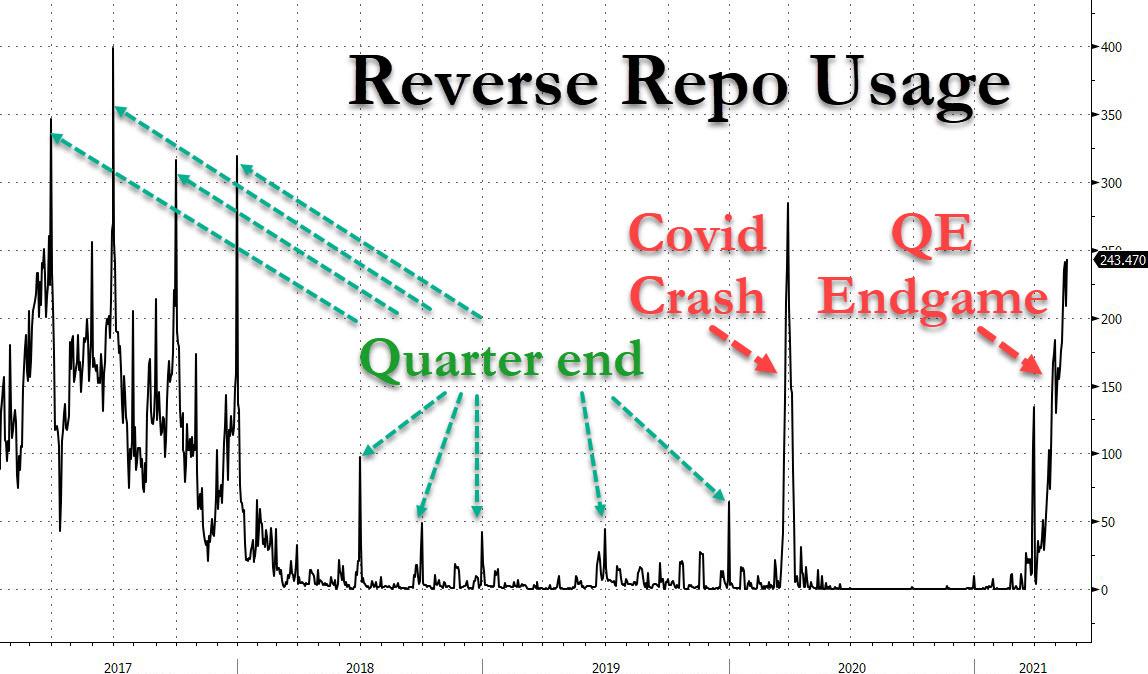
... and where we quoted from former Fed staffer Zoltan Pozsar, who warned that "The heavy use of the o/n RRP facility tells us that foreign banks too are now chock-full of reserves."
We concluded with the following bottom line: "keep a close eye on the daily reverse repo facility usage: at the rate it is rising it may soon surpass its all time high of $475BN reached at the end of 2015. At that moment the Fed will have no choice but to start the long overdue "tapering talk."
And just in case there was confusion, we elaborated that "it also means that every tick higher in RRP usage means we are that much closer to the next, and far more violent, taper tantrum."
Which is why the biggest news of the day may not be the crash in cryptos or even the Fed Minutes, but what the Fed published at 1:15pm ET when it revealed that in the latest overnight repo, 43 counterparties parked reserves worth $294 billion with the Fed, a number which not only surpassed the March 2020 covid crisis highs, but was the highest since 2017!
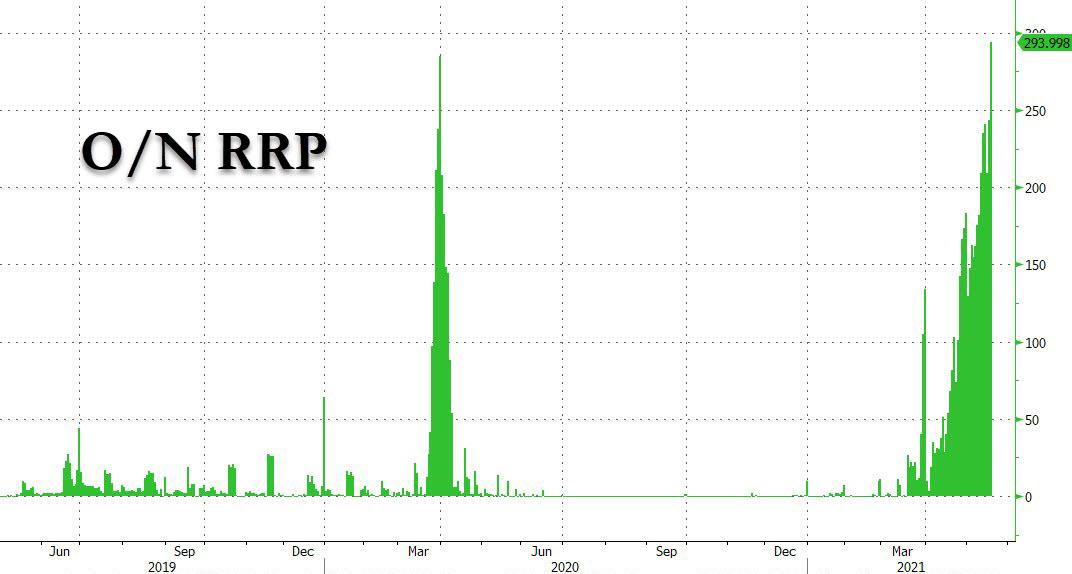
As Pozsar noted on Monday, "use of the facility has never been this high outside of quarter-end turns, and the fact that the use of the facility is this high on a sunny day mid-quarter means that banks dont have the balance sheet to warehouse any more reserves at current spread levels."
Translation: the Fed is taking Treasurys out of the market through QE purchases and putting them right back in via the RRP
Not only does this impair the proper functioning of the repo market which is rapidly running out of collateral and is forced to unwind what it just got from the Fed back to the Fed, it also means that while the Fed still has plenty of assets to monetize courtesy of the Treasury's breakneck debt issuance spree, the banks that end up holding the resulting excess reserves are running out of space and are forced to park these brand new reserves right back with the Fed in the form of the O/N RRP.
In short: the US financial system is starting to groan at every incremental new reserve created by the Fed's QE... and considering that there is at least $1 trillion more in QE to go, even with tapering, things could turn ugly soon.
This, much more than any flip-flopping commentary from the Fed, confirms that we are rapidly approaching a critical moment when the Fed will no longer be bale to conduct $120BN in QE every month, as sooner or later someone will figure out that the Fed buying up hundreds of billions in securities only to turn around the then repo out the resulting reserves each and every day, amounts to outright debt monetization with potentially calamitous consequences for yields and the US dollar.

>>> Cisco: Earnings Preview; reliably beats on EPS but upside got narrower last

Cisco: Earnings Preview; reliably beats on EPS but upside got narrower last quarter; waiting for Enterprise to turn around

Cisco Systems (CSCO) is set to report Q3 (Apr) results today after the close with a call to follow at 4:30pm ET. CSCO typically reports 5 minutes after the close. The current S&P CapitalIQ consensus is for adjusted EPS of $0.82 (up 4% yr/yr) and revenue of $12.57 bln (down 1% yr/yr). Cisco typically guides for EPS and revenue (on a percentage basis) for the next quarter.
  • Current guidance for Q3 is adjusted EPS of $0.80-0.82 and to revenue of $12.40-12.64 bln. Cisco tends to be conservative with guidance, which usually translates into analysts being on the higher end of guidance.
  • Last quarter, the stock traded lower despite a nice upside earnings report, solid guidance and a modest dividend increase. However, there were also some trouble spots. The $0.04 EPS upside was a notch lower than the $0.06-0.08 beats Cisco posted in the prior three quarters. So we'll see if Cisco reverts to its old trends or reports another narrow beat.
  • Margins are a closely watched metric with Cisco, so we'll be watching that. Last quarter, the company performed well here despite a difficult macro environment as non-GAAP operating margin in Q2 was 34.4% vs prior guidance of 32-33%. However, Cisco guided to a sequential decline in margins in Q3 at 33-34% although Cisco may have just been guiding conservatively.
  • In terms of end markets, Cisco has been seeing signs of gradual improvement led by order growth in Commercial, Public Sector, and Service Provider businesses. However, the Enterprise market remains soft, driven by some elongated sales cycles and a continued pause in spending amongst some customers brought on by the pandemic. Investors keep hoping to see Enterprise start to turn the corner, hopefully we get some positive commentary on the Enterprise segment.
  • Finally, in terms of what to expect, Cisco has not missed on EPS in the past five years, so it's pretty reliable.

Challenges : Alain Ducasse, évincé du Plaza, veut rebondir à Versailles

Alain Ducasse, évincé du Plaza, veut rebondir à Versailles

Le grand chef n'a pas réussi à convaincre le groupe Dorchester de le reconduire à la tête des cuisines du Plaza Athénée. Un coup dur pour le champion français de la restauration de luxe. Associé à Stéphane Courbit dans l'ouverture d'un hôtel de 14 chambres au château de Versailles, il annonce aussi la création d'une cantine branchée dans l'Est de Paris.

La rumeur qui courait depuis quelques jours a été officialisée le 17 mai. Le chef de nationalité monégasque Alain Ducasse va devoir raccrocher son tablier blanc au restaurant gastronomique de l'hôtel Plaza Athénée à Paris où il officiait depuis plus de vingt ans et qui était la vitrine parisienne de son groupe international de restauration de luxe. Homme d'affaires créatif, avisé, et souvent craint, actuel recordman du nombre d'étoiles Michelin détenues par un cuisinier, Ducasse a mis en place depuis trois décennies un modèle d'entreprise qui repose en grande partie sur les contrats de prestation de service signés avec des hôtels de luxe.
Un modèle très efficace même s'il semble rencontrer quelques difficultés ces derniers temps, plusieurs chefs étoilés ayant vu leur collaboration s'interrompre et plusieurs étant menacés. Pour Ducasse, c'était devenu une recette gagnante. Les palaces lui confient les clés de leurs cuisines, de leurs caves à vins et de leurs espaces de restauration. L'homme d'affaires en tablier y place ses hommes, ses méthodes, ses fournisseurs attitrés, les produits à son nom (chocolat de luxe, cuvées de champagne, cafés sélectionnés, huiles d'olives, vins fins, etc...). Il y cultive sa réputation, y forme ses cadres et apprentis et engrange les revenus.
Cela a été longtemps un modèle gagnant-gagnant. En s'enjoignant le nom et le prestige d'une star de la restauration, un palace gagne des récompenses, renforçait sa notoriété, son caractère luxueux et sa capacité à attirer les clients les plus fortunés, même si dans la réalité, seule une infime partie de sa clientèle fréquente son restaurant étoilé.
Potion amère
Bien entendu, il n'y a plus de débat sur le fait de savoir si le chef qui affiche son nom sur le menu et qui reçoit les récompenses est bien celui qui dirige la brigade au quotidien et prépare les plats proposés à des tarifs très élevés à la clientèle. "Celui qui fait la cuisine quand je ne suis pas là, c'est le même que celui qui la fait quand je suis là. Et dans les deux cas, ce n'est pas moi!", adore répéter Alain Ducasse qui dirige aussi les restaurants de l'Hôtel de Paris à Monaco, du Dorchester à Londres et du Meurice à Paris, sans même parler des restaurants qui appartiennent à son groupe Alain Ducasse Paris, ceux qu'il exploite sous concession (musées du Louvre, des Arts Premiers, château de Versailles, sites d'événementiel comme le Palais de la Mutualité et le Palais Brongniard) et les boutiques qu'il a créées pour vendre des chocolats, et cafés de luxe à son nom.
Bref l'empire Ducasse, dont le chiffre d'affaires global a parfois été estimé à 100 millions d'euros (avant Covid) est très impressionnant mais le non renouvellement de son contrat avec le Plaza Athénée, qui fait suite au non renouvellement de la concession du restaurant Jules Verne (Tour Eiffel) en 2018, apporte la preuve que même dans le monde de la gourmandise de luxe, il faut savoir digérer des potions parfois amères. Un spécialiste de la haute gastronomie estime que la perte du contrat avec le Plaza pourrait coûter près de 1,2 million d'euros de revenus au groupe Ducasse.
Lorsque la fin de son contrat parisien a été annoncée ce lundi, Alain Ducasse était à Monaco, au passe-plats du Louis XV, son restaurant de l'hôtel de Paris, en train de surveiller la préparation d'un banquet à quatre mains, donné par la Société des Bains de mer, propriétaire des lieux et des plus beaux palaces du Rocher, pour célébrer l'arrivée aux cuisines de l'hôtel Hermitage d'un autre grand chef étoilé, le parisien Yannick Alléno.
Le repas du Roi à Versailles
Ducasse confie qu'il avait décidé lui-même du moment de cette annonce et des termes employés dans le communiqué commun publié avec le groupe Dorchester. Il y est indiqué que le contrat prend fin le 30 juin, mais que les équipes de Ducasse restent aux commandes des restaurants de deux autres palaces du groupe (Le Meurice à Paris et le Dorchester à Londres). En revanche il n'y est pas indiqué que le Plaza Athénée pourrait désormais confier ses cuisines au chef parisien Jean Imbert, reflétant ainsi la volonté de cet hôtel de luxe de l'avenue Montaigne de proposer une cuisine bistronomique et branchée, moins raffinée mais aussi moins guindée et plus rentable.
Visiblement fatigué après des semaines de négociations infructueuses, Ducasse affirme qu'il souhaite désormais se projeter dans ses autres projets en développement.
Il est associé à Stéphane Courbit dans le nouvel hôtel qui doit bientôt ouvrir ses portes au château de Versailles, dans le pavillon du Grand Contrôle. "Nous avons prévu une théatralisation du service, en organisant le diner du Roi, pour les clients, ce sera unique", dévoile le chef gascon.
Cantine branchée à Paris
Il annonce aussi l'ouverture après l'été d'une cantine branchée, rue de Paradis, dans le 10e arrondissement de Paris, baptisée Sapid (du latin sapidus, saveur). Une adresse de plus à Paris, après les Allard, Aux Lyonnais, Rech… détenus par son groupe, ses autres établissements gérés sous concession et ses boutiques de café et chocolat. Pour cette partie de ses affaires, le chef entrepreneur est associé au fonds d'investissement Mirabaud Patrimoine Vivant de l'ancien ministre Renaud Dutreil. Expert dans l'art de dénicher des partenaires financiers, Alain Ducasse est aussi associé à Sommet Education (Eurazeo) avec lequel il a ouvert un campus de formation à Meudon l'année dernière, et à Webedia (Fimalac) pour ses activités d'édition de livres et de contenus online.

FT : Andrea Orcel and Ana Botín face off in Madrid courtroom over pay row

Andrea Orcel and Ana Botín face off in Madrid courtroom over pay row
UniCredit chief is claiming tens of millions of euros in compensation for Santander’s aborted job offer

Santander’s executive chair Ana Botín said her bank had never given Andrea Orcel a contract to become its chief executive, as the two former friends faced off against each other in a Madrid courtroom.

Orcel is claiming tens of millions of euros in compensation from Santander for reversing its plans to hire him in 2019, in the long-delayed hearing that began on Wednesday.

However, Botín denied that an offer letter issued to the Italian banker, now chief executive of UniCredit, constituted a contract.

On arrival on Wednesday morning, Botín greeted Orcel, a former UBS executive who was previously a longtime adviser to Santander, and the two sat four seats apart in the front row of the courtroom.

Under questioning from Orcel’s lawyers, Botín argued that the offer letter issued to him in September 2018 did not clearly define the buyout terms for a payout he was forgoing from UBS and therefore was not a contract.

Orcel, who is not due to give testimony, said he attended the hearing “out of respect to the process and the judge”.

He added: “This has always been about integrity and ensuring that the truth was put on record and I think that we will achieve that today.”

On the eve of the hearing, Orcel halved his claim for compensation from Santander from €112m to between €57.6m and €67.1m, according to two people familiar with the matter.

WSJ : Hedge Funds Increase Bets on Private Companies

Hedge Funds Increase Bets on Private Companies
Viking, Maverick look to stand-alone private-equity funds, while Anthony Scaramucci pitches Klarna

Hedge-fund firms are stepping up their presence in what has emerged as Wall Street’s hottest area: investing in private companies.

Viking Global Investors LP, Maverick Capital Ltd., Lone Pine Capital LLC and others have taken steps recently to increase their investments in private companies. Viking, a large investor in private healthcare and biotechnology companies, is aiming to raise $1 billion from investors for its first dedicated private-equity fund, said potential clients. The new fund is expected to close on Oct. 1.

Some hedge funds have been investing part of their money in private companies for years, saying they would miss out on opportunities to profit otherwise, given that companies are staying private longer. But interest from hedge funds has soared recently as profits have proliferated and companies have gone public at a rapid pace.

For the year through Friday, more than $312 billion of registered equity offerings through initial public offerings, special-purpose acquisition companies and follow-on deals came to market in the U.S., according to Dealogic. That figure is more than the annual average of nearly $290 billion that came to market in the U.S. over the decade ended 2020.

“There is huge demand,” said Jason Kaplan, a partner at Schulte Roth & Zabel LLP, who said he has been having multiple conversations a week with hedge-fund managers interested in discussing ways to invest in private companies. “They believe in the ability to drive returns and also mitigate some of the risks of public markets.”

There are concerns about the strategy given there is no guarantee investor appetite for tech companies and new offerings will continue. Activity in SPACs has slowed recently, and the stock prices of many newly listed companies have dropped below their IPO prices.

In addition, hedge fund clients continue to worry about the liquidity of investments. In the 2007-08 financial crisis, many clients were surprised by the amount of investments their managers had that were or became illiquid, limiting their ability to get their money back.

Craig Bergstrom, of the $8 billion hedge-fund investor Corbin Capital Partners LP, said of hedge funds investing in private companies: “It’s not inherently a good idea—it’s not, ‘How do I buy as much of this as possible?’ But there are some players we’ve seen execute on it very successfully.”

Among those looking for gains is Maverick, fresh off a large profit in its near decadelong investment in South Korean e-commerce giant Coupang Inc. CPNG 5.88% The firm has told investors it plans to start a late-stage growth fund.

Lone Pine is increasing to 15% from 5% the amount its hedge fund and long-only fund can invest in private companies, with investors opting into the increased exposure. Flight Deck Capital LP, a San Francisco fund started by Jay Kahn, launched May 1 with $250 million and the ability to invest a quarter of its assets under management in private companies. Mr. Kahn previously led or co-led most of the private investments at Light Street Capital Management and also invested in public companies.

Private investments have gained in popularity as several hedge-fund firms with significant private-investing efforts have posted some of the best returns in the industry. Tiger Global Management LLC, a pioneer in the hybrid approach that began investing in private companies in 2003, Coatue Management LLC and D1 Capital Partners LP have all boosted their returns by investing in private companies.

Fund managers say that they are being selective about which companies they back and that liquidity in secondary markets has increased in recent years.

Managers and their advisers also say the circumstances are different than those leading into 2008. Managers say they generally are more upfront about how much they intend to have in illiquid private investments and regularly communicate about those wagers with their clients. Funds recently have been structured from the outset to accommodate the longer time it can take to exit private investments.

For some managers, private investments also offer a chance to charge higher fees.

Anthony Scaramucci’s SkyBridge Capital, which invests billions in hedge funds for wealthy individual clients, has created special-purpose vehicles dedicated to investments in private companies.

In one recent deal, SkyBridge offered potential clients stock in Swedish payments company Klarna Holding AB for a 7.5% placement fee and 20% performance fee, according to documents viewed by The Wall Street Journal. In contrast, the maximum fees SkyBridge charges on its fund-of-funds products, which give investors exposure to a portfolio of hedge funds, are 1.5% for management fees and 10% for performance, a recent regulatory filing said.

A person familiar with the deals said the fees reflect the scarcity of such investment opportunities for wealthy individual investors.

Navigating private investments can be tricky, depending on funds’ structuring. At Maverick, Coupang’s growth and longtime status as a private company complicated matters.

In 2019, Maverick told investors that those who redeemed their investments from its hedge funds would receive cash, plus interest in a holding company dedicated to Coupang that would be converted to cash when Maverick sold its Coupang stake. Investors typically prefer receiving cash. Maverick’s hedge funds also were largely prevented from investing in other private companies because of Coupang.

Coupang’s public offering in March contributed to Dallas-based Maverick’s best quarter ever. The less than $20 million investment was valued at about $3.9 billion at the time of Coupang’s IPO.

Maverick founder Lee Ainslie on an investor call in May said the firm’s new late-stage growth fund, expected to raise $500 million, would help enable Maverick to invest in a company throughout its life cycle. Maverick hedge-fund clients also were told they could opt into or out of private investments in its hedge funds going forward.

FT : US telecoms decide focusing on pipes isn’t so dumb after all

US telecoms decide focusing on pipes isn’t so dumb after all
AT&T and Verizon unwind big bets on media content to concentrate on core businesses

John Stankey, AT&T’s chief executive, was crowing last month about the success of monster movie Godzilla vs Kong at both the box office and in driving audiences to the HBO Max streaming platform, the group’s attempt to challenge Netflix.

This week, he sounded more like a traditional telecoms executive as he outlined the “compelling opportunity” to instead grow his company’s share of the markets for broadband and 5G mobile services.

AT&T on Monday unveiled plans to spin out and merge WarnerMedia, the content business it bought only two and half years ago for a total enterprise value of $108.7bn, with rival Discovery.

The U-turn came only two weeks after its rival Verizon pulled the plug on its own media ambitions, which were born in 2015 when it paid $4.4bn to acquire AOL. Both constituents of the disastrous AOL-Time Warner deal at the turn of the century have been bought and then sold by America’s two largest telecoms companies in quick order.

The telecoms sector has long been fascinated with Hollywood as it has railed against the notion that the industry is little more than a collection of “dumb pipes” that act as conduits for value created by other companies.

Spain’s Telefónica made an ill-fated deal to buy Big Brother creator Endemol at the turn of the century while others have built sports broadcasting business, funded content studios, and acquired TV channels.

Yet telecoms-media convergence often comes at great cost and companies including AT&T and Verizon have embraced the notion that focusing on the pipes may not be so dumb after all.

“It’s like the cicadas. Every 17 years or so, the telecoms companies try to get into the media business,” said Craig Moffett, an analyst at MoffettNathanson, who recalls executives speaking about media opportunities as far back as 1984. Back then, the US telecoms industry was transitioning from a government-backed monopoly into a competitive business with the break-up of the Bell System.

“Telecoms CEOs started to look outside for ‘grass is greener’ opportunities. The sexiest of those was and always will be media,” Moffett said. “But the sexier the business, the worse the returns.”

Steve Case, co-founder of AOL and one of the architects of its $164bn merger with Time Warner, responded to the news of AT&T’s media exit by tweeting “#dejavu”.

Stankey, a telecoms veteran, was the driving force behind AT&T’s acquisition of DirecTV, the satellite TV broadcaster, and Time Warner. In a span of four months, he has unwound a decade of his own media deals — and at a hefty cost to shareholders.

In February, AT&T sold a 30 per cent stake in DirecTV to TPG, the private equity company, and spun it off into a new company valued at $16bn. That was around a quarter of the company’s $67bn enterprise value when it acquired the business six years ago. New Street Research analyst Jonathan Chaplin described the deal as “a humiliating transaction that barely qualifies as a divestiture”.

That was followed in quick succession by the spin-off and merger of WarnerMedia with Discovery in exchange for $43bn of cash and the newly formed company’s retention of debt, as well as a 70 per cent stake in the enlarged company.

Combined, these deals destroyed more than $50bn in shareholder value, according to FT calculations.

AT&T’s market capitalisation since October 2016 when it first revealed the Time Warner deal has barely changed at $230bn. Conversely, Disney has more than doubled in value to $150bn.

Stankey was promoted to chief executive of AT&T last year, taking over from Randall Stephenson, who had tried to go toe-to-toe with Hollywood producers by acquiring Time Warner, securing an asset that had slipped through the fingers of Rupert Murdoch.

Jeff Bewkes, the Time Warner chief executive at the time, had seen the incursion from Netflix and set out to sell the company to a deep-pocketed technology group that could cover its content costs in the future.

But it was a fairly short list. Facebook and Google had no interest, while Apple engaged in talks but did not pull the trigger, according to people briefed on the negotiations. Comcast had already bought a media company, as had Verizon. That left AT&T.

Bewkes asked AT&T management if they had enough money to properly invest in a global streaming service, which would entail years of losses, according to a person briefed on the discussions. He never received a clear answer from AT&T, the person added.

That was perhaps a sign that the deal would stretch AT&T to the limit. The deal made AT&T the most indebted company in the world, with $180bn of net debt, and it had already been haemorrhaging subscribers at DirecTV since 2017 as cord-cutting gathered pace.

AT&T’s media exit also cloaked a “rebased” dividend. The cut, which has not yet been quantified, will reduce one of the key attractions of holding the company’s stock: its high dividend yield. The group’s shares dropped 5.8 per cent on Tuesday.

Verizon’s media experiment also cost it billions of dollars. The company spent $9bn to buy and merge AOL and Yahoo, which it pitched as a chance to take on Google and Facebook in digital advertising.

Hans Vestberg, the former Ericsson chief who was developing Verizon’s 5G strategy, was appointed to the top job in 2018 and tried to stem growing losses at the media business. Verizon wrote off the value of its media assets — comprising properties such as Tumblr, The Huffington Post, TechCrunch and Yahoo Sports — by almost $5bn and, having tried to sell it repeatedly, finally engineered a $5bn sale to Apollo this month.

Verizon and AT&T spent almost $70bn between them acquiring C-Band spectrum in February to boost their 5G coverage, providing another trigger for a reconsideration of whether fantasy hockey leagues and the new Space Jam movies were the best use of their cash.

Nick Read, chief executive of Vodafone, said that “we have never believed as a company that we should move into content, telecoms and media have different business models”.

Vodafone, which operates the largest pay-TV business in Germany, has adopted an “aggregator” model whereby it is a neutral platform connecting millions of customers to the broadest array of content it can offer. “If you go into content creation then you have to make a serious financial bet,” said Read.