>>> Europe : Brokers Upgrades & Downgrades - 20th of May 2021

>>> Up
* Fjordkraft Raised to Neutral at SpareBank; PT 55 kroner
* Future PLC PT Raised to 3,140 pence at Berenberg
* NatWest Raised to Outperform at RBC; PT 240 pence
* SOITEC Raised to Buy at Deutsche Bank; PT 200 euros
* VAT PT Raised to 360 Swiss francs at Berenberg

>>> Down
* BT Cut to Hold at Berenberg; PT 175 pence
* Centrica Cut to Hold at Jefferies; PT 58 pence

>>> Initiation
* Casasold Rated New Outperform at EnVent S.p.A.; PT 5.31 euros
* VW Resumed Buy at Citi; PT 300 euros

>>> Call
* BT Cut to Hold With Positive Catalysts Already Passed: Berenberg
* Centrica Upside Has ‘Peaked,’ Jefferies Downgrades to Hold
* Novo Nordisk Experiments With Recycling Insulin Pens: Berlingske
* Volkswagen a Buy at Citi, Good Entry Point for Structural Winner

FT : Qantas makes plea for border reopening as it warns of $1.5bn loss

Qantas makes plea for border reopening as it warns of $1.5bn loss
Airline cautions Australia will be left behind with mid-2022 border reopening target

Qantas has appealed to Australia’s government to reopen international borders by the end of the year, warning that the country risks being left behind as other parts of the world begin easing Covid-19 restrictions.

The airline made the plea on Thursday as it forecast a more than A$2bn (US$1.5bn) loss in the 2021 financial year ending in June, hundreds more job cuts and a two-year wage freeze. But it also disclosed that it had stopped burning through cash thanks to a rebound in its domestic operations.

“No one wants to lose the tremendous success we’ve had at managing Covid but rolling out the vaccine totally changes the equation,” said Alan Joyce, Qantas chief executive.

“The risk then flips to Australia being left behind when countries like the US and UK are getting back to normal.”

Canberra plans to keep Australia’s borders closed until mid-2022 even though it expects to complete its vaccination rollout by the end of the year. The country remains largely free of Covid-19 infections owing to border closures and strict hotel quarantine.

But the airline industry has intensely lobbied authorities to speed up the border reopening, arguing that delays risk hampering the post-pandemic recovery. Jayne Hrdlicka, Virgin Australia chief executive, sparked controversy this week by calling for the border to reopen even if “some people may die”.

“Covid will be part of the community, we will become sick with Covid and it won’t put us in hospital, and it won’t put people into dire straits because we’ll have a vaccine,” Hrdlicka said, adding that the number of people who died would be “way smaller than with the flu”.

Joyce told reporters that the border closure was hitting the 50 per cent of Australians who were either born abroad or whose parents were. He said a successful vaccine programme should enable borders to reopen safely by the end of 2021.

Qantas said domestic operations were operating at 95 per cent of their pre-Covid capacity and the airline expected growth in travel within Australia in 2022.

Assuming no future lockdowns, Qantas forecast underlying earnings before interest, tax, depreciation and amortisation to be A$400m-450m this year. The figure excluded items such as writedowns and costs associated with job cuts.

Shares in Qantas, which has received more than A$2bn in taxpayer funds through Covid-19 support programmes, jumped almost 4 per cent on Thursday.

Angus Hewitt, an analyst at research group Morningstar, said the domestic business appeared on target to recover completely by the end of the financial year.

“But the big question is around the return of international travel,” he said. “We forecast negligible international travel [outside a travel bubble between Australia and New Zealand] in fiscal 2021 and expect the recovery of international flying to prove considerably more gradual.”

“While Qantas are expecting borders reopening from December 2021, we anticipate international capacity not recovering to fiscal 2019 levels until fiscal 2024,” said Hewitt.

Qantas has twice pushed back the resumption of international flights because of border closures. It hopes to begin flying internationally in January, although this target hinges on a change of heart from Canberra.

The airline said it would implement a wage freeze and seek several hundred additional redundancies as it aims to cut A$1bn in annual costs by 2023.

(ZH) Fed Alert: Overnight Reverse Repo Usage Soars Above Covid Crisis Highs


From: Laurent Chekroun (MAKOR SECURITIES LO) At: 05/19/21 22:11:01
Subject: (ZH) Fed Alert: Overnight Reverse Repo Usage Soars Above Covid Crisis Highs
Fed Alert: Overnight Reverse Repo Usage Soars Above Covid Crisis Highs

In today's FOMC Minutes there was a brief section that received little focus amid the broader analysis of the Fed's tapering, inflation language, yet which could be far more important in coming weeks in light of the violent move higher in overnight reverse repo usage.
This is what the Fed said in its discussion of money market rates and the Fed's balance sheet:
Reserve balances increased further this intermeeting period to a record level of $3.9 trillion. The effective federal funds rate was steady at 7 basis points. However, amid ongoing strong demand for safe short-term investments and reduced Treasury bill supply, the Secured Overnight Financing Rate (SOFR) stood at 1 basis point throughout the period. The overnight reverse repurchase agreement (ON RRP) facility continued to effectively support policy implementation, and take-up peaked at more than $100 billion. A modest amount of trading in overnight repurchase agreement (repo) markets occurred at negative rates, although this development appeared to largely reflect technical factors. The SOMA manager noted that downward pressure on overnight rates in coming months could result in conditions that warrant consideration of a modest adjustment to administered rates and could ultimately lead to a greater share of Federal Reserve balance sheet expansion being channeled into ON RRP and other Federal Reserve liabilities. Although few survey respondents expected an adjustment to administered rates at the current meeting, more than half expected an adjustment by the end of the June FOMC meeting."
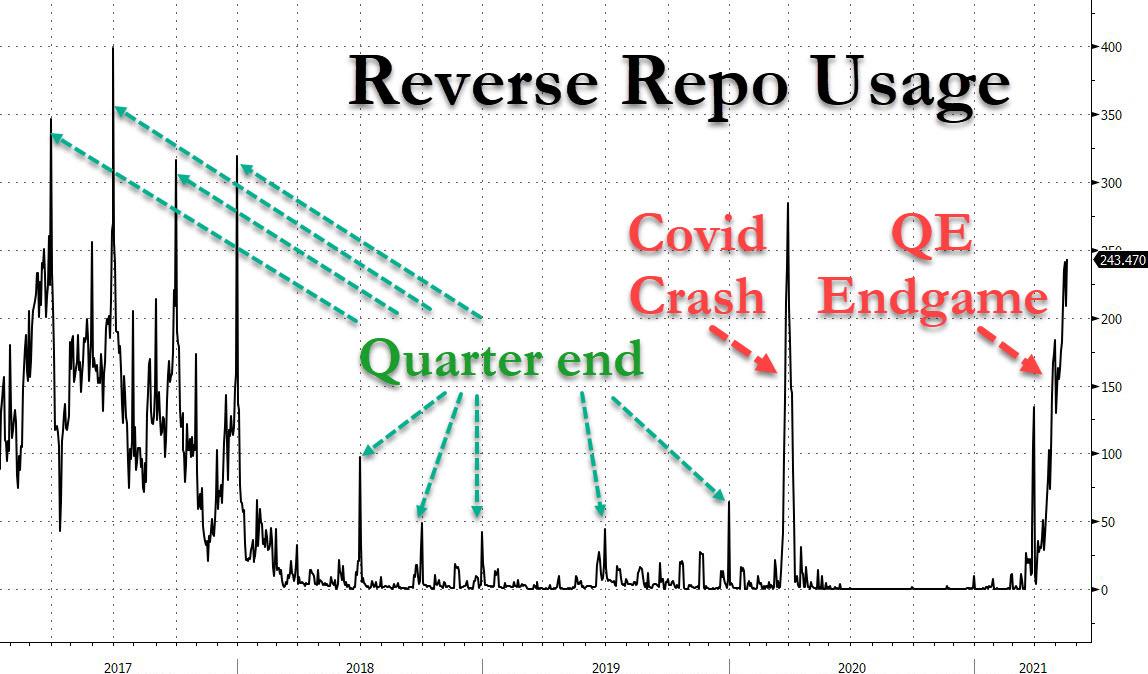
This language confirms what we said last night when we discussed the spike in overnight reverse repo usage as part of the coming QE endgame...
... and where we quoted from former Fed staffer Zoltan Pozsar, who warned that "The heavy use of the o/n RRP facility tells us that foreign banks too are now chock-full of reserves."
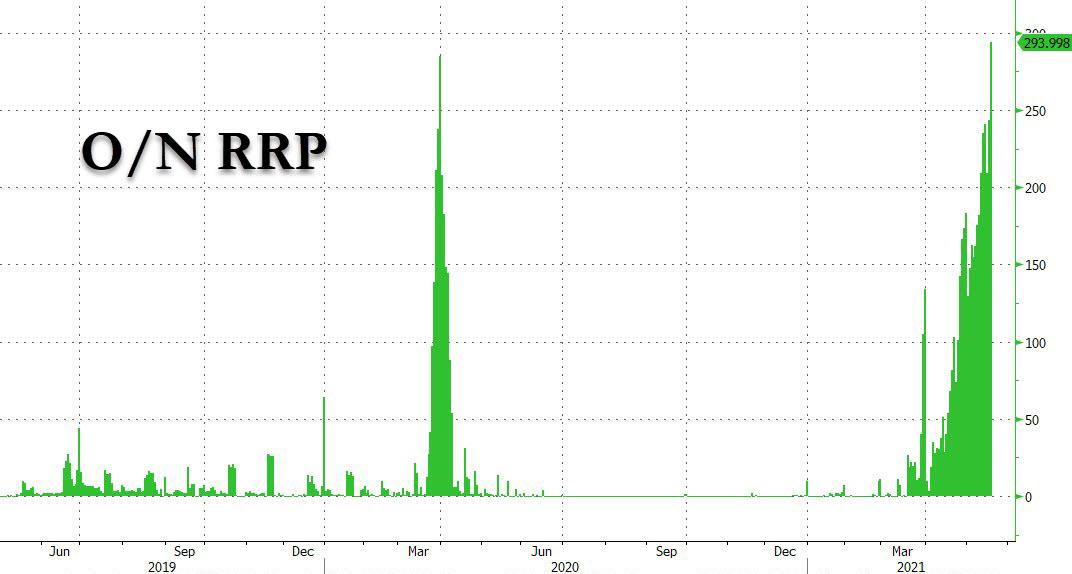
We concluded with the following bottom line: "keep a close eye on the daily reverse repo facility usage: at the rate it is rising it may soon surpass its all time high of $475BN reached at the end of 2015. At that moment the Fed will have no choice but to start the long overdue "tapering talk."
And just in case there was confusion, we elaborated that "it also means that every tick higher in RRP usage means we are that much closer to the next, and far more violent, taper tantrum."
Which is why the biggest news of the day may not be the crash in cryptos or even the Fed Minutes, but what the Fed published at 1:15pm ET when it revealed that in the latest overnight repo, 43 counterparties parked reserves worth $294 billion with the Fed, a number which not only surpassed the March 2020 covid crisis highs, but was the highest since 2017!
As Pozsar noted on Monday, "use of the facility has never been this high outside of quarter-end turns, and the fact that the use of the facility is this high on a sunny day mid-quarter means that banks dont have the balance sheet to warehouse any more reserves at current spread levels."
Translation: the Fed is taking Treasurys out of the market through QE purchases and putting them right back in via the RRP
Not only does this impair the proper functioning of the repo market which is rapidly running out of collateral and is forced to unwind what it just got from the Fed back to the Fed, it also means that while the Fed still has plenty of assets to monetize courtesy of the Treasury's breakneck debt issuance spree, the banks that end up holding the resulting excess reserves are running out of space and are forced to park these brand new reserves right back with the Fed in the form of the O/N RRP.
In short: the US financial system is starting to groan at every incremental new reserve created by the Fed's QE... and considering that there is at least $1 trillion more in QE to go, even with tapering, things could turn ugly soon.
This, much more than any flip-flopping commentary from the Fed, confirms that we are rapidly approaching a critical moment when the Fed will no longer be bale to conduct $120BN in QE every month, as sooner or later someone will figure out that the Fed buying up hundreds of billions in securities only to turn around the then repo out the resulting reserves each and every day, amounts to outright debt monetization with potentially calamitous consequences for yields and the US dollar.

FT : Bitcoin’s growing energy problem: ‘It’s a dirty currency’

Bitcoin’s growing energy problem: ‘It’s a dirty currency’
Elon Musk has highlighted the cryptocurrency’s environmental impact and governments are starting to take notice

On the shores of Seneca Lake in upstate New York, a private equity company has bought a decommissioned coal power plant and converted it to burn natural gas. It then switched it back on to become what it describes as a “power plant-cryptocurrency mining hybrid”.

Greenidge Generation Holdings, the company behind the plant, plans to go public later this year, saying it expects to become “the only US publicly listed bitcoin mining operation with its own power source”.

In a presentation to investors, it says its direct line in to the Empire Pipeline system for gas allows it to produce coins for just $3,000 a pop — a hefty margin considering that even after a heavy recent drop on a possible crackdown from Chinese regulators, they sell for about $40,000.

The company says it is proud of shifting away from coal. It is looking to buy more power plants and vastly scale up operations. Climate activists, however, are aghast that fossil fuels will be burnt to mine crypto, and are pushing regulators to clamp down on this and other similar projects to prevent a surge in greenhouse gas emissions.


But no activist has so far had such a profound impact on awareness of bitcoin’s carbon question as Elon Musk, the Tesla chief executive so fond of bitcoin that he loaded up his corporate coffers with $1.5bn of the cryptocurrency.

Musk said last week he had changed his mind, and reversed plans outlined in February to accept bitcoin for payments for his vehicles. “Cryptocurrency is a good idea on many levels and we believe it has a promising future, but this cannot come at great cost to the environment,” he said.

The statement generated a backlash from bitcoin believers, some of whom have made huge returns from early bets on the asset class and see it as the future of money. Crypto proponents have accused him of ignorance over mining methods or of seeking to protect the shadowy interests of big government. A new crypto coin named “F/ckElon” has appeared.

To academics who for years have been measuring bitcoin’s energy intensity, however, Musk has simply pointed out an established truth, albeit in his eccentric manner. It is a question so far largely ignored by governments, by heavy-hitting environmental charities, and by the banks and exchanges that facilitate the vast cryptocurrency industry.

“Bitcoin alone consumes as much electricity as a medium-sized European country,” says Professor Brian Lucey at Trinity College Dublin. “This is a stunning amount of electricity. It’s a dirty business. It’s a dirty currency.”

Economic authorities are starting to take notice. The European Central Bank on Wednesday described cryptoassets’ “exorbitant carbon footprint” as “grounds for concern”. In a paper earlier this month, Italy’s central bank said the eurozone’s payments system, Tips, had a carbon footprint 40,000 times smaller than that of bitcoin in 2019.

Measuring precisely how dirty bitcoin is has become a cottage industry in itself. The latest calculation from Cambridge university’s Bitcoin Electricity Consumption index suggests that bitcoin mining consumes 133.68 terawatt hours a year of electricity — a best-guess tally that has risen consistently for the past five years. That places it just above Sweden, at 131.8TWh of electricity usage in 2020, and just below Malaysia, at 147.21TWh.


The true figure for bitcoin could in fact be much higher; Cambridge’s extreme worst-case scenario calculation, based on miners using the least energy-efficient computers on the market as long as the process is still profitable, has peeled away from its central estimate sharply since November last year as the price of bitcoin has rocketed. The rationale: a rising bitcoin price attracts new miners, and also means that mining with older, less efficient equipment, makes financial sense.

The higher price also means the machines producing bitcoin are forced to complete ever-tougher puzzles in search of their quarry. At the upper limit, bitcoin’s electricity consumption would be about 500TWh a year. The UK consumes 300TWh. About 65 per cent of the crypto mining comes from China, where coal makes up around 60 per cent of the energy mix.

Naturally, there is space for disagreement on these statistics, and all studies on the issue accept elements of uncertainty. “There’s a lot of shades of grey,” says Michel Rauchs, a research affiliate who works on the Cambridge index.

Rauchs points out that a slice of the mining in China comes from clean hydroelectric power, including with machines that are transported from the north to the south of the country on trucks each year in the wet season. That hydro power is not necessarily diverted from anywhere else; some of these power stations were founded for factories that no longer exist, Rauchs says. In those cases, “I don’t see that it’s necessarily a problem”, he adds. About 75 per cent of miners use some kind of renewable energy, Cambridge studies show, but renewables still account for less than 40 per cent of the total energy used. Some mining may also be conducted off-grid, making it harder to track.

All this nuance makes a difference. Still, the possibility of global official intervention to cut the industry’s energy consumption is an “existential threat”, says Rauchs.


Machines on overdrive
Energy consumption on some scale is a feature, not a bug, of bitcoin — a digital currency launched by the pseudonymous Satoshi Nakamoto 12 years ago. Its detachment from the global financial and governmental system — still the most alluring feature for users seeking anonymity or wishing to bypass central banks — means it needs a new way to establish trust and security.

It does this by awarding miners coins in return for intensive puzzle-solving on the blockchain, making it a so-called “proof of work” coin. The puzzles are sufficiently hard to prevent hackers and other nefarious actors from taking control of the network, and the faster that miners can submit random numbers into the bitcoin algorithm, the more likely they are to unlock the coins. This all demands powerful machines running at full tilt.

Luckily for bitcoin miners with access to cheap energy and efficient machines, it is usually worth it. The price of bitcoin has dropped by about $30,000 apiece since the peak last month, but it has climbed by more than 200 per cent since late 2020 and more than 1,000 per cent since 2019.

Bitcoin is not the only energy-intensive cryptocurrency, but it is by far the biggest. Others include litecoin, ether and the light-hearted but rapidly growing dogecoin — initially an internet joke based on a Shiba Inu dog.

A March 2020 study by energy research journal Joule said bitcoin accounted for about 80 per cent of the market capitalisation of “proof of work” coins, of which an estimated 500 exist, and about two-thirds of the energy. “Understudied currencies add nearly 50 per cent on top of bitcoin’s energy hunger, which already alone may cause considerable environmental damage,” the study claimed.

Some cryptocurrencies are seeking to shift to a less energy-intensive “proof of stake” model, where a system allocates coins to verifiers, akin to miners, who put up coins for collateral. In the event of fraud, verifiers stand to lose their stakes, establishing trust through this channel rather than through energy-intensive “work”. Ether, the cryptocurrency native to the ethereum blockchain network, has been working on a shift to this model for more than two years, but the project is dogged by technical difficulties. Musk has also dangled the possibility that he could back other coins with a lighter energy impact.


A greener version of bitcoin is, in theory, possible. Bitcoin’s code could switch to a less energy-intensive consensus mechanism, whereby a new section of the blockchain ledger underlying the cryptocurrency would follow different rules. However, every miner would need to switch for the new path to work. Industry insiders say it is hard to imagine the entire bitcoin community, which is peppered with disagreements, lending support to such a plan.

Other ideas, such as labelling individual bitcoins as clean or dirty depending on the energy used to mine them, would also be hard to verify, and create a two-tier bitcoin system that was likely to lack support.

“Bitcoin could be the first inefficient version of a disruptive technology,” says Dr Larisa Yarovaya, a lecturer at Southampton university. “It should die for the common good of the planet and be replaced by a new model. It consumes more electricity than a country. All the rest is detail.”

Yarovaya, a former Russian Paralympic swimmer, frequently fields criticisms of her analysis and motivations from bitcoin proponents. She is undeterred, however. “It’s common sense,” she says. “[The energy consumption] is not justifiable by the high price of bitcoin. It is a speculative asset. It does not create a substantial amount of employment. It’s not widely used for transactions.”

Such concerns have not, however, sparked high-profile campaigning from environmental groups. Friends of the Earth, an advocacy group, says it is still getting to grips with the issue, as is Greenpeace, whose US arm started accepting bitcoin donations in 2014. After inquiries from the Financial Times, Greenpeace says it will now scrap the facility, which has not been heavily used. “As the amount of energy needed to run bitcoin became clearer, this policy became no longer tenable,” says Greenpeace.


Validation concerns
Environmental concerns have also not deterred a clutch of investment banks from entering the sector, despite their public commitments to sustainable development goals: Citigroup said recently it was exploring what role it could play in crypto services; Goldman Sachs has reopened bitcoin derivatives trading; and Morgan Stanley plans to offer clients access to bitcoin funds. None of these banks wished to comment on the issue of energy consumption.

Yarovaya says public companies dabbling in cryptocurrencies have served to “validate” the asset class, pumping up prices and in turn indirectly cranking up the energy usage. “They need to explain themselves,” she says, adding that cryptocurrency buyers should also take individual responsibility for their contribution.

Nigel Topping, who was appointed by the UK government to co-ordinate with businesses over climate goals ahead of the COP26 talks later this year, says bitcoin is not likely to be on the agenda for climate discussions among governments in Glasgow, but it is starting to become a real issue in broader policy discussions. “It’s becoming one of the climate baddies,” he says. “People who care about climate are in a bit of dismay. It’s just a silly idea. Proof of work is proof of burning [fossil fuels]. It’s working directly against what we’re trying to do.”


The UN is also looking at ways it can prevent the growth of cryptocurrencies from undermining its work on climate change, and is supporting the “Crypto Climate Accord” initiative, led by the Rocky Mountain Institute, says Topping. The group is not aiming to slow innovation in digital finance, but wants to ensure that future blockchain-based projects are designed to consume less energy.

Max Boonen, a former banker and founder of cryptocurrency trading platform B2C2, says “there’s a cost” to the environment from this industry, some of which is balanced out by the benefits of bitcoin’s “censorship resistance”.

Do crypto market participants worry about the energy usage? “Not in the slightest,” says Boonen. “Anyone in this market feels comfortable enough about the environmental costs. If you think it’s a problem, you don’t participate.” Nonetheless Boonen says he considers himself to be an environmentalist. He offsets some of the carbon involved in his work through “effective altruism”, such as donations to charities.

Bitcoin proponents remain convinced that the benefits outweigh the costs, arguing that cryptocurrencies provide the basis for the financial system of the future. Some, such as Jack Dorsey’s Square and Cathie Wood’s Ark Investment, argued in a white paper that the bitcoin network could in fact incentivise the more rapid development of renewable energy. “Increasing bitcoin mining capacity could allow the energy provider to ‘overbuild’ solar without wasting energy,” the paper said.

Banks and asset managers keen to meet client demand for crypto services are looking at carbon offsets. Much heavier reliance on renewable energy would soften the blow, but would still draw criticism by diverting clean power from other parts of society. After protests by residents and green NGOs, the Greenidge project in New York state announced plans to make its bitcoin generation carbon neutral by buying carbon credits. The company says it is “committed to exploring and investing in renewable energy initiatives across the country”.

Mandy DeRoche, an attorney at Earthjustice, which is campaigning against this and other resurrections of what she calls “zombie” fossil fuel-based power plants, says Greenidge buying credits is “irrelevant” considering the amount of greenhouse gases emitted, and the time has come for a more serious look at potential regulation.

“People can get distracted by, like, ‘what is bitcoin and what does it do?’ Honestly I don’t care what bitcoin does. I care that it is hugely energy-intensive, and that there are maybe better ways to go about bitcoin mining than this very inefficient, very energy-intensive process,” she says.
FT : NFTs: the race is on to pick the winners

NFTs: the race is on to pick the winners
From artworks to digital racehorses, real money is being made

Whenever I start writing about crypto investments I have that sinking feeling. The last time I touched on the subject was back in April 2018, when cryptos were in the deep freeze and heading south. My purchase of some bitcoin trackers when the price was around $6,000 was almost perfectly timed — to lose money. 

Prices were coming off a high of about $16,000 and then proceeded to bottom out at around $3,000. As I write, bitcoin is coming off highs again — just after I dipped my toes back in the water.

A few weeks ago, I bought a very small number of shares in an Aquis-listed fund called NFT Investments, which listed at 5p a share, began falling immediately afterwards and is now trading at around 3.5p. 

That said, I’m not overly concerned about whether the launch was overhyped. I think what is much more interesting is what it says about the longer term story of “non-fungible tokens” (NFTs). 

This is likely to provoke much eye-rolling among FT readers and, of course, all the caveats apply: crypto markets are insanely volatile and NFTs are just a derivative of these. They also have their legal challenges over ownership and replicability. In the end, it might all amount to a row of beans — but I think not.

First, the basics. An NFT is a certificate of authenticity held on the blockchain, a digital ledger of transactions that cannot be hacked. These tokens may refer both to an actual item, such as an artwork, as well as its authentication. Cut through the jargon and they are just a piece of code with specific functionality and a unique identifier. An NFT is thus a kind of digital securitisation, an asset of a kind that cannot be exchanged for or replaced by another identical one (hence non-fungible).

NFTs could be easily applied to a real-world physical item such as a stamp or a work of art. But they are most commonly used with digital art and collectibles. The best-known example was a work sold in March by digital artist Mike Winkelmann (aka Beeple) at auction for $69.3m. 

Artists can create or “mint” a new work and then pair it with an NFT which acts as the ownership right. They can also choose to retain some control over the digital rights of their work by encoding this within the NFT. 

But NFTs aren’t just about art. The NBA’s Top Shot collectibles programme has also already brought in more than $400m in sales of NFTs related to specific video moments in NBA history. Then there is the barely believable world of digital horseracing.

Platforms such as Zed Run sell digitally created horses with unique algorithms. Owners pay an entry fee to race their steeds against others for a prize pool. You can even “breed” the NFT horses in Zed Run’s “stud farm”. One player recently sold a stable of digital racehorses for $252,000, according to the New York Times. Another made $125,000 for a single racehorse.

This is a volatile set of markets. According to Nonfungible.com, which tracks NFT marketplaces, the average price for NFTs went from $142 in October 2020 to $4,000 in February 2021, before falling back to $1,400 in March. If you thought this was all a bit — how can I put it? — bonkers, consider the fact that in the first quarter, the market value of 38 NFTs tracked by CoinMarketCap surged more than eightfold to $22.5bn.

There are many blockchain entrepreneurs and investors out there who prize digital creations and have a great deal of money to spend. Early investors in crypto have also benefited from the move by some institutions to buy into the concept of crypto as an asset class — one that is worth an allocation of, say, 1 per cent of their portfolio. 

I would also argue that NFTs represent a broad form of accessible, easy to trade securitisation which can be applied to virtually anything digital and physical. That helps explain why NFT Investments’ first transaction was to buy into Aeon International, a developer of supply chain technology for the luxury fashion industry. This sort of development can help combat luxury counterfeiting and strengthen product authentication.

Another Aquis-listed vehicle is Dispersion Holdings, where I have also bought a very small number of shares. It goes beyond NFTs to focus on decentralised finance — or “DeFi” in the jargon — which uses blockchain and cryptocurrencies to bypass intermediaries in financial services transactions. It also owns some shares in NFT Investments. 

In a similar segment there is another fund called KR1, which acts as a venture capitalist in blockchain-related businesses (I also own some shares in that). It’s worth dwelling a bit on KR1. Its shares were trading at between 15p and 20p when I first bought but peaked at over 200p in February. 

As I see it, its business model is to back new digital asset platforms; KR1 receives tokens as an element of its investment deal. This is nicely encapsulated by its latest move to back a money market platform called Equilibrium. In return, KR1 has received just under 600,000 tokens in Equilibrium. 

Another to look at is ETF issuer Van Eck, which recently brought out the VanEck Vectors Digital Assets Equity UCITS ETF (ticker DAGB). This pure-play ETF invests in companies focused on blockchain-based applications — those that generate “at least 50 per cent of their revenue in the digital assets industry”. It is early days for this easily tradeable ETF. It’s worth noting, though, that its second biggest holding is Galaxy Digital (8.5 per cent of the fund) which is a Canadian listed digital assets business that is in effect a crypto investment bank.

This trio are good examples of how token-based digital platforms are working in areas far removed from the art world NFTs that originally brought the trend to the world’s attention. Real money has already been made — KR1’s share price has gone up more than tenfold in over six months — and quite how this sector will mature I have no idea. But it isn’t going away and it isn’t a joke — though those thoroughbred digital horses certainly induce a smile.

>>> US After Hours Summary: CSCO -5.4% falls on earnings; lots of ASCO-related announcements after the close


After Hours Summary: CSCO -5.4% falls on earnings; lots of ASCO-related announcements after the close

After Hours Gainers:

Companies trading higher in after hours in reaction to earnings/guidance: ZTO +4.4%, CPRT +3.3%, SNPS +2.2%, TARO +1.6%

Companies trading higher in after hours in reaction to news: ALLO +11.9% (CD19 Forum Highlights Positive Results from Phase 1 Studies of ALLO-501 and ALLO-501A), ONCT +10.8% (ASCO-related announcement), ADAP +8.2% (ASCO-related announcement), YMAB +7.3% (announces distribution agreement with Adium Pharma in Latin America), DTIL +4.4% (ASCO-related announcement), NVVE +3.8% (announces collaboration with Spirii), SNSE +3.8% (announces new Phase 1/2 data for SNS-301), AVEO +2.6% (ASCO-related announcement), AFG +2.5% (to declare special dividend of $12-14/sh), RCUS +2.4% (ASCO-related announcement), BGNE +1.9% (ASCO-related announcement), IOVA +1.7% (ASCO-related announcement), MEIP +1.5% (ASCO-related announcement), TAK +1.3% (ASCO-related announcement), CLVS +1.3% (ASCO-related announcement), BMY +1.2% (ASCO-related announcement), NXTC +1.1% (ASCO-related announcement), F +0.6% (to launch battery JV with SK Innovation to support EV rollout, according to Reuters), CGEM +0.6% (ASCO-related announcement), IMAB +0.5% (ASCO-related announcement), SNY +0.3% (ASCO-related announcement), SQZ +0.2% (ASCO-related announcement), PXD +0.1% (stock offering), GILD +0.1% (ASCO-related announcement), ADCT +0.1% (ASCO-related announcement)

After Hours Losers:

Companies trading lower in after hours in reaction to earnings/guidance: SCVL -7%, GDS -6.6%, CSCO -5.4%, LB -2.1% (also appoints CFOs for standalone Bath & Body Works and Victoria's Secret), KEYS -1.5%, BEKE -0.4%

Companies trading lower in after hours in reaction to news: BDTX -16% (ASCO-related announcement), ALPN -6.9% (ASCO-related announcement), SEEL -4.9% (stock offering), ADAG -4.8% (ASCO-related announcement), VYGR -3% (announces strategic shift towards its next-generation AAV capsid platform; CEO Andre Turenne to step down), IMGN -3% (ASCO-related announcement), SRNE -1.9% (stock offering), EXAS -1.6% (ASCO-related announcement), PSFE -1.6% (stock offering), DPZ -1.3% (CFO steps down), ASXC -1% (files mixed securities shelf offering), BPMC -0.7% (ASCO-related announcement), LLY -0.4% (ASCO-related announcement), AZN -0.2% (ASCO-related announcement), JNJ -0.1% (ASCO-related announcement)

>>> US Close Dow -0.48% S&P -0.29% Nasdaq -0.03% Russell -0.78%

Closing Stock Market Summary

The S&P 500 declined 0.3% on Wednesday, although it was down as much as 1.6% in early action and spent most of the session on the comeback trail. The Nasdaq Composite (-0.03%) closed relatively unchanged after being down 1.7% intraday. The Dow Jones Industrial Average (-0.5%) and Russell 2000 (-0.8%) underperformed but also closed off intraday lows. 

The weak start wasn't catalyzed by any specific news, although some pointed to the huge sell-off in the cryptocurrency market as a reminder that it might be a good idea to take some profits for stocks that are still up big this year. Familiar concerns surrounding inflation, valuations, and peak growth were recounted in the early part of the session as investors de-risked. 

Profit-taking efforts were mainly concentrated in the S&P 500 energy (-2.5%), materials (-1.5%), financials (-0.6%), and industrials (-0.6%) sectors. The information technology (+0.3%) and communication services (+0.1%) sectors, however, sneaked their way into positive territory on a closing basis. The Philadelphia Semiconductor Index rose 2.0%. 

The turnaround in the information technology sector, which was down 1.7% intraday, helped improve risk sentiment, which was further aided by an appreciation that the S&P 500 reclaimed its 50-day moving average (4081) after slipping below it in the morning.

Later in the day, the FOMC Minutes from the April meeting revealed that some participants thought it might be appropriate to start talking about tapering asset purchases in future meetings if the economy continues to make rapid progress towards the Fed's goals on employment and inflation.

The stock market's reaction to this FOMC passage was rather calm, arguably due to a view that it might have been more surprising to see no mention of the need to start talking about tapering asset purchases. Longer-dated Treasury yields moved higher following the Minutes. 

The 10-yr yield settled higher by four basis points to 1.68% while the 2-yr yield was unchanged at 0.15%. The U.S. Dollar Index rose 0.5% to 90.16. WTI crude futures fell 3.4%, or $2.20, to $63.31/bbl. The CBOE Volatility Index increased just 3.9% to 22.18 after touching 25.96 at its high. 

Separately, Target (TGT 219.01, +12.58, +6.1%) rose 6% to all-time highs following its better-than-expected earnings report. Lowe's (LOW 190.72, -2.03, -1.1%) also exceeded expectations, but shares went the other way. 

Wednesday's economic data was limited to the weekly MBA Mortgage Applications Index, which increased 1.2% following a 2.1% increase in the prior week. On Thursday, investors will receive the weekly Initial and Continuing Claims report, the Conference Board's Leading Economic Index for April, and the Philadelphia Fed Index for May. 

  • Russell 2000 +11.1% YTD
  • Dow Jones Industrial Average +10.8% YTD
  • S&P 500 +9.6% YTD
  • Nasdaq Composite +3.2% YT!d

>>> L Brands beats by $0.27, beats on revs; guides Q2 EPS above consensus (67.3

L Brands beats by $0.27, beats on revs; guides Q2 EPS above consensus (67.31 -2.18)
  • Reports Q1 (Apr) earnings of $1.25 per share, excluding non-recurring items, $0.27 better than the S&P Capital IQ Consensus of $0.98; revenues rose 82.8% year/year to $3.02 bln vs the $2.84 bln S&P Capital IQ Consensus.
    • Bath & Body Works net sales were $1.469 billion for the first quarter ended May 1, 2021, compared to net sales of $760.6 million for the first quarter ended May 2, 2020. First quarter 2021 sales in the direct channel were $349.2 million, an increase of 21 percent compared to 2020 and a 123 percent increase compared to 2019.
    • Victoria's Secret total comparable sales for the first quarter ended May 1, 2021 increased 9 percent compared to the first quarter of 2019. Comparable U.S. and Canada store sales for the first quarter of 2021 decreased 3% compared to the first quarter of 2019.
  • Co issues upside guidance for Q2, sees EPS of $0.80-1.00, excluding non-recurring items, vs. $0.67 S&P Capital IQ Consensus.
  • Due to the continued uncertainty in the environment, as well as the impending separation of the Bath & Body Works and Victoria's Secret businesses targeted to occur in August 2021, the company is not providing earnings guidance for the full year 2021.