(ZH) Goldman Steamrolls Iran Oil Output Fears, Sees Crude Hitting $80 In Months

Goldman Steamrolls Iran Oil Output Fears, Sees Crude Hitting $80 In Months

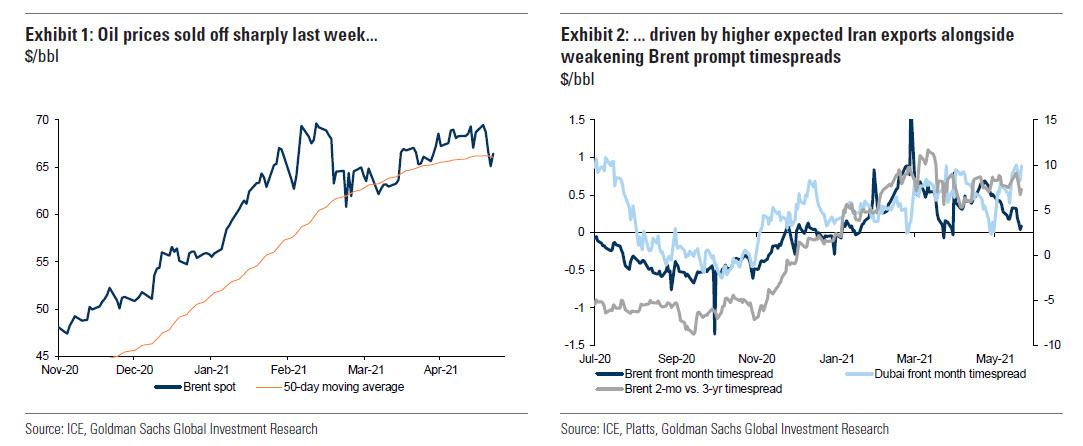
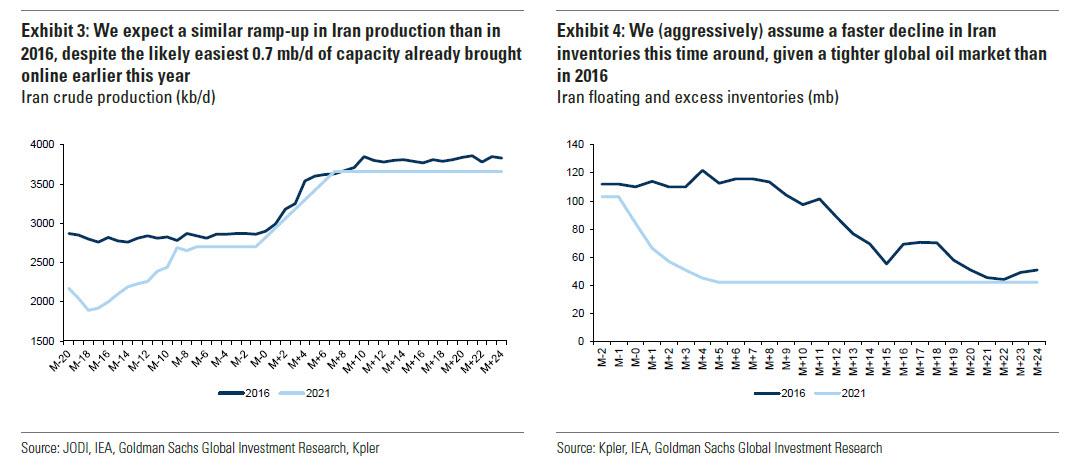
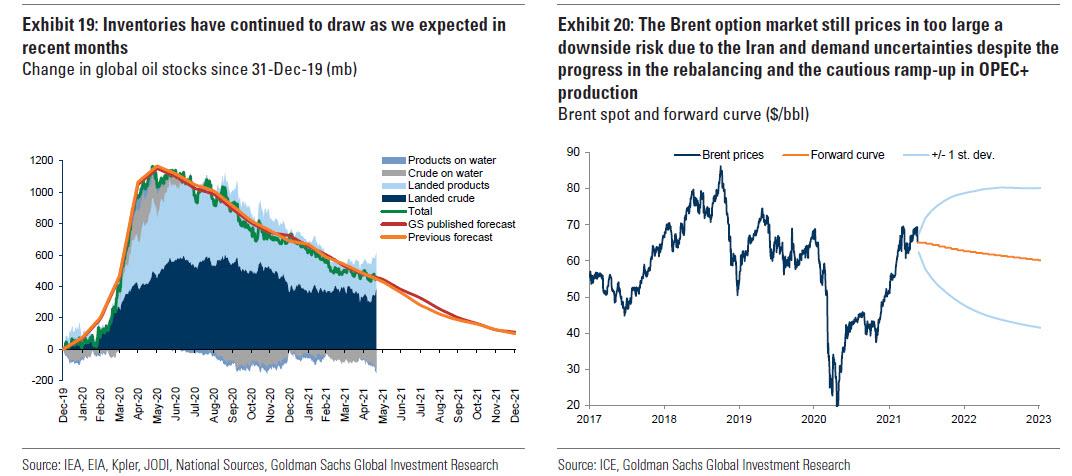
Toward the end of Q1, Goldman Sachs along with virtually every other major bank, predicted that oil had nowhere else to go but up, with bank after bank hiking their oil forecast. It also top-ticked the market, as Goldman's Damien Courvalin writes in a note published on Sunday discussing "the path to higher oil prices", in which he admits that despite the bank's "balls to the wall" bullish stance on crude, "the oil rally has given way to sideways volatility since March, due to concerns over vaccination pace, EM Covid waves and the return of Iranian barrels, with the latter pushing Brent prices down from $70 to $65/bbl last week." Or, as the bank calculates, "last week’s large sell-off was equivalent to bringing forward by 3 months a 1 mb/d increase in global production, leaving the market likely pricing the return of Iranian barrels by late summer."
After such a retracement, the Goldman commodities strategist predicts that while the market is now "pricing a return of Iranian barrels by late summer" it is again "underestimating the upcoming demand rebound, too pessimistic a view on both accounts." Which, of course, is someone that is bullish on oil would say.
Anyway, here is Courvalin's math explaining why the market is too pessimistic in his view:
  • On Iran, while comments suggest significant progress has indeed been made, the timelinen is still uncertain as according to press reports, negotiations appear focused on an agreement on the conditions for reinstating the JCPOA, implying a lag (or potential impasse) in lifting US secondary oil sanctions, or conditions that could limit the size of such a restart.
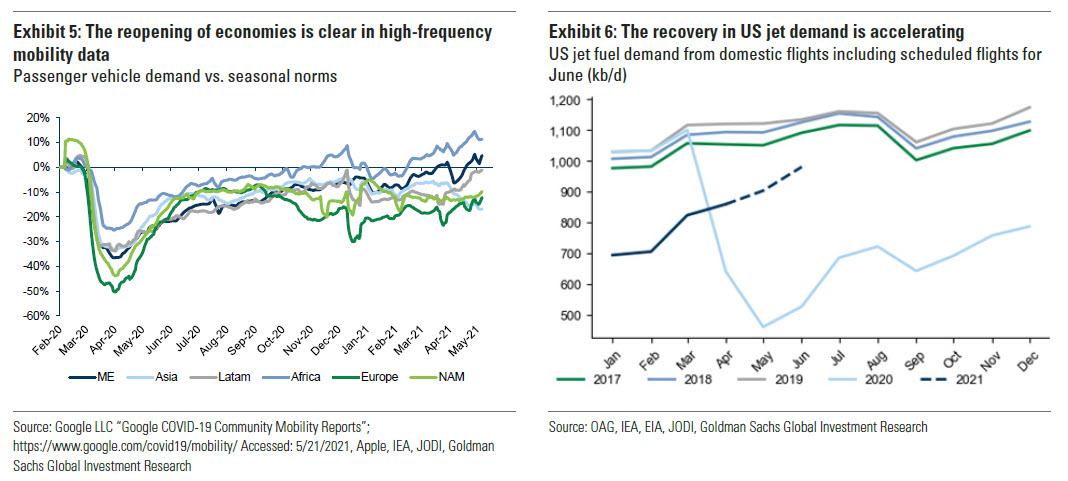
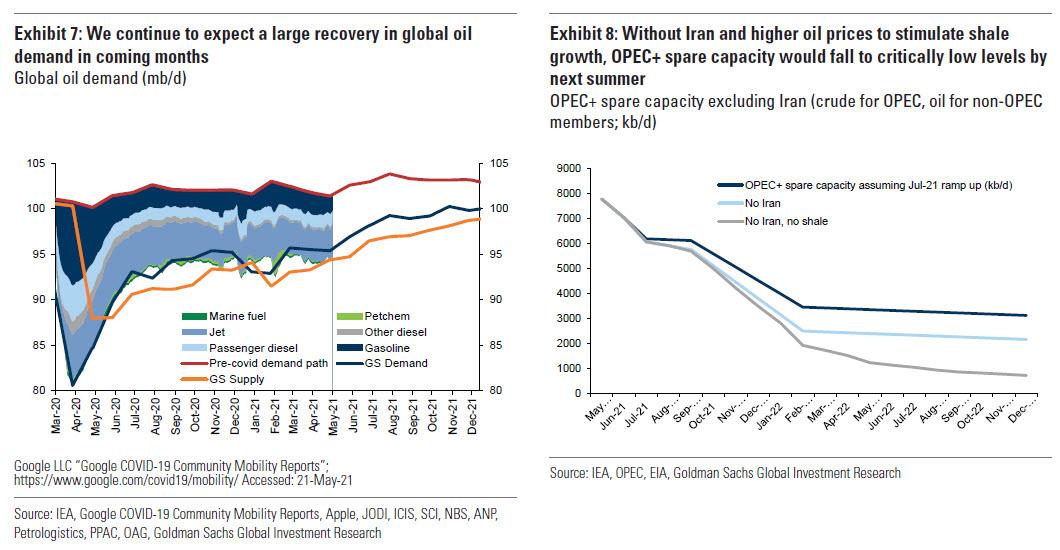
  • On demand, Goldman says that the recovery in DM mobility and travel is on track to exceed its expectations, helping offset the recent hit to South Asia and Latin America demand: "Mobility is rapidly increasing in the US and Europe, as vaccinations accelerate and lockdowns are lifted, with freight and industrial activity also surging. This DM recovery is in fact larger than we had assumed, helping offset the recent hit to demand and the likely slower recovery in South Asia and Latin America."
  • On supply, Goldman is lowering its non-OPEC+ production forecasts to account for still depressed activity levels and a slower expected rebound from shale. Given the current global deficit of 1.8 mb/d in 2Q21, Goldman believes that this demand impulse will not only absorb remaining excess inventories and a potential July ramp-up in Iran supply...


    ... but still require a cumulative additional 2.8 mb/d increase in OPEC+ production by Dec-21 (requiring an early exit from their April 2020 agreement).
Putting these three together, Goldman assures its clients that the "case for higher oil prices therefore remains intact given the large vaccine-driven increase in demand in the face of inelastic supply."
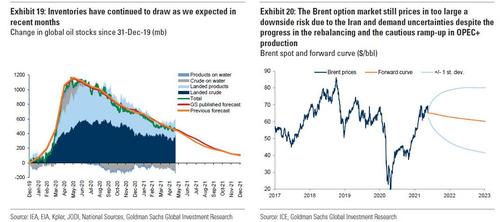
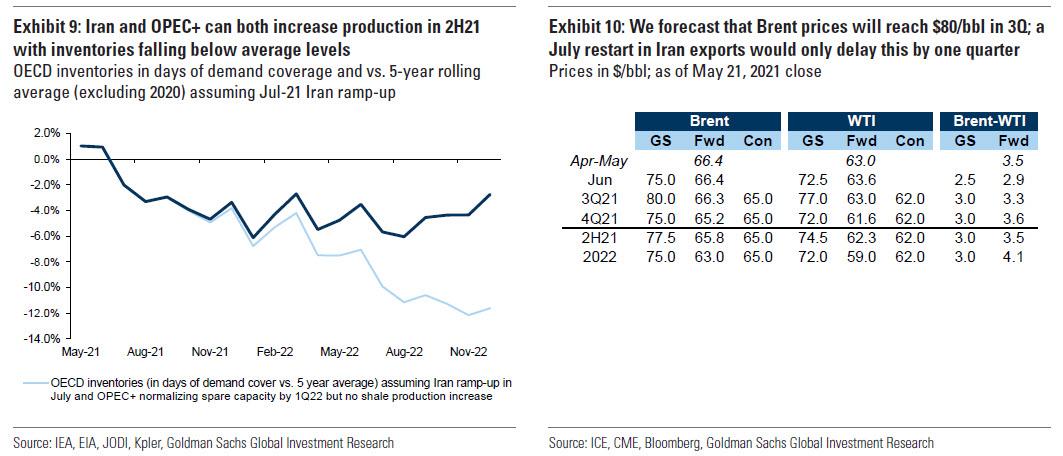
Assuming this is accurate, Courvalin's next argument is that the path to higher prices is the key uncertainty and to address this, he runs scenarios on Goldman's updated supply-demand balance, adjusting the OPEC+ and shale responses to various timings of Iran's potential export recovery: "Even aggressively assuming a restart in July, we estimate that Brent prices would still reach $80/bbl in 4Q21, with our new base case for an October restart still supporting our $80/bbl forecast for this summer."
Goldman's conclusion is some humble... " despite the global market deficit coming in line with our forecasts in recent months, we under-estimated the weight of such demand and Iran uncertainties, keeping prices trading below our $75/bbl 2Q21 fair value" before trying to convince the market that it will be right, damn it: "With growing evidence of the demand rebound, and imminent clarification on the likelihood of an Iranian return, we now see a clearer path for the next leg higher in oil prices, with the sell-off offering opportunities to position for the rally to $80/bbl."
To be sure, this is not the first time Goldman has had outrageous predictions about oil prices, with the current forecast nowhere near Goldman's $200/bbl prediction from the summer of 2008. On the other hand, with prices across all goods and services already surging, there will be nobody more relieved if Goldman is wrong on this one, than Joe Biden...

FT : Glut of cash in US financial system pressures Fed policy rate

Glut of cash in US financial system pressures Fed policy rate
Central bank may need to tweak policies if key effective level falls further, analysts say


The Federal Reserve may need to recalibrate its policy toolkit, analysts say, as a glut of cash sloshing through the US financial system has made it more difficult for the central bank to maintain tight control of its policy rate.

Short-term interest rates have plummeted to historic lows since the start of this year as financial institutions that are flush with cash compete to lend it out in ultra-low risk vehicles, such as US government securities maturing in the near future or so-called repurchase agreements.

“Clearly there is very big, insatiable demand . . . and it is like a game of musical chairs in terms of who can find the supply first,” said Teresa Ho, a strategist at JPMorgan, who estimates there is a $751bn supply-demand gap in funding markets as of April.

The surge in liquidity stems in part from the Fed’s asset purchase programme in which it buys up $120bn in US government debt every month. Bank deposits shifting into money-market funds as well as the Treasury department’s plans to draw down its record stash of cash and pay out funds associated with the recent stimulus package passed by Congress have also increased reserve balances.

At the same time, the department has pulled back on its issuance of Treasury bills, which mature in one year or less — something that has reduced the supply of a key asset used for storing cash.

Large amounts of cash have made their way back to the Fed, with demand for the central bank’s reverse repo facility — which gives financial firms a place to park it temporarily — surging. Daily usage last week climbed to the highest level since 2017, hitting $369bn on Friday.


These factors have pressured the Fed’s benchmark interest rate to a level that has begun to attract more scrutiny from analysts and investors.

The federal funds rate is hovering at 0.06 per cent, well below the middle of the 0-0.25 per cent rate the central bank is targeting. A sustained tick lower to 0.05 per cent could be sufficient to prompt action from the Fed, said Kelcie Gerson, a strategist at Morgan Stanley.

The Fed has already expanded access to the reverse repo programme and lifted limits on the amount of cash financial companies can park at the central bank from $30bn to $80bn in order to drain liquidity from the system and slow down the downward drift in short-term rates.

A next step could include increasing the interest the Fed pays banks on reserves they hold at the central bank, analysts say. Another is increasing the rate the Fed pays in its reverse repo programme.

“The Fed is vigilant on this issue,” added Thomas Simons, an economist at Jefferies. “They don’t want to allow it to get out of control.”

>>> What to look at today -24th of May 2021

U.S. equity futures fluctuated and Asian stocks were steady Monday as traders weighed the volatile slump in cryptocurrencies, the inflation outlook and China’s intensifying effort to cool raw-materials prices.
Shares posted modest gains in Japan, China and Australia but retreated in Hong Kong. S&P 500, Nasdaq 100 and European equity contracts oscillated after U.S. stocks closed mixed on Friday. Bitcoin advanced to about $35,100 following another weekend of big swings.
The stalling commodities boom remains in focus as China tries to temper speculation, with the nation vowing severe punishment for violations ranging from excessive speculation to spreading fake news.
Market-based gauges of inflation expectations have declined of late, but concerns linger that the post-pandemic recovery could stoke price pressures and force a pullback in extraordinary central bank support. Treasury yields and the dollar were steady.

Nikkei +0.41% Hang seng -0.41% CSI +0.07% Shanghai +0.16% Shenzen +0.43%

Eur$ 1.2182 CNH 6.4318 CNY 6.4332 JPY 108.84 GBP 1.4150 CHF 0.8980 RUB 73.59 TRY 8.4213 WTI$ 63.88 +3.13% Gold 1,881.25 BTC 34,850 +2500 ETH 2115 +265

S&P +0.23% Nasdaq +0.10% EuroStoxx +0.15% FTSE +0.21% Dax +0.15% SMI Closed

Macro :
- Virus Outlook Now Far More Positive Than Markets Seem to Realize
- Cathie Wood Is Trimming Her Biggest Stakes as Ark Funds Stumble
- Musk Tweets He Supports Crypto in Battle Against Fiat Currencies
- Germany To Remove France From Covid-19 Risk List: Rtrs

Keep an eye on :
- AIR FP : Texas Billionaire’s Supersonic-Jet Dream Dies as Aerion Folds
- CPR IM : Campari May Buy Premium Brands in U.S., Asia, CEO Tells Stampa
- DBHN GY : Arriva Owner Plans to Sell or Float U.K. Arm, Telegraph Reports
- DBK GY : Deutsche Bank May Ride Regulatory Tailwinds for Cross-Border M&A
- GSK LN : Glaxo Gets Ready for Next Pandemic After Covid Vaccine Stumble
- GSK LN : U.K. Ministers Fear Forced Sale of GSK, The Times Says
- HDG NA : Bergson Increases Hunter Douglas Offer Price to EU82 Per Share
- ITX SM : Zara Stores to Close in Venezuela as Inditex Brands Exit
- LHN SW : Brazil’s infrastructure minister predicts $50bn investment boom, The government is auctioning concessions in assets including airports, ports, highways and railways - FT
- LSEG LN : CCCS Grants Conditional Approval on Refinitiv, LSE Deal
- MRNA US : Moderna Plans Making Vaccines With Samsung Biologics Starting 3Q
- S30 FP : Solutions 30 to Resume Trading; Auditor Can’t Give Opinion (2)
- O2D GY : Telefónica Deutschland, 1&1 Drillisch Sign Roaming Agreement
- FP FP : Total Seeks Acquisitions in Renewables, Deep Offshore: Investir
- FP FP : Norway Wealth Fund to Oppose Electing Pouyanne as Total Director
- VWS DC : Vestas, Goldwind Revenue Could Top Consensus on Net-Zero Goals
- VOW GY : Volkswagen Mexico to Adjust Production on Chip Shortage

>>> Europe : Brokers Upgrades & Downgrades - 24th of May 2021

>>> Up
* Cairn Energy Raised to Buy at HSBC; PT 205 pence
* MorphoSys Raised to Overweight at Morgan Stanley; PT 90 euros
* MorphoSys ADRs Raised to Overweight at Morgan Stanley; PT $28
* Thyssenkrupp Raised to Equal-Weight at Morgan Stanley

>>> Down


>>> Initiation


>>> Call
* H&M Valuation Upside Potential Higher Than For Inditex: RBC
* MorphoSys Pullback Offers Entry Point, Morgan Stanley Upgrades
* Thyssenkrupp Risks Balanced, Up to Equal-Weight: Morgan Stanley

FT : Lessons from 2021’s Business of Luxury summit

Lessons from 2021’s Business of Luxury summit 
Positive post-pandemic outlooks mix with sustainable, socially conscious messaging as industry leaders look ahead

The luxury sector has endured the Covid-19 crisis with little lasting damage expected and a recovery is now under way.

That was one of the recurring messages at the FT’s annual Business of Luxury summit, held online last week. While economist Nouriel Roubini warned of the knock-on effects of rising US inflation on the global economy, Sarah Willersdorf, global head of luxury at Boston Consulting Group, predicted a full return to pre-pandemic sales levels for the luxury sector by 2022.

The recovery will not be equal
The Covid-19 crisis has had its silver linings for major luxury brands, which were able to snap up market share from smaller, independent players and those mid-turnround.

The Tod’s group had already been battling declining sales for four years prior to Covid-19, and president and chief executive Diego Della Valle said he would be open to selling the Italian luxury shoemaker to LVMH, which last month bought a 6.8 per cent stake in the group for €75m. He also hinted at plans to step back from day-to-day management at the group. After a turbulent year and a half, it was a reminder of the tough decisions brand owners are having to make to ensure their futures. 

It has been an especially challenging period for the small- and medium-sized businesses that make up the majority of the British fashion sector. Designer Roland Mouret said he lost 80 per cent of his business due to Covid-19, while Brexit has increased shipping costs and paperwork. The government is not doing enough to support the industry, he added.

Sustainability and luxury must coexist 
Sustainability was already on the minds of designers and luxury executives prior to the pandemic, but now it’s at the top of the agenda.

“Being sustainable is not even an option anymore. You have to be,” said Gabriela Hearst, creative director of the Gabriela Hearst label and Richemont-owned Chloé. At her eponymous label, she focuses on lessening her environmental footprint through materials — prioritising recycled and deadstock fabrics for example — and transport.

Claire Bergkamp, chief operating officer of not-for-profit Textile Exchange, advises brands to take a similar approach, concentrating on the materials they use most and finding lower-impact alternatives. At her former employer Stella McCartney, it was cashmere that had the biggest footprint, so the brand made sourcing recycled, high-quality cashmere a priority.

Resale and rental is also something brands should embrace, argued Laura Balmond, who leads the Ellen MacArthur Foundation’s Make Fashion Circular programme. She observed that the second-hand market is outpacing luxury goods sales, and the vast majority of brands are missing out.

“The luxury industry is quite complacent” in this respect, said Erwan Rambourg, global head of consumer and retail research at HSBC. Labels could be building loyalty among younger consumers who might make their first luxury purchase second-hand, then trade up. “As a brand you’re leaving a lot of the data and relationship to other people”. 

Know your message 
Brands need to understand that sustainability goes beyond reducing the carbon footprint of a product, said Positive Luxury co-founder Diana Verde Nieto. Equally important is social impact. Companies must ask themselves, “how do we build social justice alongside environmental justice?”

Before communicating their social values to consumers, brands must look internally at their own diversity, inclusion and sustainability efforts. “It cannot be only ideological,” said Paolo Cigognini, chief marketing and communications officer at Alexander McQueen. “We need to take action.”

Younger consumers will notice if you don’t. “Millennials care about the quality of product, but Gen Z care about cultural credibility, so what is the brand’s perceived value, the emotional connection to a brand. They need to feel [the brand’s] story is authentic,” said Felix Krueger, partner and associate director, fashion and luxury, at BCG.

Valentino creative director Pierpaolo Piccioli said the pandemic and Black Lives Matter movement have galvanised him to use his voice. “I am not a politician but fashion can be political, I think you use images to say what you are going to deliver,” he said. “If it doesn’t deliver a moral then it is empty.” 

But companies are still lagging behind on diversity, particularly in the beauty sector, said Noelly Michoux, founder and chief executive of 4.5.6 Skin, which produces custom skin care products for melanin-rich skin. “I see diversity is becoming this purely optical phenomenon. Very little is being done to ensure true inclusion at every level of the value chain.”

Go big in China
While the eurozone is expected to emerge from recession this year, growth is likely to be less than half compared with the near 9 per cent forecast for China. The repatriation of consumer spending in the mainland is transforming brands’ relationship to the world’s fastest-growing luxury market. The question now is how much spending will stay in the country as international travel resumes, says BCG’s Willersdorf. 

With more consumers buying luxury locally, brands need to introduce greater price parity and invest more in local expertise, said Carlyle’s De Benedetti. They also need to look to China for inspiration for retail and marketing, said Nader Mousavizadeh, chief executive of Macro Advisory Partners: “Don’t think of China as the endpoint of your product. A lot of what is coming out [of China] is coming to the west later.”

Wake up to your supply chain
Covid-19 created an existential threat to supply chains, forcing brands to rethink their models. Shipping ports felt the pressure of pent-up demand, resulting in logjams and rising prices: container shipping costs from China to Europe quadrupled at the end of last year. The world was reminded of the fragility of trade flows when a container ship was lodged in the Suez in March, causing weeks of delays.

As a result, companies are committed to strengthening, and in some cases shortening their supply chains to offset the risks and rising costs, said Marco De Benedetti, managing director of The Carlyle Group. This spells a massive opportunity for investment in supply chain resilience, according to Caroline Brown, managing director of Closed Loop Partners.

FT : No Bridge in Sight for Biden Infrastructure Plan

No Bridge in Sight for Biden Infrastructure Plan
Compromise appears elusive amid fundamental disagreements over what should be in the bill and how to pay for it

WASHINGTON—Prospects look dim for bipartisan agreement on an infrastructure-spending bill as lawmakers argue over the basic questions of what should be included, how large it should be and how to pay for it.

The infrastructure talks stalled after Republicans said the Biden administration’s Friday counteroffer to Senate Republicans didn’t go far enough toward the GOP position. If that stalemate continues, Democrats may attempt to move on their own, using budget reconciliation rules to pass a package without needing any Republican votes.

The bipartisan discussions have had a soft Memorial Day deadline, perhaps leading to another week of back-and-forth before Democrats start trying to assemble votes on their own.

A partisan strategy wouldn’t guarantee that the entire White House plan could become law; Democrats have slim majorities in the House and Senate, and they would need to figure out just how much taxing and spending those lawmakers can accept.

“We would like bipartisanship, but I don’t think we have a seriousness on the part of the Republican leadership to address the major crisis facing this country,” Sen. Bernie Sanders (I., Vt.), the chairman of the Senate Budget Committee, which would assemble any one-party infrastructure spending package, said on CBS’s “Face the Nation” on Sunday. “If they’re not coming forward, we’ve got to go forward alone.”

Sen. Susan Collins (R., Maine), a key Republican whose vote would likely be needed for any bipartisan deal, said the administration’s insistence on social spending makes an infrastructure bill difficult to reach.

“Negotiations should continue, but it’s important to note that there’s a fundamental difference here and at the heart of the negotiations is defining the scope of the bill: What is infrastructure?” she said on ABC’s “This Week” on Sunday. “I think we’re still pretty far apart.”

White House officials last week exchanged proposals with a group of Republican senators led by Sen. Shelley Moore Capito (R., W Va.). The latest White House offer reduced its proposed spending from $2.3 trillion to $1.7 trillion. That is still more than triple the GOP proposal, and the administration continued to stress the importance of including funding for elderly and disabled Americans.

“The human investment is important to the president,” Cedric Richmond, a White House aide, said on CNN’s “State of the Union” on Sunday. “He will not let inaction be the final answer, and he’s going to continue to invest in the American people and the infrastructure so that we can win tomorrow.”

Republicans say they would prefer to keep a bill smaller and more focused on items such as roads, bridges, ports and broadband.

The latest White House offer reduced the cost, but part of that came by moving some items to other legislation. And the administration is insisting on items such as renewable-energy tax credits, worker training, environmental cleanups and funding for veterans’ hospitals.

Mr. Richmond said President Biden is willing to let the bipartisan talks continue. Mr. Biden has been traveling the country to promote his plan. On Thursday, he will deliver remarks on the economy in Cleveland as part of those efforts.

Mr. Biden pitched his infrastructure plan during a tour of the Ford Motor Co. Rouge Electric Vehicle Center in Dearborn, Mich., last week. The plan includes funding for electric vehicles, and Mr. Biden has contended that his proposals will help create jobs and make the U.S. more competitive with countries such as China.

Even if the parties agreed on the size and composition of an infrastructure bill, however, they are far apart on how to pay for it. Republicans have been more interested in user fees such as taxes on heavy trucks and repurposing unused money while the Biden administration is pushing a corporate tax increase that would reverse much of the 2017 tax law.

Republican leaders, including Sen. Mitch McConnell (R., Ky.) have declared those 2017 tax cuts—the biggest domestic-policy legislative achievement of the Trump administration—a red line.

But user fees could clash with Mr. Biden’s promise to avoid raising taxes on households making under $400,000, and key Democrats already have expressed their opposition.

“The suggestion is somehow middle class workers are supposed to pay what mega-corporations will not,” Sen. Ron Wyden (D., Ore.), chairman of the Finance Committee, said at a hearing last week.

Democrats and Republicans are also at loggerheads over plans to establish an independent commission to investigate the Jan. 6 attack on the Capitol. The House passed a bill Wednesday to create the panel, but Republicans are objecting.

An initial Senate procedural vote on the commission-creating bill could occur as early as this week. If that fails, Democrats could empower congressional committees that they control

“We should be coming together in a bipartisan way to do a thorough investigation to make sure that the second time in American history that our Capitol was taken is the last time,” Sen. Cory Booker (D., N.J.) said on CNN.

That measure got 35 Republican votes in the House, but GOP leaders and senators have called the panel unnecessary and duplicative of law-enforcement efforts.

Several congressional committees already are investigating the government’s planning and response to the riot and attack, and the internal watchdogs of four government agencies also have launched reviews of officials’ actions. In addition, the Justice Department’s criminal probe has led to charges against more than 400 people of offenses stemming from the Jan. 6 attack.

Ms. Collins said she supports a commission but wants to make sure its staff is hired in a bipartisan way and that it finishes its work this year. She said she was optimistic that those two issues could be resolved, citing a recent conversation with House Speaker Nancy Pelosi (D., Calif.)

Sen. Roy Blunt (R., Mo.) said it was too early to create a commission and that there was already bipartisan committee work happening.

“Is the priority to secure the Capitol, to do what we need to do to better train, better prepare Capitol police, decide what we want to do in the future,” he said on Fox News Sunday. “Or is the priority to take what will be a couple years, in my view, to decide what happened inside the White House?”

WSJ : Intelligence on Sick Staff at Wuhan Lab Fuels Debate On Covid-19 Origin

Intelligence on Sick Staff at Wuhan Lab Fuels Debate On Covid-19 Origin
Report says researchers went to hospital in November 2019, shortly before confirmed outbreak; adds to calls for probe of whether virus escaped lab

WASHINGTON—Three researchers from China’s Wuhan Institute of Virology became sick enough in November 2019 that they sought hospital care, according to a previously undisclosed U.S. intelligence report that could add weight to growing calls for a fuller probe of whether the Covid-19 virus may have escaped from the laboratory.

The details of the reporting go beyond a State Department fact sheet, issued during the final days of the Trump administration, which said that several researchers at the lab, a center for the study of coronaviruses and other pathogens, became sick in autumn 2019 “with symptoms consistent with both Covid-19 and common seasonal illness.”

The disclosure of the number of researchers, the timing of their illnesses and their hospital visits come on the eve of a meeting of the World Health Organization’s decision-making body, which is expected to discuss the next phase of an investigation into Covid-19’s origins.

Current and former officials familiar with the intelligence about the lab researchers expressed differing views about the strength of the supporting evidence for the assessment. One person said that it was provided by an international partner and was potentially significant but still in need of further investigation and additional corroboration.

Another person described the intelligence as stronger. “The information that we had coming from the various sources was of exquisite quality. It was very precise. What it didn’t tell you was exactly why they got sick,” he said, referring to the researchers.

November 2019 is roughly when many epidemiologists and virologists believe SARS-CoV-2, the virus behind the pandemic, first began circulating around the central Chinese city of Wuhan, where Beijing says that the first confirmed case was a man who fell ill on Dec. 8, 2019.

The Wuhan Institute hasn’t shared raw data, safety logs and lab records on its extensive work with coronaviruses in bats, which many consider the most likely source of the virus.

China has repeatedly denied that the virus escaped from one of its labs. On Sunday, China’s foreign ministry cited a WHO-led team’s conclusion, after a visit to the Wuhan Institute of Virology, or WIV, in February, that a lab leak was extremely unlikely. “The U.S. continues to hype the lab leak theory,” the foreign ministry said in response to a request for comment by The Wall Street Journal. “Is it actually concerned about tracing the source or trying to divert attention?”

The Biden administration declined to comment on the intelligence but said that all technically credible theories on the origin of the pandemic should be investigated by the WHO and international experts.

“We continue to have serious questions about the earliest days of the Covid-19 pandemic, including its origins within the People’s Republic of China,” said a spokeswoman for the National Security Council.

“We’re not going to make pronouncements that prejudge an ongoing WHO study into the source of SARS-CoV-2,” the spokeswoman said. “As a matter of policy we never comment on intelligence issues.”

Beijing has also asserted that the virus could have originated outside China, including at a lab at the Fort Detrick military base in Maryland, and called for the WHO to investigate early Covid outbreaks in other countries.

Most scientists say they have seen nothing to corroborate the idea that the virus came from a U.S. military lab, and the White House has said there are no credible reasons to investigate it.

China’s National Health Commission and the WIV didn’t respond to requests for comment. Shi Zhengli, the top bat coronavirus expert at WIV, has said the virus didn’t leak from her laboratories. She told the WHO-led team that traveled to Wuhan earlier this year to investigate the origins of the virus that all staff had tested negative for Covid-19 antibodies and there had been no turnover of staff on the coronavirus team.

Marion Koopmans, a Dutch virologist on that team told NBC News in March that some WIV staff did fall sick in the autumn of 2019, but she attributed that to regular, seasonal sickness.

“There were occasional illnesses because that’s normal. There was nothing that stood out,” she said. “Maybe one or two. It’s certainly not a big, big thing.”

It isn’t unusual for people in China to go straight to the hospital when they fall sick, either because they get better care there or lack access to a general practitioner. Covid-19 and the flu, while very different illnesses, share some of the same symptoms, such as fever, aches and a cough. Still, it could be significant if members of the same team working with coronaviruses went to hospital with similar symptoms shortly before the pandemic was first identified.

David Asher, a former U.S. official who led a State Department task force on the origins of the virus for then-Secretary of State Mike Pompeo, told a Hudson Institute seminar in March that he doubted that the lab researchers became sick because of the ordinary flu.

“I’m very doubtful that three people in highly protected circumstances in a level three laboratory working on coronaviruses would all get sick with influenza that put them in the hospital or in severe conditions all in the same week, and it didn’t have anything to do with the coronavirus,” he said, adding that the researchers’ illness may represent “the first known cluster” of Covid-19 cases.

Long characterized by skeptics as a conspiracy theory, the hypothesis that the pandemic could have begun with a lab accident has attracted more interest from scientists who have complained about the lack of transparency by Chinese authorities or conclusive proof for the alternate hypothesis: that the virus was contracted by humans from a bat or other infected animal outside a lab.

Many proponents of the lab hypothesis say that a virus that was carried by an infected bat might have been brought to the lab so that researchers could work on potential vaccines—only to escape.

While the lab hypothesis is being taken more seriously, including by Biden administration officials, the debate is still colored by political tensions, including over how much evidence is needed to sustain the hypothesis.

The State Department fact sheet issued during the Trump administration, which drew on classified intelligence, said that the “U.S. government has reason to believe that several researchers inside the WIV became sick in autumn 2019, before the first identified case of the outbreak, with symptoms consistent with both Covid-19 and seasonal illnesses.”

The Jan. 15 fact sheet added that this fact “raises questions about the credibility” of Dr. Shi and criticized Beijing for its “deceit and disinformation” while acknowledging that the U.S. government hasn’t determined exactly how the pandemic began.

The Biden administration hasn’t disputed any of the assertions in the fact sheet, which current and former officials say was vetted by U.S. intelligence agencies. The fact sheet also covered research activities at the WIV, its alleged cooperation on some projects with the Chinese military and accidents at other Chinese labs.

But one Biden administration official said that by highlighting data that pointed to the lab leak hypothesis, Trump administration officials had sought “to put spin on the ball.” Several U.S. officials described the intelligence as “circumstantial,” worthy of further exploration but not conclusive on its own.

Asked about the Jan. 15 statement, State Department spokesman Ned Price said: “A fact sheet issued by the previous administration on January 15 did not draw any conclusions regarding the origins of the coronavirus. Rather, it focused on the lack of transparency surrounding the origins.”

Though the first known case was Dec. 8, several analyses of the virus’s rate of mutation concluded that it likely began spreading several weeks earlier.

The WHO-led team that visited Wuhan concluded in a joint report with Chinese experts in March that the virus most likely spread from bats to humans via another animal, and that a laboratory leak was “extremely unlikely.”

However, team members said they didn’t view raw data or original lab, safety and other records. On the same day the report came out, WHO chief Tedros Adhanom Ghebreyesus said the team hadn’t adequately examined the lab leak hypothesis, and called for a fuller probe of the idea.

The U.S., European Union and several other governments have also called for a more transparent investigation of Covid-19’s origins, without explicitly demanding a lab probe. They have called in particular for better access to data and samples from potential early Covid-19 cases.

Members of the WHO-led team said Chinese counterparts had identified 92 potential Covid-19 cases among some 76,000 people who fell sick between October and early December 2019, but turned down requests to share raw data on the larger group. That data would help the WHO-led team understand why China sought to only test those 92 people for antibodies.

Team members also said they asked for access to a Wuhan blood bank to test samples from before December 2019 for antibodies. Chinese authorities declined at first, citing privacy concerns, then agreed, but have yet to provide that access, team members say.