Traveling to Europe? Here’s What’s Open to U.S. Tourists
The Eiffel Tower re-opens next month, the Louvre already welcomes visitors—but you need to book a spot. For U.S. travelers planning a summer vacation in Europe, here’s what to do in six countries.
American tourists will be welcome in much of Europe this summer as the pace of vaccinations there accelerates. While some places will still be closed or restricted—Siena’s Palio horse race is canceled in July—many countries are rolling out the red carpet to visitors, hoping to revive the crucial summer tourist season.
Italy, Greece, Croatia and Iceland are among countries that have dismantled barriers to entry. France and others have indicated they will open in coming weeks. The European Union is expected to give its own green light soon to American tourists, and then it will be up to the 27 member states whether to add restrictions.
If you are waiting to book until you are 100% sure you can actually enter a particular country or countries, be ready to pounce. Ticket prices and demand tend to shoot up at the slightest policy change.
While much of Europe is likely to be open to Americans by the end of the month, summer travel there won’t be exactly as it was. In almost all cases, Americans will need either a vaccination certificate, a recent negative Covid test or proof of recovery from Covid in the past six months. Country policies vary. In Croatia, a positive Covid test taken between 12 and 180 days before arrival is considered proof that the traveler has recovered from the virus.
Almost everywhere, masks are required indoors, including for people who have been vaccinated. Rules for outdoors vary and in some countries masks are optional when it is possible to social distance. Curfews exist in some areas but are being phased out as infection rates fall.
The situation is fluid, so check the rules and epidemiological risks where you plan to travel. The U.S. Centers for Disease Control and Prevention ranks almost all of Europe as Covid level 4, the highest on its scale, and discourages nonessential travel. The CDC ranks the U.K. and Iceland level 3, or slightly less risky, and discourages travel there, too.
United Kingdom
The country is inching toward normalcy. That means it’s finally possible to have a pint at the pub again, both indoors and out. Shops and restaurants also are fully open. The Tower of London and many other historical sites have reopened in the capital and across the country.
Theaters in London are open and so are museums. On exhibit until Sept. 12 at Tate Britain is a show of works by 19th-century British landscape painter J.M.W. Turner. On July 7, Tate Britain opens a retrospective of Paula Rego, with more than 100 paintings, drawings, collages and other works by the 86-year-old Portuguese artist who studied in London.
The Glastonbury Festival, the U.K.’s most famous summer shindig, isn’t happening, but there are plenty of alternatives. The Reading and Leeds Festival is on for Aug. 27-29 with acts including former Oasis lead singer Liam Gallagher and English rapper Stormzy. The BBC Proms classical musical festival opens July 30 at London’s Royal Albert Hall and runs to Sept. 11. Glyndebourne, the summer opera festival in Sussex, runs through August and includes Mozart’s “Così fan tutte” and Verdi’s “Luisa Miller.” The Edinburgh International Festival, with theater, opera and music performances, is scheduled for Aug. 7-29 at outdoor venues throughout the Scottish city.
Soccer fans can gather on July 11 when the final of the European Championship will be played in London’s Wembley Stadium.
The U.S. is on the U.K.’s “amber list”, which means Americans must get a Covid test before flying and then are subject to multiple tests and a 10-day quarantine period upon arrival, even if they have been vaccinated. (These rules are for England; they might vary slightly for Scotland, Wales and Northern Ireland.) The U.K. updates its color-coded lists every three weeks with the next adjustment expected June 7.
Italy
Visitors who take “Covid-tested flights” from the U.S. to Italy—offered by carriers including Delta, Alitalia and American—can avoid the obligatory 10-day quarantine upon arrival.
For outdoor activities, the Amalfi coast and the Cinque Terre—a collection of fishing villages on the Italian Riviera linked by paths—are already filling up with walkers.
The Uffizi in Florence and Rome’s Galleria Borghese are among the many museums that don’t normally require reservations, but will this year. Florence’s Pitti Palace has set up a special exhibition to display Raphael’s “Portrait of Leo X with Cardinals Luigi de’ Rossi and Giulio de’ Medici,” following a two-year restoration and a period on loan in Rome. The portrait of the Medici pope will remain at the Pitti rather than return to its former home at the Uffizi. The exhibit is set to close in late June but might be extended.
Venice is hosting dozens of cultural, musical and religious events to celebrate its 1,600th birthday. Legend has it that in 421, the first stone of the Saint James church was laid near the base of what is now the Rialto bridge. The anniversary is a chance to see churches and art not usually on display to tourists. Also, the city’s Architecture Biennale, where countries build an exhibition around a theme, runs through November.
Not everything is back. The July 3 running of the Palio, where jockeys ride bareback three times around Siena’s Piazza del Campo, has been canceled due to coronavirus restrictions. Local officials haven’t decided yet on the August 16 Palio.
France
On June 9, France plans to welcome visitors from the U.S. again after more than a year.
Some of Paris’s most beloved attractions are outside, from the Champs-Élysées to the Luxembourg Gardens, the Place des Vosges and Place Vendôme. Visitors can gaze at the Eiffel Tower from below but must wait until July 16 to enjoy its spectacular views by taking the elevator or climbing up. The Palace of Versailles, a short excursion from the City of Light, reopened in May to visitors with timed reservations. Further afield, the Avignon Festival, from July 5-25 in Provence, offers weeks of visual and performing arts in cloisters, courtyards, gardens and other places around the medieval walled city.
In Paris, most reopened museums require reservations. One housing the collection of François Pinault just opened in the city’s former commodities exchange. The Louvre is displaying masterpieces such as the Mona Lisa, the Venus de Milo and Caravaggio’s “The Fortune Teller,” as well as the exhibition “Italian Renaissance sculpture from Donatello to Michelangelo,” which runs until June 21. For those seeking French Impressionism, the Orsay Museum has reopened.
Greece
Greece has been open to tourists from the U.S., Israel and most of Europe since mid-May. To attract tourists and bolster summer business, the Greek government has prioritized vaccinating people living on its many islands.
The Acropolis in Athens is open, as are most outdoor cultural sites in the Greek capital and the rest of the country. For those wanting a deeper dive into the area’s archeological and historical significance, the Acropolis museum is open.
The Free Earth festival in Halkidiki, on the coastal mainland near Thessaloniki, promises a week of live music and events on the beach. Organizers bill it as “good vibes and consciousness.”
Island-hopping remains a tourism staple in Greece. Ferries leaving the mainland have similar restrictions to flights regarding proof of vaccination, a negative Covid test or proof of recovery.
Iceland
Iceland was the first European country to let in vaccinated tourists from outside Europe. Delta, American and United have flights to Reykjavik.
The country’s big draw—nature—is putting on a spectacular show this year. The Geldingadalir volcano began erupting in March and has drawn more than 115,000 visitors since late that month, according to the Icelandic Tourist Board. Geldingadalir isn’t far from the Reykjavik airport but isn’t disrupting flights the way another erupting Icelandic volcano did in 2010.
Last year, Iceland inaugurated a 590-mile driving route around Westfjords in the northwest part of the country. Along the way, visitors can see cliffs, fjords, waterfalls and traditional Icelandic villages. Another popular drive is the 155-mile Diamond Circle route in the north of the country, which passes by massive waterfalls, the horseshoe-shaped Asbyrgi canyon and Iceland’s oldest settlement.
On Aug. 21, Reykjavik will host Cultural Night, a series of free events in the city’s streets, squares, museums and parks. The evening marks the launch of yearly cultural programs for Reykjavik’s museums and theaters. The Reykjavik Jazz Festival runs from Aug. 28 to Sept. 4.
Croatia
Croatia also didn’t wait for the EU before opening up. In addition to the vaccine-test-recovery requirement, tourists to this southeast corner of Europe must prove they have paid for accommodations or own a property here.
In a sign of the country’s growing appeal, Delta and United will have direct flights from the U.S. to Dubrovnik in July and August after not having any in the summers of 2019 or 2020.
In recent years, Dubrovnik has become a major tourist attraction, with “Game of Thrones” fans descending to see where parts of the series were filmed. In mid-August, the Sonus Festival on the island of Pag offers five days of outdoor techno music with 70 acts and pristine Adriatic beaches as the backdrop.
United Plans to Buy 15 Supersonic Planes
Airline’s deal with Boom Technology carries promise of return for faster-than-sound travel
United Airlines said it hopes to fly passengers on a planned new supersonic jetliner by decade’s end, which would resurrect high-speed flights more than two decades after that method of travel was grounded.
Parent United Airlines Holdings Inc. UAL -4.25% on Thursday said it would acquire small jetliners being developed by Boom Technology Inc. that would cut travel times and appeal to higher-paying fliers.
United said it would buy 15 of Boom’s planned Overture jets if the plane meets safety, operational and sustainability standards. Boom hopes to fly a scaled-down prototype later this year or early in 2022, with the full-size, 88-seat version targeted to carry passengers by 2029.
A trio of companies have vied to develop supersonic business jets and small passenger planes over the past decade to fill a gap left by the Anglo-French Concorde, which was retired in 2003 because of high costs and concerns about the noise it generated.
Doubts about market demand and the challenges of gaining approval for new engine technologies and materials used to make the planned aircraft quieter and more economic than the 100-seat Concorde have plagued firms developing the new jets.
Aerion Corp., with backers including Boeing Co. , folded last month after it said it had been unable to raise enough money to produce a planned supersonic business jet. Boston-based Spike Aerospace continues to develop an 18-seat supersonic jet.
Boom declined to disclose financial terms but said that the agreement includes a nonrefundable industry-standard upfront payment from United, as well as an option for the U.S. carrier to buy 35 additional aircraft for a pre-negotiated price.
Denver-based Boom was launched in 2014 and has raised $270 million from investors. Japan Airlines Co. in 2017 invested $10 million in Boom and signed nonbinding options to purchase 20 planes.
Boom said its Overture jet would be capable of flying at Mach 1.7, or 1.7 times the speed of sound. That could allow the planned jet to reduce the flight time between London and United’s hub in Newark, N.J., to 3½ hours from over six hours, and cut the journey from San Francisco to Tokyo to six hours from over 10 hours.
Some industry observers are skeptical about the supersonic market. Richard Aboulafia, an aviation consultant at the Teal Group, said there are only a handful of routes with enough traffic to support enough full-fare premium passengers, and not enough to justify the development and production of a supersonic jetliner.
Boeing decided continued investment in supersonic air travel didn’t make sense for its business, Chief Executive David Calhoun said Thursday. “It’s got to really stand on its own, and our decision on supersonic was that––it didn’t,” Mr. Calhoun said at an analyst conference Thursday. “We didn’t believe in it quite as much as we thought we could.”
Still, Mr. Calhoun said United would be on the leading edge if the technology can be developed in a reasonable time frame.
Mike Leskinen, United’s head of investor relations, said the airline believes there will be ample appetite for supersonic trips from business travelers concentrated in United’s coastal hubs “Demand is not the issue here,” he said.
Mr. Leskinen said he is confident Boom will be able to raise the additional funds it will need to develop and certify its supersonic jet. “We spent a lot of time picking the right partner,” he said.
Sitting in front of a brand-new model of Boom’s Overture at the same analyst conference Thursday, United CEO Scott Kirby declined to say how much the airline is spending on its deal with Boom.
Concorde’s launch heralded expectations of the wider adoption of supersonic flying, only for airlines and aircraft makers to opt for planes such as the Boeing 747 that were cheaper to fly.
That left Concorde an economic failure after only two carriers— British Airways and Air France —bought the plane. High costs and concerns about the noise the Concorde produced wound up curtailing its use to pricey luxury trips between Europe and the East Coast. A fatal crash in 2000 and the travel slump after the 9/11 attacks led to the Concorde’s retirement.
Boom Chief Executive Blake Scholl said there have been significant technological advancements since the Concorde was designed, such as lighter carbon-fiber components and quieter, more efficient engines. Boom last year announced a partnership with Rolls Royce Holdings PLC to develop propulsion systems for the aircraft.
The engines “allow the airplane to fly faster and burn less fuel while being quieter,” he said. Boom has said that its aircraft won’t be noisier than typical jets around airports and that sonic booms will at first only occur over the ocean, though United and Boom hope that policy makers will eventually approve supersonic routes over land.
Citing renewed interest in supersonic travel, the Federal Aviation Administration recently streamlined rules surrounding testing of supersonic aircraft.
Environmental concerns have also weighed on demand for supersonic jets, which would use more fuel than conventional jets.
Boom says the Overture would be capable of using only sustainable aviation fuel. Supplies of the fuel made from plants or waste are limited, however, and it still produces some emissions and currently costs five times more than regular jet fuel.
The deal is United’s latest foray into speculative futuristic aircraft with a potential ecological payoff. The airline earlier this year announced a $20 million investment into Archer Aviation Inc., a Palo Alto, Calif., company developing flying electric taxis.
Like the planned Boom jets, Archer’s air taxis must obtain regulatory approval and meet United’s operating requirements before the airline goes through with plans to purchase 200 of the aircraft.
Bulgari Unveils Magnifica High Jewelry Collection in Milan
The collection pays tribute to women, Italian craftsmanship and Milan with a two-day event as a sign of hope and new beginnings.
MILAN — The name of Bulgari’s new high jewelry collection couldn’t be more appropriate: Magnifica.
Indeed, the gems presented during a two-day event here are undoubtedly magnificent, and Bulgari dubbed the lineup as the most precious haute joaillerie collection it has ever presented.
A stunning spinel exemplifies this claim. Hailing from Tajikistan, and weighing 131.21 carats, it is the fourth largest spinel in terms of carat weight in the world but “the most beautiful in terms of quality,” according to jewelry creation and gem buying director Lucia Silvestri. Mounted in the Imperial Spinel necklace, the gem is surrounded by a cascade of diamonds and emerald beads, in a bold color combination of green and hot pink tones. Despite the large size of the spinel, the necklace is very light — a sort of “second skin on your neck,” Silvestri said.
Bulgari chose to unveil the collection in Milan for the first time, after past presentations in Venice, Rome and Capri.
“We always celebrate Italian craftsmanship with these events, but in this case, we also wanted to pay tribute to Milan, which has been so hard hit by the COVID-19 pandemic and fought so hard to recover,” said chief executive officer Jean-Christophe Babin on Thursday. “This is the first major live event in the city and we want to help it restart.”
A private concert at La Scala and a dinner at Cracco that evening were to be followed on Friday by a lunch event at the Bulgari Hotel.
“Milan is often associated with business, but it is also a symbol of design and we want to help promote it as an artistic and touristic site,” said Babin, noting that two jewelry pieces were inspired by the city’s medieval Castello Sforzesco.
Another first included filming the collection at the luxury shopping arcade Galleria Vittorio Emanuele II, which Babin said had never been used for a jewelry presentation. Given the travel restrictions, the film will help broadcast the collection globally. In addition, the company is planning to bring Magnifica to Asia and Japan in particular this summer; to China in September; to the U.S. in October, and to the Middle East in December.
While Italy has only just recently started to ease its restrictions, international travel is still slow, but Babin said he had met with several European high jewelry customers and a few Americans. The Chinese are increasingly more important but American and European high net worth individuals remain the main customers of high jewelry, he offered, while the upper middle class is emerging more in China and Latin America.
There is an “even stronger focus” on the U.S. for Bulgari now, and in particular on the jewelry and timepieces category in the region. Babin said that through the union of Bulgari and the recently acquired Tiffany & Co., parent company LVMH Moët Hennessy Louis Vuitton has “an advantage and an extraordinary opportunity for market shares in the U.S.” The two brands are complementary, he noted.
“There is a strong appetite for authentic Italian luxury and craftsmanship, for certified and traceable gems and 2021 is increasingly looking similar to 2019,” observed Babin. He touted the resilience of jewelry, “an eternal value, whose prices grow exponentially in time,” and Bulgari’s “unique, rare gems,” noting that the spinel itself was worth 16 million euros. “You can’t go wrong in buying a precious jewel.”
The executive said that, given the restrictions and the impact of the pandemic, there’s much accumulated liquidity and high net worth individuals are willing to invest in those brands that are “bold” and that guarantee “extraordinary gems and craftsmanship.” In addition, he believes that the pandemic has “strengthened the value of authenticity, transparency and ethics” and that customers pivot toward those brands that have built a strong emotional connection throughout the health emergency. Bulgari, as reported, has made donations and invested in research to fight the coronavirus.
The Magnifica collection, which comprises a selection of 350 masterpieces counting 60-plus designs priced in the millions, also celebrates a group of “fearless and revolutionary women, who took bold decisions that changed the course of things at the time,” Silvestri said.
They range from orator Hortensia in Ancient Rome and Maharani of Indore, to Chinese writer Eileen Chang and 17th-century painter Artemisia Gentileschi, who put a new focus on the central role of women in society. The Baroque Spiral necklace “reflects her rebellious spirit,” Silvestri said. The jewel is characterized by a spiral geometry, where cabochon rubies, emeralds, sapphires and diamonds are set one by one at different levels and inclinations in an intricate 3D creation.
Art Deco artist Tamara de Lempicka inspired the drawing of the Bulgari Diamond Swan necklace. Two stylized swan heads, their tiny eyes made of pink diamonds, are surrounded by a triumph of articulated diamond elements, punctuated by mother-of-pearl touches, recreating the birds’ wings. The necklace is matched by a set of earrings.
The Fluid Tanzanite jewel pays tribute to the unique style of Zaha Hadid, who years ago revisited Bulgari’s Bzero.1 design, and the “powerful spirit of a woman that followed her dreams,” Silvestri said. “She was so charismatic and she remains legendary.” In this creation, Bulgari’s tubogas is enriched with pavé-set diamonds on a design inspired by Hadid’s signature use of curves and irregular geometries and a central 77.88-carat tanzanite cabochon.
The Ruby Metamorphosis is a versatile high-jewelry piece that can be worn in at least nine different ways and which required 2,500 hours to be completed. It is composed of detachable pieces, including a diamond choker and a chain. A precious 10.02-carat antique cushion-cut central Mozambique ruby is central to the jewel. There is also a soft silk-like tassel mixing baguette diamonds and cabochon rubies. “It truly is a work of art, hiding a complex, articulated and carefully studied structure that enables to easily transform it,” Silvestri said.
The Emerald Elipse hides an intricate mechanism of jointed elements, with pavé-set diamonds and buff-top emeralds creating an airy tubular design, enriched with seven emerald beads and a central 62-carat Zambian pear emerald.
A 93.83-carat cabochon-cut Colombian emerald is placed in the jaws of a snake, “as if it were one of its eggs,” Silvestri said. The Hypnotic Emerald necklace required 1,800 hours to be completed and the snake’s body features pavé-set diamonds, as well as diamond baguettes and emerald cabochons, in an intricate artisanal construction.
Inspired by a Bulgari necklace dating back to 1969, the Mediterranean Queen stands out with an intricate gold and diamond construction reminiscent of waves, requiring 2,400 hours to be completed. Five oval cushion-cut Paraiba tourmalines in an aqua green color are connected by sinuous, curved elements with cabochon emeralds and diamonds. “It’s like diving into the waters off the Sardinia island,” said Silvestri, who always speaks passionately about her work and that of the artisans creating the jewels.
The eye-popping Color Legacy necklace combines seven oval aquamarines, totaling almost 84 carats, matched with 16 oval rubellites, 32 buff-top amethysts cut in Italy to follow the necklace’s silhouette, as well as 15 pear diamonds and diamonds.
>>> Up
* Beiersdorf Raised to Buy at Citi
* Syncona Limited Raised to Buy at Peel Hunt; PT 279 pence
>>> Down
* Deutsche Wohnen Cut to Sell at LBBW; PT 52 euros
* Syncona Limited Raised to Buy at Peel Hunt; PT 279 pence
>>> Down
* Deutsche Wohnen Cut to Sell at LBBW; PT 52 euros
* Galp Cut to Equal-Weight at Barclays; PT 12 euros
* Hochtief Cut to Neutral at Oddo BHF; PT 67 euros (+)
* ING Cut to Underweight at Barclays; PT 9 euros
* Provident Cut to Reduce at Peel Hunt; PT 200 pence
* QT Group Cut to Reduce at Inderes; PT 105 euros (+)
* Sportech Cut to Add at Peel Hunt (+)
>>> Initiation
>>> Initiation
* ACS Reinstated Neutral at Oddo BHF; PT 28 euros
* Burford Capital Rated New Outperform at Wedbush
* FCC Rated New Outperform at Oddo BHF; PT 14.40 euros
* Ferrovial Rated New Outperform at Oddo BHF; PT 29.50 euros
* JD Sports Assumed Equal-Weight at Morgan Stanley; PT 1,000 pence
* Kingfisher Assumed Equal-Weight at Morgan Stanley; PT 400 pence
* Ocean Outdoor Rated New Buy at Liberum; PT $9.70
* Ocean Outdoor Rated New Buy at Liberum; PT $9.70
* Singulus Tech Rated New Buy at Hauck & Aufhaeuser; PT 8.20 euros
>>> Call
>>> Call
* Fevertree Looks Vulnerable to Consensus Downgrades: Goldman (+)
* Kingfisher Self-Help Priced In, Equal-Weight: Morgan Stanley
* Kingfisher Self-Help Priced In, Equal-Weight: Morgan Stanley
* Remy PT Lifted to Street High by Deutsche Bank; Others Cautious (+)
Salvatore Ferragamo, Interparfums in Exclusive Negotiations for Fragrance License
The Florence-based company's fragrance business has been managed in-house since 2001.
MILAN — Salvatore Ferragamo SpA, parent company of the Salvatore Ferragamo Group, said on Thursday it is in ongoing exclusive negotiations with Interparfums Inc. for the worldwide licensing of Ferragamo branded perfumes.
The deal, whose closing is still subject to the signing of definitive agreements, is intended to give a further boost to the Italian fashion house’s fragrance business, while preserving a worldwide selective distribution in line with the brand positioning.
The Florence-based company’s fragrance division has been managed in-house for the last two decades.
The Ferragamo Parfums SpA company has been a separate entity yet wholly owned by Salvatore Ferragamo SpA until the board of directors of the parent company approved the merger by incorporating it in November 2020. The operation derived “from the need to simplify the Italian structure of the Salvatore Ferragamo Group, with an optimization of the resources management and an efficiency of the organization,” read a statement at the time.
Meanwhile, longtime Ferragamo Parfums chief executive officer Luciano Bertinelli quietly exited the company at the end of 2020, succeeded in the role by Teodora Sevastakieva, formerly international business director at the company.
As reported, the impact of the COVID-19 pandemic hurt Salvatore Ferragamo’s revenues in 2020. In the 12 months ended Dec. 31, 2020, revenues fell 33.5 percent to 916 million euros, compared with 1.37 billion euros in 2019. In particular, sales of fragrances dropped 52.4 percent to 41.8 million euros, mainly penalized by stores closures in both domestic and travel retail channels.
In the first quarter of 2021, sales of fragrances were up 5.3 percent to 10.5 million euros compared to the same period last year. Overall, in the three months ended March 31, the company’s revenues rose 10.3 percent to 244.6 million euros compared with 222 million euros in the same period last year.
The potential licensing agreement with Interparfums wouldn’t be the first in the history for the Ferragamo fragrance business.
In 1994, the brand signed an agreement for the development and manufacturing of its first fragrance with Eurocos Cosmetics, a Germany-based division of Procter & Gamble.
After discontinuing the deal with nothing having been produced, in March 1997 Ferragamo and Bulgari formed a joint venture — each taking a 50 percent stake — called Ferragamo Parfums SA. This resulted in two operating companies: Ferragamo Parfums and Ungaro Parfums — as prior to that Ferragamo had bought the Ungaro trademark from Chanel. At the time, Bulgari was given management responsibility under a service contract.
After a four-year-long partnership, the two parties amicably dissolved the joint-venture contract, with Ferragamo acquiring from Bulgari its 50 percent stake for an undisclosed sum. The Ferragamo Parfums division was then established in 2001 to control the entire fragrance business in-house, from the development of the scent to the distribution.
Interparfums’ fragrance licenses include Boucheron, Coach, Jimmy Choo, Karl Lagerfeld, Kate Spade, Moncler, Montblanc, Paul Smith, Repetto, S.T. Dupont and Van Cleef & Arpels. The group also owns Lanvin fragrances and the Rochas brand.
DAX:
- No major moves
MDAX:
- MorphoSys (MOR TH) +1.4%
- Beiersdorf (BEI TH) +1.1%
- Beiersdorf Up to Buy at Citi, Reckitt Among Longer-Term Stories
- K+S (SDF TH) -1.9%
SDAX:
- Hensoldt AG (HAG TH) +1.7%
- AUTO1 (AG1 TH) +1.6%
- Auto1 to Join Germany’s MDAX; DAX Index Unchanged
- SMA Solar (S92 TH) +1.3%
- Leoni (LEO TH) -1.6%
- SGL (SGL TH) -2%
- Vodafone (VODI TH) +1.5%
- Indutrade (I1M TH) +1.3%
- Vivendi SE (VVU TH) +1.2%
- Ackman SPAC Is Said to Discuss Taking Universal Music Public (2)
- MorphoSys (MOR TH) +1.1%
- Nel (D7G TH) +0.9%
- TAG Immobilien (TEG TH) -1%
- ING (INN1 TH) -1%
- Nokia (NOA3 TH) -1%
-
Unilever (UNVB TH) -1.1%
- Beiersdorf Up to Buy at Citi, Reckitt Among Longer-Term Stories
- CD Projekt (7CD TH) -1.7%
Russia's $186 Billion Sovereign Wealth Fund Dumps All Dollar Assets

Following a series of corporate cyberattacks that American intelligence agencies have blamed on Russian actors, Russia's sovereign wealth fund (officially the National Wellbeing Fund) has decided to dump all of its dollars and dollar-denominated assets in favor of those denominated in euros, yuan - or simply buying precious metals like gold, which Russia's central bank has increasingly favored for its own reserves.
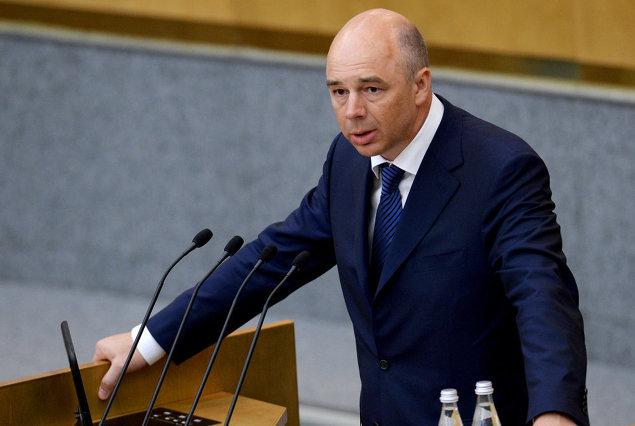
Finance Minister Anton Siluanov
Finance Minister Anton Siluanov made the announcement Thursday morning at the annual St. Petersburg International Economic Forum.
"We can make this change rather quickly, within a month," Siluanov told reporters Thursday.
He explained that the Kremlin is moving to reduce exposure to US assets as President Biden threatens more economic sanctions against Russia following the latest ransomware attacks. The transfer will affect $119 billion in liquid assets, Bloomberg reported, but the sales will largely be executed through the Russian Central bank and its massive reserves, limiting the market impact and reducing visibility on what exactly the sovereign wealth fund will be buying.
“The central bank can make these changes to the Wellbeing Fund without resorting to market operations,” said Sofya Donets, economist at Renaissance Capital in Moscow. “This in some sense a technical thing."Jordan Rochester, currency strategist at Nomura International PLC, said, “This is a transfer of euros from the central bank to the wealth fund, we’ll then see the central bank the holder of the USDs and it’s up to them to manage it. No initial market impact."
The news isn't a complete surprise: The Bank of Russia, Russia's central bank, has steadily reduced its dollar holdings over the last few years amid increasing sanctions pressure from the US and Europe. That trend continued through President Trump's term.
Just a few days ago, we reported that the Russian parliament had just authorized the sovereign wealth fund to buy gold through the central bank. However, the central bank reports its holdings with a six-month lag, making it impossible to determine its current holdings.
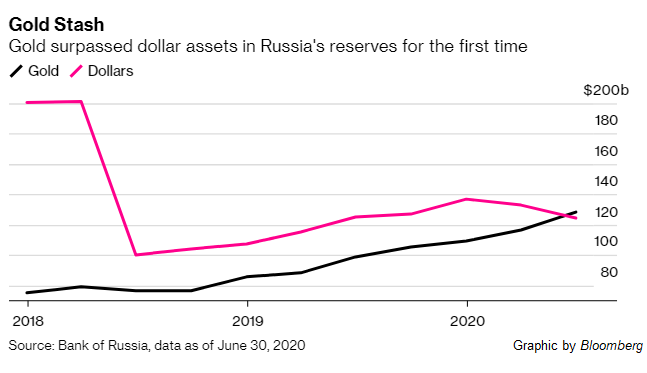
Russia’s gold holdings eclipsed its dollar reserves last year despite a halt in gold purchases. This was partly due to an increase in the value of its gold holdings with the rise in gold prices, and partly a function of the central bank’s continued efforts to shed dollar assets.
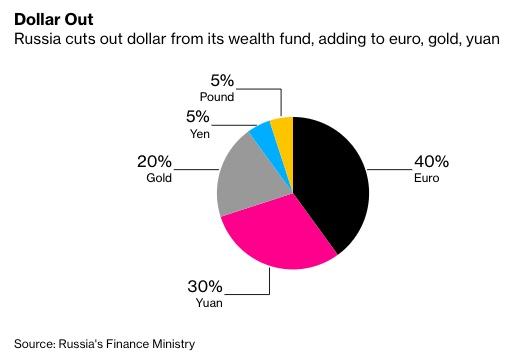
The wealth fund currently holds 35% of its liquid assets in dollars, worth about $41.5 billion, with the same amount in euros and the rest spread across yuan, gold, yen and pounds. After this latest change, the fund’s assets will be held 40% in euros, 30% in yuan, 20% in gold and 5% each in yen and pounds, Siluanov said.
Source: Bloomberg
The wealth fund holds savings from Russia’s oil revenues above a cutoff price and is used to help offset shortfalls when the market falls below that level. Together with illiquid assets, its total value is $185.9 billion.
A few years ago, Russian President Vladimir Putin warned that Washington was inadvertently accelerating de-dollarization with its aggressive financial sanctions, which were forcing its geopolitical adversaries to reduce their dependence on the greenback. Just last month, Russia reached a new milestone whereby fewer than 50% of its exports were paid for in dollars.
It appears that after years of steadily reducing its dependence on the dollar, Russia is about to intensify those efforts in a way that Washington will be forced to take notice.
G7 nations hope corporate tax accord will trigger global domino effect
EU countries are expected to quarrel over the allocation of taxing rights
Finance ministers from the Group of Seven industrial nations are hoping to agree the outlines of a deal on corporate taxation in London today, in a move they hope will add to momentum behind a broad global deal. We’ll unpack what a deal would enable, and what dominoes still need to fall before meaningful legislation can be set forth.
We’ll also explore the latest EU draft proposal for a carbon border tax, and particularly the contentious elements it conveniently leaves out.
And we’ll have a look at the growing Tea Party-like movement within the German Christian Democratic Union — and what that will mean for the post-Merkel era.
But before we get into any of that, a quick update on the no-nonsense European Public Prosecutor we wrote about here and here. Speaking to a group of Brussels-based journalists yesterday, Laura Kovesi said she is considering returning some of the €7m in extra funding her office has received, because she says it may not be used for hiring extra staff. “What am I going to spend it on, buying plants?” she asked.
The European Commission (which approved the extra funding) said it would review the request for extra staff in the coming months, once the caseload builds up.
This article is an onsite version of our Europe Express newsletter. Sign up here to get the newsletter sent straight to your inbox every weekday morning
A twist in the taxation tale
Finance ministers from the Group of Seven countries are tantalisingly close to forging a common position on corporate taxation, as they prepare for meetings in the UK today and Saturday, write Sam Fleming and Mehreen Khan in Brussels.
Such a move would represent an important step towards a long-elusive shake-up of global corporate taxation rules, with the goal of curbing the ability of multinational companies to exploit low-tax jurisdictions to scrunch down their tax liabilities.
But given the general excitement about the potential taxation shake-up, it’s worth examining a bit more closely what an accord at G7 level actually unlocks.
Such an understanding would, after all, encompass only a small (if influential) group of nations. How would this impact discussions at G20 level, and indeed talks among a far larger group of more than 100 nations under the auspices of the Paris-based OECD?
First of all, what is likely to be settled in the next day or so? If all goes well, G7 finance ministers will reach an understanding on two key fronts:
A new right should be created to tax the very largest multinationals’ profits based on where they make their sales (dubbed Pillar 1)
A global minimum corporate tax rate should be set at an effective rate of 15 per cent (so-called Pillar 2)
The G7 countries are betting that an understanding at their level would, given the involvement of key players including the US, Japan and Germany, generate political impetus among the G20 countries to adopt a similar position.
That said, the big powers need to tread delicately or risk appearing to railroad big trading partners among the G20 to fall into line.
When it comes to the Pillar 2 minimum rate, having major powers including the US on board creates its own natural momentum towards wider acceptance. If smaller countries (take Ireland, for instance) were to resist signing up to the 15 per cent rate, the US could simply top up the difference when it levies taxes on a given company under its own regime.
On Pillar 1, the OECD countries need to sign up politically to the principle and then all 139 members involved in the tax process need to ratify for it to take effect.
Enacting it within the EU is particularly complex. The European Commission has promised to propose binding legislation to enforce the measures within the bloc. Passage of laws on both Pillar 1 and Pillar 2 would require a unanimous decision among member states, however.
Pillar 1 is particularly contentious, because it would be seeking to arrange the allocation of taxing rights between EU countries. That could end up being hampered by individual member states as they haggle over the details.
But the uncertainty doesn’t only lie in the EU. There is no guarantee that the Biden administration will be able to push the necessary legislation through Congress. As a result, a number of European states are retaining the right to implement a digital tax in their own jurisdiction if matters get snarled on Capitol Hill.
The simple reality is that when it comes to international taxation, any big breakthrough tends to reveal a fresh set of hurdles just around the corner.
CBAM lacks ka-boom (for now)
Brussels’ has begun sketching out legal plans for how its novel carbon border adjustment will operate, but Europe’s big polluting industries are still left wondering how exactly it will protect them, writes Mehreen Khan in Brussels.
A leaked draft of the European Commission’s proposal for a Carbon Border Adjustment Mechanism (CBAM) confirms many of the things we already knew: the tool will be strictly limited to target a handful of imports such as steel, cement, power generation, and fertilisers. The system will require a complex and bureaucracy-heavy network of independent auditors to ensure foreign companies are accurately reporting the carbon footprint of said materials.
The CBAM is one of the most highly anticipated tools in the EU’s new green deal armoury. Trading partners like Russia and Ukraine are worried it will disproportionately target their companies, while the US is making noises about setting up its own version.
But this week’s leaked draft leaves out many of the crucial details that EU industries have been demanding. The tool has been hailed as a measure to protect European business from being undercut by foreign rivals who don’t have to abide by onerous emissions regulations or pay the EU’s domestic carbon price.
Crucially, groups such as the steel industry have demanded Brussels maintain the free carbon permits that many industries enjoy under the bloc’s emissions trading scheme. They argue that reducing these allowances to zero — as Brussels has said it will do — before the CBAM is set up will hit them with a doubly whammy of rising carbon prices and little protection from foreign competition.
Brussels’ draft doesn’t sketch out the relationship between the CBAM and how to manage free allowances. The text only refers to an undefined “transition” period whereby free credits are temporarily maintained. Separately, Europe Express has seen internal commission estimates which suggest Brussels is working towards a full phasing out by either 2030 or 2035.
The final decision will undoubtedly be subject to intense bargaining from Europe’s governments, which will need to decide how far to protect homegrown industries.