Paris Auction Highlights Galliano-Era Dior Designs


Cornette de Saint Cyr is offering for sale 500 items designed during John Galliano’s tenure at the French fashion house between 1996 and 2011.
Christian Dior Saddle bag, spring 2002.
François Benedetti/Courtesy of Cornette de Saint Cyr
BACK IN THE SADDLE: French auction house Cornette de Saint Cyr is offering for sale 500 items designed during John Galliano’s tenure at Dior between 1996 and 2011.
Close to 300 items come from the wardrobe of a Russian woman who acquired a trove of ready-to-wear and accessories, starting with Galliano’s debut collection for fall 1997. Aged 25 at the time the designer joined Dior, she bought into his most fashion-forward pieces, including logo-plastered swimwear from spring 2004.
Some 50 pieces come from a more mature client, who leaned toward tailored jackets inspired by the house’s iconic “Bar” suit.
Christian Dior Oblique-pattern jacket with floral embroideries, spring 2005. François Benedetti/Courtesy of Cornette de Saint Cyr
“The sale is very representative of the evolution of Galliano’s style at the house of Dior,” Hubert Felbacq, director of the luxury and vintage department at Cornette de Saint Cyr, told WWD.
Highlights including a black cheongsam-style evening dress from the first collection, valued at 600 to 1,000 euros, and a 2005 red belted python coat with an estimate of 5,000 to 6,000 euros, which originally cost 35,000 euros. Prices begin at 100 euros for items like shoes, cashmere twin sets and jewelry.
Felbacq expects strong interest in the earlier pieces, which are difficult to find. “The collections from 1997, 1998 and 1999 really form the basis for Galliano’s designs for Dior,” he noted.
Christian Dior evening dress, fall 1997. François Benedetti/Courtesy of Cornette de Saint Cyr
The sale comes 10 years after Galliano was abruptly fired from Dior for uttering anti-Semitic and racist insults during an altercation at a Paris café. Designs like his signature Saddle bags fell out of favor until 2015, when they started trending on the resale market. Dior relaunched the bag in 2018, reflecting its continued popularity.
The upcoming auction, to be held in Paris on June 7 at 2 p.m. CET, will feature around 100 handbags including the Lady Dior, Gaucho, Malice and Cadillac models. Four Saddle bags will be on offer, including a denim version embroidered with butterflies from 2004, Felbacq said.
The lots will be on display at Cornette de Saint Cyr’s headquarters at 6, Avenue Hoche from June 4 to 6 from 11 a.m. to 6 p.m.
Equal Measure: Corporate Directors Are Getting Younger, Slowly

Though the average age of board members at fashion and luxury companies hovers around 60, that's slowly changing.
In terms of corporate governance, experience trumps all, with the average age of board members at fashion and luxury companies hovering around 60 for nearly a decade.
But that’s slowly changing, for family-controlled firms grooming the next generation of leaders, and for brands keen to inject knowledge about the Millennial mind-set, new business models and the Chinese consumer, according to Ethics & Boards, a Paris-based firm that compiles data on corporate governance.
Younger directors are “digital native, they belong to brands’ target audience, and in terms of experience, most bring either knowledge of a pure player, or of a region,” said Floriane de Saint Pierre, cofounder of Ethics & Boards and the owner of an eponymous executive search and consulting business in Paris.
According to her latest tallies for the Ethics & Boards Luxury Index, which comprises the 40 most important listed companies in the sector, only seven have board members under 40.
What’s more, a quarter of companies on the index have no board members under age 50. “This will certainly become a point of attention for investors,” she predicted.
Among directors under age 40, the majority are still family members, “with an increasing trend of recruiting young talents since 2017, in particular with a digital or Asia Pacific profile,” de Saint Pierre said, highlighting a better balance between family and independent directors today than a few years ago. Thirty percent of directors under 40 are independent today, versus 16.7 percent in 2013, according to Ethics & Boards data.
Last month saw Lorenzo Bertelli, 33, appointed to the board of directors of Prada, Chiara Ferragni, 34, to Tod’s, and Alexandre Arnault, 29, to the supervisory board of Birkenstock.
L’Oréal and Brunello Cucinelli each have two family members under 40 on their boards: Jean-Victor Meyers, 35, and Nicolas Meyers, 33; and Carolina Cuccinelli, 30, and Camilla Cucinelli, 38.
Among prominent independent directors under 40 appointed since 2017 are “Harry Potter” actress and activist Emma Watson at Kering; Chinese economist Keyu Jin at Richemont; Rent the Runway chief executive officer Jennifer Hyman at The Estée Lauder Cos.; Stephanie Phair, Farfetch’s chief customer officer at Moncler, and Instagram executive Eva Chen at Net-a-porter Group.
Keju Jin, Stephanie Phair and Emma Watson. Courtesy Photo
In fact, the percentage of directors under age 40 has actually shrunk from 3.4 percent in 2013 to 2.2 percent this year, partly because some have already moved into the 40 to 50 age bracket since being appointed, de Saint Pierre noted.
Ethics & Boards tracks data worldwide, but because it is based in France, it is against the law to track data on race or ethnicity.
“Usually, age is not the first priority in terms of diversity efforts, and it comes after gender, race or ethnicity,” said Frédéric Godart, associate professor of organizational behavior at French business school INSEAD. “The first and foremost reason is that although age is widely recognized as being an important diversity factor, it has not received as much media attention and social movement mobilization as other factors, and as such it is not as prominent on the sociopolitical agenda.”
According to Randall Peterson, a professor at the London Business School and academic director of its Leadership Institute, diversity on boards varies across industries.
“The data we have is really clear that retail boards are where you have more women, you have more non-white representation, and where you have some younger people,” he said. “It much more reflects the customer base.”
Peterson said various studies in the U.K. have shown that boards in retail look more like the general population in terms of gender and race compared with any other business sector.
“What those data tell us broadly is that women are better represented across the board generally compared to 20 years ago — the average is about 30 percent, particularly in retail where it is approaching 50/50,” he said. “And race/ethnicity diversity is significantly lower in retail compared to the population at large, but outside of retail, non-white representation is extremely low — i.e., in the low-single digits.”
Peterson’s research confirms that age figures low on the list of priorities for board diversity.
“We’ve asked this question repeatedly,” he said in an interview. “Not surprisingly, gender is at the top, followed by race being high, but not as high as gender. Functional diversity is the next one, typically. And then you get into things like age.” Criteria considered even lower in terms of importance is socioeconomic status, regional representation and LGBTQ, he noted.
An exception is the Canadian province of Québec, where age is a priority. De Saint Pierre noted that Québec passed a law in 2016 that state-owned companies must have at least one board member under 35 years old.
There’s a host of other “diversity shortfalls” on corporate boards, according to Godart.
“For example, what about social classes? Subcultures? Neurodiversity? There are many others,” he said. “It is, of course, a challenge for corporations to tackle all these diversity dimensions at once, but in the end it needs to be done for ethical reasons, and has all kinds of benefits backed up by research. This is even more important for fashion, luxury and beauty companies that rely on creativity for survival because creativity is one of the well-known outcomes of diversity.”
However, most companies don’t understand “intersectionality,” or the interconnected nature of social categorizations such as race, socioeconomic status, and gender, and therefore tend to compartmentalize criteria, said Peterson, who is nearing completion of a study of boards of the FTSE 350, commissioned by the Financial Reporting Council. That research suggests companies that recently appointed women to their boards were of high socioeconomic status, and typically replaced men of low socioeconomic status.
“Do we replace one group with another when we do this?” Peterson asked. “So we appoint a young person — great. But that young person is very much like the rest of the board.”
So whose responsibility is it to ensure board diversity across multiple criteria?
“It is the responsibility of key stakeholders to ensure board diversity: the main shareholders, the board, itself, key executives,” Godart said. “Even if they don’t have formal authority, they can influence to promote diversity.”
Historically, boards of directors have been stacked with people nearing or past retirement age.
“There’s a lot of talk about the importance of having age diversity, but almost no action on it. And the reason is because we think of board positions as a natural progression from senior management,” Peterson explained. “You have a bird’s-eye view as a very senior manager and therefore it makes sense to go on boards where you have purview over the whole thing, and you’ve got to make decisions that are relevant to that. In order to have that kind of experience, you will have had to work for a while, which means you’re of a certain age. So isn’t overt hostility to somebody young, it’s just that we want business experience, and that takes time.”
Some findings of the FTSE 350 study are coming into view.
“The why of diversity comes down to either different points of view that help us see problems in different ways, or diversity should reflect who we serve as a customer,” Peterson said. “Marketing through social media, as opposed to traditional advertising channels — it’s hard to wrap your head around if you’re of a certain age. Young people, of course, haven’t known it any other way.
“Digital used to be the nice thing on the side — a bit of extra money if you’re selling online. These days, everything is affected by it and these people think that way,” he added.
On the downside, young people might not know the realities of a large organization, especially “how slow things can move, how embedded cultures can be,” Peterson said, also noting that the intricacies of “big finance” might take some time to grasp.
While joining boards has been considered more of a late-stage career move, de Saint Pierre argued there is no barrier in terms of qualifications “as most of these board members under 40 are already extremely successful in running a company, or in the C-suite, when they join a board. The most important criteria is just to make sure they have enough time in their busy executive life to dedicate to a board.”
Peterson said he recommends companies conduct a “skills audit” to determine board eligibility.
“The point of the skills audit is not about looking for skills that women or minorities might specifically have. But when you list the skill sets needed around the table you then look to recruit by focusing on skills, not experiences,” he said, noting that work experience-related evaluations tend to favor those in the majority and those in power. “If we recruit by skills then we need to explore with the candidates what they have done to build those skills. Here women and minorities in particular have had to improvise when organizations have not been willing to give them certain roles.”
According to INSEAD’s Godart, it isn’t enough for companies to rely on just young employees to stay relevant.
“After all, Millennial or Gen Z marketing managers could do the job of connecting with younger generations,” he said. “But remaining relevant requires making key strategic decisions that are made by the board only, and by no one else. So the generational shift needs to happen at the top as well as throughout the organization, for strategic reasons. Investors or external stakeholders may put pressure for more generational diversity.”
What’s more, Godart added, “Millennials offer a broad take on major cultural shifts that are happening globally, such as a focus on sustainability. All the above can help drive strategic changes at the level of the whole company.”
François-Henri Pinault, chairman and CEO of Kering, confirms that observation.
“Emma Watson’s contribution to the work of the board over the past year has been very significant, especially in the scope of the sustainability committee which she chairs,” Pinault told WWD. “She helped accelerate a number of concrete key initiatives around sustainable fashion and gender equality within the group, and her nomination, alongside that of Jean Liu and Tidjane Thiam, has been an important step toward achieving the ambitious goals we have set ourselves.”
US wields $2bn tariff threat against 6 nations over digital taxes
UK among targets of possible 25% levy on perfumes, clothes, jewellery and video games
The US has threatened to slap tariffs on $2bn worth of goods from the UK and five other countries as they argue about how to tax tech companies, a move that risks reigniting transatlantic trade wars unless parties resolve thorny talks over a broader international tax agreement.
The office of the US trade representative said it was imposing but immediately suspending for six months the tariffs on Austria, India, Italy, Spain, Turkey and the UK as it wrapped up a series of probes over the way the countries tax US tech giants.
The announcement comes as wealthy countries are deadlocked over an update to the international tax regime. The Biden administration has proposed giving advanced economies powers to raise corporate tax from US tech companies and other large multinationals, while instituting a global minimum corporate tax.
Governments introducing “digital services” levies have argued that tech companies pay too little tax on the profits they make in many countries, partly because they record them in low-tax jurisdictions such as Ireland. Washington has said the taxes are unfair because they disproportionately affect US companies.
Katherine Tai, the US trade representative, said the six-month suspension of the tariffs would allow more time for international tax talks to continue, but it would allow the US to maintain “the option of imposing tariffs . . . if warranted in the future”.
The Biden administration in April offered a fresh proposal to overhaul the international tax system in an attempt to break the impasse in the tax talks being held at the OECD.
The US proposal would apply taxes to the global profits of the very largest companies, including big US technology groups, regardless of their physical presence in a given country. It also sought a minimum global corporate tax rate of 21 per cent, although the US has recently said it would accept a 15 per cent minimum.
The UK would be worst-hit by the new tariffs if an agreement to dissolve them is not reached, with British exports to the US worth $887m per year saddled with levies of 25 per cent. The goods to be targeted include perfumes, make-up, clothes, jewellery and video games.
The US has already suspended tariffs of 25 per cent on $1.3bn worth of French handbags and cosmetics, having at first threatened to hit champagne and cheeses with import tariffs of 100 per cent.
Elliott Management Holds Big Dropbox Stake
Activist hedge fund is largest shareholder in software company after CEO Drew Houston
Elliott has told Dropbox it is the company’s largest shareholder after Chief Executive Officer Drew Houston, the people said. That suggests the hedge fund owns a stake of more than 10%, worth well over $800 million. The two sides have been in talks since earlier this year.
Dropbox, a cloud-computing company with a market value of roughly $11 billion, went public in March 2018 and has been trading below its IPO price for most of that time. Its modest valuation compared with those of other cloud companies such as Salesforce.com Inc. and ServiceNow Inc. has made it the subject of persistent takeover speculation.
That chatter intensified after Salesforce agreed to buy Slack Technologies Inc. last year for $27.7 billion. Other cloud companies have also gotten scooped up recently, including Cloudera Inc., which agreed to sell itself to a pair of private-equity firms earlier this week. Activist Carl Icahn is a big Cloudera shareholder.
Dropbox’s primary offering is cloud-based storage, which allows users to store documents, photos and videos online. The company also has an offering that allows teams to edit centralized documents. It also owns DocSend, purchased in March, and HelloSign, which facilitates digital signatures.
Dropbox reported revenue of $1.9 billion last year, an increase of 15%, and has more than 700 million registered users. In May, the company said its first-quarter revenue rose 12% from the previous year. It also announced a new $1 billion share repurchase authorization in the first quarter.
Investors have questioned the company’s growth prospects as services it provides become commoditized and it does less business with lucrative corporate customers than many of its peers. Dropbox laid off around 11% of its workforce in January, not long after the company told employees most of them could work remotely indefinitely.
Mr. Houston, who founded Dropbox with Arash Ferdowsi in 2007, holds majority voting control. The company’s next-largest shareholder is Vanguard Group, with a roughly 9.7% stake, according to FactSet.
Activists have historically steered clear of companies with powerful founders given that their work usually depends on being able to build a coalition of shareholder support. But Elliott has broken that mold with past investments in Twitter Inc., SoftBank Group Corp. and various iterations of computer-and-storage giant Dell Technologies Inc., all of which featured founders with significant stakes and were relatively friendly investments.
Elliott, with more than $40 billion under management, is one of the busiest activist investors. It also has a private-equity arm, Evergreen Coast Capital, that sometimes bids on companies that are targets of the firm’s activist campaigns.
Dropbox attracts activist interest from Elliott as shares languish
Hedge fund takes large stake in cloud storage group that missed out on tech rally
Elliott Management has amassed a more than 10 per cent stake in Dropbox, making the activist hedge fund the largest institutional shareholder in the cloud storage group.
The New York-based hedge fund is in talks with Dropbox and has informed the company that its stake is larger than Vanguard’s 9.9 per cent holding, said a person familiar with the matter.
Elliott declined to comment on how it intends to use its large shareholding to influence the direction of the company.
Dropbox shot to prominence earlier this decade as its cloud storage service solved a problem for consumers and workers who wanted to access their music or files from multiple devices. It quickly faced a competitive challenge, as all the big cloud computing companies came to see storage as a core part of their expanding services.
Attempts to counter that by adding new applications built on top of its cloud storage floundered and user and revenue growth has slowed sharply, with Wall Street expecting revenue to rise about 10 per cent this year.
That has left Dropbox on the sidelines as cloud software and services companies boomed during the pandemic, leading to a doubling in the Bessemer cloud index — of which Dropbox is a part — since the start of last year.
Shares in Dropbox, however, have mostly traded below the price of its initial public offering in 2018.
Dropbox employs a dual-class structure that gives founders 10 votes per share and typically acts as a deterrent to activist investors. But Elliott has not shied away from companies with powerful founders.
The $42bn hedge fund last year built a $2.5bn stake in SoftBank, seeking to tame Masayoshi Son’s sprawling technology conglomerate, despite his owning a 25 per cent stake.
Activist investors, which acquire stakes in companies and agitate for change, have re-emerged from a quiet 2020 when many feared a public backlash if they targeted companies struggling from the pandemic.
Cloud service companies that have failed to capitalise on the work-from-home trend spawned by the coronavirus pandemic have become an obvious target for activists.
Starboard Value is pushing for changes at Dropbox rival Box, where it owns an 8 per cent stake and has called for new directors to join the board.
Elliott’s stake in Dropbox was first reported by the Wall Street Journal.
Step Aside AMC: Here Are The Most Shorted Stocks Right Now
Four months after the Reddit crew sparked a historic market-wide short squeeze across a handful of small and mid-cap companies, which knocked out some of the most respected hedge funds in the world with Melvin Capital requiring a multi-billion bailout from Ken Griffin and Steve Cohen, the squeeze is back sending heavily shorted names like AMC, whose short interest we pointed out last week was off the charts...
... and which has exploded higher, a squeeze which has now shifted over to names such as Bed Bath and Beyond and various other small and mid-cap names.
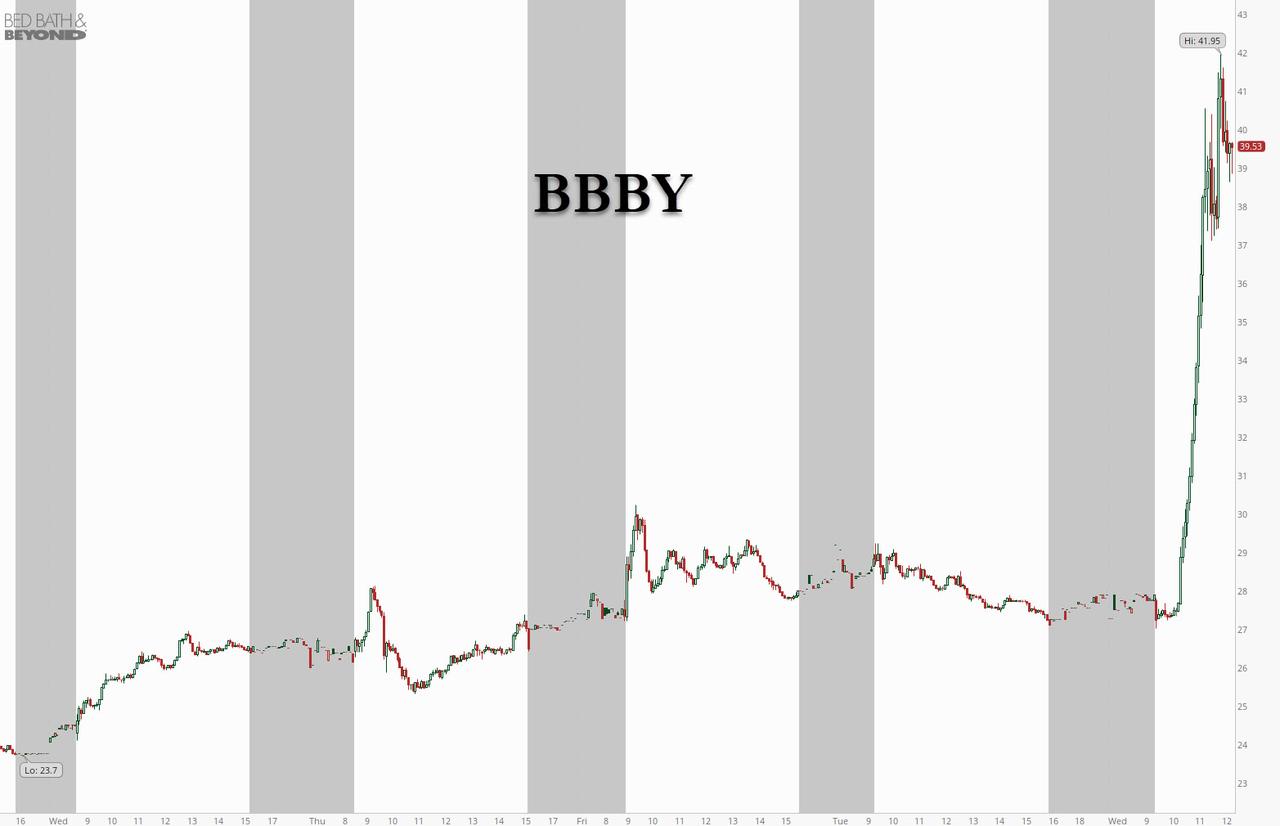
Of course, there is no mystery what's behind this: just like in late January when the meme squeeze phenomenon first emerged, the common theme here is that all these stocks are extremely heavily shorted, and retail investors are seeking to squeeze the shorts once again and thus time with even more stimmy power.
To be sure, one look at the chart of the most heavily shorted names shows what's going on.

So, just like in late January, we have compiled a list of the most heavily shorted names. It may come as a surprise to some that the former leaders here, GME and AMC are not even in the top 30.
So which companies are? Below we have screened for the most shorted Russell 2000 names (based on SI as a % of float), and which we will use to constitute our latest and greatest short basket.
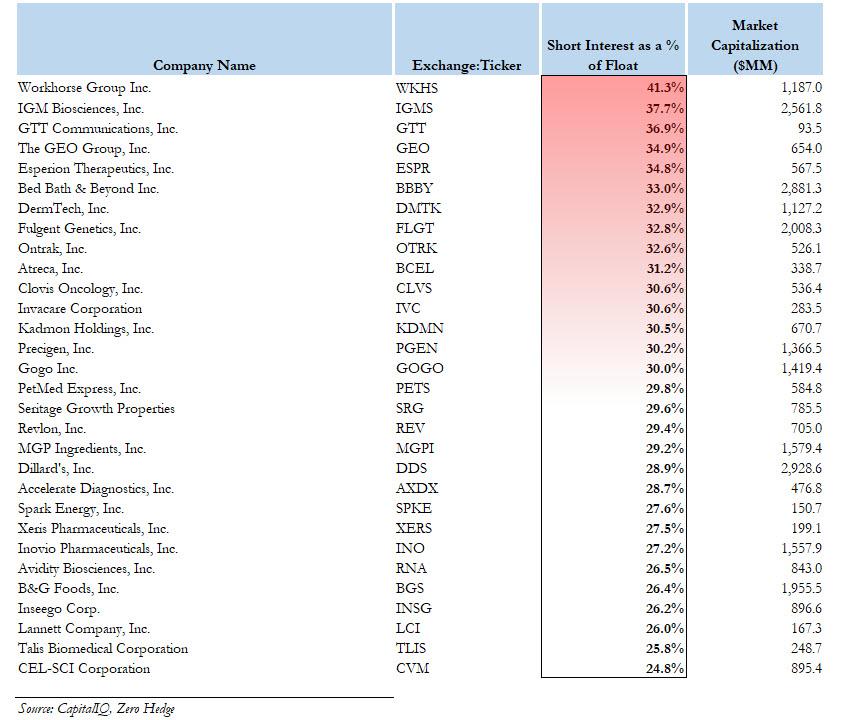
If the performance of our previous most shorted index is any indication, going long a market cap-weighted basket of these names - and especially the smaller, less liquid ones - could turn out to be the trade of the year, if not a lifetime.

Israel Spots Probable Link Between Pfizer Vaccine, Myocarditis

According to Reuters, Israel's Health Ministry released a statement Tuesday describing how Pfizer Inc. and BioNTech SE's COVID-19 vaccine could be linked to dozens of heart inflammation cases, mainly observed in younger men.
So far, the vaccine has been administered to 5 million people in the country and could soon be expanded to teens as young as 12-15 years old.

The ministry's findings found 275 cases of myocarditis between December 2020 and May 2021, including 148 cases within a month after the first vaccination. Of these, 27 cases after the first dose and 121 after the second. Half of the people had previous medical conditions.
According to the findings, most patients who experienced heart inflammation spent less than four days in the hospital, and 95% of the cases were classified as mild.
The study found "there is a probable link between receiving the second dose (of Pfizer) vaccine and the appearance of myocarditis among men aged 16 to 30."
Pfizer said in a statement that it had reviewed the Israeli observations of myocarditis, noting that no link to its vaccine has been confirmed.
"A careful assessment of the reports is ongoing and it has not been concluded," Pfizer said. "Adverse events, including myocarditis and pericarditis, are being regularly and thoroughly reviewed by the companies as well as by regulatory authorities."
Meanwhile, Nachman Ash, Israel's pandemic-response coordinator, told local radio station Radio 103 FM, "the health committee gave the green light for vaccinating 12- to 15-year-olds, and this will be possible as of next week."
An advisory group with the U.S. Centers for Disease Control and Prevention recommended last month further examination into the possible link between myocarditis and mRNA vaccines.
The handful of myocarditis cases seem to outweigh the positives as more than 55% of Israel's population has already been vaccinated.
While the country continues a vaccination spree, what's not being widely spoken about is a new study that suggests natural immunity to the virus could last a lifetime.