(ZH) The Importance Of Equity Duration

The Importance Of Equity Duration

We have seen much commentary that if US 10y yields go back to 2.5% or 3.0%, then equity markets suffer. We prefer a different way to looking at the problem. The key is what inflation is doing alongside any move in nominal yields. The below chart shows the % of the US yield curve trading below inflation. We highlight in green the periods when more than 50% of the yield curve is trading below inflation (as is the case today).
Source: Bloomberg, Macrobond and Variant Perception
Typically, negative real yields are very stimulative for equities. It is only when most of the yield curve is trading above inflation (white bars in right chart above) that equity markets start to face persistent headwinds.
Equity investors do need to worry about rising yields in terms of sector rotation. Duration is a basic concept for fixed income investors, but for equity investors, it is a less common method to look at portfolio exposures.
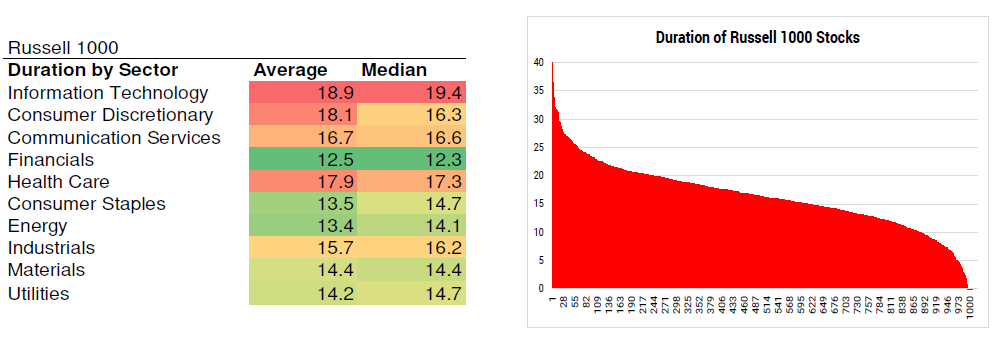
We have built a duration calculator for equities, using a combination of a 15-year DCF (consensus earnings forecasts, 2% terminal growth rate, individual cost of equity) and a terminal value duration component. This allows us to see which equities are most sensitive to a move in yields.
For the stocks in the Russell 1000, we calculate the duration of each name and aggregate to find the duration for different sectors. Financials, energy and consumer staples look like relative safe-havens. Info tech, healthcare and consumer discretionaries have the highest durations and are more vulnerable to yield moves.
Source: Bloomberg, Macrobond and Variant Perception

>>> (US) Weekend Papers Summary

(US) Weekend Papers Summary
NEW YORK TIMES
Saturday
• Employers added hundreds of thousands of jobs last month as vaccinations spread and businesses reopened, but the labor market’s recovery from the pandemic is choppy, and hopes for a surge in hiring have turned out to be optimistic.
• + FB: The social site, which has banned Donald Trump until at least January 2023, when he will be eligible for reinstatement, will look to experts to decide “whether the risk to public safety has receded” before it allows him back on the platform.
• In the last weeks of the Trump administration and continuing under President Biden, the Justice Department fought a secret legal battle to obtain the email logs of four New York Times reporters in a hunt for their sources.
• The US is grappling with a rapidly evolving threat from Iranian proxies in Iraq after militia forces specialized in operating more sophisticated weaponry, including armed drones, have hit some of the most sensitive American targets.
• Authoritarian governments, from large ones such as China to small ones such as Belarus, are increasingly reaching beyond their borders to intimidate, kidnap, and kill troublesome émigrés and other dissidents who speak out.
• Very few adolescents have become ill enough with Covid-19 to be hospitalized, but of those who did, about one-third were admitted to intensive care units, and five percent required ventilators, according to CDC data.
• With fresh data showing employers added jobs at a decent pace in May, Biden said his administration would not try to extend enhanced unemployment benefits that Republicans have criticized as a key factor in fueling a labor shortage.
• The Biden administration is sounding increasingly urgent alarms about high-profile ransomware attacks against US companies and infrastructure, prompting FBI director Christopher Wray to compare the problem to global terrorism.
Sunday
• The relationship between American businesses and their employees is changing as workers gain more leverage for the first time in a generation, and the trend, which began before the pandemic, could persist for years.
• In Donald Trump’s final weeks in office, Mark Meadows, his chief of staff, repeatedly pushed the Justice Department to investigate unfounded conspiracy theories about the 2020 election, according to uncovered emails provided to Congress.
• President Biden is doubling down on an Obama-era strategy of committing hundreds of millions of dollars to Central America to make the region more tolerable for the poor and discourage them from seeking to come to the US.
• + BIIB: If the FDA on Monday approves aducanumab, which aims to slow the progression of memory and thinking problems in the early stages of Alzheimer’s disease, analysts predict it would be come a blockbuster and bring a huge windfall to Biogen.
• Cases involving 48 people from the Canadian province of New Brunswick who have been struck with a mix of symptoms including insomnia, impaired motor function, and hallucinations have baffled medical experts around the world.
• G7 officials reached a breakthrough on Saturday in their yearslong efforts to overhaul international tax laws, backing a new global minimum tax rate of at least 15 percent regardless of where companies locate their headquarters.

WALL STREET JOURNAL
• Across the US, more than 800 utility-scale solar projects are under contract to generate nearly 70,000 megawatts of new capacity, but they face opposition for a range of reasons, including keeping land unspoiled and for their effect on endangered species.
• “Friday’s jobs report keeps the Federal Reserve on track to begin informal internal discussions about reducing the pace of its large bond-buying programs, though a concrete plan for winding down the purchases isn’t imminent.”
• Record-high prices have many owners of starter homes reluctant to trade up to a bigger and/or better home because they can’t afford to upgrade, creating a shortage of homes for sale at lower prices.
• Senate Republican Shelley Moore Capito, who is leading efforts to reach a compromise on infrastructure legislation, proposed a $50B spending increase from the latest GOP offer, a step Biden said still fell short of he wants to reach an agreement.
• + C, JPM: The banks said they will resume campaign donations from their political-action committee, but split on the question about whether they would donate money to Republican lawmakers who voted to challenge the results of the 2020 election.
• The Biden administration is moving to restore protections for endangered animals and plants that were loosened under Donald Trump, a move that had triggered lawsuits from environmental groups.
• Thousands of people in Hong Kong defied a huge police presence and threats of jail to commemorate the 1989 Tiananmen Square massacre, maintaining an annual vigil that has become a symbol of opposition to China’s crackdown on freedoms.
• Hedge fund mogul Bill Ackman’s deal for Universal Music through PSTH involves the use of a novel vehicle called a special-purpose acquisition rights company, which gives shareholders the right to buy into a deal when one is presented.
• Experts aren’t sure when, if ever, we’ll have truly autonomous vehicles that can drive anywhere without help, says columnist Christopher Mims, and they could be at least decades away despite investments that already surpass $80B in various startups.
• Entrepreneurs who create Bitcoin have long flourished in China despite problems with the government, but a recent warning of a crackdown could threaten their future and send some crypto miners to the West.
• H.O.T.S: Robinhood and SoFi are the latest startups to try to get small investors into IPOs, but sharing the benefits of early access widely isn’t always easy; Many more babies in China is a long shot, but healthcare demand isn’t going anywhere but up; Jobs are hard to fill and wages are rising, but other factors will persuade the Fed to hold off on raising interest rates for now.

FINANCIAL TIMES
Weekend
• In the push by large global economies to tax multinational profits, one issue that remains to be settled is whether a minimum tax would be exactly 15 percent, as the US proposes, or at least 15 percent, as other countries want.
• Large Japanese sponsors of the Tokyo Olympics are calling for it to be postponed so that more spectators can attend as vaccination rates around the world increase, with some companies worried about the value of their marketing spends on the event.
• US infectious disease expert Anthony Fauci is calling on China to release the medical records of nine people whose illnesses might provide vital clues into whether Covid-19 first emerged as the result of a laboratory leak.
• Brussels is calling for a rapid increase in global coronavirus vaccine production, saying it’s a better way to fight the pandemic than by relaxing patent access, as the US is calling for.
• Big Read piece says “The online attack on JBS, the world’s largest meat processor, was the latest example of the relentless rise of ransomware, but it remains nuclear whether the US will put pressure on Russia to hold the hackers involved to account.
• Lex Column: Olympic sponsors must hope that their lossmaking investment in the Japanese games will not also have a negative impact on their brands; The abundance of cheap debt, a booming stock market, and a glut of SPACs have made it hard to find big targets—but Bill Ackman’s PSTH has found a way around that; Venture capitalists cannot seem to get enough of grocery apps.

NEW YORK POST
Saturday
• + SQ: As Bitcoin and other cryptocurrencies gain popularity, many companies have emerged to serve a growing need to protect these assets from online theft, prompting Square’s announcement it might create a non-custodial hardware wallet for the digital currency.
Sunday
• Columnist Charles Gasparino says there are plenty of investors who aren’t convinced that green investing is anything more than a politically induced fad that will never make money, and wouldn’t get financing were it not for government grants.

FT : Anglo American coal spin-off may be worthless, says short seller

Anglo American coal spin-off may be worthless, says short seller
Thungela Resources has much higher clean-up costs than forecast, claims Boatman Capital Research

Mining company Anglo American has “massively underestimated” the environmental liabilities associated with a South African coal business that it is spinning off, according to short seller Boatman Capital Research.

This means that Thungela Resources, shares of which are due to start trading in London and Johannesburg on Monday, may be worthless.

Boatman, which has also waged a long-running campaign against engineer Babcock International, claimed in a report published on Sunday that the clean-up costs for Thungela’s seven mines could be as much as $1.36bn, or nearly three times the amount of money it has currently set aside, because of proposed regulations.

“Given that Thungela’s mines have remaining lifespans of 5-11 years (assuming no extensions), this is now a pressing issue for the company and its shareholders,” said the report, setting an equity value of zero.

Major miners are under pressure from investors to divest from coal because of its contribution to climate change. Thermal coal is burnt in power stations to generate electricity, a process that is responsible for about 30 per cent of global carbon dioxide emissions. 

Rio Tinto sold its last coal mine in 2018, while BHP is also looking to divest its thermal coal business. 

The demerger will allow Anglo to focus on producing metals that will be in demand during the shift towards clean energy such as copper and platinum.

It will also test the appetite of London-based investors for coal mining stocks. In a report published last week, the company’s corporate broker Liberum said Thungela could command a market value of $440m to $950m.

Anglo hit back at the claims made by Boatman, saying the $480m clean-up provision on Thungela’s balance sheet was “over and above” the regulatory guidance for miners in South Africa.

It also said provisioning for environmental liabilities based on draft regulation did not accurately “reflect the actual or likely sums needed to discharge such liabilities”.

 “It is precisely because these sums are considered to be artificial, and arbitrarily inflated, that the draft has remained under review since 2015. This is an industry-wide matter in South Africa, so the regulations on which the Boatman report apparently draws its conclusion are far from being finalised,” the company said.

Thungela, which means to “ignite” in isiZulu, is one of South Africa’s largest thermal coal exporters. Under the demerger, investors will receive one Thungela share for every 10 Anglo American shares that they hold.

The demerger of Thungela follows a sharp increase in South African thermal coal prices, which have risen 25 per cent to $113 a tonne this year.

Anglo is providing a $180m capital injection to Thungela, which will start its first day of trading with no debt. It has also agreed to provide “contingent capital support” until the end of 2022 if thermal coal prices fall below a certain threshold.

Analysts reckon the most likely buyers of the stock will be value-based income funds. Thungela’s stated dividend policy is to pay out a minimum of 30 per cent of operating free cash flow to shareholders.

“We anticipate that the company may be able to pay some dividends initially thanks to Anglo’s price support and dowry, but we believe beyond that point the dividends will be unsustainable and the true value of the company will become obvious,” said Boatman.

FT : Volkswagen nears €10m settlement from former chief Martin Winterkorn

Volkswagen nears €10m settlement from former chief Martin Winterkorn
Carmaker will recommend shareholders accept deal after it sought damages from Dieselgate-era boss

Volkswagen will recommend that its shareholders accept a settlement of approximately €10m from former boss Martin Winterkorn, according to people familiar with the matter.

The German carmaker announced in March that it would seek damages from Winterkorn, who was in charge of the group in the lead-up to the diesel emissions scandal in 2015.

The affair, in which 11m vehicles were found to be fitted with software that duped emissions tests, has cost VW more than €32bn in fines and legal fees to date.

Volkswagen’s decision to sue Winterkorn, who resigned as chief executive soon after the scandal came to light, came after a comprehensive report on Dieselgate by law firm Gleiss Lutz was delivered this year.

The report, commissioned by VW’s supervisory board, concluded that “negligent breaches of duty had occurred” in the company’s top ranks.

The world’s second-largest carmaker by volume subsequently accused Winterkorn of having had knowledge of the existence of unlawful software from 27 July 2015 but failed to “clarify the circumstances” of its use.

Additionally, VW said the former boss had “failed to ensure that the questions asked by the US authorities in this context were answered truthfully, completely and without delay”.

VW’s supervisory board also concluded that Rupert Stadler, the former Audi boss, breached his duties of care, as did four other managers. Stadler denies wrongdoing.

Winterkorn has rejected allegations of wrongdoing. Lawyers acting on his behalf said in March that in the run-up to Dieselgate, “he did everything necessary and omitted nothing that would have . . . prevented or minimised the damage caused”.

Over the weekend, settlement deals with all of those accused in March were discussed at a VW supervisory board meeting and the proposals will be put to shareholders next month, at the company’s annual general meeting.

The €10m figure for the settlement with Winterkorn was first reported by Business Insider. VW confirmed the supervisory board’s decisions but declined to comment on the precise figures of any settlement. 

Winterkorn is facing separate fraud charges and is due to stand trial in Germany this September. He has also been charged in the US but is unlikely to be tried there as Germany does not extradite its citizens. He denies the charges.

Stadler is currently being tried in Munich, in a case that is set to continue for several months.

At its meeting, VW’s board also voted to recommend an extension to the tenure of Hans Dieter Pötsch, who took over as the company’s chair soon after the scandal in 2015.

Last year, VW agreed to pay €9m in fines to close a case in which Pötsch, and current chief executive Herbert Diess, who joined VW in July 2015, were themselves accused of market manipulation in the run-up to the Dieselgate scandal.

German prosecutors had charged the duo for allegedly withholding information from shareholders on the existence of cheat devices, thus “unlawfully influencing the company’s share price”.

VW’s stock plunged more than 40 per cent after the scandal came to light, wiping billions of euros from its market value.

The company said the accusations against Pötsch and Diess were unfounded.

FT : Chip shortage to last until at least mid-2022, warns manufacturer

Chip shortage to last until at least mid-2022, warns manufacturer
Forecast from Singapore-based Flex comes as scarcity forces carmakers to scale back production

The global chip shortage disrupting the car industry and threatening the supply of consumer technology products will last for at least another year, one of the world’s largest electronics contract manufacturers has warned.

The forecast from Flex, the world’s third-biggest such manufacturer, is one of the gloomiest yet for a crisis that is forcing car and consumer electronics groups to re-examine their global supply chains.

A rapid rebound in vehicle sales combined with a lockdown-driven boom in games consoles, laptops and televisions has left the world’s chipmakers overwhelmed by the sharp increase in demand.

Singapore-based Flex has more than 100 sites in 30 countries and manufactures devices and electronics for companies including Ford, British household appliances designer Dyson, UK online grocer Ocado and US computer and printer maker HP. Its position in the supply chain makes it a large buyer of chips.

Lynn Torrel, Flex’s chief procurement and supply chain officer, said that the manufacturers it relies on for semiconductors have pushed back their forecasts for when the shortage will end.

“With such strong demand, the expectation is mid to late-2022 depending on the commodity. Some are expecting [shortages to continue] into 2023,” she said.

The forecast from Flex, which sits at the heart of the supply chains for the car, medical devices and consumer electronics industries, follows a bruising six months during which shortages have forced car companies to scale back production and furlough staff.

The issue has led many companies to adopt a more assertive approach to sourcing, such as by paying for chips in advance. Tesla, the US electric-car maker, has explored buying a chip plant outright.

Electronics manufacturers in Asia have also recently warned that the chip shortage was beginning to spread to TVs, smartphones and home appliances, with the situation made worse through stockpiling by Chinese groups hit by sanctions.

Pandemic-related problems with supply chains have been compounded by the blocking of the Suez Canal in March, the extreme cold weather in Texas, and a recent fire at a large chip factory in Japan.

Revathi Advaithi, chief executive of Flex, said that the disruption wrought by the pandemic is prompting its multinational customers to take a far more serious look at restructuring their supply chains than the trade war between the US and China ever did. This could include making them more regional, she added.

“Most companies won’t make a decision to regionalise just on tariffs,” she said. “They know it could be a short-term thing but things like the pandemic and escalation of shipping costs that impact the total cost of ownership drives regionalisation.”

New York-listed Flex, which recorded $24.2bn in revenues last year and has manufacturing facilities evenly split between Europe, Asia and the Americas, has been forced to interrupt production for a wide range of electronics products.

Chipmakers are investing in new production capacity but it can take up to two years to set up the complex facilities.

Torrel said the picture could improve if Covid-19 vaccinations cause consumer spending to shift towards services and people spend less money on consumer electronics as the world recovers from the pandemic.

However, she cautioned that seemingly small problems — such as a recent two-week lockdown in Malaysia, where many semiconductor suppliers are based — can have an outsized effect on supply chains already under pressure.

FT : Dubai Reit faces fight ahead of Islamic bond restructuring vote

Dubai Reit faces fight ahead of Islamic bond restructuring vote
Shareholder resistance to restructuring plans marks a rare case of investor activism in the Gulf

A group of international lenders is battling for greater transparency and governance changes at a major Dubai real estate investment trust ahead of a crunch vote on its restructuring plans on Monday, marking a rare case of investor activism in the Gulf.

Emirates REIT, the largest sharia-compliant Reit in the United Arab Emirates, faces resistance from a group of debtholders as it seeks to restructure a $400m Islamic bond, or sukuk, maturing in December 2022. A $10.2m payment is due later this month.

The dispute poses another challenge for the Gulf’s commercial hub as the UAE seeks to clear its reputation in the wake of several financial scandals, including the collapse of UK-listed, Abu Dhabi-based hospital operator NMC and the Dubai-based emerging markets private equity firm Abraaj.

Emirates REIT has described the restructuring as “a straightforward and voluntary amend and extend transaction . . . designed with the interests of sukuk holders in mind”. The vehicle, which is listed on Nasdaq Dubai, has said it is confident of securing the consent of the 75 per cent of bondholders required by June 7.

But a group of investors, referring to themselves as the “Ad Hoc Group”, is calling for better governance at the Reit’s manager, Equitativa, as one condition for agreeing to the restructuring. Equitativa is owned by Sylvain Vieujot and his wife, Magali Mouquet, who are chief executive and executive director of Emirates REIT, respectively.

Members of Ad Hoc include international asset managers such as Scotland’s Aberdeen Standard Investments and Vontobel of Switzerland, people familiar with the group said. Both of those asset managers declined to comment.

The group, which says its members hold 40 per cent of the debt, is calling for the manager to reduce what they argue are “excessive” management fees and to offer investors a better financial package for the restructuring.

“The Ad Hoc group is disappointed with the character and business ethics of a company that refuses to engage with meaningful debt stakeholders who are expressing legitimate concerns, demanding transparency and improvement of governance,” said a representative. “The group reserves its options in the event its grievances are not addressed.”

In response, a spokesperson for Equitativa said the Reit has a “robust corporate governance framework,” with five separate boards and numerous independent directors, and that its fees were “in line with industry peers”.

The company, advised by Houlihan Lokey, added its restructuring proposal is fair. It would replace the existing unsecured sukuk with a new instrument maturing in 2024, backed by property valued at $280m.

Last year a group of shareholders, separate to the bondholders, wrote to the Reit’s regulator to raise concerns whether it was overvaluing its portfolio to boost fees.

The Dubai Financial Services Authority told the Financial Times it would take appropriate action if it found any evidence of wrongdoing, but declined to comment on any active investigations.

Emirates REIT, which denied the shareholders’ claims that it was overvaluing, last month said it would reduce its management fees by 20 per cent this year after a new valuation team marked down the value of its portfolio by 19 per cent to $690m at the end of 2020, from $855m in the third quarter of last year. The company attributed the decline to coronavirus’ impact on Dubai’s property sector.

The opposing bondholders, advised by Rothschild, have called for Emirates Reit to disclose these external valuation reports as they argue that the reduction is unlikely to be solely driven by Covid-19.

In the wake of the restructuring proposal, Fitch downgraded Emirates Reit to its lowest rating before a default, but the rating agency said it had enough liquidity to meet the June coupon payment.

However a representative of the bondholder group said it believes, based on cash flow forecasts, that the company may be unable to meet a December payment. Equitativa said it is comfortable with its liquidity position.

Wired : The Safest Way to Store and Share Your Nudes

The Safest Way to Store and Share Your Nudes
Listen, if you’re going to take them, follow these precautions so they don’t go anywhere you don’t intend them to.


LAST WEEK, GOOGLE announced a handy new upcoming feature for Google Photos: the ability to hide your sexy photos in a Locked Folder where friends can’t accidentally swipe to it. OK, sure, Google didn’t come right out and say that’s what it’s for, but we all know it’s not for photos of your secret dog. However, a hidden folder is only one part of a balanced privacy diet. Here’s how to be safe from start to finish if you decide to take and share photos of yourself.

Before we get started, a disclaimer: The surest way to ensure that nude photos of you never end up somewhere you didn't intend is to not take nude photos. Just like the surest way to avoid pregnancy or STIs is to never have sex. But it's important to recognize that abstinence-only education is incomplete. So, while remembering that not taking nude photos is an option (and no one should ever pressure you to take compromising photos of yourself), this guide will focus on how to stay safe without resorting to digital abstinence.

Make Sure You Trust the Recipient
As with any intimate act, sharing nude photos or videos of yourself requires trust. It’s a good idea, before you even take the pictures, to know whether the person you’re sending them to might share them with someone else or keep them longer than you agree to, or whether they can be trusted to delete them if you ask.

Unfortunately, figuring out how to trust another person is a bit too complicated for a guide like this, but here are a few red flags that might indicate it’s better to hold off:

  • You’ve only known them for a short time. Hormones can make anyone seem better, safer, and more exciting than they actually are. If you just met someone and you don’t yet know a whole lot about them, it’s never a bad idea to wait.
  • They’re pressuring you to do things you’re uncomfortable with. If you’re not comfortable taking photos of yourself, and your partner's response is, “C’mon baby, I need to see you!” that’s a big red flag that they don’t respect your boundaries.
  • Your personal or professional reputation would be harmed if the photos got out. Depending on the industry or community you work in, it might not be much of a scandal if photos of you got out. In fact, some communities exist to support people voluntarily sharing their photos with strangers. However, you are never required to be part of that group. If you think your work, family, or friends could be affected, it might be safer to skip the sharing, even if you trust your partner.

No matter what, remember the number one rule: You should always be able to say no. Not just to taking or sharing the photos initially, but anything that comes after. If you don’t want a partner to share your images, post them online, or store them somewhere unsafe, or if you want them to delete the photos at any time, you should be able to ask for that. If someone tries to take that option away from you, they’re not respecting your consent and they might not be a good person to share sensitive images with.

Crop Out or Hide Identifying Features (and Data)
It’s entirely possible, even with a partner you trust, for photos of you to get out. Your phone or your partner’s phone could get hacked, a wayward gallery app could be left open, or someone who used to be trustworthy could break that trust. Regardless of the circumstances, one key way to minimize harm if that happens is to make sure the pictures you take have as little identifying information in them as possible.

This can include cropping photos to cut out faces or identifiable parts of the background. If you crop out your face but there’s an artwork on the wall that your family knows is yours, the picture could still be traced to you. Blurring or censoring tattoos is a good idea (your phone usually has tools you can use to draw over images), but also keep in mind that the location of tattoos itself can be used to identify you.

Also, don’t forget to remove identifying data. If your phone’s camera automatically adds location data to your photos, turn that off. Photos also come with a ton of other embedded information called EXIF data. Stripping that information from your photos before sharing them will help ensure that no one else can figure out when, where, and how a photo was taken.

Turn Off Cloud Backups, and Store Photos Privately
Once you take photos, you’ll want to keep tabs on where they end up. This can be tough if your phone is backing them up to your desktop, tablet, and the cloud before you’re even done taking them. To avoid this, you have two options: Either turn off cloud backups or use a different app that doesn’t automatically back up photos. For example, while Snapchat has its own cloud backup features, taking photos with Snapchat won’t automatically back up to Google Photos. So you could take normal photos with your regular camera app, but take more risqué photos using Snapchat and save them locally just to your phone.

This is also where features like Google’s Locked Folder or Apple’s Hidden albums come in handy. Google’s version will only keep a copy of anything in the Locked Folder on your phone, which prevents it from accidentally showing up elsewhere. While Apple still allows iCloud to sync files that are in a Hidden album, those files will stay hidden on all the devices they’re synced to.

If your phone or device doesn’t already have a feature to hide photos, you can still keep them stored safely on your own. A password-protected folder on your device or even external storage like an SD card or USB drive can be a safe place to store photos once you’re done editing and sharing them.

Use Secure Messaging Apps (Read: Not Facebook) to Send Photos
Once your nudes leave your phone, it’s no longer entirely in your control who sees them. Any server where they’re temporarily (or permanently) stored could be a potential place where photos get leaked or stolen. One of the best ways to avoid that problem is to use encrypted messaging apps like Signal or Telegram.

These apps encrypt any messages or photos you send between devices, so even if someone snooped on your data as it's traveling to its destination, they wouldn’t be able to see what it is. Only the device sending the data and the device receiving can see the photos. Both apps also allow you to create self-destructing messages that will delete themselves after a certain amount of time.

Of course, it’s important to remember that if someone can see it, they can copy it. Encrypted messaging is good for making sure some third-party doesn’t find your photos, but even with messages that self-destruct, it’s always possible for the person you share with to take screenshots, take photos of their screen with another camera, or save copies that can still leak long after you think the message is gone. Once again, make sure you trust the person you’re sharing with before you send those pictures.

Lock Your Phone and Set Up Remote Tools
For all our focus on hackers trying to steal compromising photos from a mainframe, ultimately one of the biggest threats to your privacy can come from inside your own home. A nosy family member, a curious child, or a houseguest with boundary issues could all end up picking up your phone, thumbing through your gallery, and seeing something not meant for their eyes.

To prevent this, it’s a good idea to set up security on your phone. (Actually, that’s a good idea regardless.) At the very least, make sure your phone is protected by a PIN. Most modern phones have either fingerprint or facial ID that can even more securely lock your phone. A family member could look over your shoulder and memorize your PIN, but they can’t memorize your fingerprint. This extra layer of protection will help keep prying eyes away, and it might even be required for some security features, such as Google’s new Locked Folder.

Also be sure to set up remote tools to locate and lock your phone. Both Apple and Google have built-in features that let you find a lost phone with GPS, lock it remotely, and even erase the phone if you really need to make sure no one can get at the files stored on it. Ideally, you won’t need this feature 99 percent of the time (especially just for regular nude-sharing). But the one time you need it because you think someone took your phone and might get access to your photos, you’ll be glad you had it.


Daily Best : Everybody is always trying to find the right island beyond Santorin

Everybody is always trying to find the right island beyond Santorini or Mykonos that will make them seem like more than tacky tourist—Sifnos is it.

Every year countless thousands of us sit down in front of our computers and frantically try to figure out which Greek island to go to. Just going to Santorini and Mykonos would seem too basic—or we’ve already been and want to feel like we’re going somewhere a traveler and not a mere tourist would go.

In May, with Greece open and few tourists likely until June, I wanted to see those Santorini sunsets without the crush of tourists. Something about all the Instagrammers I saw at Sarakiniko on Milos made it less appealing, and while Folegandros seemed like a good fit, the person I was traveling with had already been. Paros and Naxos looked cool, but something just wasn’t right for me.

So, I took the advice of a Greek friend and opted for an island that had everything I wanted—charm, natural beauty, great food, and just enough difficulty to weed out mass tourism.

The island of Sifnos.

Sifnos has no airport, so it’s by boat that you’ll get to this mid-sized Cycladic island. The port of entry is Kamares, a lovely harbor with a long stretch of beach and a mountain rising behind it. It’s made up of delightful white buildings with blue shutters, a number of which you can sit at and order a frappe coffee, the Greek-style iced coffee that was trending on Tik Tok early in the pandemic because it’s made with instant coffee. (I’m more of a double espresso guy so I was a little skeptical, especially because of the sugar, but I loved it, especially after the three-hour ferry from Santorini.)

You arrive at Kamares, the port village, where you will be greeted with sight of the lovely harbor. A car on this little island is a must, and there are many rental services at the port to make it easy. Generally speaking, I know nothing about cars, but I would advise getting a car with good clearance off the road. The Honda Civic we rented was clearly not the best choice (it was the only automatic car they had available). There are a lot of rough little roads to get to different beaches and pretty spots on the island. In addition to knowing next to nothing about cars, I also have a terrible sense of direction, but everything is about 25 minutes from the port and navigating the island is straightforward.

In addition to finding the ideal island, don’t we all also crave that iconic Greek stay with dramatic views of the Mediterranean (the Mama Mia fantasy). And on Sifnos I found what is unequivocally my favorite AirBnB I’ve rented—ever.

Villa Fengaria is a little paradise set at the edge of the island down a bumpy road (extra reminder about that car selection!). The host is Ella, a half-French half-Greek woman who designed the whole estate. It’s very much a mix between a south of France summer house and the traditional Greek white house. (From July through August, Ella told me, Parisians occupy every little corner of the island.)

The sweeping views that transformed every night at sunset into a polychromatic sky followed by exceptionally bright stars with almost no light pollution except from the island miles away meant I felt no need to leave to go out to dinner. Instead I preferred cooking a simple meal with ingredients from the market nearby. After an amazing but touristy stay in Santorini, this semi-remote villa on Sifnos was refreshing.

But if I turned into a homebody, that did not mean there was nothing to do on Sifnos.

Beautiful white stucco churches with blue domes are not rare on Greek islands, but the Chapel of the Seven Martyrs on Sifnos is special. It’s perched on an islet jutting out from Kastro, the island's ancient capital. Unsurprisingly, with the blue of the Mediterranean contrasting with the white chapel in such a dramatic setting, it’s the most photographed spot in Sifnos.

But the best part about this place is not the chapel but the cliff by its side where you can swim and jump. It was only when we got there and saw a group of teenage girls and boys on top of the rocks that we realized we could go in. We didn’t have our suits, but, luckily this was Europe so nobody was shocked by us going in in briefs.

It was like a scene out of a film—a group of teenage girls and boys lounging on the rocks daring each other to jump in the clear water.

One of Sifnos’ more iconic beaches is Vroulidia—one of those classic Mediterranean spots that’s tucked in a cove and surrounded by cliffs. However, if you are a fan of sandy beaches, this one is not for you as it’s also a classic Mediterranean pebble beach.

Vroulidia is supposedly accessible by car, but this really wasn't the case for us considering, again, the car we rented. So we parked a 20-minute walk away. Usually this wouldn't be a problem for me, but I had the less-than-brilliant idea to wear leather sandals, a nightmare for this rocky steep walk. But I got very lucky: a car stopped and offered to bring us down.

The two Frenchmen who gave us a lift were renting a villa nearby and were surprised to hear that we were trying to get to this beach. We soon realized why: The two taverns where you might normally rent sandals and parasols were completely closed! Wooden piers that are usually there to ease the access to the water were also removed. The beach was completely deserted (except for the two men who helped us). A little disappointed, we ended up finding a concrete dock on the side of the creek perfect to lay on and jump off into the water. I imagine that once tourism returns full time, the amenities will also come back. While my sartorial choices were poorly planned, I did manage to pack bread, cheese, and water (a godsend, because the walk back to the car was even more brutal).

Out of the few times we went out for lunch, my favorite was Taverna Chrisopigi. It's right by the beach of Apokofto, a small but sandy beach with crystal clear water. I always worry when restaurants have great views because I fear they're selling scenery more than food. But at Taverna Chrisopigi, everything—the seafood, the lamb, fried tomatoes, and stuffed eggplant—was fantastic.

Before you get on your ferry to return to Athens, or another island, take a final swim at Faros Beach right by the port. If you want to make the moment last into your ferry ride, grab a gyro on one of the terraces to take with you.

COVID-related info: We entered Greece in the first week that all its internal restrictions were lifted. Getting in was easy with the vaccination card and test taken less than 72 hours before arriving. One thing to keep in mind, however, is that depending on the place you are connecting you might need a test that was taken 48 hours before arriving at that airport (like Munich), though more direct flights are opening up later this summer.

NY Post : Bill Gates, Warren Buffett building nuclear reactor in coal-rich Wyomi

Bill Gates, Warren Buffett building nuclear reactor in coal-rich Wyoming

Billionaire buddies Bill Gates and Warren Buffett are teaming up to build a nuclear reactor — on the site of a coal plant that’s being phased out in Wyoming.

Nuclear reactor design company TerraPower, which Gates founded about 15 years ago, and power company PacifiCorp, which is owned by Buffett’s Berkshire Hathaway, are partners on the Natrium nuclear reactor pilot project, the companies said.

The Department of Energy is also involved in the project through funding and a cooperative agreement.

TerraPower claims its Natrium reactor, which was designed in partnership with GE Hitachi Nuclear Energy, is more fuel-efficient, cost-effective and safer than traditional nuclear reactors, Gates said by video earlier this week at a news conference in the state capital, Cheyenne.

“We think Natrium will be a game-changer for the energy industry,” said Gates, who’s going through a high-profile divorce. He appeared to be wearing his wedding ring in the video.

“Wyoming has been a leader in energy for over a century and we hope our investment in Natrium will help Wyoming to stay in the lead for many decades to come,” he added.

But some scientists have expressed concern that there’s little evidence that advanced nuclear reactors are safer than traditional ones.

A recent report from the Union of Concerned Scientists noted that the supply chain for advanced reactors could be a target for terrorists looking to create a crude nuclear weapon. “In fact, certain alternative reactor designs pose even more safety, proliferation, and environmental risks than the current fleet,” the report states.

The specialized storage technology of the Natrium system can boost its output to the amount of energy required to power about 400,000 homes, TerraPower said.

“Together with PacifiCorp, we’re creating the energy grid of the future where advanced nuclear technologies provide good-paying jobs and clean energy for years to come,” TerraPower’s CEO Chris Levesque said. “The Natrium technology was designed to solve a challenge utilities face as they work to enhance grid reliability and stability while meeting decarbonization and emissions-reduction goals.”


Levesque added that the project will take about seven years to build.

Wyoming Gov. Mark Gordon said the project will create hundreds of jobs in the state. He added that an exact location for the project will be announced by the end of the year.