(ZH) "We Took Out The June 2007 Highs": Morgan Stanley's Sell Signal Just Hit An

"We Took Out The June 2007 Highs": Morgan Stanley's Sell Signal Just Hit An All Time High

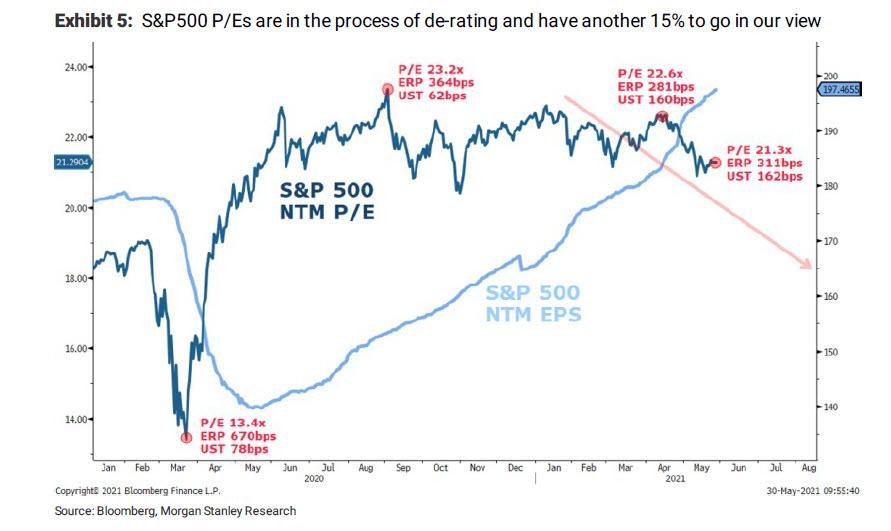
For the past several months, Morgan Stanley's fundamental analysts have been turning increasingly bearish on stocks, with the pessimistic sentiment plateauing earlier this week when chief equity strategist Michael Wilson said that there is far too much optimism in the market, and that while earnings are slowly rising, forward PE multiples are far too high and are set to slide, with "the de-rating about 75% to go or an approximate 15% decline in P/Es from here." As a result, in Wilson's view - which is rapidly emerging as the most bearish on Wall Street - "earnings revisions will not be able to offset that de-rating, leaving the overall market vulnerable to a 10-15 % correction over the next 6 months."
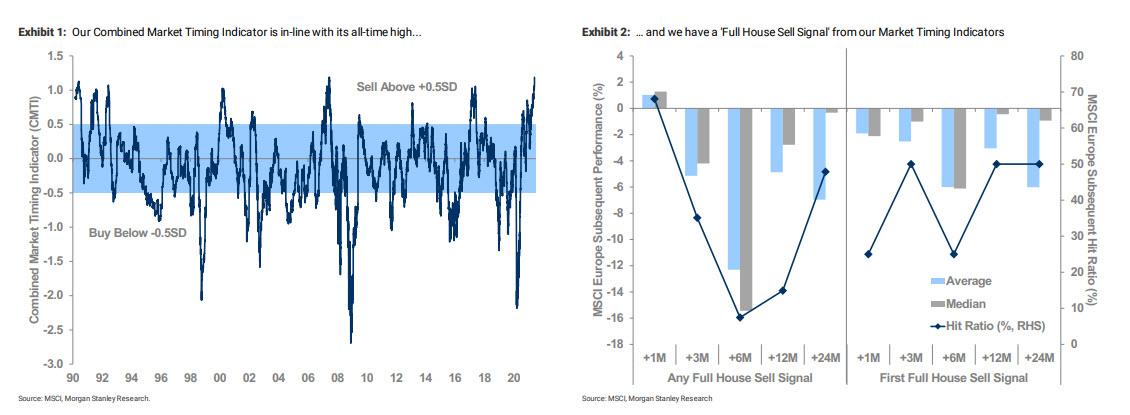
It now appears that Morgan Stanley's fundamental bearishness has spilled over into the bank's technical analyst team and as the bank's chief Euro equity Strategist Matthew Garman writes, for only the fifth time in over 30 years, each of Morgan Stanley's five market timing indicators are giving a sell signal at the same time.
Not only that, but the bank's Combined Market Timing Indicator - which has been in sell territory since March - just hit a new all time high of 1.19, surpassing the previous record high seen in June-2007, right around the time of the first great quant crash and before the market collapsed.
According to Garman, the only time equities have risen after a "Full House" Sell Signal was in Feb 17, shortly after the Shanghai Accord kicked in to prevent a global recession. The other previous occasions where there was a "Full House" Sell Signal were Mar-90, May-92, Jun-07. According to MS, "in the 6M post the initial Full House Sell Signal, MSCI Europe has fallen on average 6%."
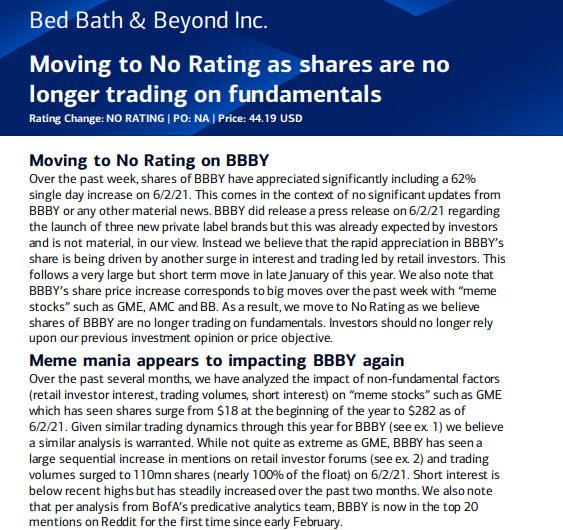
So with every in house risk indicator screaming sell, does that mean that Morgan Stanley will have the balls to tell its clients to sell? Why of course not, because in this market where stuff like the AMC, GameStop and Bed Bath squeezes force analysts to admit they no longer have any idea what's going on...
... Morgan Stanley is keeping the hope and assuming that the current period will be similar to 2017 - the only other time when a massive sell signal did not result in a market plunge.
Back in 2017, we remained constructive despite the signal given i) strong EPS growth, ii) an early cycle environment, iii) EU inflows, iv) low sentiment and v) a rise in M&A. Sentiment metrics may look more elevated than in 2017, but many of those factors remain in place today. While we see a trickier risk-reward for equities globally, we maintain our view that there is a compelling case for Europe to outperform global peers.
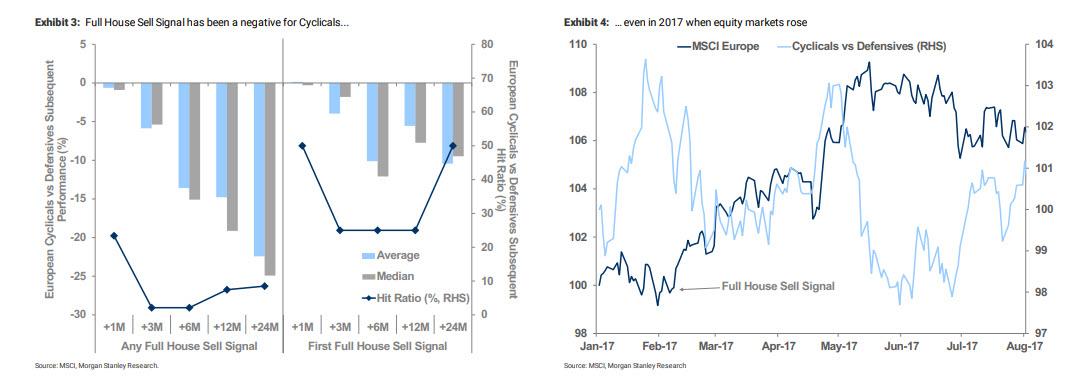
Yet even Morgan Stanley is forced to admit that while Defensives may just scrape by after a record sell signal, cyclicals are about to be hammered. The next chart shows the relative performance of Cyclicals versus Defensives after a Full House Sell Signal on. As MS notes, "perhaps unsurprisingly, given the poor performance at the market level, Cyclicals have struggled. In the 6M post the four initial Full House Sell Signals, Cyclicals have underperformed Defensives on average 12%, and this drops to -15% looking at any day
when the MTIs have all said sell at the same time."
This was true even in 2017 when equity markets rose: "we previously cited similarities with the 2017 Full House Sell Signal as reasons to not get overly cautious on equity markets in aggregate at this moment in time. After the February-2017 Full House Sell Signal, MSCI Europe continued to rise pretty consistently through the rest of the year. However, despite strong performance from the market in aggregate, the performance of Cyclicals versus Defensives was much poorer. Between February and June 2017 Cyclicals underperformed Defensives by 6%."
It's not just the bank's sell signal that is prompting concerns about the future returns of cyclicals: Borrowing a page from our own warnings (see "China's Credit Impulse Just Turned Negative, Unleashing Global Deflationary Shockwave"), Morgan Stanley looks at "a number of China data points which are giving warning signs" first and foremost the collapse in China's credit impulse, to wit:
While credit tightening has been front-loaded in 1H21, as outlined here, our economists remain constructive on China's growth recovery. Having said that, a number of Chinese data points do suggest the Cyclical bounce looks overextended. China's credit impulse has just turned negative, and historically this has provided a lead indicator for the year-on-year performance of European Cyclicals (Exhibit 5). Similarly, the relative performance of Cyclicals versus Defensives has closely tracked moves in Chinese 10Y bond yields, which are now at their lowest levels since September 2020, standing in sharp contrast to the performance of Cyclicals.
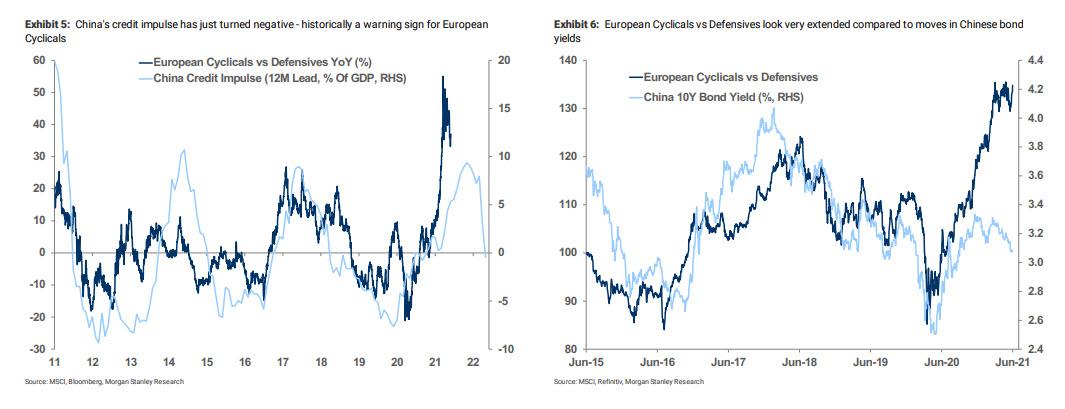
Putting it all together, readers have to ask themselves if what is coming will be an analog of the one and only episode on history when the market did not plunge after all Morgan Stanley market timing indicators hit a sell (and were at an all time high), or will this case be similar to Mar-90, May-92, Jun-07 when the outcome was anything but a happy ending.

>>> Barron’s Weekend Summary

Barron’s Weekend Summary: cover story on casino industry

* Cover story: Casino industry is rebounding amid the reopening and a surge in leisure travelers. But Las Vegas casinos still have some hurdles ahead of them, including labor shortages and the slower recovery in corporate travel. (MGM, WYNN, LVS)

* Tech Trader: Cautious on ZM. Zoom has had an incredible last four quarters as one of the most obvious work from home plays. But as the pandemic wanes growth will likely slow, and now Zoom needs a 'second act' to leverage its vastly expanded user base.

* Features: 1) Positive on PTC; Barrons sees more upside as the company seeks to dominate the Internet of Things. 2) Positive on EAT: the casual-dining company appears to be a buying opportunity, with the stock lagging other hospitality names in the recovery.

* European Trader: BP's pivot to renewable energy has big potential and sizable risks. A stock buyback could help lift shares over the next 12 months and the short term bullish story will be helped by rising oil prices.

* Banks: positive on PNFC, PNC, ABTX, banks that operate in regions with booming growth.

FT : UK readies contingency plans to delay June 21 easing

UK readies contingency plans to delay June 21 easing
Surge testing in Reading and Wokingham as Delta variant case numbers rise across UK

Civil servants are drawing up contingency plans to delay the June 21 easing of England’s lockdown restrictions, as the UK reported another large rise in coronavirus cases on Friday and surge testing for the Delta variant was launched in parts of Berkshire.

Pressure from scientists on prime minister Boris Johnson to leave some Covid-19 measures in place for England intensified with further evidence that the more contagious Delta variant originally detected in India was displacing the previously dominant Alpha (Kent) variant and pushing up infections fast.

On Saturday NHS Test and Trace began surge testing in Reading and Wokingham following identification of cases of the Delta variant first identified in India.

On Friday, 6,238 further cases of Covid-19 were reported, the most since March 15. Data from the Office for National Statistics showed that 85,600 people in England were infected in the week to May 29 — about one in every 640 — up from one in 1,120 people the week before.

A senior civil servant closely involved with coronavirus planning said officials were drawing up contingency plans to delay the fourth and final phase of easing, possibly to July 5, if the data suggested it was necessary. “A variety of options are being drawn up, including a delay to step four and trading off some measures against others.”

Another Whitehall insider said there was an increasing sense that a “smallish delay” may be likely. “Irreversibility is key to this. The prime minister doesn’t want to go backwards, so if it’s a choice of more measures in the future, I think he can stomach a minor delay,” they said.

But one senior Downing Street official cautioned “we’re not in that space yet” for a delay. “There’s still nothing in the data that shows we need to change our plans.” The official added that there would be more clarity in the data by the end of next week.

The Independent Sage group of scientists issued an “emergency statement” urging the government to rule out immediately plans to lift the last restrictions on June 21. Professor Christina Pagel, a mathematician at University College London, told the group’s weekly briefing: “We now have an exponentially increasing dominant variant that is more transmissible, more vaccine resistant and likely more severe than Alpha.”

But studies show full inoculation has been effective so far in reducing hospitalisation and deaths from the Delta strain.

Sir John Bell, Regius professor of medicine at the University of Oxford, told the Financial Times that the proportion of fully vaccinated people in the UK remained “too low” for him to feel “entirely comfortable” with a full unlocking on June 21, adding that it was sensible to wait for more data to become available before a final decision was made.

By June 3, half of the adult UK population had received both doses of a Covid-19 vaccine. According to Public Health England, both the Oxford/AstraZeneca and BioNTech/Pfizer vaccines are only 33 per cent effective against symptomatic disease after one dose, with efficacy rising steeply after the second dose.

“I think we need to go further . . . I’d be a lot more comfortable if we were closer to 70 per cent by June 21,” said Bell. “My sense is that if things look on the edge or are starting to get more serious then running it out for another two weeks would help manage that, while we get everybody vaccinated.”

However, he added his concerns were “tempered” by the fact that scientists had yet to identify “a truly vaccine resistant strain” and the number of hospital admissions was not gaining pace.

Hospital admissions dipped 2 per cent in the UK in the week to May 31. Deaths within 28 days of a positive Covid test fell by three to just 55 in the week to June 4.

Also on Friday, the UK Medicines and Healthcare products Regulatory Agency extended its approval for the Pfizer Covid vaccine to 12 to 15-year-olds, following a similar decision by the European Medicines Agency last week.

The Joint Committee on Vaccination and Immunisation will advise whether the government’s inoculation programme against Covid-19 will be extended to this age group. It is not clear when that will happen. Currently, in the UK, vaccination is not routinely offered to patients aged younger than 18.

WSJ : Jimmy Choo on How Covid Changed Fashion and Why He Thinks We Will Dress Up

Jimmy Choo on How Covid Changed Fashion and Why He Thinks We Will Dress Up Again
The legendary designer talks about his favorite ‘puppy’ shoes, which he created when he was 11, and why he is still working at age 72

Legendary designer Jimmy Choo parted ways with the company that bears his name two decades ago. But he continues to ply his craft, designing couture gowns, shoes and a new bridal collection. At the same time, he serves as a tourism ambassador for his native Malaysia and is launching a London fashion school to educate young designers.

Mr. Choo recently spoke with The Wall Street Journal about how Covid-19 changed the fashion industry, what motivates him to keep designing, and whether people will dress up again. The following are edited excerpts from the conversation.

WSJ: What has it been like showing your collections online instead of on a runway? Do you think the industry will revert to its old ways once the pandemic fades?

Mr. Choo: In the last year, we did one digital show. I believe, as Covid slowly dies down, we will go back to the fashion runways. People like to hear the music and see the models. In digital, the feel is different. I think the real shows will come back.

WSJ: The pandemic ushered in a shift to more casual dressing. Do people still want to dress up?

Mr. Choo: I’ve been in Malaysia for the past year. Here, we still dress up nicely. Otherwise life will be too boring. People like to go shopping and to wear nice things.

WSJ: Why did you start JCA London Fashion Academy? How is the school different from other fashion schools?

Mr. Choo: In college, I studied design. But we never learned about the business side of fashion or how to work with the factories. My father always said to me, you should pass on your skill. If you don’t pass it on it will be lost.

WSJ: What advice do you have for young designers?

Mr. Choo: They have to love what they’re doing. If they don’t love what they are doing, there is no point. You can’t say, ‘I want to be famous and make a lot of money.’ Also, if there is something you don’t know, you should ask people. If you keep quiet, you will never learn. My father taught me that.

WSJ: How did you get your start?

Mr. Choo: My father always told me, whenever you drink water, think about where the water comes from. My father was a shoe designer. My uncle, my mother also designed shoes. I come from a shoe family. My father didn’t say, ‘You must follow my footsteps.’ But I always say thanks to my mom and dad. If it wasn’t for them, I wouldn’t be here today.


The first pair of shoes Mr. Choo designed, at age 11, were for his mother. Mr. Choo called them ‘puppy’ shoes, because she called him Puppy.
PHOTO: AMANI AZLIN SHAH FOR THE WALL STREET JOURNAL
WSJ: What was your favorite shoe to design and what was the inspiration for it?

Mr. Choo: When I was 11, I designed a pair of shoes for my mom for her birthday. I called them “puppy” shoes, because my mom called me Puppy. That was her nickname for me when I was young. When I went to a friend’s house, my mom or dad would shout, ‘Puppy come home for dinner.’ I didn’t like it. I said, ‘Call me something else.’

WSJ: You sold your stake in Jimmy Choo, the footwear company that is now owned by Capri Holdings Ltd., in 2001. Why?

Mr. Choo: As a designer you work all the time. I never went home to see my children. I slept in the workshop. The next morning, I’d wash and start working again. It was time to spend more time with my family.

WSJ: But you still design shoes under your Chinese name, which is Zhou Yang Jie in the Mandarin dialect.

Mr. Choo: A lot of old friends come to me and say, ‘Can you make shoes for my daughter?’ Designing is never out of my heart. Until I am 90 or 100 years old, if I can pass on my knowledge, I will be very happy.

WSJ: You’ve been designing couture gowns for The Atelier Couture, where you have been design and creative director since 2017. Why are you launching a bridal collection now?

Mr. Choo: When I was in London doing my couture shows, I saw a lot of customers, who would ask me what type of shoe would fit their bridal outfit. So I made a lot of wedding shoes for wedding dresses. I said to myself, ‘One day I would love to design a wedding dress.’ My nephew and his whole family make bridal gowns by hand. We said, how about we work together? It’s all a family business. We all understand each other.

WSJ : Ackman’s Planned Universal Music Deal Includes His Grandfather’s Hit Song

Ackman’s Planned Universal Music Deal Includes His Grandfather’s Hit Song
Talks with Vivendi unit that began in November included the billionaire getting his family’s old record

Hedge-fund billionaire William Ackman’s deal for a stake in Universal Music Group wouldn’t be his family’s first brush with the music industry—though it could be more lucrative.

His grandfather, Herman Ackman, wrote a song in 1926 that he sold for $150 on Tin Pan Alley, the old-time New York City hub of publishers who dominated pop music. “Put Your Arms Where They Belong (For They Belong to Me)” turned out to be a hit, with more than 750,000 copies sold.

Mr. Ackman opened his first meeting with Universal management with the tale, according to people involved in the deal.

Executives at the largest music company in the world connected the dots to find that Universal, through acquisitions over the past century of music-business consolidation, owns Mr. Ackman’s grandfather’s recordings. While the companies were going back and forth on the mechanics of the potential special-purpose acquisition company deal, Universal executives tracked down two 78s of the song and the sheet music, then mounted and framed them as a gift to Mr. Ackman, according to the people.

If the transaction goes through, the bid by Mr. Ackman’s Pershing Square Tontine Holding Ltd. for 10% of Universal Music Group would mark a new high point in the industry’s resurgent growth, which has sparked interest from Wall Street investment and private-equity firms such as KKR & Co., to everyday investors like those who can buy shares in publicly traded music-investment company Hipgnosis Songs Fund Ltd.

Mr. Ackman’s potential deal would value Universal Music Group at about $40 billion, and could be inked in the next few weeks, people familiar with the matter said. Universal parent Vivendi SE said Friday that the transaction is subject to a shareholder vote later this month to distribute 60% of Universal’s shares and list the company in the Netherlands.

Universal is the uncontested dominant player in the record business, commanding some 40% market share in the U.S. and 30% globally.

Market share is key in the streaming economy, especially as it accounts for more than 80% of recorded-music revenue in the U.S. and more than 60% globally. Spotify and other services pay out revenue from subscriptions and advertising based on market share.

Universal’s artists are consistently topping the charts and among the top-streamed around the world. Nine of the top 10 recording artists of 2020—and slices of the 10th—are on Universal’s roster, according to the International Federation of the Phonographic Industry.

Still, some investors say that the highest-paying markets for music streaming are reaching a plateau in their growth and that the newer subscriptions are coming from markets with lower pricing power. Also, some industry executives say that certain music assets, such as song catalogs, are too highly valued and can’t provide high enough returns based on the multiples getting paid for them.

Over the past two years, artists, managers and music executives have seen a surge of financial players interested in music. They want to reap the benefits of a stable asset that has bucked economic downturns, including during the Covid-19 pandemic, and that promises to grow as the world comes online with streaming services like Spotify and Apple Music.

Vivendi held discussions with various private-equity firms and other potential investors interested in taking a piece of the company, according to one of the people. Mr. Ackman set himself apart, this person said, with his genuine interest in the business, connection with management and eye for growth.

“The total addressable market is every person on the planet,” said Mr. Ackman about Universal. “Every time a song gets played on Spotify, Apple, Peloton, YouTube, the artist gets paid, the songwriter gets paid and Universal gets paid.”

Mr. Ackman started discussing a potential combination with Universal and Vivendi in November after Jacqueline Reses, a Pershing Square Tontine director, introduced him to a member of Vivendi’s board, some of the people familiar with the matter said.

This week, Mr. Ackman flew to Paris, where he met Vincent Bolloré, the billionaire chairman of the supervisory board, and Vivendi CEO Arnaud de Puyfontaine, one of the people said. It was their first face-to-face get-together after months of Zoom meetings.

On Wednesday night, Mr. Ackman had dinner with Mr. Bolloré on the roof of Vivendi’s offices overlooking the Arc de Triomphe. By Thursday, Mr. Ackman was back in New York and they agreed on a deal via Zoom.

While streaming has room to grow as markets around the world increasingly come online, the music business is increasingly looking to new partners across social media, videogames and fitness for revenue opportunities.

Universal artists include some of the most-streamed in the business, such as Taylor Swift, Billie Eilish and Drake, and its publishing arm houses some of the world’s best-known songwriter catalogs, including Bob Dylan’s.

Mr. Ackman said he believes streaming is going to grow for a long time, and described Universal Chairman and Chief Executive Officer Lucian Grainge as an icon of the industry.

Consumers embraced streaming over the past five years, which has made it possible for music to be played everywhere--not just on a car radio or blaring from a CD player. It is in your ears while you exercise, cook and play videogames. Spotify and others upended the model of owning CDs or digital downloads, with consumers instead paying a monthly fee or listening to ads in exchange for access to essentially all of the music in the world.

FT : London’s private clubs dig deep after Covid storm

London’s private clubs dig deep after Covid storm
Reopening of The Conduit offers fresh hope as upmarket venues battle to lure back members

Nine months after Metro Bank seized control of The Conduit’s Mayfair venue over unpaid debt, the private members’ club is finalising renovations on a leased building at the heart of Covent Garden, due to open by August.

The club, a new entrant to London’s “club land” when it opened in 2018, teased back its 3,000 members this week with an online discussion on Chinese human rights, before fully opening its catering, meeting and work spaces to a clientele that has adopted a hybrid lifestyle split between the city and out-of-town homes.

The Covent Garden site will also feature a bookshop with more than 1,000 titles curated by The Conduit staff and “The Fix”, a space spread over two floors where members “take meetings and exchange ideas”.

The opening offers fresh hope after a ruinous period for London’s private members’ clubs, which have struggled with serial lockdowns and falling commuter numbers, as well as retention of foreign hospitality workers, including those from Europe who have been restricted by immigration rules imposed since Brexit.

In an email to its members last July, Chelsea Arts Club, a 130-year-old club aimed at creative people, said the crisis had already wrought “catastrophic damage” on its finances and asked members if they would give some “voluntary financial support”.

Of the 103 members clubs in London before the pandemic, seven, including The Conduit, have closed. Others include Soho members’ club Milk & Honey and The Hospital Club, rebranded “h Club”, which focused on catering to the music and entertainment sector, and also shut its sister venue in Los Angeles.

“My bet is that in the same way as human beings adapted extraordinarily well to the current circumstances, we’ll revert to a norm far quicker than you think. People are longing for community and want contact again,” said Paul van Zyl, co-founder of The Conduit, whose basic membership costs £1,800-a-year.

“We’ll be obsessive around hygiene, but community and proximity are more valuable than ever. There’s a real yearning,” he added.

Alongside The Conduit’s rebirth, there are other glimmers of hope in clubland. Pavilion, which operates three clubs in London, is planning to open a fourth venue in the coming weeks in Knightsbridge, while The Arts Club is expanding internationally with new openings planned in Los Angeles and Dubai before next year.

Many traditional clubs have survived by giving members a reason to continue paying an annual subscription while premises were shut. Even the most historic venues, often with older members, have embraced Zoom wine tastings, talks and home food deliveries.

Remy Lyse, chief operating officer of The Arts Club, Mayfair, said that during lockdown it had only lost about 3 per cent more members than in a normal year by offering online events. These ranged from breakfast talks, to virtual painting classes and a podcast for members.

Did it break even over this period? “Some weeks it did, some weeks it didn’t,” Lyse said.

The biggest challenge now for clubs located in and around St James’, Mayfair and Soho, an area renowned for its historic members’ institutions, will be the slow return to offices, lack of corporate events and international travel.

Even after hospitality venues were permitted to open indoors from May 17, footfall across London has remained at 28 per cent below 2019 levels.

Most venues expect a substantial return of commuters in September at the earliest, while international travel looks unlikely to resume significantly until fear of unknown variants entering the UK subsides.

The Army & Navy Club, a 184-year-old institution originally established for members of the armed forces, nicknamed “The Rag”, said 93 per cent of members had stayed loyal and agreed to pay their annual membership up front to give the club immediate access to funds.

Robin Bidgood, chief executive, said trading had been around a third of normal levels throughout the pandemic, with a small number of members using the club as a permanent residence and for essential business travel.

Corporate event bookings were beginning to resume, he added, with army regimental dinners confirmed from September.

Many older clubs with ageing memberships have noted the rapid expansion and popularity of Soho House, which has grown to roughly 30 outlets and 100,000 members from its original London base over the past 26 years.

During the pandemic, it invested heavily in an app for members and new offers such as its “Cities Without Houses” scheme, which offers access to online events, discounts and networking.

It is planning a New York listing that could be valued as high as £3bn, while new clubs in Austin, Tel Aviv and Rome are being prepared to open this year.

Bidgood said he has watched Soho House’s progress as the Army & Navy works to become “a go to place for that younger audience [rather than] that traditional element of clubs being old and stuffy with ancient people having a snooze under the newspaper”.

But, he warned, clubs must be careful not to become “five-star hotels with members” as the opportunity for clubs is to maintain a personal relationship with clients.

“There is always a financial angle but we are not driven by making plenty of clubs. Less is more for me,” said Lyse. “I’m sure things may work slightly differently but there is so much excitement that I think people will come back.

FT : Hedge fund stars shy away from the limelight

Hedge fund stars shy away from the limelight
Many of the biggest names in industry prefer to manage money without dealing with external investors

There are many things over which hedge fund traders have no control — choppy markets, retail investors plotting against them on Reddit and global pandemics to name but a few.

But it seems that having to deal with the often annoying and demanding outside investors who put money in their funds is one that, if they are rich and successful enough, they can avoid.

The recent decision by Alan Howard, the billionaire co-founder of Brevan Howard, to redeem external investors in the AH hedge fund he personally manages appears to do just that.

The fund has been highly successful. It reaped big gains from bets against Italian bonds in 2018, amid concerns that Italy would loosen ties with the EU and increase its debt pile, and again last year as market volatility soared during the early stages of the coronavirus pandemic.

After the move, Howard will continue to manage money, contributing to Brevan’s main $6.2bn Master fund and its Multi-Strategy fund. These funds allocate to a range of managers, of which Howard is just one, and are open to outside investors.

But, crucially, ejecting external investors from Howard’s own fund cuts out a lot of the extensive questions and reporting that can be required of a fund’s lead manager by exacting investors. Howard, whose fortune is estimated at £1.5bn according to the Sunday Times Rich List, has never been one for the limelight. Reducing this hassle has been one of the benefits of the move for Howard, say people familiar with his thinking.

All hedge fund managers “enjoy trading”, said one hedge fund industry insider. “No one enjoys the pain of investors asking a lot of questions.”

Brevan declined to comment.

The nuisance factor from investors has increased markedly since the financial crisis. Up until then, a fund manager’s reputation, the exclusivity of the fund and, of course, stellar performance had been key selling points to the wealthy individuals and family offices who poured money into the sector. If other reputable investors were backing a fund then that was often a good indicator that they had checked out the manager and it was probably safe to invest.

But all that changed with the discovery of Bernard Madoff’s $65bn Ponzi scheme in December 2008, in the depths of the financial crisis. Suddenly, the large institutional investors such as endowments and pension funds who were increasingly accounting for hedge funds’ investor bases wanted assurances that such a fraud could not happen again before they wrote the next large cheque.

The result has been a boom period for due-diligence practitioners and compliance staff, and the expenditure of a lot of extra time and money by hedge funds. Managers now have to sit through lengthy and rigorous operational due-diligence checks, as investors verify a fund’s trading processes, risk management frameworks, valuation methodologies, cyber security protection, disaster recovery etc etc. Some investors have specific requirements about the amount and frequency of information disclosed to them, as well as access to a fund’s lead manager. 

Institutional investors’ operational due diligence can consist of upwards of 250 questions, according to James Newman, co-head of perfORM Due Diligence Services.

“Adoption of technology has provided efficiencies in data collection, but you’re still talking about many hours of research over a six-to-10 week period typically before an institution can pull the trigger [on an investment],” he said.

The difficulty of meeting managers during the coronavirus pandemic, as well as rising cyber security threats, have only increased the level of comfort some investors need.

Breaking free of the demands of outside investors has been a large reason behind the conversion of some major hedge funds into family offices.

In late 2015, billionaire Mike Platt announced that he was converting his hedge fund firm BlueCrest into a family office. The move freed Platt, who has gone on to make big trading gains, from the tight risk limits of outside investors. And as one hedge fund investor who chose not to put money with Platt noted at the time: “Now that he is a billionaire, he doesn’t want to, or have to, deal with external investors.”

Louis Bacon’s gain of more than 70 per cent last year was helped by a newfound ability to take risk after Moore Capital returned money to outside investors.

Brevan, whose assets are rebounding after strong gains last year, remains a hedge fund firm and has insisted that it has never contemplated converting into a family office. But Howard’s decision serves as a reminder that very successful traders may eventually tire of the demands of their clients.

Investors should always be entitled to ask questions about what fund managers are doing with their money. But they may also come to realise that overzealous box-ticking just for the sake of it could eventually drive away some of the best managers.

>>> US Close Dow +0.52% S&P +0.88% Nasdaq +1.47% Russell +0.31%

Closing Market Summary

The stock market finished the week on a strong note as the Nasdaq (+1.5%) paced a daylong rally while the S&P 500 (+0.9%) and Dow (+0.5%) followed. The Dow and S&P 500 gained a respective 0.7% and 0.6% for the week while the Nasdaq advanced 0.5%.

Equities jumped out of the gate after the May jobs report showed continued growth in employment but at a pace that was not strong enough to prompt calls for an imminent tightening of monetary policy. The market followed its firmly higher start with a slow upward drift that continued into the afternoon.

Sectors that underperformed yesterday were at the forefront of today's rally with technology (+1.9%; +1.2% for the week) and communication services (+1.4%; +0.6% for the week) turning positive for the week while the consumer discretionary sector (+0.8%; -1.0% for the week) ended among today's leaders, but still finished the week behind most of the remaining groups.

The technology sector benefited from renewed strength in top components like Apple (AAPL 125.89, +2.35, +1.9%) and Microsoft (MSFT 250.79, +5.08, +2.1%) while chipmakers also pulled their weight with NVIDIA (NVDA 703.13, +24.34, +3.6%) spiking to a fresh record and the PHLX Semiconductor Index jumping 2.4%. Broadcom (AVGO 475.00, +10.20, +2.2%) revisited this week's high after beating Q2 expectations and issuing above-consensus revenue guidance for Q3.

Mega cap names also contributed to the strength in the communication services sector, showing no concern for indications that the G-7 is close to agreeing to a global minimum corporate tax rate of 15.0%. Alphabet (GOOG 2451.76, +47.15, +2.0%) hit a fresh record before trimming its gain.

The discretionary sector received significant support from Tesla (TSLA 599.05, +26.21, +4.6%) as the stock bounced off a two-week low amid a pushback to yesterday's report about a sharp slowdown in sales in China. Retailers underperformed with the SPDR S&P Retail ETF (XRT 94.01, -0.20, -0.2%) ticking lower but lululemon (LULU 329.52, +12.16, +3.8%) jumped almost 4.0% after beating Q1 expectations and issuing above-consensus guidance for the fiscal year.

Several sectors started the day in negative territory, but most were pulled higher during the daylong climb. The energy sector (+0.6%) showed some early weakness after gaining 6.0% over the past three days, but eventually turned positive, extending this week's gain to 6.7%. The growth-sensitive group received continued support from the price of oil, which rose $0.80, or 1.2%, to $69.61/bbl.

Treasuries finished the day on their highs with the 10-yr yield falling seven basis points to 1.56%. The benchmark yield slipped two basis points for the week, stopping just above last week's low.

Today's economic data was limited to the Employment Situation report and Factory Orders:

  • May nonfarm payrolls increased by 559,000 (consensus 720,000). The 3-month average for total nonfarm payrolls increased to 541,000 from 533,000 in April.
    • April nonfarm payrolls revised to 278,000 from 266,000. March nonfarm payrolls revised to 785,000 from 770,000
    • May private sector payrolls increased by 492,000 (consensus 650,000). April private sector payrolls revised to 219,000 from 218,000 March private sector payrolls revised to 724,000 from 708,000
    • May unemployment rate was 5.8% (Briefing.com consensus 5.9%), versus 6.1% in April
    • Persons unemployed for 27 weeks or more accounted for 40.9% of the unemployed versus 43.0% in April
    • The U6 unemployment rate, which accounts for unemployed and underemployed workers, was 10.2%, versus 10.4% in April
    • May average hourly earnings increased 0.5% (consensus 0.2%) versus a 0.7% increase in April. Over the last 12 months, average hourly earnings have risen 2.0%, versus 0.4% for the 12 months ending in April
    • The average workweek in May was 34.9 hours (consensus 34.9), versus a downwardly revised 34.9 hours (from 35.0) in April. The labor force participation rate was 61.6%, versus 61.7% in April
  • Factory orders for manufactured goods decreased 0.6% m/m in April (consensus 0.5%) after increasing an upwardly revised 1.4% (from 1.1%) in March. Shipments of manufactured goods were up 0.4% after increasing 2.1% in March.
    • The key takeaway from the report is that, while there was a downturn in new orders for manufactured goods, that downturn followed eleven consecutive monthly increases, suggesting there was some normal slowing after a long streak of increases in orders for manufactured goods. Importantly, new orders for nondefense capital goods, excluding aircraft -- a proxy for business spending -- remained strong, rising 2.2%.

Monday's data will be limited to the 15:00 ET release of the Consumer Credit report for April (Briefing.com consensus $22.00 bln).

  • Russell 2000 +15.8% YTD
  • Dow Jones Industrial Average +13.6% YTD
  • S&P 500 +12.6% YTD
  • Nasdaq Composite +7.2% YTD