Asia Nikkei : Panasonic unloads entire Tesla stake

Panasonic unloads entire Tesla stake
Exclusive: Japanese electronics company says relationship "will not change"

OSAKA -- Panasonic sold all its shareholdings in key battery customer Tesla last fiscal year, Nikkei learned Friday, in a move that likely earned the Japanese company billions of dollars to fund new strategic investments.

Panasonic will continue to supply electric-vehicle batteries to the American automaker. "Our relationship with Tesla as a business partner will not change going forward," a Panasonic executive said.

All of the Tesla shares held by Panasonic were sold by the end of March. The gain likely accounts for much of the 429.9 billion yen ($3.88 billion) in "proceeds from sale and redemption of investments" in the company's consolidated statements of cash flows for that fiscal year, up about 380 billion yen from the year before.

After signing its first supply contract with Tesla in 2009, Panasonic bought into the automaker in 2010, soon after its initial public offering on Nasdaq. The move gave Tesla valuable monetary support while marking a step forward for the expansion of Panasonic's auto battery business.

The Japanese company bought roughly 1.4 million shares at $21.15 apiece. Its annual securities report for the year ended March 2020 put the market value of its stake at 81 billion yen, or $730 million.

Tesla's price began skyrocketing in the spring of 2020, reaching $900 per share at one point -- nine times its value at the end of that March after accounting for such factors as a stock split. Selling around these highs would have netted Panasonic billions of dollars.

The sale helps meet Panasonic's growing appetite for capital. In addition to a $7.1 billion deal to buy U.S. supply chain software developer Blue Yonder, announced in April, the company continues to invest in growing its auto battery operations.

(ZH) Albert Edwards: The Fed Is Trapped In An Epic Bubble, It Can Never Normaliz

Albert Edwards: The Fed Is Trapped In An Epic Bubble, It Can Never Normalize Rates Again

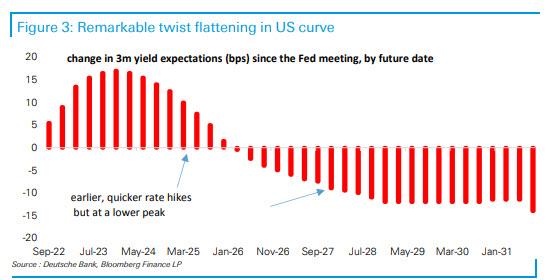
One week ago, we explained why the Fed made a huge policy error last Wednesday when its latest dot plot showed two rate hikes: in simple terms, while market pricing for hikes in 2023 and 2024 went up, yields beyond that dropped as the market said that the best the Fed can do is less than 2-years of rate hikes.
Said otherwise, if the Fed decides to hike - as first Powell hinted and then Bullard doubled down on Friday sending stocks plunging - the market is saying that it won’t be able to go very far before inflation and growth hit a speed limit, pushing yield expectations after the initial hike lower.
This very pessimistic view on r*, first laid out here in 2015, is also in line with market behavior beyond the bond market. First, as Deutsche Bank's FX strategist George Saravelos said, it is aligned with the very high dollar responsiveness we have seen to even small shifts in Fed stance: huge pent-up demand for yield from investors across the planet forces a stronger dollar and a bigger disinflationary impact quicker than assumed. In other words, a low global r* (remember the rest of the world still has massive current account surpluses, or excess savings) pushes US r* even lower.
Second, a low r* is consistent with continued equity resilience, especially in growth stocks heavily reliant on a low medium-term discount rate. That the equity moves in the past two days were led by huge relative rotation from the Russell to the NASDAQ should not be a surprise. This, as Deutsche Bank ominously warns, is 2010-19 secular stagnation pricing, version 2.
Here, another, even bigger question emerged: will the US even be able to sustain positive GDP growth absent trillions in new stimulus each and every year? And even more ominous: what happens to inflation if the Fed is forced to cut rates well before the inflationary burst is extinguished? These are among uncomfortable questions markets will have to answer in the coming months.
* * *
Fast forward to today when SocGen's in-house permagrouch, Albert Edwards, offered an answer to all of these critical questions posed by the Fed: according to Edwards, the market does not have to worry much about such trivial questions as "is inflation transitory or not" for the simple reason that The Fed’s ambition to normalize rates can never be achieved.
Picking up on the observations made by Deutsche Bank's head of FX, Edwards writes that while the global reflation trade was already in retreat, its head of lobbed off by the Fed in its surprisingly hawkish statement of intent last week, a "retreat which quickly turned into a rout across many asset classes."
And while it was not quite in the same league as Bernanke's 2013 "Taper Tantrum" it clearly demonstrated the market’s sensitivity to the Fed’s intentions, fickle as they may be. The biggest surprise: after an initial selloff, the long end of the bond market rallied - in contrast to the sharp sell-off in 2013, or as Edwards echoes what we said: Maybe the market now realizes that a Fed tightening cycle is impossible?
Referencing a WSJ article by the Fed's former mouthpiece, Edwards writes that according to Jon Hilsenrath there are two explanations.
  • First, the Fed has done a better job communicating its intentions this time round (personally I think not).
  • Secondly and more worryingly, Hilsenrath writes that the markets could be too complacent.
Edwards next notes that according to Jeremy Stein who was a Fed Governor during the 2013 tantrum, the markets shouldn’t take a benign view of the extent of potential tightening as “The Fed cannot support markets if there’s an inflation surprise.” He said that Fed Chair Powell, his former colleague, has been adept at shifting his stance when needed. Despite the market’s tranquillity today, he said, Powell may need that nimbleness in the months ahead. Indeed, Mr. Powell said in a June 16 news conference “We will do what we can to avoid a market reaction. But ultimately, when we achieve our macroeconomic goal, we will taper as appropriate”.
The permacynical Edwards then explodes, and says that when he reads those sorts of statements, he "literally laughs out loud" and asks "is this the same Jerome Powell who at the end of 2018, after talking tough for months about the unwinding of the Fed balance sheet being on “auto-pilot” did a 180 degree about turn when markets began to swoon at the end of that year? He is indeed nimble – in retreat!"
Perhaps Edwards is no longer alone in his uber skepticism: after all none other than Bank of America recently said that everyone knows the Fed will stop tapering as soon as the S&P drops 10%... which isn't a good sign when it comes to Powell's credibility.
So why does Edwards think the bond market reacted inversely to its Taper Tantrum shock? "In my opinion the bond market rallied because they know that Fed easy money comes at a heavy price."
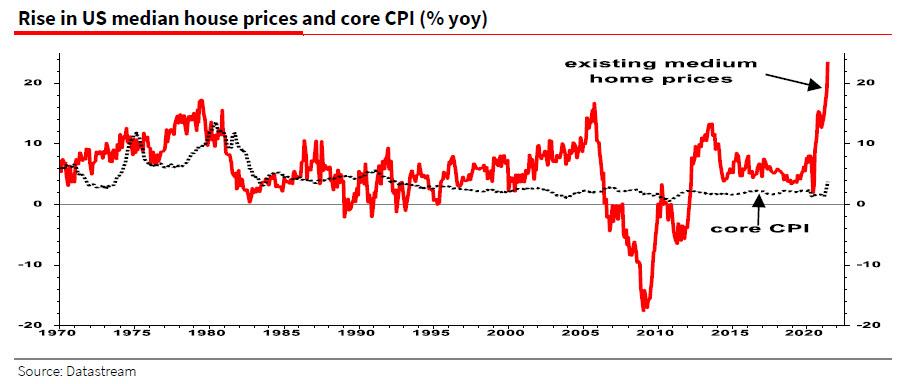
It's not just that: with the Fed having gone all in on reflating everything, not just the economy and stock market but the housing market too, a crash in any of the three would result in an immediate depression. That's why Edwards thinks that the bond market "just doesn’t believe the Fed can follow through on its tougher talk. Why? Because having created another huge, real-terms house price bubble, they are trapped"...
... which confirms what we have said since 2009: that "central banks have become slaves to the bubbles that they blow – the markets quickly forcing a reversal of any tightening. This time around will be no different."
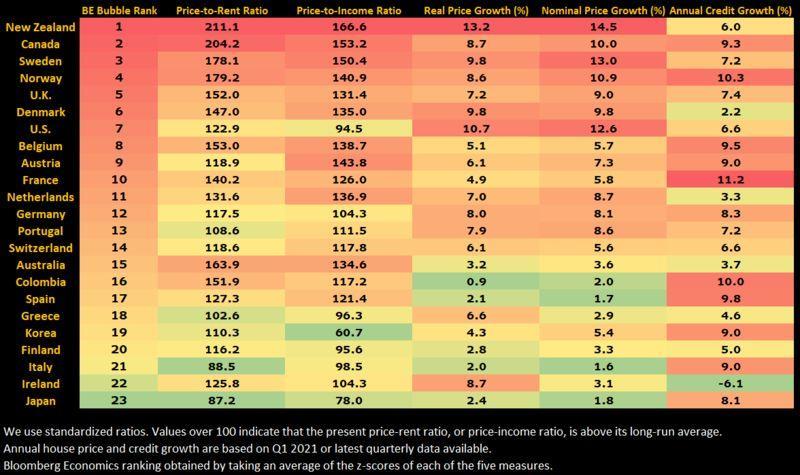
And speaking of blowing house price bubbles, Edwards points out that "there isn’t even room for the Fed on the medal podium. Pointing to the chart below...
... Edwards concludes that 'this is now a global property bubble of epic proportions never before seen by man or beast and it has entrapped more CBs than just the Fed."
Bottom line: any attempt to normalize will leads to an immediate bursting of one or more asset bubbles, which will immediately draw the Fed right back in, resulting in an even bigger bubble, and yes- it means that sooner or later the Fed's two most hated assets, cryptos and gold, will both trade far above $100,000 once the world realizes that the hyperinflation that even BofA sees coming is not "transitory."

>>> US Close Dow +0.95% S&P +0.58% Nasdaq +0.69% Russell +1.31%

Closing Stock Market Summary

The S&P 500 (+0.6%) and Nasdaq Composite (+0.7%) set intraday and closing record highs on Thursday while the Dow Jones Industrial Average (+1.0%) and Russell 2000 (+1.3%) outperformed with gains of at least 1.0%. The bullish price action was driven in part by optimism surrounding government-related news. 

Namely, the White House unveiled a $1.2 trillion "Bipartisan Infrastructure Framework" that included $579 billion in new spending, bank stocks rallied ahead of the Fed's stress test results after the close, and the FDA granted Breakthrough Therapy designation for Eli Lilly's (LLY 232.97, +15.87, +7.3%) investigational antibody therapy for Alzheimer's disease. 

Nine of the 11 S&P 500 sectors contributed to the record-setting performance, paced by financials (+1.2%), energy (+0.9%), communication services (+0.8%), and industrials (+0.8%). The real estate (-0.5%) and utilities (-0.1%) sectors closed lower.

The consumer discretionary sector (+0.1%) featured continued strength in Tesla (TSLA 679.82, +23.25, +3.5%), which extended its weekly gain to 9%, but the sector was held back by Amazon.com (AMZN 3449.08, -54.74, -1.6%).

Some attributed the weakness in Amazon to the House Judiciary Committee advancing several antitrust bills, a report from CNBC highlighting Amazon's publicity surrounding its recent Prime Day event was more muted than previous years, and news that the Teamsters launched an effort to unionize the company's employees. 

Separately, weekly initial jobless claims (411,000) stayed above 400,000 for the second straight week but the market overlooked the report in favor of expectations that the labor market will greatly improve in the fall. On a related note, the bipartisan infrastructure framework invests two-thirds of the resources proposed in President Biden's American Jobs Plan, which could ultimately aid in the recovery effort.  

Elsewhere, the 10-yr yield settled unchanged at 1.49%, which remained supportive for the stock market. The 2-yr yield increased three basis points to 0.27%. The U.S. Dollar Index was little changed at 91.78. WTI crude futures increased 0.3%, or $0.22, to $73.31/bbl. 

Reviewing Thursday's economic data:

  • Initial jobless claims for the week ending June 19 decreased by 7,000 to 411,000 ( consensus 380,000). Continuing claims for the week ending June 12 were 3.390 million, which is the lowest since March 21, 2020.
    • The key takeaway from the report is that the initial claims level is still quite high, leaving ample room for improvement in a job market that is expected to strengthen in coming months.
  • Durable goods orders increased 2.3% month-over-month in May (consensus +2.8%) and were up 25.7% year-over-year. Orders, excluding transportation, increased 0.3% month-over-months (consensus +0.7%) and were up 17.7% year-over-year.
    • The key takeaway from the report was the strength seen in transportation equipment (+7.6%), which was driven by a 2.1% increase in orders for motor vehicles and equipment and a 27.4% increase in orders for nondefense aircraft and parts.
  • The third estimate for Q1 GDP was unchanged at 6.4%, as expected, while the third estimate for the GDP Price Deflator was also unchanged at 4.3%, as expected. 
    • The key takeaway from the report is that it's another affirmation of the reopening strength seen in the U.S. economy, although its dated nature (we're almost done with Q2) leaves it devoid of market-moving impact.
  • The Advance report for International Trade in Goods for May showed a deficit of $88.1 billion, versus a revised $85.7 billion (from $90.6 billion) in April. The Advance report for Retail Inventories for May decreased 0.8%, while the Advance report for Wholesale Inventories for May increased 1.1%.

Looking ahead, investors will receive Personal Income and Spending for May, PCE Prices for May, and the final University of Michigan Index of Consumer Sentiment for June on Friday.

  • Russell 2000 +18.2% YTD
  • S&P 500 +13.6% YTD
  • Dow Jones Industrial Average +11.7% YTD
  • Nasdaq Composite +11.5% YTD

FT : Siemens: revving up new engines for growth

Siemens: revving up new engines for growth
The reworked German group deserves a bigger fanfare for its tech overhaul

Siemens has come a long way in its 170-odd years. On Wednesday, the one-time titan of German industry showcased its new stripes as a tech wunderkind, providing hardware and software for everything from running buildings to streamlining production for a Covid vaccine.

Ambitious growth targets of 5-7 per cent for revenues over the business cycle, up from 4-5 per cent, are a sharp turn from the profit warnings that marked the last decade. 

Since then, Siemens has ditched the vast conglomerate structure, hiving off its energy and health businesses and coalescing around digital industries and infrastructure. These markets, it reckons, have a total addressable size of €440bn. Having jettisoned capital intensive heavy industry — along with accompanying long product cycles — the company aims to win round investors with more investment in research and development and a progressive dividend policy.

Overall, R&D is estimated at about 8 per cent of sales last year, up from 6-7 per cent in 2017-2019. In digital industries it is set to outspend nearly all of its peers. Jefferies reckons on 13 per cent, pipped only by Japanese robotics maker Fanuc. Improved cash conversion paves the way for other investments, both organic and M&A.

The tilt towards higher growth markets, allied with a leaner structure, brings P&L benefits. Siemens has carved out the low-growth energy business. Transitioning to digital industries means that it is targeting a profit margin of 17 per cent to 23 per cent. It expects last year’s digital revenue of €5.3bn to grow at a compound annual growth rate of roughly 10 per cent until 2025.

So why the collective shrug from investors? Some optimism is already baked in, with total returns outpacing those of peers. But it may also be because revenue models are still evolving across newer business lines, from licences to subscription in the case of software. Siemens faces a new set of competitors in its chosen fields too. Growth in cloud-based applications has attracted rivals including Dassault Systems. Still, with shares trading at a discount to peers, according to S&P Global data, the reworked German group deserves a bigger fanfare.

FT : BlackRock and Citadel cut Morrisons bets after share price surge

BlackRock and Citadel cut Morrisons bets after share price surge
Hedge funds were caught out by an unsolicited approach for UK supermarket group

Citadel and BlackRock are among the investment firms that have quickly slashed their bets against WM Morrison after being caught out by a surge in the UK supermarket group’s share price.

Morrisons, a popular stock among short sellers, jumped 35 per cent on Monday following news over the weekend that it had rejected an unsolicited £8.7bn takeover bid from US private equity group Clayton, Dubilier & Rice.

That sudden move inflicted losses on a number of funds, including Ken Griffin’s Citadel, which had been increasing its bets against the supermarket in recent days, as well as Daniel Loeb’s Third Point and Man Group’s GLG Partners, according to regulatory filings and analysis by data group Breakout Point.

Hedge fund short seller losses on Monday alone could total around £86m, according to Breakout Point estimates, although it is unclear at what price funds were able to reduce their positions.

Prior to the bid, Morrisons was the second most shorted consumer staples stock in Europe, according to Breakout Point, as measured by disclosed positions. 

The losses have come during difficult year for short sellers, who borrow stock and sell it in the market, betting they will be able to buy it back at a lower price as the share price falls.

Retail-driven surges in meme stocks such as GameStop have hit short sellers including US-based Melvin Capital and Light Street Capital, as well as London-based White Square Capital, which is shutting its main fund, the Financial Times reported this week. Losses from betting against such stocks have run into billions of dollars.

Ken Griffin’s Citadel upped its bet to 0.53 per cent of the company’s shares on June 10 and then three more times in recent days, leaving it with a 0.8 per cent short position just before the bid was reported. On Monday it slashed its position to 0.27 per cent. 

BlackRock had previously disclosed a 2.29 per cent short position, but on Monday lowered this to 1.13 per cent, and then below 1 per cent on Tuesday. London-based GLG Partners was running a 0.53 per cent bet before the bid, but cut this to 0.38 per cent on Monday.

Third Point, which took a 0.5 per cent position last summer, and Ross Turner’s Pelham Capital, with a 1.65 per cent bet, had also bet against the supermarket.

Equity hedge funds have also complained that stocks they bet on are not responding as they expect, while the rally in beaten-down companies has caught out some managers.

This year’s poor fortunes stand in contrast to 2020, when US and UK hedge funds made more than €1bn in a week from the collapse of German payments company Wirecard.

BlackRock and Man Group declined to comment. Citadel, Third Point and Pelham did not respond to a request for comment.

WSJ : Artist Beeple Sold His NFT for $69 Million—But Has a Tough Time Breaking I

Artist Beeple Sold His NFT for $69 Million—But Has a Tough Time Breaking Into the Art World
The artist has laid low since Christie’s sold his work, and is launching a new project


Digital designer and artist Mike Winkelmann, who goes by Beeple, sparked a global frenzy for non-fungible tokens, or NFTs, after Christie’s sold his digital collage for $69 million in March—but since then he’s maintained a relatively low profile, stoking curiosity about his next big move.

Now, Mr. Winkelmann is opening up, revealing that he’s had a rocky entrée into the art establishment even though he currently ranks as the world’s third most-expensive living artist after Jeff Koons and David Hockney. Instead of chatting up the world top’s collectors and curators, he’s primarily focused on launching a new NFT venture next month that will seek to transform historic moments into collectible NFTs. He’s planning to start with tennis star Andy Murray’s 2013 Wimbledon win.

“I wouldn’t say the art world has been overly welcoming,” Mr. Winkelman said. “Everyone is taking a cautious approach toward me and NFTs, and I get it because it’s all happened so fast.”

Mr. Winkelmann’s blistering rise and bumpy aftermath echoes the entire NFT art phenomenon, which started gaining traction last fall as digital artists realized they could attach data already being used to track cryptocurrency onto their own pixelated images and sell one-of-a-kind work the way painters sell original canvases.

Immediately following Christie’s sale of Mr. Winkelmann’s “Everydays: The First 5,000 Days,” a gold-rush atmosphere spread across the art market, with dozens of artists and galleries clamoring to sell NFT art. The early fever appears to have subsided, though pioneering and seminal NFT artworks created by digital artists including Pak, Mad Dog Jones and FEWOCiOUS continue to sell at auction houses such as Sotheby’s, Christie’s and Phillips for record sums.

Earning the art world’s respect hasn’t been easy for Mr. Winkelmann. Even before the Christie’s sale, Spike Art Magazine critic Dean Kissick was dismissing Mr. Winkelmann’s lush sci-fi landscapes and political portraits as “images of hell.” After the auction, ArtReview’s critic J.J. Charlesworth wrote an editorial, “Why the Art World Loves to Hate NFT Art,” in which he said Beeple’s “images suck.”

Collector Scott Lynn, whose firm Masterworks.io buys blue-chip art, said Mr. Winkelmann’s $69 million sale represented “a moment in time when the art and the cryptocurrency worlds overlapped,” but he thinks that convergence is over, adding, “He’s not going to stand the test of time.”

Others think the artist is already an icon. Hong Kong-based collector and cryptocurrency investor Jehan Chu has said Mr. Winkelmann is “emblematic of a new digital-art movement” and expects the “art world to catch up soon.”

Initially, Mr. Winkelmann said he tried to insinuate himself among the art world’s elite, attending a chic art fair in New York and previewing the million-dollar offerings at several major auction houses there. He went to a street-art conference in Hawaii, but said in traditional art circles he has often been met with consternation bordering on contempt.

“People in the art world move slowly,” he said. “They look at change in hundred-year increments, so it’s easy to dismiss me.”

Mr. Winkelmann’s trajectory offers clues into the longer-term assimilation prospects of hundreds of NFT artists as well as cryptocurrency collectors and art buyers curious to add digital art to their collections.

Mr. Winkelmann said he hasn’t upended his lifestyle noticeably since his record sale. “We upgraded from a Corolla to a Camry,” he said. He’s also expanded his design studio operations, hiring at least seven employees and increasing his footprint from his brother’s garage into a 24,000 square-foot space.

He said he’s also had to reassess what he calls his own “dismissive” attitude toward traditional art, eliciting guidance from savvy art-world players like Fair Warning auctioneer Loic Gouzer, best known for brokering the auction of a $450 million Leonardo da Vinci, “Salvator Mundi.”

“Art is not as esoteric as I thought it was,” Mr. Winkelmann said. “I was very shaky on it and I used to think art history was stupid, but I realize I need to know the story of art if I’m going to push that story forward.”

He’s contemplating becoming an art patron himself, he said. Growing up in Wisconsin, the 40-year-old graphic designer and animator said he didn’t collect art, and the walls of his home now in the suburbs of Charleston, S.C., remain bare, he said.

His recent foray into the fine art world has intrigued him to consider collecting art, both digital and physical pieces. Old Masters, in particular, “give me chills,” he said. “There’s something so calming about them.” Traditional art, he thinks, is “already influencing my art in new ways.”

Before his Christie’s sale, he says, he began developing his idea to create NFTs from historic moments and auction them off.

Although he conceded there is no practical way anyone can claim to own a publicly experienced moment, he and his new company, WENEW, plan to offer the “most canonically complete” package of physical and digital memorabilia along with in-person celebrity experiences tied to major moments in music, sports and comedy over the past half-century. He aims to sell those packages as NFTs.

From July 2nd through 5th, his firm’s site will team up with Mr. Murray to auction the athlete’s 2013 Wimbledon win. Bids will start at $100, and the winner will get a suite of digital images of the winning match. The winner will also be invited to play tennis with him and receive tickets to attend the next Wimbledon tournament. A majority of the proceeds will funnel to Mr. Murray, Mr. Winkelmann said, though WENEW and any photographers whose images were used as part of the NFT will earn an undisclosed share as well.

Mr. Murray, in an emailed statement, called the NFT landscape a “new and exciting space and one I am looking forward to being involved in.”

Mr. Winkelmann said he hopes people see the venture as the “next step in the evolution of collecting,” likening it to the way that baseball cards once “made it possible to collect sports.” But he’s also aware that the venture may seem left-field to those in art circles who are still adjusting to him as a blue-chip artist. Mr. Winkelmann said he regards WENEW as a design-driven effort distinct from his art career.

Some in the traditional art world say they’re willing to give the artist’s latest project a shot. Art adviser Elizabeth Jacoby said she’s intrigued to see if he can establish a “secondary market for experiences,” which doesn’t exist now apart from physical mementos. “He’s looking at the NFT market and seeing people—like rock stars and athletes—who didn’t get to participate in it, and he’s finding a way to monetize our memories of them in a new dimension,” she said. “I like this idea more than his art stuff.”
>>> US Gapping down

Gapping down
In reaction to earnings/guidance
:

  • RAD -6.5%, KBH -4.1%, FUL -2.3%, CNXC -2.1%, DRI -0.5%

Other news:

  • PRTG -29.9% (files for $200 mln mixed securities shelf offering)
  • DQ -9.7% (US to block some solar goods made in Xinjiang region, according to Bloomberg)
  • TALO -6.2% (prices secondary offering of 5 mln shares of common stock; additional terms not disclosed)
  • BIIB -6% (Biogen and Eisai receive FDA Breakthrough Therapy designation for lecanemab)
  • BNL -4.7% (prices offering of 10 mln shares of common stock at $23.00 per share)
  • OSW -2.5% (prices offering of 8,421,053 secondary common shares by selling shareholders at $9.50 per share)
  • JKS -1.8% (US to block some solar goods made in Xinjiang region, according to Bloomberg)
  • HIW -1.6% (sells property)
  • THC -1.5% (MPW to acquire five hospitals from THC for $900 mln)
  • BSY -1.1% (prices offering of $500.0 mln of convertible senior notes due 2027)

Analyst comments:

  • DLTR -1.3% (downgraded to Neutral from Overweight at Piper Sandler)
  • LMNL -1% (downgraded to Neutral from Buy at H.C. Wainwright)

>>> US Gapping up

Gapping up
In reaction to earnings/guidance
:

  • SCS +5.2%, ACN +4.4%, GMS +2.2%

Other news:

  • ARAV +23.1% (announces "positive" initial results from the Phase 1b portion of its Phase 1b/2 study in patients dosed with 15mg/kg of AVB-500 in combination with cabozantinib who have clear cell renal cell carcinoma)
  • DHX +19% (announces additional $12 mln authorization under share buyback program)
  • RCUS +18.6% (Phase 2 ARC-7 study with domvanalimab-based combinations showed encouraging clinical activity)
  • KUKE +8.8% (Kuke Music Holding's KUKEY Lessons have been included in China's pre-school music education curriculum and deployed in more than 4,000 kindergartens across China)
  • LLY +7.3% (donanemab receives FDA's Breakthrough Therapy designation for treatment of Alzheimer's disease)
  • ARAY +6.8% (Family pet's lung cancer is treated with targeted radiotherapy using the Accuray Radixact System with Synchrony Technology; Mac, a Fox Terrier Mix, is doing well following radiotherapy treatment)
  • AGTC +5.8% (reports 12-month data from its ongoing phase 1/2 achromatopsia clinical trials showing biologic activity in patients with mutations in the ACHM B3 Gene)
  • FSP +5.3% (authorizes the repurchase of up to $50 mln)
  • BOCH +4.6% (Bank of Commerce to merge into Columbia Banking System (COLB) in all-stock transaction)
  • KPTI +4.5% (expands royalty agreement with HealthCare Royalty Management for up to $100 mln)
  • FSLR +4.2% (US to block some solar goods made in Xinjiang region, according to Bloomberg)
  • KOR +3.7% (received additional drill hole results from the Mother Lode mineral resource expansion program)
  • KZIA +3.3% (granted patents by the respective agencies of the United States and India in respect of the manufacturing process for paxalisib)
  • IPI +3.2% (announces increase to potash and Trio pricing)
  • ZEAL +2.9% (announced that ZEGALOGUE (dasiglucagon) injection 0.6mg/0.6mL is now commercially available in the U.S. in both an auto-injector and prefilled syringe) LODE +2.2% (to purchase an additional 5% of its 45%-owned technology development partner Quantum Generative Materials in exchange for $50 million)
  • VKTX +2% (announces the initiation of a Phase 1b clinical trial of VK0214, a novel small molecule agonist of the thyroid hormone receptor beta, in patients with X-linked adrenoleukodystrophy)
  • PACB +1.3% (announces collaboration for whole genome sequencing)
  • ALNY +1.3% (announces FDA acceptance of new drug application for investigational vutrisiran for the treatment of the polyneuropathy of hereditary ATTR amyloidosis)
  • MPW +1.1% (MPW to acquire five hospitals from THC for $900 mln)
  • VRAY +1% (GenesisCare expanded its partnership with ViewRay)

Analyst comments:

  • MGA +3% (upgraded to Buy from Neutral at Goldman)
  • LEA +2.6% (upgraded to Buy from Neutral at Goldman)
  • CS +2.5% (upgraded to Buy from Hold at Berenberg)
  • MGM +2.5% (upgraded to Buy from Hold at Deutsche Bank)
  • APTV +1.8% (upgraded to Buy from Neutral at Guggenheim)
  • STX +1.5% (upgraded to Outperform from Market Perform at Northland Capital)