Didi Sets Valuation Target of $62 Billion to $67 Billion in IPO
Chinese ride-hailing company looks to raise $3.9 billion at midpoint of its price range
Didi Global Inc., the Beijing-based ride-hailing company, is targeting a valuation of $62 billion to $67 billion in its IPO, according to its latest public filing.
The fully diluted valuation, which typically includes restricted stock units, could eclipse $70 billion, people familiar with the matter told The Wall Street Journal.
Didi is looking to raise $3.9 billion in the initial public offering by selling 288 million American depositary shares, assuming they price at the midpoint of its targeted range of $13 to $14 per ADS, the filing said.
Didi, which recently changed its corporate name, has said it would use the money it raises to invest in technology, grow its business outside of China and introduce new products.
Much like Uber Technologies Inc. UBER 0.61% in the U.S., China’s Didi operates a smartphone app where users can hail rides, regular taxis and carpooling services. Didi is known for successfully pushing Uber out of China, winning a harsh price war that ended in 2016 when Uber merged its China unit with Didi in exchange for a stake in Didi.
Didi plans to list its American depositary shares on the New York Stock Exchange under the symbol DIDI.
Didi is expected to be one of the most hotly anticipated IPOs in a banner year for them. Traditional U.S.-listed IPOs have raised more than $70 billion already this year, according to Dealogic. Fund managers, venture capitalists, bankers and lawyers have said they are busier with IPOs than they have been in decades at this time of year, which is usually quieter. Some say business is even crazier than during the dot-com boom of the late 1990s.
For the full year 2020, Didi posted revenue of 141.74 billion Chinese yuan, equivalent to $21.63 billion, down 8.4% from a year ago as the coronavirus pandemic cut into business. It posted a full-year net loss of 10.68 billion yuan, equivalent to $1.63 billion.
Didi was founded in 2012 by Alibaba Group Holding Ltd. BABA 1.64% alumnus Cheng Wei, and it merged with a rival in 2015 to gain scale. Mr. Cheng owns 7% of the company’s shares and controls 15.4% of its voting power before the IPO, according to the filing.
Other high-profile investors in Didi include SoftBank Group Corp. 9984 2.26% , Uber and Tencent Holdings Ltd. TCEHY 0.77% entities.
Panasonic unloads entire Tesla stake
Exclusive: Japanese electronics company says relationship "will not change"
OSAKA -- Panasonic sold all its shareholdings in key battery customer Tesla last fiscal year, Nikkei learned Friday, in a move that likely earned the Japanese company billions of dollars to fund new strategic investments.
Panasonic will continue to supply electric-vehicle batteries to the American automaker. "Our relationship with Tesla as a business partner will not change going forward," a Panasonic executive said.
All of the Tesla shares held by Panasonic were sold by the end of March. The gain likely accounts for much of the 429.9 billion yen ($3.88 billion) in "proceeds from sale and redemption of investments" in the company's consolidated statements of cash flows for that fiscal year, up about 380 billion yen from the year before.
After signing its first supply contract with Tesla in 2009, Panasonic bought into the automaker in 2010, soon after its initial public offering on Nasdaq. The move gave Tesla valuable monetary support while marking a step forward for the expansion of Panasonic's auto battery business.
The Japanese company bought roughly 1.4 million shares at $21.15 apiece. Its annual securities report for the year ended March 2020 put the market value of its stake at 81 billion yen, or $730 million.
Tesla's price began skyrocketing in the spring of 2020, reaching $900 per share at one point -- nine times its value at the end of that March after accounting for such factors as a stock split. Selling around these highs would have netted Panasonic billions of dollars.
The sale helps meet Panasonic's growing appetite for capital. In addition to a $7.1 billion deal to buy U.S. supply chain software developer Blue Yonder, announced in April, the company continues to invest in growing its auto battery operations.
Albert Edwards: The Fed Is Trapped In An Epic Bubble, It Can Never Normalize Rates Again
One week ago, we explained why the Fed made a huge policy error last Wednesday when its latest dot plot showed two rate hikes: in simple terms, while market pricing for hikes in 2023 and 2024 went up, yields beyond that dropped as the market said that the best the Fed can do is less than 2-years of rate hikes.
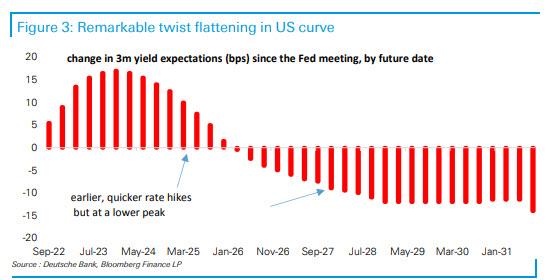
Said otherwise, if the Fed decides to hike - as first Powell hinted and then Bullard doubled down on Friday sending stocks plunging - the market is saying that it won’t be able to go very far before inflation and growth hit a speed limit, pushing yield expectations after the initial hike lower.
This very pessimistic view on r*, first laid out here in 2015, is also in line with market behavior beyond the bond market. First, as Deutsche Bank's FX strategist George Saravelos said, it is aligned with the very high dollar responsiveness we have seen to even small shifts in Fed stance: huge pent-up demand for yield from investors across the planet forces a stronger dollar and a bigger disinflationary impact quicker than assumed. In other words, a low global r* (remember the rest of the world still has massive current account surpluses, or excess savings) pushes US r* even lower.
Second, a low r* is consistent with continued equity resilience, especially in growth stocks heavily reliant on a low medium-term discount rate. That the equity moves in the past two days were led by huge relative rotation from the Russell to the NASDAQ should not be a surprise. This, as Deutsche Bank ominously warns, is 2010-19 secular stagnation pricing, version 2.
Here, another, even bigger question emerged: will the US even be able to sustain positive GDP growth absent trillions in new stimulus each and every year? And even more ominous: what happens to inflation if the Fed is forced to cut rates well before the inflationary burst is extinguished? These are among uncomfortable questions markets will have to answer in the coming months.
* * *
Fast forward to today when SocGen's in-house permagrouch, Albert Edwards, offered an answer to all of these critical questions posed by the Fed: according to Edwards, the market does not have to worry much about such trivial questions as "is inflation transitory or not" for the simple reason that The Fed’s ambition to normalize rates can never be achieved.
Picking up on the observations made by Deutsche Bank's head of FX, Edwards writes that while the global reflation trade was already in retreat, its head of lobbed off by the Fed in its surprisingly hawkish statement of intent last week, a "retreat which quickly turned into a rout across many asset classes."
And while it was not quite in the same league as Bernanke's 2013 "Taper Tantrum" it clearly demonstrated the market’s sensitivity to the Fed’s intentions, fickle as they may be. The biggest surprise: after an initial selloff, the long end of the bond market rallied - in contrast to the sharp sell-off in 2013, or as Edwards echoes what we said: Maybe the market now realizes that a Fed tightening cycle is impossible?
Referencing a WSJ article by the Fed's former mouthpiece, Edwards writes that according to Jon Hilsenrath there are two explanations.
- First, the Fed has done a better job communicating its intentions this time round (personally I think not).
- Secondly and more worryingly, Hilsenrath writes that the markets could be too complacent.
Edwards next notes that according to Jeremy Stein who was a Fed Governor during the 2013 tantrum, the markets shouldn’t take a benign view of the extent of potential tightening as “The Fed cannot support markets if there’s an inflation surprise.” He said that Fed Chair Powell, his former colleague, has been adept at shifting his stance when needed. Despite the market’s tranquillity today, he said, Powell may need that nimbleness in the months ahead. Indeed, Mr. Powell said in a June 16 news conference “We will do what we can to avoid a market reaction. But ultimately, when we achieve our macroeconomic goal, we will taper as appropriate”.
The permacynical Edwards then explodes, and says that when he reads those sorts of statements, he "literally laughs out loud" and asks "is this the same Jerome Powell who at the end of 2018, after talking tough for months about the unwinding of the Fed balance sheet being on “auto-pilot” did a 180 degree about turn when markets began to swoon at the end of that year? He is indeed nimble – in retreat!"
Perhaps Edwards is no longer alone in his uber skepticism: after all none other than Bank of America recently said that everyone knows the Fed will stop tapering as soon as the S&P drops 10%... which isn't a good sign when it comes to Powell's credibility.
So why does Edwards think the bond market reacted inversely to its Taper Tantrum shock? "In my opinion the bond market rallied because they know that Fed easy money comes at a heavy price."
It's not just that: with the Fed having gone all in on reflating everything, not just the economy and stock market but the housing market too, a crash in any of the three would result in an immediate depression. That's why Edwards thinks that the bond market "just doesn’t believe the Fed can follow through on its tougher talk. Why? Because having created another huge, real-terms house price bubble, they are trapped"...
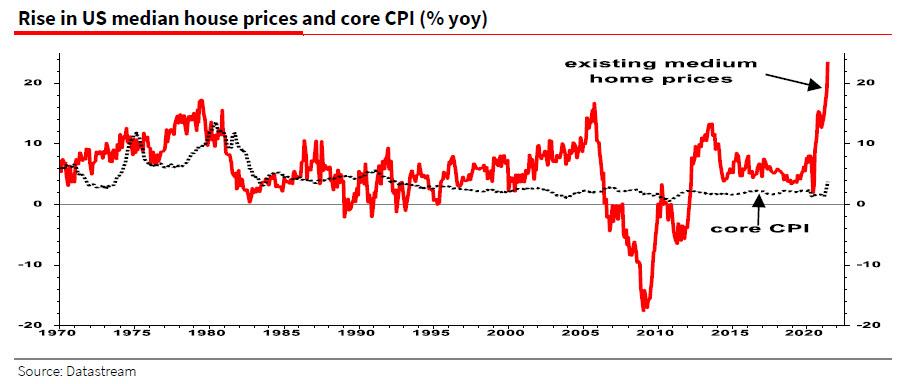
... which confirms what we have said since 2009: that "central banks have become slaves to the bubbles that they blow – the markets quickly forcing a reversal of any tightening. This time around will be no different."
And speaking of blowing house price bubbles, Edwards points out that "there isn’t even room for the Fed on the medal podium. Pointing to the chart below...
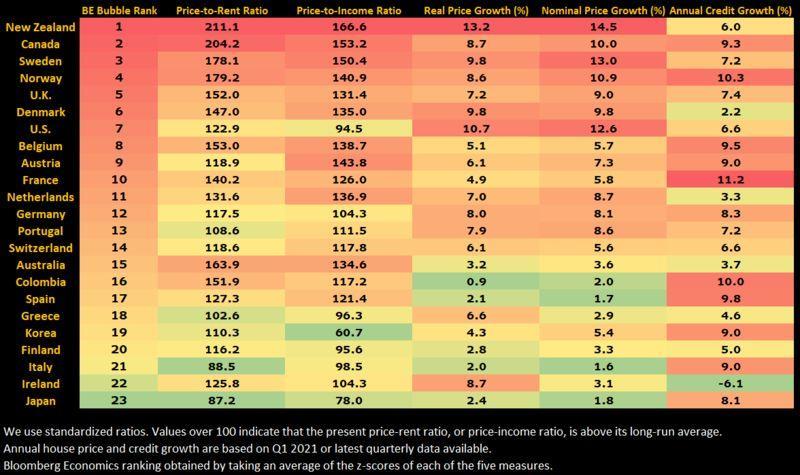
... Edwards concludes that 'this is now a global property bubble of epic proportions never before seen by man or beast and it has entrapped more CBs than just the Fed."
Bottom line: any attempt to normalize will leads to an immediate bursting of one or more asset bubbles, which will immediately draw the Fed right back in, resulting in an even bigger bubble, and yes- it means that sooner or later the Fed's two most hated assets, cryptos and gold, will both trade far above $100,000 once the world realizes that the hyperinflation that even BofA sees coming is not "transitory."
Natixis fined €7.5m for ‘misleading’ investors on subprime exposure
French court hands victory to small shareholders over investment bank’s press release
French investment bank Natixis has been fined €7.5m after a court found that it misled investors over its exposure to subprime mortgage assets, handing victory to a group of small shareholders.
The penalty is the first imposed by a French criminal court on a bank related to its communication around the risky assets that were at the heart of the global financial crisis of 2008, according to lawyers in the case.
The case, which started with a complaint brought in 2009 by the Association for the Defense of Minority Shareholders (Adam), representing around 750 Natixis shareholders, centred on a press release the bank sent out in November 2007.
The release outlined exposure of €356m to a portfolio of collateralised debt obligations and added that the “risks borne by Natixis in subprime [assets] are limited”. In its complaint, the shareholder association alleged that the actual exposure amounted to €1.59bn.
In its ruling, the Paris Criminal Court found that Natixis had “knowingly disseminated misleading information” in the press release.
Natixis proved one of the biggest French casualties when bonds backed by US subprime mortgages collapsed in value, forcing governments to bail out some of the world’s largest banks and triggering a global recession.
Shares in Natixis plunged to less than €1 in March 2009, down from €19.55 when the bank went public in December 2006.
Alongside the fine, the shareholders who had brought the case were awarded a lump sum depending on the amount of stock they owned between November 2007 to February 2008. The award equated to about €3 for every share owned.
Eric Dezeuze, a lawyer representing Natixis, said the sum awarded to the plaintiffs would likely cost Natixis around €2m.
Natixis said in a statement that it “considers that it did not commit any offence” and “has decided to lodge an appeal against this decision as the Paris Criminal Court did not take into account the arguments presented at the hearing”.
The court defeat comes after a bruising 12 months for Natixis, which in January agreed to sell its majority stake in H2O after the asset manager’s decision to put €1bn of investors’ money into illiquid bonds linked to Lars Windhorst, a controversial German financier, alarmed investors.
In February, French co-operative bank BPCE made a formal offer to take full control of Natixis, in which it already owns a majority stake.
Hedge funds rethink tactics after $12bn hit from meme stock army
Short sellers on guard over risk that day trader sprees could trigger ‘extinction-level events’
Hedge funds that bet on falling share prices are stepping up their efforts to spot the next GameStop after this year’s “meme stock” bonanza left the industry nursing billions of dollars of losses in just six months.
Huge gains in the price of companies favoured by day traders who assemble on message boards such as Reddit caught out some short sellers badly in late January. In recent weeks, these stocks have staged a second rally, with a rise in stocks including cinema chain AMC inflicting yet more pain.
Hedge fund losses since the start of the year from betting against just GameStop, AMC and Bed Bath & Beyond total more than $12bn, according to data group S3, while bets against a number of others have each run up additional losses of hundreds of millions of dollars. More than half short sellers’ $5.1bn of losses betting against AMC this year have come in June.
The heavy toll shows how moves by individual investors, which are regularly co-ordinated on forums such as r/WallStreetBets, has heightened the risks for professional investors in the Wall Street equities market.
“In two waves, a few hedge funds have seen modestly sized short positions turn into extinction-level events,” said Andrew Beer, managing member at investment firm Dynamic Beta Investments. Funds that suffer multiple rounds of losses on short bets “will face difficult questions from investors as to whether their risk management failed to adapt to a changed market environment”.
The highest-profile hedge fund casualty has been Melvin Capital, which lost 53 per cent in January and is still down 44.7 per cent this year to May. Light Street Capital, the fund led by ‘Tiger cub’ alumnus Glen Kacher, was also hit early this year and again in May, with losses in the first quarter predominantly driven by soured short bets. London-based White Square Capital, which lost money shorting GameStop, is also shutting its main fund.
An index compiled by Goldman Sachs of stocks favoured by retail investors has almost doubled since June 2020, while another that tracks companies that are targeted by short sellers has gained 28 per cent.
Traders across the industry, both those caught directly in abrupt rallies in heavily shorted stocks as well as those hit by the ensuing market volatility, have now been forced to start tracking potential retail investor manoeuvres, or risk huge losses and backlash from their investors.
“The danger is you don’t really know what stock the retail community is going to go after next,” said Amy Wu Silverman, equity derivatives strategist at Royal Bank of Canada. “There is not a stock that is ‘safe’.”
Wu Silverman had typically concentrated on advising institutional clients about their hedging strategies. Now hedge funds seek her help to identify the early warning signs of a retail-driven meme stock surge.
“It has completely upended our markets, and we have had to make really dramatic changes to how we model things and how we manage risk,” she said. Retail investors chasing volatility “has gotten to the point where you can’t ignore it”.
Losses inflicted by retail investors have proved a rude awakening to hedge funds, which had just enjoyed a banner year in 2020 making their biggest gains since the aftermath of the financial crisis, according to HFR.
Some funds are considering taking a greater number of smaller short positions to cut down on the potential losses a single stock can cause, say industry insiders. D1 Capital, whose founder Daniel Sundheim previously worked at Viking, is one fund that has been considering reducing the size of short bets this year, say people familiar with the strategy. Others are looking at betting against indices, rather than individual stocks.
Managers in the US and UK have begun using algorithms to scour forums such as r/WallStreetBets or other data sources to try to spot co-ordinated buying. While the practice is new to most western funds, this kind of surveillance is already common for many Asian managers, according to Patrick Ghali, managing partner at advisory firm Sussex Partners.
Tiger cub Lee Ainslie’s Maverick Capital wrote to investors in April that its quant team “now systematically monitors Wall Street Bets and other similar forums that cater to less experienced, retail investors”. Moez Kassam, chief investment officer at Anson Funds in Toronto, said his firm has been building algorithms to follow commentary and sentiment on Reddit, as well as using some bought from external companies.
Fintech company S3 now provides a company’s “short squeeze risk” score to Bloomberg terminal users, while alternative research provider Quiver Quantitative scrapes Reddit investment threads for ticker mentions and sentiment.
“You don’t want your book to be exposed to the whims of r/WallStreetBets,” said Quiver founder James Kardatzke.
Data group Sentifi, which buys data from the likes of Reddit and Twitter and uses it to score sentiment around stocks, said it detected a nearly 1,200 per cent rise in chatter around AMC between May 20 and June 1. The cinema chain’s shares had already started to rise by then, but then doubled on June 2. Sentifi said the number of customers using its platform had doubled over the past year.
Swiss investment firm Unigestion has also started looking at how it can deploy its machine reading and data techniques — which it already uses to spot changing sentiment — around meme stocks.
“It is an important, though short-term, risk factor” in markets, said Unigestion portfolio manager Salman Baig. “For us, any factor that can disrupt markets is of primary concern.”
Graduation day for Spacs as FTSE Russell shakes up index
One in five additions to Russell 3000 benchmark went public via blank-cheque company
Dozens of companies that entered public markets through deals with blank-cheque vehicles are set to graduate into the blue-chip Russell 3000 index on Friday, giving a potential boost to the fortunes of electric vehicle developers and other speculative ventures.
FTSE Russell, which maintains the popular benchmark, will reconstitute its indices by adding and subtracting companies based on their market capitalisations and other factors.
Companies that join the Russell 3000 often receive a bump in their share prices, while gaining exposure to a wide swath of investment managers and inclusion in passive funds that track the index.
Investment vehicles with $9.1tn of assets either track or are benchmarked to Russell indices, according to FTSE Russell.
This year, the additions to the Russell 3000 index are set to include a number of early-stage electric vehicle companies that went public through special purpose acquisition companies, whose shares first soared and then declined as wild investor enthusiasm gave way to concerns about regulatory scrutiny of the sector.
Among them are Canoo, Lordstown Motors and Nikola, companies that have dealt with the departures of key personnel and face investigations from the Securities and Exchange Commission over their disclosures to investors. All three have said they are co-operating with regulators.
Other notable additions will include the sports betting business DraftKings, healthcare company Multiplan and 3D sensors manufacturer Velodyne Lidar, according to a preliminary list published by Russell.
More than 20 per cent of the companies joining the Russell 3000 index this year will have gone public through Spacs, according to Steven DeSanctis, an equity strategist at Jefferies.
“You’re opening yourself up to a much larger audience,” DeSanctis said. “You should see an increase in trading volume for a lot of these stocks.”
Unlike the more widely-held S&P 500 index, Russell indices welcome companies that have not reported recent profits or substantial revenues, and include companies with market capitalisations as small as a few hundred million dollars.
The index reconstitution could add fuel to critics of Spacs, who argue the vehicles provide a less rigorous route to public markets compared to regular initial public offerings.
“The danger is that these companies went public without that vetting process,” said Usha Rodrigues, a professor of law at the University of Georgia who has researched Spacs. “There’s more of a risk to each shareholder in those individual companies and, to the extent that there’s a lot of them, to all the holders of the Russell 3000.”
An index of Spacs maintained by IPOX has fallen more than 20 per cent from a peak in the first quarter, as investors sour on the structure following a deluge of new offerings. The SEC has issued a series of warnings about Spacs to investors and the companies themselves, particularly concerning their sales and profit projections.
Several high-profile short sellers have targeted companies that have come to market via a Spac and will now be added to the Russell indices — but retail traders on Reddit forums have cheered the index reconstitution as a positive signal for popular stocks.
The Russell index changes go into effect after the close of trading on Friday; the session is usually one of the busiest trading days of the year as investors and index funds reshuffle portfolios in anticipation.
Rich People’s Problems: I’m square-eyed over an 88-inch, £40,000 TV
More of a statement than an investment, but the right brand may carry some residual value
According to the Bank of England, we’ve stashed away nearly £200bn since the pandemic began. I want something to show for my hoarded cash — particularly as we’ll soon be inviting guests back into the house.
As well as a tech upgrade for the “summer of sport”, I’m ready for a bit of an interior refresh. I’ve almost forgotten how to go shopping, yet Amazon is not the place to find talking points. Fortunately, the upper echelons of society have discovered a way to enjoy the delights of a car boot sale — rebrand it as a French “brocante”.
Held in the grounds of stately homes, you generally park up in a field under the direction of floppy-haired public-school educated marshals before browsing stalls with canvas awnings selling all manner of rich people’s junk, trinkets and artisan products.
Recently, some friends and I went on a road trip to Suffolk to attend such an event. We drove there in our matching 1982 and 1983 Mercedes SLs — the perfect modern classic for a sunny day’s excursion.
Mine has its original radio cassette player still works, allowing Madness, Haircut 100, Abba and the Bee Gees to be released from the time warp of toot (my loft). I knew it was right to keep my old cassettes. A few years ago, you couldn’t give them away, so I didn’t. Now they’ll cost you at least a fiver apiece to replace on eBay.
On arrival, we were ushered to some convenient parking spaces because our cars were “cool”. There’s a warm breeze, fluttering bunting, a light hubbub of posh chat and the reassuring crunch under foot from the shingle path. Forget the cashless society, I had fresh notes at the ready for a good old-fashioned haggle.
You’ll always get a better deal for cash, but you need to watch out for faux antiques. Within minutes, I’d snapped up some locally-made sheepskin rugs (just the thing for around the fire pit — and 20 per cent discount for cash).
Two stalls on, we depleted the artisan candle stock (if guests are coming around, we’ll have to mask the smell of chien). It’s also important to have a new objet or two as talking points. So imagine my delight when I spotted an antique copper gyroscope globe. Feeling like I was a contestant on Antiques Road Trip, I secured £20 off the £60 price tag.
The brocante turned out to be a wallet cleaner, but I also needed to inflict some more serious damage on my bank account — and invest in some new home tech.
Lockdown has exposed the vintage nature of our TVs, but television purchasing has become a highly complex art in recent years.
Given the speed at which the latest models are superseded by newer screens, money spent on TVs can hardly be described as an investment. But — and I would say this, wouldn’t I? — there are also good reasons to push your budget into the top end.
In the “man cave”, a show-stopper for watching sport or movies requires a massive screen and a lot of noise, while a TV for your living room requires art and style. Either way, you’ll have to swallow a dictionary of tech-speak to understand what on earth you’re buying.
For the man cave, I plumped for a £4,000 Sony Bravia 77-inch XR XR77A80J (2021). Its full title includes the terms OLED, HDR 4K, UltraHD Smart Google TV with Dolby Atmos and Acoustic Surface Audio. If you have no idea what all that stuff means, here’s a quick translation.
An LED telly without the preface of an “O”, “U” or “Q” is cheap — but the picture isn’t up to much. Virtually nothing is streamed in more than 4K resolution, so 8K screens are pointless (and expensive). And despite advances in tech, a TV needs everything built in, otherwise you end up with wires everywhere (ugh).
So why did I go for a Sony? For the first time since the Trinitron series in the 1980s, Sony now produces some of the best screens on the market. However, my decision hinged on availability, screen size and launch date. With fast-evolving tech, saving money by purchasing last year’s model is a false economy.
Should I buy two? No. It’s not right for the living room. I don’t have a wall big enough and putting a TV that big on a stand is vulgar. For some years, I have taken the style over substance approach to living room televisions. Bang & Olufsen are the masters.
Navigating one’s way through the B & O range may bring small beads of sweat to your brow. At £7,100, the Beovision 55-inch floor stander is neither a great looker nor worth the cash. Anyway, a 55-inch screen isn’t big enough — a bit like buying a Tesla 3 because you couldn’t afford an S. Go big, or go home!
Big means the Beovision Harmony. Three versions are available; 65-inch, 77-inch and a massive 88-inch, but even I don’t need a telly that large. In any event, the price tag of about £40,000 is a little over the top and the 8K picture quality goes to waste.
But the 65-inch at £12,900? When you switch it on, the speakers tilt from vertical to horizontal and the screen rises. Pointless, but superb. The picture looks great when it’s on, and the telly looks fantastic when it’s off.
Have I totally lost my marbles? B & O use LG for their tech and I wouldn’t buy an LG telly unless I was 30 years younger and furnishing my first flat. But I rationalise it in the same way that a Soviet wind-up tells the time just as well as a Rolex. They do the same job, just in a different wrapper.
Bang & Olufsen handcrafts its products and they are designed to stimulate envy. My current B & O television is nearly 10 years old, but can be programmed to remember where you sit. When you switch it on, it will turn to face you. Ultimately, this isn’t a television you are buying, but a piece of furniture.
If I push the boat out, could I offset the higher price tag by selling it on in a few years? Looking at the second-hand market for consumer electronics, the prospects of a lucrative resale are not bright.
Yes, I could take it off to eBay and sell it for £2,000. But hold on to it for longer — much longer — and I suspect the picture will change. If you try and buy B & O from the 1970s or early 1980s it is surprisingly expensive. So I will probably put it in the attic, next to the cassettes. If Madness is worth a fiver today, the old B & O might have a value in 2040.
I’ve decided the best way to think of the new purchase is as £1,290 a year for 10 years, which is a small price to pay for the show off-ability. All of this means I won’t have much money left to go out, but at least we’ll be ready for our guests — or the next lockdown.
After Hours Summary: Bank stocks tick higher on positive Fed bank stress test results; NKE +12.3% jumps on earnings; CAMP -6.6%, FDX -4.3%, SNX -2.6% fall on earningsAfter Hours Gainers:
Companies trading higher in after hours in reaction to earnings/guidance: NKE +12.3%, BB +0.7%
Companies trading higher in after hours in reaction to news: MRTX +4% (receives FDA Breakthrough Therapy Designation for adagrasib), LPRO +3% (signs producer agreement with insurance carriers), ASAN +2.8% (TWLO and ASAN to dual list on Long-Term Stock Exchange in August, according to WSJ), ONCS +2% (CEO resigns), CZR +1.5% (to retain ownership of Horseshoe Hammond), WFC +1.2% (Fed issues bank stress test results), GVA +1.2% (wins $16 mln Alaska airport contract), BAC +0.7% (Fed issues bank stress test results), XLF +0.6% (Fed issues bank stress test results), JPM +0.5% (Fed issues bank stress test results), BLDP +0.3% (announces a rebranding), KBR +0.2% (wins $194 mln US Air Force contract), TERN +0.1% (initiates patient dosing in Phase 1b AVIATION trial), C +0.1% (Fed issues bank stress test results), BTG +0.1% (commences arbitration proceedings for Menankoto permit), REXR +0.1% (acquries five industrial properties in California)
After Hours Losers:
Companies trading lower in after hours in reaction to earnings/guidance: CAMP -6.6%, FDX -4.3%, SNX -2.6%, PRGS -1.2%
Companies trading lower in after hours in reaction to news: TBPH -8.2% (stock offering), SNCR -7.2% (files for $100 mln common stock offering), OMP -6.1% (stock offering), BVS -3.3% (completes minority investment in Vaporox), ADVM -1.6% (names new CFO), UNVR -1.6% (expands distribution agreement with Tata Chemicals), UPS -1.5% (on FDX earnings), TWLO -0.4% (TWLO and ASAN to dual list on Long-Term Stock Exchange in August, according to WSJ), HEAR -0.3% (partnering with NBA star Immanuel Quickley), MPX -0.2% (stock offering), IQV -0.1% (introduces Clinical Data Analytics Suite)
Didi Sets Valuation Target of $62 Billion to $67 Billion in IPO
Chinese ride-hailing company looks to raise $3.9 billion at midpoint of its price range
Didi Global Inc., the Beijing-based ride-hailing company, is targeting a valuation of $62 billion to $67 billion in its IPO, according to its latest public filing.
The fully diluted valuation, which typically includes restricted stock units, could eclipse $70 billion, people familiar with the matter told The Wall Street Journal.
Didi is looking to raise $3.9 billion in the initial public offering by selling 288 million American depositary shares, assuming they price at the midpoint of its targeted range of $13 to $14 per ADS, the filing said.
Didi, which recently changed its corporate name, has said it would use the money it raises to invest in technology, grow its business outside of China and introduce new products.
Much like Uber Technologies Inc. UBER 0.61% in the U.S., China’s Didi operates a smartphone app where users can hail rides, regular taxis and carpooling services. Didi is known for successfully pushing Uber out of China, winning a harsh price war that ended in 2016 when Uber merged its China unit with Didi in exchange for a stake in Didi.
Didi plans to list its American depositary shares on the New York Stock Exchange under the symbol DIDI.
Didi is expected to be one of the most hotly anticipated IPOs in a banner year for them. Traditional U.S.-listed IPOs have raised more than $70 billion already this year, according to Dealogic. Fund managers, venture capitalists, bankers and lawyers have said they are busier with IPOs than they have been in decades at this time of year, which is usually quieter. Some say business is even crazier than during the dot-com boom of the late 1990s.
For the full year 2020, Didi posted revenue of 141.74 billion Chinese yuan, equivalent to $21.63 billion, down 8.4% from a year ago as the coronavirus pandemic cut into business. It posted a full-year net loss of 10.68 billion yuan, equivalent to $1.63 billion.
Didi was founded in 2012 by Alibaba Group Holding Ltd. BABA 1.64% alumnus Cheng Wei, and it merged with a rival in 2015 to gain scale. Mr. Cheng owns 7% of the company’s shares and controls 15.4% of its voting power before the IPO, according to the filing.
Other high-profile investors in Didi include SoftBank Group Corp. 9984 2.26% , Uber and Tencent Holdings Ltd. TCEHY 0.77% entities.