>>> Barron’s Weekend Summary

Barron’s Weekend Summary: The 30 top CEO’s in America were able to turn the crisis of the Covid-19 pandemic into opportunity.

* Cover Story: The 30 top CEO’s in America were able to turn the crisis of the Covid-19 pandemic into opportunity. And to understand the extent of the challenge, consider the rollercoaster ride that commodity prices experienced. “There was a day in April 2020 when Texas crude sold for less than nothing—$37 less, in futures trading….Now, oil is over $70 a barrel.” Therefore, chief executives at the country’s top companies had to navigate the storm from “dire downturn” to “frantic rebound.”

* Tech Trader: Just Eat Takeaway.com (ticker: JET.UK) serves as a gateway into the fast growing food delivery sector. The company was created by the merger of Takeaway and London-based Just Eat in June 2020. But shortly thereafter it acquired Grubhub, which had put itself up for sale, for $7.3 billion.

* Trader: “It’s as if the Fed meeting never happened.” Less than two weeks after the Federal Reserve hinted it would have to start raising interest rates over inflation concerns, triggering bearish sentiment in the Dow Jones Industrial Average – which endured its worst week since October 2020, the markets rebounded robustly in the week that started on June 21.

* Interview: Joyce Chang, Global Head of Research for J.P. Morgan, is an experienced observer. She analyzes some of the current market trends in this interview and what they mean. The main point for investors is: “expect continued gains for stocks and oil. The overarching trend she sees is a shift, prompted by digitalization and the demand for fintech and crypto. “Market dynamics have moved beyond talking about traditional market liquidity provided by banks and what hedge funds and mutual funds are doing, as nonbank financial institutions have ramped up activity.”

* Profile: Intellia (NTLA+) has gained over 60% in the course of 2021, clsing at $88.83 on Friday. The company’s appeal owes to its pipeline of the gene-editing technology treatments known as Crispr-Cas9, the discovery of which earned Emmanuelle Charpentier and Jennifer Doudna a Nobel Prize. “Intellia’s experimental treatment repairs an errant gene that causes transthyretin amyloidosis, or ATTR: a buildup of a misfolded protein in the nerves and heart that is often fatal.” Intellia’s partner in developing the treatment, Regeneron Pharmaceuticals (REGN), should also benefit as it will split profits if the treatment reaches market. Pfizer (PFE) and Alnylam Pharmaceuticals (ALNY) are also working on fast-growing new drugs for treating ATTR amyloidosis.

* Features: 1) Positive on HTZGQ, CAR. The rental-car industry is benefiting from a domestic US travel surge and a vehicle shortage this summer to raise prices. “Vacationers are paying $275 a day or more for midsize sport utility vehicles from Hertz in popular locations and $100-a-day rentals are common, double what Hertz was getting in the first quarter. Used-car prices, meanwhile, have surged, benefiting the industry when they sell their fleets.” Hertz (HTZGQ), Avis Budget Group (CAR), and privately owned Enterprise control some 95% of the domestic market. 2) Positive on The housing market. While house sales could slow after the summer, there’s still plenty of demand left and mortgage rates should stay near 3%. Mortgage insurance companies are appealing: NMIH, ESNT, MTG.

* European Trader: Cautious on FibroGen (FGEN). The EU’s Medicines Agency’s Committee for Medicinal Products for Human Use has recommended granting Fibrogen’s key product roxadustat marketing authorization in the European Union as a treatment for anemia symptoms in chronic kidney disease patients. The drug, meanwhile, has experienced setbacks in getting US approval.

* Emerging Markets: China is trying hard to stop Bitcoin, but it won’t be easy. Bitcoin’s decentralized system is intended to be “impervious to government control.” Bitcoin’s price did suffer, losing 16% after the Chinese central bank declared on June 21 that cryptocurrencies disrupted “financial orders, breed criminal activity, and seriously infringe property safety.” But, it then it rallied back.

* Commodities: Shares of copper mining company Antofagasta (ANTO.UK) could suffer “because of a political lurch to the left in Chile, raising the possibility of higher taxes on resource companies. Recent drops in the price of copper aren’t helping either.” “The left-wing is on the ascension in Chile, and that doesn’t bode well for where the taxes come out in the end,” says Tyler Broda, head of EU mining research at RBC Capital Markets in London.

* Streetwise: The focus is on non-disruptive technology, such as ubiquitous objects like pens, and the kind of products made by brands owned by Newell Brands (NWL) as UBS began coverage of the households-products group in the past week, recommending that investors buy Newell and sell Clorox (CLX).

FT : World’s largest superyacht to offer multimillion-euro apartments for sale

World’s largest superyacht to offer multimillion-euro apartments for sale
Bet on luxury demand with 220-metre-long vessel featuring residences from €9.5m

With prices starting at €9.5m, backers of what will be the world’s largest superyacht are offering 39 apartments for sale as they bet on resilient demand for exclusive luxury travel.

The 220-metre vessel is due to launch in 2024 and will provide buyers with “the intimacy of a private yacht alongside the chance to network in a vibrant community of like-minded owners”, its investors said as they announced the €500m project on Monday.

Somnio will be more than 40 metres longer than the current record holder Azzam, owned by the Abu Dhabi royal family. The project has been spearheaded by Carl Le Souef, a US millionaire who founded one of Australia’s largest skincare companies, Private Formula International, and now runs Somnio Global, a sustainable technology group.

Cruise liners and residential ships were forced into a total shutdown in March 2020 after onboard coronavirus outbreaks prompted port officials to ban vessels from docking or quarantine them offshore.

Protracted negotiations with governments over a restart, particularly in the US where health authorities have set rigorous requirements for cruise companies to resume operations, has meant ships have only recently begun to sail international itineraries.

Carnival, the world’s largest cruise ship operator, said last week that just over half its fleet capacity was confirmed to sail by the end of its financial year in November as it reported a net loss of $2bn for the three months until the end of May.

Residential vessels have been a feature of the cruise market since 2002 when the Norwegian shipping magnate Knut Kloster launched ResidenSea, the first company to build a liner where people owned apartments on board as they might a holiday rental.

Tony Peisley, an independent cruise industry analyst, said that although ResidenSea originally intended to build 10 ships, only The World was finished. In 2003, the company had to be refinanced with its apartment owners clubbing together to provide funding to ensure its survival. The vessel has 165 apartments, with penthouses selling for about €20m.

“The business model carries high capital and operational costs and other failed start-ups all found that it was tough to find enough buyers willing to pay the millions required up front,” Peisley said, adding that many of the super-rich preferred to own their own yachts.

Construction has already started on Somnio, with revenues from off-plan sales helping finance the rest of the build.

According to BOAT International, the specialist superyacht media company, sales of private yachts hit an all-time high in May with 68 boats sold after steady growth throughout the pandemic as wealthy consumers hunted out ways to travel in spite of Covid-19 restrictions.

Apartments on board Somnio will cost upwards of €9.5m, with owners collectively deciding on an annual itinerary. The yacht will have a 10,000-bottle capacity wine cellar and a beach club, as well as host talks by scientists using onboard equipment to study marine environments.

FT : Financial watchdog bans crypto exchange Binance from UK

Financial watchdog bans crypto exchange Binance from UK
FCA also issues consumer alert against sprawling cryptocurrency group

The UK’s financial watchdog has ordered Binance to stop all regulated activities in Britain and imposed stringent requirements in a stinging rebuke of one of the world’s biggest cryptocurrency exchanges.

The intervention by the Financial Conduct Authority in recent days is one of the most significant moves any global regulator has made against Binance, a sprawling digital asset firm with subsidiaries around the world. The exchange has until Wednesday evening to confirm it has complied with the watchdog’s demands, and removed its advertising.

The intervention is a sign of how regulators are cracking down on the cryptocurrency industry over concerns relating to its potential role in illicit activities such as money laundering and fraud, and over often weak consumer protection.

The FCA also this weekend issued a consumer warning against both the Cayman Islands-registered Binance holdings company and Binance Markets Limited, a London-based affiliate that is controlled by chief executive Changpeng Zhao and is overseen by the UK regulator.

“Binance Markets Limited is not permitted to undertake any regulated activity in the UK,” the FCA said, adding, “no other entity in the Binance Group holds any form of UK authorisation, registration or licence to conduct regulated activity in the UK.”

The group did not immediately respond to a FT request for comment, but has previously said it “takes its compliance obligations very seriously and is committed to following local regulator requirements wherever we operate”.


Binance Markets Limited is not approved under the FCA’s cryptocurrency registration regime, which is required for UK groups offering digital asset services.

The entity had applied to become a registered cryptocurrency company with the regulator, but pulled that application last month “following intensive engagement from the FCA,” according to a spokesperson for the watchdog and two people familiar with the situation.

The FCA’s focus in deciding whether or not to approve such applications is based on a review of controls and practices to prevent anti-money laundering and the financing of terrorism.

Binance is one of the most important operators in the fast-emerging crypto market, offering a wide range of services to customers around the world, including trading in dozens of digital coins, futures, options, stock tokens, as well as savings accounts and lending. It recorded crypto trading volumes equivalent to $1.5tn last month, according to data from TheBlockCrypto.

As part of the FCA’s actions, the regulator ordered Binance to display by next Wednesday on its website that, “BINANCE MARKETS LIMITED IS NOT PERMITTED TO UNDERTAKE ANY REGULATED ACTIVITY IN THE UK.” Binance Markets Limited also must “secure and preserve all records and/or information . . . relating to all UK consumers from its systems” and halt any advertising and financial promotions.

Binance Markets Limited was established a year ago as part of a plan by the broader group to launch a UK-focused exchange, Binance UK, which would have been “ring fenced” from the wider global operation, according to public documents and the two people familiar with the matter. Although the FCA has restricted Binance from offering services in the UK, British citizens can still access Binance’s services in other jurisdictions.

London-based Binance Markets Limited had permission from the FCA to provide consumers with investment services in traditional currencies, something Binance achieved by purchasing a financial company that was already registered with the regulator. The transaction was approved by the FCA last June, according to public documents.

The FCA’s decision comes after Japan’s Financial Services Agency warned last week that Binance was conducting unauthorised trade in cryptocurrencies with Japanese citizens. It is the second time the FSA has warned about Binance after publishing an identical notice in 2018.

Germany’s financial watchdog warned investors in April that Binance had probably violated securities rules over its launch of trading in stock tokens, something the exchange tried unsuccessfully to appeal against.

WSJ : Tesla Recalls 285,000 Vehicles in China, Most of Them Locally Made

Tesla Recalls 285,000 Vehicles in China, Most of Them Locally Made
The recall, which includes over 90% of Chinese-made vehicles sold by Tesla, was prompted by safety risks related to their cruise control system.

Tesla Inc. is recalling more than 285,000 passenger vehicles in China—including over 90% of locally made vehicles sold by the company—because of safety risks associated with their cruise control system, the country’s market regulator said Saturday.

The recall of the U.S. company’s automobiles came after an investigation into possible defects, which found that their cruise control system could be accidentally activated and potentially result in an unexpected speed increase, the State Administration for Market Regulation said.

The recall includes 249,855 Model 3 sedans and Model Y compact crossover vehicles manufactured by Tesla’s Shanghai plant, as well as 35,665 imported Model 3 cars, the regulator said.

Affected Tesla customers can upgrade their cruise control software remotely without having to go to the store, according to the company and the market regulator.

The regulator said it received a request from Tesla a few days earlier for the recall, which affects vehicles produced between December 2019 and June 2021.

“We apologize for the inconvenience caused by this recall to all car owners,” Tesla said through its official social-media account on Weibo, China’s Twitter -like platform. “Tesla will continue to improve safety in strict accordance with national requirements.”

A Tesla spokesperson said the company declined to comment further.

The recall adds to Tesla’s woes in the Chinese market, where consumer confidence has already been rattled after a run of bad publicity over the company’s handling of customer complaints and perceived quality issues.

The recalled autos manufactured in China account for 93.7% of all Chinese-made vehicles sold by Tesla, according to figures released by the China Passenger Car Association. Tesla doesn’t publish its own monthly sales or production figures.

In April, Tesla faced a backlash when one of its customers staged a protest at Auto Shanghai, China’s premier auto-industry exposition, by shouting allegations about faulty brakes on Tesla vehicles. The incident prompted the company to issue a public apology and pledge to set up a customer-satisfaction unit as it assured buyers that it takes quality concerns seriously.

In February, Tesla was summoned by Chinese authorities citing consumer complaints about quality issues in a rare rebuke for the company, the first foreign auto maker to operate a wholly owned plant in China. Chief Executive Elon Musk has also had to reassure Chinese officials and consumers that Tesla cars couldn’t be used to spy on China.

Until its recent difficulties, Tesla had overwhelmingly been seen as a prestigious brand in China, boosted by the popularity of Mr. Musk, who has said that China’s fast-growing market will become the company’s largest. China currently hosts Tesla’s only operational plant outside the U.S. The vehicle maker won approval for its Shanghai factory in 2018 despite the deterioration of U.S.-China trade relations under then-President Donald Trump.

However, the adverse publicity due to quality concerns has led some Tesla owners and potential buyers to walk away. On Weibo, the recall prompted renewed criticism of the company, which some Chinese internet users called “arrogant.”

“The problem of brake failure has not been settled, and now there is a danger of sudden acceleration?” one user wrote.

WSJ : Sydney Expands Covid-19 Lockdown to Halt Delta Variant

Sydney Expands Covid-19 Lockdown to Halt Delta Variant
Australia’s largest city and the surrounding areas will be under lockdown for two weeks to help stamp out the latest coronavirus outbreak.

SYDNEY—Sydney and surrounding areas will go into lockdown for two weeks as officials widen existing restrictions in an effort to halt the spread of the highly infectious coronavirus variant Delta across Australia’s largest city.

Residents of Greater Sydney and the nearby Blue Mountains, Central Coast and Wollongong regions have been told to stay at home from Saturday evening until July 7 other than for a handful of reasons such as essential work or shopping.

The move came 24 hours after central Sydney and three other parts of the city were placed in lockdown. Authorities extended the orders to about 75% of New South Wales state’s 8.2 million people after 12 new cases took the total from the city’s latest outbreak to 82.

State Premier Gladys Berejiklian said the lockdown is aimed at totally eliminating the local spread of the virus.

“There’s no point doing three days and then having the virus continue to bubble away in the community,” Ms. Berejiklian said.

Helped by its island status and regular restrictions, Australia has reported fewer than 31,000 Covid-19 cases since the start of the pandemic, mostly among travelers returning from overseas. Yet less than 5% of the 26 million population is fully vaccinated and state governments have criticized the federal government over levels of vaccine supply.

“We could actually use a lot more vaccine and, if we had it available, obviously that would help,” New South Wales state Health Minister Brad Hazzard said.

Australia’s therapeutic-drug regulator on Friday provisionally approved Johnson & Johnson’s vaccine, making it the third Covid-19 vaccine to receive regulatory approval in the country, after those from AstraZeneca PLC and Pfizer Inc.

Sydney’s response reflects rising concern among officials over the highly transmissible Delta variant, which was first detected in India last year. While Melbourne has endured multiple citywide lockdowns, Sydney has previously relied on contact tracing and restrictions including partial lockdowns.

Authorities have traced Australia’s recent outbreak to a Sydney limousine driver who transported international flight crew.

WSJ : App Taps Unwitting Users Abroad to Gather Open-Source Intelligence

App Taps Unwitting Users Abroad to Gather Open-Source Intelligence
The Premise app pays users, many in the developing world, to do tasks like taking photos and completing surveys for clients including the U.S. military

WASHINGTON—A network of gig workers world-wide is unwittingly providing basic intelligence to the U.S. military using only a consumer app on their smartphones.

San Francisco-based Premise Data Corp. pays users, many of them in the developing world, to complete basic tasks for small payments. Typical assignments involve snapping photos, filling out surveys or doing other basic data collection or observational reporting such as counting ATMs or reporting on the price of consumer goods like food.

About half of the company’s clients are private businesses seeking commercial information, Premise says. That can involve assignments like gathering market information on the footprint of competitors, scouting locations and other basic, public observational tasks. Premise in recent years has also started working with the U.S. military and foreign governments, marketing the capability of its flexible, global, gig-based workforce to do basic reconnaissance and gauge public opinion.

Premise is one of a growing number of companies that straddle the divide between consumer services and government surveillance and rely on the proliferation of mobile phones as a way to turn billions of devices into sensors that gather open-source information useful to government security services around the world.

The company says 90% of its work is gauging public sentiment and understanding human geography by paying users to fill out surveys, yielding data that it says has uses for commercial businesses, nonprofits and governments. A smaller number of projects, it says, involve asking users to go out into the world to complete tasks such as taking pictures or walking a predetermined route. Sometimes those tasks involve collecting data on nearby wireless signals or other cellphones, the company said, comparing the practice to how Google and Apple map Wi-Fi networks with phones using their operating systems.

“Data gained from our contributors helped inform government policy makers on how to best deal with vaccine hesitancy, susceptibility to foreign interference and misinformation in elections, as well as the location and nature of gang activity in Honduras,” Premise Chief Executive Officer Maury Blackman said. The company declined to name its clients, citing confidentiality.

Premise launched in 2013 as a tool meant to gather data for use in international development work by governments and nongovernmental organizations. In recent years, it has also forged ties to the U.S. national-security establishment and highlighted its capability to serve as a surveillance tool, according to documents and interviews with former employees. As of 2019, the company’s marketing materials said it has 600,000 contributors operating in 43 countries, including global hot spots such as Iraq, Afghanistan, Syria and Yemen.

According to federal spending records, Premise has received at least $5 million since 2017 on military projects—including from contracts with the Air Force and the Army and as a subcontractor to other defense entities. In one pitch on its technology, prepared in 2019 for Combined Joint Special Operations Task Force-Afghanistan, Premise proposed three potential uses that could be carried out in a way that is “responsive to commander’s information requirements”: gauge the effectiveness of U.S. information operations; scout and map out key social structures such as mosques, banks and internet cafes; and covertly monitor cell-tower and Wi-Fi signals in a 100-square-kilometer area. The presentation said tasks needed to be designed to “safeguard true intent”—meaning contributors wouldn’t necessarily be aware they were participating in a government operation.

The company said the document reflected only potential capabilities and doesn’t accurately characterize the work it does for military clients. A spokesperson for coalition forces in Afghanistan didn’t respond to a request for comment about whether coalition forces ever saw the concept note or had engaged Premise’s services.

A second document, submitted to the Air Force for a grant that the company ultimately received, echoed similar capabilities—with Premise saying it could dispatch workers to do “directed observations, associated sentiment, and wireless network mapping.” Another Premise document says the company can design “proxy activities” such as counting bus stops, electricity lines or ATMs to provide incentives for contributors to move around as background data is gathered.

Data from Wi-Fi networks, cell towers and mobile devices can be valuable to the military for situational awareness, target tracking and other intelligence purposes. There is also tracking potential in having a distributed network of phones acting as sensors, and knowing the signal strength of nearby cell towers and Wi-Fi access points can be useful when trying to jam communications during military operations. Nearby wireless-network names can also help identify where a device is, even if the GPS is off, communications experts say.

Mr. Blackman said gathering open-source data of that nature doesn’t constitute intelligence work. “Such data is available to anyone who has a cellphone,” he said. “It is not unique or secret.”

“If some of our data is used by government departments to shape policy and to protect our citizens, we are proud of that,” he said.

Premise submitted a document last July to the British government describing its capabilities, saying it can capture more than 100 types of metadata from its contributors’ phones and provide them to paying customers—including the phone’s location, type, battery level and installed apps. A spokesman for the British embassy in Washington didn’t respond to a question about whether any U.K. government agencies were using the service.

Users of the Premise app aren’t told which entity has contracted with the company for the information they are tasked with gathering. The company’s privacy policy discloses that some clients may be governments and that it may collect certain types of data from the phone, according to a spokesman.

“All those who collect and use Premise are fully informed by the public terms of service—available on the app and the Premise website—that the open-source data, collected by local paid ‘contributors’ from their cellphones, could be shared with any of Premise’s customers, including government agencies,” Mr. Blackman said.

Currently the app assigns about five tasks a day to its users in Afghanistan, according to interviews with users there, including taking photos of ATMs, money-exchange shops, supermarkets and hospitals.

One user in Afghanistan said he and others there are typically paid 20 Afghani per task, or about 25 cents—income for phone and internet services. A few months ago, some of the tasks on the site struck him as potentially concerning. He said the app posted several tasks of identifying and photographing Shiite mosques in a part of western Kabul populated largely by members of the ethnic Hazara Shiite minority. The neighborhood was attacked several times by Islamic State over the past five years, and militants killed at least 50 people there in May in three explosions targeting a girls’ school, an attack for which no group has claimed responsibility. Because of the nature and location of the tasks in a hot spot for terrorism, the user said he thought those tasks could involve spying and didn’t take them on.

Premise said photographing religious sites such as mosques, temples, synagogues and churches is a standard task assigned to contributors around the world to help clients understand the physical and social geography of a place. Contributors are only asked for exterior photographs and aren’t asked to enter any sites.

None of the more than three million people who have worked with Premise over the past five years has come to harm as they have completed more than 100 million tasks or surveys, the company said.

Premise began as a way to register prices in the developing world and help its customers better understand the needs of the population. But the company struggled to turn a profit in those markets, and the demand for its services was inconsistent, former employees say.

In 2018, the board brought in Mr. Blackman as CEO, hoping he could stabilize the company’s finances and bring in new business, according to current and former employees. Mr. Blackman had experience in the government contracting world, having earlier founded Accela, a company that developed software for government. He pushed to pursue more intelligence and military contracts, the employees said, which led to a culture clash within the company’s workforce, many of them veterans of the development world who objected to some uses of the military and intelligence contracts that were being considered for the platform. A spokesman for the company dismissed that account as coming from disgruntled former employees and said the company hasn’t departed from its original mission. David Soloff, Premise’s co-founder, who preceded Mr. Blackman as CEO, didn’t respond to a request for comment.

In recent years, Premise’s data has been purchased by numerous defense contractors or government agencies working on defense programs, federal records show. The Air Force paid the company $1.4 million in 2019 to do “persistent ground ISR”—a military abbreviation that stands for intelligence, surveillance and reconnaissance. The Air Force Research Laboratory said the contract was focused on data science and machine learning work for military units but declined to provide additional details.

At least five other defense contractors working on intelligence or defense contracts have purchased the data, federal spending records show. Premise stepped up its presence in Washington in recent years, posting jobs requiring security clearances on LinkedIn and bringing on employees whose LinkedIn profiles say they are veterans of the intelligence community.
(ZH) BofA Crashes The "Transitory" Party: Sees Up To 4 Years Of "Hyperinflation"

BofA Crashes The "Transitory" Party: Sees Up To 4 Years Of "Hyperinflation"

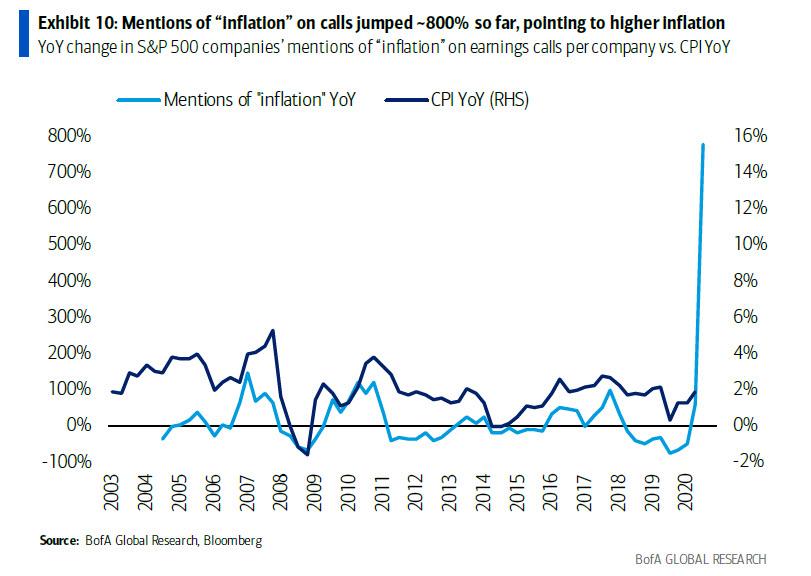
At the start of May, when observing the avalanche of "higher inflation" mentions on Q1 earnings calls, which had quadrupled YoY; and jumped by a record 800% YoY...
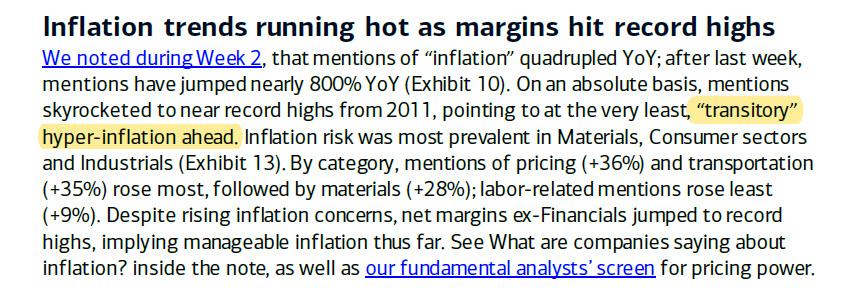
... BofA chief equity strategist Savita Subramanian summarized the current state of affairs as follows: "On an absolute basis, [inflation] mentions skyrocketed to near record highs from 2011, pointing to at the very least, “transitory” hyper-inflation ahead."
Needless to say, a "serious" bank warning of hyperinflation - transitory or otherwise - was enough to spark very serious concerns that the Fed was losing control of prices, a panic which only grew after Deutsche Bank joined the chorus, earlier this month when it warned that inflation was about to explode "Leaving Global Economies Sitting On A Time Bomb."
Of course, BofA had left itself a loophole, the same loophole used so generous by the Fed as often as several times each day: after all the definition of transitory is fluid, and could be as short as just a few weeks, making the coming period of pain somewhat manageable.
Not so fast.
While the Fed has bet what little credibility it has left on the benign meaning of "transitory" in setting its monetary policy (no rate hikes until 2023 by which point inflation will be in the double digits) and today's UMichigan commentary echoed the Fed's cheerful sentiment, predicting that soaring inflation won't last long, with Consumer Survey economist Richard Curtin writing that "year-ahead inflation expectations fall slightly to 4.2% in June from May's decade peak of 4.6%, [as] consumers believed that the price surges will mostly be temporary", one of the most respected Bank of America strategists just crashed the "transitory" party, and in a note published today, BofA Chief Investment Strategist Michael Hartnett wrote that, far from transitory, soaring US prices may last up to 4 years.
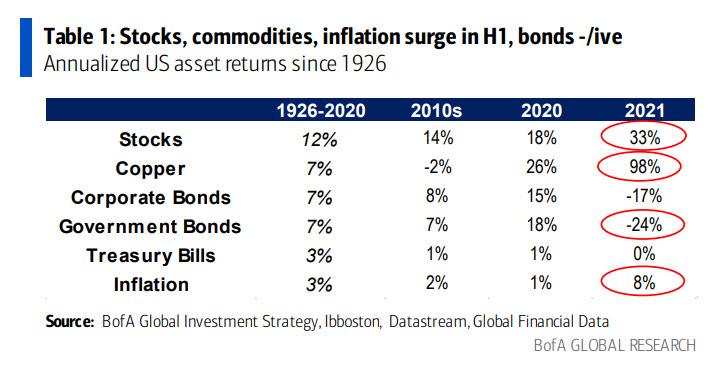
Observing that US inflation averaged 3% in the past 100 years, 2% in 2010s, 1% in 2020, and is "annualizing 8% thus far in 2021", Hartnett writes that it is " so fascinating so many deem inflation as transitory when stimulus, economic growth, asset/commodity/housing inflations (are) deemed permanent."
As a result, Bank of America sees "US inflation firmly in 2-4% range next 2-4 years" consisting of "asset, commodity, and housing inflation." And even though the Fed may have staked its reputation and credibility on keeping the current ultra-loose regime until well into 2023, Hartnett predicts that "only a market crash will prevent global central banks tightening next 6 months."
Hartnett then lists the various factors that form his hawkish view starting with the fiscal policy bubble, writing that the latest Biden infrastructure plan ($600bn new spend) "takes running tally of global monetary & fiscal stimulus to $30.5tn past 15 months, an amount equivalent to entire Chinese & European GDP’s." Just in case there is any confusion why despite millions still unemployed, consumer spending is now far higher than it was before the covid pandemic.
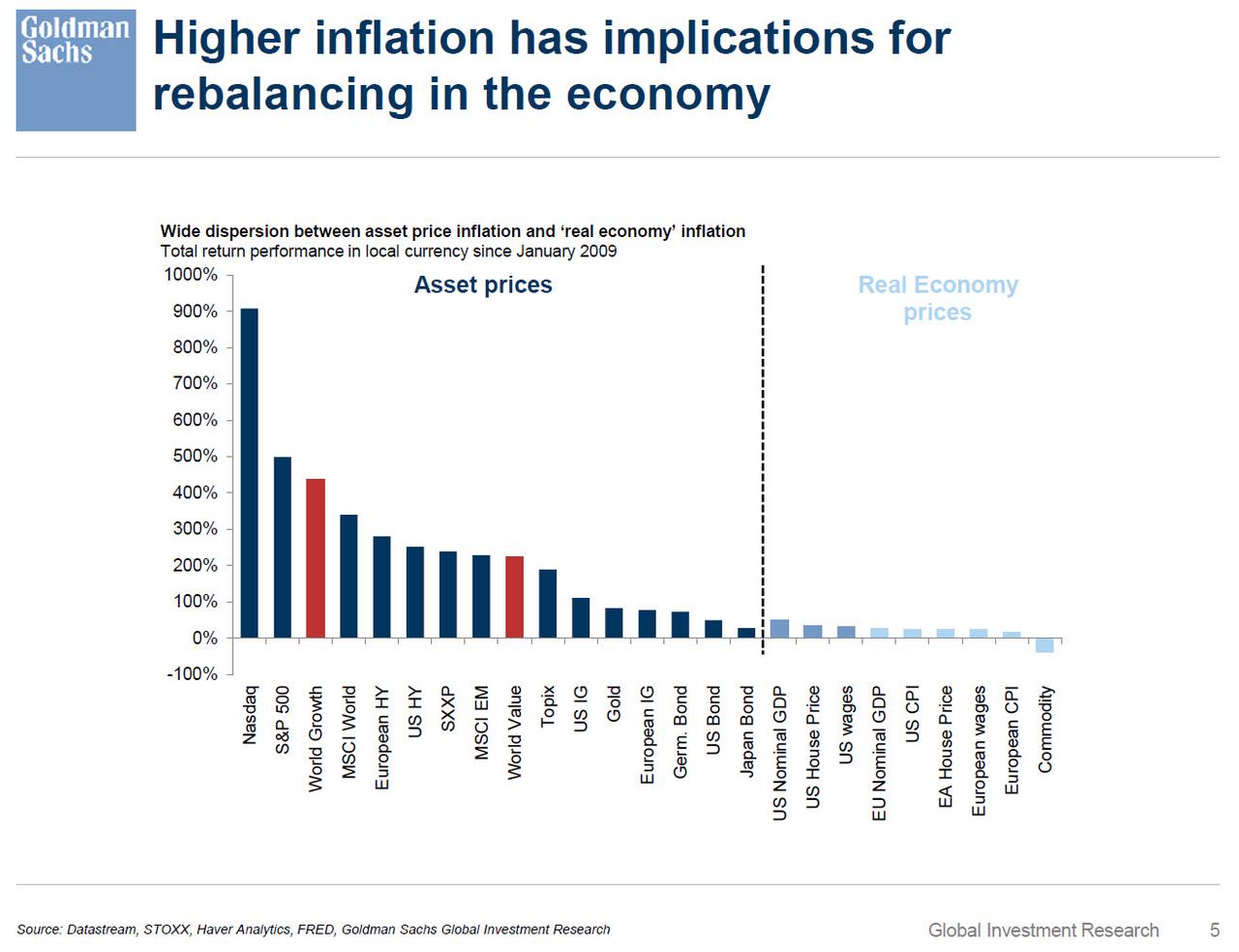
The BofA CIO then looks at asset inflation, which as even Goldman has shown is hyperinflating compared to the more dormant economic inflation (which however is also starting to move)...
... and pointing out that central banks have bought $900 million of financial assets every hour in past 15 months leading to "epic gains in stocks & commodities past 15 months relative to 100-year history (Table 1)" and pushing the global equity market cap up staggering $54 trillion over this period.
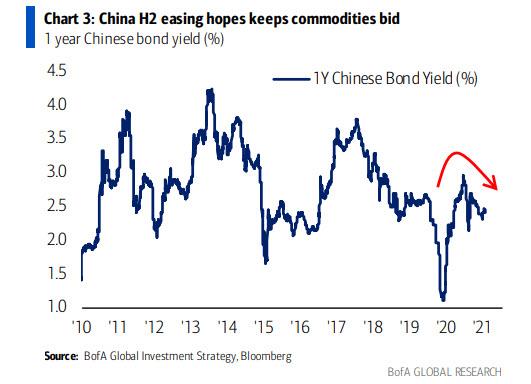
There's more: after soaring for much of the past 6 months, commodity inflation has continued to rise, driven by hopes that China will ease further in the second half (China 1-year rates down 50bps past 6 months)...
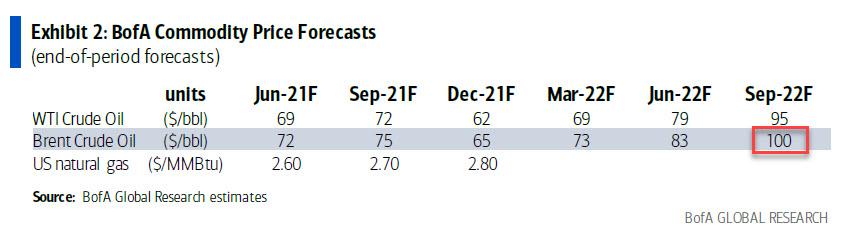
... despite recent Fed hawkish practice run; note that recently another BofA strategist said he expects oil to hit $100/bbl in 2022.
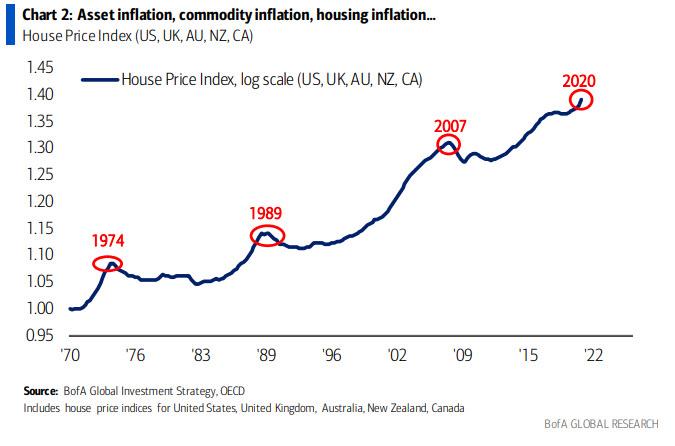
Last but not least, there is the housing inflation (or "hyperinflation" according to Ivy Zelman), with Hartnett writing that surging house prices across US, UK, Scandanavia, Canada, Australia, NZ (up almost 30% YoY), mark the 4th housing boom of past 50-years ).
This has forced central banks in in Norway, Denmark, New Zealand, Australia, and Canada - but not the Fed of course - to tilt toward “macro-prudential” measures, i.e. to consider surging home prices when making policy decisions.
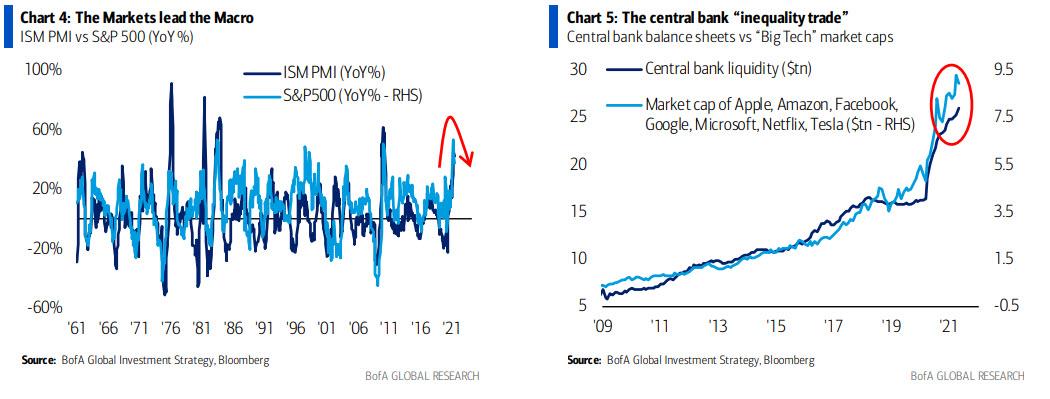
Needless to say, all these asset bubbles generously created by the Fed and other central banks continue to widen the record inequality rift. And while central banks will never admit it, Hartnett writes that markets almost always lead macro (stocks excellent lead indicator of economic growth - Chart 4), and since the Fed knows it can only impact business & consumer behavior via credit spreads & stock prices (Chart 5)...
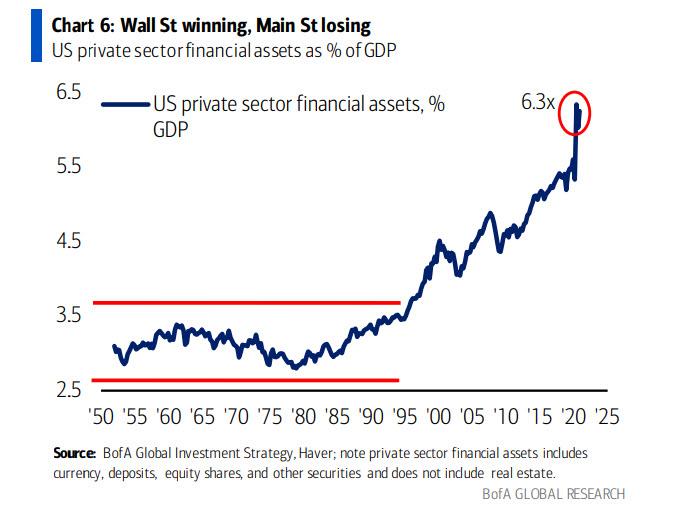
... its policy is totally directed at Wall Street. But the problem is that the Wall Street boom, built up ever since the LTCM "fed put" bailout and the Greenspan days, is enormous relative to Main Street and as the familiar chart below shows, US financial assets are now 6.3x GDP...
... and for context, US stocks are up $27 trillion higher compared to pre-COVID levels while US payrolls are 8 million below Feb'20 level.
As the head BofA strategist concludes, it is "tough to solve inequality with QE." If only anyone at the Fed had this degree of clarity.
Putting all of the above together, Hartnett concludes that while stocks are hitting daily all time highs, the party is ending with higher inflation, hawkish central banks, weaker growth; combo of rising Rates, Regulation, Redistribution (3Rs) & peak Positioning, Policy, Profits (3Ps), leading to low/negative stock/credit H2 returns, and the resulting optimal "barbell" trade is long inflation assets & defensive/quality assets.
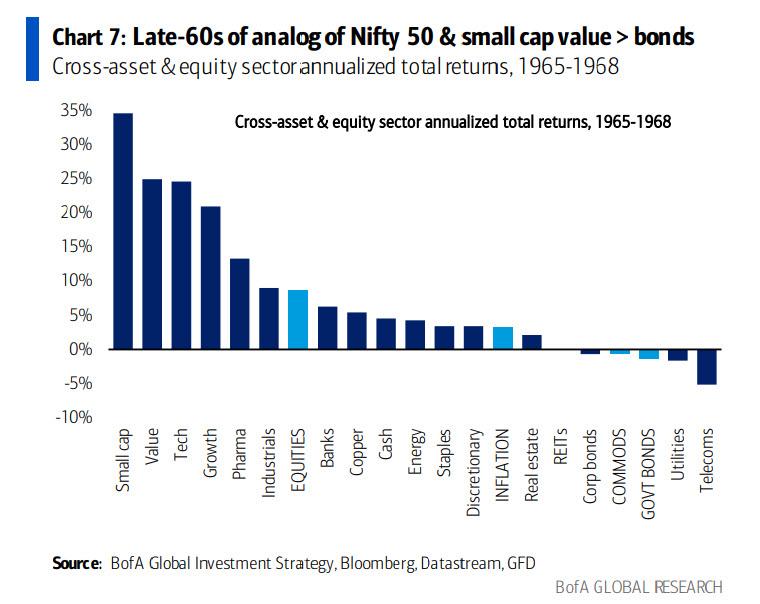
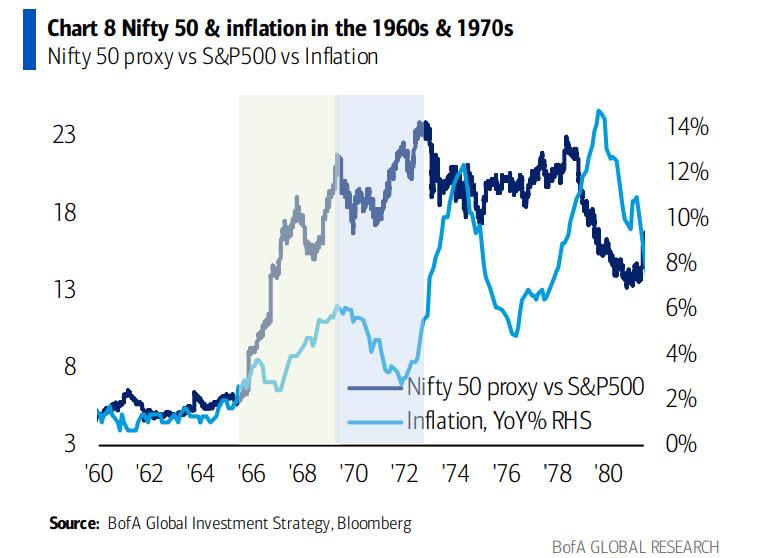
Why? Because to Hartnett, the proper analog to the current buying frenzy is the late-60s "when inflation & interest rates became unanchored on back of fiscal excess and subservient Fed caused barbell of Nifty 50 & small cap value stocks to significantly outperform bonds."
And speaking of 1960s parallels, Hartnett sees the iconic Nifty 50 as the analogue to today's FANGs: "note best performance from Nifty 50 was 1966-70 period on 1st rise in inflation (Chart 8); 2nd surge in inflation in early-70s saw Nifty 50 hit secular peak...
... which was followed by a decade of underperformance. In other words, the days of FAAMGs outperformance are almost over.