Gapping up
In reaction to earnings/guidance:
- SCS +5.2%, ACN +4.4%, GMS +2.2%
Other news:
- ARAV +23.1% (announces "positive" initial results from the Phase 1b portion of its Phase 1b/2 study in patients dosed with 15mg/kg of AVB-500 in combination with cabozantinib who have clear cell renal cell carcinoma)
- DHX +19% (announces additional $12 mln authorization under share buyback program)
- RCUS +18.6% (Phase 2 ARC-7 study with domvanalimab-based combinations showed encouraging clinical activity)
- KUKE +8.8% (Kuke Music Holding's KUKEY Lessons have been included in China's pre-school music education curriculum and deployed in more than 4,000 kindergartens across China)
- LLY +7.3% (donanemab receives FDA's Breakthrough Therapy designation for treatment of Alzheimer's disease)
- ARAY +6.8% (Family pet's lung cancer is treated with targeted radiotherapy using the Accuray Radixact System with Synchrony Technology; Mac, a Fox Terrier Mix, is doing well following radiotherapy treatment)
- AGTC +5.8% (reports 12-month data from its ongoing phase 1/2 achromatopsia clinical trials showing biologic activity in patients with mutations in the ACHM B3 Gene)
- FSP +5.3% (authorizes the repurchase of up to $50 mln)
- BOCH +4.6% (Bank of Commerce to merge into Columbia Banking System (COLB) in all-stock transaction)
- KPTI +4.5% (expands royalty agreement with HealthCare Royalty Management for up to $100 mln)
- FSLR +4.2% (US to block some solar goods made in Xinjiang region, according to Bloomberg)
- KOR +3.7% (received additional drill hole results from the Mother Lode mineral resource expansion program)
- KZIA +3.3% (granted patents by the respective agencies of the United States and India in respect of the manufacturing process for paxalisib)
- IPI +3.2% (announces increase to potash and Trio pricing)
- ZEAL +2.9% (announced that ZEGALOGUE (dasiglucagon) injection 0.6mg/0.6mL is now commercially available in the U.S. in both an auto-injector and prefilled syringe) LODE +2.2% (to purchase an additional 5% of its 45%-owned technology development partner Quantum Generative Materials in exchange for $50 million)
- VKTX +2% (announces the initiation of a Phase 1b clinical trial of VK0214, a novel small molecule agonist of the thyroid hormone receptor beta, in patients with X-linked adrenoleukodystrophy)
- PACB +1.3% (announces collaboration for whole genome sequencing)
- ALNY +1.3% (announces FDA acceptance of new drug application for investigational vutrisiran for the treatment of the polyneuropathy of hereditary ATTR amyloidosis)
- MPW +1.1% (MPW to acquire five hospitals from THC for $900 mln)
- VRAY +1% (GenesisCare expanded its partnership with ViewRay)
Analyst comments:
- MGA +3% (upgraded to Buy from Neutral at Goldman)
- LEA +2.6% (upgraded to Buy from Neutral at Goldman)
- CS +2.5% (upgraded to Buy from Hold at Berenberg)
- MGM +2.5% (upgraded to Buy from Hold at Deutsche Bank)
- APTV +1.8% (upgraded to Buy from Neutral at Guggenheim)
- STX +1.5% (upgraded to Outperform from Market Perform at Northland Capital)
Early premarket gappers
- Gapping up:
- DHX +16.1%, RCUS +13.7%, AGTC +11.5%, KUKE +9.8%, FSP +8.4%, KZIA +6.7%, BOCH +3.7%, GMS +3.3%, IPI +3.2%, SCS +3.2%, FSLR +3%, NXE +2.1%, PACB +1.9%, EBAY +1.1%, VRAY +1%, BIIB +0.8%, CSIQ +0.7%, TAN +0.6%, V +0.6%
- Gapping down:
- PRTG -26.4%, DQ -7.7%, TALO -6.3%, BNL -4.4%, KBH -4.1%, OSW -3.7%, FUL -2.3%, CNXC -2.1%, JKS -1.7%, HIW -1.6%, BSY -1.1%
Visa buys Swedish fintech Tink in €1.8bn deal
Open banking specialist offers technology that allows bypassing of traditional card networks
Visa has struck a €1.8bn deal to buy Swedish fintech Tink, less than six months after a previous attempt to buy its US rival Plaid was blocked by regulators.
Tink develops technology that allows third parties to connect to customer data from different financial institutions, enabling them to offer services such as account aggregation and payments that bypass traditional card networks such as Visa’s.
Regulators have been trying to encourage services such as those offered by Tink as a way to encourage more competition and choice in the European payments market, and in 2018 introduced “open banking” rules that forced banks to allow these companies to access their data.
Visa said the acquisition would encourage open banking, which has so far been held back by unreliable services and low levels of familiarity and trust among consumers.
Al Kelly, chief executive and chair of Visa, said: “Visa is committed to doing all we can to foster innovation and empower consumers in support of Europe’s open banking goals. By bringing together Visa’s network of networks and Tink’s open banking capabilities we will deliver increased value to European consumers and businesses with tools to make their financial lives more simple, reliable and secure.”
The €1.8bn purchase price is a 165 per cent premium to the value given to Tink by investors including PayPal and BNP Paribas in a fundraising round last December, and reflects rapidly rising interest in open banking. Earlier this year, Plaid raised money at a valuation of $13.4bn, almost triple the price Visa agreed to pay for it in early 2020.
These earlier takeover plans were scuppered by regulators at the US Department of Justice, who accused Visa of trying to eliminate a potential future competitor, a charge it denied.
Simon Taylor, head of ventures at financial technology consultancy 11:FS noted that: “Europe is a very different open banking market to the USA, with far more players and a regulated standard, but Tink is one of the largest players, and many of the concerns that led to the investigation into the Plaid/Visa deal may apply here.”
People close to Visa stressed that Tink operates a “different business model” from Plaid and that open banking regulations make the European market very different from the US, where Plaid is based. Visa stressed in the deal announcement that Tink was just one of “over 440 third party providers across Europe that provide open banking services”.
Charlotte Hogg, Visa’s Europe chief executive, said: “In Tink, we have found a strong partner with whom we can accelerate innovation in open banking for the benefit of our collective clients and the citizens of the UK and the EU.”
Visa said it would retain the Tink brand and its current management team and headquarters in Stockholm.
Daniel Kjellen and Fredrik Hedberg, Tink’s co-founders, said: “Partnering with Visa will allow us to further grow our organisation, products and services, to better serve our existing as well as future customers — while continuing to operate as an independent brand and build on the incredible strengths of Tink.”
NFT marketplace startup Rarible closes $14.2 million Series A
You’ve likely seen the headlines surrounding the pretty major decline in NFT sales from the market’s recent peak, with some reports indicating as much as a 90 percent decline in recent weeks. And while plenty of crypto speculators are on the losing end of that rapid decline, others see a future where digital collectible and digital goods take over the internet.
NFT marketplace Rarible announced Wednesday that they’ve closed a $14.2 million Series A from Venrock Capital, CoinFund and 01 Advisors. The startup allows users to buy and auction off digital art. The firm also has its own Rarible governance token which allows users to make and vote on proposals around the platform’s features and fees.
The startup says it has reached $150 million in sales on the platform since launching 18 months ago.
NFT startups have raised major sums in recent months as investors coalesced around backing early players in the digital collectibles space. OpenSea, one of the most popular NFT hubs, raised a $23 million funding round in early spring from Andreessen Horowitz and Naval Ravikant. In March, invite-only NFT marketplace SuperRare raised a $9 million Series A. Last month, Bitski raised $19 million in bid to become the “Shopify of NFTs.”
Alongside the funding announcement, Rarible shared that they’ve officially partnered with NBA Top Shot maker Dapper Labs to bring their NFT marketplace to Dapper’s Flow blockchain. Dapper Labs has begun building out a wider coalition of NFT platforms on its proprietary blockchain which is more energy efficient and less costly than transactions on the Ethereum network, though it is also much more centralized. Rarible says they will make this transition in the “next couple of months.”
The startup has broad goals for making the NFT space more approachable to everyday web users, saying in a a blog post that they hope to use this funding to explore more user-friendly developments like accepting credit card payments. “We need a world where an indie creator can effortlessly create an NFT and sell it for $5 to his community of supporters, as well as where a pop icon can use NFTs to establish close contact with her multi-million audience in a sustainable way,” the post reads.
Wise (formerly TransferWise) confirms direct listing on the LSE in early July, reportedly at a $6B-$7B valuation
Following Wise’s announcement earlier this month that it planned to go public by way of a direct listing on the LSE, today the company made the news formal with a regulatory filing. The London-based company — formerly known as TransferWise and primarily in the business of transferring money across different currencies — with 10 million users said it plans to list in “early July 2021” but did not provide further details on pricing of its class A shares, in keeping with how direct listings work. It’s been reported, however, that the plan is for the valuation to be in the range of $6 billion to $7 billion with the listing.
(Overall, Wise has put in place a dual-class share structure in place with two classes of shares in issue, class A shares and class B shares, in order to support Wise’s focus on its mission as it transitions into the public markets, it noted. Class B shares are not tradeable.)
“The Company will not set a price in respect of the class A shares or offer any class A shares in connection with the direct listing,” it noted in the statement. “The opening price of the class A shares will be determined in the opening auction on the date of Admission.” While direct listings have somewhat taken off as a route for tech companies to go public in the U.S. — a trend spearheaded by another European juggernaut, Spotify — this is a new turn for the LSE, which published its own new rules on the process the same day that Wise announced its plans.
In the meantime, we can watch for more details around the public offering, and updates about the company’s business, will be coming out in a prospectus and other related statements in the coming days and weeks.
Bypassing the big investment banks and the related roadshow of a more conventional listing can be a bold move, one that companies who want to avoid the volatility and commitment of that process might opt to take if they feel they have enough momentum to hit the market directly. Wise in its statement today hinted that there has been some early interest, based on its share offering to Wise customers.
“I am pleased to confirm our plans for a direct listing in London. This process will broaden the ownership of Wise, in support of our mission to move money around the world faster, cheaper and more conveniently,” said Kristo Käärmann, CEO and co-founder of Wise, in a note in the statement. “Since announcing our expected intention to float last week, we’ve had over 60,000 expressions of interest in our customer shareholder programme, OwnWise, which is designed to reward customers who buy Wise shares and stick with us for the longer-term. This direct listing is about further aligning our mission and our shareholder base and I’m enormously proud that customers want to be a part of that.”
Wise has been one of the huge success stories for fintech coming out of Europe, and London — founded by Estonians Käärmann and Taavet Hinrikus, the company’s been based out of London and has stuck with that even through all the financial turmoil of Brexit. Its 10 million customers currently process around $7 billion (£5 billion) in cross-border transactions every month, which remains its primary business even as it diversifies into newer, related areas of financial services. In its most recent financial year, Wise’s revenue grew to $586 million, up from $422 million. That represents $57 million (£41 million) in profit before tax, and the company says it has been profitable since 2017.
Class B shares will hold 9 votes per share, are strictly non-transferable and, amongst other voting right cancellation events, expire on the fifth anniversary of any listing, the company confirmed. Wise’s shareholders and holders of vested options as at 23 May 2021 are entitled to elect to receive 50% of their class A share holding in the Company with additional corresponding class B shares on a 1:1 basis (save for Kristo Käärmann, CEO and co-founder of Wise, who is entitled to elect to receive 100% of his class A share holding in the Company with additional corresponding class B shares on a 1:1 basis), it added.
“The voting rights attaching to the class B shares are, subject to certain regulatory approvals, capped so that no shareholder can, by virtue of the class B shares they hold, cast more than one vote less than 35% of the eligible votes in respect of any shareholder decision (save for Kristo Käärmann who, for so long as he is CEO of the Company, will be capped in respect of his class B shares at one vote less than 50% of the eligible votes in respect of any shareholder decision and if, at any time, he is not CEO of the Company he will be capped at one below 35% of the eligible votes in respect of any shareholder decision). The class B shares are non-tradeable and will not be listed.”
>>> Up
* Berkeley Raised to Buy at Citi; PT 5,103 pence (+)
* Campari Raised to Neutral at Citi; PT 11.50 euros
* Credit Suisse Raised to Buy at Berenberg; PT 11 Swiss francs
* Credit Suisse Raised to Buy at Berenberg; PT 11 Swiss francs
* DiaSorin Raised to Outperform at Mediobanca SpA; PT 183 euros (+)
* Glaxo Raised to Hold at Deutsche Bank; PT 1,350 pence
* Pernod Ricard PT Raised to 220 euros at Deutsche Bank
* Thyssenkrupp Raised to Hold at LBBW; PT 9 euros
>>> Down
>>> Down
* BP Cut to Hold at HSBC; PT 360 pence
* Europris Cut to Hold at SEB Equities; PT 52 kroner
* Pirelli Cut to Sell at Goldman; PT 4.70 euros
* Europris Cut to Hold at SEB Equities; PT 52 kroner
* Pirelli Cut to Sell at Goldman; PT 4.70 euros
* Proximus Cut to Neutral at Oddo BHF; PT 18.50 euros (+)
>>> Initiation
>>> Initiation
* Alphawave IP Rated New Overweight at JPMorgan; PT 450 pence
* Coface Rated New Buy at Berenberg; PT 12.40 euros
* Conduit Rated New Buy at Berenberg; PT 620 pence
* Conduit Rated New Buy at Berenberg; PT 620 pence
* Cora Gold Rated New Buy at Fundamental Research; PT 18 pence
* Ebro Foods Rated New Outperform at Oddo BHF; PT 22.70 euros
* Expres2ion Biotech Holding Rated New Buy at Pareto Securities (+)
* Helvetia Rated New Hold at Berenberg; PT 98 Swiss francs
* ICE Fish Farm Rated New Buy at Pareto Securities; PT 55 kroner (+)
* LDA SM Rated New Buy at Berenberg; PT 2.08 euros
* LDA SM Rated New Neutral at Mediobanca SpA; PT 1.80 euros
* Mapfre Rated New Outperform at Mediobanca SpA; PT 2.15 euros (+)
* NOS Reinstated Overweight at JPMorgan; PT 4 euros
* Phoenix Group Rated New Hold at Berenberg; PT 790 pence
* Square Rated New Buy at DA Davidson; PT $275
* Talanx Rated New Buy at Berenberg; PT 44.50 euros
* Viscofan Rated New Outperform at Oddo BHF; PT 66.85 euros
>>> Call
* Credit Suisse Can Deal With Issues, Berenberg Upgrades to Buy
>>> Call
* Credit Suisse Can Deal With Issues, Berenberg Upgrades to Buy
* Essity Price Target Cut at Deutsche Bank as Estimates Reduced (+)
* Heineken May Deliver 1H Beat, Consensus Looks Too Low, Citi Says (+)
* Next Fifteen Update Shows Strong Start to The Year: Peel Hunt (+)
* Wood’s Order-Book Decline Since March Is Surprising: Jefferies (+)
How Powerful Is Your Passport In A Post-Pandemic World?
With COVID-19 cases falling in many parts of the world and vaccination programs ramping up at warp speed, international travel no longer seems like a distant dream.
The Henley Passport Index, which has been regularly monitoring the world’s most travel-friendly passports since 2006, has released its latest rankings and analysis.
Visual Capitalist's Anshool Deshmukh details below that the most recent data provides insight into what travel freedom will look like in a post-pandemic world as countries selectively begin to open their borders to international visitors.
Prominent Countries Still Holding Strong
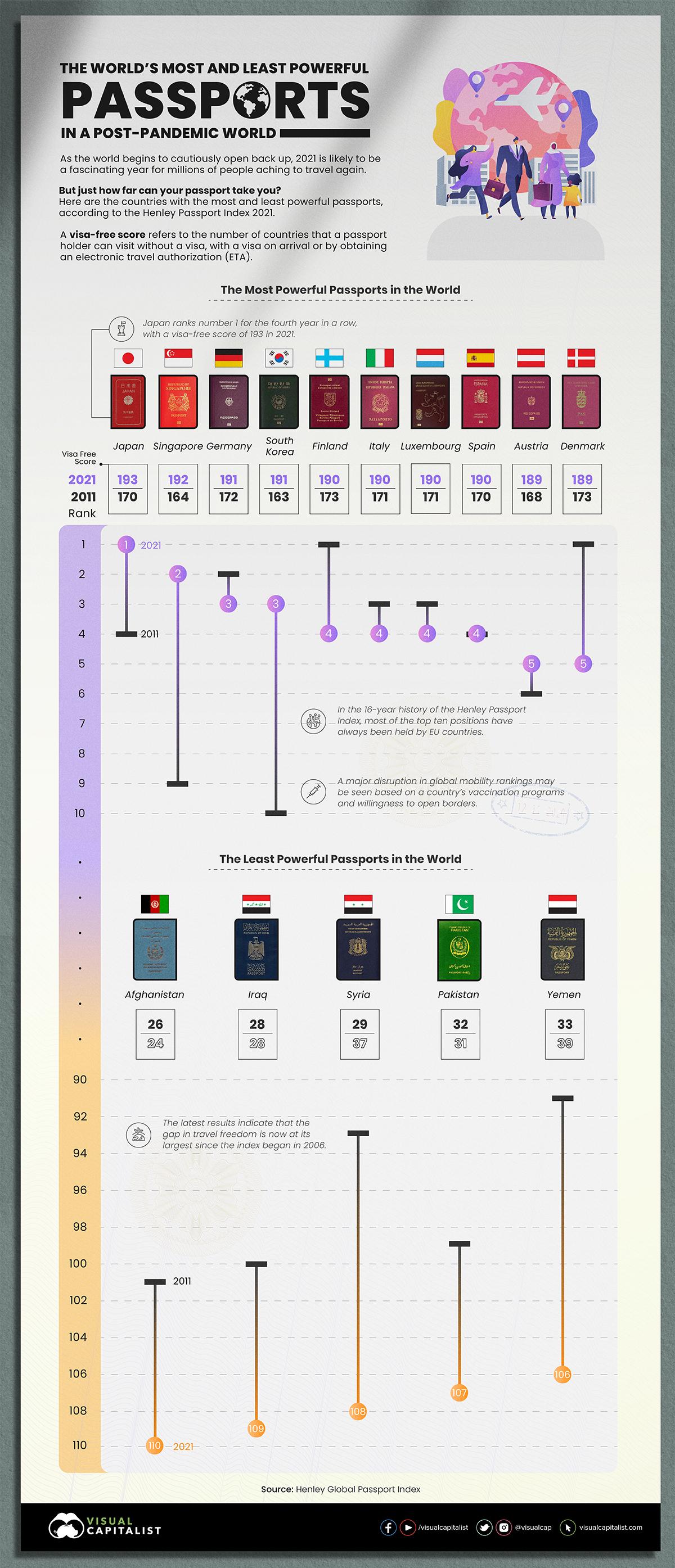
The rankings are based on the visa-free score of a particular country. A visa-free score refers to the number of countries that a passport holder can visit without a visa, with a visa on arrival, or by obtaining an electronic travel authorization (ETA).
Without considering the constantly changing COVID-19 restrictions, Japan firmly holds its position as the country with the strongest passport for the 4th year in a row.
This positioning is based on exclusive data from the International Air Transport Association (IATA)—with Japanese passport holders theoretically able to access a record 193 destinations from around the world visa-free.
The last time Japan didn’t hold the number one position was back in 2017, when it shared the 5th spot with countries like the United States, New Zealand, and Switzerland.
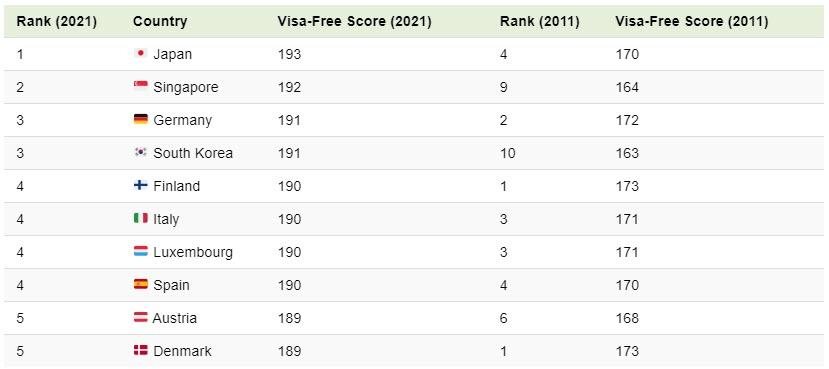
Singapore remains in 2nd place, with a visa-free score of 192, while Germany and South Korea again share joint-3rd place, each with access to 191 destinations.
Throughout the 16-year history of the Henley Index, EU countries have maintained a dominant position in the passport strength reports. Finland, Italy, Luxembourg and Spain all hold the 4th position while Austria and Denmark round up the top 5 with a visa-free score of 189.
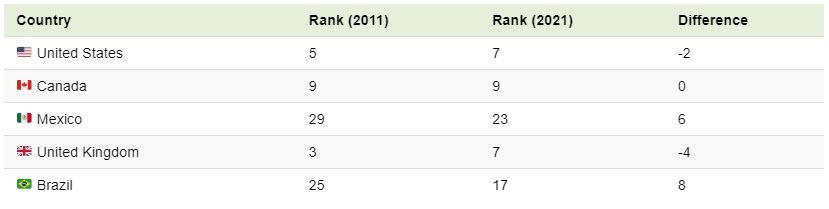
The United States and the United Kingdom jointly share the 7th position with a visa-free score of 187 destinations. Canada, Mexico and Brazil hold the 9th, 23rd and 17th positions respectively, with Brazil experiencing a significant jump of eight places over the last 10 years.
Editor’s note: Visit the Henley Passport Index site for a full list and ranking of all countries around the world.
The Countries With The Least Travel Freedom
Afghanistan continues to be the country with the least amount of travel freedom, coming in last place (110th rank) with a visa-free score of 26 destinations. Iraq, Syria, Pakistan and Yemen have access to slightly more visa-free travel, but still linger at the bottom of the overall ranking.
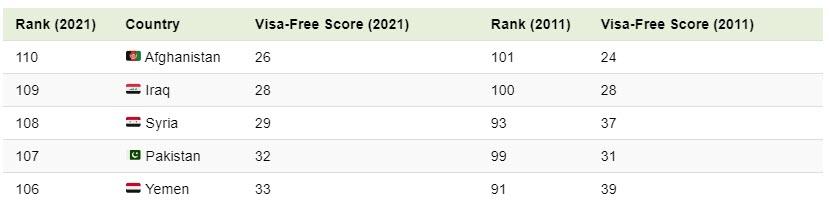
The latest report indicates that the gap in travel freedom is now at its largest since the index began in 2006. Japanese passport holders can access 167 more destinations than citizens of Afghanistan, who can visit only 26.
The Biggest Gainers In a Decade
Over time, small annual moves in the Henley Passport Index can make a big impact—and in the last decade, countries like China and the UAE have been the biggest movers:

China has risen by 22 places in the ranking since 2011 by going from a visa-free/visa-on-arrival score of 40 destinations to now 77.
The most remarkable turnaround story on the index by far, however, is the UAE. In 2011, the UAE was ranked 65th with a visa-free score of 67 destinations. Today, thanks to the Emirates’ ongoing efforts to strengthen diplomatic ties with countries across the globe, it is now ranked 15th with a remarkable visa-free score of 174 destinations.
Highlights of the day: Car chip supply to increase in 2H21
With more capcity support from foundry houses, car chip vendors can now ramp up their output. Some international automotive IC vendors have notified their clients that they can expect more supplies in second-half 2021. Foundry houses have been keen on expanding production capacity. Globalfoundries has just broken ground for a 12-inch fab construction project in Singapore. In the dispaly industry, glass substrate supplier Corning is said to be reducing supply to Korean clients who are set to terminate LCD panel production despite delays.
Automotive chip suppliers gearing up for output ramp-up: International automotive IC vendors have notified customers that they can expect 30% more in shipments during the second half of 2021, as compared to previous estimations, with their delivery lead times set to be shortened substantially from the over 50 weeks previously, according to industry sources in Taiwan.
Globalfoundries breaks ground for new fab in Singapore: Globalfoundries on June 22 broke ground for a new 12-inch wafer fab at its Singapore campus, according to the pure-play foundry.
Corning to adjust glass supply among panel makers: Corning is reportedly adjusting its supply strategy amid the tight supply of display glass substrates and the structural changes of the display industry, according to sources from Taiwan's supply chain.
Visualizing The World's Population By Age Group
An aging population can have far-reaching consequences on a country’s economy.
With this in mind, Visual Capitalist's Carmen Ang looks at the age composition of the global population in 2020 in the infographic below, based on the latest figures from the United Nations.
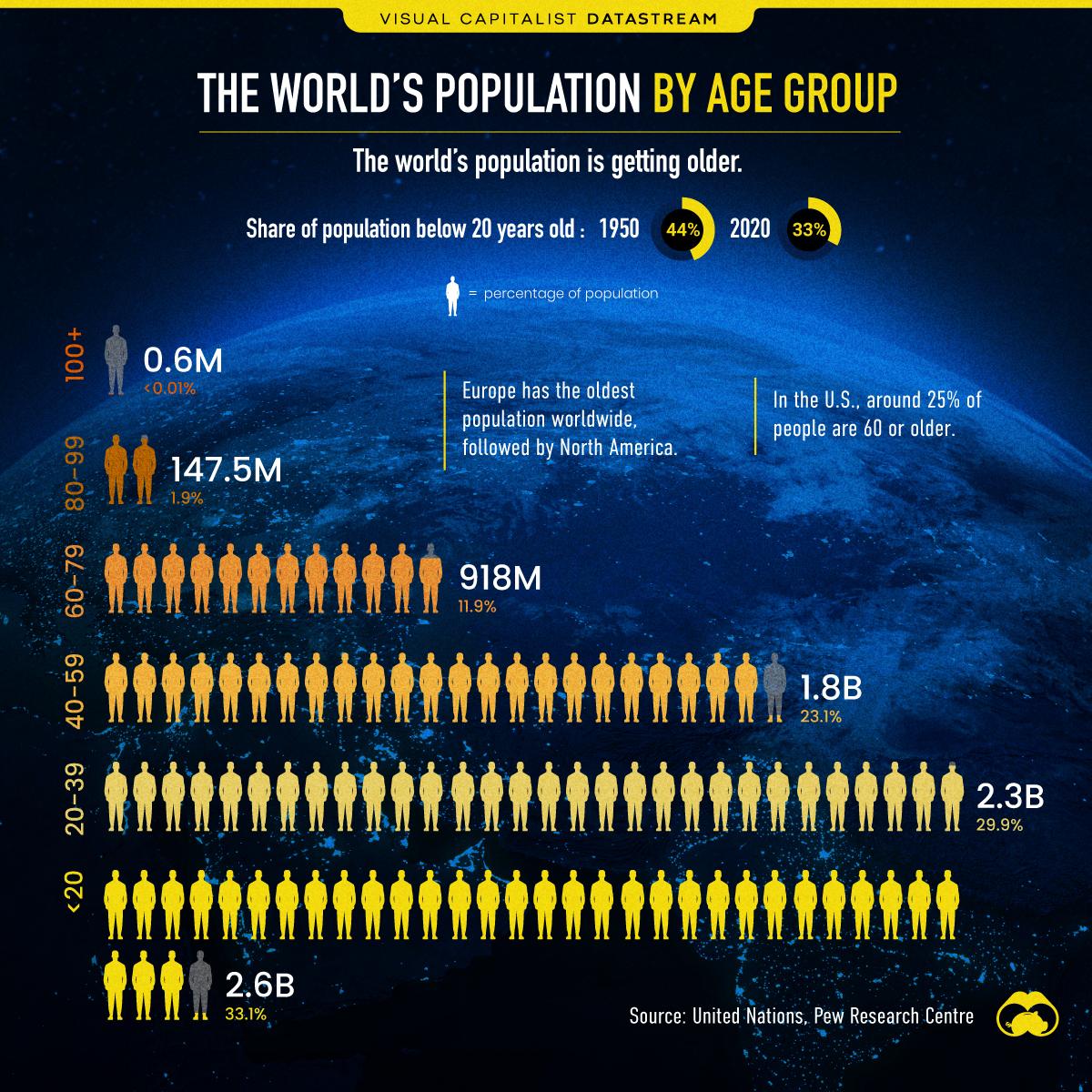
The Global Age Composition
Our global population is getting older, largely because of increasing life expectancies and declining birth rates.
In 2020, more than 147 million people around the world were between the ages of 80-99, accounting for 1.9% of the global population.
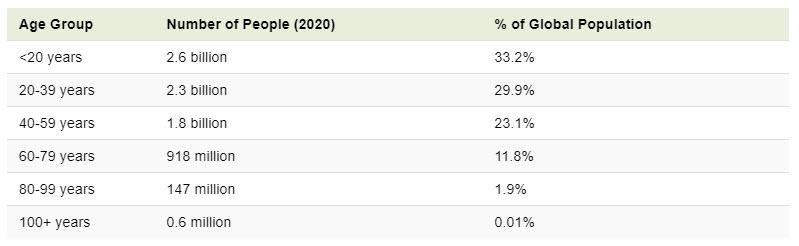
While that percentage may seem small, that particular demographic accounted for merely 0.05% of the population in 1950, meaning our world has a notably higher percentage of older people than it did 70 years ago.
Why is this significant? An aging population typically means a declining workforce and an increase of people looking to cash in their pensions. This can put pressure on the working class if taxes are raised.
Of course, an aging population can have positive impacts on society as well. For instance, elderly citizens tend to volunteer more than other age groups. And research has shown that older communities have lower crime rates. By 2050, the crime rate in Australia expected to drop by 16% as the country’s population gets older.
To mitigate some of the risks associated with a rapidly aging population, certain countries are working towards more sustainable pension systems, to support aging citizens while taking the stress off the working population.
Kuo: 2022 iPhones could feature under-display Touch ID, ‘lowest price ever’ for 6.7-inch iPhone
Reliable Apple analyst Ming-Chi Kuo is out with a new investor note in which he doubles down on his expectations for an all-new flagship iPhone lineup in the second half of 2022. The analyst says Apple will launch two low-end 6.1-inch and 6.7-inch flagships alongside two high-end 6.1-inch and 6.7-inch flagships.
Kuo reiterates that the 2022 iPhone lineup could feature support for under-display fingerprint technology and a wide-camera upgrade to 48MP. These devices would serve as the successors to the iPhone 13 series that will be released later this fall.
The 2022 iPhone lineup could look something like this in terms of marketing names: iPhone 14, iPhone 14, iPhone 14 Pro, and iPhone 14 Pro Max. Kuo says that the iPhone 14 Max will represent the lowest price ever for a large 6.7-inch iPhone:
We reiterate our previous key specifications forecast for 2H22 iPhone models, namely that Apple will launch two high-end iPhones (6.1″ and 6.7″) and two low- end iPhones (6.1″ and 6.7″) in 2H22.We believe the growth drivers for the new 2H22 iPhones will come from 1) the potential for under-display fingerprint support (using Apple’s own technology), 2) the lowest price ever for a large (6.7″) iPhone (we expect it to be under USD 900), and 3) a wide camera upgrade to 48MP for high-end models.
Kuo’s comments about pricing are particularly interesting. The analyst believes the iPhone 14 Max, or whatever it ultimately ends up being called, will be priced at under $900 USD. For comparison’s sake, the current iPhone lineup includes the 6.7-inch iPhone 12 Pro Max, which is priced at $1,099.
This also means that the iPhone 14 lineup will not include the 5.4-inch ‘iPhone mini’ form factor. This is something that Kuo has previously reported is due to lower-than-expected sales.
Kuo’s latest report today does not detail what sort of design changes to expect with the iPhone 14 lineup. In the past, however, he has said that the iPhone 14 Pro and iPhone 14 Pro Max will ditch the notch design for a new “punch-hole display” similar to what’s used in some flagship Android phones.
What do you think of the rumors about the 2022 iPhone 14 lineup? Let us know down in the comments!