(ZH) Hedge Funds Slash Gross Exposure As They Brace For Second Half Slowdown: Go

Hedge Funds Slash Gross Exposure As They Brace For Second Half Slowdown: Goldman Prime

Traders can commiserate with the following assessment of recent market action from Deutsche Bank's Craig Nicol, who this morning writes that "it feels hard to get much of a pulse on the market at the moment with this week in particular feeling like some of the summer lull and illiquidity factors are starting to weigh."
Confusion indeed reigns because despite 13 all time highs in the past 16 sessions, it sure doesn't feel like a euphoric market when breadth is collapsing and just a handful of stocks are pushing indexes to new highs. Meanwhile, with trillions in excess liquidity sloshing around and the Fed still injecting $120BN every month, woe to anyone who shorts stocks, especially any name that becomes the meme stock short squeeze du jour.
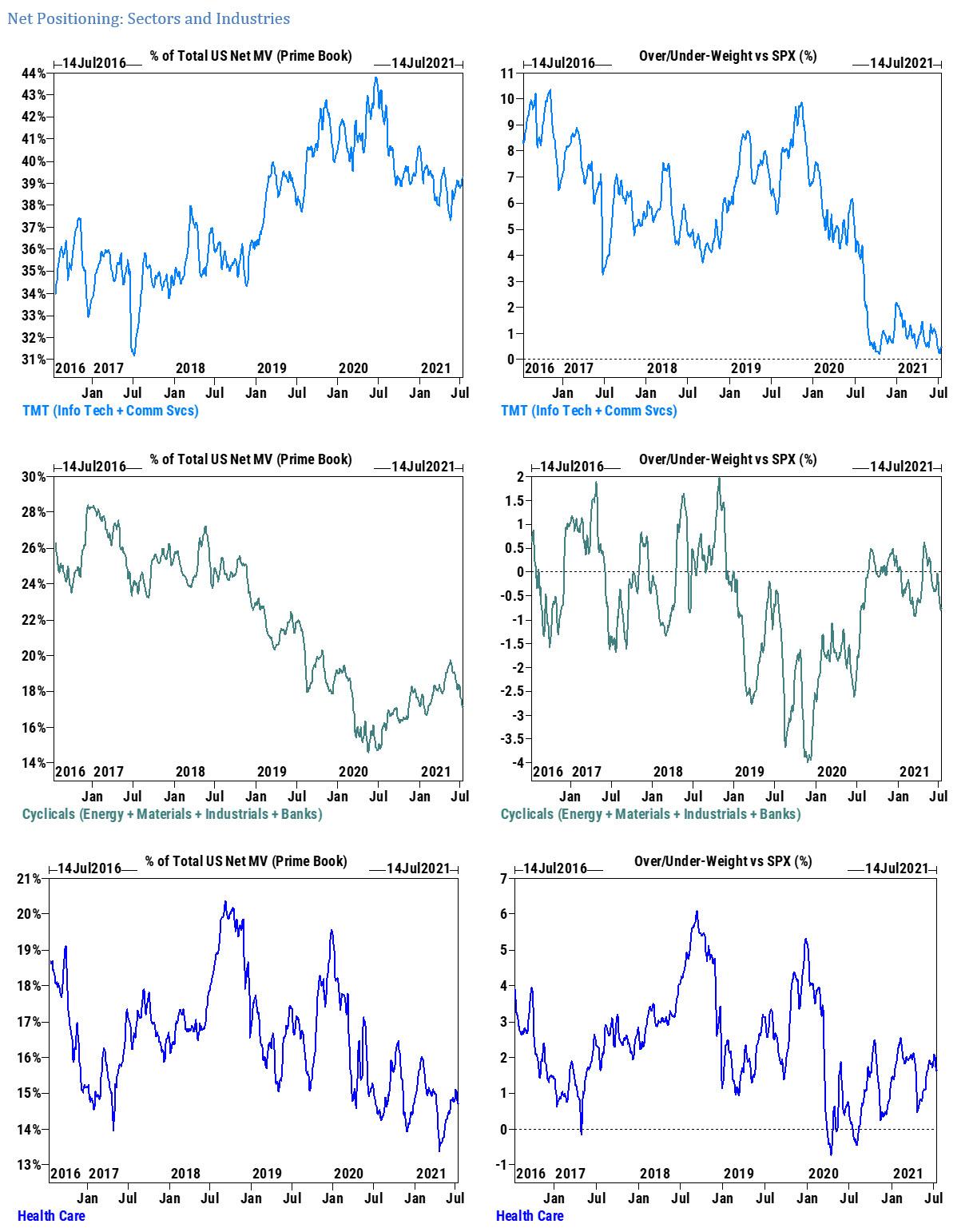
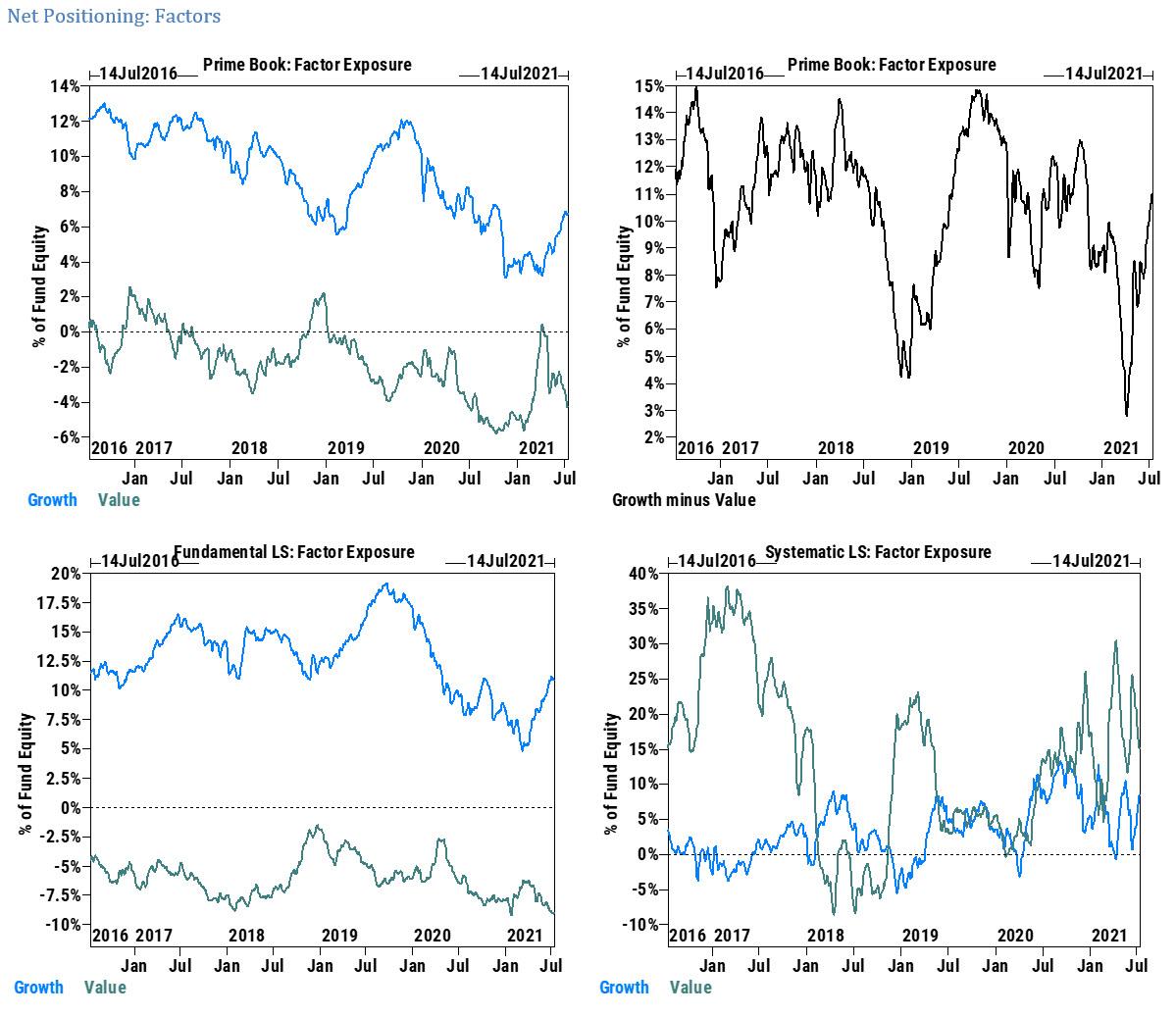
Amid this confusion it is therefore hardly surprising that hedge funds are cashing in (and hitting the Hamptons and St Barts). According to the latest Goldman Prime Analytics chartpack, the one prevailing them is accelerated degrossing as the 2 and 20 crowd scales down gross exposure as they lose conviction in this period of transition from value to growth (and soon, back to value), even as they remain net long for the most part.
As Goldman's PB team notes, here are the five top themes they are currently watching:
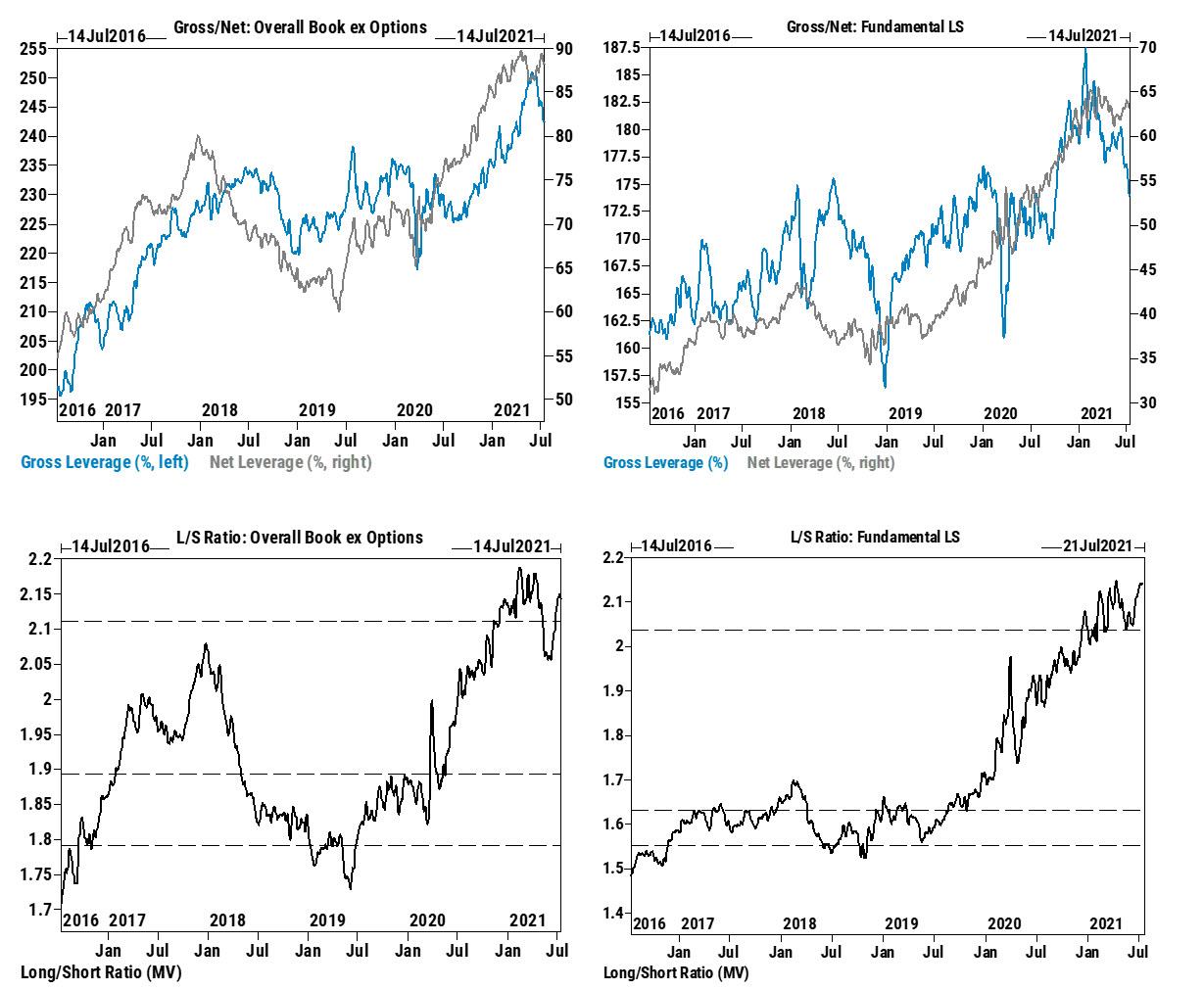
  • Hedge funds have reduced Gross leverage for four straight weeks, led by Fundamental LS managers whose Gross exposure is now in the 21st percentile vs. the past year.
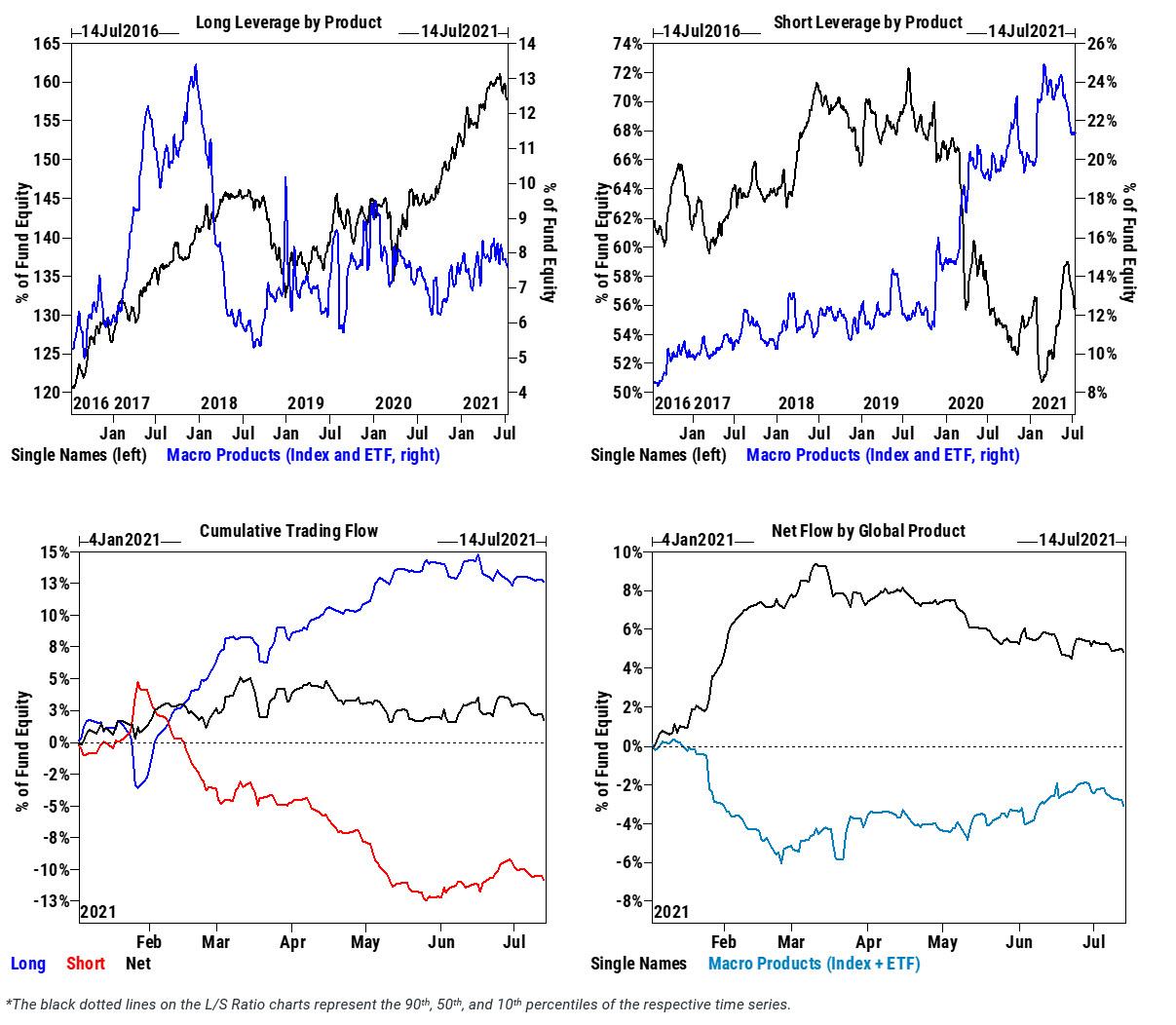
  • But Net leverage is relatively unchanged (and remains high) as both long and short exposures have come down in Single Names as well as Macro Products.
Managers are now the least O/W Chinese equities since Jun ’19, driven by continued rotation out of offshore listings (link) on the back of heightened US-China tension and policy fears.
  • Positioning movements by region (into US), sector (into TMT), and factor (into Growth) all point to increased expectation of a cyclical slowdown in 2H ‘21. That said, the latest QuickPoll survey results show that the broader investor community is still split 50/50 on the transitory vs non transitory market narrative.

Software – not Internet nor Semis – has been the dominant driver of the recent increase in US TMT positioning, consistent with the observation from GS TMT Specialist Pete Callahan, while the L/S ratios in several Consumer Disc subsectors – all trending up in recent weeks – suggest higher confidence in the strength of the US consumers and select reopening plays.

(ZH) The Hangover Is Here: Explosive Inflation Leads To Record Collapse In Home,

The Hangover Is Here: Explosive Inflation Leads To Record Collapse In Home, Car Purchase Plans

For the past several months we have warned about the pernicious effects soaring prices are having on both corporations ("Buckle Up! Inflation Is Here!") and consumers (""This Is Not Transitory": Hyperinflation Fears Are Soaring Across America"), prompting even otherwise boring sellside research to get (hyper) exciting, with Deutsche Bank (which warned this week that "Inflation Is About To Explode "Leaving Global Economies Sitting On A Time Bomb"") and Bank of America (which "Just Threw Up All Over The Fed's "Transitory" Argument") now openly claiming that the Fed is wrong, and the US is facing an unprecedented period of far higher, non-transitory inflation, with DB going so far as to warn "policymakers will face the most challenging years since the Volcker/Reagan period in the 1980s."
But none of this has spooked the Fed into conceding - or believing - that inflation is anything more than transitory. And maybe just this once, the Fed has a point because all else equal, by which we mean lack of rising wages, the best cure to higher prices is, well, higher prices.
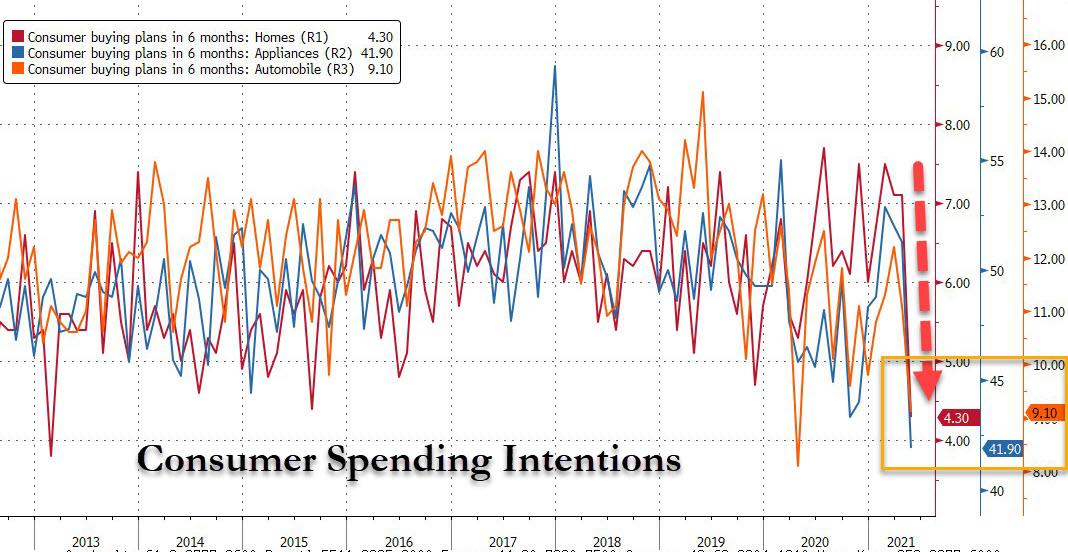
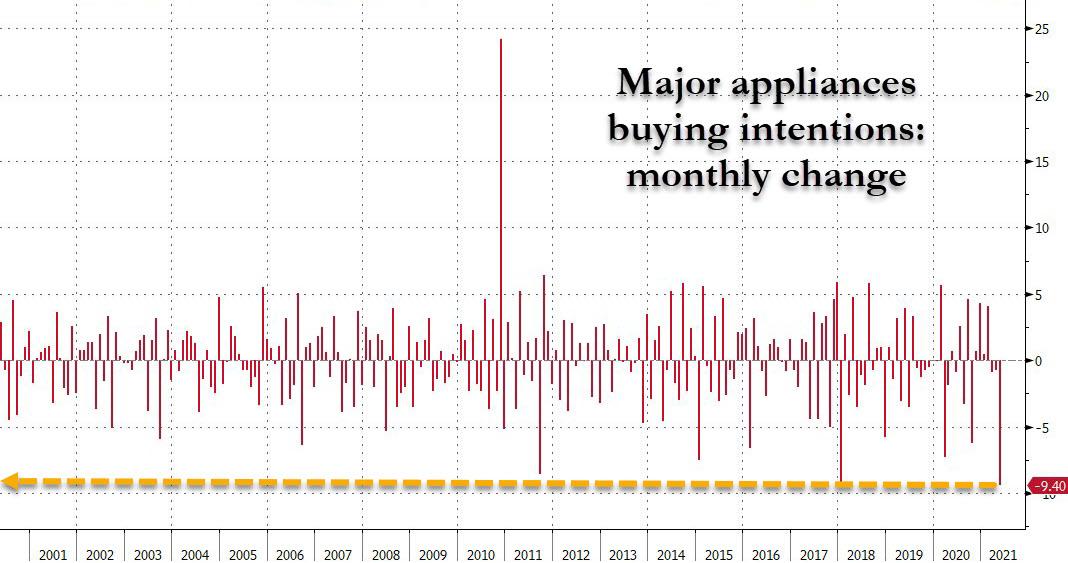
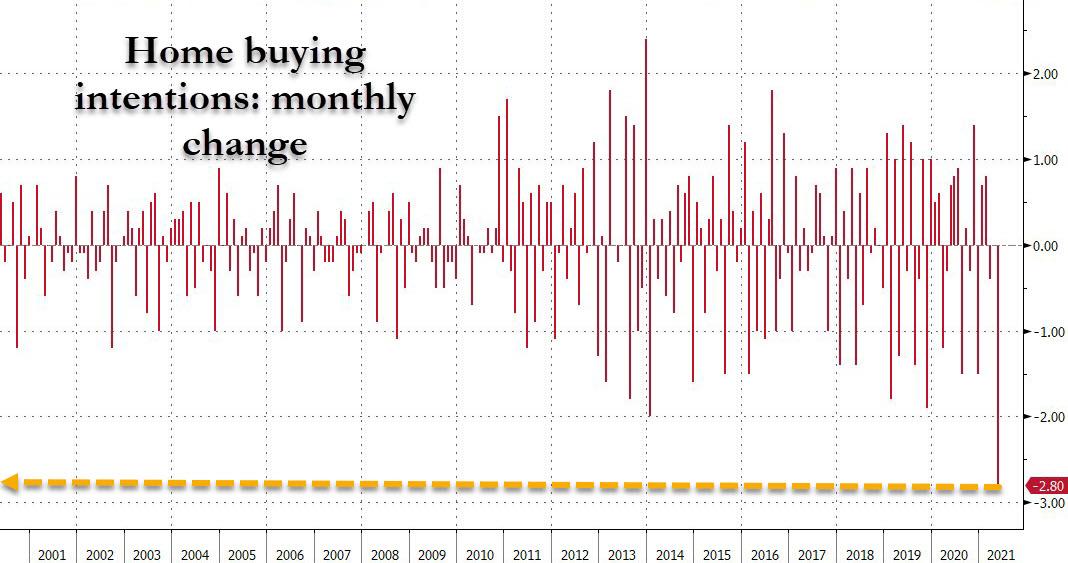
Presenting Exhibit A: Last month we observed that anticipating an end to Biden's stimmy bonanza end and that soon they will have to live again within their means, Americans' buying intentions (6 months from today) as measured by the Conference Board, had cratered across the 3 major spending categories: homes, automobiles and major household appliances.
The drop was so massive, it amounted to the biggest one-month drop in intentions to purchase appliances...
... and homes...
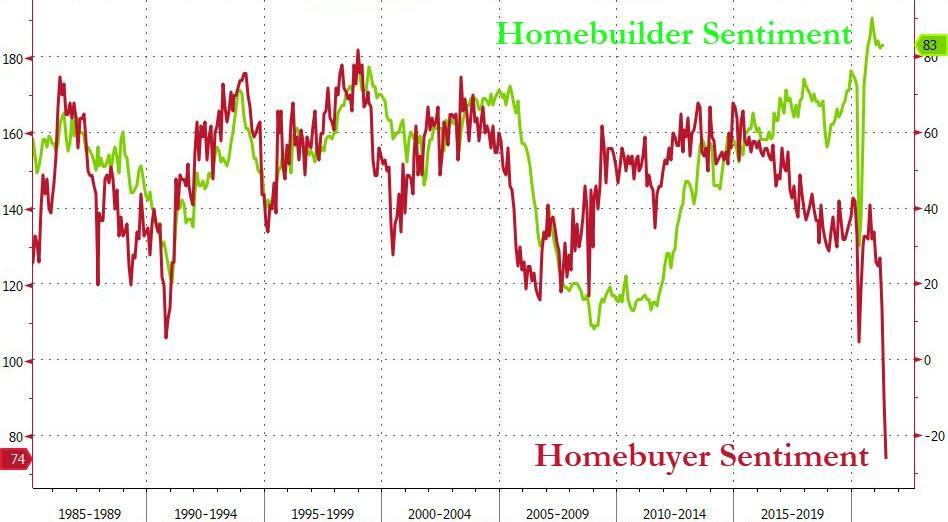
This confirms what we noted earlier, namely a record divergence between crashing homebuyer confidence (due to record home prices) and soaring homebuilder confidence (also due to record home prices). Guess which one will matter in the end.
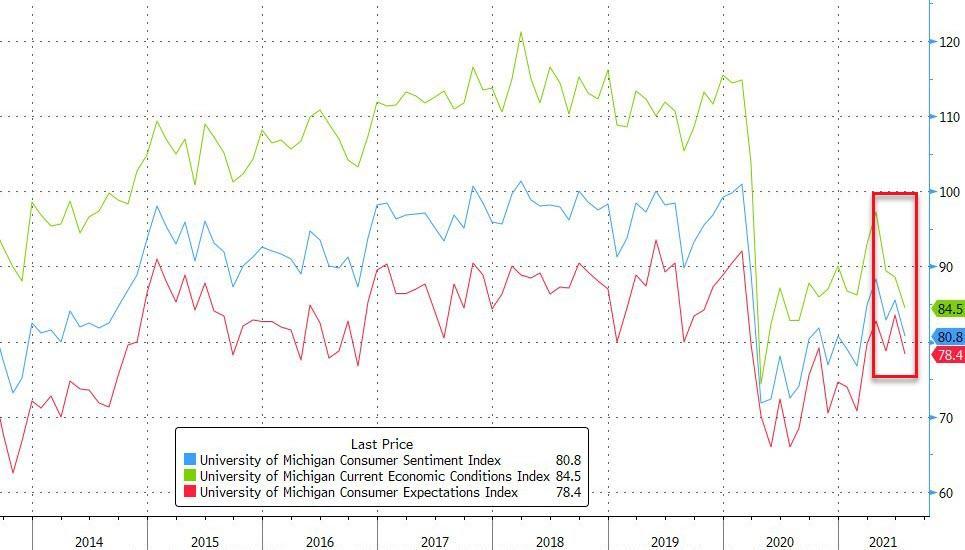
Fast forward to today when we just got Exhibit B: the June UMichigan Sentiment Survey. Here things quickly got ugly, because not only did all the sentiment indicators miss across the board...
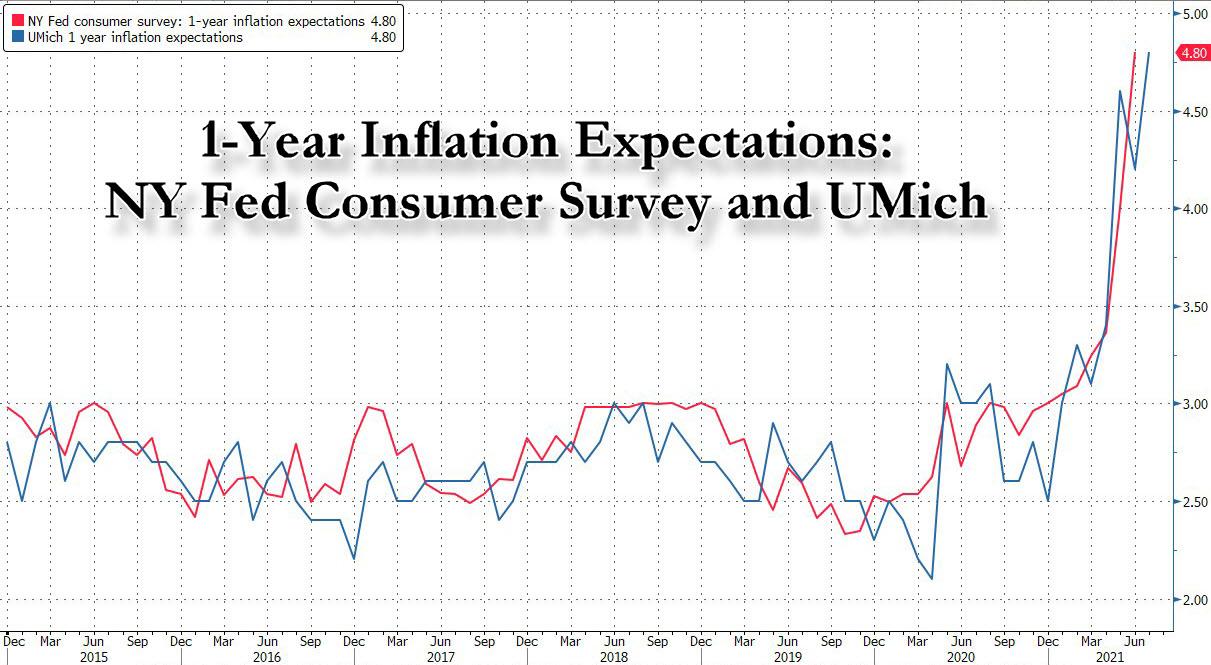
... but in a stark reversal of last month's "good news" when inflation expectations dropped slightly, in the preliminary July number, 1 year inflation expectations unexpectedly exploded higher, from 4.3% to 4.8%, surpassing the May high and printing at the highest level since June 2008 (confirming the NY Fed's own survey of consumer expectations that this is anything but transitory), with 5-10 year inflation expectations also rising from 2.8% to 2.9%, pouring cold water on any "transitory" argument.
But what we found even more concerning is what chief economist, Richard Curtin said namely that "rather than job creation, halting and reversing an accelerating inflation rate has now become a top concern." As Curtin adds, "Inflation has put added pressure on living standards, especially on lower and middle income households, and caused postponement of large discretionary purchases, especially among upper income households."
It gets worse because as the UMich director notes next, "consumers’ complaints about rising prices on homes, vehicles, and household durables has reached an all-time record."
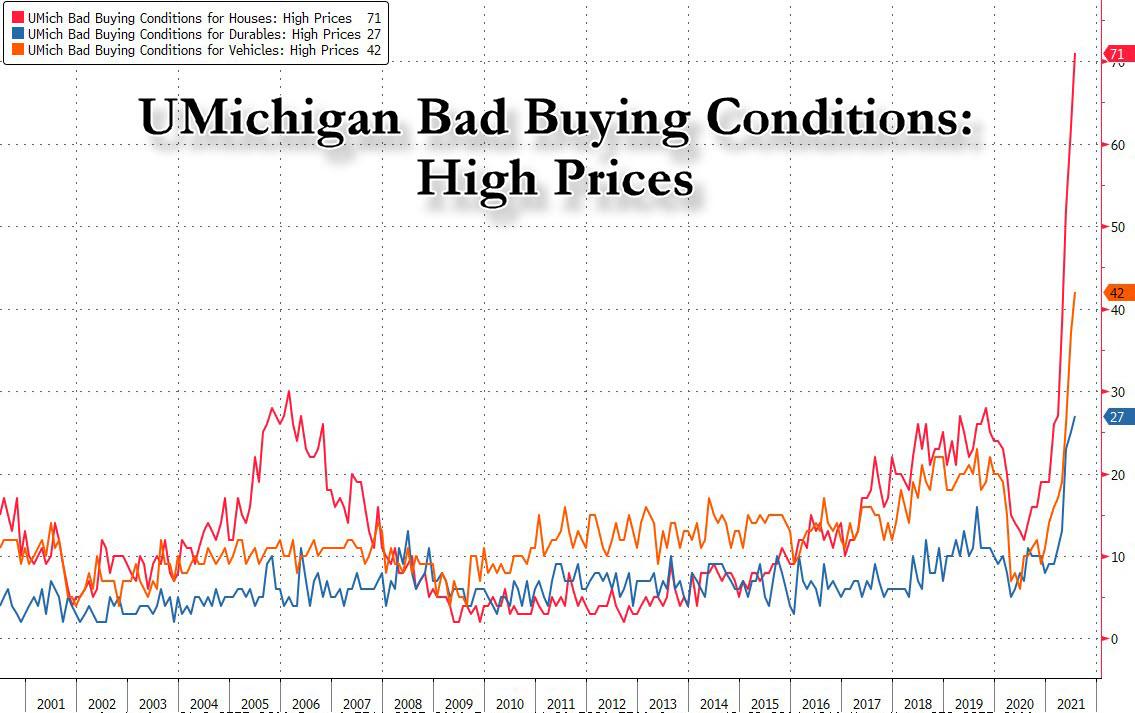
This can also be seen in the following chart showing records across the board for "bad buying conditions" due to high prices for houses, durable goods and autos. In other words, due to soaring prices, America is going on a buyers' strike!
The silver lining is that so far, excess savings from trillions in stimmies have successfully offset this looming threat. As Curtin elaborates, "purchase rates have benefitted from record increases in accumulated savings and reserve funds" but as he concedes, "a critical issue is whether consumers will find greater value in keeping a significant portion of their savings as a precautionary hedge, or spending a significant portion in an effort to avoid their inflationary erosion and to benefit from buying-in-advance of increasing market prices."
The mask will quickly fall away however, giving way to a full blown stagflation in early 2022, if inflation is not transitory, and here is Curtin admitting just that: "the precautionary impulse will quickly fade if the “transitory” spike in inflation extended into 2022." Meanwhile, "resurgent consumer spending propelled by fiscal stimulus is likely to increase inflation" while "small policy steps could now have a large impact on ending inflationary psychology."
This means that another round of stimmies - which is what the current round of Delta strain fearmongering is all about - could actually have negative consequences this time.
But wait, it gets worse: as Curtin admits, this time may indeed be different, because "every instance of a comparable rise in near-term inflation expectations since 1990 was eventually countered by the maintenance of a much lower expected long-term inflation rate" something we have not yet seen this cycle. That's because "the factors that now underlie the recent surge in inflation are quite unique. A rising inflation in the months ahead may convince consumers that they underestimated its eventual rise, causing them to revise how high it will climb and how long the inflation runup will last."
In other words, if the Fed is wrong that inflation is "transitory", then the US economy is about to suffer a very painful hard-landing. Not only that, but the last trace of Fed "credibility" will be erased.
Oh, and for those saying wage hikes may be permanent we have some bad news: employers know very well that the extended unemployment benefits bonanza ends in September at which point millions of currently unemployed workers will flood back into the labor force sending wages sharply lower, and is why instead of raising base pay, most potential employers offer one-time bonuses, which - as the name implies - are one-time. As for higher wage pressures, well... just wait until October when everything reverses, Uncle Sam is no longer a better paying competitor to the US private sector, and wages slump.
What does that mean for the economy? Well, all those producers and retailers who got used to bumper demand and pushed their prices sharply and not so sharply higher, will face a stark choice: either drag prices right back down, or sell far fewer goods and services. That, or just await the next bailout.
One thing is certain: six months from today - if today's soaring inflation has not faded away - the US economy will be far, far uglier.

FT : Richemont/luxury: top brands strengthen their grip on big spenders

Richemont/luxury: top brands strengthen their grip on big spenders
Swiss group shows off sparkling numbers amid a broad rebound in high-end jewellery sector

Swiss luxury group Richemont is showing off some sparkling numbers. Amid a broad rebound in the luxury sector, it more than doubled sales for the three months to June. The upswing in demand for pricey labels has also helped Burberry to report sales that are back at pre-pandemic levels. But Richemont’s leading position in jewellery should help it to continue making outsized gains.

The sustainability of the luxury recovery now looks assured. There were concerns that a short-term boost from consumers’ inability to splash their cash savings on experiences might reverse once economies reopen.

Yet the resilience demonstrated by mega-brands such as Cartier and Van Cleef & Arpels has not flagged. Both are benefiting from a long-term shift towards branded jewellery, particularly driven by Asian clientele. Innovations such as Clash — an edgy, modern and relatively affordable line unveiled by Cartier in 2019 — have proved popular with younger buyers. 

There is room to grow market share. Branded jewellery accounts for little more than a quarter of the market at present, far less than other luxury sectors. It could rise to 40 per cent by 2030, says Citi. Not that Richemont will lack competition. Other fashion groups wish to move further into high-end branded jewellery. This was illustrated by rival Kering’s enthusiasm for a tie-up, which was firmly rejected by Richemont's chair Johann Rupert.

Accordingly, there is not much of a speculative premium in the share price. This has not stopped Richemont from outperforming in the luxury sector this year, rising by 37 per cent. Even so, the shares — on a 2022 price-to-earnings ratio of 27 — trade at a 10 per cent discount to the sector.

That discount should close in time, but it will not disappear. Hard luxury like jewellery is more cyclical than fashion or leather goods. Purchases of bigger-ticket items are more likely to be postponed in downturns. But the growth in branded jewellery is a secular trend. Richemont is exceptionally well-placed to benefit.

FT : UK to take start-up stakes in wider push to promote tech sector

UK to take start-up stakes in wider push to promote tech sector
Chancellor to launch new fund backing R&D-intensive companies and shake up competition rules

The UK government is planning to take large stakes in promising British start-ups as part of a wider push to support the tech industry, which will include overhauling competition rules and issuing “new tech visas” to attract talent.

Chancellor Rishi Sunak will on Tuesday invite founders and tech entrepreneurs to a summit where he is set to launch the Future Fund Breakthrough, a £375m fund that will invest in a handful of R&D intensive companies looking to grow quickly. 

The launch of the fund comes after a bumper month for the UK technology sector in which Revolut, the London-based digital banking start-up became the UK’s most valuable private tech company of all time when a new fundraising valued the company at $33bn. In a further boost, British fintech company Wise, formerly known as TransferWise, listed in London last week with a market value of more than £8bn.

The government wants to back new digital champions in the UK to compete with rivals in the US and China and plans a number of announcements in coming weeks to support start-ups and help grow promising companies in tech, life sciences and other areas of innovation. Government efforts will include taking stakes directly in firms through the Future Fund Breakthrough.

Unlike an earlier version of the fund — launched in April 2020 — the new scheme is not aimed at supporting companies hit by the pandemic. Instead, it will back British companies needing money for research and development to accelerate the deployment of breakthrough technologies.

Eligible companies need to aim to raise at least £20m from private investors in a planned fundraising. 

The government is also launching consultations on a new “digital markets unit” to help curtail the dominance of the large US technology groups such as Google and Apple, according to people familiar with the matter. 

It is hoped the new competition watchdog will open up markets for smaller UK start-ups by ensuring easy and equal access to app stores, and challenge potentially unfair use of software bundling and licensing deals. Large companies will be given “strategic market status” and a code of conduct that will come with potential fines up to 10 per cent of revenues.

In a bid to address the concerns of tech executives, who have raised the alarm about a shortage of skilled programmers and other staff after Brexit ended the free movement of people from the EU, the government is working in tandem on the details of a new visa system.

This will allow “talented entrepreneurs” to live and work in the UK. Under the “innovator visa” scheme, entrepreneurs will be given visas either if they have approval from an “endorsing body” or if they have secured funding from a source recognised by one. There are more than 50 endorsing bodies that can give out visas under the system.

A separate system is being drawn up for “scale-up visas” to help fast growing tech companies hire talented staff from abroad.

Commenting on the government initiatives, Dominic Hallas, executive director of Coadec, which represents UK start-ups said: “The last year has been really positive. The big question now is about how we make sure the regulatory agenda doesn’t overshadow all the progress.”

In parallel with Treasury plans, the business secretary Kwasi Kwarteng will next week launch a 10-point innovation strategy, in support of next generation technologies in the UK such as quantum, life sciences, genomics, robotics and artificial intelligence. 

Proposals include improving access to finance for fast-growing but risky ventures, and cutting red tape that is holding back development in some sectors. 

The Treasury did not comment.

FT : Lordstown Motors under investigation by US federal prosecutors

Lordstown Motors under investigation by US federal prosecutors
Electric vehicle start-up is already facing a probe from securities regulator

Federal prosecutors are investigating electric vehicle start-up Lordstown Motors, examining its pre-orders and merger last year with special purpose acquisition company DiamondPeak Holdings.

The company disclosed the probe by the US attorney’s office for the southern district of New York in a regulatory filing on Thursday.

In March, short seller Hindenburg Research accused the Ohio manufacturer of inflating pre-orders and exaggerating the viability of the technology used in its flagship pickup truck, the Endurance.

The US Securities and Exchange Commission has been examining the company for months and has sent it two subpoenas. Thursday’s filing is the first confirmation from the company that there is also a criminal investigation.

“We have co-operated, and will continue to co-operate, with these and any other regulatory or governmental investigations and inquiries,” Lordstown said in the filing.

Lordstown attracted national attention in 2019, when it said it would buy the auto plant that General Motors planned to close in north-east Ohio, a region that has struggled economically. The Detroit automaker loaned the start-up $40m for the purchase.

As the auto industry is shifting towards electric vehicles, Lordstown was seen as one player in the push to revitalise the area.

But three months after Hindenburg Research published its report about the company, Lordstown acknowledged that some of its pre-orders were unlikely to result in purchases.

“One entity that provided a large number of pre-orders does not appear to have the resources to complete large purchases of trucks,” the company said, while others “provided commitments that appear too vague or infirm to be appropriately included in the total number of pre-orders disclosed”.

But the manufacturer defended its technology and production timeline, saying Hindenburg Research’s criticisms were inaccurate.

In June, however, the company warned that it did not have enough cash to start production of the Endurance and that its business could fail. Less than a week later, both the chief executive and chief financial officer resigned.

FT : Phoebe Philo, the cult fashion designer returns

Phoebe Philo, the cult fashion designer returns
Known for creating elegant, empowering clothes, the industry darling is back with her own label

In September 2018, on the evening of Hedi Slimane’s debut show for the LVMH-owned fashion label Celine, a group of women gathered outside Paris’s La Bar Du Caveau to honour his predecessor, Phoebe Philo.

The “Philophiles” — among them fashion stylist Yasmin Sewell, jewellery designer Gaia Repossi and model Daniela Kocianova — were clad in roomy shirts, baroque pearl earrings and wide, pleated trousers, their cashmere jumpers tied cross-body in imitation of Philo herself. They were there to toast a designer who, for a decade, had been the de facto outfitter of fashion’s in-crowd, as revered for the exact cut of her trousers and trenchcoats as for her ability to chart the course for the industry season after season.

Three years after stepping away from the white-hot centre of fashion — during which she focused on raising her three children in London — Philo is back. This week, the 48-year-old British designer announced she would launch a namesake label with minority backing from her old employer, LVMH. She promised clothing and accessories of “exceptional quality and design” (read: prices at the higher end of the luxury goods spectrum) and said that further information would be forthcoming in January.

The announcement sent ripples across an industry that had long speculated that Philo would succeed Karl Lagerfeld at Chanel, or take the top post at a multibillion-revenue house such as Burberry. But Philo has long harboured ambitions to run her own label, telling The Guardian in 2009 that after stepping down from Richemont-owned Chloe, where she was creative director from 2001 to 2006, she had explored launching her own line, but “the time wasn’t right and then Celine came along and it just fitted”.

Securing backers for her venture was presumably easier this time around. Philo, alongside then chief executive Marco Gobbetti, quintupled Celine’s sales to just over €900m between 2008 and 2018, according to Citi luxury goods analyst Thomas Chauvet.

“Phoebe has an incredible talent for anticipating and creating the new objects of desire for her audience,” says Gobbetti, the outgoing Burberry chief executive who hired her in 2008. “At Celine, she had a transformative impact on fashion and luxury, coming out of the recession and creating incredible desire and excitement for timeless yet modern investment pieces.”

“We were all designing for Phoebe at the end of the day,” says designer Rok Hwang of Rokh, who worked under Philo from 2008 to 2012. “She was really the muse.”

Born in Paris and raised in London, Philo was given a sewing machine for her 14th birthday. She went to Central Saint Martins with Stella McCartney, whose right hand she went on to be at Chloe before succeeding her there in 2001. At Chloe, Philo was credited with ushering in the trend for baby doll dresses and heavy leather accessories, such as the Paddington bag.

Known for designs that made women feel both empowered and elegant, her tenure at Celine was marked by a succession of “it” bags — among them the Trapeze and Luggage totes, and the slim Trio cross-body — and timeless, pragmatic clothes that sometimes command above-retail prices on second-hand websites.

Her designs often challenged conventional good taste before coming to define it: fur-lined slippers, trainers with dresses, the single earring. “She was the first to mix neons with subtle colours,” says former Barneys fashion director Marina Larroude of the trends she introduced. “Now it sounds dumb, because everyone does it. But whatever she put on the runway, you knew that it was going to be what the masses were going to see in the next decade.”

Described as “precise,” “private”, “enigmatic” and in possession of a “clear vision”, friends and former colleagues say what sets her apart from other designers is a commitment to high standards — “I find mediocrity hard,” she told British Vogue in 2014 — and a total focus on the customer.

“Phoebe’s way of thinking is really different from anyone I’ve worked with before and after,” a former design colleague says. “Especially in a male-dominated industry, which fashion unfortunately is, it’s very rare to have someone who really thinks about the final customer, and thinking about whether this is practical, can you drop off your kids at school doing this, is the earring too heavy.”

Former colleagues say she resisted trends proposed by Celine’s marketing teams. One recalls a long search by Philo for a suitable chain to use during a trend for bags with chain straps, which she believed dug into women’s shoulders. “I don’t like clothes imposing themselves on women,” Philo said of the tension between fashion and function in 2014. “They are to be used in real life.”

Though Celine’s revenues grew quickly, and Barneys sold “multimillions” of Philo-designed jumpers annually, “she was not a commercial designer”, says Larroude. “She didn’t want to do the beauty and the men’s, she didn’t want the machine. I think she wanted to keep it at a certain standard.” Those who know and have watched Philo closely believe she will take the same approach to her own venture. 

“We just all naturally assumed that other brands would fill the gap [left by Philo after she left Celine] and they didn’t,” the former colleague observed. “If there’s so much excitement that she’s back, it’s because no one was able to fill that void.”
Reuters- Exclusive-Louis Vuitton-backed L Catterton explores public listing -sou

Exclusive-Louis Vuitton-backed L Catterton explores public listing -sources

(Reuters) - L Catterton, the private equity firm backed by French billionaire Bernard Arnault and luxury goods empire Louis Vuitton Moet Hennessy, is exploring options to go public, according to people familiar with the matter.
L Catteron's deliberations come as the shares of publicly listed private equity firms are hovering at record highs.

Peers TPG and Bridgepoint Group are preparing for stock market debuts, while Owl Rock Capital Group and Dyal Capital Partners went public in May in a three-way merger with a special purpose acquisition company (SPAC).
L Catterton has held discussions with investment banks in recent weeks to evaluate its potential options, which could include an initial public offering or a SPAC merger, the sources said.
The sources cautioned that discussions are at an early stage and no final decision has been made.
They spoke on condition of anonymity because the deliberations are confidential.
L Catterton declined to comment.
Headquartered in Greenwich, Connecticut, L Catterton manages more than $28 billion in assets. It was created in 2016 as a joint venture between consumer-focused private equity firm Catterton, Louis Vuitton owner LVMH and Groupe Arnault, Arnault's family holding.
It has been a prolific investor and acquirer of luxury consumer businesses, such as German footwear brand Birkenstock and upscale fitness brands Equinox and Peloton Interactive Inc. It has invested in more than 200 retail businesses.
Several of its portfolio companies are currently evaluating options to go public or have gone public over the past year, including Honest Co, founded by Hollywood actress Jessica Alba, and car retailer Vroom Inc.
The shares of publicly listed managers of assets such as private equity have soared in recent months, as the stock market rally boosted the value of their holdings and low interest rates allowed them to use cheap debt to juice returns on their deals.
Private equity firms Blackstone Group Inc, KKR & Co, Apollo Global Management and Carlyle Group have gained between 21.4% and 58% this year, outperforming the 16.1% advance by the S&P 500 index.