Barrons : Synthetic Biology Could Be the Next Big Thing. Here’s How to Play It.

Synthetic Biology Could Be the Next Big Thing. Here’s How to Play It.

Synthetic biology is in its infancy, but it’s drawing comparisons to the internet of a generation ago. Bill Gates, Cathie Wood, and venture capitalist John Doerr are among those who are investing in synthetic biology companies.

What excites investors is the promise of programming the DNA of microorganisms like yeast as if they were computers and getting them to produce products more cheaply and with a lower carbon footprint than traditional manufacturing.

Synthetic biology could reduce the need for petroleum-based chemicals as well as for plant- and animal-based products, benefiting the environment. Proponents say that the total addressable market is over $1 trillion.

“This is what it might have been like 25 years ago if some guy had walked up to you and said the internet was going to be an amazing investment and you had no idea what he was talking about,” says Rick Schottenfeld, the general partner of the Schottenfeld Opportunities fund, an investor in Amyris. “This is where we are with synthetic biology.”

Yet for all the bold claims and hopes for an industry once known as industrial biotech, revenue overall currently totals less than $1 billion. And no one is making a profit.

Synthetic biology has so far produced mostly niche products like squalane, a moisturizer formerly sourced from shark liver; vitamin E; a sugar substitute; and vanillin. Amyris, which makes an estimated 70% of the world’s squalane using engineered yeast cells and sugar cane, says its efforts have saved as many as three million sharks a year.

The small scale of the industry at present hasn’t dimmed investor interest in the three main plays on synthetic biology: Amyris (ticker: AMRS), Zymergen (ZY), and Ginkgo Bioworks. Ginkgo is due to go public in the current quarter through a merger with Soaring Eagle Acquisition (SRNG), a special-purpose acquisition company, or SPAC. It will be renamed Ginkgo Bioworks Holdings.

Investors may want to take a basket approach to the stocks. The combined market value of the three is $25 billion.

Synthetic biology, which blends biotechnology and industrial chemistry, isn’t an easy concept to grasp. The “magic of biology,” Ginkgo CEO Jason Kelly has noted, is that cells run on something akin to a computer’s digital code. Instead of zeros and ones, the four DNA base pairs — adenine, cytosine, guanine, and thymine— guide cells.

“Think of synthetic biology as hijacking the natural biology of the cell and reprogramming it to produce something of interest,” says Doug Schenkel, a Cowen analyst who has Outperform ratings on Amyris and Zymergen. “Rather than have yeast make beer, you hijack it to make the scent of a flower.”


Programming DNA, of course, is harder than programming computers, but progress is coming quickly.

With impressive DNA coding capabilities, Ginkgo views itself as the industry’s Amazon Web Services, working with companies in consumer, pharmaceutical, and agricultural areas to design microorganisms and cells from mammals to make desired products or drugs. It provided help to Moderna (MRNA) in its development of the Covid-19 vaccine.

“Ginkgo is looking to build a platform to make biology and cells as easy to program as computers,” says Kirsty Gibson, a portfolio manager at Baillie Gifford, which is buying stock in Ginkgo as part of the SPAC deal. “What’s really exciting is that it’s not limited by industry verticals—agricultural, flavor and fragrances, pharmaceuticals, food.”

Amyris’ controlling shareholder is one of the country’s most successful venture capitalists, John Doerr, who was an early investor in Alphabet (GOOGL) and Amazon.com (AMZN).

“I believe synthetic biology will continue to be a big part of making our planet healthier and our future more sustainable,” Doerr tells Barron’s. “Amyris is delivering on the promise of synthetic biology.” Doerr is chairman of Kleiner Perkins, the Silicon Valley venture-capital firm.

Synthetic-biology manufacturing often involves large fermentation tanks filled with genetically re-engineered microorganisms like yeast that are filtered out of the finished product. This manufacturing technique uses little energy, but is unproven on a major scale.

Amyris is the furthest along, based on revenue and products. It projects $400 million in 2021 sales and break-even results based on earnings before interest, taxes, depreciation, and amortization, or Ebitda. Amyris, whose shares trade around $13.50, is valued at $4 billion and looks like the best bet. Its CEO, John Melo, sees a potential $2 billion in sales and $600 million of Ebitda in 2025.

With an all-star investor lineup including Gates’ Cascade Investment, Ginkgo has generated the most buzz. Based on the SPAC transaction, it has the highest market value of the three—about $18 billion. Its projected 2021 revenue, however, is very modest, about $100 million.

Perhaps reflecting its lofty valuation, Soaring Eagle Acquisition shares haven’t budged since the May SPAC deal. The result is that investors can buy the stock for $9.95, a slight discount to the price of $10 at which several prominent investment firms including Cathie Wood’s Ark Investment Management and Baillie Gifford, an early backer of Tesla (TSLA), agreed to invest $775 million as part of the SPAC merger with Ginkgo.

Ginkgo calls its microorganism design fees “foundry revenues.” It has royalty deals or equity stakes in 54 partners, and is working with Bayer (BAYRY), Roche Holding (RHHBY), Sumitomo Chemical (4005.Japan), and Robertet (RBT.France), a maker of flavors and fragrances.

Zymergen, which went public in April at $31, is focused on consumer electronics. It has developed a durable optical film called Hyaline, which can be used on foldable cellphones and tablets. Now trading around $35, Zymergen is valued at $3.5 billion. SoftBank Goup’s (SFTBY) venture fund and Baillie Gifford are investors.

Amyris shares have doubled this year as the company has delivered strong revenue growth.

“Amyris takes sugar, selling for under 50 cents per kilogram (22 cents a pound), and converts it into skin creams and other direct consumer-care products that retail for over $50 for a 50 milliliter bottle (1.7 ounces),” wrote HSBC analyst Sriharsha Pappu in initiating coverage of Amyris with a Buy rating and $20 price target.

The company uses bioengineered yeast to produce an array of products from sugar cane, including vitamin E, squalane, vanillin (the flavoring for vanilla), and a sugar substitute using a compound called Reb M that is normally found in the stevia plant.

The vanillin, CEO Melo says, “is equivalent in quality to Madagascar vanillin and is sustainably produced from sugar cane. We don’t have to worry about water or land use or child labor.” Madagascar is the world’s top producer of vanillin.

Cosmetics are a major focus. Amyris launched the Biossance line of products in 2017, selling directly to consumers and through retailers like Sephora. A major ingredient in many Biossance products is squalane, a version of squalene, a naturally occurring moisturizer in the skin.

Melo sees the company’s consumer branded business, including Biossance and Purecane, a sugar substitute, as the key growth drivers. Up next is an acne product. Amyris is also an ingredient supplier. Melo sees branded products generating $150 million of sales this year, up from about $50 million in 2020, and topping $300 million in 2022.

WSJ : The Novel Material That’s Shrinking Phone Chargers, Powering Up Electric C

The Novel Material That’s Shrinking Phone Chargers, Powering Up Electric Cars, and Making 5G Possible
Gallium, once an industrial-waste product, is transforming our increasingly electrified world

If you’re reading this on a screen, it’s likely you’re literally staring at the future.

Present in most LED screens, as well as the LED lights that now provide much indoor illumination, is the metal gallium. And while not as well known as silicon, it is taking over in many of the places that silicon once reigned supreme—from antennas to charging bricks and other energy-converting systems known as “power electronics.” In the process, it’s enabling a surprising array of new technologies, from faster-charging cellphones, to lighter electric vehicles, to more power-efficient data centers that run the services and apps we use.

A byproduct of extracting aluminum from rock, gallium has such a low melting temperature that it turns into a runny, silvery-white liquid when you hold it in your hand. On its own, it isn’t terribly useful. Combine it with nitrogen, to make gallium nitride, and it becomes a hard crystal with valuable properties. It shows up in laser sensors used in many self-driving cars, antennas that enable today’s fast cellular wireless networks, and, increasingly, in electronics critical to making renewable-energy harvesting more efficient.

Many of the most tangible things made possible by gallium nitride, also known as GaN, are happening in power electronics. Today, you can buy small USB-C chargers with enough juice to power your laptop, phone and tablet simultaneously, even though they are no bigger than the much less powerful versions that have for years come with our gadgets.

Power electronics that convert one voltage level to another also are key to many aspects of electric vehicles. They are smaller, lighter, more efficient and emit less heat, so EVs can travel farther on a charge, says Jim Witham, chief executive of chip maker GaN Systems. Those properties also are great at squeezing significantly more electricity out of renewable energy sources such as solar panels, he adds. Even small efficiency gains in converting electricity add up when they happen multiple times, as in a renewable-powered grid that includes battery storage.

Miracle material that GaN may be, it faces competition from tried and true silicon and a growing list of new materials that show potential to revolutionize our electronics. Still, its uses are expanding. GaN Systems also has customers testing its chips in data centers, where reducing power consumption and waste heat can translate into massive savings on electric bills. None of its data-center customers have publicly acknowledged using the technology.

There was a time, not so long ago, that GaN was a mere laboratory curiosity. Then the Pentagon got interested, hunting for new kinds of electronics to drive next-generation radars and wireless communications. Beginning around 2000, funding from Darpa, the Defense Department’s advanced research agency, drove the experimentation required to overcome many of the hurdles to its commercialization, says Rachel Oliver, a professor of materials science and director of the Centre for Gallium Nitride at Cambridge University.

Alongside its myriad applications in the civilian world, GaN now shows up in military hardware used for everything from radio jamming to missile defense, all made possible by its unique properties.

In contrast to silicon, GaN can handle relatively large amounts of electricity. It has the unusual property of being both very good at moving electrons about and very good at not allowing them to go where you wouldn’t want them to be, which makes it both useful and relatively safe, says Dr. Oliver.

Along with its talent for conducting electricity, it’s GaN’s ability to operate at frequencies that are much higher than possible with silicon—between 30 and 500 times as fast in commercial applications—that enable chargers that are much smaller or deliver more power than traditional ones.

As our entire world becomes more and more electrified, from our sources of energy to the devices that use it, anything that more efficiently performs the critical but easy-to-overlook function of converting electricity from one form to another has the potential to become both ubiquitous and an enormous source of revenue. That’s why there are dozens of startups and established companies in this space, including Navitas Semiconductor, GaN Systems, Power Integrations, Texas Instruments, Infineon and STMicroelectronics.

The market for GaN power electronics is still quite nascent, however. In 2019, the entire market for all transistors was about $16 billion, whereas the market for the kind offered by Navitas, GaN Systems and others was $45 million, says George Brocklehurst, a vice president of research at Gartner.

There are other potentially revolutionary materials that are beginning to compete with silicon, like graphene, but GaN microchips have the considerable advantage that they can be produced in the same sort of manufacturing facilities—called fabs—that make conventional microchips, says Stephen Oliver, head of marketing at Navitas.

Because they don’t require the most advanced chip-manufacturing technology, GaN chips can be produced in older, paid-for fabs that might otherwise be idled. A fortunate side effect has been that GaN chip supply hasn’t been caught up in the wider global semiconductor shortage, says Mr. Oliver. Navitas’s chips are currently manufactured in the oldest fab still operated by TSMC, the Taiwanese chip-manufacturing titan.

GaN uptake is now becoming so widespread that prices are rapidly falling. That’s why you can now buy a GaN charger for $20 to $70 that is better in every way than the ones that came with your gadgets.

Companies like GaN Systems are pushing the technology into other areas. Both BMW and Toyota are investors in GaN Systems. In 2019, Toyota showed off a prototype vehicle with entirely GaN-based power electronics, from the car’s onboard charger to its LED lights.

That said, GaN chips aren’t a slam-dunk winner. Advances in materials science have generated a handful of competitors. Traditional silicon power electronics are still dominant in most applications, and in the automotive world, silicon carbide, an alternative with many of the same properties as GaN, has a much longer track record, says Gartner’s Mr. Brocklehurst.

An array of promising but less well-understood substances could give all of the previously mentioned ones a run for their money, including gallium oxide and aluminum oxide. Both are semiconductors that can be patterned into microchips, says Dr. Oliver.

Where the material revolution hasn’t taken hold is in the biggest market for semiconductors: the processors powering our computers. Until recently, Dr. Oliver says, GaN has been good at doing only half the things that a traditional silicon transistor can do.

So far, GaN can’t handle the electric-current flows needed to run the kind of computations carried out by traditional silicon logic chips. But recent findings suggest that may be changing.

“If you’d asked me a few years ago if we’d see GaN for logic, I’d say: ‘Oh, don’t be stupid,’ ” she says. “But now it’s possible, and it may lead to faster devices.”

FT : Booster shot debate takes centre stage as global Covid cases rise

Booster shot debate takes centre stage as global Covid cases rise
There are calls in some quarters to give out third doses, but billions of people are still waiting for their first jab

Sharply rising Covid-19 infection rates across the world have ignited a scientific and ethical debate about whether booster shots are needed to maintain protection against the virus. 

This week, following a spike in cases linked to the Delta variant, Israel became the first country to offer boosters, authorising third doses of the BioNTech/Pfizer jab to adults with serious pre-existing medical conditions, Other countries are considering whether and when to follow suit.

But the science on if boosters are needed to provide long-term immunity against the Delta variant is so far inconclusive. And the World Health Organization has challenged the ethics of administering third shots, while billions of people in lower-income countries are still waiting for their first.

Rajiv Shah, president of the Rockefeller Foundation, said he expected that booster Covid shots will be necessary in the years to come as the virus continues to circulate, much like with influenza, for which annual revaccination is required.

“The task of vaccinating the world is not a one-time task,” he told the Financial Times, adding that revaccination “will be an endemic reality”.

But it is unclear whether boosters are needed now. Studies in May by Public Health England in the UK, where the Delta variant is dominant, found that two shots of the BioNTech/Pfizer shot were still 96 per cent effective at preventing hospitalisation. The research did identify a drop in protection against symptomatic infection with Delta, but only slight — 88 per cent effective compared to 93 per cent against the Alpha variant first identified in Kent.

The leading jab makers have all said full vaccination is expected to provide immunity for at least six to 12 months. This week, Johnson & Johnson said interim results showed its single-shot vaccine produced a strong immune response eight months after vaccination, including against the Delta variant.

Other studies, however, have suggested that the immune response generated by several of the current vaccines could be last longer. University of Washington researchers in June found that both Pfizer’s and Moderna’s mRNA vaccines produced “persistent” immunity, with a stronger response in people who had previously been infected with coronavirus and later received full vaccination. 

“The reason for a booster would be . . . the emergence of a new variant to which the immune response from a vaccine no longer covers it,” said Michael Saag, associate dean of global health at the University of Alabama at Birmingham. “Right now I’m not seeing that,” he said, adding that the numbers of vaccinated people becoming seriously ill from Covid had not significantly increased.

The leading drug companies appear to be in favour of quick boosters, with Pfizer and Moderna pushing most vocally for the use of third shots.

Last week, Pfizer said it planned to apply for emergency use authorisation in August from the US Food and Drug Administration to give people a third dose. The announcement provoked an immediate reaction from the FDA and the Centers for Disease Control, which said, in a joint statement, that fully vaccinated individuals “do not need a booster shot at this time”. “[We are] prepared for booster doses if and when the science demonstrates that they are needed,” the agencies said.

The booster market presents a huge opportunity for the pharmaceutical industry, with analysts anticipating tens of billions of dollars in revenues for Moderna and Pfizer alone.

In the UK, the government’s joint committee on vaccination and immunisation, recently issued interim advice that millions of the most vulnerable people, especially the elderly, who tend to have weaker immune responses, should be revaccinated in the autumn. A final decision on whether to authorise the booster campaign will depend on the results of on going studies into the length of protection provided by the vaccines, the UK has said.

Azra Ghani, chair of infectious disease epidemiology at Imperial College London, said it was “pragmatic” for the UK to plan ahead given its plentiful supply of doses.

Two-thirds of the adult population in the UK has been fully vaccinated and the government is still expecting doses from its original procurement contracts with Novavax and Johnson & Johnson, in addition to extra Pfizer vaccines ordered earlier this year. The EU is similarly preparing to administer boosters, having ordered 1.8bn Pfizer doses to be delivered from the end of this year until 2023.

The EU has said it can donate any surplus. Still, Tedros Adhanom Ghebreyesus, director-general of the World Health Organization, this week slammed wealthy countries for ordering additional shots, while vast swaths of the developing world cannot even get hold of first doses.

“The global gap in Covid-19 vaccine supply is hugely uneven and inequitable,” Tedros said. “Some countries and regions are actually ordering millions of booster doses, before other countries have had supplies to vaccinate their health workers and most vulnerable.”


Nearly half of the US is fully vaccinated, compared to less than 2 per cent of the total population of Africa, according to the WHO.

“It really is ethically concerning,” said Michael Carome, director of the health research group at advocacy group Public Citizen. “The real focus should be on getting the vaccine out to the countries where they’re lagging well behind because ultimately that will protect everyone.”

Ghani, at Imperial College London, said the decision about whether to boost was ultimately a political balancing act. 

For individual countries, “there’s really no harm giving out a booster dose”, she said. However globally, “those vaccines could likely save more lives if given as first and second doses to people who haven’t received them. And of course, that would have the benefit of reducing transmission and making this country safer”.

FT : Why US regulation is failing the cryptocurrency test

Why US regulation is failing the cryptocurrency test
America has so many financial rulemakers that sometimes it winds up without rules

The US is a funny country. We have so many financial regulators that we sometimes wind up without proper financial regulation. Cryptocurrencies represent the latest example.

The trade in bitcoin and its brethren has grown too big to be ignored — and yet that is what has happened. No official public data exist on prices, volume or volatility. No single authority regulates crypto exchanges. No one can be certain investors are being properly protected.

Even folks in the libertarian crypto world are wondering when the federal government will step in. Mike Novogratz, a fund manager who has helped lead the charge into the asset class, told CNBC there would be “relief” in the market once rules of the road were set and suggested Congress give the job to Gary Gensler, head of the Securities and Exchange Commission.

“When Gary finally addresses it, it will be good,” Novogratz said of his fellow Goldman Sachs alumnus. “He would love to regulate all the crypto. He doesn’t have the mandate.”

It all amounts to a particularly American regulatory failure. Waiting for Gensler to get his hands on all the crypto has turned into the Wall Street equivalent of waiting for Godot.

The underlying difficulty is that US financial regulation is fragmented. There are multiple federal banking and market authorities, with overlapping jurisdictions, plus state regulatory systems. As Jamie Dimon, JPMorgan Chase’s chief executive, put it in his annual letter to shareholders: “There is no one real authority that can co-ordinate all the moving parts and bridge differences.”

In the long run, this is not entirely a bad thing. Checks and balances are as American as apple pie or junk bonds; having so many regulators serves as protection against any one of them messing up.

But this system has its weaknesses. New products that are neither fish nor fowl in a regulatory sense can fall through the cracks. Crypto is hard to regulate because it is hard to define. While true believers call cryptos currencies, US regulators view them differently. Bitcoin, for instance, has been deemed a commodity. Other cryptos are seen as securities.

This resulting confusion helps explain why neither the SEC nor the Commodity Futures Trading Commission is directly regulating crypto exchanges such as Coinbase. No one has given them the job — a source of frustration for the regulators.

Congress, in its fashion, is on the case. Elizabeth Warren, the Democratic senator, wrote to Gensler this month to ask whether the SEC “has the proper authority to close existing gaps in regulation that leave investors and consumers vulnerable to dangers in this highly opaque and volatile market”.

Gensler’s response, due by July 28, will undoubtedly be persuasive. But whether it will prod legislators to act quickly is another matter. If history is any guide, Congress will wait for things to fall apart before deciding how they should have been put together in the first place.

The resulting impasse is exacerbating anxieties that regulators are falling further behind the curve. The crypto craze reminds many Wall Street veterans of the unregulated rise of credit default swaps in years leading to the financial crisis. Like crypto, CDS were hard to characterise, being a form of insurance that was not regulated as such, and were seen by their advocates as being too cool to be overseen by mere bureaucrats.

“It took a crisis to focus our attention on products like CDS,” said Sarah Hammer, managing director of the Stevens Center for Innovation in Finance at the University of Pennsylvania’s Wharton School. “In some ways, crypto is more challenging than derivatives because it falls into many different regulatory laps.”

The irony for participants in the crypto markets is that they might be better off if a cop like Gensler was already on the beat. The various parties could get to know each other and reach some sort of an accommodation. It could even be a relief, as Novogratz said.

Now, the best way for regulators to get a handle on the crypto markets may be to come out swinging, using their general enforcement powers to set things straight. The SEC has already brought scores of crypto cases. Dan Berkovitz, CFTC commissioner, recently raised doubts about the legality of any derivatives deals taking place on decentralised finance, or “defi”, programs that use blockchain technology to cut out intermediaries.

It could get very interesting. I find myself reminded of that moment in the film All About Eve when Bette Davis turns to her guests and presents her forecast for the evening to come. “Fasten your seat belts,” she tells them, “it’s going to be a bumpy night.”

>>> Weekly Market Update: Initial Q2 earnings unable to stave off resurgent infl

Weekly Market Update: Initial Q2 earnings unable to stave off resurgent inflation and Covid concerns


Markets struggled to find direction this week as concerns about Covid variants and the potential for a prolonged period of inflation weighed on sentiment despite a solid start to the Q2 earnings season. US data showed higher-than-expected inflation which may be eroding consumer confidence readings, though advanced retail sales were above forecast. Tuesday’s CPI data came in hot, with the 5.4% y/y reading at its highest annual rate since mid-2008, the crescendo of the housing bubble. Fed officials continued to drop hints about future plans for tapering QE, including the Chicago Fed’s Evans suggesting unemployment reaching 4.5% by year end could dictate some adjustment. For his part, Chair Powell remained steadfast in his stance that tapering is still ‘a ways off’ in Congressional testimony.

On the political front, Democrats on Capitol Hill arrived at a $3.5T budget for spending and tax plans, including a Medicare expansion. Sino-American tension grew as the Biden Administration issued a business advisory, warning companies of the risks around China’s growing influence in Hong Kong, which Beijing strongly objected to. Crude oil prices were pointed lower for most of the week on reports that Saudi Arabia has given in to UAE demands to ease production restrictions. There was also a modest sell off in stocks, though a flight to safety was not especially apparent as gold was about flat and demand was lackluster in the 10- and 30-year Treasury auctions. For the week, the S&P lost 1%, the down slipped 0.5%, and the Nasdaq fell 1.9%.

In corporate news this week, earnings season kicked off as major banks began reporting their quarterly results. JPMorgan traded lower despite reporting its Q2 profit more than doubled year on year, while Goldman Sachs jumped after big beats on both its top and bottom line. Bank of America shares fell after low interest rates squeezed its Q2 revenue. Wells Fargo was the only lender out of the four biggest to post an increase in revenue last quarter, notching its highest revenue since before COVID started. Morgan Stanley beat Wall Street consensus estimates despite weak results in its fixed-income, currency and commodities segments.

Delta Airlines reported a beat on its top and bottom line, noting that it sees domestic leisure travel as fully recovered now to 2019 levels. Union Pacific said it would suspend shipments for 7 days from West Coast ports to Chicago in order to ease congestion on the tracks. Netflix announced it would be entering the video game market and planned to offer streaming games beginning next year. Apple is reportedly seeking to boost iPhone production by 20% in the current year - press


SUN 7/11
6758.JP Expect that robots will takeover manufacturing of TVs, cameras and smartphones, unmanned production lines expected to cut costs by 70% at main TV factory in Malaysia by 2023 v 2018 - FT
000660.KR Started mass production of of 8GB LPDDR4 mobile DRAM based on 1a-nm EUV process this month; Expect 1a-nm DRAM to alleviate supply and demand conditions

MON 7/12
LCAP Announces business Combination with MSP Recovery, a Leader in Data-Driven Solutions, Recovering Improperly Paid Benefits on Behalf of Medicare, Medicaid and Commercial Payers in deal valued at $32.6B
(US) June NY Fed Survey of Consumer Expectations: Median inflation expectations increased 0.8ppts in June to 4.8% at the one-year horizon
AVGO Reportedly in talks to acquires SAS Institute Inc for as much as $20B - press
*(US) TREASURY'S $38B 10-YEAR NOTE REOPENING DRAWS 1.371%; BID-TO-COVER RATIO: 2.39 V 2.58 PRIOR AND 2.44 OVER THE LAST 8 REOPENINGS
MCD Franchisees agree to adopt employee incentive plan which includes childcare and other benefits - press

TUES 7/13
MDCA Raises FY21 Organic Rev ~+9-11% (prior 7-9%), adj EBITDA $200-210M (prior $190-200M), citing continues strong demand in Q2 - filing
(HU) Hungary Fin Min Varga: OECD "two-pillar" minimum global tax proposal "far from acceptable"
JPM Reports Q2 $3.03 adj (ex reserve release) v $3.05e, Managed Rev $31.4B v $30.0Be; Ave loans "flat" q/q
FAST Reports Jun net sales $533.4M +1.7% y/y
GS Reports Q2 $15.02 v $9.57e, Rev $15.4B v $11.5Be; Confirms to raise dividend 60% to $2.00/shr from $1.25/shr (indicated yield 2.17%)
CAG Reports Q4 $0.54 v $0.52e, Rev $2.74B v $2.74Be; Now expect FY22 input cost inflation to be materially higher than we anticipated at the end-Q3; Raises annual dividend to $1.25/shr from $1.10/shr
BINANCE.IPO Suspends withdrawals GBP and EUR as payment provider Clear Junction has stopped facilitating them
(HK) Biden administration to issue a business advisory warning companies of growing China influence in Hong Kong, increasing the risk of operating in HK - press
*(US) JUN CPI M/M: 0.9% V 0.5%E; Y/Y: 5.4% V 4.9%E (highest annual rate since Jun 2008)
*(US) TREASURY $24B 30-YEAR BOND REOPENING DRAWS 2.00%; BID TO COVER 2.19 V 2.29 PRIOR AND 2.40 OVER LAST 8 REOPENINGS
*(US) JUN MONTHLY BUDGET STATEMENT: -$174.2B V -$192.0BE
AAL Guides Q2 -$1.76 to -$1.67 v $2.32e, Raises Q2 Rev -37% vs 2019 (prior -40% vs 2019), guides Q2 ASMs -24.6% vs 2019 (prior -25% to -20% vs 2019)
(US) Fitch affirms United States sovereign rating at AAA; Outlook Negative
(US) Weekly API Crude Oil Inventories: -4.1M v -8.0M prior (8th straight weekly draw)
AVGO Reportedly no longer in talks to acquire SAS Institute for $20B - press
AAPL Said to be seeking 20% increase in iPhone production in the current year - press
(US) Senator Schumer (D-NY): Senate Democrats have arrived at a $3.5T budget deal for spending and tax plans; budget to include Medicare expansion

WEDS 7/14
*(UK) JUN CPI M/M: 0.5% V 0.2%E; Y/Y: 2.5% V 2.2%E (2nd month annual pace above BOE target and highest since 2018)
BAC Reports Q2 $1.03 v $0.78e, Rev $21.5B v $21.8Be; Says consumer spending significantly surpassed pre-pandemic levels, loan levels have begun to grow; Total Loans & Leases -0.08% y/y
(AE) UAE and Saudi Arabia said to have reached compromise in oil production deal - press
DAL Reports Q2 -$1.07 v -$1.37e, Rev $7.13B v $6.30Be; Says domestic leisure travel is fully recovered to 2019 levels
DAL CEO: we are in a full recovery of our business - CNBC interview
MAR CEO: US recovery has been led by leisure with Strong pricing power - CNBC interview
*(US) JUN PPI FINAL DEMAND M/M: 1.0% V 0.6%E; Y/Y: 7.3% V 6.7%E
(US) Fed chief Powell semi-annual testimony in House Committee on Financial Services: Still a ways off from meeting tapering threshold; Long term inflation expectations are consistent with Fed goals
*(CA) BANK OF CANADA (BOC) LEAVES INTEREST RATES UNCHANGED AT 0.25%; AS EXPECTED; CUTS QE BOND BUYING PROGRAM TO C$2B PER WEEK FROM C$3B
*(US) DOE CRUDE: -7.9M V -4ME; GASOLINE: +1.0M V -2ME; DISTILLATE: +3.7M V +1ME (8th straight weekly decline in crude stocks; Crude stocks fall to lowest since Jan 2020)
(US) Fed Chair Powell: If Fed sees inflation remaining materially higher for a period of time, threatening inflation expectations, then the Fed will change its policy - testimony to House Committee on Financial Services
(US) FEDERAL RESERVE BEIGE BOOK: ECONOMY STRENGTHENED FROM LATE MAY TO EARLY JULY; OUTLOOK FOR DEMAND IMPROVED FURTHER BUT SOME EXPRESSED UNCERTAINTY OR PESSIMISM OVER EASING OF SUPPLY CONSTRAINTS
AIG To sell 9.9% equity stake in Life & Retirement business to Blackstone for $2.2B cash; To sell certain affordable housing assets to Blackstone Real Estate Income Trust, Inc. for $5.1B
NFLX Entering video game market, will offer streaming games next year; former Electronic Arts, Zynga and Facebook executive Mike Verdu to lead - press
*(CN) CHINA Q2 GDP Q/Q: 1.3% V 1.0%E; Y/Y: 7.9% V 8.0%E (**Note prior quarter growth revised lower by 33%)

THURS 7/15
2330.TW Reports Final Q2 (NT$) Net 134.4B v 120.8B y/y; Op 145.7B v 131.1B y/y, Rev 372.2B v 372.2B prelim; Says auto chip shortages to be gradually reduced for customers starting Q3
(UK) BOE’s Saunders (dove): Withdrawing stimulus may be appropriate fairly soon; any rate rise in the next year will likely be limited
WIT Reports Q1 (INR) Net 32.4B v 28.3Be, Rev 182.5B v 176.3Be; Guides Q2 Rev above cons ests
PAG Reports prelim Q2 adj >$4.00 v $2.04e citing strength of the auto and commercial truck retail model
AXTA Announces Global Price Increases across all of its global lines of business, effective immediately
*(US) JULY EMPIRE MANUFACTURING: 43.0 V 18.0E (record high)
*(US) INITIAL JOBLESS CLAIMS: 360K V 350KE; CONTINUING CLAIMS: 3.24M V 3.30ME
*(US) JULY PHILADELPHIA FED BUSINESS OUTLOOK: 21.9 V 28.0E
(US) Fed Chair Powell: bar for the Fed to start tapering asset purchases is still a ways off - Senate testimony
(US) Fed's Evans (dove, voter): if unemployment is at 4.5% by the end of the 2021, would guess some adjustment in stance would be appropriate
AA Reports Q2 $1.49 adj v $1.35e, Rev $2.83B v $2.61Be; Raises FY21 shipment outlook
- Raises FY21 aluminum shipments 2.9-3.0M metric tons, total annual bauxite shipments 50-51M dry metric tons, total alumina shipments 14.1
RIO.AU Reports Q2 Pilbara iron ore shipments 76.3Mt v 86.7Mt y/y; Pilbara iron ore production 75.9Mt v 83.2Mt y/y
(CN) China Carbon Emissions Market opens up at CNY48/ton

FRI 7/16
*(EU) EURO ZONE JUN FINAL CPI Y/Y: 1.9% V 1.9%E; CPI CORE Y/Y: 0.9% V 0.9%E
*(US) JUN ADVANCE RETAIL SALES M/M: +0.6% V -0.3%E; RETAIL SALES (EX-AUTO) M/M: +1.3% V +0.4%E
KSU Exec: Saw core pricing gains in the quarter - conf call comments
*(US) JULY PRELIMINARY UNIVERSITY OF MICHIGAN CONFIDENCE: 80.8 V 86.5E
(US) Atlanta Fed GDPNow: cuts Q2 GDP forecast to 7.5% from 7.9%
UNP Suspends shipments for 7 days from West Coast ports to Chicago to ease congestion – press 

>>> US Close Dow -0,86% S&P -0,75% Nasdaq -0,80% Russell -1,24%

Closing Stock Market Summary

The S&P 500 fell 0.8% on Friday, as the market faded a positive start driven by the cyclical stocks and reverted to a defensive posture. The Nasdaq Composite (-0.8%), Dow Jones Industrial Average (-0.9%), and Russell 2000 (-1.2%) struggled alongside the benchmark index.    

The opening gains ranged from 0.3% (Dow) to 0.9% (Russell 2000) after data showed total retail sales increase 0.6% m/m in June (Briefing.com consensus -0.6%). The Dow also came within two points of its all-time high. 

Cyclical stocks quickly turned around, as did small-caps, on no specific catalyst, although a disappointing read on consumer sentiment appeared to reinforce the selling. The preliminary July reading for the University of Michigan Index of Consumer Sentiment slipped to 80.8 (Briefing.com consensus 86.3) from 85.5 in June.

The S&P 500 energy (-2.8%), materials (-1.5%), financials (-1.3%), and consumer discretionary (-1.3%) sectors piled on the losses into the close while the defensive-oriented utilities (+1.0%), consumer staples (+0.2%), real estate (+0.1%), and health care (+0.2%) sectors closed higher.

The Treasury market, meanwhile, continued to pressure the bank stocks -- the SPDR S&P Bank ETF (KBE 48.90, -1.26, -2.5%) dropped 2.5% -- while working in favor of those defensive sectors with relatively high dividend yields. 

The 10-yr yield was unchanged at 1.30%, even as consumers' expectations on inflation kept rising, according to the consumer sentiment report. The 10-yr yield touched 1.34% following the retail sales report. This remained well below the dividend yields of the real estate, utilities, and consumer staples sectors. 

Charles Schwab (SCHW 68.89, -1.66, -2.4%) didn't help its own cause with a mixed earnings report, but State Street (STT 84.35, +2.38, +2.9%) did with better-than-expected quarterly results. Dow Inc. (DOW 60.01, -1.90, -3.1%) was downgraded to Underperform from Neutral at BofA Securities.

Separately, Moderna (MRNA 286.4., +26.75, +10.3%) jumped 10% on news it will join the S&P 500 on July 21. Intel (INTC 54.97, -0.84, -1.5%) is reportedly in talks to acquire GlobalFoundries for $30 billion.

The 2-yr yield was unchanged at 0.23%. The U.S. Dollar Index increased 0.1% to 92.71. WTI crude futures increased 0.1%, or $0.10, to $71.76/bbl.

Reviewing Friday's economic data, which featured the Retail Sales report for June:

  • Total retail sales, weighed down by a 2.0% decline in motor vehicle and parts dealers sales, still increased 0.6% month-over-month (consensus -0.6%) following a downwardly revised 1.7% decline (from -1.3%) in May. Excluding autos, retail sales jumped 1.3% month-over-month (consensus +0.3%) following a downwardly revised 0.9% decline (from -0.7%) in May.
    • The key takeaway from the report is the stronger-than-expected read for the ex-auto figure, which reflects the unleashing of pent-up demand on the part of consumers flush with cash and a desire to leave their house.
  • The preliminary July reading for the University of Michigan Index of Consumer Sentiment slipped to 80.8 (consensus 86.3) from the final reading of 85.5 for June. This is the lowest reading since February and compares to the 99.3 reading seen in July 2020.
    • The key takeaway from the report is the understanding that consumer sentiment declined as consumers' inflation expectations rose.
  • Business inventories increased 0.5% m/m in May (consensus +0.4%) following an upwardly revised 0.1% increase (from -0.2%) in April.

Looking ahead, investors will receive the NAHB Housing Market Index for July on Monday.

  • S&P 500 +15.2% YTD
  • Dow Jones Industrial Average +13.3% YTD
  • Nasdaq Composite +11.9% YTD
  • Russell 2000 +9.5% YTD

(ZH) JPM On What's Behind The Market Selloff

JPM On What's Behind The Market Selloff

With stocks sliding for the second day in a row, and decisively ending a streak that saw the S&P hit record highs on 13 of the past 16 trading days, traders are stumped trying to figure out what's behind the market's weakness.
Addressing this topic, JPM senior trader Brian Heavey had some observations, which however won't be especially actionable because as he admits, "short answer is there is no "great" reason for the sell off." Here are his thoughts on what's behind the air pocket in the market.
  • Market internals have been weakening for days now and it seems the violent sell-off was only a matter of time.
  • Bank stocks struggling to rally to could be the canary in the coal mine once again forQ2 earnings season (recall retail prints were generally sold amid elevated expectations despite VERY strong prints vs. consensus).
  • Rates continues to come down and value/cyclical simply can't find it's footing at the moment. Days like today give us a window into positioning and it is clear the specialty retail trade (GPS, AEO, LEVI, etc) remains well owned. Low quality packaged food(CAG, etc), grocery stores and home improvement all outperforming (names that have been popular shorts of late).
  • Also hearing LOW sounded positive at competitor’s fireside chat today.
  • FLOW WISE - We were better sellers in retail to start the day (LB the only buy name).When IWM held around 2pm (precisely at 2pm which was strange...) we saw someHFs bottom feeding some popular longs (ASO in particular
And here is some additional technical trading color from JPM's Ron Adler:
  • Overall market action and deal performance are providing more ammunition to the general risk-off and fatigue theory of late.
  • Thursday saw more deals pricing at the low end/trading below while the Renaissance IPO Index (IPOUSA Index) continues to flag.
  • The demand in MSFT/AAPL/AMZN/GOOGL over the past few days is notably absent, and without the titular heads of the market (reads: Megacap tech) of late, the market would be much, much lower.
  • It feels like we’re preparing for a bit of a drawdown/vacuum as traders right-size positions ahead of the heart of earnings season.
  • We continue to see more HF profit taking (and some shorts) in Growth Software/Internet; A/D lines are also starting to add to the tally of the decliners.
To this we have just one question: back on June 21 the ES exploded almost 300 points higher over the next 4 weeks after Biden had a private sitdown with Powell and Yellen.
How long until he has another one?

(ZH) Options Volumes Hit Record, Concentrated In Just Five Stocks

Options Volumes Hit Record, Concentrated In Just Five Stocks

Last August, in the middle of the low-volume summer doldrums, tech names exploded higher for several weeks in a move which stumped traders only for it to be reveled (on this website first) that the action was due to an attempt by SoftBank's brand new public equity trading desk to ramp gamma higher in tech names.
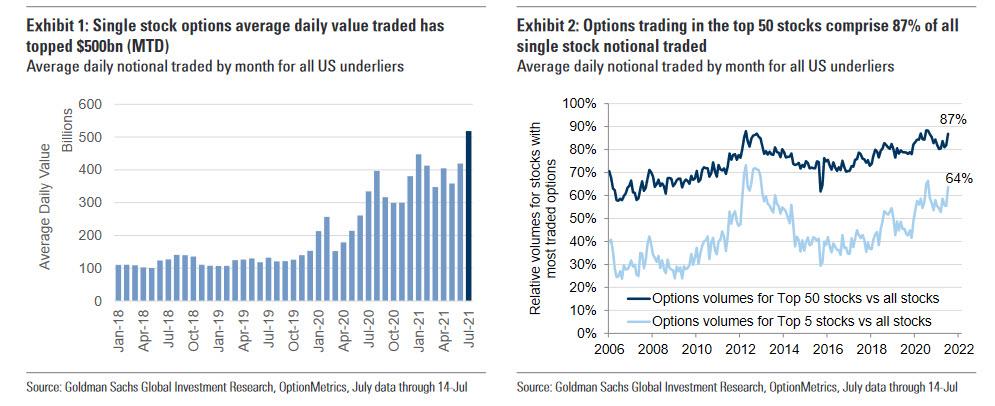
The start of July witnessed an almost identical move, as FAAMG names soared higher driven by a surge in call buying. And, while we doubt SoftBank is behind the latest move the sharp increase in options trading activity to start July - July 2nd recorded the highest day of single stock options trading in history - has driven month-to-date average daily notional traded to all-time-highs.
According to Goldman's Vishal Vivek, strong options trading activity in single stocks, dominated by volumes in AMZN, TSLA, AAPL, NVDA and GOOGL, have driven average daily value traded to an all time high: $534 BN of options have traded on the average day in July (including $348bn in call options), well above the prior year average of $367bn.
As shown below, otions trading has been concentrated in a handful of stocks, with 64% of all trading this month in just 5 names (AMZN, TSLA, AAPL,NVDA, GOOGL), while 87% in the top 50 underliers.
And as has been the case for much of the past year, investors have increasingly focused on trading ultra short-dated options; options with less than 2 weeks to expiry comprise 75% of all trades.
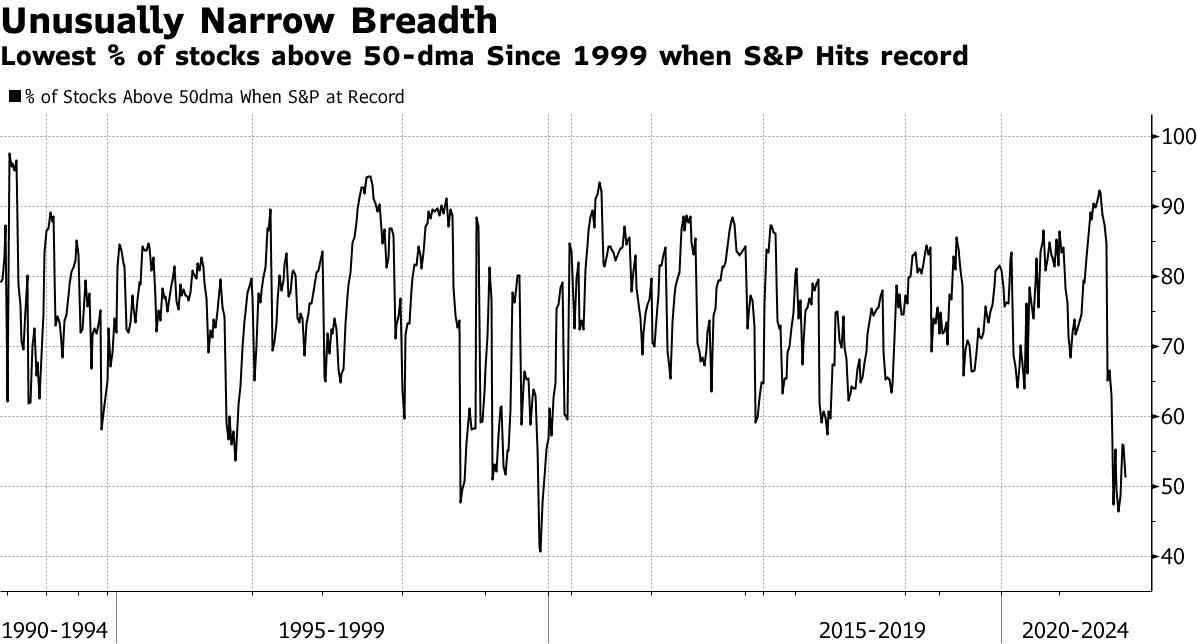
What is notable is that whereas recent bursts of option activity which culminated in the first quarter of 2021 targeted meme stocks, this time the call buyers are going for the FAAMGs themselves. It remains unclear if buyers of call are institutions or retail buyers - it is reasonable that if a big names was behind the ramp it would have leaked by now - it is certainly the case that absent continued option inflows, the push higher in the gigatech "generals" - which have almost single-handedly managed to push stocks to all time highs even as market breadth has collapsed...
... will halt and reverse, something we are already seeing in Amazon and Microsoft. Should this reversal accelerate, and if the market's leadership fails to sustain the recent push higher, then all bets are off.