>>> Barron’s Weekend Summary: The labor shortage in the US is intensifying and s

Barron’s Weekend Summary

* Cover Story:The labor shortage in the US is intensifying and solutions are not forthcoming. “There are 9.2 million job openings and 9.5 million unemployed in the U.S., with workers quitting their jobs at a near-record rate as companies seek to fill a record number of open positions. Employers, economists, and policy makers blame the bottleneck on twin forces they expect to ease this fall: generous jobless benefits and a year of remote learning that has pushed some two million parents—mostly mothers—out of the labor force.”

* Tech Trader: “The world’s five largest tech companies— Apple (ticker: AAPL), Microsoft (MSFT), Amazon.com (AMZN), Alphabet (GOOGL), and Facebook (FB)—all reported quarterly results. Their collective performance was astonishing. As a group, their revenue increased 36%, to $332 billion. These companies spent the pandemic making gobs of money.”But unimpressed investors decided to take profits and all but one – Alphabet which gained 1.3% for the week - fell. Amazon lost the most: 7.6% on Friday.

* Trader : The Covid pandemic has been good to healthcare stocks. And while most people are concerned over the return of Covid-19 and its variants, healthcare stocks are poised for gains, “rising 8.5% over the past three months, the best of any sector. The Health Care Select Sector SPDR exchange-traded fund (ticker: XLV) is trading near an all-time high—and don’t be surprised if more highs follow.”

Last week’s tumble of the big tech appears bad on the surface, but the big tech stocks are far more resilient. “The weakness at the index level hid strength beneath the market’s surface. More than 300 companies in the S&P 500 ended in positive territory. And some of the gains were sizable, with companies such as Advanced Micro Devices (AMD), Mattel (MAT), and Perkin Elmer (PKI) adding more than 10% each, mostly on positive earnings news. The Invesco S&P 500 Equal Weight exchange-traded fund (RSP) rose 0.6%, while the small-cap Russell 2000 gained 0.8%.”

“The EV-SPAC vehicle rally has turned into a rout, and things might not improve anytime soon. This past week was dreadful for electric-vehicle stocks that came to market via special-purpose acquisition vehicles, or SPACS. Nikola (NKLA) shares dropped 15.2% after former CEO Trevor Milton was charged with securities fraud. Faraday Future Intelligent Electric (FFIE) fell 18.5%. Lordstown Motors (RIDE) was down 16.5%, while Arrival (ARVL) lost 6.8%.”

* Interview: Barron’s spoke with Richard Parsons, who was chairman and CEO of Time Warner in the wake of its AOL merger. about the evolving media landscape, the post pandemic recovery, and his recent foray into the world of blockchain. He sees a future for movie theaters, and a tightening competitive race in the streaming wars. Parsons, a lifelong New Yorker, is also bullish on the future of the Big Apple.

* Features: 1 The long-awaited infrastructure-investment bill, totaling some $1 trillion is almost a ‘done deal’. “The legislation should be a boost to businesses like Vulcan Materials (ticker: VMC) and Martin Marietta Materials (MLM), which make concrete and asphalt; Caterpillar (CAT) and Terex (TEX), which make construction equipment; and United Rentals (URI), which rents the machinery. Most of their stocks have already jumped on the prospect of infrastructure spending.But one infrastructure play has been overlooked: Atlas Technical Consultants (ATCX) provides engineering and design services, inspection and certification of buildings and public works, and other construction-related services.”

“Mandates for Covid-19 vaccination have started dotting the map, as businesses and governmental units across the country try to stem the spike in cases spread by the virus’s contagious Delta variant. At the same time, research is concluding that the protection from vaccination starts to taper after several months, boosting the case for booster shots. All this makes Covid vaccine sales look like a long-term business for Pfizer (ticker: PFE), BioNTech (BNTX), Moderna (MRNA), and other producers.”

* Europe: Bitcoin was trading lower on Friday, ending the week around $39,000. The cryptocurrency suffered a 2% drop in the last 24 hours alone, which suggests some profit-taking—following a recent 35% surge. But, “the news out of Europe was both positive and unsettling for the cryptocurrency.And Congress may be getting closer to regulating the crypto industry.”

* Emerging Markets: Indian Prime Minister Narendra Modi wants to increase his country’s energy output from ‘renewable’ sources by some 500%. And shares in companies such as Mumbai-based conglomerate, Reliance Industries (RIL.India) - which have quadrupled over the past five years as it shifted from oil refining into telecoms and internet through its Jio Platforms subsidiary - are likely to continue performing strongly.

* Commodities : Semiconductors manufacturing represents the fundamental pillar of Taiwan’s economy. The recent “chip shortages mean that cheaper electronics are selling out and Taiwan factories have been replenishing stocks with more expensive chips. And when it comes to chips, it’s all about the size of the wafer, which is essential in the production of integrated circuits,” leading led to a higher export value of semiconductors.

* Streetwise: Intel’s CEO Pat Gelsinger “says that “intel is back” and that he can mlm return the chipmaker to glory by 2025.” Jack Hough examines his plan. “Intel will get dibs on the next generation of the world’s most coveted chip-making machines, and reclaim its technology lead by 2025,” said Gelsinger, who “reckons the company could “triple, quadruple” in value.”

(ZH) "Not A Drill": Infrastructure Bill Could Sink American Crypto Industry

"Not A Drill": Infrastructure Bill Could Sink American Crypto Industry

The government aims to partially cover the cost of a massive infrastructure bill by taxing crypto companies... and the entire industry will feel it.
Things just got ugly for crypto in Washington, D.C.
For years, the threat of major regulation has been raised like a hammer, ready to smash the crypto industry. Now, the hammer is ready to drop in the unlikely form of a major infrastructure bill in the U.S. Senate.
"This is not a drill," writes Jake Chervinsky, an influential crypto lawyer and a sober voices in a hype-prone industry. In a must-read Twitter thread, Chervinsky explains how the $550 billion bill - which is primarily about roads and bridges - could shiv American crypto companies.
The pain comes in the part of the bill that explains how the U.S. will help pay for those roads and bridge. Namely, the bill states that Uncle Sam plans to cover $28 billion of the costs by squeezing crypto brokers.
The trouble is that the bill defines "broker"—a term normally used to describe the likes of Coinbase and Robinhood—as basically any business that touches crypto.
As Chervinsky writes,
"This definition is so broad, it could apply to nearly every economic actor in the US crypto industry, if read literally."
The catch-all "broker" term could apply to miners, DeFi startups, and others who will have to file customer forms with the IRS, a task that is in some cases impossible.
The upshot is that the U.S. crypto industry is in the same position as the online gambling industry a decade ago when Congress regulated it out of existence. In the eyes of lawmakers, crypto companies—like online casinos—appear to be both sinful and rich, which makes them the perfect target for a revenue raid.
The difference, of course, is that crypto is not a new form of vice to be taxed but rather a world-changing technology like the Internet. Sure, it has enabled bad stuff (including gambling-like behavior) but the Internet did too, and U.S. lawmakers came around to realize it made strategic sense to build the web on American shores rather than driving it out of the country.
There is also the matter of that $28 billion of taxes the crypto industry is supposed to provide. How did the Senate arrive at that figure? No one really knows, but that's not the point. The point is for Congress to conjure up numbers that will "pay" for roads and bridges, and taxing crypto "brokers" offers a way to do that.
If you think that this is just another regulatory bogeyman that will never happen, think again. The crypto broker provision is part of a larger $550 billion package that is poised to pass, and that President Biden is aiming to make the landmark accomplishment of his first year. If the U.S. crypto industry has to become road kill to make that happen, few in Washington will bat an eye.
All of this reflects poorly on U.S. elected officials, but the crypto industry bears responsibility too. For years now, the industry's leaders have carried on like they're too rich or too cool to be bothered with Washington DC. Now, that's coming back to bite them. Meanwhile, the handful of companies who are making a serious effort to help crypto build political capital get branded with the c-word ("centralized") and dumped on by others in the industry. That's what happened to Uniswap, which is probably the most promising DeFi project, when it it recently dared to devote some of its budget to defend crypto in the Capitol.
For now, everything is not lost. One Washington insider—who describes the situation as a "live fire exercise"—tells Decrypt the industry has mobilized like never before and various factions are putting aside differences to fight a common threat. But she added that "we're running out of cards to play" as Democrats pull out the stops to pass the infrastructure bill by August. Ironically, the crypto industry's best hope could be other Democrats—namely, the progressive caucus threatening to blow up the entire bill unless their leaders pass a related bill full of left-wing spending goodies.
In the absence of a Democratic party crack-up, the crypto industry's best hope is a long-shot bid to rewrite the broker language before the bill takes another step forward. Barring that, Chervinsky notes that the next step will be fighting a rear-guard action in the courts, and urging allies in Congress to prevent the worst parts of the law decapitating the industry when it goes into effect in 2023.
The bottom line is that this regulatory storm has been brewing years. The crypto industry should have done more to head it off. Now, it may be too late.

(ZH) Goldman Flow Desk Weekly Recap

Goldman Flow Desk Weekly Recap

Quick Look…Best performers on the Week...
The Worst…
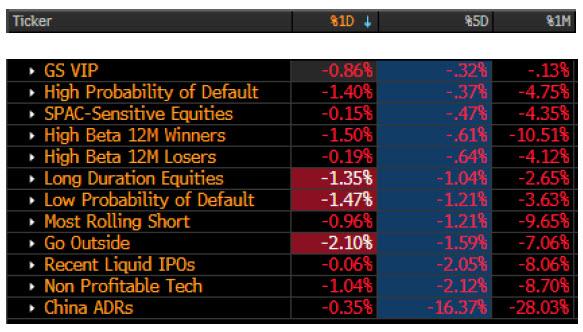
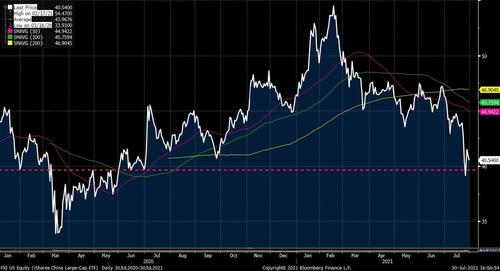
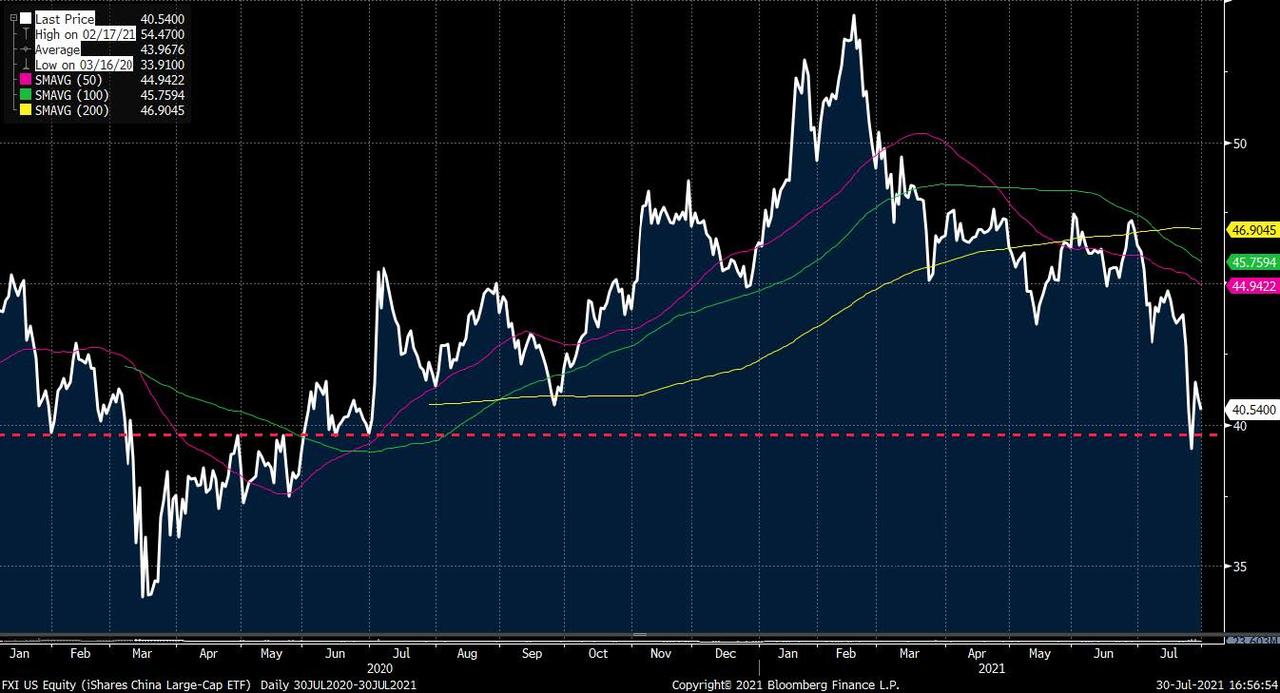
*DESK ACTIVITY…Markets ending the month in the red after a lackluster session dictated by the AMZN sales miss after the close yday and additional delta variant headlines hitting the tape. Albeit we are just a hair off ATH’s and despite ending in negative territory, all three indices ended July higher and it marks the 6th consecutive monthly gain for the S&P. According to Stat News’ Covid dashboard, the U.S.’ 7-day moving average for cases as of yesterday reached the highest number since April 19 and has been steadily increasing for the past month. Another pain point this week was the weakness in Chinese stocks as Beijing continues their crackdown on tech companies – KWEB capped off their worst 2 week performance since inceptive and FXI suffered worst month since Sept. 2011. We finished up the busiest earnings week in the history of the SPX (51% of the index reported) and solid prints continue to be unrewarded – another round of prints next week (12% of SPX). Have a great weekend.
*US DESK FLOWS…The desk finished the day with HF skewed better for sale 1.07x while LO skewed better to buy 1.13x. We were significantly active in info tech, and consumer discretionary names. In terms factors, we net bought value, and we net sold growth.
*ACROSS THE POND…Flows on the desk today ended up c.1.1x better for Sale. LOs were our most active group, amounting for the majority (c.50%) of flow actually skewed (c.1.1x) to buy. HFs kept their activity relatively high (c.30% of total flow) with a (c.1.2x) sell skew. Sector-wise, we saw net demand for Discretionary, Energy and Real Estate vs supply for Industrials and Financials.
*THEMES OF THE WEEK…China Crackdown…Delta Variant…Earnings…TMT Pain…Inflows and August Flows…Seasonals Shift…
-CHINA…More headlines hitting today: U.S. SECURITIES AND EXCHANGE COMMISSION CHAIR GARY GENSLER SAYS HAS ASKED STAFF TO SEEK CERTAIN DISCLOSURES FROM OFFSHORE ISSUERS ASSOCIATED WITH CHINA-BASED OPERATING COMPANIES…SEC CHAIR GENSLER SAYS NEW DISCLOSURES WILL BE REQUIRED FOR CHINESE COMPANIES BEFORE REGISTRATION STATEMENTS DECLARED EFFECTIVE
XI...Has stabilized…for now…
(Source: Bloomberg as of 07/30/21)
-DELTA VARIANT…*MORE THAN 110,000 VACCINE BREAKTHROUGH CASES IDENTIFIED IN U.S.: BBG…110K break through cases / 164M vaccinated = 0.0671% infection rate among fully vaccinated…
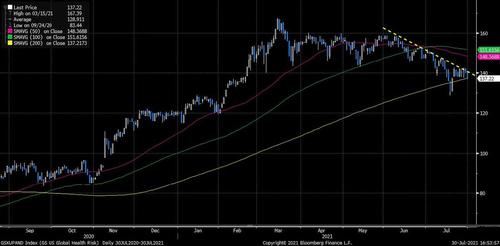
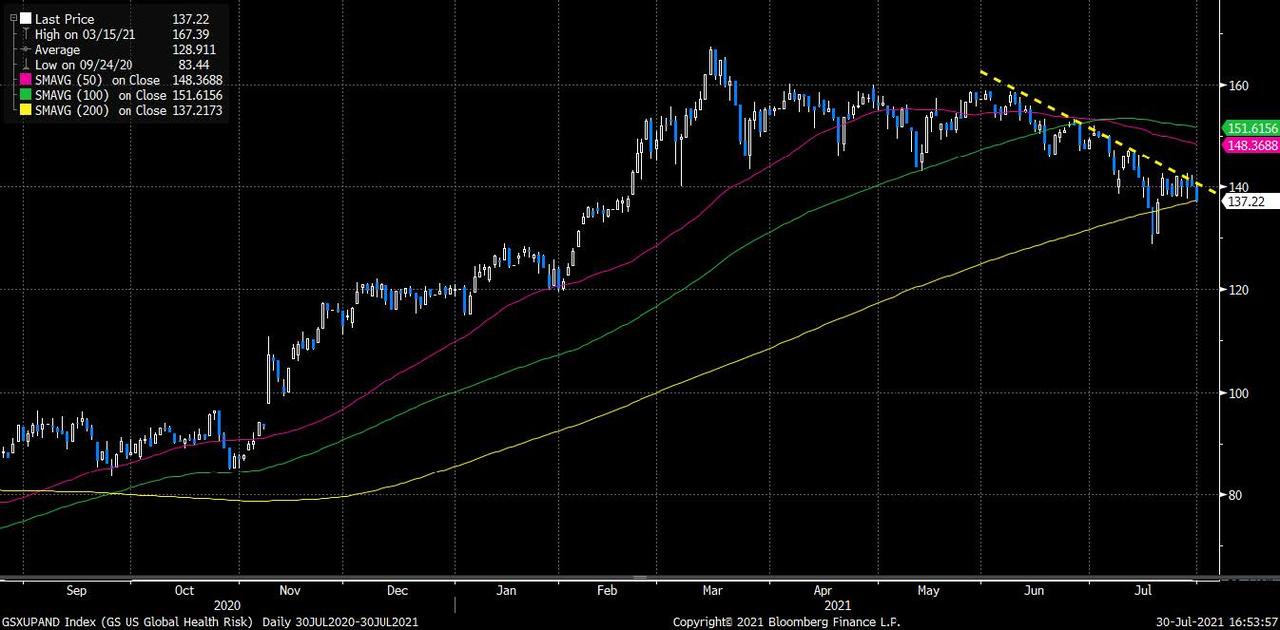
Global Health Basket (GSXUPAND)…continues to fade…sitting right on the 200dma of 137.22…
(Source: Bloomberg as of 07/30/21)
-Q2 EARNINGS…This week was the busiest earnings week in the history of the U.S. stock market with 51% of S&P's cap reporting. Next week the action slows significantly with just 12% of cap reporting. We are STILL seeing the highest percentage (74%) of companies beat street wide earnings ests (by >1SD) in the 20+ years that we have tracked this data (well ahead Q121 which was previous best at 61%) . Very few (4%) companies are missing. However, beats are NOT being rewarded and the few misses we have seen are being punished. I will be keeping a close eye on AMZN today already down 7% pre mkt (clearly should weigh on overall mkt sentiment especially after FB closed down 4% yesterday).
-296 S&P500 companies have reported 2Q results (76% of total market cap). So far 74% of companies reporting have beat street wide earnings estimates by >1SD (significantly higher than 46% historical avg) whereas only 4% have missed estimates by >1SD (significantly lower than historical avg of 14%).
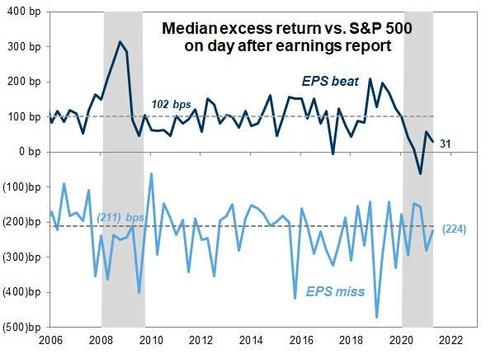
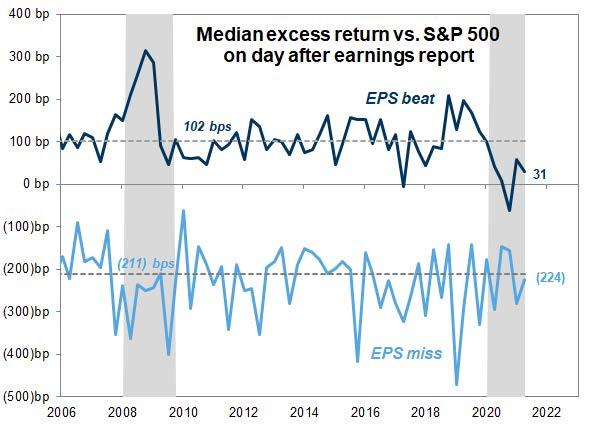
-Firms beating earnings ests by at least 1SD have only outperformed the S&P 500 by 31bps on the trading session directly after reporting (vs a historical avg of +103bps of outperformance). Companies missing earnings ests by at least 1 SD have underperformed the S&P 500 by -224bps, which is worse than historical avg of -211bps of underperformance.
(Source = GIR as of 7/30/21 Snider, Hammond) – ty Snider / Hammond
-TMT (Callahan)…‘Where does Tech’ go from here? … a bit of a buzz / debate around the risk of Tech losing its leadership as soggy T+1 price action for the ‘FAAMG’ group (.. nothing new .. ) and NDX -75bps today leave the group without a catalyst & fresh off a torrid stretch (up ~20% in 6-wks) ... to balance that nervous energy, it is worth noting that the backdrop should still prove supportive for 'Big Tech' (low rates, hybrid WFH/re-opening, moderating US growth, big cash balances, etc), though likely more ‘intra-FAAMG’ rotations and stock selections. To level-set on YTD moves: GOOGL +55%, FB +31% (vs EPS revisions up ~25% YTD), MSFT +29%, AAPL +10%, AMZN +5%. More TMT earnings to come Monday…
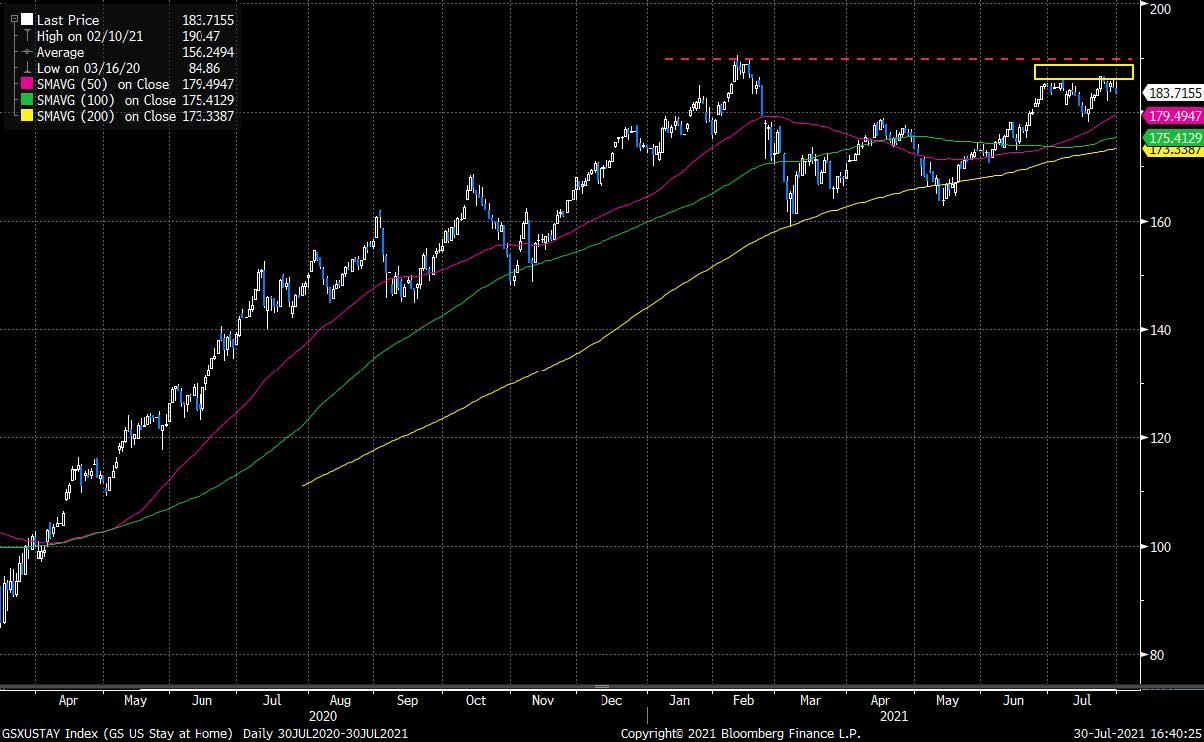
-WFH Theme as a theme has NOT aged well during earnings – AMZN, NFLX, CTXS to name a few .. next week, watch Video Games (px action today = indicative of positioning / what's priced in?), streaming names (FSLY, AKAM, etc) and E-Commerce .. keep an eye on: GSTMTWFH / GSXUSTAY Index.
GSXUSTAY Index…Stalling at the top here…
-INFLOWS CONTINUE (Rubner)…This week (week 30) global equities logged +$23.233 Billion worth of inflows ~ right in line with the YTD run rate. In 2021, there has been +$636.30 Billion YTD inflow into global equity funds, +$518 Billion inflows or 82% passively and +$118 Billion inflows or 18% passively. Global Equity inflows are annualizing +$1.10 Trillion for 2021. This is not small and on pace for the largest annual inflow on record by 2.5x. There have been 143 US trading days this year, which means daily equity flows of +$4.443 billion inflows everyday “buying dip alpha” or $21.21 Billion per week.
-BUT OUTFLOWS IN AUGUST? Over the last 30 years, money flows change in August. I expect this year to be no different. August typically sees the largest outflow of the year. Even if there are no outflows, but the inflows stop, this will change the #BTD dynamic in the market. Detailed analysis below. Its vacation time now that earnings (which were faded) are behind us. Stay nimble in August, I am focusing on liquidity.
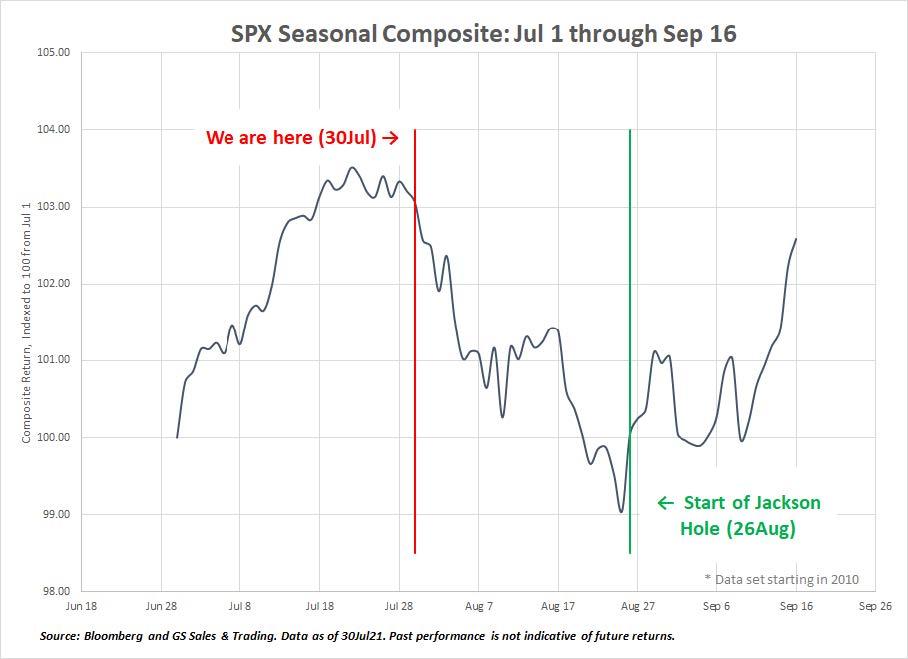
-SEASONALS SHIFT…We are coming out of one of the strongest periods of the year and heading into one of the worst – no surprise given the historical outflow dynamic. This runs us right into Jackson Hole.
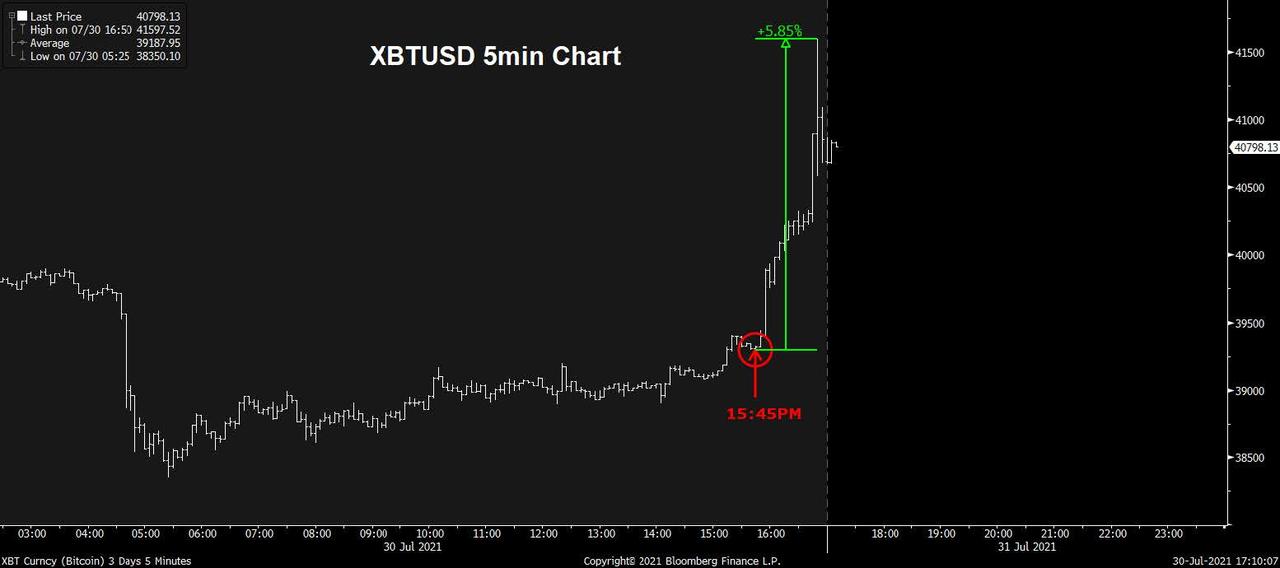
-CRYPTO been catching a bit of a bid into and post the US equity close. Since 15:45 NYC time, XBT has rallied almost 6%. Not sure if this is noise or signal but something to keep an eye on.
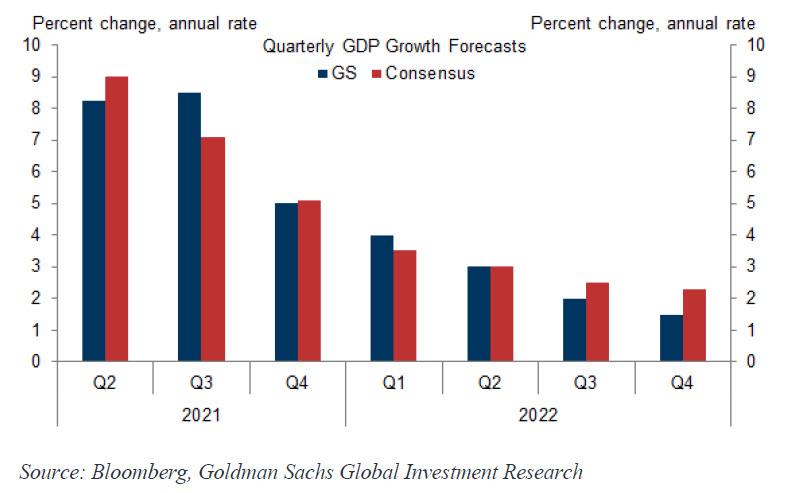
*NOTES IN CASE YOU MISSED…After Peak Growth: A Slightly Slower Service Sector Recovery (Walker) – Until a couple of months ago, GIR’s GDP growth forecast had been distinguished for the prior year by being well above consensus expectations, reflecting their optimistic view of the prospects for an early vaccination timeline and a strong economic recovery. But at this point, their forecast is instead distinguished from consensus expectations by the sharpness of the deceleration that they expect over the next year and a half, from 8.25%/8.5% during the Q2/Q3 mid-year boom all the way down to a trend-like 1.5-2% by 2022H2 (Exhibit Below).
After GDP Growth Peaks in Mid-2021, GIR Expects a Sharper Deceleration Than Consensus to a Trend-Like 1.5-2% in 2022H2
Corresponding to the downgrade to their growth forecast, they have also bumped up their unemployment rate forecast slightly from 4.2% to 4.4% at end-2021. GIR expects to learn considerably more about the prospects for labor market recovery from the July employment report, which should provide a test of the impact of seasonal adjustment irregularities and the early expiration of federal unemployment benefits in some states.

(ZH) Google Play Store To Ban "Sugar Daddy" Apps

Google Play Store To Ban "Sugar Daddy" Apps

Google published several changes to its Google Play Store policy on Wednesday, including banning "sugar dating" apps.
The policy change in question reads, "We're updating the inappropriate content policy to institute new restrictions on sexual content, specifically prohibiting compensated sexual relationships (i.e. sugar dating)."
Those who aren't familiar with "sugar dating" involve older, wealthier individuals dating young partners and showering them in gifts or money, often in exchange for sexual favors.
Play's policies already forbid apps that promote "services that may be interpreted as providing sexual acts in exchange for compensation." The updated policy change kicks in on Sept. 1.
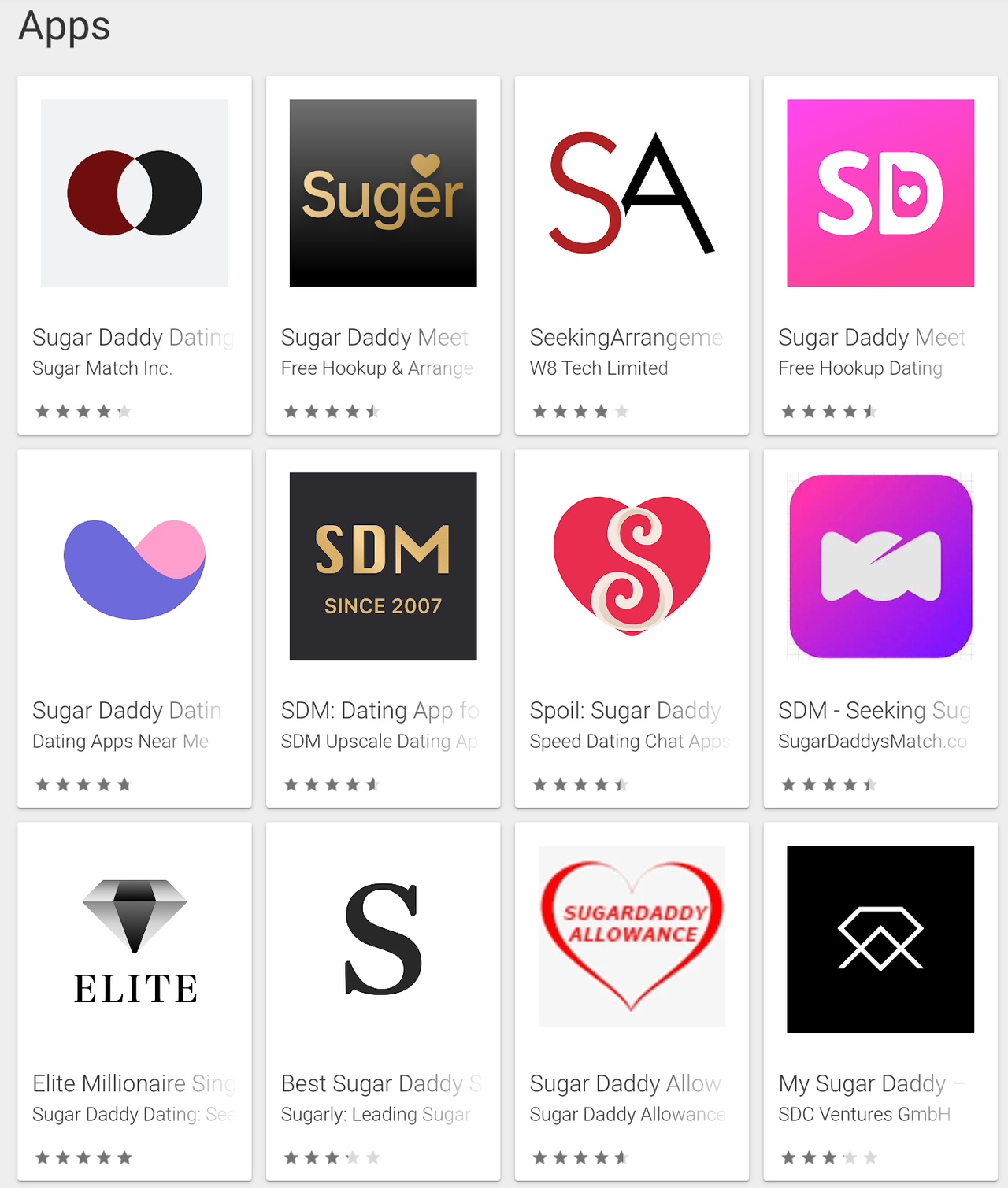
A search shows plenty of sugar daddy-style apps on Play, including "Sugar Daddy Dating," "Elite Millionaire Singles," and "SeekingArrangement."
There was no mention of which apps would be banned, but there are workarounds such as manually entering the website on an Android web browser or sideloading the dating app.
So much for some millennials who traded sexual favors to older partners to pay off their student debt.

(ZH) Wildfires Are Coming For Wine, Weed, And Christmas

Wildfires Are Coming For Wine, Weed, And Christmas

There are 86 large wildfires that have burned 1,498,205 acres in 12 US states and emit large quantities of carbon dioxide, carbon monoxide, and dangerous particulate matter into the atmosphere this summer that could affect wine weed and Christmas.
The West Coast fire season is off to a fiery start, and an abundance of smoke can destroy precious vineyards and damage the fruit.
University of California Davis researchers say California's wine country is being consumed by a megadrought and resulting wildfires that taint and affect crop yields.
"We're seeing the impact of climate and climate change," said Megan Bartlett, a UC Davis plant biologist and assistant professor.
"Especially after the heatwaves and the megadrought a few years ago, we really saw, as an industry, declines in (crop) yield. These are really pressing problems, especially now."
The smoke of wildfires permeates regions like Napa Valley and other top-producing vineyards, changing the taste of wine.
"Can you imagine licking an ashtray?" Anita Oberholster, a Cooperative Extension enology specialist at UC Davis, said.
"When wines are heavily impacted, it can taste like that."
The smoke of wildfires can also stress or even kill marijuana plants growing outdoor or in greenhouse operations.
"Smoke taint is the most obvious and the most apparent threat to cannabis as [it's] exposed to these forest fires, and that's something you're going to be able to readily tell from just qualitatively examining the cannabis," Josh Wurzer, president of SC Labs, told Cannabis Business Times.
"So, that's certainly a concern—just ruining the flavor of the cannabis," Wurzer said.
Although Christmas is about five months away, record-breaking heatwaves and raging wildfires are destroying Christmas tree farms in Oregon. We noted days ago that Reuters spoke with multiple tree farm operators, who said their crop yields this year would be reduced.
Dozens of wildfires burning in the Western half of the US are unleashing near-surface smoke in parts of California but also countrywide. Smoke was visible on the East Coast last week.
So what this all means is that if wildfires persist, wine and marijuana crop yields could be affected and or at least tainted, which would lower quality, and Christmas tree yields would also be reduced, resulting in higher prices.

WSJ : Robinhood Sold IPO Shares to More Than 300,000 of Its Customers

Robinhood Sold IPO Shares to More Than 300,000 of Its Customers
Buyers represented about 1.3% of the online brokerage’s 22.5 million funded accounts

Hundreds of thousands of Robinhood Markets Inc.’s HOOD 0.95% customers bought shares in the trading app’s rocky initial public offering earlier this week.

In a post on its app, Robinhood said 301,573 users participated in the IPO, which raised about $2 billion and valued the company at $32 billion. That represents about 1.3% of the company’s 22.5 million funded accounts as of June 30.

Breaking with recent Wall Street tradition, the company sold a big chunk of the shares in its hotly anticipated debut to the small-time investors who trade on its app. As much of 25% of the IPO shares went to Robinhood customers, The Wall Street Journal earlier reported. In a typical IPO, individual investors get well under 10%.

The decision helped make for a volatile first day of trading in Robinhood shares. The stock opened Thursday even with the $38 IPO price and quickly fell more than 10%. It closed down 8% at $34.82. The stock did a bit better on Friday, closing up about 1% at $35.15.

An allocation of 25% would mean the average Robinhood customer participating in the IPO spent about $1,600 to buy 41 shares.

While a small share of Robinhood’s customer base, the number of users who invested in the deal is high for a typical IPO offered on the trading app. Some 78,250 Robinhood users bought shares in fitness company F45 Training Holdings Inc.’s recent public offering, the most popular IPO offered on Robinhood before its own.