FT : Lebanon’s PM-designate Sa’ad Hariri quits

Lebanon’s PM-designate Sa’ad Hariri quits
Beirut plunged deeper into crisis after 10 months of failed attempts to form new government

Lebanon’s prime minister-designate Sa’ad Hariri has quit after almost 10 months of failed attempts to form a new government, plunging the country deeper into crisis.

Hariri announced his resignation after a crunch meeting with President Michel Aoun. Hariri said the two had been unable to reconcile differences which have dogged talks over the formation of a new government since Hariri took the position in October last year.

Lebanon is suffering its worst-ever peacetime economic crisis. It has been exacerbated by a power vacuum since the current cabinet resigned shortly after the Beirut port explosion in August last year along with the failure to enact badly needed reforms.

The crippled local currency dived lower on the news, with local media reporting all-time black market lows of L£20,000 to the dollar — 92 per cent lower than the official exchange rate, which public employees’ salaries are still tied to.

Hariri and Aoun have clashed over the composition of the cabinet, whose posts are usually shared out between Lebanese political parties according to informal religious quotas. The executive positions are also carved up between the biggest sects: the premier is a Sunni Muslim, the House Speaker a Shia and the president a Christian.

While Hariri has argued that Aoun was stopping him exercising his constitutional right as premier-designate to select every member of his cabinet, Aoun has claimed he should be allowed to name Christian ministers and blocked Hariri’s picks. Hariri submitted another list to the president on Wednesday with 24 ministers.

“I asked the president if he needed more time to study the formation,” Hariri said in a short statement after their meeting on Thursday, “but from his response it seems that we won’t agree.”

Lebanon desperately needs a fully empowered government to enact much-needed banking and economic reforms. Other countries have said they are not prepared to provide aid to the Mediterranean nation of about 7m people unless corruption and wasteful public spending is curbed.

France has led the international community in its calls for the formation of a new government in Lebanon, formerly under a French mandate. EU foreign ministers this week agreed to pursue sanctions against those responsible for the delay in forming the cabinet.

“The reality is [politicians] want to escape accountability . . . and they’re looking at the elections next year,” said Mohanad Hage Ali, a Beirut-based research fellow at Carnegie Middle East Center, referring to general elections due to be held in 2022. “Their focus is how to shift blame to the other side and use the sectarian system in that game rather than take charge and lead the country out of the crisis.” Hage Ali described the stalemate as “a collective cowardly act”.

Lebanon’s economy has buckled in just under two years, with gross domestic product shrinking by an estimated fifth from 2019 to 2020, according to the World Bank.

The population, which includes hundreds of thousands of Syrian and Palestinian refugees, has been hit by fuel and medical shortages, runaway inflation and high unemployment.

Swaths of Beirut were blown up in a huge chemical accident last August, which killed more than 200 people and was widely blamed on official negligence. Public anger over the blast felled the previous government days after the explosion.
>>> Kazakh bitcoin mining surge

Kazakh bitcoin mining surge
China’s share of global electricity usage for bitcoin mining fell to under half for the first time this April, while Kazakhstan has been catapulted to third place as its share of mining increased sixfold. Today’s Big Read looks at the world’s largest stablecoin tether and the former plastic surgeon who is now the CFO behind it.

(ZH) Gundlach Warns Dollar Is "Doomed", Stocks Are At "Nosebleed" Levels

Gundlach Warns Dollar Is "Doomed", Stocks Are At "Nosebleed" Levels
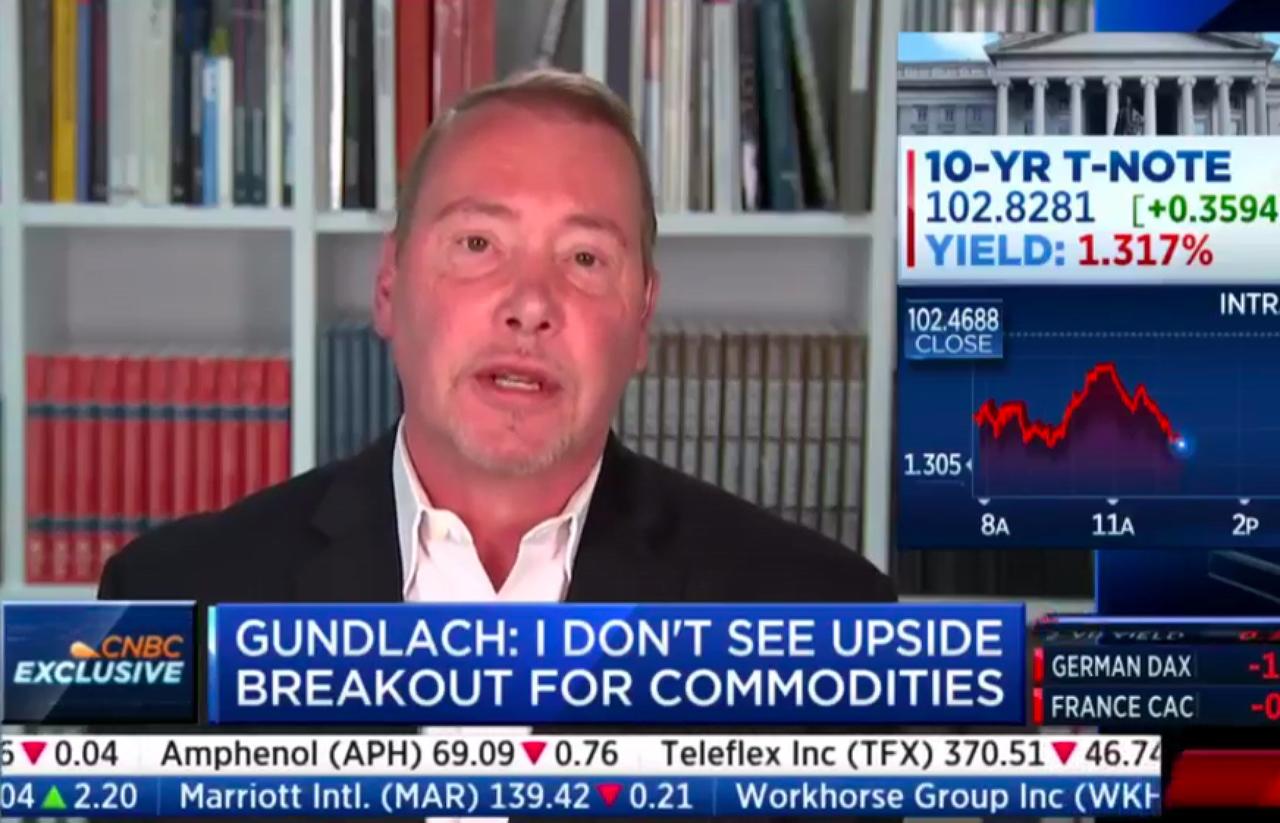
It has been a while since DoubleLine Founder Jeffrey Gundlach sat for a lengthy interview with CNBC's Scott Wapner, aka "the Judge", during the network's "Halftime Report". Gundlach has at times clashed with various CNBC personalities, but his interviews draw a large audience thanks to his status as one of the industry's foremost bond-market gurus - perhaps because his often bearish take on markets is a refreshing departure from the parade of uber-bulls that populates CNBC's market-hours programming.
During Thursday's interview, Gundlach - who started speaking just as Fed Chairman Jerome Powell was wrapping up his second day of Congressional testimony - warned that the only way stocks can sustain their record highs would be for the Fed's unprecedented stimulus programs to remain in place forever.
This isn't the first time Gundlach has warned about an impending blowup in stocks. Back in March, he claimed that suggesting the stock market is "anything other than very overvalued" versus history is ignorant of "all the metrics of valuation," according to BI.
To try and avoid a market reckoning, Powell & Co. are moving the goalposts about what constitutes "transitory" inflation.
While Gundlach doesn't see much upside for commodities, he believes rising wages will continue to drive the price of goods higher. And although the Fed's asset-buying and a general wash of liquidity have kept bond yields "ridiculously low", the stock market has been trading at "extremely high" valuations.
Equity valuations might be outrageous, Gundlach said. But while stocks are enjoying outrageous valuations based on most metrics, when compared to bonds, stocks actually look cheap.
"The reason I say stocks are cheap compared to bonds is a very simplistic comparison, it's the yield on the Treasury vs. stocks," Gundlach said.
The biggest threat to markets, as Gundlach sees it, is persistently accelerating inflation (echoing a warning from Sen. Pat Toomey and other Republicans from Powell's latest Congressional testimony). He argued that "even two more months" of higher-than-anticipated inflation could force a "reality check" at the Fed.
"Everywhere I go I talk to people at all levels of business and they say the same thing, they can't get workers," Gundlach said.
While Powell himself acknowledged that inflation has been more persistent than the Fed had anticipated, the Fed chief warned against overreacting to the data.
Moving on, Wapner asked Gundlach for his thoughts about the greenback, and Gundlach reiterated his warning that the dollar is "doomed" over the long-term.
"I don't want to be overly dramatic, but I think [the dollar] is doomed," Gundlach said.
"Ultimately, the size of our deficits — both trade deficit, which has exploded post-pandemic, and the budget deficit, which is, obviously, completely off the charts — suggest that in the intermediate term — I don’t really think this year, exactly, but in the intermediate term — the dollar is going to fall pretty substantially," he said.
As for what's driving Treasury yields lower, Gundlach explained that several factors are weighing on yields, and it's not just the Fed.
"Yields are this low because of all the liquidity in the system. There's so much money that's out there, banks are so flush with deposits, you see all these dislocations in the repo market..."
"We also have a lot of foreign buying...when you're a Japanese investor and you hedge your currency risk so you're just owning the yield...Foreigners had been liquidating Treasury holdings for years until several months ago, and now the foreigners are back."
"The bond market doesn't look cheap vs stocks, it doesn't look cheap vs inflation, but there are motivations...to buy it," Gundlach continued. For example, pension funds: "Many pension plans have actually reached their best funding status since prior to the global crisis. There's motivation for pension plans for when they get to fully funded status to just lock it in. When you're running a pension plan where you experience multiple bear markets, they want to avoid that bad."
While foreign investors and pension plans are helping the Fed suppress rates across the curve, there's one area where the Fed's influence is overwhelming.
"The Fed has absolute, iron-fisted control over short term interest rates."
In the past, Gundlach has warned about the dangers of a corporate debt implosion, and on Thursday, he warned that corporate bonds are also at their most expensive level in 20 years.
Finally, asked for his view on cryptocurrency, Gundlach said crypto was a "proxy for speculative fervor" and that the chart "looks pretty scary".
"I saw one guy who said it would be worth $400,000 then he said it was going to crash...I try to be a little more consistent...I've never been long bitcoin I've never been short bitcoin...it's not for me."
To sum up: According to Gundlach, stocks are overvalued (except vs bonds), corporate bonds are the most expensive in 20 years, commodity prices have peaked, yet inflation is accelerating, bitcoin is a "highly speculative" asset to be avoided, and the Fed is cornered.
In other words, get ready for a wild ride in markets over the next year as the Fed is forced to start hiking interest rates and dialing back its balance sheet.

(ZH) Calling An End To The Commodity Rally? Not So Fast

Calling An End To The Commodity Rally? Not So Fast

While much has been made around the fact that Lumber futures are now down for the year having been up c.200% at its peak, good luck trying to find actual lumber at your friendly neighborhood Home Depot at anything but nosebleed prices. Why? Simple: rising prices are stickier than superglu, and once higher producers will either wait until the last possible moment to cut, or will simply cartelize and limit production until demand eventually catches up with the new level of supply.
Regardless, of the lag behind commodity end prices, lumber is still the big exception rather than the norm.
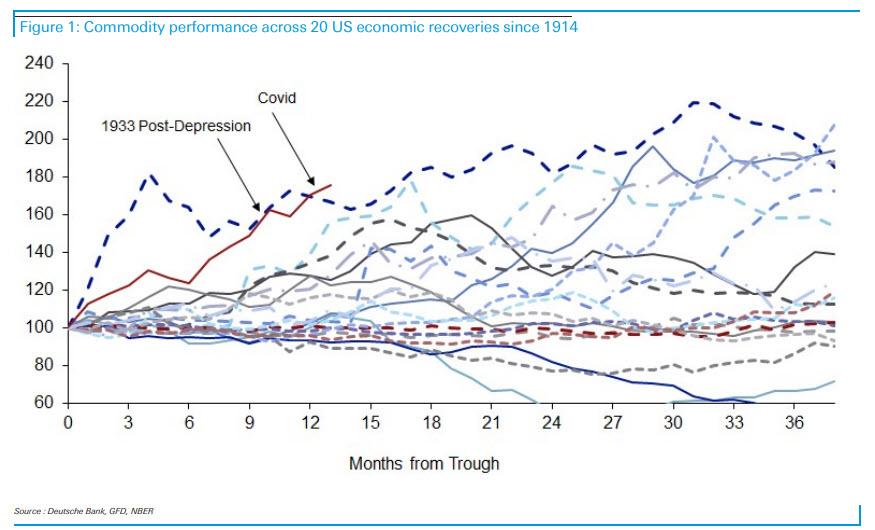
As DB's Jim Reid writes in his daily Chart of the Day titled "Food (energy and metals) for thought", even as the reflation trade has stumbled over the last couple of months, commodities remain near their six-year highs. In fact, looking at the chart below, which shows the post-trough recovery in commodity prices over the last 20 recovery cycles going back to 1914, the post-Covid recovery is now the strongest on record, having just overtaken even the rebound from the 1933 Great Depression.
So for those who are calling an early end to the commodity rally, Bloomberg's John Authers has some words of caution: "in the case of the post-Depression rebound, the rally in commodities went on to be enduringly strong for another two years."
And while it is possible that the commodity price reaction to an extreme and unusual downturn will differ from historical patterns, Authers concludes that "it’s hard to say at present that there’s any good evidence that commodity prices aren’t going to keep contributing to inflation for a while."

FT : Revolut valued at $33bn after $800m fundraising

Revolut valued at $33bn after $800m fundraising
Digital bank becomes the UK’s most valuable fintech

Revolut, the London-based digital banking start-up, has raised $800m in a funding round that makes it the UK’s most valuable fintech.

The deal, led by SoftBank’s Vision Fund 2 and Tiger Global Management, values the six-year-old company at $33bn (£23.9bn), a sixfold increase compared with its last fundraising in early 2020. The company is now worth more than NatWest, one of the UK’s so-called big four retail banks.

The rapid increase highlights insatiable demand from investors for fast-growing companies, which has renewed concerns about overheating in private tech markets. Investors poured almost as much money into private start-ups in the first half of this year as they did in the whole of 2020.

Mikko Salovaara, Revolut’s chief financial officer, said the company did not need to raise money, but added “the environment for raising is very strong and we had a lot of investor interest” so it decided to take advantage of the opportunity.

Revolut’s net losses widened from £107m to £168m last year, but it began to break even in the final two months of the year. Salovaara said it had been “strongly profitable” in the first quarter of 2021.

>>> Europe : Brokers Upgrades & Downgrades - 15th of July 2021

>>> Up
* Accor Raised to Buy at Deutsche Bank; PT 36.70 euros
* Airbus Raised to Buy at Citi; PT 130 euros
* Alma Media Raised to Buy at SEB Equities; PT 12.90 euros
* Couche-Tard Raised to Outperform at BMO; PT C$59
* Hugo Boss Raised to Overweight at Morgan Stanley; PT 60 euros
* InterContinental Hotels Raised to Buy at Deutsche Bank
* Konecranes Raised to Buy at Goldman; PT 58 euros
* Lundin Mining Raised to Buy at Canaccord; PT C$13.50
* SGL Raised to Reduce at AlphaValue
* SocGen Raised to Buy at Grupo Santander; PT 40.24 euros

>>> Down
* AddNode Cut to Sell at Handelsbanken; PT 320 kronor

>>> Initiation
* ArcelorMittal Rated New Overweight at Barclays; PT 36 euros
* Beazley Rated New Buy at Citi
* Credit Suisse Rated New Hold at Jefferies; PT 10 Swiss francs
* dotdigital Rated New Buy at Deutsche Bank; PT 255 pence
* Dr. Martens Rated New Buy at Investec; PT 550 pence
* EKF Diagnostics Rated New Buy at Investec; PT 88 pence
* Hiscox Rated New Neutral at Citi; PT 910 pence
* Lancashire Rated New Neutral at Citi; PT 648 pence
* SSAB Rated New Overweight at Barclays; PT 56 kronor
* Tinybuild Rated New Buy at Shore Capital
* Thyssenkrupp Reinstated Underweight at Barclays; PT 8.50 euros
* UBS Group Rated New Buy at Jefferies; PT 20 Swiss francs

>>> Call
* Airbus Upgraded at Citi on A320 Production Rates, Cost Savings
* Hugo Boss Ready for Transformation, Morgan Stanley Upgrades
* Kingfisher Upgrade Not a Surprise, Consensus to Rise: Analysts
* Siemens Gamesa Warning Shows Underlying Weakness, Citi Says
* UBS a Buy With Street-High PT at Jefferies, Credit Suisse Hold