>>> What to look at today - 11th of October 2021

Asian stocks climbed Monday, helped by rallies in Japan and Chinese technology shares, while crude oil surged past $80 a barrel amid a global energy crunch.
Japanese shares were boosted by a weaker yen and Prime Minister Fumio Kishida’s comments that he isn’t considering capital-gains tax changes at present. A Hong Kong gauge of Chinese tech equities jumped more than 3% on easing concerns about Beijing’s crackdown on internet platforms after food delivery giant Meituan received a lower-than-expected antitrust fine.
U.S. futures fell after Wall Street declined Friday on disappointing jobs growth data that also showed a jump in earnings. Wage gains and higher energy costs are stoking inflation and supporting the case for tighter monetary policy to tackle inflation, including a looming reduction in Federal Reserve stimulus.
West Texas Intermediate crude was at the highest since 2014, while China’s coal futures reached a record as flooding shuttered mines. Treasury futures fell, after the 10-year U.S. Treasury yield advanced past 1.6% Friday. There’s no cash Treasuries trading Monday due to a U.S. holiday. The dollar edged up.
Goldman Sachs Group Inc. economists cut their forecasts for U.S. growth this year and next, blaming a delayed recovery in consumer spending. The declines were mostly offset by upgrades to projections for the following two years. 
In cryptocurrencies, Bitcoin was steady, trading around $56,000.

Nikkei +1,58% Hang Seng +2,23% CSI +0,47% Shanghai +0,38% Shenzen -0,08%

Eur$ 1.1572 CNH 6,4405 CNY 6.4377 JPY 112,67 GBP 1,3637 CHF 0.9285 RUB 71.8363 TRY 8.9665 WTI$ 80,86 +1,35% Gold 1,756.59 -0,2% BTC 56,420 +985 ETH 3,512 -2

S&P +0,01% Nasdaq -0,08% EuroStoxx +0,13% FTSE +0,12% Dax +0,14% SMI+0,59%

Macro :
- Goldman Cuts U.S. Growth Forecasts for 2021 and 2022 on Consumer
- California Fire Threat Returns With Diablo Winds and Power Cuts
- Stablecoins Added to Agenda of U.S. Financial Stability Watchdog
- World’s Energy Chaos Turns Russia Into Top Emerging-Market Pick
- German Greens and Liberals Spar Over Budget Before Monday Talks
- U.S. Bank Stocks May Be Too Hot With Earnings Season Nearing
- U.S. Arrests Couple on Spy Charges to Sell Nuclear-Sub Data
- Magnitude 6.2 Earthquake Strikes Near Hawaii :USGS

Spac :
- Billy Beane’s RedBall SPAC Said to Near Deal With SeatGeek

Keep an eye on :
- ADL GY : LEG Immobilien to Buy Some Adler Assets for EU1.485b
- ALV GY : California Fire Threat Returns With Diablo Winds and Power Cuts
- AAPL US : Justice Department Accelerates Apple App Store Probe, DJ Reports
- AZPN US : Emerson Plans to Bid Around $160/Shr for Aspen Technology: DJ
- AV/ LN : Aviva, Tesco Want U.K. to Mandate Corporate Net-Zero Plans
- BSLN SW : Basilea Presents Preclinical Data on Derazantinib, Paclitaxel
- BAYN GY : Blackstone, CVC Said Among Suitors for Bayer Pest Control Unit
- BIO GY : Biotest: Trimodulin Benefited Hospitalized Covid-19 Patients
- EN FP : Spie to Sell Equans Assets Outside Europe If Bid Succeeds: Echos
- BP/ LN : BP-Backed Energy Supplier Pure Planet Is Close to Collapse: Sky
- CA FP : Auchan Talks to Buy Carrefour Are Said to Stall Over Price
- CA FP : Reuters: Auchan not planning hostile bid after Carrefour ends talks -Les Echos https://t.co/6ocYGdhPSN https://t.co/hunDCr1CH6
- CGG FP : CGG Prelim 3Q Segment Revenue $270M
- EVT GY : Evotec Files for U.S. IPO, Seeks Nasdaq Listing Under ‘EVO’
- GALP PL : Galp 3Q Average Working Interest Production 128.2 Kboepd
- HOT GY : Flatiron JV Wins Contract for $433 Million I-95 Widening Project
_ IBE SM : Spain Minister to Meet with Iberdrola CEO Galan: Confidencial
- ICAD FP : Icade Healthcare Europe Acquires Assets in Italy and France
- IDIA SW : Idorsia: Modify Study of Lucerastat Didn’t Meet Primary Endpoint
- INDUA SS : Industrivarden 3Q NAV/Shr SEK295 Vs. SEK258 Y/y
- LEG GY : LEG Immobilien to Buy Some Adler Assets for EU1.485b
- MB IM : Del Vecchio “Pleased” Mediobanca Improved Governance Standards
- MEDX SW : Medmix 3Q Orders CHF132.8M, Up 21% Organic Y/Y; Confirms Outlook
- MEDX SW : Medmix Plans Dividend for Next Year and M&A, CEO Tells FuW
- OCDO LN : AutoStore Loses Bid to Challenge Ocado Robot Warehouse Patent
- REE SM : KKR, Allianz Interested in Red Electrica Fiber-Optic: Expansion
- IOT IM : Italy’s Seco Acquires Garz & Fricke Group for About EU180m
- SEYE SS : Smart Eye Drops After Shareholders Approve Dilutive Incentives
- SQI FP : DBAY Advisors Raises Sqli Tender Offer Price to EU31/Shr
- TSLA US : Musk Says Tesla Software Update Delayed by a Few Days
- UCG IM : UniCredit Resolves Dispute on Swap Transactions With Sicily
- VWS DC : Vestas to Build Factory, FLSmidth Wins Order in India: PM Office

>>> Europe : Brokers Upgrades & Downgrades - 11th of October 2021

>>> Up
* Erste PT Raised to 49 euros from 42 euros at Morgan Stanley
* Hargreaves Lansdown Raised to Equal-Weight at Morgan Stanley
* Outokumpu Raised to Hold at Jefferies; PT 5.50 euros
* Veolia Raised to Buy at AlphaValue/Baader

>>> Down
* Britvic Cut to Sector Perform at RBC; PT 870 pence
* CARLSBERG DOWNGRADED TO HOLD VS BUY AT HSBC
* Danone Cut to Hold at HSBC
* Exxon Cut to Underperform at Exane; PT $60
* KBC Group Cut to Neutral at JPMorgan; PT 85 euros
* Repsol Cut to Underperform at Exane; PT 11.50 euros
* Sabadell Cut to Underweight at Morgan Stanley; PT 67 euro cents
* TeamViewer Cut to Equal-Weight at Morgan Stanley; PT 18.50 euros
* Volution Cut to Add at Peel Hunt; PT 510 pence

>>> Initiation
* Agilyx Rated New Buy at Arctic Securities; PT 62 kroner
* Dunelm Rated New Buy at Berenberg; PT 1,620 pence
* Kingfisher Rated New Hold at Berenberg; PT 370 pence
* Melia Hotels Reinstated Sell at Intermoney Valores
* NOS Rated New Hold at Intermoney Valores; PT 4 euros
* Victorian Plumbing Group Rated New Buy at Berenberg
* Wickes Rated New Buy at Berenberg; PT 280 pence

>>> Call
* Dunelm, Wickes Among Buys in Home and Living Sector: Berenberg
* Sabadell Downgraded at Morgan Stanley, Consensus Too Optimistic
* TeamViewer Needs Clarity, Cut to Equal-Weight at Morgan Stanley
* U.S. Bank Stocks May Be Too Hot With Earnings Season Nearing

(ZH) Is The Great "Bear Market" Of 2021 Finally Over?

Is The Great "Bear Market" Of 2021 Finally Over?

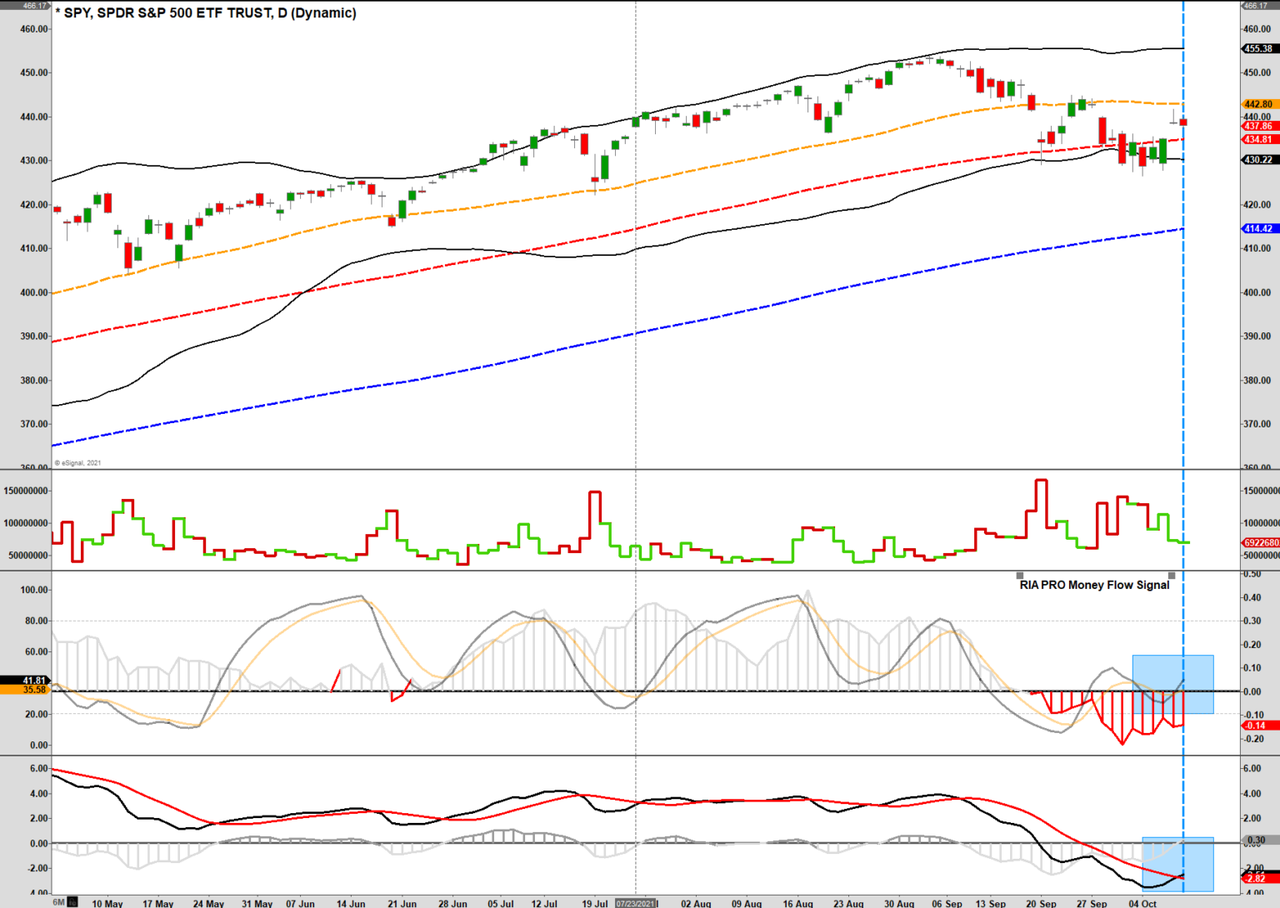
“It is worth noting there are two primary support levels for the S&P. The previous July lows (red dashed line) and the 200-dma. Any meaningful decline occurring in October will most likely be an excellent buying opportunity particularly when the MACD buy signal gets triggered.
The rally back above the 100-dma on Friday was strong and sets up a retest of the 50-dma. If the market can cross that barrier we will trigger the seasonal MACD buy signal suggesting the bull market remains intact for now.
Chart updated through Friday
Notably, the very short-term moving average convergence divergence (MACD) indicator (lower panel) did trigger this past week. With markets not yet back to extremely overbought territory, and sentiment still very negative, the bulls are trying to reclaim the 50-dma.
Our seasonal MACD indicator (next to the bottom panel) also triggered, but just barely. We need to see some follow-through buying action next week.
Money Flow Buy Signal Also Positive
The RIAPRO Money Flow indicator also triggered a buy signal, becoming more robust support for a short-term rally this past week.
So, do all these signals mean the “Great Bear Market Of 2021” is behind us?
After a harrowing 5% decline, sentiment is now highly negative, supporting a counter-trend rally in the markets. Thus, we think there is a tradeable opportunity between now and the end of the year. But, as we will discuss below, significant headwinds continue to accrue, suggesting higher volatility in the future.
I want to reiterate our conclusion from last week:
If you didn’t like the recent decline, you have too much risk in your portfolio. We suggest using any rally to the 50-dma next week to reduce risk and rebalance your portfolio accordingly.
While the end of the year tends to be stronger, there is no guarantee such will be the case. Once the market “proves” it is back on a bullish trend, you can always increase exposures as needed. If it fails, you won’t get forced into selling.
That advice remains apropos this week as well. The biggest mistake investors make is allowing emotion to dominate their investment decision-making process. Such is why “buy and hold” investing is appealing during a bull market because it removes decisions from portfolio management.
However, as we discussed this past week in “The Best Way To Invest.”
“Buy and hold” strategies are the “best way” to invest until they aren’t.
The Debt Ceiling Non-Crisis
As discussed in the“Debt Ceiling Non-Crisis,” the hyperbole surrounding the debt limit was on full display, culminating with this tweet from Bernie Sanders:
While “Ole’ Bernie” is trying to coerce his counterparts to raise the debt limit, his statement is full of misinformation to scare individuals. As noted in our article:
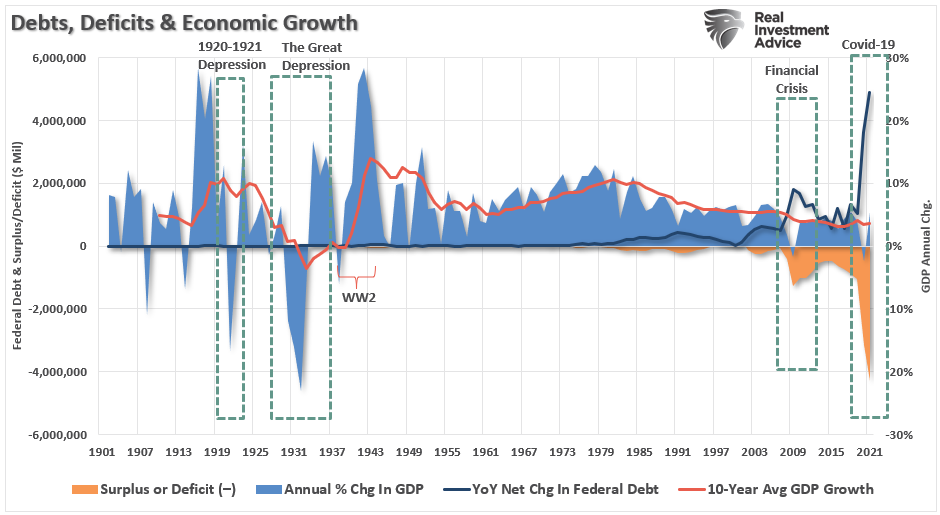
“In 1980, that all changed, and seven administrations and four decades later, Government debt surged, deficits exploded, and the debt ceiling rose 78 times. (49 times under Republicans and 29 times under Democrats.)
As Congress lifts the debt ceiling for the 79th time, the runaway spending and deficit increases continue to accelerate. The consequence of increasing debts and deficits is evident in the declining economic growth rates over the past 40-years.”
In other words, this isn’t about paying bills from the Trump Administration, but also every President before him back to Ronald Reagan. For each year that we amass more enormous debts and deficits, the interest payments increase along with the growing burden of “mandatory spending.”
The problem today, as discussed in the “Insecurity Of Social Security,”
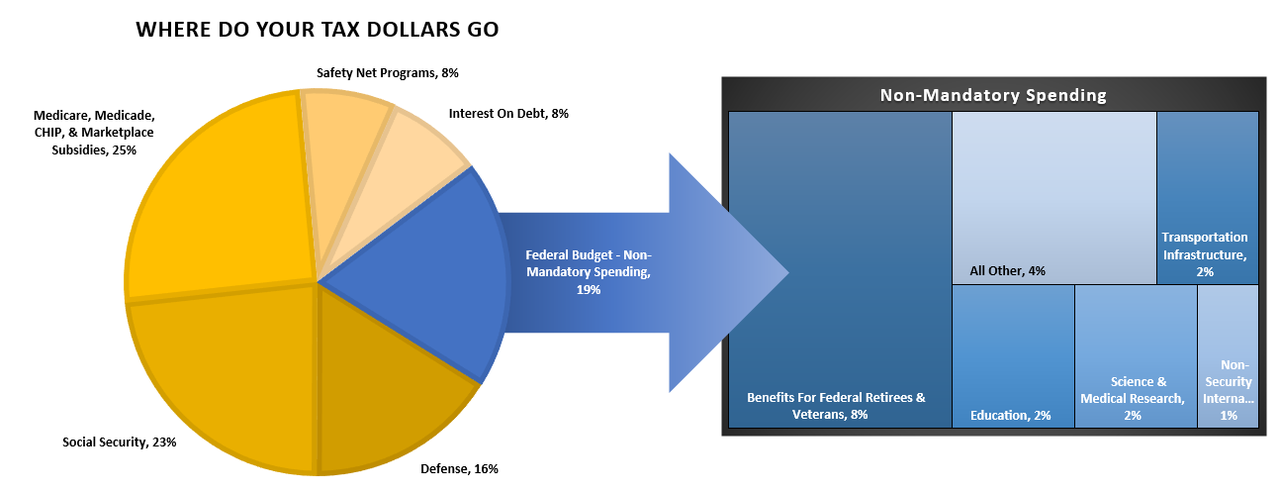
“In the fiscal year 2019, the Federal Government spent $4.4 trillion, amounting to 21 percent of the nation’s gross domestic product ().GDP Of that $4.4 trillion, federal revenues financed only $3.5 trillion. The remaining $984 billion came from debt issuance. As the chart below shows, three major areas of spending make up most of the budget.”
In 2019, 75% of all expenditures went to social welfare and interest on the debt. Those payments required $3.3 Trillion of the $3.5 Trillion (or 95%) of the total revenue collected. Given the decline in economic activity during 2020, those numbers become markedly worse. For the first time in U.S. history, the Federal Government will have to issue debt to cover the mandatory spending.
Only A Temporary Fix
Think about that for a moment. In 2021, we will spend more on our “mandatory spending” than “revenue” will cover. Such means the Government will continue to go further into debt every year just to run the country. On top of the required spending, our politicians now want to add another $5 trillion in debt for “infrastructure.”
See the problem here.
The “debt ceiling” was always a “non-crisis.” It was just political brinksmanship playing out on national television. The resolution, as expected, came last week with Senate Minority Leader, Mitch McConnell, proposing a debt limit ceiling lift to $29 trillion. Such will fund the government through December.
“Senate leaders reached a bipartisan agreement Wednesday to defuse the impending debt limit crisis by allowing for a short-term increase in the statutory borrowing cap while lawmakers negotiate a longer-term solution.
Democrats said they would agree to an offer from Minority Leader Mitch McConnell that would pave the way for an increase in the debt limit into December. But the two parties still disagreed on any long-term strategy.” – Roll Call
While raising the debt ceiling may look like a victory for the Democrats, it may not be.
“While raising the debt ceiling just once is proving to be a challenge, the only thing worse would be having to vote to raise it twice

From a political perspective, the only thing less attractive than voting to raise the debt limit to $31 trillion is voting to raise it to $29 trillion and then voting a second time to raise it to $31 trillion’” – Zerohedge
Odds Increasing We’ve Seen The Highs For This Year
There are reasons to be optimistic as we head into the seasonally strong period of the year. However, while the seasonal and technical backdrop is improving short term, we should not dismiss the numerous headwinds.
  • Valuations remain elevated.
  • Inflation is proving to be sticker than expected.
  • The Fed will likely move forward with “tapering” their balance sheet purchases in November.
  • Economic growth continues to wane.
  • Corporate profit margins will shrink due to inflationary pressures.
  • Earnings estimates will get downwardly revised keeping valuations elevated.
  • Liquidity continues to contract on a global scale
  • Consumer confidence continues to slide.
While none of these independently suggest a significant correction is imminent, they will limit the market’s advance making new highs less attainable. Furthermore, given the “debt crisis” will return in December, the risk of volatility remains elevated.
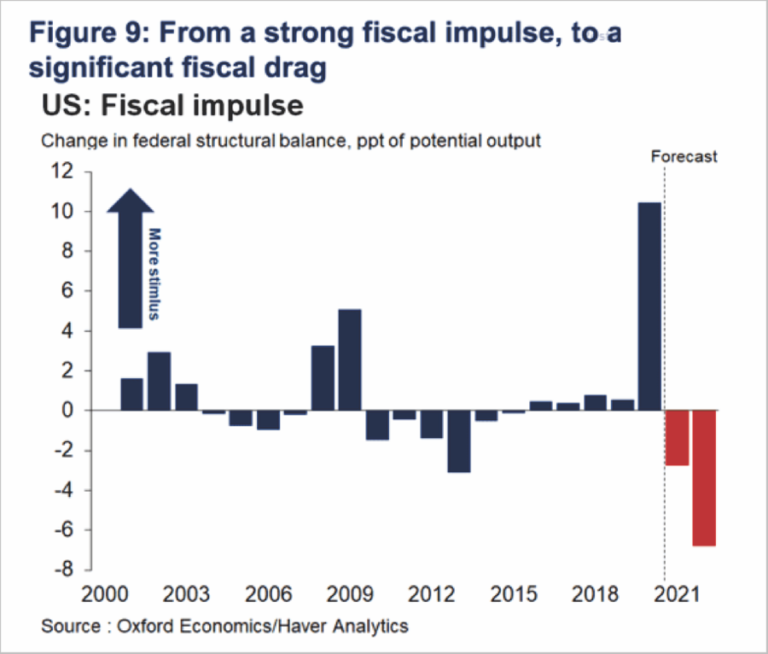
Much of the mainstream media overlooks the rapid decline in liquidity that supported the market over the last year. While the “human infrastructure” bill will provide some support, the difference is the spending is spread out over 10-years versus the “checks to households” in 2020.
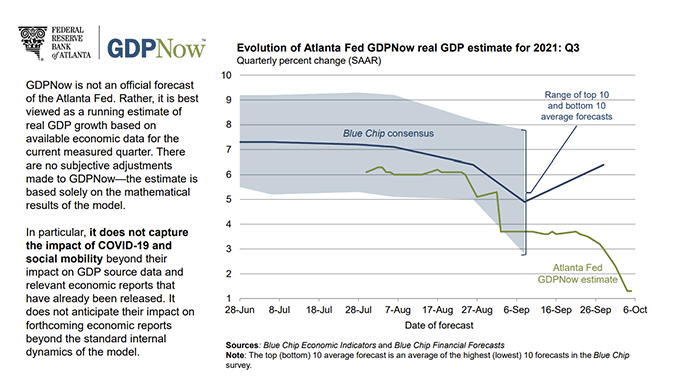
Furthermore, that liquidity drain is rapidly deteriorating the outlook for economic growth. Here is the latest report from the Atlanta Federal Reserve:
“The GDPNow model estimate for real GDP growth (seasonally adjusted annual rate) in the third quarter of 2021 is 1.3percent on October 5, down from 2.3 percent on October 1.
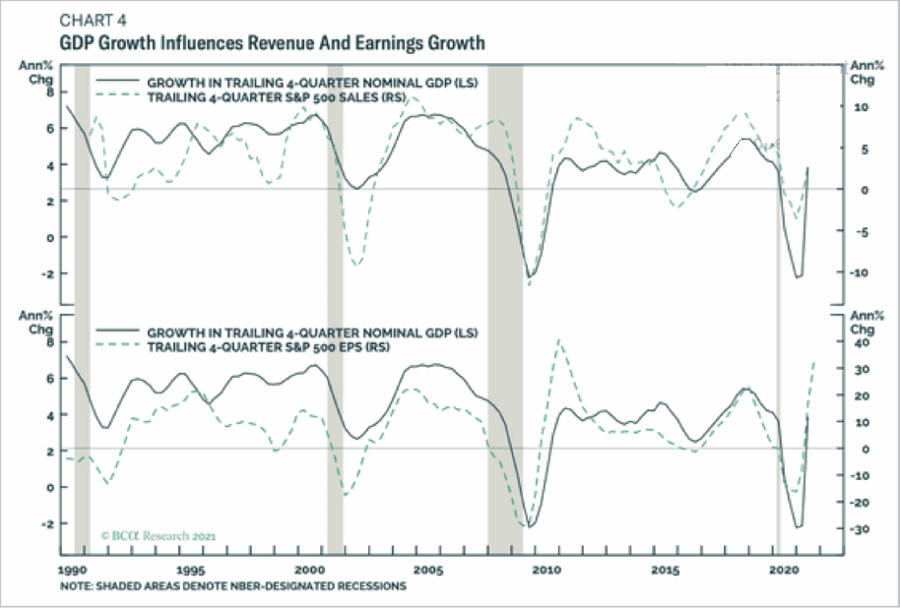
As BCA Research shows, as we head into the last quarter of the year and 2022, the slower economic growth rates will coincide with corporations’ weaker revenue and earnings growth.
As noted, with valuations already elevated, a reversal in earnings growth will likely limit a stronger advance.

(ZH) Robinhood Insiders Speed Up Stock Sales Days After New Risk Disclosures Rel

Robinhood Insiders Speed Up Stock Sales Days After New Risk Disclosures Relating To Crypto And Payment For Order Flow

Robinhood fell about 2% after hours on Friday after the company announced it was planning to speed up a previously announced stock sale.
Andreessen Horowitz, 9Yards Capital and New Enterprise Associates are among the selling shareholders, who may get an opportunity to offload their shares as early as Wednesday, according to Bloomberg, citing a company filing.
Robinhood fell 28% when the potential sales were first announced back at the beginning of August.
Bloomberg explained: "The company filed a second amendment to a Sept. 1 filing, for the potential resale of shares by holders and an acceleration request asking the SEC to declare the filing effective at 4:30 p.m. ET on Oct. 13."
At the same time, Robinhood also disclosed in a new filing Thursday night that "regulatory intervention in cryptocurrency trading" and "a payment arrangement between brokerages and trading firms" were additional risks the company faced to its business.
The company made the statements in an amended filing related to the stock sale, Bloomberg reported.
“The regulatory landscape involving cryptocurrencies is constantly evolving and is subject to change,” the company wrote.
It also made note of the fact that crypto trading accounted for 41% of its revenue in the second quarter.

Robinhood had also previously warned about its Q3 guidance, something Zero Hedge contributor Quoth the Raven recently wrote about while highlighting risks in owning the name.
"Robinhood’s valuation is simply a bubble, in my opinion, which makes it the short end of this trade," he wrote. "The company moved as high as $52 per share at one point, all on an orchestrated gamma squeeze by the folks over at Wallstreetbets. This took an already overvalued name at the time of its IPO and stretched its valuation into stratospheric territory."
He continued: "But think back: Robinhood had trouble finding a bid at its $37/share valuation when it went public and, since then, has done nothing but reported Q2 earnings that included a warning about a slowdown in trading activity, either setting the stage for a rougher Q3 or sandbagging."
The article also noted the concentration on crypto asset risk, stating: "The company’s revenue stream is becoming increasingly dependent on its crypto trading business at a time when U.S. regulators have admitted they won’t ban bitcoin, but still have a long way to go in setting rules for the new asset class."
Finally, it pointed out the payment for order flow model as potentially being at risk, per SEC Chairman Gary Gensler, who said banning the practice was "on the table" in late August.
On top of that, at the end of September, we wrote a comprehensive article asking whether or not the President of Robinhood dumped all of his AMC stock right before the brokerage suspended trading in the name.
“I sold my AMC today. FYI – tomorrow morning we are moving GME to 100% - so you are aware,” Robinhood's President and COO, Jim Swartwout allegedly said in an internal chat.
Perhaps Robinhood's existing investors that are looking to hit the exits early have become far too aware of all of these risks...