>>> TradeGate Pre-Market Indications

DAX:
  • Volkswagen (VOW3 TH) -1.2%
  • Covestro (1COV TH) -1.2%
  • Infineon (IFX TH) -1.2%
    • Infineon ADRs Rated New Buy at President Capital Management
  • Deutsche Bank (DBK TH) -1.3%
    • China Starts Inspection of Financial Regulators, State Banks
  • Daimler (DAI TH) -1.6%
MDAX:
  • Cancom (COK TH) +4.1%
    • Cancom to Buy Back Up to 3.5 Million Treasury Shares
  • Fuchs Petrolub (FPE3 TH) +1.2%
  • Lufthansa (LHA TH) +0.4%
    • Lufthansa Pays Back $1.7 Billion of Germany’s Silent Stake
    • EasyJet Increases 1Q Capacity Plans to Up to 70% of ‘19 Levels
  • Thyssenkrupp (TKA TH) -1.3%
    • Aluminum Retreats From 13-Year High as Stagflation Worries Mount
  • Nemetschek (NEM TH) -1.3%
  • United Internet (UTDI TH) -1.6%
  • Wacker Chemie (WCH TH) -1.7%
SDAX:
  • About You (YOU TH) +1%
  • Adler Group (ADJ TH) +0.4%
    • Adler’s Caner Files Criminal Complaint Against Short Seller
  • SGL (SGL TH) -0.8%
  • Nordex (NDX1 TH) -0.8%
  • Aareal Bank (ARL TH) -1.4%
  • ADVA Optical (ADV TH) -2.3%

FT : UK pledges $1.7bn to African ports venture with Dubai operator

UK pledges $1.7bn to African ports venture with Dubai operator
CDC Group to invest $720m for minority stake in project in Egypt, Senegal and Somaliland

The UK government’s development investment arm is to make the single-biggest investment in its 73-year history by taking a minority stake in three African ports in a $1.7bn joint venture with DP World, the Dubai-based ports operator.

CDC Group is announcing on Tuesday that it is to invest an initial $320m in the expansion of ports in Egypt, Senegal and the self-declared east African state of Somaliland. It also intends to funnel a further $400m into DP World ports and logistics operations, including dry ports, it said.

DP World, which has been expanding rapidly in Africa, will invest an initial $1bn.

Tenbite Ermias, head of Africa at CDC, said the deal had been four years in the making. “It is a visible commitment to growing Africa’s ability to trade in both directions, to reduce costs and to simplify exports,” he said. “We have a shared vision with DP World — to open up as many ports across the continent as possible. Our investment allows them to stretch their dollar further, to do more.”

Ermias estimated that the expansion of the three ports — Dakar in Senegal, Sokhna on Egypt’s Red Sea coast and Berbera in Somaliland — would create nearly 140,000 direct jobs in the three countries and add more than $50bn to total trade by 2035.

The expansion of Berbera, former capital of the protectorate of British Somaliland, would increase Somaliland’s gross domestic product by an estimated 6 per cent, he said, as well as providing an alternative to using Djibouti for landlocked Ethiopia. The investment in Dakar, he added, would not only help Senegal but also provide an export route for landlocked Sahelian countries such as Mali.

“This is not geopolitics,” Ermias said of the instability in the Horn of Africa and the possible perception that UK aid was helping Ethiopia, whose government is embroiled in a brutal civil war in Tigray province. “We make investments in risky places; this is our mandate.”

As the UK aid budget comes under pressure, CDC’s investment marks what has been a gradual shift of UK development funds into so-called impact investments that also bring a commercial return. CDC, which has a portfolio of $7.1bn, reinvests profits from its investments into new projects and describes itself as “largely self-funding”, although its capital is supplemented by the UK government each year.

CDC received £650m from the UK government in 2020. Over past 10 years it has received about 3 per cent of Britain’s overseas development budget.

Paul Collier, professor of economics and public policy at Oxford university’s Blavatnik School of Government, said that international development finance institutions like CDC should work more closely together to invest in fragile states where private investment was lacking.

“The future of aid is to ignite the private sector,” he said. “Countries will stay poor for ever unless their private sectors grow.”

Many African leaders have emphasised that they see trade and investment, and not aid, as their path to development. Nana Akufo-Addo, Ghana’s president, has spoken of pushing his nation “beyond aid” by transforming raw materials inside the country rather than exporting them in unprocessed form.

Sultan Ahmed bin Sulayem, chair and chief executive of DP World, said: “This partnership with CDC . . . will enable us to increase our investments in ports and logistics infrastructure across Africa . . . and create transformational opportunities for millions of people.”

Nick O’Donohoe, CDC’s chief executive, said Africa’s ability to trade was being hampered by logistical bottlenecks, which were in turn adding to social fragility. “Stable and flourishing economies are built on reliable access to global and intra-continental trade,” he said.

Previous large CDC investments have been in digital infrastructure and energy projects and, most recently, in a consortium participating in Ethiopia’s telecoms privatisation. Those investments were all intended to catalyse economic growth and create jobs, it said.

>>> What to look at today - 12th of October 2021

Stocks and U.S. equity futures fell Tuesday, hurt by concerns about elevated inflation stoked by energy costs and the possibility of a widening Chinese crackdown on private industry. Treasury yields were steady.
MSCI Inc.’s Asia-Pacific index snapped a three-day climb, with the technology sector leading losses and South Korea underperforming. Signs that Beijing is widening its scrutiny of private and state enterprises soured the broader mood. U.S. and European futuresretreated following declines in U.S. shares as the prospect of a slowing recovery from the pandemic shadowed trading. 
Oil held above $80 a barrel amid a power crisis from Europe to Asia. China’s thermal coal futures surged to a record for a second day. The energy crunch is squeezing supplies of aluminum, whose price hit a 13-year high. Other industrial metals have also rallied, fueling inflationary pressures. 
Global markets are struggling to shake off worries that inflation spurred by an energy crunch and pandemic-related supply-chain snarls will sap company profits and economic expansion. Financial firms this week will kick off the third-quarter earnings season, heralding a key test of investor confidence.
Traders are also awaiting reports on the U.S. consumer-price indexand retail sales. The figures will help inform expectations about the likely timeline for Fed tapering and any eventual rate hikes.
US After Hours MATX +5.1% higher on bullish guidance; QTRX up +19.9% after receiving FDA Breakthrough designation

Nikkei -0,79%% Hang Seng -1,02% CSI -1,20% Shanghai -1,53% Shenzen -1,87%

Eur$ 1,1558 CNH 6,4556 CNY 6,4529 JPY 113,29 GBP 1,3596 CHF 0,9278 RUB 71,8623 TRY 8,9994 WTI$ 80,45 Gold 1756 BTC 56,950 -0,73% ETH 3491

S&P -0,47% Nasdaq -0,53% EuroStoxx -0,91% FTSE -0,57% Dax -0,80% SMI -0,55%

Macro :
- Morgan Stanley Sees Stocks Suffering on Souring Consumer Outlook
- Crypto Stocks Rise as Bitcoin Climbs to Highest Level Since May
- Macron to Unveil Investment Plan of Up to EU50B, Les Echos Says
- Roubini Says Fed May ‘Wimp Out’ on Tightening Despite Inflation

Keep an eye on :
- AIR FP : Airbus Books One Order, No Cancellations in September
- AKH NO : Aker Horizons Sells 42m Aker Carbon Capture Shrs at NOK23.8/Shr
- ALO FP : Alstom Wins Contract for Line 18 France Automatic Metro System
- COK GY : Cancom to Buy Back Up to 3.5 Million Treasury Shares
- DAI GY : Mercedes Weak 3Q Sales May Represent Low Point for EU Automakers
- DLAR LN : De La Rue Sees Earnings in Line With Expectations
- DSV DC : DSV Boosts FY Ebit Before Significant Items View, Beats Est.
- ELUXB SS : Electrolux to Acquire Unified Brands for SEK2.14 Billion
- FAST NA : Fastned 3Q Revenue Related to Charging EU3.2M Vs. EU1.6M Y/y
- GXI GY : Gerresheimer 3Q Adjusted Ebitda Misses Estimates
- GIVN SW : Givaudan 3Q Like-for-like Sales Beat Estimates
- IHG LN : IHG in Talks to Find Successor to Chairman Patrick Cescau: Sky
- LONN SW : Lonza Sees 2021 Capex at ~25% of Sales; Updates 2024 Guidance
- LHA GY : Lufthansa Pays Back $1.7 Billion of Germany’s Silent Stake
- PGHN SW : TA Associates to Buy 25% of Partners Group Unit Foncia; No Terms
- PHIA NA : Philips’s Breathing-Device Lawsuits Over Toxic Foam Move Forward
- SOBI SS : Sobi Prelim 3Q Revenue Beats Estimates
- GLE FP : SocGen Retail Merger With Credit Du Nord on Track
- STLA IM : Stellantis Plans to Turn Turin Factory Into an Electric Car Hub
- FTI FP : TechnipFMC Gets Substantial Long-Term Contract by Petrobras
- TRYG DC : Tryg 3Q Profit After Tax Misses Estimates; FY Outlook Kept
- XIOR BB : Xior Buys 32.36% Stake in Quares; to Launch Tender Offer

FT : SpaceX: how Elon Musk’s new rocket could transform the space race

SpaceX: how Elon Musk’s new rocket could transform the space race
The entrepreneur hopes the Starship will help take humans to Mars. Rivals fear it will dominate US deep space exploration

At the southernmost tip of Texas, alongside the Gulf of Mexico, a gleaming stainless steel rocket has been rising from the salt marshes.

At nearly 400ft, the new SpaceX rocket will eventually be taller than the Saturn V that carried Nasa’s Apollo missions to the moon, and its 33 engines will deliver twice the thrust. For Elon Musk, SpaceX’s founder, it is meant to play a key role in one day establishing a human colony on Mars.

But the rocket, dubbed the Starship, could have a far more immediate impact on a space industry that has already been shaken by Musk’s ambitions. With the power to carry as much as 100 tons into low orbit around the Earth, his admirers claim Musk is about to transform the economics of the launch business.

“It’s game over for the existing launch companies,” says Peter Diamandis, a US space entrepreneur. “There’s no vehicle out there on the drawing board that could compete.”

Musk’s space company still has some way to go to live up to the promise, including winning regulatory clearance to launch Starship from its Texas site and showing that it can reliably reach space while returning both the rocket’s stages for reuse — an essential step in reducing launch costs.

Also, many experts question whether a large rocket designed to colonise another planet can double up as an all-purpose transport for more varied and mundane tasks closer to Earth. But SpaceX’s success in turning its current rocket, the Falcon 9, into the main workhorse for reaching space has made others in the commercial space industry nervous.


“If you’re not careful, SpaceX will be the only game in town,” says Fatih Ozmen, co-founder of Sierra Nevada Corp, a private US company that has been contracted by Nasa to fly cargo to the International Space Station. Blue Origin, Jeff Bezos’ private space company, makes a blunter claim: SpaceX could end up with “monopolistic control” of US deep space exploration.

Musk’s venture has put itself in a commanding position in the new commercial space industry with surprising speed. It is only 13 years since it became the first private company to launch its own rocket into orbit, breaking into an industry previously dominated by nation states. It has also leapt ahead of contractors such as Boeing and Lockheed Martin, whose joint venture, United Launch Alliance, had carried the flag for US space launch — though using Russian engines.

SpaceX’s ascendancy has been underlined over the past six months by a striking series of wins.

They include a $2.9bn contract awarded by Nasa to use the Starship to land its astronauts on the moon as early as 2024. It was the space agency’s decision to pick only one supplier for this programme, after earlier indicating it would select two, that brought the warning from Blue Origin. Nasa officials point out that they have only awarded SpaceX a single mission, leaving them open to choose other suppliers for future landings. But Blue Origin claims that adapting its systems to work with the Starship will force design changes that will lock the agency into a dependence on SpaceX in the long term.

Musk went on to upstage Bezos a second time late last month. Just weeks before, the Amazon founder and Sir Richard Branson had each made personal trips to the edge of space on their company’s respective rockets. The brief moments they enjoyed in microgravity were eclipsed when SpaceX carried four passengers more than five times higher for a three-day joyride around the Earth, making them the first all-civilian crew to reach space.

SpaceX also announced the first 500,000 orders for its Starlink broadband network, making it the first in a new generation of broadband communications companies operating from a constellation of satellites in low orbit, around 500km above the earth.

And last week, Nasa said two astronauts who had been scheduled to fly on a Boeing spacecraft would be switched to SpaceX’s spaceship instead. The company that defined an earlier era of aerospace has hit too many technical obstacles to carry astronauts on its first commercially developed spaceship, putting it well behind what until recently was just a scrappy start-up.

Rocket science
At the heart of SpaceX’s spate of successes is the Falcon 9, which has brought down the cost of reaching space and become a springboard both for the company’s wider business and Musk’s ultimate goal of reaching Mars.

“In terms of performance, cost and reliability, it really is the most successful rocket ever built,” says Diamandis.

SpaceX’s share of the global launch market, excluding China, climbed above 50 per cent for the first time in the first half of 2021, according to BryceTech, a space research and consultancy firm. And while China launched nearly as many rockets as SpaceX in that period, the US company lifted nearly three times as much weight into space.

The tactics that turned the Falcon 9 into the era’s most widely used rocket are now being applied to the Starship. They echo many of the things that also account for the breakout success of Musk’s electric car company, Tesla.

Foremost has been the success of Musk and SpaceX’s CEO, Gwynne Shotwell, at pushing disruptive technologies into mainstream production. In the case of the Falcon 9, that meant using 3D-printing for its engines, the most complex part of the rocket, and reusing the main booster, for future launches.

To master new techniques like these, SpaceX worked on almost every detail of designing and creating its own rockets rather than relying on suppliers, with Musk himself acting as a chief engineer in the early days to goad his team on. SpaceX also took on the full development risk itself, rather than being able to fall back on guaranteed payments from Nasa, forcing much greater financial discipline. As a result, the space agency estimates that the $400m SpaceX spent to develop the Falcon 9 rocket was 10 times lower than the likely cost of a rocket built under traditional government contracting.

Another advantage that SpaceX has shared with Tesla has been its ready access to cheap capital, thanks to the high valuation investors have been prepared to put on its business. Musk has raised more than $6.5bn for the company in the private market, lifting its valuation to $74bn earlier this year. Share sales by some of its investors have since valued it at more than $100bn, according to CNBC.

Most rivals have to generate cash from their existing businesses to fund new ventures, says Steve Collar, chief executive of satellite company SES. The ease with which SpaceX has been able to tap investors has opened the way for it to take much bigger risks, he adds.

One result of the ample cash, along with the company’s access to its own launch service, has been Starlink, which has beaten would-be rivals like OneWeb and Amazon’s Kuiper to launch its broadband service.

Racing to be first has involved technical gambles with its satellite designs, and Starlink is already on its third generation of technology. But even if it ends up writing off billions of dollars’ worth of satellites on the way to perfecting its constellation, the setback would not hurt the company the way it would a rival without access to such cheap capital, says Collar.

Rivals complain that as a result, SpaceX risks squeezing out other companies that haven’t yet achieved its scale and don’t enjoy its funding advantages. Blue Origin, which has lodged a formal complaint over Nasa’s moon landing award, said losing the contract would rob it of one important market for its New Glenn rocket, which has already cost $2.5bn to develop and has yet to leave the launch pad.

SpaceX’s vertically integrated manufacturing approach will also deprive other US suppliers of business, weakening the wider industrial base the country had built up to support its long-term ambitions in space, Amazon and others warn.

However, SpaceX’s customers — including those in government — do not seem to share the misgivings.

“Before SpaceX we only really had the ULA, so we’re in a better position than we were,” says Phil McAlister, director of NASA’s commercial space flight division.

Diamandis goes further: “The US government is lucky to have a company like SpaceX based here,” he says, since its efficiencies feed through directly into the US space programme. And companies that compete with SpaceX in some markets seem more than happy to use its launch services, despite supporting a rival.

“When they came into the [satellite] industry, that freaked people out a bit — but I don’t think it needs to,” says Collar of SES, which is still happy to rely heavily on SpaceX rockets.

Soaring demand
The warnings that a vertically-integrated rocket company could weaken an important supply chain also gets short shrift in many parts of the emerging commercial space industry. Most new rocket companies have adopted a similar model. Jory Bell, a partner at Playground Global, a venture capital firm that has invested in the space industry, also points out that the traditional supply chain has served more of a political purpose than a commercial one. Having suppliers spread across the country has enabled a larger number of politicians to claim success by winning a share of government space contracts.

The most telling argument against the risk of monopoly, though, is that the plunging price of reaching space has brought a boom in demand that is far more than any one company can manage. Much of it is coming from new communications networks aiming to launch constellations comprised of thousands of satellites, as well as more governments eager to reach space for national defence or to take part in deeper space exploration.

“This is a market that will be supply-constrained for many years,” says Edison Yu, an analyst at Deutsche Bank. The space launch market will be worth $37.5bn a year by the end of the decade, he predicted — five times as much in 2021.

That should leave more than enough room for at least one big rival to SpaceX to emerge, according to many in the industry. And even if some existing launch companies struggle, held back by older technologies, uncompetitive manufacturing approaches or cultures built on government contracting, a new generation of disruptive rocket companies is rapidly emerging.

Along with Bezos’ own Blue Origin, they include Relativity Space, a company led by former SpaceX executives, which has raised $1.3bn and plans to make entire rockets using 3D printing, not just the engines.

“We don’t have to beat SpaceX — we just have to beat everyone else,” says Bell at Playground Global, one of Relativity’s financial backers. A generation of engineers and space entrepreneurs trained by SpaceX is helping to build an entire industry based on its ideas, he added.

Satellites and beyond
Starship’s first orbital flight, when it comes, will still reverberate through the space industry. Its sheer scale will change the economics of getting to orbit, setting a new pricing benchmark against which others are likely to be judged.

The Falcon 9 has already brought the price for customers willing to share a launch with others down to $5,000 per kilogramme, around a third of what it was before, says Yu. That price could fall to $1,000, and perhaps even as low as $500, once Starship becomes fully operational, he predicts.

How well adapted it will be for the satellite launches that make up the bread and butter of today’s space industry is another matter. Since Starship will not be able to deposit its large payloads into multiple orbits, the satellites it carries will need their own propulsion to manoeuvre into place, making them considerably more expensive, says Yu.

“You need to get a lot of mass to orbit for some things — and you need speed and agility and precision for other things,” says Dan Hart, chief executive officer of Virgin Orbit, which reached orbit for the first time this year after launching a rocket from under the wing of a Boeing 747.

That is likely to make the Starship “a capability that’s more suited to Mars than commercial satellites”, says Collar at SES.

Some also question how committed SpaceX will be in the coming years to battle for market share in the routine satellite launch business. Falcon 9 was always intended as a stepping stone, to develop the cash flow and the technology needed to carry the company much deeper into space.

Musk should be taken seriously when he muses about turning away from the Falcon 9 and redirecting all of SpaceX’s effort to the Starship and the goal of reaching Mars, according to supporters like Diamandis. “He kills his old products and burns the ship,” he says — one reason he has often succeeded at ambitious new undertakings.

With a lock on today’s launch market, it is probably still far too soon to write the epitaph for the Falcon 9. But when the Starship finally takes to the heavens, it is likely to draw a clear dividing line between one era of space and the next.

FT : Hedge funds snap up uranium in bet on green energy shift

Hedge funds snap up uranium in bet on green energy shift
This year nuclear fuel has risen in price to its highest level since 2012

After years of stagnant prices, a 37 per cent rally in prices for nuclear fuel uranium has helped attract investors back to the sector.

Funds such as Ben Melkman’s New York-based Light Sky Macro, Anchorage Capital and Tribeca Investment Partners have been positive on the outlook for the raw material, as a global energy crunch highlights the role of nuclear power in a transition away from fossil fuels.

The price of raw uranium, known as yellowcake, rose to its highest level since 2012 at $50 a pound last month. The move has attracted new investors into the market for the first time since before the financial crisis, when buying by investors drove the price from $20 a pound to a record high of $136 a pound in June 2007.

“We’ve been patiently waiting for something to happen for a long time,” said Ben Cleary, of Tribeca Investment Partners in Singapore, whose fund is up 345 per cent net of fees this year. “Clearly there’s speculative money coming back into the sector, there were massive price moves in September.”

Canadian asset manager Sprott has catalysed the price rise with significant buying of uranium, but investors say the broader energy transition is highlighting the key role of nuclear — a low-carbon source of baseload power.

Sprott’s Physical Uranium Trust is one of the few that buys and stores physical uranium. Most funds have added exposure through mining equities, which have rallied 58 per cent this year, according to the Global X Uranium ETF.

The rapid rise in natural gas and coal prices to fresh highs this month has exacerbated an energy crisis in Europe and China, and has “placed uranium back in the spotlight”, said Rob Crayfourd at CQS New City Investment Managers.

“The political fallout of this energy crisis will be a greater willingness in the west to extend the life of the existing reactor fleet,” he said. “It has focused governments on the benefits of secure supply of energy from the nuclear fleet. We expect that to lend support [to prices].” 

Light Sky’s founder Melkman, who was previously a partner at hedge fund Brevan Howard, has gained more than 5 per cent this year, said a person who had seen the numbers.

“Light Sky Macro sees an immediate and sizeable opportunity in the uranium sector, making it one of our highest conviction views for 2021,” he wrote in a note to clients, seen by the Financial Times, earlier this year.

A drawdown of inventory during the coronavirus pandemic has compounded tightening supply, while demand is expected to surge in the coming decades, added Melkman, who has been investing in the sector since 2018.

“The growing focus on ‘green energy’ at a political level and the growing demand for [sustainable] assets in the investment community should turn uranium into one of the most asymmetric trades for the coming years,” he wrote, meaning that the possibility of potential gains far outweighs the risk of losses.

Also profiting is Sean Benson, founder of London-based Tees River. His uranium fund, which buys equity stakes in uranium miners, is up 115 per cent this year.

Benson argues in an investor letter, seen by the FT, that a deficit of supply relative to demand and a “very supportive” climate change agenda mean that “the current uranium cycle is better than the last on every fundamental metric”. His Critical Resources fund, which invests about one-third of assets in uranium, is up 44 per cent this year.

FT : France bets on more nuclear power in face of Europe energy crisis

France bets on more nuclear power in face of Europe energy crisis
Emmanuel Macron expected to announce ‘mini-reactors’ as political and public opinion shifts

President Emmanuel Macron is expected to give the go-ahead for a cluster of nuclear reactors as Europe’s energy crisis spurs renewed French interest in the contentious source of power.

France is a bastion of nuclear power in Europe, with more than 70 per cent of its electricity derived from nuclear plants. However, after the disastrous 2011 explosion at a plant in Fukushima, Japan, and big cost overruns at a new plant in Flamanville in north-west France, national pride around France’s nuclear capability dissipated.

Early in his presidency Macron announced the intention to shut 14 reactors and cut nuclear’s contribution to France’s energy mix from 75 to 50 per cent by 2035.

But the mood is changing. This week, Macron is expected to announce the development of six so-called small modular reactors (SMRs), or “mini” nuclear plants.

Approval is also a way for Macron to show his pro-nuclear credentials when a number of his most likely challengers in next year’s presidential election are pushing for more investment.

“Nuclear is coming [back] to the fulcrum of the energy debate in France and much faster than I ever thought it would,” said Denis Florin, a partner at Lavoisier Conseil, an energy-focused management consultancy.

Advocates say nuclear power’s availability and predictability has proved its worth at a time of soaring gas prices — while renewable energy remains volatile and difficult to store. Those advantages, which have protected French industrial companies and consumers from the most severe price hikes seen in other parts of Europe, have begun to outweigh lingering safety concerns.


About 25 per cent of France’s electricity is sold at a regulated price of €42 per megawatt hour (MWh). The rest is subject to wider market prices and, specifically, a European pricing mechanism that means countries pay for the last unit of energy consumed — normally gas — which has led to some frustration among French consumers.

France’s finance minister, Bruno Le Maire, has advocated a complete overhaul of Europe’s electricity pricing mechanism, which he argues unfairly prevents French citizens from fully benefiting from its nuclear capability.


France also wants nuclear energy to be labelled as “green” in the evolving EU green finance taxonomy that determines which economic activities can benefit from a “sustainable finance” label. France and eastern European capitals want to show investors that nuclear energy is part of the EU’s journey towards carbon neutrality, while Germany and others have resisted, pointing principally to the environmental impact of nuclear waste.

Many on the left of French politics remain wedded to the idea of reducing France’s nuclear power supply, seeing it as a substitute for ambitious investment in renewable energy sources, such as wind and solar, at a crucial juncture in EU governments’ ambitions to reach carbon neutrality by 2050.

But proponents of nuclear power argue that in recent weeks France has boasted much lower carbon emissions than Germany, which has been rapidly phasing out its nuclear fleet since 2011 and has invested heavily in renewable energy but has also become more reliant on coal.

Nicolas Goldberg, a senior energy analyst at Columbus Consulting, said Macron has now “firmly taken the path of seducing the right more than the left” with his nuclear policy, at a time when many rightwing presidential rivals promise that they would enhance France’s nuclear capability.


Centre-right candidate Valérie Pécresse said this month that she would halt the planned shutdown of 12 nuclear reactors and give the state-controlled energy company EDF the green light to produce six new nuclear power stations.

Eric Zemmour, who is rising quickly in polls after captivating the French public with his anti-immigration rhetoric, has also called for more nuclear investment and lambasted Macron’s investment in wind energy. “I do not want our country to lose its energy sovereignty under the pretext of an absurd energy transition copied from Germany,” he wrote in the magazine Le Point this month.

Such calls also reflect shifts in public opinion.

While a recent opinion poll by Odoxa found that the French public is still on the whole more favourable to wind power than nuclear, at 63 per cent compared with 51 per cent, French citizens’ support for nuclear has increased 17 percentage points over the past two years, while positive perceptions of wind power have decreased by the same amount.

According to the same survey, nuclear power is judged to be less expensive than wind and less damaging to the landscape, as well as being a field where France is “more advanced than its neighbours”.


Macron’s proposed six new “mini-reactors” run on technology that is billed to be less powerful but also less complex to produce and run than conventional reactors. Industry analysts say they help to keep France’s industrial competitiveness given that prototypes are already being developed in China, Russia, the US and Japan.

Several analysts believe Macron will go deeper into nuclear technology through the construction of at least six conventional European Pressurised Reactors (EPRs), to be built by 2044 — a project the government has mulled for years. Documents obtained by the French press in 2019 suggested those would cost France’s heavily indebted EDF roughly €47bn.

This month RTE, the French grid operator, is due to publish six scenarios for France’s future energy mix by 2050, ranging from 100 per cent renewable energy to several new nuclear plants. “I am confident that Macron will announce six or eight new EPR power plants at the end of this month — he’s just waiting for this report,” said Goldberg.

For those who have spent years advocating greater investment in renewable energy sources, and thought they had the president’s ear, the mounting momentum towards nuclear has come as a disappointment.

“Every euro invested in nuclear is a euro not invested in other energies,” said Matthieu Orphelin, an MP who used to represent Macron’s party but has now switched to France’s Greens. “A permanent, headlong rush into nuclear power will not save us.”

FT : Axa joint venture jumps on China electric-car ETF bandwagon

Axa joint venture jumps on China electric-car ETF bandwagon
The launch means there are now four ETFs tracking the narrow theme, all of which listed in the past six months

Axa SPDB Investment Managers will launch China’s fourth smart electric-car themed exchange traded fund just six months after the first came to the market as fund houses tap buoyant investor sentiment for assets that match the country’s carbon neutrality goals.

The listing of the Axa SPDB CSI Intelligent Electric Vehicles ETF comes after E Fund Management rolled out China’s first autonomous electric-vehicle focused ETF in April, and two more similar fund strategies were launched in July.

The new vehicle managed by the Sino-French fund joint venture between Shanghai Pudong Development Bank and Paris-based insurance group Axa has been listed on the Shanghai exchange, a regulatory filing shows.

The ETF tracks the CSI Intelligent Electric Vehicles Index, which mirrors the performance of A-share companies that cover various aspects of the manufacturing and promotion of electric vehicles, including automation designs, motors and sensors, and communications systems, among others.

Electric car, chipmaker and electrical equipment stocks account for almost two-thirds of the weighting of the underlying benchmark index, which was created in 2009, according to Wind data cited in a press release issued by Axa SPDB IM.

The index’s top ten holdings represent 62 per cent of its total weighting and include battery maker Contemporary Amperex Technology, carmaker BYD, Will Semiconductor, lithium compound producer Jiangxi Ganfeng Lithium and plastic-producing group Yunnan Energy New Material.

China’s pledge to begin reducing carbon emissions by 2030 and achieve net zero by 2060 has prompted the launch of a number of sustainability-themed fund products.

The development of China’s new-energy vehicle industry has been boosted since the State Council released a blueprint for its growth in November last year. The industry must hit a compound annual growth rate of 33 per cent for the coming 15 years as China transforms from a “major carmaker” to a “carmaker giant”, amid growing concerns over climate change, according to the new guidelines.

In an accompanying smart electric-vehicle specific directive, Chinese authorities have demanded that combined sales of partially automated and higher specification conditionally automated electric vehicles represent more than 50 per cent of overall car sales in 2025, and over 70 per cent in 2030.

Globally, the market for electric vehicles is expected to soar from 2.9 per cent of total market share as of 2020 to 92.3 per cent in 2050, according to Morgan Stanley Research.

China’s first smart electric-car themed ETF, launched by E Fund, was listed in Shanghai on May 12 this year. It held Rmb230m ($36m) in assets as of end-June, data from Eastmoney show.

The Taikang CSI Intelligent Electric Vehicles ETF was listed on the Shanghai bourse on July 20 is the largest electric-car ETF. It raised Rmb570m in initial assets.

The CCB Principal CSI Intelligent Electric Vehicles ETF, from Sino-American fund joint venture CCB Principal Asset Management, started trading on the Shenzhen exchange on August 9 with Rmb241m in assets.

A fifth one, managed by Hwabao WP Fund Management in the form of an ETF feeder fund, will begin its subscription period on October 25.

WWD : Investors Are Cautious About Luxury Sector, Barclays Finds

Investors Are Cautious About Luxury Sector, Barclays Finds
Prospects for China and the U.S. will be closely studied as luxury firms begin reporting third-quarter results.

Luxury’s biggest players start reporting third-quarter results this week, and Barclays doesn’t expect them “to be a key catalyst for the space.”

After speaking with more than 50 investors across Europe, Asia, the U.S. and the Middle East, the British bank found “a cautious view on the sector, mainly because of the lack of visibility around China and concerns around growth normalization after a strong COVID-19 recovery period.”

“We think investors will need reassurance on the ability of the sector to continue delivering solid top-line growth and to maintain resilient margins,” Barclays said in a report released Monday.

It expects investors to be hungry for indications on current trading in China and the U.S., and the outlook for those linchpin markets.

“The third quarter has been disrupted by the comments made by the Chinese government around common prosperity and curbing excessively high income, and by concerns around a potential slowdown in the U.S. market,” Barclays said.

In China, there are concerns about the potential for further regulations around the entertainment industry and social media platforms that could impact how brands communicate with consumers, and about a climate in which “flaunting one’s wealth” could be frowned upon.

For the U.S., investors expect a more cautious outlook as the impact of stimulus checks fades and outsize demand normalizes.

Investors seem divided on prospects for Swatch and Kering, whereas they largely accepted Barclay’s “overweight” ratings on Compagnie Financière Richemont and LVMH Moët Hennessy Louis Vuitton.

LVMH is to report its third-quarter results after the French stock market closes on Tuesday and Barclays expects “solid trends” and organic growth of 22 percent for the group and its fashion and leather goods business segment.

“Trends at Kering, however, should be less impressive, as the company indicated that the third quarter should remain a transition quarter for Gucci. We forecast organic growth of 9 percent for Gucci and 11 percent for Kering,” the report said.

The pressure seems to be ratcheting up on Kering to make an acquisition that might reduce its overexposure to Gucci.

Investors pushed back on Barclays’ overweight rating for Swatch “as the market remains skeptical about management’s ability to deliver on guidance. The group is also seen as exposed to a structurally challenging industry.”

Barclays forecasts organic growth of 25 percent in the third quarter for Hermès International and first-half organic growth of 58 percent for Richemont.

(ZH) "It's A Disastrous Day" - All Hell Breaks Loose In China's Bond Markets

"It's A Disastrous Day" - All Hell Breaks Loose In China's Bond Markets

The US bond market may be closed, but it was fully open in China, and locals took advantage of this fact to do one thing: sell.
In the aftermath of our viral post ""Catastrophic" Property Sales Mean China's Worst Case Scenario Is Now In Play", China property firms bonds were hit with another wrecking ball on Monday as Evergrande was set to miss its third round of (offshore) bond payments in as many weeks and rival Modern Land became the latest scrambling to delay deadlines.
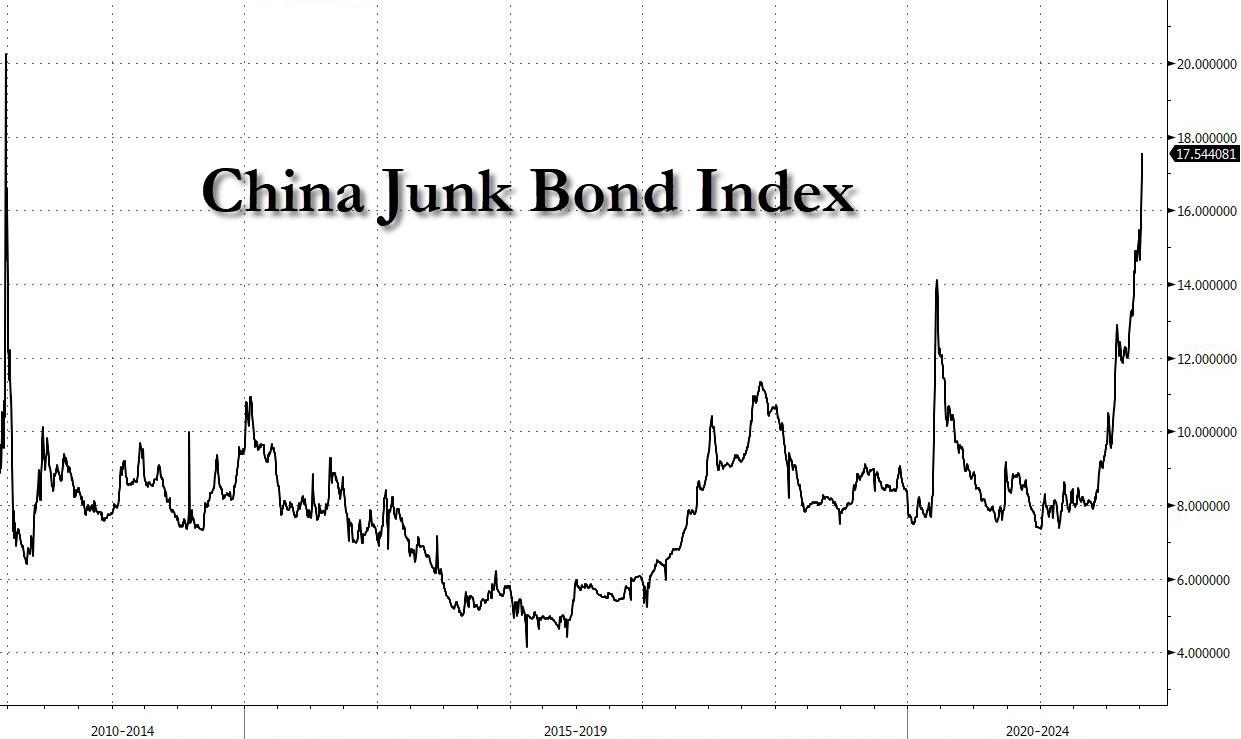
Having already suffered the fastest drop on record, Chinese junk bond markets - where property developer issuers dominate - were routed once again as fears about fast-spreading contagion in the $5 trillion sector, which drives a sizable chunk of the Chinese economy, continued to savage sentiment. Meanwhile, China Evergrande Group's offshore bondholders still had not received interest payment by a Monday deadline Asia time, Reuters reported citing sources.
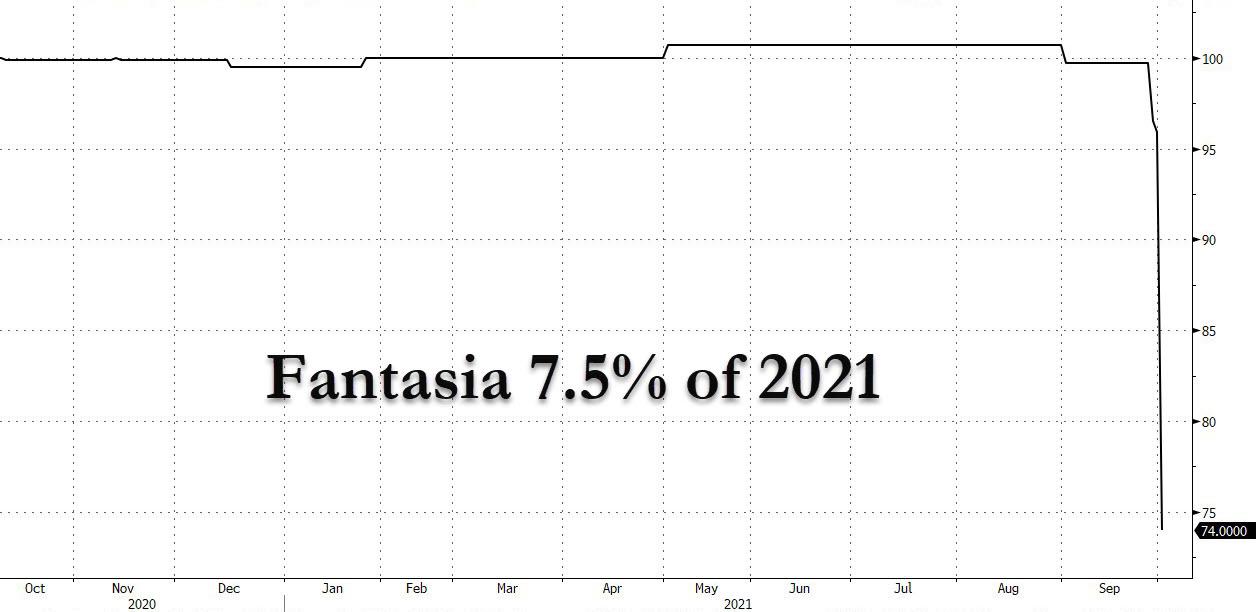
But while Evergrande's default is now just semantics, and one week after Fantasia shocked bondholders with a surprise announcement it too would stuff creditors just weeks after it had said its liquidity was fine, which sent its bond plunging from par to 74 cents in seconds...
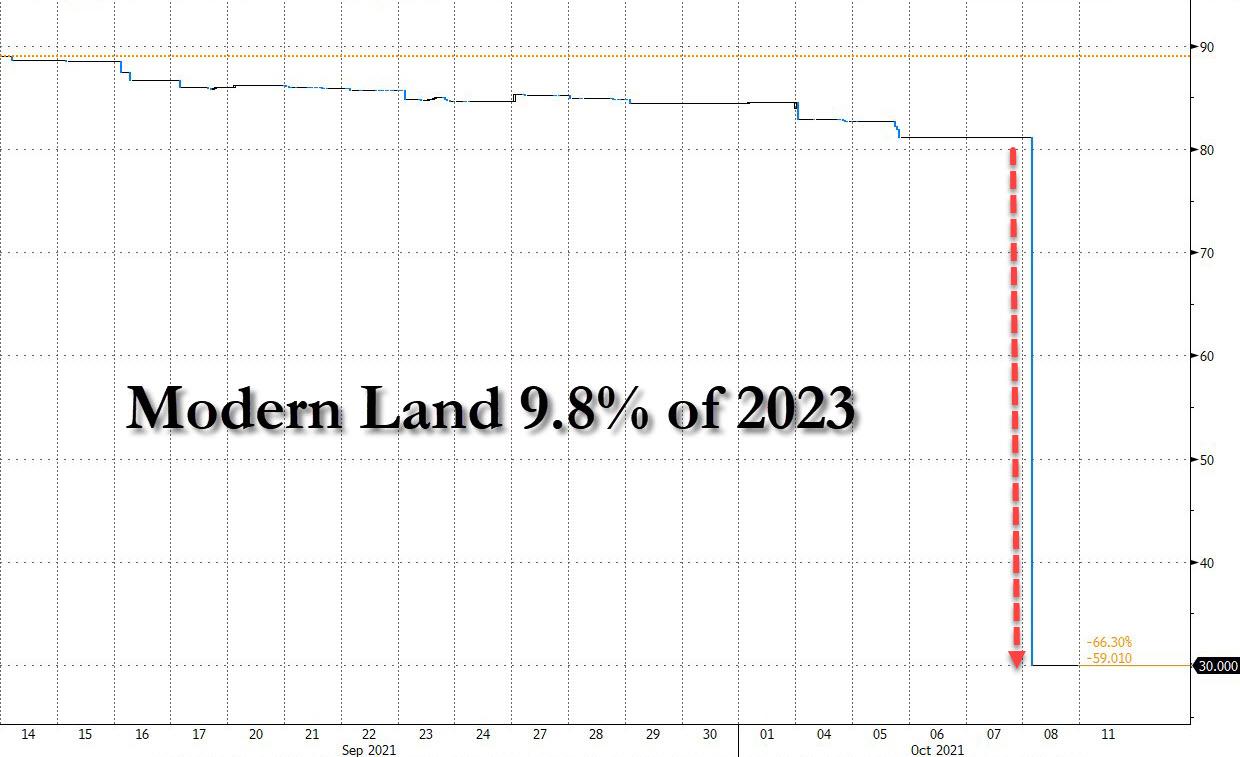
... other signs of stress included smaller rival Modern Land asking investors to push back by three months a $250 million bond payment due on Oct. 25 in part "to avoid any potential payment default." This was not expected, and Modern Land's April 2023 bond plunged more than 50% to 30 cents on the day.
Elsewhere, Xinyuan Real Estate proposed paying just 5% of principal on a note due Oct. 15 and swapping that debt for bonds due 2023. Fitch Ratings called the move a distressed debt exchange while downgrading the firm to C. At least the two companies are relatively small: Modern Land and Xinyuan have $1.35 billion and $760 million of dollar bonds outstanding, respectively, according to data compiled by Bloomberg. In comparison, Evergrande has $19.2 billion.
Among the declines for high-yield issuers, China Aoyuan Group’s 6.35% note due 2024 dropped 13.2 cents on the dollar to 57.5 cents; Sunac's 6.5% dollar bond due 2026 declined 9.4 cents to 57.9 cents, leaving both poised to close at the lowest-ever levels.
Kaisa Group, which was the first Chinese property developer to default back in 2015, also saw some of its bonds slump to less than half their face value while supposedly "safe" names such as R&F Properties, and Greenland Holdings, which both have prestige projects in global cities like London, were also widely sold.
Yields on Chinese junk-rated dollar bonds surged 291 basis points to 17.54% last week, the highest level in about a decade, according to a Bloomberg index.
And just to add insult to injury, China's10-year government bond futures declined to a three-month low as the central bank’s latest liquidity draining weakened expectations of fresh monetary policy easing. Futures contracts on 10-year notes fall 0.4% to 99.14, the lowest level since July 12. 10-year sovereign bond yields rose 5bps, the biggest gains in two months, to 2.96%.
"It's a disastrous day," Clarence Tam, fixed income PM at Avenue Asset Management in Hong Kong, told Reuters, highlighting how even some supposedly safer "investment grade" firms had now seen 20% wiped off their bonds. "We think it's driven by global fund outflow .... Fundamentally, we are worried the mortgage management onshore hits the developers' cash flow hard," he added, referring to concerns people could stop putting deposits down on new homes.
In other words, the dynamic we discussed over the weekend in which we explained why "China's Worst Case Scenario Is Now In Play" is spreading from the biggest rotten apples - i.e., Evergrande, Fantasia - to collapsing confidence in the property sector, to credits that until now were seen as healthy and immune from a property implosion. In short, the bursting of the US housing bubble has moved to China, and yes - that culminated with the original Lehman moment.
Meanwhile, JPMorgan analysts highlighted how international investors were now demanding the highest ever premium to buy or hold 'junk'-rated Chinese debt. There is now a whopping 1,200 basis point difference between the bank's closely-followed JACI China high yield index and a similar index of investment grade AA-rated local Chinese market bonds, known as "onshore" bonds. The option-adjusted spread on the ICE BofA Asian Dollar High Yield Corporate China Issuers Index (.MERACYC) is also at its widest ever.
"Evergrande's contagion risk is now spreading across other issuers and sectors," JPMorgan's analysts said, demonstrating a rare talent for observing the obvious.
And while today may have been "disastrous" it could get far, far worse if the market loses faith that Beijing will bail out the bond market.
"We believe policymakers have zero tolerance for systemic risk to emerge and are aiming to maintain a stable property market, and policy support could be forthcoming if the deterioration in property activity levels worsen," said Goldman head of Asia Credit Kenneth Ho.
Overnight we saw the first sign of such an implicit support in Harbin, the capital of northeastern Heilongjiang province, which became one of the first cities in China to announce measures to support property developers and their projects. According to a report on a website run by Harbin Daily, the city will offer as much as 100,000 yuan home-purchase subsidy to “talents” that meet certain requirements. The city would also make more existing homes eligible for housing provident fund loans to buyers; the moves are aimed at promoting stable and healthy development of the city’s property market, according to the document.
The cash-strapped property developer's troubles and contagion worries have sent shockwaves across global markets and the firm has already missed payments on dollar bonds, worth a combined $131 million, that were due on Sept. 23 and Sept. 29.
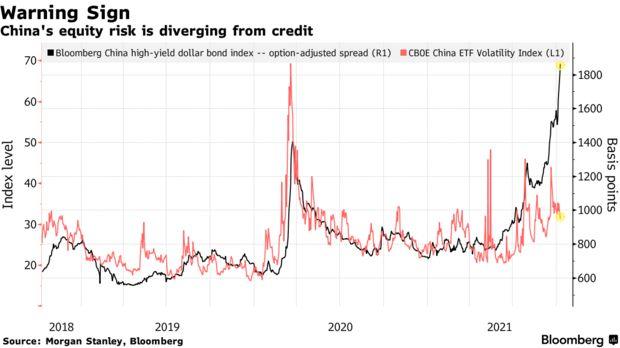
While China's property sector turmoil has so far been contained to the bond market, tensions amid offshore bonds could soon create headaches for the country’s equity traders, according to Gilbert Wong, head of Asia quantitative research at Morgan Stanley. High-yield credit spreads over comparable Treasuries are the widest on record -- at about 1,866 basis points on an option-adjusted basis, data compiled by Bloomberg as of Friday show. But a measure of stock volatility has actually fallen so far this month.
Still, the pair has shown a close relationship in recent years, which suggests their divergence may not last. In the end, a crash in the stock market, where hundreds of millions of Chinese residents are invested, may be just the kick Beijing needs to wake it out of its no bailout stupor