Gapping down
In reaction to earnings/guidance:
- APTV -3.1% (lowers guidance)
Other news:
- SBOW -2.2% (files for 1,341,990 share common stock offering by selling shareholders)
- MCS -1.9% (files for $150 mln mixed securities shelf offering)
- ABUS -1.5% ( filing prospectus supplement under a shelf registration)
- HOOD -1.4% (files acceleration request for resale registration statement)
- RGNX -1.2% (reports initial data from Phase II ALTITUDE trial of RGX-314)
- RMBL -0.7% (files for 5,833,333 Class B share common stock offering by selling shareholders)
Analyst comments:
- HYLN -5.5% (downgraded to Sell from Neutral at UBS)
- ACI -2.1% (downgraded to Perform from Outperform at Oppenheimer)
- CMCSA -1.5% (downgraded to Mkt Perform from Outperform at Raymond James)
- CHTR -1.1% (downgraded to Mkt Perform from Outperform at Raymond James)
- FMC -0.9% (downgraded to Sector Weight from Overweight at KeyBanc Capital Markets)
Gapping up
Select metals/mining stocks trading higher:
- RIO +3.1%, BHP +2.7%, FCX +2.4%, X +1.9%
Select oil/gas related names showing strength:
- PSX +2.8%, RDS.A +2.6%, USO +2.5%, HAL +2.5%, SLB +2.5%, XLE +1.9%, TTE +1.9%, XOM +1.8%, BP +1.7%
Other news:
- PTGX +91.7% (announced the FDA removed the full clinical hold on rusfertide clinical studies)
- ADMS +71.4% ( to be acquired by Supernus Pharmaceuticals (SUPN) for $8.10/share in cash)
- FLXN +68.7% (to be acquired by Pacira (PCRX) for $8.50 per share)
- LQDA +5.5% (announces that the US Patent Trial and Appeal Board ruled in its favor in the proceeding against ‘901 patent owned by United Therapeutics)
- AZPN +4.6% (Emerson (EMR) to accelerate software strategy to capitalize on high growth industry verticals and technology segments in transaction with AspenTec; AspenTech shareholders will receive approximately $87 per share in cash and 0.42 shares of common stock of the new AspenTech)
- BDTX +4.2% (Presents Preclinical Data on BDTX-1535)
- TPB +2.6% (FDA rescinds previously disclosed marketing denial order for Turning Point Brands' vapor products)
- CLF +1.6% (acquires Ferrous Processing and Trading Company for $775 mln)
- NIO +1.5% (reports Q3 e-scooters sales increased 58% yr/yr)
- AMWL +1.4% (files for 13,196,331 share common stock offering by selling shareholders)
- LCID +1.4% (repurchased an aggregate of 857,825 shares of Class A Common Stock from certain individuals who were directors and employees of the Company's predecessor, Atieva)
- ADVM +1% (reports clinical data on ADVM-022 at ASRS)
- VLTA +1% (announces that it has further extended its market penetration with the installation of new charging stations at Stop & Shop in Connecticut)
Analyst comments:
- CVNA +1.7% (upgraded to Outperform from Neutral at Wedbush)
- CCXI +1.3% (upgraded to Outperform from Mkt Perform at SVB Leerink)
- LLY +1.1% (upgraded to Buy from Hold at Berenberg)
Early premarket gappers
- Gapping up:
- LQDA +8.4%, AMWL +5.2%, BDTX +4.2%, RDS.A +2.6%, BHP +2.5%, AZPN +2.4%, RIO +2.3%, PSX +2.3%, USO +2.1%, HAL +2.1%, LCID +2.1%, CLF +2%, CFG +1.8%, XLE +1.8%, BP +1.8%, SLB +1.8%, TTE +1.8%, NIO +1.6%, XOM +1.2%, ADVM +1%
- Gapping down:
- RGNX -3.1%, MCS -1.9%, HOOD -1.9%, ABUS -1.8%, SBOW -0.7%, RMBL -0.7%
How Stocks Perform During Stagflation, And Why Goldman's Clients Are Worried
In our third and final post of the day discussing stagflation (here are part one and part two), we look squarely at the reason why Wall Street is finally freaking out about the threat of rising inflation in a time of shrinking growth or outright contraction (for Wall Street's definition of stagflation or rather lack thereof, see here) by taking a look at how markets perform during periods of stagflation. Spoiler alert: it's ugly.
As Goldman's chief US equity strategist David Kostin writes in his Weekly Kickstart, “Stagflation was the most common word in client conversations this week as equity market volatility remained elevated." One look at interest rates and energy prices should explain why.
There is a reason why Goldman clients are worried: while Kostin repeats that "stagflation is not our economists’ base case expectation" even as his economics team just cut its GDP forecast again while hiking its inflation outlook, he admits that "the weak historical performance of equities in stagflationary environments helps explain why investors are concerned."
How weak? Well, during the last 60 years, Goldman calculates that the S&P 500 has generated a median real total return of +2.5% per quarter, but that quarterly return fell to -2.1% in stagflationary environments, worse than the median returns in environments characterized solely by weak economic growth or high inflation.
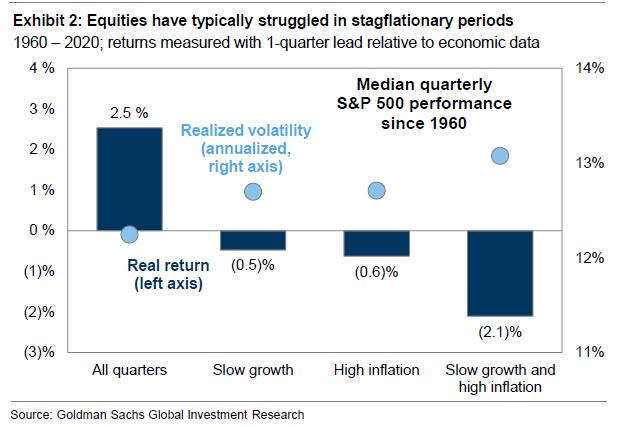
Of course, one would have to look far and wide to find a trader who was actually active during the last major stagflationary episode, or even during the somewhat milder ones at the start of the century, and is why Kostin notes that "US equity investors have had little experience with stagflation in recent decades" which have been characterized mostly by deflation.
By way of background, Kostin defines "stagflationary periods" - a term which as the recent Deutsche Bank poll found there was a wide disparity of opinions as to what exactly is "stagflation" - as episodes of two or more consecutive quarters in which core CPI inflation ran at least 50 basis points above the consensus long long-term expectation while real US GDP growth registered 50 bp or more below trend.
As the next chart shows, since 1960, 41 quarters (17%) have met these criteria, but the vast majority of those occurred between the late 1960s and early 1980s. In the 21st century, stagflation has been virtually non-existant, until now.

It should hardly come as a surprise that most of the equity market weakness in historical stagflationary environments has been attributable to pressure on corporate profit margins. That's because stagflation has been associated with stable real revenues but declining profit margins and real earnings, indicating companies struggling to raise prices quickly enough to offset rising input costs.
In addition to the earnings headwinds, Godlman also notes that P/E multiples have also declined modestly during stagflationary periods alongside rising interest rates.
Who are the winners and losers during stagflation?
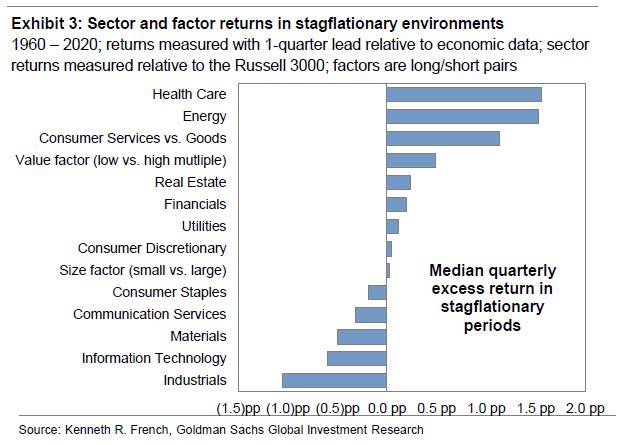
At the sector level, Energy and Health Care have typically generated the strongest returns during periods of stagflation. That may explain why during the past month, Energy has been the strongest sector in the market, rising by 14% alongside an equivalent surge in crude oil, yet Health Care has declined by 6% and lagged the S&P 500 (-3%). This split outcome hint at dynamics that are more consistent with a market pricing rising growth and inflation than one focused on the type of economic growth weakness that would characterize a stagflationary environment.
And while Goldman purposefully ignores the "other" possibility, it may also indicate that the market is woefully mispricing stagflation risks, as DB's Jim Reid suggested earlier. In light of Goldman's increasingly more frequent downgrades of US GDP, it is this alternative that looks far more realistic to us.
In any case, looking at the big stagflation losers Goldman notes that "Industrials and Information Technology have generally lagged most during stagflationary environments. The Info Tech sector is less cyclical now than it was during the stagflationary years of the late 1960s to early 1980s due to the compositional shift toward software and services firms." Today, however, the sector’s massive long long-term growth profile has given it a longer “duration” than most other equities, making it particularly sensitive to real interest rates.
Further to this point, Albert Edwards showed last week that global tech stocks have become "cojoined" been with the US 30y bond yield since the start of this year. The SocGen strategist noted that "if the US 30y yield rises to 2.4% from the current 2.1%, it would knock some 15% off tech stock prices. Imagine if the US 10y rose from 1.5% currently to 2¼%! We could see quite a bear market in tech!"
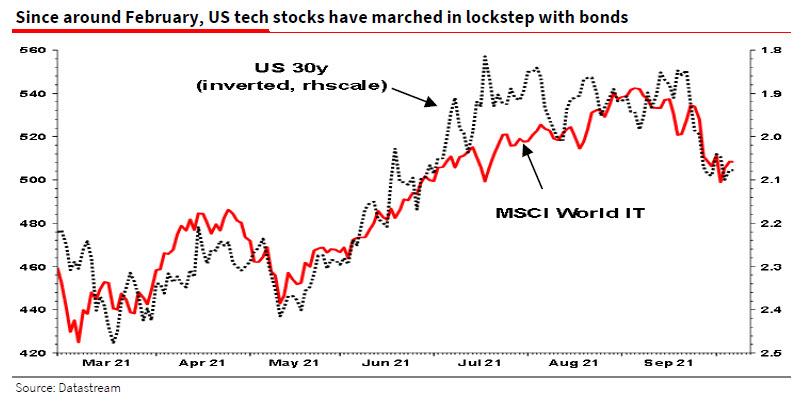
Going back to Kostin, not even this perennial optimist can deny that the sector would likely still be vulnerable to stagflation today if such an environment led investors to price higher future interest rates to combat inflation.
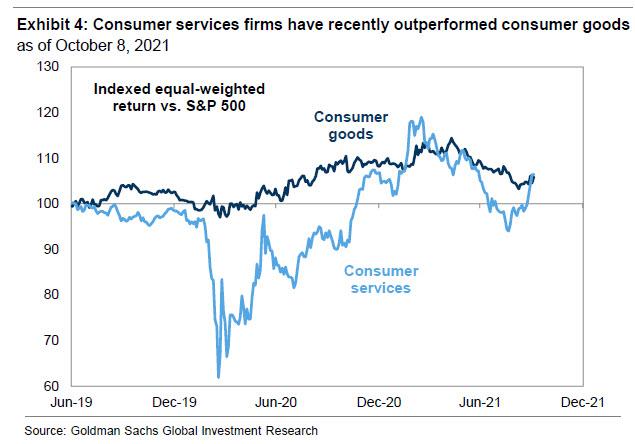
Goldman then looks at the thematic shifts that have emerged during stagflationary periods, and notes that stagflation has been associated with shifts in consumer spending behavior and the outperformance of services companies relative to firms selling goods. Value and Size factors have generated roughly the same median returns during stagflationary periods as they have in general during the last 60 years. However, during stagflationary environments, real personal consumption expenditures for goods have grown at a median annualized rate of 1% compared with 3% for services. To justify this point Goldman looks at the historical performance of consumer stocks which reflects this gap: "Consumer services industries like restaurants and entertainment have outperformed goods industries including apparel and retail by over 100 bp per quarter during stagflationary periods compared with roughly equivalent performance in all periods." The coming stagflation likely explains why consumer goods companies have lagged the S&P 500 since May, while consumer services firms have traded with the shifting virus outlook (see Exhibit 4).
Another reason why stagflation has pernicious and adverse side-effects on all aspects of life is that historically it has weighed on not just economic growth but also the growth of household wealth. Household net worth has grown by a median real rate of 0.5% per quarter since 1960, but just a 0% rate during periods of stagflation. These periods have also been associated with declining household allocations to equities, helping explain the weakness in equity valuation multiples. Home prices have typically declined in real terms during stagflation while gold has appreciated.
And yet, despite these admissions that stagflation has all but arrived, Goldman falls back on the tired, cliched narrative that "inflation is transitory" and the bank - which has a 4700 S&P price target, expects "equity market will continue to rally." Goldman also falls back on the ironclad bullish defense that every dip has been bought so far, and the current one will too, because why not:
... we believe this dip will prove a good buying opportunity, as 5% pullbacks usually have in the past. The 226 trading day stretch between last November and last Thursday ranked as the 8 8th longest period since 1930 without a 5% S&P 500 pullback. Since 1980, an investor buying the S&P 500 down 5% from its 12 12-month high would have gained a median of 6% during the subsequent three months and enjoyed a positive return in 82% of episodes (28 of 34). Our year year-end S&P 500 target of 4700 reflects 7% upside from today’s price.
Its traditionally oblivious optimism aside, Goldman notes that Q3 earnings reporting season begins next week, and investors will be paying close attention to corporate messaging regarding the path of profit margins.
Last quarter companies expressed an unprecedented degree of attention on input costs and price hikes, and we expect margins will remain the primary focus of both investors and managements this quarter.
Curiously, at this point a major schism has opened up between Goldman's traditionally bullish take and Morgan Stanley's increasingly bearish outlook, and as the bank's equity strategist Michael Wilson wrote last week when he predicted that a "fire and ice" scenario is coming that will send stocks sliding more than 10% in the coming days, a large number of companies are flagging serious supply chain issues in off-cycle earnings reports suggests and "both forward earnings estimates and price de-rated after many of these reports."

Jumping to the punchline, Wilson thinks this will be a pervasive dynamic during 3Q reporting season and it will "trigger downside in earnings revisions at the index level - a headwind for price."
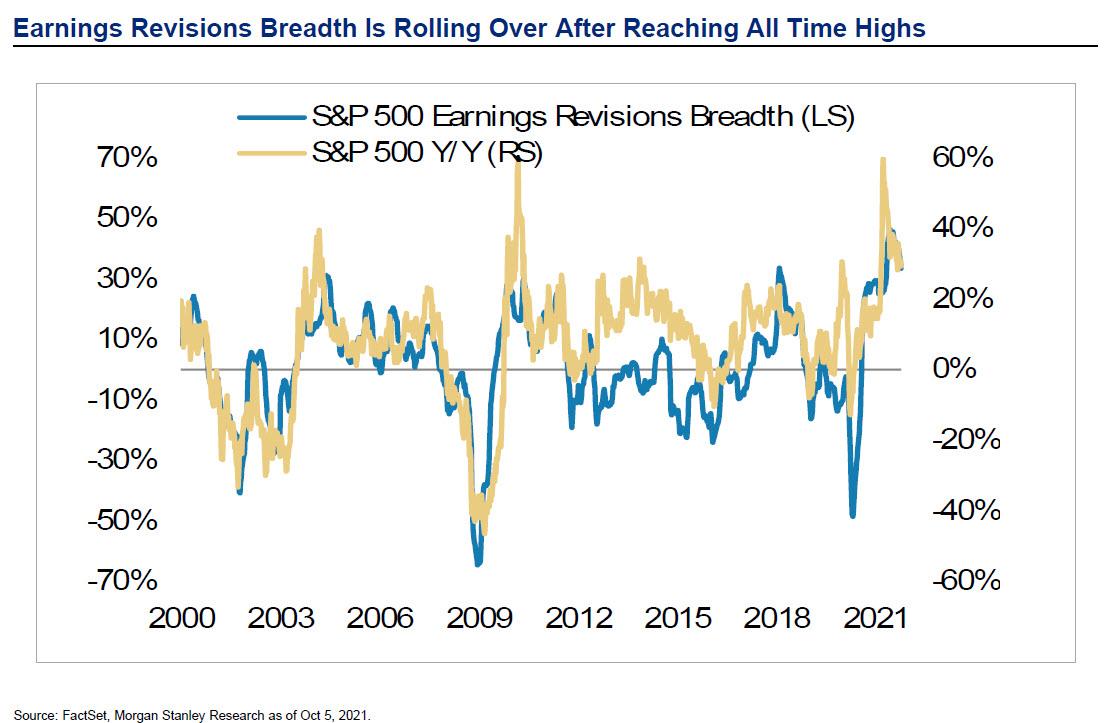
Which begs the question: who will be right on the outcome of Q3 earnings season, and whose year-end price target will be closer to the S&P500 on Dec 31: Goldman with 4,700 or Morgan Stanley at 4,000.
How to Get Cryptocurrency Regulation Right
Companies that want to influence the inevitable rules for crypto businesses such as decentralized finance should engage with the government.
As the cryptocurrency universe expands, with innovative offerings and thousands of new users each week, the U.S. regulatory response has been slow and uneven.
In certain areas, U.S. regulators have successfully applied traditional models. The Securities and Exchange Commission treats those who issue new speculative cryptocurrencies like issuers of securities. The Treasury Department’s anti-money-laundering office, the Financial Crimes Enforcement Network, regulates firms that transfer or exchange cryptocurrencies as money-service businesses—like Western Union —with the accompanying responsibility of knowing their customers and monitoring for suspicious activity.
But huge swaths of the crypto universe, such as the decentralized finance, or DeFi, sector, have been left ungoverned, creating risks to consumers and national security. Some DeFi products promise 8% to 12% returns to customers, who have no legal recourse if their money disappears. Users can set up multiple “unhosted” wallets anonymously and move millions of dollars across borders with no one guarding against transfers to terrorist groups or countries that are subject to sanctions.
For years regulators underestimated these risks, viewing cryptocurrencies as a niche pursuit for cyber enthusiasts, speculators and libertarians. No more. Between 20 million and 46 million Americans hold cryptocurrencies. The total market capitalization for cryptocurrencies is around $2 trillion, exceeding the global supply of Japan’s yen and on track to eclipse the British pound. In the past year investments in DeFi projects, which allow the borrowing of money and trading of currencies without intermediaries, has grown by 6,000%, with as much as $100 billion currently held in them.
Regulators are now wide awake. In July, Treasury Secretary Janet Yellen convened the President’s Working Group on Financial Markets to study stablecoins—a type of cryptocurrency that seeks to peg its value to fiat currencies like the dollar—to address risks related to market stability, consumer protection and money laundering. In Congress, legislation has been introduced to ensure comprehensive regulation of cryptocurrencies. And the Financial Action Task Force, the international standard-setting body on combating money laundering, issued draft guidance this spring calling on all countries to regulate unhosted wallets, including by holding accountable those who control and profit from these applications. Cryptocurrencies now top the agenda of finance ministers and central-bank governors around the world.
Americans should welcome the regulators imposing safeguards. From my career advancing U.S. sanctions and anti-money-laundering goals, I know that one of the best ways to track bad actors is to follow the money. Unhosted wallets coupled with tools designed to mask the movement of funds on the blockchain threaten the ability of law enforcement to trace criminal and terrorist financing.
At the same time, the government must avoid overregulation. Cryptocurrencies offer promising new ways of moving funds and delivering financial services. My law firm helped the Venezuelan National Assembly, led by Interim President Juan Guaidó (recognized as the legitimate Venezuelan government by the U.S. and 60 other governments), to deliver direct payments in cryptocurrency to more than 60,000 health workers fighting Covid in Venezuela, circumventing the Maduro regime’s stranglehold on the country’s banking system. Cryptocurrencies could also bring down the costs of cross-border remittances, the more than $500 billion sent home each year by migrants, some of whom pay as much as 10% in fees per transfer.
It is imperative, then, that regulators get this right. With DeFi in particular, where individuals invest and exchange money via algorithms and smart contracts rather than intermediaries, older regulatory models may not work.
The best outcome will emerge from collaboration between regulators and the crypto industry. Regulators will need private-sector expertise to help map a rapidly evolving landscape and avoid unintentional damage. And cryptocurrency companies would benefit from involvement in the rulemaking process and being able to test a range of compliance approaches under a regulatory safe harbor.
Such public-private collaboration won’t be easy. Regulators generally prefer to do their work behind closed doors. And many crypto developers and investors were drawn to this space precisely to escape government regulation. For them, a regulated DeFi environment is an oxymoron, and the best approach is resistance. But regulation is coming. Western governments will not simply ignore the $100 billion DeFi sector, which carries such serious ramifications for consumers, market stability and national security.
Nor will Western regulators be cowed by the argument that regulation will push the sector offshore. A tremendous amount of the investment, innovation, and user base of DeFi applications is in the West. Western regulators have leverage to restrict the participation of their companies and citizens in unlawful offshore platforms. Further, China and other authoritarian governments are also threatened by platforms that allow for anonymous financial transactions, if for reasons other than ours. The Financial Action Task Force’s statements suggest that the world’s largest economies agree on the need to regulate the DeFi space.
Some in the crypto community understand the inevitability of regulation and are working on solutions. Innovators are developing cryptographic tools under which access to a DeFi application could be limited to users whose identity has been vetted by a reliable third party, enabling certain anti-money-laundering safeguards in an ecosystem without custodians. More such innovative thinking will be needed.
But for companies that want to have a hand in influencing the outcome, now is the time to engage with the government. Public-private collaboration provides the best hope to craft regulation that preserves the promise of DeFi without upending safeguards that protect us all.
Mr. Szubin is of counsel at Sullivan & Cromwell. He served as acting Treasury undersecretary for terrorism and financial intelligence (2015-17) and director of Treasury’s Office of Foreign Assets Control (2006-15).
Chinese Developer Modern Land Asks to Delay Bond Repayment
Property firm seeks three-month extension for debt due
Chinese property developer Modern Land (China) Co. 1107 -2.11% asked investors for permission to defer repaying a $250 million bond due later this month, in the latest sign of the financial stress that has gripped China Evergrande Group EGRNF -5.26% and many of its rivals.
Modern Land also said its chairman and president would together provide the equivalent of $124 million in loans, helping to shore up the group’s finances.

Restrictions on credit to the sector have helped trigger a crisis at Evergrande and put pressure more broadly on developers’ stocks and bonds. A default last week by Fantasia Holdings Group Co. 1777 1.82% on $206 million of dollar bonds caused the bond-market selloff to intensify.
Shares of Modern Land have fallen more than 40% this year. Its dollar bonds due March 2024 crashed to 25 cents on the dollar as of last Friday, according to Tradeweb, down from 72 cents at the end of September.
On Monday, Modern Land said it wanted to delay repaying its $250 million of 12.85% bonds due on Oct. 25 by three months, though it plans to buy back 35% of the bonds on the original maturity date.
The delay is intended to improve liquidity, manage cash flows and “avoid any potential default under the notes,” Modern Land said. It is offering investors $1 for every $1,000 in face value of bonds they hold as a fee for consenting to the changes. It needs to secure at least 90% approval.
In a separate statement, Modern Land said its controlling shareholder, Chairman Zhang Lei, and President Zhang Peng would together provide a total of 800 million yuan, the equivalent of about $124 million, in shareholders’ loans within the next two to three months. The statement touted Zhang Lei’s “continuous commitment to the group and his unwavering confidence in the group’s businesses and development.”
Last week, Modern Land said its contracted sales for September of properties and car-parking spaces totaled about 3.56 billion yuan, or the equivalent of about $553 million. That was about 22% lower than the year-earlier period.
Evergrande Is Leaving Foreign Bondholders in the Dark, Advisers Say
Bondholder advisers say the embattled property developer isn’t sharing information on asset disposals, restructuring plans
Advisers to China Evergrande Group’s EGRNF -5.26% international bondholders have made little progress in their efforts to engage with the embattled property developer, as the clock ticks toward a likely default.
The Chinese real estate giant skipped interest payments due on about $2.03 billion in U.S. dollar bonds on Sept. 23, and has a 30-day grace period before its bondholders can call a default. Evergrande also didn’t pay the coupon on another set of dollar bonds last week. The 25-year-old company is China’s largest issuer of junk bonds, with more than $19 billion in dollar debt outstanding.
Representatives of investment bank Moelis MC 0.84% & Co. and law firm Kirkland & Ellis LLP, which are advising a group of Evergrande bondholders, held an online meeting Friday that was attended by hundreds of investors, including managers of hedge funds, mutual funds and major banks.
“We had a few calls with advisers, but no meaningful dialogue with the company or additional information,” Bert Grisel, a Moelis managing director, told hundreds of meeting attendees. “We have about two weeks left, there is absolutely a situation of urgency” to press the issue, he said.
So far, Evergrande isn’t engaging with the bondholders’ advisers, according to a person familiar with the matter. Multiple legal letters were sent to the company since the first bond payment was missed. Evergrande responded this week, but without providing any meaningful information, they said.
Evergrande and its advisers—which include U.S. restructuring specialist Houlihan Lokey HLI -0.21% —also haven’t been forthcoming about the company’s recently disclosed asset-sale plans, which could adversely affect the recovery prospects for international bondholders, according to Moelis and Kirkland & Ellis.
Prices of some of Evergrande’s dollar bonds have plunged to between 15 cents and 25 cents on the dollar, deeply distressed levels that indicate offshore creditors are pessimistic about how much money they can recover from the company.
Evergrande reported the equivalent of more than $300 billion in liabilities at the end of June, including about $89 billion in interest-bearing debt. The developer recently said it has had trouble paying contractors and building-materials suppliers, leading to construction delays. It also owes large sums of money to its employees and individual investors in China to whom it sold investment products.
A committee of bondholders being advised by Moelis and Kirkland & Ellis includes global funds, asset managers and distressed investors that together hold Evergrande debt with a face value of $2.5 billion. Moelis said it is in touch with more noteholders holding a similar amount, which could bring the total notional amount represented to $5 billion. One purpose of Friday’s call was to corral support from more Evergrande bondholders.
Evergrande disclosed in late September that it struck a deal with a Chinese state-owned enterprise to sell part of its stake in Shengjing Bank Co. for the equivalent of $1.55 billion. The commercial bank demanded that Evergrande use net proceeds from the stake sale to repay what the developer owes it, according to a regulatory filing.
“That is a transaction that could be perceived as preferential treatment of that creditor,” Mr. Grisel said Friday.
Earlier this week, Evergrande’s property-management unit said that it could be subject to a takeover bid, another deal that could raise cash for the parent company.
“What we don’t want is to have a situation where so-called offshore assets are being monetized in some way and the value of those assets being leaked to other parties, whether that be onshore or elsewhere,” Neil McDonald, a restructuring partner at Kirkland & Ellis said during the investor call.
Mr. McDonald said that he had reminded Evergrande and its advisers of its fiduciary duties, which require them to preserve assets and treat creditors equally. He added that Kirkland & Ellis has been working with law firm Harneys as part of a contingency plan in the event that Evergrande fails to protect creditor rights.
Prices of many Chinese property developers’ bonds have tumbled after Evergrande missed its interest payments and Fantasia Holdings Group Co. , another Shenzhen-headquartered developer, failed to repay a $206 million five-year dollar bond.
The selloff intensified over the past few days, as dozens of developers’ junk-rated bonds gapped lower in price amid fears of more defaults. Weak September sales numbers contributed to the market malaise.
Chinese property developer Kaisa Group Holdings 1638 -0.54% ’ 9.375% bonds due in 2024 tumbled 28 points from the beginning of the week, wiping out a third of its value, according to Tradeweb. Dollar bonds sold by Redsun Properties Group lost 16 points this week. The yield on an ICE BofA index of Chinese companies’ high-yield bonds reached 19.8% on Thursday, its highest in more than a decade.
Emerson Plans to Merge Industrial-Software Businesses With AspenTech
Cash-and-stock deal would value AspenTech at around $160 a share
Emerson Electric Co. EMR -0.72% plans to merge two of its software businesses with Aspen Technology Inc. AZPN 2.84% in a roughly $11 billion deal aimed at capturing growing demand for industrial technology.
The cash-and-stock transaction would value AspenTech, as the company is known, at around $160 a share, officials from the companies said. AspenTech’s shareholders would receive $87 and 0.42 share of the combined company for each share they currently own. The transaction is expected to be announced Monday.
The combined company’s offerings would be used by clients to do everything from designing industrial systems to running, repairing and analyzing them. Companies ranging from oil drillers to life-sciences startups are pouring billions of dollars into software to increase efficiency, providing Emerson and other established industrial concerns new avenues for growth.
Bedford, Mass.-based AspenTech makes software for companies in industries including chemicals, mining and energy streamline engineering and maintenance processes. It had roughly $700 million of revenue for its fiscal year, ended in June.
Emerson, a larger industrial conglomerate, is based in St. Louis. It makes products ranging from Ridgid pipe wrenches to software for power plants and has a market value of around $58 billion following a sharp rise in the stock since early last year.
The deal involves two small businesses from Emerson’s automation unit, which makes software and systems for manufacturers, oil producers and utilities and accounted for about two-thirds of the company’s revenue last year. The businesses are OSI Inc., which Emerson purchased last year for $1.6 billion, and Geological Simulation Software. They account for roughly $300 million of the automation segment’s roughly $12 billion in annual revenue.
Emerson, which is also contributing roughly $6 billion in cash as part of the deal, would own 55% of the new entity on a fully diluted basis. AspenTech shareholders would own the rest.
The price represents a 27% premium to AspenTech’s closing share price before Bloomberg reported last week that the two companies were in talks. AspenTech shares closed at $141.55 Friday.
The new entity would retain AspenTech’s name and be led by its chief executive, Antonio Pietri.
The companies have had a commercial partnership since 2018. Mr. Pietri and Emerson CEO Lal Karsanbhai said in interviews they sketched out the deal over an Italian dinner in Boston’s North End in July, concluding in part that a combined company could be better positioned for further acquisitions.
“We believe there are ample opportunities for us as an industrial, and a significant software business, to truly expand into other areas,” Mr. Karsanbhai said.
Mr. Karsanbhai, an Emerson veteran, previously led the company’s automation segment and took the top job around eight months ago. He succeeded longtime CEO David Farr, who retired earlier this year after 21 years leading the company and guiding it through the early days of the coronavirus pandemic.
Last August, Mr. Farr struck the deal for OSI, or Open Systems International Inc., which expanded Emerson’s power-station-management software into renewable-power sources, an increasingly important part of the industry.
Emerson’s remaining business would include the rest of its automation division as well as climate controls, such as heating- and air-conditioning equipment, and tools and home products like thermostats and garbage disposals.
Industrial companies have provided a steady stream of deals over the past decade as they reconfigure themselves to suit evolving technology and investors’ preference for narrowly focused companies. Sprawling conglomerates such as General Electric Co. and United Technologies Corp. have been remaking themselves and looking at bigger pushes into technology.
In a move similar to Emerson’s, rival Schneider Electric SE in 2018 merged its industrial-software business with Aveva Group PLC in a roughly $4 billion deal.
It is a boom time for mergers in general, as companies with surging stocks and ample cash look for deals that will boost growth and profitability. In the U.S., companies have struck more than $2 trillion of takeover deals so far in 2021, more than double the year-earlier pace, according to Dealogic.
>>> Up
* Erste PT Raised to 49 euros from 42 euros at Morgan Stanley
* Hargreaves Lansdown Raised to Equal-Weight at Morgan Stanley
* Ibersol Raised to Buy at JB Capital Markets; PT 10.50 euros (+)
* Outokumpu Raised to Hold at Jefferies; PT 5.50 euros
* Puma Raised to Hold at DZ Bank; PT 103 euros (+)
* Signify Raised to Buy at Kepler Cheuvreux; PT 49 euros (+)
* Veolia Raised to Buy at AlphaValue/Baader
* Weir Raised to Buy at Stifel; PT 1,875 pence
>>> Down
* Britvic Cut to Sector Perform at RBC; PT 870 pence
* CARLSBERG DOWNGRADED TO HOLD VS BUY AT HSBC
* Danone Cut to Hold at HSBC
* Exxon Cut to Underperform at Exane; PT $60
* KBC Group Cut to Neutral at JPMorgan; PT 85 euros
* Repsol Cut to Underperform at Exane; PT 11.50 euros
* Sabadell Cut to Underweight at Morgan Stanley; PT 67 euro cents
* TeamViewer Cut to Equal-Weight at Morgan Stanley; PT 18.50 euros
* Volution Cut to Add at Peel Hunt; PT 510 pence
>>> Initiation
* Agilyx Rated New Buy at Arctic Securities; PT 62 kroner
* Dunelm Rated New Buy at Berenberg; PT 1,620 pence
* Kingfisher Rated New Hold at Berenberg; PT 370 pence
* Melia Hotels Reinstated Sell at Intermoney Valores
* NOS Rated New Hold at Intermoney Valores; PT 4 euros
* Victorian Plumbing Group Rated New Buy at Berenberg
* Wickes Rated New Buy at Berenberg; PT 280 pence
>>> Call
* JPMorgan Says Buy Into the Dip as Stagflation Fears Will Ease (+)
* Dunelm, Wickes Among Buys in Home and Living Sector: Berenberg
* Asos FY22 Outlook Puts Medium-Term Targets in Doubt: Jefferies (+)
* Sabadell Downgraded at Morgan Stanley, Consensus Too Optimistic
* Senior Trading Update ‘Good,’ FY Guidance Unchanged: Jefferies (+)
* TeamViewer Needs Clarity, Cut to Equal-Weight at Morgan Stanley
* U.S. Bank Stocks May Be Too Hot With Earnings Season Nearing
* Veolia a ‘Buy & Hold Must,’ Double-Upgraded at AlphaValue/Baader (+)