(ZH) How Bubbles, Price, & COVID-19 Changed Bitcoin For Me

How Bubbles, Price, & COVID-19 Changed Bitcoin For Me

Bitcoin is not a bubble. It’s the monetary escape hatch we need now that the COVID-19 cat is out of the bag...
I trained as a financial historian. My academic work focused on banks and financial markets in the past, and I was always fascinated by iconic bubbles of financial history — the tulip mania, the financial boom of the 1690s, the South Sea Company and Britain’s many financial panics in the 19th century.
I wrote a thesis on the 1847 commercial crisis. I analyzed financial returns on London’s stock market in the Victorian and Edwardian eras, and showed that returns then squared well with the first round of factor analyses developed a century later. I investigated the Bank of England's role in the 1857 crisis, the 1866 Overend, Gurney & Company collapse and the 1890 bailout of Baring Brothers. (If you are under the impression that financial crises, government mismanagement and central bank bailouts only happened in the post-1971 era of modern monetary debasement, you are sorely mistaken).
You could, Ray Dalio-style, say that nothing is new under our financial sun: many of these past crises map well onto more modern ones — perhaps, because there are only so many ways to make losses or catastrophically ruin monetary arrangements.
While the concept of “bubbles” runs freely across the chronicles of financial history and those who study it, I was less convinced. The hand-waving arrogance with which well-established financial historians would denounce something as a bubble, delusion or financial madness would be familiar to most bitcoiners reading The New York Times or The Economist today. Mostly, these otherwise astute academics meant to launch derogatory remarks on the sorts of people who handled assets, and implied that real-world plebs in trading pits or exchanges couldn’t possibly possess knowledge of the superior kind with which their own university libraries embodied them. Worse, when pushed, the idea of bubbles never seemed to mean much else than “what goes up must come down.”
What fascinates me about Bitcoin is the questions it poses for monetary economics — monetary rules, macroeconomic stability, regression theorem, Gresham's law and the classification of fiat-commodity money. When I first heard rumblings of this technological solution to overthrow the state’s monetary monopoly, I mostly denounced it as hopeful technobabble. My orange-pilled friends couldn’t explain why it mattered monetarily, how it improved much on what we had (or with better central bankers, could have). The use value seemed altogether superfluous in a fintech world where moving value was easier than ever and central banks couldn’t even hit their inflation targets, let alone shove us over the brink of hyperinflation.
Then, two things changed: price and COVID-19.
To many laymen, reasoning from a change in asset price seems like an asinine and bubble-fueled reason to change one’s mind — the quintessential herd mentality. To convince you that it’s not, I return to the idea of bubbles before I argue that Bitcoin is the monetary escape hatch necessary in a less free world.
PRICES KNOW SOMETHING YOU DON’T
At the base of economics lies an information and calculation argument: real market prices, emerging in trade between willing participants, generate information about the world. It allows us to calculate profits and losses, to see if what we make is worth more than what we put in. It allows market participants (i.e., all of us) to grasp what’s going on — not, mind you, in the news agency way of broadcasting highly-curated pictures from afar, but by informing your economic decisions. Shortages and price declines tell us what’s scarcer and more plentiful, what’s in high demand and what is better used elsewhere.
Financial markets and assets do the same thing for society’s current and future allocation of savings. The prices of securities vary more than market prices because the (far-off) future and how to assess it is less knowable than the immediate present or recent past. The “trouble with bubbles” is that nobody knows the future.
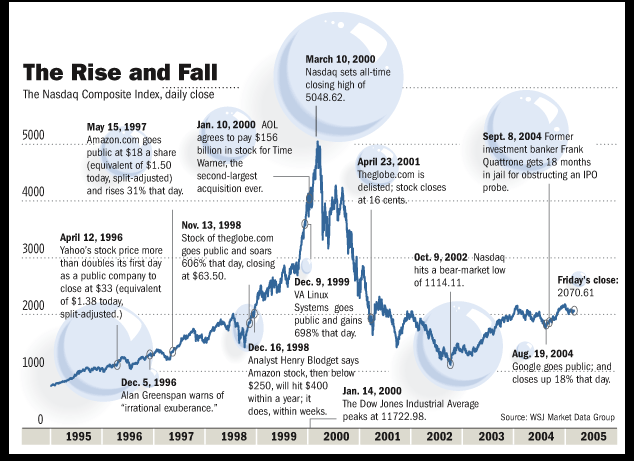
Asset prices incorporate the knowledge that exists about the present and forecasts the future in the best way that we know how. If owners of securities are wrong about that future, they lose money or miss out on profitable investments. Scott Sumner of the Mercatus Center at George Mason University explains this well for the two most recent bubbles in U.S. financial history: the dot-com bubble in the late ’90s and early 2000s, and the housing bubbles a few years thereafter:
“I think asset prices are usually relatively efficient based on fundamentals. I'm very dubious of people who claim that such and such a market is obviously overvalued. Most experts, I think, believe that the tech stocks in 2000 were obviously overvalued, or housing prices in 2006 were obviously overvalued… people [were] saying things like ‘those stock prices only make sense if you think American internet firms will eventually dominate the global economy.’
"Well, they do now. Or the 2006 housing prices would only make sense if you think interest rates will get lower and lower and NIMBY [not in my backyard] regulations will stop new construction. Well, both of those things have happened and we’re now at a new normal of much higher housing prices in America. I think these markets we're picking up some long-term trends that really did change the traditional fundamental price earnings ratio or rent price ratio in housing.”
Knowing that something is “obviously overvalued” is the kind of extreme hubris that opponents of Bitcoin suffer from in outsized amounts. The fundamental value is zero, says economist Steve Hanke; as renowned and astute a writer as Nassim Taleb wrote some mathematical equations and proved (“proved”) that bitcoin’s fundamental value was nil. How could they possibly know that?
Perhaps they ran a model, mentally or computationally, plugged in some values, and out popped a bubble verdict. Could be, but when you’re testing market (ir)rationality, you’re also implicitly testing the model: “Irrational bubbles in stock prices,” concluded the father of the efficient market hypothesis, Eugene Fama, in the 1990s, “are indistinguishable from rational time-varying expected returns.”
Fundamentals, and our confidence in them, change, which is reflected in asset prices moving up or down. Against Taleb, Nic Carter had the pithiest rebuttal: No sir, it’s $34,500 — or whatever the market priced it at when he said it.
When prices fall after a rally — say, internet stocks from 200 to 2001, home prices from 2007 to 2009 or bitcoin in April 2021 — laymen and professionals alike say that it’s a bubble. But what if the price increases captured something real, and were then validated by future events?
U.S. median house prices recouped their losses four years later, and today stand about 60% higher (that’s nominally; deflated by CPI, house prices are about 16% higher in 2021 than at the peak of 2007). Internet stocks, including some of those ridiculed as hopelessly overvalued in 2001, dominate the U.S. stock market — their products and services have conquered the world.
The chattering classes’ case against Netflix, just a few years ago, was similarly overwhelming: This hopeful tech company couldn’t possibly monetize its overextended services. It would have to conquer the world for the stock’s then-valuation to make sense… and then it did exactly that. Netflix expanded services, upped its margins and offered original content. Few are the analysts today yapping about Netflix as an obvious bubble.
Bitcoin's scope and promise is larger than any of them. What is its future value?
For the next year, I predict that bubble charges against bitcoin, of which we saw plenty this year, will fade away. Both because angry nocoiners tire of making them when they’re received with ridicule, and because the longer something stays alive, expands and flourishes, the less sense the etiquette makes. Nobody calls Amazon a bubble anymore, nor Netflix. Even Tesla’s haters have largely surrendered, accepting that what propelled it to the fifth-largest U.S. company by market capitalization is something other than bubbling madness.
No Bitcoiner takes the bubble attack seriously. Price matters, and only bubbles that fail (i.e., don’t recover) are relegated to history’s dustbin as “bubbles”; the successful ones are just promising ventures, deemed as such by a future that has hindsight as a guide.
AN ESCAPE TO FREEDOM
Every society that collapsed into turmoil — economic, monetary, military, social or other — has had individuals contemplating when to leave. It’s not an easy decision, forecasting doom and deterioration for one’s country of birth. Many are the migrants who can tell painful stories of uprooting their lives, made increasingly impossible by authorities, famine, war or hyperinflation, for an uncertain existence elsewhere.
When staring down the "unending path to unfreedom that we’re experimenting with these days" as I argued earlier this year, what else is there but escape? When rule by the people is replaced by ruling the people, escape hatches are crucial. COVID-19 measures all over the world — and the agitated tenacity with which troves of people embodied them — showed me that lines of privacy and tyranny drawn in the sand could be approached, flirted with… and then crossed by about a mile.
Seeing the writing on the wall, I, like many others, wanted an out. In an uncertain future, you never know which place becomes a beacon of freedom (two years ago, who would have bet on Sweden? And now that it, too, is conforming — whereto?) and who will confiscate your assets. The idea of a monetary escape hatch clicked with me.
"When in doubt,” wrote Ray Dalio in his new book, “get out”:
“If you don't want to be in a civil war or a war, you should get out while the getting is good... History has shown that when things get bad, the doors typically close for people who want to leave. The same is true for investments and money as countries introduce capital controls and other measures.”
If history is any guide, you won’t be able to peacefully and in organized fashion be able to take your assets with you: “When the flight of wealth gets bad enough,” concluded Dalio, “the country outlaws it.”
Plenty of Americans have taken that advice, though so far, only in a regional sense — the exodus from California speaks volumes. Others living under oppressive regimes, in the West and elsewhere, have taken similar actions, departing their domiciles for freer pastures elsewhere.
Bitcoin facilitates the monetary component of that shift, to move value from an unfree jurisdiction to a freer one. When fleeing a sinking ship, you need your body, your health and your loved ones. Ideally, you want your most treasured belongings too, which, thanks to bitcoin, you can now carry without anybody knowing. It comes with the more important shift of holding funds outside the purview (and control!) of your invasive government. Dan Held’s Thanksgiving wishes stated it clearest:
“With governments restricting more of our rights, what would be our light at the end of the tunnel? And with COVID, this trend has accelerated, with our movement and access to goods and resources diminished all for the sake of public safety.”
You never know what you rely on until it’s abruptly taken away. When your assets are confiscated, your money devalued, your transactions declined and your bank decides to freeze your account for whichever made-up reason it’s trumpeting next, it’s too late. Backups and escape hatches must be put in place before they’re needed.
I never saw the need for a monetary or financial escape before: I had access to inflation-protection and developed financial markets. I could move my funds wherever I wanted, whenever, for a sliver of what it would have cost just decades ago. Except for the occasional technical glitch or misadventures in poor countries, my transactions were never declined. I had not, to put it bluntly, checked my financial privilege. The last decade or so, culminating with COVID-19, convinced me that the unproblematic and worriless existence I had taken for granted might not always be that way.
Measures against this public emergency probably won’t be what ultimately does in freedom, collapses societies and ushers in the authoritarianism of dystopias. But the COVID-19 cat is out of the bag now, and the power play that rulers experimented with this year and the last is from now on available at every political negotiation table like it never was before. With only vague references to public safety and astonishingly low barriers, locking up people in their homes is now a feasible option.
The ability to escape — to get out — hasn’t been this important in generations. This time isn’t different, but this time we have Bitcoin. Perhaps that’s enough.


(ZH) China Releases Astonishing Images Of Mars Taken By Tianwen-1 Spacecraft

China Releases Astonishing Images Of Mars Taken By Tianwen-1 Spacecraft

To celebrate the new year, China National Space Administration (CNSA) published astonishing pictures of the Tianwen-1 Mars orbiter above the north pole of the red planet, according to Shanghai Morning Post.
CNSA said the images were taken by a detachable sensor equipped with two high-definition cameras. The first picture shows the orbiter above the north pole ice cap of Mars.
The second picture is a close-up of the orbiter's golden exterior skin where high-speed data communication antennas and a solar wing are seen. Beyond the orbiter are ice caps though not the ice we consider on Earth. Mar's ice caps are dry ice (solid carbon dioxide) and water ice.
The third picture shows the north pole ice cap, almost like a vanilla swirl ice cream cone.
The next image is the Zhu Rong rover on the surface of Mars. We can see the topography of the desolate planet that Elon Musk wants to rocket people to at the end of the decade.
We've been closely following the Tianwen-1 mission. In February of last year, the orbiter entered the orbit of the red planet. A couple of months later, a rover was released on the surface of the planet.
The mission so far means China is the only country besides the US to land a rover on Mars successfully. Its mission is to explore the surface and geology of the planet.
Space is becoming the next battleground domain for both US and China. Beijing has become super aggressive in space in the last year. The country has also landed a spacecraft on the moon and collected lunar rock samples.
The final frontier is space -- the world's superpowers are on a hunt for trillion-dollar deposits of rare metals that will power Earth's green energy revolution in decades to come.

Barrons : This Online Retailer Found New Customers in the Pandemic. Sephora Coul

This Online Retailer Found New Customers in the Pandemic. Sephora Could Help It Keep Them.

Europe’s biggest online-only fashion retailer Zalando has had a tough year, as shoppers returned to physical shops after pandemic lockdown restrictions eased.

The Berlin-based e-commerce player mainly sells clothes, beauty products, and footwear from third-party vendors to customers in 23 countries. It also makes some of its own branded items.

Zalando (ticker: ZAL.Germany) saw its shares tumble 23%, to 69.96 euros ($78), over the past 12 months. It increased its marketing cost ratio by 4.6 percentage points to 9.8% in the second quarter to gain new customers and retain those who discovered it during the pandemic.

By November, Zalando was cutting prices for the same reasons. Third-quarter adjusted earnings before interest, and taxes, or Ebit, fell to €9.8 million from €118 million in the same period the previous year. However, things are looking up, with Zalando saying that the fourth quarter started strongly and was buoyed by a cold snap that drove full-price sales of winter clothes.

There are other catalysts for growth that could see the stock rebound. Its scale is key—it has 46 million active consumers, making it an attractive platform for brands to showcase their products. The company also handles payment processing, fulfillment, and customer service through its Zalando Partner Program, resulting in cost savings for its partners.

Adam Cochrane, an analyst at Deutsche Bank, estimates that the stock could leap 71.5%, to €120, because Zalando’s scale helps it stay relevant with big global brands. He says the company is capable of reaching its goals of gaining about 10% market share for European apparel and expanding long-term profit margins.

“Valuation has come down off its recent highs, but still warrants a justifiable premium to the European peer group,” he wrote in a client note. “We believe the move to become more of a platform model where it acts like a marketplace for retailers hoping to get the reach that Zalando brings to the table...is the right one.”

Another growth driver is the potential to expand through partnerships. Sephora, the cosmetics retailer owned by LVMH Moet Hennessy Louis Vuitton (MC.France), said in June that it had agreed to sell high-end beauty products on Zalando’s platform.

Sherri Malek, an analyst at RBC Capital Markets, has a €115 price target on the stock, and estimates that adjusted earnings could reach €641.9 million by 2023 from the €420.7 million seen in 2020. “Share-price weakness on near-term headwinds creates an opportunity to buy into a high-quality, long-term growth story at a more attractive price,” she wrote in a note.

Founded in 2008, Zalando has a market value of €18 billion and employs about 16,000 staff. It fetches a steep multiple of 64.3 times this year’s expected earnings and is valued at a 10% premium to its peers. For 2020, Zalando posted adjusted earnings of €421 million, up from €225 million the prior year. Revenue was €8 billion in 2020, up from €6.5 billion.

Zalando has tried to differentiate itself from other fashion peers on sustainability initiatives. The company is aiming to reduce its total carbon footprint by 80% by 2025, according to RBC’s Malek.

For the third quarter, adjusted earnings were €9.8 million on revenue of €2.3 billion. Last month, the company said that revenue for 2021 is expected to increase 26% to 31%, to €10.1 billion to €10.5 billion.

Co-CEO Robert Gentz told Barron’s in a statement that “we are looking confidently ahead into 2022, with several strategic initiatives in the pipeline that will excite customers and partners alike and push our sustainability agenda further forward.”

WSJ : Metaverse Needs More Than VR Christmas Bump

Metaverse Needs More Than VR Christmas Bump
Oculus headset sales are growing, but it still qualifies as a niche product relative to the Facebook parent’s ambitions

Among the drawbacks to Facebook’s recent rebranding as a “metaverse” company are that it is no longer enough just to make a solid videogame device.

The company now formally known as Meta Platforms FB -2.33% appears to have had a decent holiday season for its Oculus VR headset. Analysts for KeyBanc Capital and Jefferies both noted in reports last week that downloads of the Oculus app jumped over Christmas; Brent Thill of Jefferies added that daily active users of the app on Christmas Day were up 90% from the same day the previous year. Facebook has never regularly disclosed sales data for Oculus, which it acquired in 2014 for $2 billion. But IDC estimates that unit sales of the company’s VR devices in 2021 will come in between 5.3 million and 6.8 million, once the market research firm’s fourth-quarter data is finalized.

Either one would be a nice jump from the 3.5 million Oculus units estimated to have sold last year. And it is far better than the anemic sales from before the company put out its first Quest headset in mid-2019. Oculus devices before that mostly required a cable running to a high-powered PC. Such “tethers” have severely limited the appeal of VR devices even to the gamer crowd. Analysts estimate that Sony sold about 5.5 million units of its tethered PlayStation VR headset in the fiscal years 2019 to 2021, according to consensus estimates from Visible Alpha. That is equivalent to about 12% of the total PlayStation console units the company sold in that time.


But while Facebook founder Mark Zuckerberg has long made clear that his ambitions for Oculus go well beyond gaming, the company’s name change two months ago significantly raised the stakes on that bet. Proponents of the metaverse concept insist the idea is about more than virtual reality. But VR is one of the main technologies that would set such a virtual world apart from simply browsing the internet on computers and mobile devices. “Without VR, there is no presence. And presence is the key point,” said longtime VR market analyst Stephanie Llamas of VoxPop.

Hence, a company banking its future on the metaverse will have to get a lot more devices into a lot more hands. Estimated Oculus sales over the past five years amount to less than 3% of Facebook’s daily user base in North America and Europe—the two markets that account for the vast majority of its business. It also is anyone’s guess how many people who got a headset for Christmas will be anything but casual users. And some of the recent sales could have gone to Meta’s own employees trying to score some face time with the boss. The Wall Street Journal reported that Mr. Zuckerberg has been taking more of his internal meetings in virtual reality of late.

Facebook’s metamorphosis assumes that enough people will be willing to invest a few hundred dollars to plug into a virtual world controlled by a company with serious public trust issues now generating more than $110 billion a year in advertising revenue. Getting VR headsets under the Christmas tree may prove to be the easy part.

WSJ : Can Paper Replace Plastic? A Packaging Giant Is Betting It Can

Can Paper Replace Plastic? A Packaging Giant Is Betting It Can
Environmental-driven shift is complicated by cost of cardboard and carbon-footprint calculus

KALAMAZOO, Mich.—When a new building-size machine cranks up this month, it will begin turning mountains of recycled cardboard into paperboard suitable for greener forms of packaging.

The $600-million project, the first new paperboard production line built in the U.S. in decades, represents an enormous bet by owner Graphic Packaging Holding Co. GPK 0.67% on a future without foam cups, plastic clamshell containers or six-pack rings.

Graphic wants to be able to offer more environmentally friendly packaging so that the consumer-goods companies that buy its products can tout a cleaner supply chain to their own investors and consumers. Once Graphic shuts down four smaller and less-efficient machines, including one at its Kalamazoo complex that is 100 years old, it will use a lot less water and electricity, it says, and emit 20% less greenhouse gases.

ESG investing has put trillions of dollars into the control of funds that promise to invest it with environmental, social and governance goals in mind, as the abbreviation implies. That, in turn, has companies striving to operate with less waste and greenhouse-gas emissions.

Graphic says green investing has opened up a market worth more than $6 billion a year for replacing plastic with paper on store shelves, even if that might result in consumers seeing slightly higher prices.

Graphic’s gamble is a big test of whether the flood of ESG capital can transform supply chains. Plastic packaging is frequently less expensive than paper, is more effective in many applications, and sometimes even has a smaller carbon footprint. Consumer-goods companies will have to be persuaded that their customers will pay more and that paper packaging really is greener.

Graphic executives contend their customers have little chance of meeting emissions and waste targets without substantially cleaner supply chains. “A lot of those goals flow through us,” said finance chief Stephen Scherger.

Plastic makers, for their part, say that they are investing in recycling and waste-collection technologies, and that their products compare favorably with paper once factors such as shipping weight and avoided food waste are considered.

Graphic, based in Sandy Springs, Ga., sells packaging material to the nation’s biggest food, beverage and consumer-products companies: Coca-Cola Co. and PepsiCo Inc., Kellogg Co. and General Mills Inc., Nestlé SA and Mars Inc., Kimberly-Clark Corp. and Procter & Gamble Co. Its beer-box business generates about $1 billion annually. It sells some 13 billion cups a year.

Graphic and other producers of paperboard, a single-sheet cardboard used mainly in packaging, are working to introduce newfangled products such as fiber yokes for six-packs and microwavable meal trays molded from cardboard. Graphic has announced plans for a line of cups with a water-based coating to replace the polyethylene lining, one step closer to the holy grail of a compostable cup.

When Graphic announced plans for the new paperboard plant in 2019, investors initially questioned the cost and necessity. Green investing has since gained momentum, though, and new investors have lined up behind the project.

In September, Graphic sold $100 million of so-called green bonds to help pay for it. The green designation, earned through a Michigan state program to promote recycling facilities, allowed it to sell debt with interest payments not subject to federal and state taxes. Demand for the bonds outstripped supply by a factor of 20, Mr. Scherger said.

Elsewhere, the company is adding $100 million of equipment to its Texarkana, Texas, mill so it can pulp more loblolly pine trees into extra-strong paperboard for cups and beer cartons. In July, Graphic paid $280 million for seven converting facilities, which fold paperboard into packaging, bringing its total to 80. In November, it gained even more when it purchased a $1.45-billion rival in Europe, where trends in sustainable packaging often start.

It has spent about $180 million moving several Louisiana facilities under one roof to eliminate millions of miles driven between them each year. It installed a boiler that burns tree tops and other organic waste from its Macon, Ga., pine-pulp operations to power its mill there. Energy consumption and emissions at both Southern facilities factor into the carbon footprints for the paperboard yokes that Graphic is selling in Europe to replace shrink wrap.

In July, hedge-fund manager David Einhorn disclosed that his Greenlight Capital had taken a $15-million stake in Graphic. Greenlight predicts paperboard is set for sustained price gains because too little has been invested in production.

“The U.S. has added so little paperboard capacity that the average mill in this country is over 30 years old,” Mr. Einhorn wrote to investors. He said demand should rise with consumption and the ESG-driven push to remove plastic from supply chains.

Plastic became ubiquitous after World War II, when shortages of natural materials touched off a race for synthetic replacements, including nylon and plexiglass. Extracting fossil fuels and turning them into plastic produces a lot of greenhouse gases. Only 14% of plastic packaging is collected for recycling and just a portion of that winds up in new products, while about one-third isn’t collected at all, according to a 2016 report by the World Economic Forum, Ellen MacArthur Foundation and McKinsey & Co. Research published in 2019 by Goldman Sachs Group Inc. said only 12% of plastic is recycled, while 28% is incinerated and 60% remains in the environment.

The 2016 study, which is cited regularly, depicted oceans in crisis, fouled by soda bottles, shopping bags and clothing fibers, with a garbage truck worth of plastic winding up in the water every minute. By 2050, the study said, there would be more plastic in the sea, by weight, than fish.

With governmental authorities from California to China cracking down, stock analysts list plastic use as one the biggest threats to packaged-goods firms. Companies including Coca-Cola and Anheuser-Busch InBev SA have mentioned plastic-to-paper moves in the sustainability reports they produce for investors and outside firms that calculate corporate ESG scores.

“It takes us a full year to use as much plastic as a leading beverage company uses in just two weeks,” cereal maker Kellogg’s chief sustainability officer boasted at an investment conference earlier last year, as beverage-company executives waited to pitch the same audience.

In 2019, Graphic’s executives unveiled plans to take market share from plastic and build the state-of-the-art recycled-board machine in Kalamazoo. “You’re not going to see islands of paper floating around the ocean,” said Joe Yost, Graphic’s head of Americas, at a meeting with stock analysts.

Yet even with a rush of companies promising to cut emissions and reduce waste, the new mill was a hard sell. It was a huge expense that would take two years before it was operational and earning money. In an era in which the average holding time for stocks is measured in months, two years is a long time for investors.

Graphic Chief Executive Michael Doss prepared the board of directors for blowback. “Not everyone is going to like this,” he recalled telling them. “Our industry has a track record of overexpanding and making poor capital allocations.”

Graphic began as a unit of Colorado’s Coors Brewing Co. that manufactured boxes that wouldn’t get soggy in refrigerated trucks. Coors spun off the box business as a separate public company in the early 1990s. Acquisitions followed, giving Graphic its big presence in the Southern pine belt, where its mills make paperboard from sawmill scraps and trees unfit for lumber.

Graphic holds about 2,400 patents and has more than 500 applications pending, which protect its package designs and machines installed on customers’ manufacturing lines to fill and fold cartons.

Its executives say research and development is focused these days on expanding the use of paperboard from grocery shelves to deli, produce and beer coolers. “We are attacking anything that is plastic,” said Matt Kearns, a packaging designer for Graphic.

Plastic, though, is less expensive than paperboard. Advancements in paper packaging, such as compostable cups, will likely add to costs. Paperboard producers have increased prices several times over the past year to cover their own rising expenses. Some buyers are exploring less expensive alternatives to paperboard, said Adam Josephson, a paper and packaging analyst at KeyBanc Capital Markets.

“Can companies such as Graphic sell more products when the cost is considerably higher than the products they’re already selling?” Mr. Josephson asked. “That is very much in question.”

For some companies, going green means using more plastic. Plastic wrap is lighter than boxes, which means less fuel burned in transit. Plastic has relatively low recycling rates, but so do cups and takeout containers that are made of paper but also fused to polyethylene. It takes an industrial process to peel away the reusable tree pulp.

Wendy’s Co. said its restaurants will dump plastic-lined paper cups next year and replace them with clear plastic, which it said more consumers will be able to recycle. “This demonstrates how plastic can be viewed as an environmental opportunity instead of a liability,” said Tom Salmon, chief executive of Berry Global Group Inc., BERY 0.60% which is making the cups.

Paper doesn’t always have a smaller carbon footprint, either. Making paperboard consumes power and water, and it generates greenhouse gases.

One of Graphic’s most promising new products is the KeelClip. The paperboard yoke folds over the top of cans and has finger holes. It is fast replacing plastic wrap and six-pack rings in Europe’s beverage aisles. KeelClips are as easy to recycle as cereal boxes, and Graphic says they can have about half the carbon footprint of shrink wrap, a common way to bundle beers in Europe.

Graphic is bringing the KeelClip to America, where it must contend with the ubiquitous plastic six-pack ring. Dirt cheap and light-as-a-feather, the six-pack ring endures despite decades as a symbol of humanity’s abuse of nature. Generations of American school children have been shown photos of ensnared wildlife.

The KeelClip eliminates the need for a lot of plastic wrap in transit, and it is much less likely to muzzle a dolphin. However, Graphic says KeelClip’s carbon footprint—the emissions generated by every step of its manufacture and distribution—is slightly higher than a six-pack ring.

Each KeelClip generates the equivalent of 19.32 grams of carbon dioxide, compared with plastic rings’ 18.96 grams, according to Sphera, an ESG-consulting firm that Graphic hired to analyze the packages.

Graphic says it is working on that. The DiamondClip, aka the EnviroClip, is under development. It will be strong enough to hold six sweaty beers, the company says, but skimpy enough to have half the carbon footprint of the plastic rings.

WSJ : AT&T, Verizon Refuse FAA Request to Delay 5G Launch

AT&T, Verizon Refuse FAA Request to Delay 5G Launch
Cellphone carriers offer to transportation officials to tailor air-safety protections to mirror limits in France

AT&T Inc. T -0.73% and Verizon Communications Inc. VZ -0.56% rebuffed a request from federal transportation officials to delay the launch of new 5G wireless services but offered a counterproposal that would allow limited deployments to move forward this week.

The cellphone carriers said Sunday in a letter reviewed by The Wall Street Journal that they could further dim the power of their new 5G service for six months to match limits imposed by regulators in France, giving U.S. authorities more time to study more powerful signals’ effect on air traffic. The plan from the companies, which have said they plan to start service Wednesday, could prolong a standoff between the telecom and aviation industries over how to proceed.

“If U.S. airlines are permitted to operate flights every day in France, then the same operating conditions should allow them to do so in the United States,” the CEOs wrote in the letter.

Telecom-industry officials have pointed to dozens of countries, including France, that have already allowed cellular service over the frequencies in question, known as C-band. France is among the countries that have imposed wireless limits near airports while regulators study their effect on aircraft.

The message from AT&T CEO John Stankey and Verizon CEO Hans Vestberg was in response to a letter Transportation Secretary Pete Buttigieg and Federal Aviation Administration chief Steve Dickson sent late Friday. The New Year’s Eve missive asked the carriers to postpone their planned 5G launch by “no more than two weeks” while officials worked to address the wireless services’ effect on specific airports on a rolling basis over the coming weeks.

The FAA and Transportation Department didn’t immediately respond to requests for comment on Sunday.

FT : Brussels proposes green label for nuclear and natural gas

Brussels proposes green label for nuclear and natural gas
European Commission paves way for investments despite concerns over waste and CO2 emissions

Brussels wants to recognise nuclear power and forms of natural gas as “green” activity as part of a landmark EU classification scheme to help financial markets decide what counts as sustainable investment.

In long-awaited plans, the European Commission has paved the way for investment in new nuclear power plants for at least the next two decades and natural gas for at least a decade, under a green labelling system known as the “taxonomy for sustainable finance”. 

The labelling system, which will cover industries that generate about 80 per cent of all greenhouse gas emissions in the EU, is the first attempt by a major global regulator to decide what counts as truly sustainable economic activity and help stamp out so-called greenwashing in the financial sector.

A draft legal text, seen by the Financial Times, says the EU’s green label should be awarded to controversial energy sources including nuclear power and natural gas under certain circumstances.

The decision was taken after a vocal group of pro-nuclear countries, led by France, and pro-gas governments in southern and eastern Europe, demanded the taxonomy should not punish energy sources that provide a bulk of their power generation.

Nuclear power does not emit greenhouse gases but produces toxic waste that requires safe disposal and can pose radiation risks. Natural gas does produce carbon dioxide but its supporters say it is far less polluting than traditional fossil fuels and is a vital way to help pave the way for lower emissions.

Brussels was forced to delay a decision on how to classify the two energy sources earlier this year after disputes inside the college of commissioners over whether they should be awarded the green label. The battle to recognise nuclear power and natural gas as green has intensified in recent months as EU countries have faced record electricity prices this winter, driven by soaring demand for natural gas imports.

The draft taxonomy text says nuclear power should be considered a sustainable economic activity as long as EU countries that host power stations can safely dispose of toxic waste and meet a criteria to cause “no significant harm” to the environment. The construction of new nuclear plants will be recognised as green for permits granted until 2045, says the text.

Natural gas investment is also included in the green label as a “transitional” energy but must meet a more detailed set of conditions, including producing emissions less than 270g of CO2 per kilowatt hour — for new gas plants approved before the end of 2030 — and if it is replacing traditional fossil fuels such as coal generation.

The EU imports around three quarters of its natural gas needs, most of which is supplied by Russia. The bloc’s energy crisis has sparked criticism from some member states that Moscow is artificially driving up gas prices and the EU should accelerate away from gas imports to renewable energy.

The taxonomy text will need approval from a majority of EU member states and members of the European Parliament. EU diplomats said the text was likely to win widespread support from governments but the green classification for gas and nuclear was criticised by environmental groups.

France’s EU commissioner Thierry Breton has said he is in favour of labelling both technologies as green as it would help the EU meet a goal of cutting CO2 emissions to net zero by 2050, compared to 1990 levels.

“Gas is not the best to achieve our goal because you generate some CO2 but at least it’s better as a transition than coal,” Breton told reporters last month. “We need to have the right financing in the taxonomy, including nuclear energy.”

FT : Octopus defies energy crisis to draw global investors

Octopus defies energy crisis to draw global investors
UK energy tech and supply group focuses on growth after fundraisings take value close to $5bn

In a five-month wave of collapses that has halved the number of British household energy suppliers, one company appears to have been swimming against the tide.

Octopus Energy has raised $900m from former US vice-president Al Gore’s sustainable investment group and Canadian pension fund CPP Investments, pushing its valuation close to $5bn, rivalling British Gas owner Centrica.

The London start-up, founded in 2016, now operates in 13 countries and serves 3.1m UK households and businesses, putting it firmly among the country’s six biggest energy retailers.

The fundraising comes as record wholesale gas and power prices have triggered the industry’s worst crisis in decades, resulting in the demise of two dozen of the company’s competitors in Britain.

Rivals have called for government intervention, with Good Energy recently declaring a “national crisis”. Suppliers are continuing to hold talks with UK ministers over the festive season to push for support for the sector and customers, who face rises of as much as 56 per cent in their bills when Britain’s energy price cap is next adjusted in April.

Greg Jackson, Octopus founder and chief executive, believes it is imperative to find ways of diffusing the impact of the “once in 30 years event” over several years for consumers.

“The key really is for the industry and the government to work together to find a way to spread it so we don’t see it all hitting bills in a single year,” says Jackson.

Energy UK, the trade body, has suggested government loans may be needed to allow suppliers to spread the costs for consumers but not imperil their own businesses in the process.

Jackson said private financing could also fill that gap.

“There is plenty of private sector finance available to deal with things in the energy sector and in this case, whether it be private or government [financing], all we need is a mechanism to use it to bring down bills this year and spread the cost over a number of years,” Jackson says.

Bulb Energy, the biggest company to fail so far, was founded just a year earlier than Octopus. Until 2020 it outcompeted Jackson’s company for customers. Now it is being propped up by the taxpayer, with an initial loan of £1.7bn, while administrators working on behalf of the government to figure out what to do with its assets and customers.

Jackson accepts it is “totally reasonable” to question the success of Octopus while others are dropping like flies, but he also likes to distance himself from comparisons with other suppliers.

“I compare us more to a tech disrupter like Amazon than a UK energy retailer like Bulb,” he said. “We were founded by tech entrepreneurs.”

“Sadly the energy retailers seen going pop in the UK . . . haven’t been disrupters. They have largely been mini versions of a traditional energy company without the economies of scale, the balance sheet or the risk management.”

Jackson, a seasoned entrepreneur and investor, founded Octopus with the unrelated Stuart Jackson, who is chief financial officer, and James Eddison, chief technology officer.

At the heart of the company are its “Kraken” and “KrakenFlex” software, which it also licenses to other companies including EDF Energy, Eon UK and Origin Energy of Australia.

Jackson likened Kraken, which helps companies save costs and improve areas of their business such as billing and customer service, to the disruptive software systems that underpin global companies such as Uber.

KrakenFlex, meanwhile, allows companies to offer the services that customers will increasingly want in the future and that will help grid operators balance supply and demand more efficiently. Among its uses is enabling households trade energy via their electric vehicle battery, charging while demand and prices are low and selling back to the grid at a profit when demand is high.

About 25m customers globally are on the Kraken platform and Octopus intends to increase this to at least 100m by 2027.

Software licensing agreements generate lower revenues but higher profit margins than energy retail and have been key to the company’s ability to attract new investors, according to Jackson. Octopus also raised funds from Origen Energy and Japan’s Tokyo Gas in 2020. In total it has attracted $1.5bn in equity investment.

“Half of our $5bn valuation is down to [the] tech platform which we are licensing,” Jackson said.

However, Octopus has not been immune to the recent market chaos.

“If it weren’t for the energy crisis our UK energy retail business would have been a break-even business this year . . . the energy crisis has probably set that back a year,” he said.

The company’s last available accounts, for the year to April 30 2020, show a net loss of nearly £47m on revenue of £1.2bn and net liabilities of £62m. Its next accounts are due to be filed at Companies House in January.

Jackson insists he is not concerned with short-term profits.

“What we will see is businesses within the group, as they reach maturity, will be profitable but we will be ploughing that back in growing the group,” he said.

“I think what people need to get their head around is the massive scale of this market and therefore the opportunity for us to keep attracting capital to keep growing is far greater than the sort of short-term profit pressure.”

FT : German Greens lead attack on EU plan to label nuclear power ‘sustainable’

German Greens lead attack on EU plan to label nuclear power ‘sustainable’
Brussels’ proposal is central to European goal of channelling billions of euros into green investments

Germany, Austria and Luxembourg have hit out at Brussels’ plans to classify nuclear power as a sustainable technology in the EU’s landmark labelling system for green investment, which is central to Europe’s plans to decarbonise the bloc’s economy.

German economy minister Robert Habeck, who is a member of the Green party in the country’s governing coalition, said: “It is questionable whether this greenwashing will even find acceptance on the financial market.” He told German press agency DPA on Saturday: “In our view, there was no need for this addition to the taxonomy rules.”

Brussels’ proposal is part of a so-called “taxonomy” list, which aims to help channel billions of euros of investment needed to decarbonise the bloc’s economy.

The plan, the first attempt by a leading regulator to bring clarity to investors seeking to put private capital into sustainable economic activity, covers about 80 per cent of the bloc’s emissions and is intended to be a “gold standard” for markets to decide what is truly green or not.

But the process has been beset by fierce political infighting inside the European Commission and its member states.

Leonore Gewessler, Austria’s minister for climate and energy, said on Saturday that Vienna would consider suing the European Commission if the classification of nuclear power as green went ahead. Claude Turmes, Luxembourg’s energy minister, meanwhile called the inclusion of nuclear power a “provocation”. 

The inclusion of nuclear power is widely seen as a victory for the French government which has urged Brussels to ensure the new rules do not punish a technology that provides almost two-thirds of French electricity. Nuclear reactors do not generate CO2 emissions but produce highly toxic waste.

The inclusion of natural gas also means a number of EU economies that rely on gas imports in southern and eastern Europe will back the initiative.

The inclusion of gas is also supported by Germany’s finance minister, Christian Lindner, who is the leader of the Liberal party in the governing coalition. The draft proposal says gas can be considered sustainable under certain conditions, such as for new gas plants approved before the end of 2030 that emit less than 270g of CO2 per kilowatt hour and if replacing traditional fossil fuels such as coal.

“Germany realistically needs modern gas-fired power plants as a transitional technology because we are giving up coal and nuclear power,” Lindner told the Süddeutsche Zeitung on Sunday. “I am grateful that arguments seem to have been taken up by the commission.”

Three German nuclear plants went offline at the end of 2021, with the country’s remaining three facilities due to be decommissioned in a year as part of a commitment to phase out all nuclear energy following the 2011 Fukushima disaster in Japan.

The Brussels draft text will form part of a consultation with EU countries and independent experts that will run until January 12. However, anti-nuclear EU governments do not have the power to veto the taxonomy, which diplomats say is likely to win majority support in the EU Council.

Astrid Matthey, one of the independent experts who advises the commission on the rules, criticised the draft for “contradicting the very purpose of the taxonomy”.

“The conditions under which both technologies are to be included are far from ensuring that we reach the Paris climate targets and do-no-significant-harm to the environment. There is still a long way to go for this draft to become aligned with the Green Deal and the EU’s environmental targets”, said Matthey.