FT : Putin’s dictatorship is based now on fear rather than spin

Putin’s dictatorship is based now on fear rather than spin
The origins of the war in Ukraine lie in Russian economic stagnation, corruption and the leader’s dwindling popularity

The fact that Vladimir Putin invaded Ukraine at huge economic cost to Russia does not mean the economy does not matter to him. On the contrary, economic performance — or, rather, underperformance — played a key role in his decision. As he could no longer deliver income growth, or at least convince Russians the economy is doing better than it could otherwise, he tried to replay the 2014 Crimea scenario. This might have worked but he miscalculated.

Putin’s aggression has brought material devastation and human tragedy to Ukrainians. But the war has also destroyed Russia’s economy. In 2022, Russian gross domestic product will shrink by at least 11 per cent — the worst recession since the early 1990s. Why did he start this war?

The political scientist Adam Przeworski once wrote that the authoritarian equilibrium rests on economic prosperity, lies or fear. Like most 21st-century “spin dictators”, Putin originally eschewed fear. In his first decade in office, he presided over a period of fast economic growth, driven by rising oil prices and economic reforms in the 1990s and early 2000s. This prosperity brought him genuine popularity.

However, as Putin’s centralisation of power promoted corruption and stifled competition, his economic model lost steam. After the recovery from the global financial crisis, Russian GDP growth slowed almost to zero. As incomes stopped growing, Putin’s popularity declined substantially as well. According to the independent Levada Center, Putin’s approval rating decreased from a peak of 88 per cent in September 2008 to the low 60s in late 2013.

Putin decided to address an economic problem with a non-economic solution. Annexing Crimea in 2014 did boost his popularity, probably beyond his expectations. Levada Center polls showed that Putin’s approval went back to 88 per cent in just a few months.

However, the Crimea effect faded away. As Putin’s governance model is incompatible with economic growth, Russia’s economy continued to stagnate. Despite repeated promises of reforms, investment did not take off, capital kept fleeing the country and Russia fell further behind developed countries. Putin’s corrupt model protected his proxies at the expense of ordinary Russians. In 2019, Russian GDP was 6 per cent above its pre-Crimea level, but real incomes of Russian households were 7 per cent below their 2013 peak.

Putin then turned to Przeworski’s second pillar of authoritarianism: lies. Russia’s government intensified censorship and propaganda. Putin tried to convince Russians that their stagnating living standards were better than any potential alternative. However, this narrative was increasingly hard to spin as younger Russians evaded propaganda and circumvented censorship through social media. By April 2020, Putin’s approval fell to a historically low 59 per cent. He responded by poisoning and imprisoning opposition leader Alexei Navalny, cracking down on independent media and closing the Memorial human rights group. Even this did not help the dwindling enthusiasm for his rule.

Running out of options, Putin returned to his 2014 recipe — hoping that a short victorious war would once again raise his popularity despite the lack of economic success. This time, however, he gravely miscalculated. He overestimated his military strength, under-appreciated Ukrainians’ courage and will to defend their country, and did not expect the unity and resolve of the western response. Dictators are prone to making such mistakes, especially those who, like Putin, eliminate critics, suppress independent media and stifle debate in and outside the system. Surrounded by yes-men, Putin was bound to become overconfident — and to launch a war which was neither short nor, at least so far, victorious.

The consequences of Putin’s aggression are catastrophic for Russia’s economy and deadly for Russian politics. Before the war, he was a spin dictator, pretending to be a democrat and relying on money and manipulation of information. Once he saw that 2022 is not 2014, he moved to Przeworski’s third pillar: fear. A week after the war started, he closed down the few remaining independent media and introduced wartime censorship.

Borrowing from Adolf Hitler, he now refers to antiwar protesters as “national traitors” and threatens to “spit them out like a fly”. Putin’s regime has completed its reversion from a 21st-century spin dictatorship to a 20th-century dictatorship based on fear. Unfortunately, this is what Russia will look like until he is gone.

FT : Shielding EU energy users from high prices may backfire, warn economists

Shielding EU energy users from high prices may backfire, warn economists
Subsidies and tax cuts worth €80bn in 4 countries seen as ‘terrible economics’ that will not reduce consumption

The four biggest EU countries have announced more than €80bn of measures to shield consumers and businesses from soaring energy prices exacerbated by Russia’s invasion of Ukraine — but economists warn many of these measures could prove counterproductive.

Germany, France, Italy and Spain have responded to the surge in energy prices by announcing plans to cut taxes or to fund rebates on fuel, electricity or natural gas, in an attempt to shield their economies from surging costs for companies and a drop in consumers’ disposable income.

Yet by softening the blow of higher energy prices, governments may aggravate the problem by reducing the incentive for households and businesses to reduce their consumption of electricity and fuel, while making it harder to wean off their dependence on Russian fossil fuels.

“This is terrible economics,” said Rüdiger Bachmann, economics professor at the University of Notre-Dame. “You want the price mechanism to have its effect, by signalling that a good is scarce, so people decide if they want to change their behaviour.” 

Many European countries are transferring money to vulnerable groups to help them cope with higher consumer energy prices, which have risen 45 per cent in the eurozone in the past year mainly as a result of tighter supplies. The Bruegel think-tank found only three of the 25 countries it assessed were not making such payments.

But Bruegel found that 17 countries were also cutting taxes or duties on energy, while 10 countries were regulating retail energy prices and three were regulating wholesale prices.

The French government has gone further by capping the increase in household electricity bills. EDF, the French state-owned energy group, estimated the cap would reduce earnings by €10bn when combined with a requirement to sell its nuclear power below wholesale rates.

“The subsidy on household energy is crazy — it reduces the incentive to reduce energy consumption,” said Klaus Adam, economics professor at the University of Mannheim. “Give everyone an amount each month and let them decide if they want to use it to pay the higher gas prices or if they want to save energy consumption and spend it on something else.”

Veronika Grimm, a member of the council of economic experts which advises the German government, criticised the latest package of measures announced by Berlin last week to help businesses with high energy prices.

The package will include “a time-limited and narrowly defined cost subsidy” for companies whose electricity costs have at least doubled since last year. “It is very unfortunate to subsidise the use of fossil fuels by directly subsidising energy consumption,” Grimm told Die Welt newspaper. “Ultimately, this keeps the gas price high on the exchanges.”

As part of Spain’s €16bn “shock plan” to address the fallout from the Ukraine conflict, it plans to cut fuel price costs in an attempt to defuse an unofficial transport strike that started last month. Spain is also working on a new scheme with Portugal to cap gas prices.

France last month announced a scheme to give a €0.15-per-litre rebate on fuel for four months from this month, while Germany’s €16bn plan to help households include a three-month cut in fuel prices by €0.30 per litre for petrol and €0.14 for diesel. Italy said in February it would spend about €6bn to help cut levies on energy bills, after already spending about €10bn trying to reduce consumer power costs.

By keeping demand high, economists say such measures could undermine an EU-led push to transition away from Russian energy imports. Brussels recently agreed a ban on Russian coal imports from this August and is debating a similar embargo on oil imports while working towards a plan to cut gas imports from the country by two-thirds over the next year.

Germany is resisting calls for an immediate EU embargo of all Russian energy imports. Five German economic institutes warned recently that such a move would cause a major recession in the country, sending output down 2.2 per cent next year and wiping out more than 400,000 jobs.

Lower household energy usage could be a key part of this shift away from Russian imports. “Household gas consumption offers substantial savings potential, for instance in heating, at a low economic cost,” said Katharina Utermöhl, senior economist at Allianz.

If all German households cut their room temperature by three degrees during colder months, Utermöhl estimated it would lead to a savings in gas consumption equivalent to the amount used by the country’s basic metal and food products sectors, which employ about 1mn people.

MIT News : A new heat engine with no moving parts is as efficient as a steam tur

A new heat engine with no moving parts is as efficient as a steam turbine
The design could someday enable a fully decarbonized power grid, researchers say.

Link : https://bit.ly/3M9TRgd

Caption: A thermophotovoltaic (TPV) cell (size 1 cm x 1 cm) mounted on a heat sink designed to measure the TPV cell efficiency. To measure the efficiency, the cell is exposed to an emitter and simultaneous measurements of electric power and heat flow through the device are taken.


Engineers at MIT and the National Renewable Energy Laboratory (NREL) have designed a heat engine with no moving parts. Their new demonstrations show that it converts heat to electricity with over 40 percent efficiency — a performance better than that of traditional steam turbines.
The heat engine is a thermophotovoltaic (TPV) cell, similar to a solar panel’s photovoltaic cells, that passively captures high-energy photons from a white-hot heat source and converts them into electricity. The team’s design can generate electricity from a heat source of between 1,900 to 2,400 degrees Celsius, or up to about 4,300 degrees Fahrenheit.
The researchers plan to incorporate the TPV cell into a grid-scale thermal battery. The system would absorb excess energy from renewable sources such as the sun and store that energy in heavily insulated banks of hot graphite. When the energy is needed, such as on overcast days, TPV cells would convert the heat into electricity, and dispatch the energy to a power grid.
With the new TPV cell, the team has now successfully demonstrated the main parts of the system in separate, small-scale experiments. They are working to integrate the parts to demonstrate a fully operational system. From there, they hope to scale up the system to replace fossil-fuel-driven power plants and enable a fully decarbonized power grid, supplied entirely by renewable energy.
“Thermophotovoltaic cells were the last key step toward demonstrating that thermal batteries are a viable concept,” says Asegun Henry, the Robert N. Noyce Career Development Professor in MIT’s Department of Mechanical Engineering. “This is an absolutely critical step on the path to proliferate renewable energy and get to a fully decarbonized grid.”
Henry and his collaborators have published their results today in the journal Nature. Co-authors at MIT include Alina LaPotin, Kyle Buznitsky, Colin Kelsall, Andrew Rohskopf, and Evelyn Wang, the Ford Professor of Engineering and head of the Department of Mechanical Engineering, along with Kevin Schulte and collaborators at NREL in Golden, Colorado.
Jumping the gap
More than 90 percent of the world’s electricity comes from sources of heat such as coal, natural gas, nuclear energy, and concentrated solar energy. For a century, steam turbines have been the industrial standard for converting such heat sources into electricity.
On average, steam turbines reliably convert about 35 percent of a heat source into electricity, with about 60 percent representing the highest efficiency of any heat engine to date. But the machinery depends on moving parts that are temperature- limited. Heat sources higher than 2,000 degrees Celsius, such as Henry’s proposed thermal battery system, would be too hot for turbines.
In recent years, scientists have looked into solid-state alternatives — heat engines with no moving parts, that could potentially work efficiently at higher temperatures.
“One of the advantages of solid-state energy converters are that they can operate at higher temperatures with lower maintenance costs because they have no moving parts,” Henry says. “They just sit there and reliably generate electricity.”
Thermophotovoltaic cells offered one exploratory route toward solid-state heat engines. Much like solar cells, TPV cells could be made from semiconducting materials with a particular bandgap — the gap between a material’s valence band and its conduction band. If a photon with a high enough energy is absorbed by the material, it can kick an electron across the bandgap, where the electron can then conduct, and thereby generate electricity — doing so without moving rotors or blades.
To date, most TPV cells have only reached efficiencies of around 20 percent, with the record at 32 percent, as they have been made of relatively low-bandgap materials that convert lower-temperature, low-energy photons, and therefore convert energy less efficiently.
Catching light
In their new TPV design, Henry and his colleagues looked to capture higher-energy photons from a higher-temperature heat source, thereby converting energy more efficiently. The team’s new cell does so with higher-bandgap materials and multiple junctions, or material layers, compared with existing TPV designs.
The cell is fabricated from three main regions: a high-bandgap alloy, which sits over a slightly lower-bandgap alloy, underneath which is a mirror-like layer of gold. The first layer captures a heat source’s highest-energy photons and converts them into electricity, while lower-energy photons that pass through the first layer are captured by the second and converted to add to the generated voltage. Any photons that pass through this second layer are then reflected by the mirror, back to the heat source, rather than being absorbed as wasted heat.
The team tested the cell’s efficiency by placing it over a heat flux sensor — a device that directly measures the heat absorbed from the cell. They exposed the cell to a high-temperature lamp and concentrated the light onto the cell. They then varied the bulb’s intensity, or temperature, and observed how the cell’s power efficiency — the amount of power it produced, compared with the heat it absorbed — changed with temperature. Over a range of 1,900 to 2,400 degrees Celsius, the new TPV cell maintained an efficiency of around 40 percent.
“We can get a high efficiency over a broad range of temperatures relevant for thermal batteries,” Henry says.
The cell in the experiments is about a square centimeter. For a grid-scale thermal battery system, Henry envisions the TPV cells would have to scale up to about 10,000 square feet (about a quarter of a football field), and would operate in climate-controlled warehouses to draw power from huge banks of stored solar energy. He points out that an infrastructure exists for making large-scale photovoltaic cells, which could also be adapted to manufacture TPVs.
“There’s definitely a huge net positive here in terms of sustainability,” Henry says. “The technology is safe, environmentally benign in its life cycle, and can have a tremendous impact on abating carbon dioxide emissions from electricity production.”
This research was supported, in part, by the U.S. Department of Energy.

(ZH) Musk Speaking To Co-Investors As Twitter Board Adopts "Poison Pill" To Thwa

Musk Speaking To Co-Investors As Twitter Board Adopts "Poison Pill" To Thwart Hostile Takeover

(Update: 20:00ET): In an attempt to move along his hostile takeover following Twitter's adoption of a poison pill takeover defense (see below), the NY Post reports that Elon Musk is speaking to potential co-investors who could partner with him on a bid for the social network, and cites sources according to whom a new plan that includes partners could be announced within days.
One possibility is teaming with private-equity firm Silver Lake Partners, which was planning to co-invest with him in 2018 when he was considering taking Tesla private, and whose Co-CEO Egon Durban is already a Twitter board member and led Musk’s deal team during the 2018 failed effort to take Tesla private, sources said. Silver Lake declined to comment.
Whether Musk would present Twitter with an entirely new offer — perhaps raising his current bid — or whether new partners would simply go in on a purchase with him isn’t clear. A Musk spokesperson declined to comment.
As we predicted earlier (see below), one way to circumvent Twitter's Poison Pill is for Musk "to be joined by one or more like-minded, anti-censorship investors such as Peter Thiel who either build up stakes through the poison pill 15% limit in the process making a management and board replacement by proxy vote the simple outcome." And indeed, the Post writes now that the "pill may not stop other entities or people from acquiring their own shares of up to 15% of the company. Those owners could partner with Musk to force a sale, make changes in the executive ranks or push for other overhauls of the company."
“This is not over,” a source close to the situation told the Post.
It sure isn't because separately, Bloomberg, Reuters and the Post all report that besides Musk’s offer, Twitter has been fielding takeover interest from other parties, including technology-focused private equity firm Thoma Bravo, which is considering making a rival offer. The New York Post reported Thoma Bravo’s interest on Thursday.
Additionally, Bloomberg Intelligence analyst Mandeep Singh writes that “Musk could decide to partner with Oracle, whose co-founder Larry Ellison sits on Tesla’s board and has expressed interest in acquiring social media company TikTok’s U.S. assets, and a private equity consortium that includes Thoma Bravo to thwart Twitter’s poison pill, while raising the bid 10-15% to about $50 billion.”
* * *
As was widely expected and reported in the aftermath of Elon Musk going hostile on Friday morning, on Saturday morning Twitter adopted a measure that will shield it from hostile acquisition bids in a desperate step to prevent billionaire Elon Musk’s offer to take the company private and make it a bastion of free speech.
The board set up a shareholder rights plan, also known as a "poison pill" which as we clarified yesterday for the benefit of the company's overly dramatic, overly literal and overly snowflake employees, is not literal...
... and which is exercisable if a party - read Elon Musk - acquires 15% of the stock without prior approval, lasting for one year (if the pill had expired the day after the midterms it may have been a bit too obvious). The plan seeks to ensure that anyone taking control of Twitter through open market accumulation pays all shareholders an appropriate control premium, according to a statement Friday.
For a company that has struggled greatly with value creation - on Friday TWTR stock closed at $45.08, or 18 cents higher than where it closed on its first day as a public company, or $44.90 - a poison pill defense strategy allows existing shareholders the right to purchase additional shares at a discount, effectively diluting the ownership interest of the hostile party. Poison pills are common among companies under fire from activist investors or in hostile takeover situations.
Under Twitter’s plan, each right will entitle its holder to purchase, at the then-current exercise price, additional shares of common stock having a then-current market value of twice the exercise price of the right.
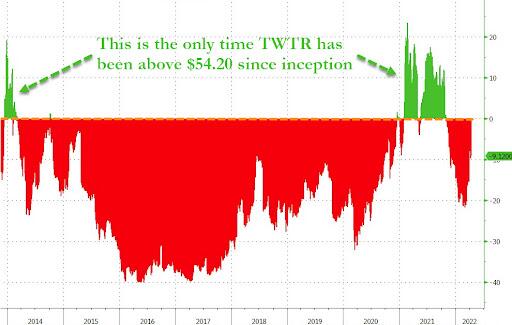
Twitter enacted the plan to buy time, Bloomberg reported citing a person familiar with the matter, although it wasn't clear time for what: at $54.20, Musk's offer represents a premium to the historical TWTR price since IPO on 92% of the time.
And since the Twitter board, whose constituents are listed below...
... is about to get bombarded with a barrage of lawsuits claiming it violated its fiduciary duty, the board also said it wants to be able to analyze and negotiate any deal, and may still accept it (spoiler alert: it won't).
Twitter’s board met Thursday to review Musk’s proposal - which according to the world's richest man was his “best and final” offer and who had already accrued a stake of more than 9% in Twitter since earlier this year - to determine if it was in the best interest of the company and all of its shareholders.
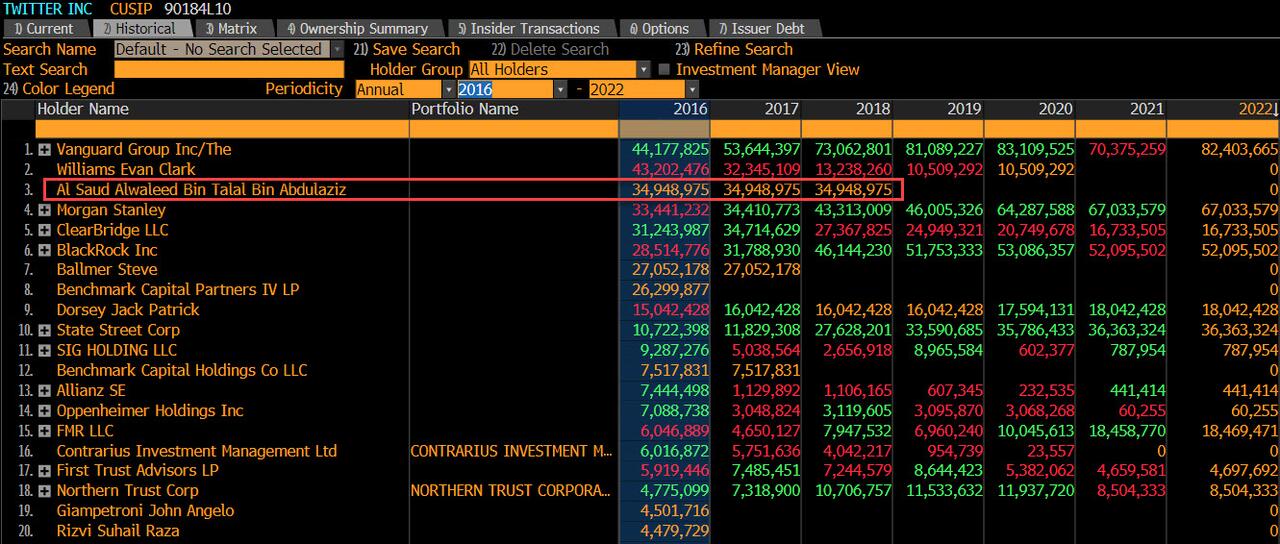
Included in Musk’s securities filing disclosing the bid Thursday morning was a script of text he sent to the company. In it he said, “it’s a high price and your shareholders will love it.” Hilariously, one prominent - and former - investor said the offer was too low and the market reaction appeared to agree. Saudi Arabia’s Prince Alwaleed bin Talal said the deal doesn’t “come close to the intrinsic value” of the popular social media platform. Which is, well, hilarious since as we showed yesterday, it appears the Prince no longer has direct ownership of even one share of Twitter stock.
Speaking later Thursday at a TED conference, Musk said he wasn’t sure he “will actually be able to acquire it.” He added that his intent was to also retain “as many shareholders as is allowed by the law,” rather than keeping sole ownership of the company himself.
After initially surging, Twitter shares dropped 1.7% in New York on Thursday, reflecting the market’s view that the deal is likely to be rejected or to fall through.
Musk first disclosed his Twitter stake on April 4, making him the largest individual investor. At the TED conference, he indicated that he has a Plan B if Twitter’s board rejects his offer. He declined to elaborate. But in his filing earlier in the day, he said he would rethink his investment if the bid failed.
“If the deal doesn’t work, given that I don’t have confidence in management nor do I believe I can drive the necessary change in the public market, I would need to reconsider my position as a shareholder,” said Musk.
* * *
Previewing the poison pilll defense, on Thursday, Cameron Winklevoss, founder of the Gemini cryptocurrency exchange, tweeted (of course) that “Twitter is considering a poison pill to thwart @elonmusk’s offer." In response, Musk said that a “poison pill” move would be a "breach" of the board's fiduciary duty and could expose Twitter’s board to “titanic” legal liability.
Winklevoss alleged in his tweet that, by adopting the poison pill tactic, Twitter was demonstrating its commitment to preserving the status quo even if it has a negative impact on existing shareholders.
“They would rather self-immolate than give up their censorship programs. This shows you how deeply committed they are to Orwellian control of the narratives and global discourse. Scary,” he wrote. Twitter has repeatedly suppressed and "shadowbanned" conservative viewpoints, allegations the company has repeatedly denied.
Adam Candeub, a law professor at Michigan State University, said that Twitter’s board could face legal consequences if they turn down an offer that’s financially lucrative to shareholders.
“Twitter’s owned by shareholders, and the directors have to act in a way that’s in their best interests, not in the way that allows them to keep control of the corporation,” Candeub told The Epoch Times.
“If they turn down a very favorable price, there will be dereliction of their legal duty, and there could be lots of legal consequences.”
* * *
Now that his original plan has been thwarted, Musk has said that he has a "Plan B" in stock for the company although he did not disclose what it is. As Mark Cuban pointed out yesterday...
... one possible response is for Elon to be joined by one or more like-minded, anti-censorship investors such as Peter Thiel who either build up stakes through the poison pill 15% limit in the process making a management and board replacement by proxy vote the simple outcome, or they just raise the takeover price to a level that even the woke Twitter board can not reject.
Or skip the whale investor approach entirely, and open up twitter to a mass investor buyout, in the form of a DAO, where "token holders will get to vote on what's trending and who gets verified."
Alternatively, Musk can take his appeal directly to his 82 million twitter followers (a quarter of Twitter's total 217 million global Daily Active Users) and have them all buy several shares, then pledge them for Elon during the next proxy vote. Because as much as Twitter wants to reject any buyout offer that will prevent it from imposing the censorship its liberal board and employees love so much, there is only so much it can do.
In the end, however, the only question is how dedicated is Musk to control Twitter, because if he really wants it, he will get it.

Barrons : ‘Sell in May and Go Away’ Could Be the Best Strategy This Year

‘Sell in May and Go Away’ Could Be the Best Strategy This Year

This could be the year to follow the adage: Sell in May and go away.

It was a pretty lousy holiday-shortened week. The S&P 500 dropped 2.1%. The Nasdaq Composite fell 2.6%. The Dow Jones Industrial Average was the relative winner, slipping just 0.8%.

The reasons are pretty simple. War, inflation, disease, and the Federal Reserve’s newfound determination to put the brakes on rising prices are all ratcheting up uncertainty and hurting investor sentiment. It’s a lot to digest. Maybe it’s best just to give up—for a while.

“Markets discount three things. Earnings and rates, of course. But the third is conviction about those inputs,” says DataTrek co-founder Nicholas Colas. “It’s a fancy way of saying [the] markets hate uncertainty.”

“We’ve already got a fair amount of uncertainty,” adds Colas. “But can we really know if the 10-year [yield] stops at 3% or goes to 4%? No one knows. Not investors, not the Fed.”

Bond yields are up because the central bank is committed to slaying inflation by raising interest rates.

The Fed makes hawkish statements from time to time, but its tone now is very different than in recent years, says Brian Rauscher, Fundstrat’s head of global portfolio strategy and asset allocation. “I know it’s overly simplistic, but don’t fight the Fed,” Rauscher told clients on a conference call this past week. In other words, if the central bank says it is set on slowing the economy, believe it.

Hawkishness isn’t great news for stocks. “We’re going to have a tough spring and summer,” says Stifel market strategist Barry Bannister. He looks at everything from purchasing manager indexes to real bond yields, retail sales, and more—and they’re “all saying the same thing”: there is trouble ahead.

That trio of market veterans is like a Greek chorus of bad news. But they could well be right. While the Fed tightens, investors should use seasonality to their advantage and be spectators to the drama this summer.

The market, in all likelihood, will be down in the first four months of the year. Since 1980, when the market is down through April, it has fallen from the start of May through September six of 15 times, or 40% of the time. The average move from May through September in those 15 years is minus 1.5%.

When the market rises to begin the year, it drops from May through September 23% of the time. Not as bad. And the average gain over that span is 8%.

That history means investors don’t lose a lot by going conservative in a year like this.

Of course, investors don’t just go to cash and take an extended vacation. Most of the time they make changes in their portfolios at the margins. In practical terms, it means taking exposure down a little or shifting into more-defensive positions.

Bannister and Rauscher both like the healthcare sector as an option for nervous investors. Taking up healthcare and taking down riskier exposure to industrial and commodity stocks looks like a prudent way to survive the turmoil of 2021.

Barrons : Utility Stocks Are Hot Right Now. Here’s Why.

Utility Stocks Are Hot Right Now. Here’s Why.

Higher bond yields are roiling the stock market. Utility shares have benefited—and it doesn’t look like their run-up is over.

The 10-year Treasury yield has surged to 2.83% from 1.51% at the end of 2021, as the Federal Reserve raises borrowing costs to curb inflation. It’s already begun hiking interest rates and is expected to reduce its bond holdings soon—which bodes badly for riskier sectors like industrials, consumer discretionary, and banking, but helps bolster defensive sectors like utilities.

The Fed’s moves have helped send the S&P 500 down 7.8% this year. The Utilities Select Sector SPDR exchange-traded fund (ticker: XLU), meanwhile, is up 6.3%.

Normally, higher yields hurt utility stocks, as they typically accompany strengthening economic demand, prompting investors to favor cyclicals. Utilities don’t see higher earnings growth when the economy strengthens.

Right now, however, higher yields are a result of the Fed trying to slow economic growth, and that’s scaring investors into utilities. Such a slowdown would dent profit gains in cyclical sectors. But utilities' earnings growth should be stable, as they can keep raising prices for residential and commercial customers, which is precisely why strategists at Morgan Stanley recently upgraded the sector.

Analysts expect utilities’ 2023 earnings per share to rise almost as fast as the S&P 500’s 10% rate, which could decline should the economy falter. Utilities’ steady growth—higher than the low single digits in percentage terms in the past few years—is aided by demand for renewable energy.

State regulators only allow utilities to realize a set return on their assets—roughly 10%. When they invest in renewable projects, they boost their total assets. As their assets increase, their earnings grow almost as fast.

“There’s a lot of macro uncertainty, and this group has a lot of appealing characteristics,” says Wells Fargo analyst Neil Kalton. “If there are some pullbacks, we want to step in and add to positions.”

Consider Dominion Energy (D). The company said in its most recent earnings release that it aims to expand its asset base by 9% annually starting this year. That will drive almost 7% EPS growth, to $4.38, for 2023, according to FactSet. Driving Dominion’s asset expansion would be 11% growth in zero-carbon electricity generation, amounting to about $5.4 billion of a total $7.4 billion in annual investments.

Dominion is “levered to decarbonization and renewables,” says Guggenheim analyst Shahriar Pourreza, who rates the stock a Buy. “They’re going to grow [earnings] into perpetuity at 6% to 8%.”

That could take Dominion stock higher, as it isn’t necessarily as expensive as it looks. At $87.40, it trades at 21.2 times forward EPS, above the S&P 500’s 18.9 times. It’s normal for utilities to trade expensively during heightened economic uncertainty. ”If investors are worried about recession, Dominion is going to work for investors,” says Mizuho analyst Anthony Crowdell.

Barrons : Why Twitter Shareholders Should Sell Out to Elon Musk

Why Twitter Shareholders Should Sell Out to Elon Musk

Elon Musk’s embrace of Twitter leaves investors with a riddle wrapped in a mystery.

Much as he has whipsawed the prices of Bitcoin and Dogecoin with his tweets in the past, Musk generated a frenzy of headlines over Twitter (ticker: TWTR) in recent weeks: first, taking a big stake, then joining the board, not joining the board, and finally offering $54.20 a share to take the company private.

Even for a company that has frustrated repeated efforts to wring big profits from its monopoly on real-time news, the takeover bid falls well short of offering a neat solution to Twitter’s woes. Indeed, the stock closed Thursday at $45.08, in apparent disbelief that Twitter will get bought by Musk or anyone else.

That is still 15% above where it traded before Musk disclosed his 9.1% position. On Friday, the company announced it had adopted a “poison pill” to thwart a hostile takeover.

So what should Twitter shareholders do? Sell to Musk or anyone else who will take their money, suggests Michael Nathanson of SVB’s MoffettNathanson and other analysts. Under its present management and business model, Twitter stock is unlikely to revisit last year’s $80 peak.

The upside for the stock is now capped, says an analyst whose hedge fund sold its position at last year’s higher prices. “The situation’s turned 180 degrees in just a week,” he says. “It was amazing when Elon seemed like he would turn the stock into a meme. Then it all fell apart.”

Musk, the chief executive of Tesla (TSLA) and SpaceX, told a TED talk audience this past week that he was not after Twitter for the money, but rather for his love of free speech. Many tweeters on the platform say he would turn Twitter into an unmoderated nightmare, like the town square in a Purge movie or right-wing sites like Parler.com. Those fears aren’t warranted.

Musk calls himself a free speech “absolutist,” but he isn’t. He told the TED audience that a platform’s content needs some moderation to filter calls to violence and conform with local law. Rule breakers deserve timeouts, he said. Musk’s suggestion that Twitter speech controls should be “open source” echoes the aims of the platform’s co-founder and recent chief executive, Jack Dorsey.

Turning Twitter into a haven for hate speech would destroy its business value, notes Eric Goldman, a law professor at Santa Clara University who studies the regulation of social media.

Musk may say he’s primarily interested in Twitter’s civic value, but he does know something about creating valuable businesses. He has suggested that the company try to get more revenue from subscriptions.

Twitter hasn’t gotten far in its pursuit of the direct-response advertising sales enjoyed by Facebook parent Meta Platforms (FB) or Google parent Alphabet (GOOGL). Despite Twitter’s goal of getting half its ad revenue from direct-response clicks, Nathanson notes that brand advertising still brought in 85% of revenue last year. Privacy restrictions by Apple (AAPL) have steepened the grade for anyone trying to climb into performance-advertising.

As a result, Nathanson thinks it’s generous to assume that Twitter can reach 2025 cash earnings of 25% on $10.7 billion in revenue (or double last year’s sales of $5 billion). But he does. Applying a multiple of 13 to that estimate of $2.7 billion in 2025 earnings before interest, taxes, depreciation, and amortization (Ebitda)—which is between the multiples of Meta and Alphabet—the analyst says Twitter would have an enterprise value just shy of $35 billion, in a couple of years’ time. And that’s before discounting to the present. Today, Twitter already trades at that level.

In his letter to the board, Musk called his $54.20 bid a “best and final offer.” In the past, others have looked into acquiring Twitter, including Walt Disney (DIS) and Salesforce (CRM). If Twitter’s board doesn’t see Musk as its white knight, it’s not likely they would find one willing to bid far more than his cannabis-joke price.

Unless you’re like Musk and want to own Twitter for idealistic reasons, you should let him have it. He won’t ruin it, so you can do so with a clear conscience.

Barrons : Is Tesla Stock Vulnerable to the ‘Key-Man’ Risk? The Meaning of Musk i

Is Tesla Stock Vulnerable to the ‘Key-Man’ Risk? The Meaning of Musk in the Long Term.

It’s not easy riding with Elon Musk on one of his adventures. Tesla stock has been jumpy since he took his Twitter stake. On Thursday, after he made his takeover bid, Tesla shares fell 3.7%, shedding $38.6 billion in market value.

Shareholders are nervous. Many investors see the unpredictable Musk as irreplaceable—the so-called key-man risk. “Tesla is Elon Musk,” says Roth Capital analyst Craig Irwin, likening him to Apple ’s Steve Jobs. “He’ll be the most important person at Tesla for the next 20 years.”

Last year, Tesla shares (ticker: TSLA) fell 16% in two days following a Twitter poll Musk ran asking if he should sell 10% of his stake to pay taxes. The Twitterverse voted “yes,” Musk sold $16 billion in shares—and the stock hasn’t closed above $1,200 a share since. It’s now just under $1,000.

Accounting for what Musk already owns, buying Twitter could mean selling some 40 million Tesla shares. Of course, Musk could borrow against his Twitter stake, with a loan secured by his Tesla position, or, says Future Fund Active exchange-traded fund founder Gary Black, “line up a private equity backer or lenders who can provide leverage. He can sell some SpaceX shares. He doesn’t necessarily have to sell more [Tesla] stock.”

Bottom line: Most Tesla shareholders are used to Musk’s non-Tesla activities. In the long run, the stock moves on making and selling electric cars.