(ZH) China "Invents" Names For Territory Under India's Dominion, Expert Says

China "Invents" Names For Territory Under India's Dominion, Expert Says

By Venus Upadhayaya of Epoch Times
China has “standardized” the names of 15 places in Arunachal Pradesh, an Indian state on the border with Bhutan and Burma that the Chinese regime has attempted to claim and aggressively intruded upon for the past few decades. However, Indian Foreign Ministry spokesperson Arindam Bagchi said that assigning invented Chinese names to locations in the state won’t alter the fact that Arunachal Pradesh is and always will be an “integral part” of India.

An Indian Buddhist monks approaches the Thupten Gatsal Ling Gunpa, a branch of Tawang Monastery, in Itanagar, capital of Arunachal Pradesh, northeast India
India has governed Arunachal Pradesh since 1954, when the area was established as the North-East Frontier Agency (NEFA) under the British Raj. After the Sino–Indian war of 1962, relations between the two countries deteriorated and border disputes emerged. These have escalated in recent years with the Doklam standoff in 2017 and the bloody clash in the Galwan Valley in 2020.
In 1972, India renamed the NEFA as Arunachal Pradesh, a federally governed territory, or Union territory, and in 1987, it was given the status of a state under the Indian constitution.
However, since 2006, China has claimed the territory and refers to Arunachal Pradesh as “Zangnan,” or South Tibet. On Dec. 29, the Chinese Ministry of Civil Affairs said it had given formal Chinese names to 15 places in “Zangnan.” The announcement came days before China’s new land border law took effect on Jan. 1.
The Chinese “standardized” names apply to eight residential areas, four mountain peaks, two rivers, and one mountain pass, according to Chinese state-run outlet Global Times.
Along with assigning names, the Chinese regime has also set up an administrative structure for the area under Chinese counties and prefectures.
These include Sengkezong and Daglungzong in Cuona County of Shannan Prefecture; Mani’gang, Duding, and Migpain in Medog County of Nyingchi Prefecture; Goling and Damba in Zayu County of Nyingchi Prefecture; and Mejag in Lhunze County of Shannan Prefecture.
China’s claims on Arunachal Pradesh began in 2006, when then-Chinese Ambassador to India Sun Yuxi asserted, “The whole of Arunachal Pradesh is Chinese territory,” ahead of then-Chinese leader Hu Jintao’s official visit to India.
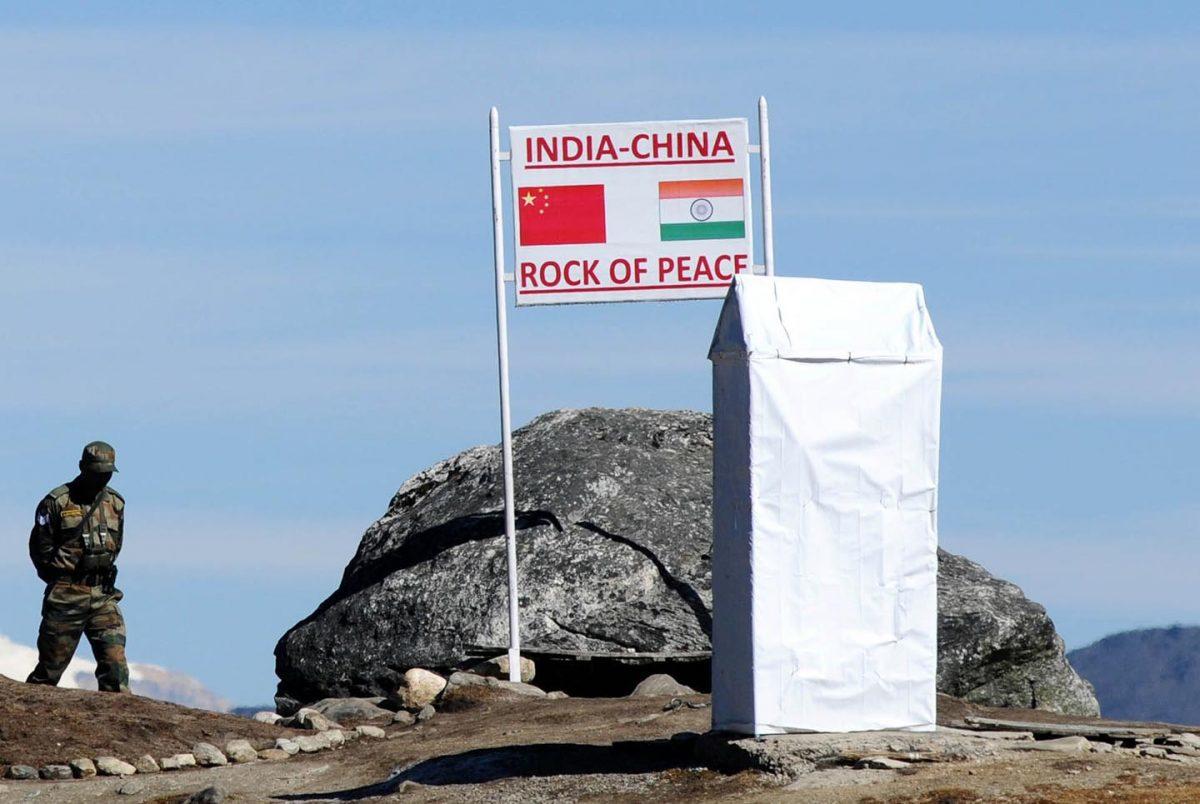
Indian Army personnel keep vigilance at Bumla pass at the India-China border in Arunachal Pradesh
"Lying Maps"
Frank Lehberger, a sinologist specializing in CCP policies in Tibet and a senior fellow at the Indian think tank Usanas Foundation, compared the Chinese attempt with Soviet leader Joseph Stalin’s invention and perfection of “death by cartography.” Stalin personally redrew maps in the Central Asian Fergana Valley to ensure that all former Soviet republics in that region would remain dependent on the Soviet Union and would be shaken by inter-ethnic violence if they tried to declare independence.
Lehberger pointed to delimitation exercises, also called “lying maps,” that he said Stalin followed for the purpose of automatically creating civil unrest, in case of a breakup of the Soviet Union.
“Stalin drew those maps of the internal borders in the Soviet Union in such a way that they could not be detangled in case of the collapse of the Soviet Union and that border wars and civil wars would ensue almost automatically,” Lehberger said. “He got his wish. It happened there twice in 1990 and 2010, at the border of Kyrgyzstan and Uzbekistan, as well as in 2008 in Georgia, 2014 in Crimea, and 2021 in Armenia.”
He added that on old and new Chinese maps, or on official lists of place names in Arunachal Pradesh, Itanagar, which is the state capital of Arunachal Pradesh, is nonexistent.
Out of the 15 places recently named by China, The Epoch Times could locate the following on Google Earth: Duding (Tuting in India), Mani’gang (Monigong), Sengkezong (Senge), Daglungzong (Taklung Dzong), Migpain (Mipi H.Q.), Goling (Goiliang), and Damba (Dhanbari).
While one location is labeled as Mejag in Lhunze County of Shannan Prefecture (known as Meyaba Rai), Lehberger called this fake because Google Earth shows the entire vicinity consists only of thick mountain forests. No dwellings or infrastructure, where civilians could permanently live, appear there.
The first batch of six modified names for places in Arunachal Pradesh was given by the Chinese ministry in 2017, in what Indian media called a retaliatory move following a visit by the Dalai Lama. The state is also a seat of Vajrayana Buddhism and houses the four-century-old Tawang monastery, one of the biggest Buddhist monasteries in Asia.
Lehberger told The Epoch Times that China’s attempt to assign names to places in Arunachal Pradesh is a practice that began even before Sun Yuxi’s statement, in the early 2000s.
Lehberger, who has spent years researching Chinese maps of Tibet and Arunachal Pradesh, shared with The Epoch Times a 2005 map from an official Chinese atlas that includes the regime’s “invented names” for areas in Indian territory.
“Here next to the nonexistent Itanagar on the Chinese map, you find only tiny ‘villages’ with fake names like ‘Ta-geng-si’ or ‘Duo-li.’ Similar sounding Indian place names do not appear anywhere in the vicinity of [the Arunachal Pradesh state capital of] Itanagar on Google Earth,” he said.

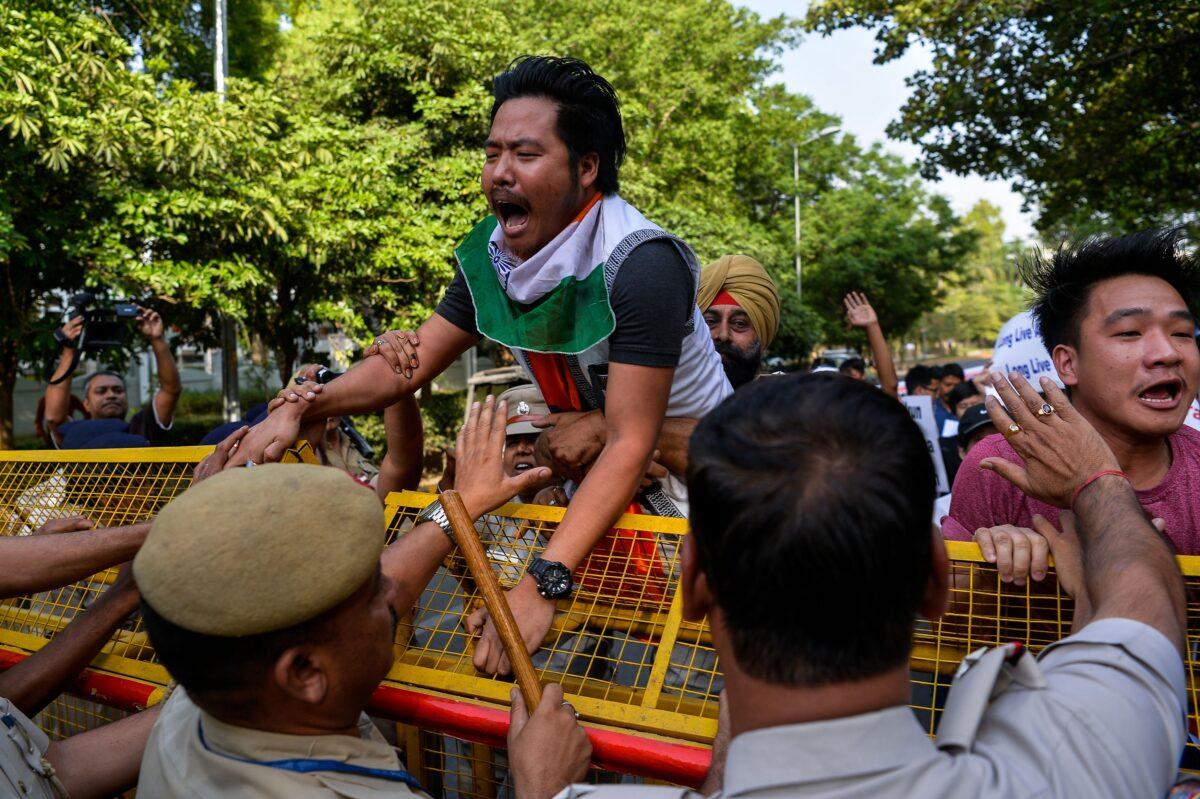
Demonstrators shout slogans as they protest against China’s claim of six districts of Arunachal Pradesh state in New Delhi
He added that the only indirect hint that the Chinese atlases provide for the existence of the state capital is the location of its eastern suburb of Doimukh. The Chinese phonetic spelling of this town is rendered on many Chinese maps as Duo-Yi-Mu-ke. He called it “a deliberate attempt to distract” from the existence of the capital city, which has a population of about 65,000 and is home to Arunachal Pradesh’s legislative assembly.
By filling in place names in the Indian state, Chinese maps do not “look so empty for ordinary Chinese, who have no clue that since 1962 Arunachal belongs to India,” he said. The CCP can’t admit the existence of Itanagar as a metropolis in so-called South Tibet or Zangnan, because it’s bigger than the “supposed county seat of Cuona” from where the area is “supposedly” being administered.
Neither “Ta-geng-si” nor “Duo-li” is among the 15 or so “standardized” names of places in what China claims as “Zangnan,” but Lehberger said that the 2005 map establishes that those two nonexistent places were already officially sanctioned by the CCP and its map-making departments.
Lehberger pointed out another nonexistent village, supposedly south of the Dafla Range and a few kilometers southwest of the Dikrong Power House. While it’s marked on the 2005 official Chinese map of Tibet as “Wupang,” it doesn’t exist on Google Earth.
“Call it the logic of the Chinese lies,” he said, adding that the “name standardization” is just the communist regime’s way of making those place names public on the international stage, a process it has been working on quietly for more than two decades.
“People in India must wake up to what [the Chinese regime has] been doing already for decades.”
He said the government of India should consider canceling the joint declaration it signed with China in 2003, when it recognized that the Tibet Autonomous Region was a territory of the People’s Republic of China. Doing so would theoretically render “null and void” any Chinese attempt to use its border law to redraw the line of actual control and steal more territory from India. The precedent for canceling such a declaration has already been set—by the Chinese regime itself.
“China in 2020 did unilaterally abrogate an internationally binding agreement on the status of Hong Kong, guaranteed by the U.N.,” he said. “So there is a precedent already and it was initiated by the Chinese leadership.
“This proves that the Chinese government and leadership are not willing to fulfill any international treaty obligations, be it with the UK regarding Hong Kong, or with India. Therefore, India should take this into account.”

FT : Private debt funds: cautious banks are fuelling their growth

Private debt funds: cautious banks are fuelling their growth
A low interest rate environment and falling returns in even the riskiest part of the traditional debt market are driving demand

Once a niche area of the global asset management industry, private debt funds have emerged as a growing sector for credit investors seeking yield.

The funds, run by the likes of Blackstone, Apollo, Carlyle and KKR, make direct loans to small and midsize companies with limited market access. In extending loans, private equity funds are elbowing out banks which have turned leery following the financial crisis and, more recently, the pandemic.

S&P Global estimates that the global private debt market grew tenfold in a decade to $412bn at end-2020. Assets parked in private credit funds have more than doubled over the past five years to hit a record $1.1tn last March, according to Preqin. The first 11 months of 2021 alone saw some 190 private credit funds raising a record $181bn.

Behind the demand are two drivers: persistently low rates and falling returns in even the riskiest part of the traditional debt market. The spreads in yield offered by riskier corporate bonds over US Treasuries hit a fresh low last summer.

Private debt provides higher fixed rate returns than public deals as investors are parking their money for a long time in lower liquidity debt. This so-called “illiquidity premium” for private debt has gained appeal among yield hungry institutional investors.

The focus on smaller companies means direct lenders are often the only creditors, giving them more control over terms. That builds in two advantages: mitigating risks from defaults and remaining in pole position if they occur.

Scalability and returns are the big issues as more investors enter the private-credit world. Are there enough suitable small to medium-size borrowers to absorb all the cash looking for a home? And will the flood of money push down yields? Less stringent lending standards could mean a reckoning in the next couple of years. The sell-off in junk bonds in November should make private debt fund investors nervous.

>>> Europe : Brokers Upgrades & Downgrades - 5th of January 2022

>>> Up
* Amadeus Raised to Overweight at Barclays; PT 70 euros
* Chrysalis Investments Raised to Buy at Jefferies
* Deutsche Wohnen Raised to Buy at Kepler Cheuvreux
* ElringKlinger Raised to Overweight at JPMorgan; PT 16 euros
* Ferguson Raised to Buy at Berenberg; PT 15,000 pence
* LSE Raised to Buy at Citi; PT 9,300 pence
* Marks & Spencer Raised to Add at AlphaValue/Baader
* Ocado Raised to Buy at Berenberg; PT 1,990 pence
* Pirelli Raised to Overweight at JPMorgan; PT 7.50 euros

>>> Down
* Axfood Cut to Sell at Carnegie; PT 230 kronor
* Continental Cut to Neutral at JPMorgan; PT 110 euros
* Investors House Cut to Reduce at Inderes; PT 6.20 euros
* Nestle Cut to Underperform at Jefferies; PT 110 Swiss francs
* Stabilus Cut to Underweight at JPMorgan; PT 62 euros
* Volvo Cut to Neutral at JPMorgan; PT 210 kronor

>>> Initiation
* Carnival Reinstated Hold at Jefferies; PT $24
* Telenet Rated New Buy at Jefferies; PT 42.50 euros

>>> Call
* Amadeus Raised to Overweight at Barclays, Sees Market Share Gain
* LSE ‘Simply Too Cheap’ After De-Rating, Citi Upgrades to Buy
* Nestle Downgraded at Jefferies on Downside Risks to Consensus
* Telenet Has Clear Path to Unlock Value, New Buy at Jefferies
* Watch Crypto Prices to Gauge Power of Retail on Stocks, RBC Says

>>> What to look at today - 5th of January 2022

Most stocks in Asia dropped Wednesday with technology share declining as investors fret about interest rates increases. Treasuries held losses. An index of tech shares in Hong Kong fell to the lowest since May 2020. South Korea and China also dropped along with U.S. futures. Shares in Japan edged higher. The Nasdaq 100 underperformed amid a selloff in tech names as Treasury yields climbed for a second day. Treasuries were steady after yields rose amid increasing conviction the Federal Reserve will raise rates at least three times beginning in May to counter price pressures. The yield curve steepened as yields on long maturities also climbed amid heavy supply of new corporate bonds.  The dollar was little changed, while the yen traded near its lowest since January 2017. Data Tuesday showed mixed signs on U.S. inflation. Prices paid by manufacturers in December came in sharply lower than expected. However, figures showing a record U.S. job quit rate added to concerns over wage inflation.  Meanwhile, North Korea appears to have launched its first ballistic missile in about two months, just days after leader Kim Jong Un indicated that returning to stalled nuclear talks with the U.S. was a low priority for him in the coming year. Crude oil in New York held gains. OPEC and its allies agreed to revive more halted production as the outlook for global oil markets improved, with demand largely withstanding the new coronavirus variant. Elsewhere, Bitcoin traded near $46,000. Goldman Sachs Group Inc. predicts $100,000 is possible as the cryptocurrency continues to take market share from gold as a store of value.
US After Hours Earnings make return after holiday break, SGH -5.1% and MLKN -4.3% head lower; WEJO +26.7% jumps on partnership with MSFT; INSP +5.4% higher on bullish guidance

Nikkei +0.10% Hang Seng -1.31% CSI -1.01% Shanghai -1% Shenzen -1.75%

Eur$ 1.1295 CNH 6.3735 CNY 6.3709 JPY 115.99 GBP 1.3535 CHF 0.9156 RUB 75.4330 TRY 13.4344 WTI$ 77.07 +0.10% Gold 1,812.95 -0.08% BTC 46,450 +0.50% ETH 3,820 -0.16%

S&P -0.19% Nasdaq -0.40% EuroStoxx -0.04% FTSE -0.22% Dax -0.09% SMI

Macro :
- Fed Minutes Eyed for Details on Rate Liftoff, Shrinking Assets
- Goldman Says Bitcoin $100,000 a Possibility by Taking on Gold

Keep an eye on :
- ALV GY : Allianz’s French Unit Transfers EU2.1b Savings Contracts to CNP
- AMUN FP : Amundi Targets 50% AuM Growth by 2025 in Passive Management
- BAKKA NO : Bakkafrost Reports Total Harvest of 25,800 Tons in 4Q
- BNP FP : BNP to UniCredit, $1 Trillion Banking Outlook Skewed Positively
- CNC LN : Concurrent Tech Sees Earnings Slightly Ahead of Market Views
- CNP FP : Allianz’s French Unit Transfers EU2.1b Savings Contracts to CNP
- DAI GY : Mercedes Recall Faces Delay Due to Parts Shortage, Bild Says
- EDF FP : EDF Considers Steps to Help Companies Stung By Energy Cost Surge
- 3333 HK : Evergrande Unit Proposes Delaying Possible Yuan Bond Repayment
- FORTUM FH : Uniper Agrees on New Financing Due to Commodities Volatility
- GXI GY : Gerresheimer Shares Fall After JPM Reiterates Neutral Rating
- IPH FP : Innate Pharma Obtains EU28.7M in State-Guaranteed Loans
- ISP IM : Intesa, UniCredit May Join KKR’s Telecom Italia Bid: Sole
- NVG PL : Navigator to Increase Tissue Paper Prices Due to Higher Costs
- PUB FP : Publicis Announces Purchase of Tremend
- SIGN SW : SIG Combibloc to Buy Evergreen Fresh Carton Business in Asia
- SLIGR NA : Sligro FY Sales Meet Estimates
_ STLA IM ; Chrysler Plans to Go All Electric by 2028, CEO Says: CNBC
- TIT IM : Intesa, UniCredit May Join KKR’s Telecom Italia Bid: Sole
- TSLA US : Nikola Drops $2 Billion Patent Suit Against Tesla Filed in 2018
- UCG IM : Intesa, UniCredit May Join KKR’s Telecom Italia Bid: Sole
- UN01 GY : German Energy Giant Uniper Gets $11 Billion to pay Margin Calls

WSJ : Sony Looks to Sell Its Own Electric Vehicles

Sony Looks to Sell Its Own Electric Vehicles
PlayStation maker shows off an SUV prototype at CES and plans to create a mobility unit


Sony Group Corp. said it would create a car unit and explore entering the electric-vehicle market, in another sign of how the electronics and car businesses are overlapping.

At the CES technology conference in Las Vegas, Sony showed off a prototype seven-seat electric sport-utility vehicle with all-wheel drive. Sony shares rose 4% in morning trading in Tokyo on Wednesday after the news.

Sony first displayed an EV sedan at CES two years ago, but it said at the time it didn’t necessarily plan to sell a Sony car. The initial prototype served to show off Sony’s image sensors, which can be a key part of autonomous driving systems.

The new Las Vegas announcement suggested Sony does plan to sell vehicles under its own brand rather than merely supplying its technology to other car makers. The company said it would establish a company called Sony Mobility Inc. in the spring.

The EV market is getting increasingly crowded with Tesla Inc. leading the pack of EV-only companies competing against traditional car makers, almost all of which have announced ambitious plans to expand their EV offerings.

In an interview in September 2020, Sony Chief Executive Kenichiro Yoshida expressed strong interest in getting into the vehicle market. He said he had felt for years that the maker of PlayStation videogame consoles and other electronics should “make something that moves.”

“We believe Sony is well-positioned as a creative entertainment company to redefine mobility,” Mr. Yoshida said at the conference Tuesday.

Electric vehicles have fewer moving parts than those running on gasoline and rely more on software controls, making it easier for companies that specialize in electronics to get into the business. Apple Inc. has explored entering the EV market for years, although it has never released details about its plans.

Sony is a major Apple supplier because of its image-sensing business, which makes parts used in iPhones and other smartphones.

Sony said 40 sensors were installed in its prototype. It said it eventually aimed to offer what is known as level four autonomous driving, in which the car can drive itself without human involvement under certain conditions.

Another Apple partner, contract manufacturer Foxconn Technology Group, is also making a foray into EVs. Foxconn, known for assembling Apple’s iPhones and other branded tech devices, introduced three electric-vehicle prototypes last October.

Foxconn Chairman Young Liu has said the company aims to supply three million electric vehicles annually by 2027, which he estimated would be about 10% of the global market then.

Video :

>>> US After Hours Summary: Earnings make return after holiday break, SGH -5.1%

After Hours Summary: Earnings make return after holiday break, SGH -5.1% and MLKN -4.3% head lower; WEJO +26.7% jumps on partnership with MSFT; INSP +5.4% higher on bullish guidance

After Hours Gainers:

Companies trading higher in after hours in reaction to earnings/guidance: SENS +26.8% (reaffirms FY21 revenue guidance, also provides operational updates), INSP +5.4% (issues upside Q4 revenue guidance), ACMR +3.6% (guides FY21 and FY22 revs above consensus)

Companies trading higher in after hours in reaction to news: WEJO +26.7% (announces Wejo Natural Edge platform, in partnership MSFT), ONCT +10.3% (announces agreement with the FDA on Phase 3 registrational study design for zilovertamab), BYND +7% (KFC to launch Beyond Meat's meatless chicken on its menus starting Monday, according to CNBC), BCEL +2.1% (to present data on broadly neutralizing SARS-CoV-2 antibodies), MTRX +0.8% (adds execs to grow market position in hydrogen and renewable energy), NTNX +0.7% (eliminates dual-class stock structure), VAL +0.6% (announces several new contract awards), AMBA +0.3% (launches CV3 AI domain controller family), CATO +0.2% (announces planned retirement of CFO), BA +0.2% (ALGT to purchase 50 737 MAX jets totaling $5 bln, according to Reuters), FNKO +0.1% (names new chairman)

After Hours Losers:

Companies trading lower in after hours in reaction to earnings/guidance: SGH -5.1% (also announces 2-for-1 stock split), MLKN -4.3%

Companies trading lower in after hours in reaction to news: ANNX -25.1% (reports Phase 2 data for ANX005 in Huntington's disease), SWIM -8% (stock offering), ARE -3.5% (stock offering), ZYNE -0.3% (provides clinical development updates)

>>> US Close Dow +0.59% S&P -0.06% Nasdaq -1.33% Russell -0.16% VIX 16.91 +1.87%

Closing Stock Market Summary

The S&P 500 declined 0.1% on Tuesday in a mixed session, which was better represented by the sharp divergence between the Dow Jones Industrial Average (+0.6%) and Nasdaq Composite (-1.3%). Both the S&P 500 and Dow set intraday record highs while the Dow also set a closing record high. The Russell 2000 declined 0.2%.

Today's session was reminiscent of the classic reopening trade, except that it's 2022 and daily COVID-19 cases in the U.S. topped one million yesterday. Value/cyclical stocks outperformed at the expense of growth stocks, the Treasury yield curve steepened, and WTI crude futures settled at $75.00 per barrel (+$1.00, +1.3%). 

More specifically, the S&P 500 energy (+3.5%), financials (+2.6%), industrials (+2.0%), and materials (+1.3%) sectors rose between 1-4%. The 10-yr yield increased four basis points to 1.67% while the 2-yr yield decreased two basis points to 0.76%. The U.S. Dollar Index increased 0.1% to 96.28. 

Notably, the 10-yr yield has now risen 16 basis points start the year, increasing the probability that 2022 will be marked by a higher-interest rate environment, as forecasted by many analysts on Wall Street. This view weighed on the highly-valued growth stocks, albeit in a delayed reaction since the Nasdaq was up 0.1% in early action.

The information technology (-1.1%), health care (-1.4%), and consumer discretionary (-0.7%) sectors struggled amid weakness in the growth stocks. The Vanguard Mega Cap Growth ETF (MGK 260.20, -3.27) fell 1.2%. The iShares Biotechnology ETF (IBB 148.29, -4.08) fell 2.7%. The ARK Innovation ETF (ARKK 92.69, -4.30) fell 4.4%.

Selling interest in the growth stocks accelerated soon after the release of the December ISM Manufacturing Index at 10:00 a.m. ET. While the index decelerated more than expected to 58.7% (Briefing.com consensus 60.3%) from 61.1% in November, it still denoted an expanding manufacturing sector.

More encouragingly, the Prices Index in the ISM report showed a noticeable ease in inflation pressures. The Omicron variant could pose risks this month, but the inference from today (and prior weeks) is that market sees the economic impact from the variant as short-term.

Growth stocks eventually pared losses in the afternoon, helping the market end the Santa Claus rally period on a better note.

Reviewing Tuesday's economic data:

  • The December ISM Manufacturing Index checked in at 58.7% (consensus 60.3%) versus 61.1% in November. A number above 50.0% is indicative of expansion. December marked the 19th straight month of expansion for the manufacturing sector, albeit at a slower pace.
    • The key takeaway from the report is the recognition that price pressures softened some, presumably due to improved supply chain conditions; however, supply concerns (and inflation worries) aren't going to fade away knowing that the Omicron variant is driving global staffing challenges.
  • Job openings decreased to 10.562 million in November from a revised 11.091 million (from 11.033 million) in October.

Looking ahead, investors will receive the ADP Employment Change report for December, the FOMC Minutes from the December meeting, the preliminary IHS Markit Services PMI for December, and the weekly MBA Mortgage Applications Index on Wednesday.

  • Dow Jones Industrial Average +1.3% YTD
  • Russell 2000 +1.1% YTD
  • S&P 500 +0.6% YTD
  • Nasdaq Composite -0.1% YTD