WSJ : Cryptocurrency-Based Crime Hit a Record $14 Billion in 2021

Cryptocurrency-Based Crime Hit a Record $14 Billion in 2021
Although the amount of crypto collected through criminal activity went up significantly in 2021, it represents a smaller percentage of overall crypto transaction volume

The dollar amount collected through cryptocurrency-based crime hit a record high in 2021, as the volume of cryptocurrency transactions overall grew into tens of trillions of dollars, according to blockchain data platform Chainalysis Inc.

However, the volume of illicit activities remains a small share of the total cryptocurrency transactions volume, according to a preview of Chainalysis’s 2022 Crypto Crime Report to be published in February.

The volume of cryptocurrency transactions grew to $15.8 trillion in 2021, up 567% from 2020, in a sign that the trading of digital assets is becoming increasingly mainstream. Illicit transactions totaled $14 billion in 2021, up 79% from $7.8 billion the previous year. But illicit transactions only made up 0.15% of cryptocurrency transaction volume in 2021.

While risks remain for potential cryptocurrency investors, Ross Delston, a Washington, D.C., lawyer who advises clients on anti-money-laundering issues, said he doesn’t expect the level of interest to ebb anytime soon.

“What’s so interesting about cryptocurrency is we usually associate it with illicit transactions; there is so much news about anything that goes wrong with crypto,” he said. “As Chainalysis points out in the report, it’s relatively a small fraction of transactions that are criminal in nature.”

In its report, Chainalysis warns that its tracked volume of illicit activity is likely to rise later as the company identifies more bad actors and incorporates data gained from that into its historical analysis. The company added that with the exception of 2019, which was notable for the PlusToken cryptocurrency scam, bad actors have made up a smaller component of overall cryptocurrency transaction volume over the past few years.

Chainalysis also warns that the rise of DeFi, or decentralized finance—an umbrella term for financial services offered on public blockchains—is a particularly menacing threat to the sector.

Out of the total of about $3.2 billion in cryptocurrency stolen in 2021, 72% was stolen from DeFi protocols, according to Chainalysis.

DeFi also was an increasingly popular way of money laundering, according to Chainalysis. The use of DeFi as a way to launder money increased 1,964% between 2020 and 2021, according to the company.

Chainalysis’s report is valuable but has its limitations, said Jeffrey Alberts, a partner at law firm Pryor Cashman LLP with a focus on financial technology. For instance, he said the data doesn’t capture all the illicit transactions but only those crypto addresses Chainalysis has associated with illicit activity and might exclude those addresses Chainalysis doesn’t know belong to known criminals.

“All of this said, it is clear that there was a massive increase in valid activity involving cryptocurrency in 2021,” he said, adding that the trend is likely to continue this year.

Alex Zerden, who worked on policy issues related to illicit finance in both the Obama and Trump administrations, said the report is a useful contribution from Chainalysis to the public’s understanding of trends in illicit finance involving cryptocurrency, but it would be beneficial to have additional clarity on the definitions of “illicit activities” mentioned in the report. He said having a common language between various regulators and industry observers would be helpful to discuss this issue from a policy development perspective.

“Having other academic, quasi-academic analysis would help to support these claims, and further transparency on flow of funds is welcomed,” said Mr. Zerden, the founder of financial technology advisory firm Capitol Peak Strategies LLC and an adjunct senior fellow at the Washington-based Center for a New American Security.

WSJ : GameStop Entering NFT and Cryptocurrency Markets as Part of Turnaround Pla

GameStop Entering NFT and Cryptocurrency Markets as Part of Turnaround Plan
The retailer is launching a division dedicated to the buzzy new technologies amid a push to turn a profit

GameStop Corp. GME 1.28% is launching a division to develop a marketplace for nonfungible tokens and establish cryptocurrency partnerships, according to people familiar with its plans, pushing the company into much-hyped areas as it tries to turn around its core videogame business.

The retailer has hired more than 20 people to run the unit, which is building an online hub for buying, selling and trading NFTs of virtual videogame goods such as avatar outfits and weapons, according to the people. The company is asking select game developers and publishers to list NFTs on its marketplace when it launches later this year, the people said.

GameStop also is close to signing partnerships with two crypto companies to share technology and co-invest in the development of games that use blockchain and NFT technology, as well as other NFT-related projects, the people said. The retailer expects to enter into similar agreements with a dozen or more crypto companies and invest tens of millions of dollars in them this year, the people said.

Grapevine, Texas-based GameStop has been working to reset its business after years of losses. The company was at the center of a stock-trading frenzy last year that boosted its share price, which rode a surge in interest and optimism from individual investors.

Many saw potential in GameStop despite the pandemic’s negative impact on foot traffic and even though consumers have been increasingly opting to download and stream games over the internet, rather than buy the kind of hard copies that the company specializes in selling.

Last year, GameStop overhauled its executive team and board of directors, naming activist investor Ryan Cohen as chairman. Mr. Cohen, who co-founded online pet-products retailer Chewy Inc. and sold it for $3.35 billion in 2017, has been pushing to make GameStop more tech-centric.

The turnaround effort has yet to show significant results in GameStop’s financial performance. In the quarter through October, the company said revenues grew, but its loss widened compared with the same period a year earlier. The revenue growth came from sales of hardware and accessories, while revenue from game software slipped 2%.

“We believe our emphasis on the long term is positioning us to build what will ultimately become a much larger business,” GameStop Chief Executive Matt Furlong said on an earnings call with analysts last month. Mr. Furlong, who joined the company last year from Amazon.com Inc., then mentioned that GameStop was exploring business opportunities involving blockchain and NFT technologies.

There have been signs some investors are losing patience. Through Thursday’s close, GameStop shares had plunged by more than 45% over the past six weeks, though the stock remains far above where it was when investors started piling into GameStop shares a year ago. The stock surged more than 20% in after-hours trading following The Wall Street Journal’s publication of the news.

Diving into the crypto and NFT space puts GameStop on a rapidly growing list of companies trying to cash in on these nascent and largely unproven technologies. A handful of NFT marketplaces already exist and some feature tokens from game publishers. Earlier this week, a marketplace called OpenSea said it raised $300 million in venture capital and is now valued at $13.3 billion, greater than GameStop’s valuation of close to $10 billion.

The videogame industry is likely to play a major role in the adoption of cryptocurrency, NFTs and blockchain technology, analysts say. Gamers are expected to be among the first to embrace the technologies because they are already spending a lot on virtual goods. Virtual real estate in videogames, as well as videogame collectibles, are a rapidly growing segment of the NFT market.

In recent weeks, some of the industry’s biggest publicly traded videogame companies have launched or announced plans to sell NFTs, including Ubisoft Entertainment, Zynga Inc. and Square Enix Holdings Co. Some industry executives and players, though, have expressed concerns about the value of NFTs and developers’ motives for creating them.

By getting into the crypto and NFT space while it is still in its infancy, GameStop hopes to avoid missing out on opportunities to be part of a budding trend as it did with computer-game downloads about a decade ago, the people familiar with its plans said. GameStop tried to get into the streaming of videogames at the time but abandoned the effort. Today, the downloading and streaming of games are rapidly growing trends.

WSJ : Friends With Ties to Boards of Designer Brands, Albertsons Charged in Insi

Friends With Ties to Boards of Designer Brands, Albertsons Charged in Insider Trading Ring
Illicit tips garnered at least $4 million in trading profits

WASHINGTON—Three friends tapped family ties to the boards of public companies including Designer Brands Inc. and Albertsons Cos. to get tips that gained them at least $4 million in illicit trading profits, according to law-enforcement officials.

Two of the men—hedge-fund manager Kris Bortnovsky and fintech entrepreneur Ryan Shapiro —were indicted Thursday in Boston and charged with securities fraud and conspiracy. The third trader, David Schottenstein, agreed to plead guilty to conspiracy to commit securities fraud, according to court records.

Mr. Schottenstein, the founder of a sunglasses retailer, passed illicit tips to his friends that he got from a cousin who is a board member of Designer Brands, the parent company of the Designer Shoe Warehouse chain, according to prosecutors and regulators.

The cousin also knew about grocery retailer Albertsons’ 2018 plan to merge with Rite Aid Corp. because his father served on Albertsons’ board of directors, according to court filings. The cousin shared the undisclosed merger plan with Mr. Schottenstein, who prosecutors say traded on the information and shared the tip with his friends.

The traders purchased shares of Rite Aid, whose stock price rose after the deal became public in February 2018, and other securities that would pay off if the merger became public, according to the Securities and Exchange Commission, which filed a separate civil fraud lawsuit against the three men.

Court documents don’t name Mr. Schottenstein’s cousin, who wasn’t charged.

“Traders who seek to profit from inside information are no match for the SEC’s sophisticated data analysis methods like the ones used to uncover this alleged insider trading ring,” said Joseph Sansone, chief of the SEC’s market-abuse unit.

Messrs. Bortnovsky and Shapiro were arrested last month in Miami, but the criminal complaint against them was sealed until Thursday, when a federal grand jury in Boston returned an indictment against them.

Mr. Schottenstein will plead guilty to conspiracy to commit securities fraud, according to an agreement made Wednesday with the Boston U.S. attorney’s office. He faces a maximum prison sentence of 20 years as well as a financial penalty of at least $250,000 and forfeiture of $634,000 in trading gains.

“I take full and sole responsibility for my conduct and deeply regret my actions,” Mr. Schottenstein said in a statement provided by his lawyers. “I apologize to my family, friends and colleagues,”

Spokesmen for Designer Brands and Albertsons didn’t return messages seeking comment. James Froccaro, an attorney for Mr. Bortnovsky, said his client is innocent and plans to plead not guilty. An attorney for Mr. Shapiro didn’t immediately respond to requests for comment.

Mr. Bortnovsky, 40 years old, managed a small hedge fund in which Mr. Schottenstein was an investor, according to court records. He netted about $260,000 by trading ahead of the Designer Brands and Albertsons announcements, according to the SEC. His hedge fund and a related account earned about $3.4 million, according to the SEC.

The two men communicated frequently about their trades, according to the SEC. In one text message cited by the SEC in its federal court complaint, Mr. Schottenstein told Mr. Bortnovsky: “u never LOST due to my tips…EVER…not once.”

Mr. Schottenstein also frequently spoke with his cousin before buying Designer Brands shares in August 2017. The bets paid off when Designer Brands later reported quarterly results that beat expectations, sending the shares up 17%, according to the SEC.

>>> US After Hours Summary: GME +30% higher on WSJ report to enter NFT, crypto; DCT +8%, QDEL +2.3% higher on eaarnings/guidance; SONO +3.9% up on NYT report that GOOG infringed


After Hours Summary: GME +30% higher on WSJ report to enter NFT, crypto; DCT +8%, QDEL +2.3% higher on eaarnings/guidance; SONO +3.9% up on NYT report that GOOG infringed

After Hours Gainers:

Companies trading higher in after hours in reaction to earnings/guidance: DCT +8%, AEHR +5.7%, SLP +4.8%, FC +4.8%, PRTS +3.2% (guides Q4 revs above consensus), QDEL +2.3% (guides Q4 revs well above consensus), OCDX +1.9%, PSNL +1.7% (guides Q4 revs above consensus)

Companies trading higher in after hours in reaction to news: GME +30% (turnaround plan to enter NFT and cryptocurrency markets, according to WSJ), IMRX +6.8% (reports compelling preclinical data on IMM-1-104), NAKD +5.1% (stock offering), SONO +3.9% (trade court ruled Google infringed on speaker technology owned by SONO, according to NY Times), WWE +3.1% (WWE signs licensing agreement with IGT to develop WWE-branded lottery games), AYX +2.8% (to acquire Trifacta for $400 mln; expects Q4 revs to be at or above high-end of previous guidance), CFRX +2.7% (receives additional award from Cystic Fibrosis Foundation), AHT +2.5% (reports preliminary RevPAR results for Q4), PRCH +2.3% (Park West Asset Mgmt discloses 5.1% stake), ALB +1.3% (announces price increase for Catalysts customers), MX +1.3% (to develop OLED DDIC for automotive displays), JHX +1.1% (names interim CEO, also raises FY22 adjusted net income guidance), GOOG +0.5% (trade court ruled Google infringed on speaker technology owned by SONO, according to NY Times), LULU +0.3% (names Michael Aragon as CEO of MIRROR and lululemon Digital Fitness), MRNA +0.2% (CEO says people may need fourth COVID-19 shot, according to CNBC), BA +0.1% (Bell Boeing venture awarded $1.6 bln Navy contract)

After Hours Losers:

Companies trading lower in after hours in reaction to earnings/guidance: WDFC -0.9%

Companies trading lower in after hours in reaction to news: AHH -4.6% (stock offering), GKOS -3% (receives 510k FDA clearance for its iPRIME Viscodelivery System), NBIX -2% (provides preliminary Q4 product sales), TMUS -1.8% (provides Q4 customer metric data), NYT -1.4% (confirms deal to acquire The Athletic for $550 mln), IGT -1% (WWE signs licensing agreement with IGT to develop WWE-branded lottery games), JNJ -0.1% (cites new study that shows that a single shot of JNJ vaccine resulted in long-lasting protection up to 6 months)

>>> US Close Dow -0.47% S&P -0.10% Nasdaq -0.13% Russell +0.56% VIX 19.61 -0.61%

Closing Stock Market Summary

The stock market closed mixed on Thursday in an underwhelming effort following yesterday's retreat. The S&P 500 and Nasdaq Composite both declined 0.1%, and the Dow Jones Industrial Average declined 0.5%. The small-cap Russell 2000, however, advanced 0.6%. 

There was a bit of a growth-stock scare in the morning, as the 10-yr yield hit 1.75% and the Nasdaq declined as much as 1.2% after the open. Fortunately, the 10-yr yield stabilized, and investors presumably felt comfortable enough to buy beleaguered growth stocks, especially after the S&P 500 bounced off its 50-day moving average (4672). 

Buying conviction was kept in check, though, partly because of anxiety surrounding monetary policy normalization, the upwards path in interest rates, and the possibility for more selling in the days to come. There might also have been a wait-and-see mindset for the December employment report tomorrow.

Five of the 11 S&P 500 sectors ended the session in positive territory while six sectors closed lower. The materials (-1.2%), health care (-1.2%), and utilities (-1.1%) sectors declined more than 1.0% while the information technology sector declined 0.5%. 

The heavily-weighted technology sector held back the S&P 500 in a meaningful way considering the Invesco S&P 500 Equal Weight Index (RSP 162.03, +0.36) gained 0.2%. The biggest gainers were found in the financials (+1.6%) and energy (+2.3%) sectors, which extended their weekly gains to 4% and 9%, respectively. 

While growth stocks pared intraday losses, there was still there was a lingering preference for value stocks. This preference was better represented by the 0.3% gain in the Russell 3000 Index, versus the 0.2% decline in the Russell 3000 Growth Index. 

Walgreens Boots Alliance (WBA 52.44, -1.56, -2.9%) was a value-oriented stock that underperformed despite reporting better-than-expected earnings results and raising its FY22 EPS guidance. Shares of the Dow component fell 3% after being up 0.9% intraday. 

Recapping the moves in the Treasury market, the 10-yr yield settled three basis points higher at 1.73% while the 2-yr yield rose six basis points to 0.88% amid expectations for a more aggressive Fed. The U.S. Dollar Index increased 0.1% to 96.30. WTI crude futures rose 2.0%, or $1.58, to $79.40/bbl after briefly topping $80.00/bbl.

Reviewing Thursday's economic data:

  • Initial claims for the week ending January 1 increased by 7,000 to 207,000 (consensus 198,000) and continuing claims for the week ending December 25 increased by 36,000 to 1.754 million.
    • The key takeaway is that the latest data didn't disrupt the idea that the labor market is tight and that initial claims are running at pre-pandemic levels, which at the time were thought to be quite low.
  • The ISM Non-Manufacturing Index for December decreased to 62.0% ( consensus 67.1%) from a record high 69.1% in November. The dividing line between expansion and contraction is 50.0%. The December reading marks the 19th straight month of growth for the services sector.
    • The key takeaway from the report is that it isn't surprising to see some softening following a record-high print and the arrival of the Omicron variant; however, the uptick in the prices index is a worrisome inflation point given the narrative that consumers will be engaging more with services companies in 2022 than they did in 2021.
  • The trade deficit for November widened to $80.2 billion (consensus -$69.4 billion) from $67.2 billion in October. Exports were $0.4 billion higher than October exports and imports were $13.4 billion more than October imports.
    • The key takeaway relates to the soft growth in exports, which reflects relatively weak demand abroad before the Omicron variant made its presence felt.
  • Factory orders for manufactured goods increased 1.6% m/m in November ( consensus 1.2%) following an upwardly revised 1.2% increase (from 1.0%) in October. Shipments of manufactured goods jumped 0.7% after increasing 2.0% in October.
    • The key takeaway from the report is the lack of order growth for nondefense capital goods, excluding aircraft -- a proxy for business spending. That connotes a slowdown, but to be fair, it follows a string of monthly increases, so it appears at this juncture to be some natural slowing after an extended period of strength.

Looking ahead, investors will receive the Employment Situation Report for December and Consumer Credit for November on Friday.

  • Dow Jones Industrial Average -0.3% YTD
  • S&P 500 -1.5% YTD
  • Russell 2000 -1.7% YTD
  • Nasdaq Composite -3.6% YTD

(ZH) Northeast Braces For Potential Bomb Cyclone As Next Winter Storm Fast Appro

Northeast Braces For Potential Bomb Cyclone As Next Winter Storm Fast Approaches

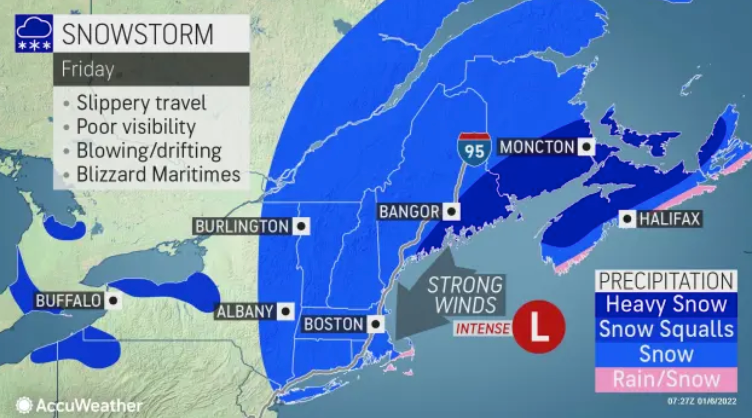
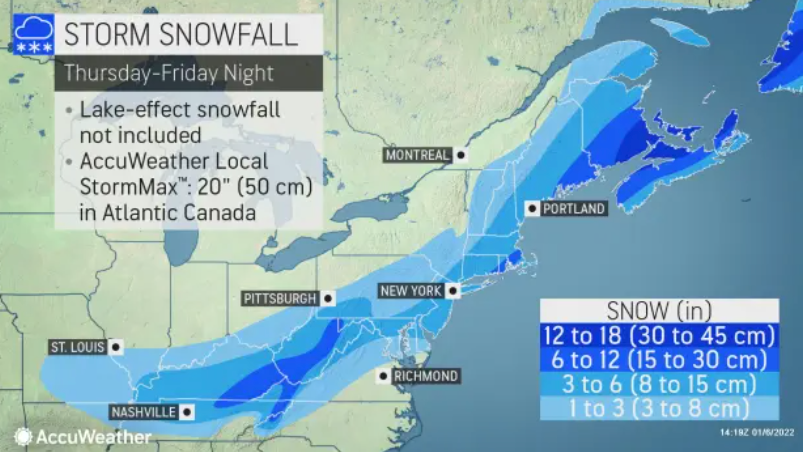
AccuWeather Senior Meteorologist Joe Lundberg delivered some unwelcoming news for millions of residents across the mid-Atlantic and Northeast on Thursday morning. He said a major snowstorm is expected to sweep across the region Thursday night into Friday, battering areas already hit with snow on Monday.
Lundberg said the storm could rapidly strengthen overnight and develop into a bomb cyclone. This means the storm's central pressure will rapidly drop over 24 hours, indicating the storm will strengthen as it moves up the Northeast.
By Thursday evening, Kentucky, West Virginia, Maryland, Virginia, North Carolina, and Tennessee should experience accumulating snow. Around the Washington–Baltimore metropolitan area, where nearly a foot fell in some places, up to six inches of snow is expected through Friday. Philadelphia and New York City are expected to pick up around 6 inches. The heaviest snow could be across eastern Maine, Connecticut, Rhode Island, and eastern Massachusetts.
Expect slippery conditions along the Interstate 95 corridor from Washington, D.C. to Baltimore to Philadelphia to New York City to Boston.
For Friday, expect a blizzard from eastern Maine across the border into New Brunswick, Canada. Conditions could quickly deteriorate if the storm undergoes bombogenesis.
For the working-age population working remotely, don't expect a day off as there is no such thing as a snow day anymore. That also goes for students. Unless you can in sick for the "Omi-cold."

(ZH) "Massive Meltdown": 40% Of Nasdaq Companies Are Down More Than Half From Th

"Massive Meltdown": 40% Of Nasdaq Companies Are Down More Than Half From Their Highs

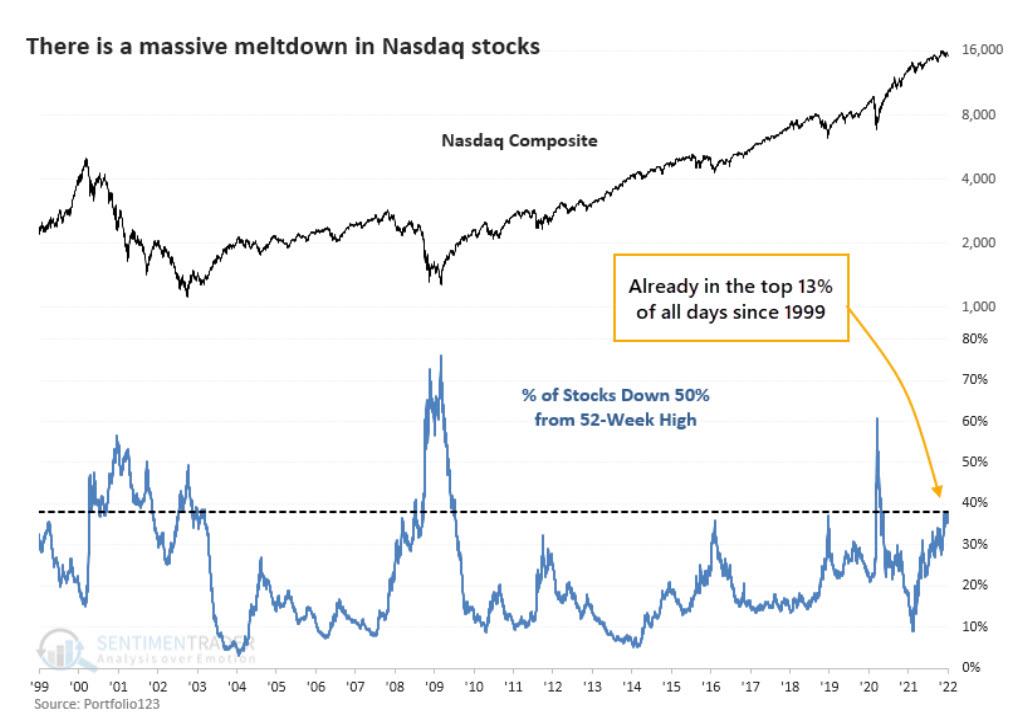
In a testament to the narrow breadth of the Nasdaq, and the broader market in general, where as a reminder 51% of all market gains from April through December were just from the five most popular tech names - AAPL, MSFT, NVDA, TSLA, GOOGL - Sundial Research notes that a near-record number of tech stocks have plunged by some 50%, a number that was only surpassed by the March 2021 crash and the global financial crisis.
Roughly four in every 10 companies on the Nasdaq Composite have seen their market values cut by 50% or more from their 52-week highs, while a vast majority of index constituents are mired in bear markets, according to Jason Goepfert, chief research officer at Sundial.
"Whatever the fundamental and macro considerations, there is no doubt that investors have been selling first and trying to figure out the rest later," Goepfert said in a note and first noted by Bloomberg.
It's also why hedge fund holding all but the largest companies have had a miserable year, and why as we noted earlier, hedge funds had already undergone some of the biggest selling and degrossing in the past decade ahead of yesterday's FOMC minutes rout.
“Valuations are at historical highs, companies are raising billions based on fairy dust, and the Fed is signaling a tightening cycle,” Goepfert said. “All of these are scaring investors that we’re on the cusp of a repeat of 1999-2000.”
Tech stocks have been under especially heavy selling pressure since the start of the year amid a bond-market rout that’s sent 10Y TSY surging as high as 1.75% on Thursday, surpassing the highest level of 2021. The carnage accelerated after the latest FOMC minutes pointed to earlier and faster rate hikes, suggesting to some that the central bank became more hawkish quicker than many had expected. As a result, traders were quick to dump high-duration tech shares, whose high valuations become harder to justify in a rising-rate environment.
The Nasdaq index is on pace for its biggest weekly decline since November, even as it rose in the New York afternoon trading session Thursday. A 3.3% fall Wednesday marked its worst single-day session since February last year. However, the drop has been relatively contained thanks to the continued support of the big five generals, which have so far been resistant to wholesale selling.

FT : ArcelorMittal bank accounts in Ukraine frozen over tax evasion claims

ArcelorMittal bank accounts in Ukraine frozen over tax evasion claims
Attack on steel group by country’s authorities is latest in number of probes over past few years

Steel group ArcelorMittal’s bank accounts in Ukraine have been frozen by a court after a senior executive at the company was accused of tax evasion in the latest attack on the group by the authorities.

The multinational company, one of the world’s leading steel producers, is Ukraine’s largest foreign direct investor and has faced several investigations over tax in the past few years.

The Luxembourg-based group bought the steel mill in Kryviy Rih — Ukraine’s largest and one of the biggest in Europe — from the state for $5.2bn in 2005. It says it has pumped an additional $4.8bn into the country since then.

A Ukraine court ruled in favour of a request from the prosecutor-general’s office for the freezing of accounts, resulting in the halt of financial transactions, as fears mount over a Russian military attack. Russia has deployed more than 100,000 troops close to the Ukraine border and demanded that the US and Nato agree to security pledges banning former Soviet states from joining the western military alliance and restricting where US troops could be stationed in eastern Europe.

Ukraine court documents accused the group’s chief financial officer in Ukraine of failing to pay tax arrears of 2.24bn hryvnias ($81m). The allegations are based on investigations conducted by the counter-intelligence agency Security Service (SBU) and are the latest in a number of court cases and probes against the company over tax.

The CFO, who was named by ArcelorMittal as Serhiy Plichko, could not be reached for comment.

But ArcelorMittal, on his behalf, defended him against the accusations. Yaryna Klyuchkovska, an ArcelorMittal spokesperson, said tax evasion cases should not fall under the “purview of the SBU’s investigative powers” and the freezing of assets order in Kyiv “was based on an individual, not the company”.

“The company considers these charges baseless and a clear example of political pressure on a major foreign investor,” a separate company news release stated.

“Still, the criminal charges, however contrived, are brought against an individual, not the company. There is no current tax related civil proceeding against ArcelorMittal Kryviy Rih and therefore no legal grounds to freeze the company’s accounts.”

Klyuchkovska noted that the company had won previous court rulings related to alleged tax evasion in its name and found it puzzling why a corporate officer would be targeted individually, which is a criminal, not administrative case.

The prosecutors said on their telegram channel, used to broadcast official messages, that their action was aimed to “compensate for the damage caused to the budget of Ukraine”.

The Information : Inside Blackstone’s Plans to Create an Entertainment Empire

Inside Blackstone’s Plans to Create an Entertainment Empire
Private equity firms have long been unable to stomach hefty investments in new entertainment companies. But Blackstone’s big bet on Kevin Mayer and Tom Staggs’ Candle Media is testing whether the money gushing into streaming can change all of that.

wo years ago, Joe Baratta couldn’t figure out what Blackstone, the private equity giant he worked for, should do for its next move in media and entertainment.

The big TV companies, such as ViacomCBS and Discovery, were bleeding viewers as people cut the cord to cable television and streaming powerhouses like Netflix grew ever bigger. “We were trying to figure out whether any of these assets were investable,” said Baratta, global head of private equity at Blackstone, referring to media companies.

Then, in the fall of 2020, Baratta huddled with Kevin Mayer, a longtime Disney executive who had just left TikTok as CEO of the social media app. At first, Blackstone executives discussed the idea of Mayer consulting with the firm or managing one of its existing portfolio companies. But Mayer and a former Disney colleague, Tom Staggs, had a different pitch: Would Blackstone back a brand-new media company they were forming that would tap into the gusher of money going into streaming?

THE TAKEAWAY
• Blackstone aims to take Candle Media public in next two years
• Company eyeing gaming, social media and commerce
• Candle has discussed buying ATTN, Imagine Entertainment
By snapping up independent film and TV studios, Mayer and Staggs planned to sell content to all the major streaming services, while also generating revenue through commerce. A Zoom call between Mayer and Stephen Schwarzman, Blackstone’s CEO, to discuss the vision for the company was supposed to be 30 minutes, Mayer said in an interview. It ended up lasting around three hours.

Last summer, Blackstone agreed to back the pair and so far has contributed just under $2 billion in cash, according to people familiar with the situation. Since last summer, Mayer and Staggs have used that war chest, along with equity and debt, to make around $4 billion worth of acquisitions.

Earlier this week, the company revealed its name, Candle Media, when it announced that it had bought a minority stake in Will Smith and Jada Pinkett Smith’s Westbrook Inc., an entertainment company that produced the recent movie “King Richard.” Candle Media spent around $60 million to buy an 11% stake in the business, according to a person familiar with the situation.

“If you look across the whole media landscape, the intersection of growth and scale is a tricky one because there are a lot of very large off trends in the media business with cord cutting,” said David Kestnbaum, a senior managing director at Blackstone who heads up its media practice. Instead, he told The Information in an exclusive interview, Blackstone is looking at “how do we make multiples of our money in something that is dramatically very on trend.”

More deals are on the way. The company is looking at smaller acquisitions in gaming, commerce and social media as well as content companies outside the U.S., Baratta said.

Candle Media has discussed buying digital media company ATTN, which makes video clips promoting social causes, along with Ron Howard and Brian Grazer’s Imagine Entertainment and Mythical Entertainment, led by the YouTube creators known as Rhett & Link, said people familiar with the situation.

Blackstone aims to take Candle Media public in the next couple of years and believes it could someday be worth between $20 billion and $30 billion, according to a person familiar with the situation.

“There is no scaled, born-for-this-generation content-creation and commerce company, and we think we can create that,” Baratta said.

The new venture is a test of whether private equity can finally find a reliable way to hit it big in Hollywood. Private equity firms haven’t been afraid to buy up lower-risk media assets that produce sizable, steady streams of cash, even if they’re not growing much. Newspapers and broadcast TV and radio stations are popular targets, though private equity firms have been criticized for mercilessly cutting costs to squeeze more profits out of them.

And like its peers, Blackstone has bought its way into another consistent entertainment moneymaker: music publishing. A few years ago it acquired Sesac, which owns the rights to songs by Bob Dylan, Neil Diamond and Mariah Carey.

But private equity firms have only dabbled in the content-creation business through smaller investments, rarely placing big bets on new entertainment companies like the one Blackstone is making with Candle Media. With good reason: Hollywood is a cruel place where investors’ dreams go to die on the red carpet. It’s a high-risk, hits-driven business where the only sure things have traditionally been based on superhero, animation and other blockbuster intellectual properties already locked up by the giant studios.

The current golden age of streaming might be changing that—or at least that’s Blackstone’s bet. Netflix, Amazon, Apple TV+, HBO Max and other streaming heavyweights are creating a gold rush for content to fill their service’s home screens with movies and shows.

Baratta sees a big opportunity for Candle Media to create a stable revenue stream by simply earning fees to make shows for the streaming services. That’s what Hello Sunshine—the production company founded by actor Reese Witherspoon that Candle bought for roughly $900 million—did in the case of “The Morning Show,” a hit series that Apple TV+ distributes and owns. It’s a much less risky proposition than spending tens or hundreds of millions of dollars on a project that may or may not take flight.

“The number of productions that have to be made every year, year in and year out, is at a different scale than it was 10 years ago,” Baratta said. “We think we can have a really successful business just manufacturing content even if we don’t own it…that is a recurring revenue stream in a way that it wasn’t 10 years ago.”

Still, the really giant paydays in entertainment tend to come when companies own their own content, so Candle Media plans to do that too. Moonbug Entertainment—a children’s entertainment company that is Candle Media’s biggest acquisition so far at $3 billion—owns its shows, including its popular series “CoComelon,” which it licenses to Netflix. With Blackstone’s backing, Hello Sunshine plans to retain ownership of more of the shows and movies it makes—licensing them to streaming services for a period of time.

Owning its shows and movies will enable Candle to resell the rights to other services around the globe and make more money—particularly if the shows are hits. However, such an approach is risky since it means the projects have to be wildly popular to be profitable.

But Candle may have a hard time retaining ownership of more of its shows and movies, as streaming companies like Netflix and Amazon will push back on that unless the projects are things they feel they can’t live without, said Evan Shapiro, a former producer who consults with entertainment companies.

“Who is making a deal with Hello Sunshine that is going to allow them to own their content?” he asks.

Focusing on high-end premium content makes sense given the demand for it, but Mayer and Staggs should focus more on newer, creator-economy projects that they can own, he said. “It feels a little old Hollywood to me,” Shapiro said of the company’s current focus.

Commerce, too, is a big buzzword in Candle Media’s vocabulary, as it is for other media businesses looking for novel sources of revenue. For example, the company is discussing ways to build a commerce business around Witherspoon’s popular book club. Selling stuffed animals drawn from London-based Moonbug characters is another possibility.

“We are a content incubation and packaging business and we are going to own some of it and we are going to spend some money on some of it and then we are going to create an e-commerce ecosystem around the content we own,” said Baratta.

Ultimately, Blackstone’s gamble on Candle Media is a bet on Mayer and Staggs, two of the most experienced executives in entertainment. Both were contenders for the CEO spot at Disney and were architects of the entertainment giant’s acquisitions of Lucasfilm, Pixar and Marvel. But even with Blackstone’s deep pockets behind it, Candle Media won’t have the vast resources of Disney, which can make money off its intellectual properties through theme parks and merchandise, not just through shows and movies.

“Knowing which projects to own to take a risk on is a seasoned judgment,” said Mayer.

Connecting Creators

For Mayer, 59, the new venture is a comeback from an aborted detour into the tech industry at TikTok. He lasted only four months at the social media app, leaving in August 2020 after the Trump administration pressured the company to sell its U.S. operations due to TikTok’s ties to China. The Biden administration backed off from the threats against the app, which Chinese internet powerhouse ByteDance owns.

Mayer immediately started plotting his next move, including the possibility of raising a fund for a private equity firm. One of the people he met with during that time—Joe Ravitch, co-founder of boutique investment bank The Raine Group—talked him out of the idea, telling Mayer he would need to raise multiple funds before he would start making real money.

Instead, Ravitch suggested Mayer build his own company by acquiring other entertainment businesses. Mayer liked the idea, and Raine drew up a business plan for him.

At the same time, Mayer was talking to Staggs, 61, who resigned from Disney as chief operating officer in 2016 when he was passed over as CEO, about reuniting. Staggs joined the new venture, and the duo, along with Raine, began meeting private equity firms about investing in the company.

Blackstone’s Baratta and Mayer had chatted about the challenges in the media business even before Mayer had joined TikTok. When they met again in 2020 to talk about the new company, Blackstone executives liked Mayer’s idea of investing in content, said Baratta. His vision for Candle Media was to allow the heads of the businesses it acquired to continue operating independently, which many of them find appealing, Baratta said.

“We want to invest in where the world is going,” he said. “Obviously, content is in high demand and it will stay.”

After teaming up with Blackstone, Mayer and Staggs’ company began talking to Hello Sunshine, which Witherspoon founded as a way to showcase storytelling about women, about an acquisition.

Mayer knew Sarah Harden, CEO of Hello Sunshine, for more than 15 years from working together in the entertainment business. Witherspoon, for her part, reached out to Whitney Wolfe Herd, co-founder and CEO of dating site Bumble, to learn more about what the Blackstone team was like to work with, according to a person familiar with the situation (Blackstone was an investor in Bumble).

Candle Media announced the Hello Sunshine acquisition in August. While the deal valued the company at around $900 million, Blackstone contributed around $700 million in cash upfront to finance the deal, according to a person familiar with the situation. It beat out KKR, Carlyle and other rival private equity firms for the deal, according to other people familiar with the situation.

The valuation on Hello Sunshine was steep, translating to more than seven times the entertainment company’s expected revenue for 2021. That is a big premium over where large entertainment companies like Lionsgate and ViacomCBS were trading last year, at around 1.5 times 2021’s expected revenue.

The hefty premium sparked a rush by production studios—especially ones backed by celebrities—to seek investments or sales at high valuations. Mayer and Staggs held discussions with LeBron James’ production company, SpringHill Company, about a deal, but nothing came of it, said people familiar with the situation. RedBird Capital Partners ended up leading an investment in SpringHill.

Mayer’s connections helped again in the Moonbug deal. The company—which has one of the most popular shows on Netflix with “CoComelon”—has held discussions with other potential bidders, including Comcast and KKR, according to people familiar with the situation. Rene Rechtman, CEO and co-founder of Moonbug, knew Mayer from when Rechtman was head of international at Maker Studios, which Disney bought in 2014. Initially, Rechtman told Mayer his plan was to take Moonbug public, according to a person familiar with the situation.

But Mayer and Rechtman stayed in touch. Eventually, the combination of Blackstone’s backing for Candle Media, the involvement of Mayer and Staggs and the freedom they promised for Moonbug won him over.

“If you sell to a strategic, you become part of their business, but now we are still ourselves,” said Rechtman, who lives in London with his family. “I told the board, ‘You already invested in me, but now you get me, Kevin and Tom.’”

And at the end of last year, Candle Media also acquired Faraway Road Productions, the Israeli studio behind “Fauda,” a popular Israeli political thriller that runs on Netflix, according to people familiar with the situation.

Candle Media, naturally, has ideas about new things to do with its shiny new entertainment assets. For example, it plans to explore ways for Moonbug and Hello Sunshine to work together, Staggs said. But he stresses that Candle Media won’t meddle in the creative process.

“At Disney, part of our job was making sure the creative organizations were positioned to succeed and not get overly bogged down by corporate,” he said. “We aren’t doing this to be auteurs—we don’t want to read 100 scripts and tell people what to make.”

The success of Candle Media may rest partly on how good Mayer is at juggling an increasingly full dance card. He is also chair of Dazn, billionaire Len Blavatnik’s streaming sports service, and is consulting with Discovery CEO David Zaslav on that company’s acquisition of WarnerMedia—a deal that is supposed to close later this year.

Blackstone’s Baratta, for one, isn’t concerned about Mayer getting distracted from Candle Media, noting that Mayer was upfront about his other commitments in his discussions with Blackstone. He believes Mayer’s other work will give him better insight into how Candle Media can grow.

Mayer, for his part, said he wore many more hats in his last job at Disney, when he ran everything from streaming services to advertising sales, than he does now.

“I had like 16 jobs,” he said.
>>> US Gapping down

Gapping down
In reaction to earnings/guidance
:

  • BLI -31.4% (guides FY21 and FY22 revs below consensus, also CEO to step down), HUM -7.4% (to reaffirm 2021 guidance at upcoming conferences; initial 2022 Adjusted EPS guidance will include an explicit COVID related headwind), HEAR -4.2% (sees FY21 revs at low end of prior guidance), BBWI -2.5% (sees Q4 at high-end of guidance) SCHN -1.2%

Other news:

  • STRO -15.3% (announces interim data from dose-expansion cohort of STRO-002 Phase 1 study)
  • SGMO -9.8% (was notified that Sanofi (SNY) terminated licensing agreement)
  • RIOT -2% (produced 425 Bitcoin in December, up 334% yr/yr)
  • AFCG -1.3% (prices its underwritten public offering of 3,000,000 shares of its common stock at a public offering price of $20.50/share)
  • CNM -1% (prices secondary public offering of 20 mln shares of its Class A common stock by certain selling stockholders at $26.00/share)

Analyst comments:

  • ESTC -4.1% (downgraded to Hold from Buy at Jefferies)
  • AKAM -3.2% (downgraded to Neutral from Overweight at Piper Sandler)
  • ADT -2.5% (downgraded to Sector Perform from Outperform at RBC)
  • DG -2.4% (downgraded to Equal Weight from Overweight at Wells Fargo)
  • KNX -1.3% (downgraded to Underperform from Peer Perform at Wolfe Research)
  • GILD -1.1% (downgraded to Equal-Weight from Overweight at Morgan Stanley)